
| REPORT ATTRIBUTE | DETAILS |
|---|---|
| Historical Period | 2020-2023 |
| Base Year | 2024 |
| Forecast Period | 2025-2032 |
| Home Energy Management System (HEMS) Market Size 2024 | USD 4740.12 Million |
| Home Energy Management System (HEMS) Market, CAGR | 13.4% |
| Home Energy Management System (HEMS) Market Size 2032 | USD 12962.64 Million |
Market Overview:
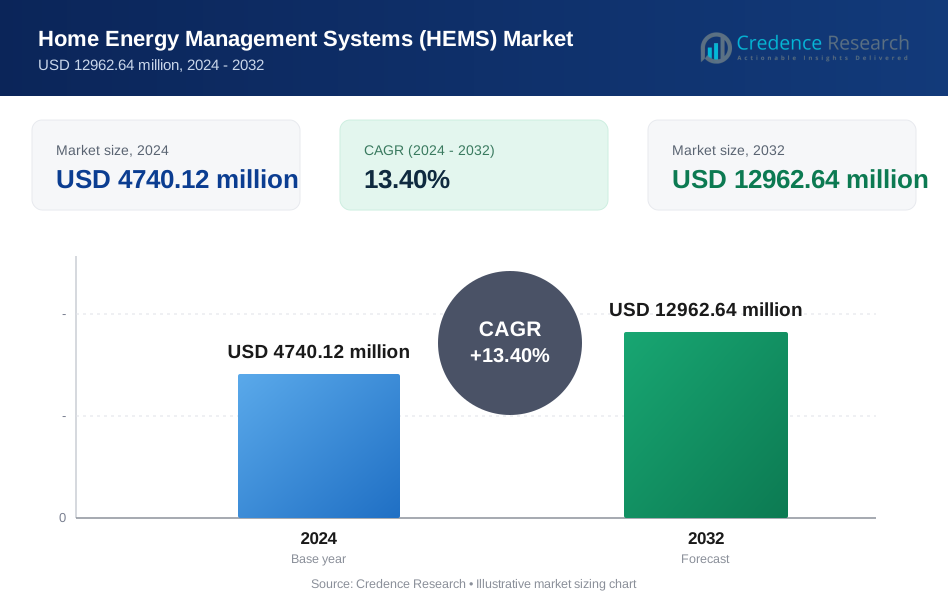
Home Energy Management System (HEMS) Market size was valued at USD 4740.12 million in 2024 and is anticipated to reach USD 12962.64 million by 2032, at a CAGR of 13.4% during the forecast period (2024-2032).
Several key drivers are fueling the growth of the HEMS market. The rising adoption of renewable energy sources, such as solar panels and wind turbines, has necessitated the integration of systems that can efficiently manage and optimize energy use within households. This trend is also supported by the growing installation of energy storage systems, such as batteries, which allow consumers to store excess energy for later use. Additionally, growing consumer awareness regarding environmental sustainability and the financial benefits of energy efficiency is encouraging the widespread adoption of HEMS. As individuals seek to lower their utility bills, energy management solutions provide a direct route to cost savings. The increasing penetration of smart home technologies, including IoT-enabled devices, is also contributing to market expansion by enhancing the ability to monitor and control energy consumption remotely. Furthermore, government incentives and regulations aimed at reducing carbon footprints and promoting energy conservation are providing further impetus to market growth. These policies are stimulating the development and adoption of smart grids and HEMS in both residential and commercial spaces.
Regionally, North America dominates the HEMS market, driven by the high adoption of smart home technologies and the increasing demand for energy-efficient solutions. The United States, in particular, is a significant contributor to this growth due to the widespread installation of smart meters and solar energy systems. Moreover, partnerships between technology providers and utilities are accelerating the deployment of advanced HEMS solutions. Europe follows closely, with strong government support for renewable energy integration and energy efficiency initiatives. Countries like Germany and the UK are leading the way with aggressive sustainability targets and policies aimed at reducing greenhouse gas emissions. The Asia-Pacific region is expected to witness the fastest growth during the forecast period, primarily due to the rapid urbanization, growing middle-class population, and rising demand for energy-efficient solutions in countries like China and India. As these nations modernize their infrastructure, HEMS will play a pivotal role in managing energy consumption in urban areas.
Market Insights:
- The Home Energy Management System (HEMS) market is projected to grow from USD 4740.12 million to USD 12962.64 million by 2032.
- Adoption of renewable energy sources like solar panels and wind turbines is a key factor driving the growth of the HEMS market.
- Increasing consumer awareness about sustainability and the financial benefits of energy efficiency is contributing to higher demand for HEMS solutions.
- The integration of IoT-enabled smart home devices enhances HEMS capabilities, enabling remote monitoring and control of energy consumption.
- Government incentives and regulations promoting energy efficiency and carbon reduction are accelerating HEMS adoption.
- North America leads the market, driven by widespread smart home technology adoption and strong government support for energy-efficient solutions.
- The Asia-Pacific region is expected to witness the fastest growth, driven by urbanization, a growing middle class, and rising demand for energy-efficient technologies.
Market Drivers:
Increasing Adoption of Renewable Energy Sources:
The growing adoption of renewable energy sources, such as solar panels and wind turbines, is a significant driver of the Home Energy Management System (HEMS) market. As more households shift towards sustainable energy options, the need for efficient systems to manage and optimize energy consumption within homes has become critical. HEMS allows consumers to seamlessly integrate renewable energy sources into their daily energy usage by managing power flow from solar panels or wind turbines. Additionally, HEMS aids in storing excess energy generated during peak times, which can be used when renewable energy production is low. This capability not only maximizes energy efficiency but also reduces reliance on traditional power grids, leading to cost savings and a reduction in carbon footprints.
Growing Consumer Awareness of Energy Efficiency:
As awareness of environmental sustainability grows, more consumers are opting for energy-efficient solutions to reduce their carbon footprint and lower energy costs. For instance, Honeywell’s HEMS platform enables homeowners to monitor real-time energy consumption, analyze usage patterns, and receive actionable recommendations to optimize efficiency, helping users lower their carbon footprint and electricity bills. The increased focus on climate change, coupled with rising energy prices, has heightened consumer interest in smart home solutions that offer energy-saving capabilities. HEMS enables homeowners to monitor and control their energy consumption in real time, providing insights on usage patterns and allowing for informed decisions on how to reduce energy waste. By offering consumers a way to optimize energy consumption, HEMS systems not only contribute to environmental sustainability but also help households reduce electricity bills, making them an attractive option for cost-conscious consumers.
Integration of Smart Home Technologies:
The widespread adoption of smart home technologies is another key factor driving the growth of the HEMS market. As IoT devices become increasingly prevalent in residential settings, the ability to monitor and control various household systems remotely has become a key advantage. For instance, Nest smart thermostats seamlessly integrate with HEMS platforms, allowing users to create personalized energy management schedules and automate temperature adjustments based on occupancy and weather conditions. HEMS leverages these technologies to allow users to manage their home’s energy use from anywhere through mobile apps or voice assistants. With the integration of smart thermostats, smart lighting, and automated appliances, HEMS enables consumers to create personalized energy management schedules, further optimizing efficiency. This convergence of smart home systems with energy management platforms not only enhances the user experience but also accelerates the adoption of HEMS.
Government Incentives and Regulatory Support:
Government policies and regulations aimed at reducing energy consumption and promoting sustainable living are crucial drivers of the HEMS market. Many governments across the globe are implementing regulations that encourage the adoption of energy-efficient technologies and renewable energy sources. These initiatives often include tax incentives, rebates, and subsidies for the installation of solar panels, energy-efficient appliances, and smart home devices. Furthermore, stringent energy efficiency standards in buildings and the promotion of green building certifications have led to increased adoption of HEMS in both residential and commercial settings. As governments continue to focus on achieving energy conservation goals and reducing greenhouse gas emissions, the demand for HEMS is expected to rise, particularly in regions with strong sustainability agendas such as Europe and North America.
Market Trends:
Integration of Artificial Intelligence (AI) and Machine Learning (ML):
One of the most prominent trends in the HEMS market is the increasing integration of Artificial Intelligence (AI) and Machine Learning (ML) technologies. These advanced systems allow HEMS to not only monitor energy consumption but also predict usage patterns and optimize energy management in real-time. AI-powered algorithms can adjust settings such as temperature, lighting, and appliance usage to improve energy efficiency based on the habits of the household. This level of personalization enhances the user experience and reduces energy waste, making it an attractive solution for both environmentally conscious consumers and those looking to reduce their energy bills.
Rise of Demand for Smart Grids and IoT Integration:
The rise in demand for smart grids and the growing integration of Internet of Things (IoT) devices are shaping the future of the HEMS market. Smart grids enable real-time monitoring and more efficient distribution of electricity, while IoT devices, such as smart meters, thermostats, and appliances, provide valuable data on energy consumption patterns. For instance, the Government of India has funded smart grid demonstration projects that deploy Advanced Metering Infrastructure (AMI) and smart meters, which facilitate bidirectional flow of information between consumers and utility control centers, supporting real-time monitoring and control of energy use. HEMS systems are being developed to connect seamlessly with these smart devices, allowing consumers to monitor and control their energy usage remotely. As IoT adoption expands, HEMS will increasingly rely on data-driven insights to optimize energy usage and provide a more connected and intelligent home energy experience.
Focus on Sustainability and Eco-friendly Solutions:
As environmental concerns continue to grow, there is a heightened focus on sustainability within the HEMS market. Consumers are becoming more conscious of their carbon footprints, leading to a greater demand for eco-friendly solutions. For instance, HEMS solutions in Germany, such as those offered by E.ON, integrate renewable energy sources like solar panels and battery storage with home energy management, enabling users to maximize self-consumption of green energy and reduce CO2 emissions. HEMS systems are now being designed with sustainability in mind, integrating renewable energy sources such as solar panels and wind turbines, along with energy storage solutions like batteries. These systems help consumers manage their energy use more efficiently and make the most of their renewable energy investments. This trend is reinforced by government initiatives and regulations promoting clean energy, further driving the adoption of HEMS.
Integration with Electric Vehicles (EVs):
The increasing adoption of electric vehicles (EVs) is another emerging trend in the HEMS market. As more households invest in EVs, there is a growing need to manage the energy consumption of these vehicles. HEMS systems are being developed to integrate with EV charging stations, allowing consumers to monitor and optimize the charging process. By scheduling charging during off-peak hours or using renewable energy sources, homeowners can reduce their overall energy costs. This trend highlights the evolving role of HEMS in managing not just household energy use but also the growing demand for EV charging solutions.
Market Challenges Analysis:
High Initial Investment and Installation Costs:
One of the key challenges facing the Home Energy Management System (HEMS) market is the high initial investment required for system installation. While HEMS offers long-term energy savings and environmental benefits, the upfront costs can be prohibitive for many consumers. The expense of purchasing and installing the necessary hardware, such as smart meters, sensors, and energy storage systems, can deter widespread adoption, especially in price-sensitive markets. For instance, integrated HEMS functionality is now being included in smart meters, inverters, and batteries by manufacturers such as Enphase and Sonnen; this approach allows the HEMS capability to be ‘pre-installed’ as part of solar or battery systems, so the extra installation cost for HEMS is essentially zero when these devices are already being fitted for other purposes. Additionally, integrating renewable energy sources such as solar panels or wind turbines further increases costs, making it less accessible for households with limited budgets. Despite the potential savings in the long run, the high upfront investment remains a significant barrier to the growth of the HEMS market. This challenge is particularly evident in emerging markets where the adoption of energy-efficient technologies is still in its nascent stages. Manufacturers and service providers need to explore ways to reduce installation costs to make HEMS more affordable for a broader consumer base.
Privacy and Security Concerns:
Another challenge hindering the adoption of HEMS is the growing concern over data privacy and security. HEMS systems collect vast amounts of data on household energy usage patterns, and this data is often stored in the cloud or transmitted to external servers. This creates potential risks related to data breaches or unauthorized access, raising concerns about the privacy of consumers. Additionally, the integration of various smart home devices within the HEMS infrastructure increases the number of potential vulnerabilities, making systems more susceptible to cyberattacks. As HEMS continues to rely on IoT devices, ensuring the security of data transmission and storage becomes critical. Addressing these privacy and security concerns will be essential for building consumer trust and promoting broader market adoption. To mitigate these risks, companies will need to adopt stringent cybersecurity measures and offer transparent data management practices to reassure consumers about the safety of their personal information.
Market Opportunities:
The Home Energy Management System (HEMS) market presents significant opportunities driven by the growing adoption of renewable energy sources and the increasing focus on energy efficiency. As more consumers invest in solar panels, wind turbines, and other sustainable energy solutions, the demand for systems that can optimize energy use within households is expected to rise. HEMS can offer a seamless integration of these renewable energy sources, allowing homeowners to manage energy distribution, store excess energy, and reduce reliance on the traditional grid. This growing interest in sustainable energy solutions provides a strong market opportunity for companies offering advanced HEMS technologies that not only optimize energy usage but also contribute to lowering carbon footprints.
Additionally, the increasing penetration of smart home technologies creates new avenues for the expansion of the HEMS market. The integration of Internet of Things (IoT) devices such as smart thermostats, smart lighting, and automated appliances presents an opportunity for HEMS providers to offer comprehensive energy management solutions that allow consumers to monitor and control their energy consumption remotely. With the rising adoption of these connected devices, there is a growing need for advanced energy management systems capable of leveraging data to optimize usage and enhance overall efficiency. As the demand for connected homes and energy-saving technologies continues to grow, the HEMS market stands to benefit from increased consumer interest and technological advancements, creating ample opportunities for market players to expand their offerings.
Market Segmentation Analysis:
By Component
The Home Energy Management System (HEMS) market is segmented based on components into hardware and software. The hardware segment includes smart meters, energy storage devices, and sensors that collect and manage data related to energy consumption. Energy storage systems, such as batteries, are becoming increasingly essential as consumers seek to optimize renewable energy use. The software segment comprises platforms and applications that analyze energy data, control appliances, and provide insights for energy optimization. This segmentation reflects the growing trend toward integrated solutions that combine hardware and software to offer comprehensive energy management capabilities.
By Technology
The HEMS market is driven by several technologies, including the Internet of Things (IoT), Artificial Intelligence (AI), and cloud computing. IoT-enabled devices, such as smart meters and thermostats, allow users to monitor and control their energy use remotely. AI enhances energy management by optimizing consumption patterns and predicting future energy needs. Cloud computing supports the real-time data storage and analysis necessary for effective energy monitoring and management, enabling users to track energy usage via apps and dashboards.
By Application
HEMS systems are increasingly being used in residential settings to monitor and optimize energy consumption. This segment also extends to the integration of renewable energy sources like solar power and wind energy, enabling homes to effectively manage their energy usage, storage, and distribution. Additionally, with the rise in smart home adoption, energy management solutions are becoming integrated with various household devices to enhance overall efficiency and sustainability. The growing preference for smart homes is a key factor in the expansion of this application segment.
Segmentations:
By Component
- Hardware
- Smart Meters
- Sensors
- Energy Storage Devices
- Software
- Energy Management Platforms
- Mobile Applications
By Technology
- Internet of Things (IoT)
- Artificial Intelligence (AI)
- Cloud Computing
By Application
- Residential
- Commercial
- Industrial
By System
- Standalone Systems
- Integrated Systems
By Deployment Type
- On-premises
- Cloud-based
By Residence Type
- Single-family Homes
- Multi-family Homes
- Apartments
By Region
- North America
- Europe
- Asia-Pacific
- Latin America
- Middle East & Africa
Regional Analysis:
North America
North America holds the largest market share of 40% in the Home Energy Management System (HEMS) market. This dominance is driven by the high adoption of smart home technologies, government initiatives promoting energy efficiency, and the increasing integration of renewable energy sources. In the United States, HEMS systems are becoming a staple in residential properties due to the widespread installation of smart meters, energy-efficient appliances, and solar energy systems. Additionally, favorable government incentives, including tax rebates and subsidies for energy-efficient technologies, support market expansion in North America. The region's robust infrastructure and advanced technological landscape create a strong foundation for further HEMS adoption, positioning it for sustained growth.
Europe
Europe holds a significant market share of 30%, with strong demand for HEMS solutions driven by the region’s commitment to sustainability and energy efficiency. Countries such as Germany, the UK, and France have implemented stringent regulations aimed at reducing carbon footprints, which has encouraged the adoption of smart energy management systems. The European Union's aggressive sustainability goals, including the push for net-zero emissions, further support HEMS adoption. Additionally, the growing demand for green building certifications and energy-efficient homes contributes to the regional market's expansion. Europe's forward-thinking policies and widespread environmental consciousness make it a crucial market for HEMS innovation and growth.
Asia-Pacific
The Asia-Pacific region is experiencing the fastest growth in the HEMS market, capturing a market share of 20%. Rapid urbanization, increasing disposable incomes, and the rising adoption of smart home technologies in countries like China, Japan, and India are key factors driving this expansion. As the middle-class population in these countries continues to grow, demand for energy-efficient solutions is surging. Governments in the region are also promoting the integration of renewable energy sources and incentivizing energy-saving technologies. This combination of rising consumer demand and governmental support for sustainable living positions the Asia-Pacific region as a high-growth area for the HEMS market in the coming years.
Key Player Analysis:
- Honeywell International Inc.
- Vivint Smart Home, Inc.
- General Electric Company
- Ecobee, Inc.
- Panasonic Holdings Corporation
- Ecofactor
- Schneider Electric Se
- Comcast
- Com
- Robert Bosch Gmbh
- Johnson Controls
Competitive Analysis:
The Home Energy Management System (HEMS) market is highly competitive, with several prominent players leading the way in innovation and market penetration. Companies like Honeywell International Inc., Schneider Electric SE, and Siemens AG are at the forefront, leveraging their established technological expertise and extensive market reach to develop advanced HEMS solutions. These players focus on integrating IoT, artificial intelligence (AI), and renewable energy systems to provide smart, efficient energy management solutions for residential consumers. Smaller, emerging companies, such as GridPoint, Inc. and People Power Company, are differentiating themselves by offering highly specialized and customizable solutions, often targeting niche markets or regions with unique energy needs. Competition is further intensified by the increasing adoption of smart home devices and the growing demand for energy-efficient and sustainable solutions. As the market evolves, differentiation will rely heavily on technological advancements, customer support, and the ability to integrate new energy management features seamlessly.
Recent Developments:
- In February 2025, Honeywell completed a comprehensive portfolio review and announced plans to separate its Automation and Aerospace businesses, creating three industry-leading public companies. The Building Automation segment, which includes energy management solutions, showed double-digit organic sales growth, reflecting strong demand for HEMS and related technologies.
- In April 2025, Vivint, in partnership with Reliant (an NRG company), introduced the "Smarter Home Bundle" in Texas. This bundle offers qualifying customers a free Vivint Doorbell Camera Pro and Smart Thermostat with professional installation. The exclusive Vivint app experience integrates energy insights and device control, and enrollment in the Reliant Degrees of Difference program enables automatic thermostat adjustments during peak demand, supporting grid reliability and virtual power plant capabilities.
- In March 2025, Panasonic announced a €30 million capital and business alliance with tado°, a leading European provider of IoT-based home energy management solutions, to jointly develop advanced operation control software for Panasonic Aquarea Heat Pumps, aiming for up to 30% reduction in energy consumption. The collaboration will integrate smart thermostats, dynamic tariffs, and optimize heat pump performance using real-world user data, with a software release targeted for September 2025.
- In January 2025, at CES, Panasonic officially introduced OASYS™, emphasizing its holistic approach to HVAC and home energy management, supporting comfort, air quality, and energy efficiency. OASYS is positioned as a key solution for affordable, zero-energy-ready homes.
Market Concentration & Characteristics:
The Home Energy Management System (HEMS) market exhibits a moderate level of concentration, with key global players such as Honeywell International Inc., Schneider Electric SE, and Siemens AG holding a significant share. These industry leaders dominate the market due to their established brand presence, extensive technological expertise, and comprehensive product offerings. However, the market also features numerous smaller, innovative players that focus on niche solutions, offering specialized products tailored to specific consumer needs, such as renewable energy integration or advanced AI-driven energy optimization. The market is characterized by rapid technological advancements, particularly in the integration of IoT, smart home devices, and AI-driven analytics to improve energy efficiency. Consumer demand for more sustainable, energy-efficient homes drives ongoing innovation, leading to increasingly sophisticated systems that offer real-time energy monitoring, remote control, and automated energy-saving features. As the market matures, differentiation will largely depend on technological capabilities and customer-centric solutions.
Report Coverage:
The research report offers an in-depth analysis based on Component, Technology, Application, System, Deployment Type, Residence Type and Region. It details leading market players, providing an overview of their business, product offerings, investments, revenue streams, and key applications. Additionally, the report includes insights into the competitive environment, SWOT analysis, current market trends, as well as the primary drivers and constraints. Furthermore, it discusses various factors that have driven market expansion in recent years. The report also explores market dynamics, regulatory scenarios, and technological advancements that are shaping the industry. It assesses the impact of external factors and global economic changes on market growth. Lastly, it provides strategic recommendations for new entrants and established companies to navigate the complexities of the market.
Future Outlook:
- The adoption of Artificial Intelligence (AI) and Machine Learning (ML) will drive advancements in predictive energy management, optimizing household energy consumption based on historical data and real-time usage patterns.
- The growing integration of renewable energy sources like solar panels and wind turbines with HEMS will become more common as consumers seek sustainable and cost-effective energy solutions.
- Increased consumer demand for electric vehicle (EV) charging management will lead to more sophisticated HEMS solutions that can balance home energy consumption with EV charging needs.
- The rise of smart home ecosystems will create synergies between HEMS and other IoT devices, enhancing overall automation and energy management capabilities in households.
- Government incentives, tax rebates, and regulatory frameworks supporting energy efficiency will accelerate the adoption of HEMS, particularly in residential markets.
- As energy storage systems improve, they will complement HEMS, allowing for better storage and utilization of renewable energy, reducing reliance on the grid.
- Mobile app integrations will continue to make HEMS solutions more accessible and user-friendly, empowering homeowners to monitor and control their energy usage remotely.
- The shift toward 5G networks will facilitate faster data transmission, enhancing the responsiveness and functionality of HEMS in real-time monitoring and control.
- Rising consumer awareness of sustainability will increase the demand for energy-efficient and eco-friendly solutions, driving further growth in the HEMS market.
- As technological advancements in energy management continue, HEMS will expand to include integration with smart appliances, further optimizing energy use across entire households.
Request a Free Sample
Fill in your details and we'll send you a free sample report.
- Sample data tables & charts
- Research methodology
Market Dynamics
Adoption of Renewable Energy Sources
The increasing installation of solar panels and wind turbines in homes is driving demand for HEMS, as these systems enable efficient integration, management, and optimization of renewable energy within households.
Rising Consumer Awareness of Energy Efficiency
Growing awareness of environmental sustainability and the financial benefits of reducing energy consumption is encouraging more homeowners to adopt HEMS to monitor, control, and optimize their energy use, leading to lower utility bills and reduced carbon footprints.
Integration of Smart Home and IoT Technologies
The proliferation of IoT-enabled devices and smart home technologies allows for remote monitoring and automation of energy consumption, making HEMS more attractive and accessible to consumers seeking convenience and efficiency.
Government Incentives and Regulatory Support
Policies, tax rebates, and subsidies aimed at promoting energy efficiency and reducing carbon emissions are accelerating the adoption of HEMS, especially in regions with strong sustainability agendas such as North America and Europe.
Growth in Energy Storage and Electric Vehicle Adoption
The increasing use of home energy storage systems and electric vehicles is boosting demand for HEMS, as these systems help manage energy flows, optimize charging schedules, and maximize the use of stored or renewable energy.
Need a Custom Version of This Report?
Tailor the scope, geography, or segments to your exact requirements.
- Custom geography or segment scope
- Direct access to our analyst team
Frequently Asked Questions
What is the current size of the Home Energy Management System (HEMS) market?
What are the key drivers for the growth of the HEMS market?
Which region dominates the HEMS market?
How does government support influence the HEMS market?
Which region is expected to see the fastest growth in the HEMS market?
Table of Content
Chapter 1 Market Segmentation
- 1.1 Segmentation Framework
- 1.1.1 Product and Service Classification
- 1.1.2 Application and End-Use Classification
- 1.1.3 Technology and Solution Classification
- 1.1.4 Customer and Distribution Channel Classification
- 1.1.5 Geographic Segmentation
- 1.1.6 Market Segment Definitions and Boundaries
- 1.2 By System
- 1.2.1 Standalone Systems
- 1.2.2 Integrated Systems
- 1.3 By Component
- 1.3.1 Hardware
- 1.3.2 Software
- 1.4 By Technology
- 1.4.1 Internet of Things (IoT)
- 1.4.2 Artificial Intelligence (AI)
- 1.4.3 Cloud Computing
- 1.5 By Application
- 1.5.1 Residential
- 1.5.2 Commercial
- 1.5.3 Industrial
Chapter 2 Introduction
- 2.1 Report Objectives and Scope
- 2.2 Product Definition and Industry Terminology
- 2.3 Market Inclusions and Exclusions
- 2.4 Research Process
- 2.4.1 Primary Research and Expert Interviews
- 2.4.2 Secondary Research and Source Review
- 2.4.3 Top-Down and Bottom-Up Estimation
- 2.4.4 Data Triangulation and Verification
- 2.5 Market Size Measurement Basis
- 2.5.1 2024: USD 4740.12 million → 2032: USD 12962.64 million
- 2.6 Historical and Forecast Reference Periods
- 2.6.1 Base Year: 2024
- 2.6.2 Forecast Period: 2024-2032
- 2.7 Research Assumptions and Limitations
Chapter 3 Executive Summary
- 3.1 Market Snapshot and Key Findings
- 3.2 Base-Year Market Size, 2024
- 3.3 Forecast Market Size, 2032
- 3.4 Revenue and Volume Growth Outlook
- 3.5 Key Demand and Supply Indicators
- 3.6 Leading Market Segments
- 3.7 Fastest-Growing Market Opportunities
- 3.8 Regional Performance Highlights
- 3.9 Technology and Industry Transformation
- 3.10 Competitive Landscape Summary
- 3.11 Analyst View and Strategic Implications
Chapter 4 Global Home Energy Management Systems (HEMS) Market Trends and Developments
- 4.1 Historical Industry Development
- 4.2 Recent Market Trends and Developments
- 4.3 Demand and Customer Behavior Trends
- 4.4 Technology and Product Innovation
- 4.5 Artificial Intelligence, Automation and Digitalization
- 4.6 Local Manufacturing and Supply Chain Realignment
- 4.7 Industry Partnerships, Mergers and Acquisitions
- 4.8 Sustainability and Circular Economy Developments
- 4.9 Government and Private Sector Investment Trends
- 4.10 Emerging Business Models and Commercialization
- 4.11 Industry Developments and Announcements
Chapter 5 Global Home Energy Management Systems (HEMS) Market Production, Supply and Demand Analysis
- 5.1 Demand Trend and Consumption Analysis
- 5.2 Demand Forecast, 2024-2032
- 5.3 Production and Output Trend
- 5.4 Production and Output Forecast, 2024-2032
- 5.5 Installed Capacity and Capacity Utilization
- 5.6 Company-Wise Production Plants and Statistics
- 5.6.1 Installed Production Capacity
- 5.6.2 Actual Production
- 5.6.3 Planned Capacity and Expansion Targets
- 5.7 Supply Chain Structure and Procurement Trends
- 5.8 Supply-Demand Gap and Bottlenecks
- 5.9 Import Dependence and Sourcing Structure
- 5.10 Contract Manufacturing and Outsourcing
- 5.11 Regional Supply and Demand Concentration
Chapter 6 Global Home Energy Management Systems (HEMS) Market Pricing Analysis
- 6.1 Pricing Structure and Measurement
- 6.2 Historical Pricing Trends
- 6.3 Pricing Outlook, 2024-2032
- 6.4 Average Selling Price and Unit Economics
- 6.5 Pricing by Product and Market Segment
- 6.6 Geographic Pricing Differences
- 6.7 Key Input, Energy, Labor and Logistics Costs
- 6.8 Contract Pricing and Purchasing Models
- 6.9 Pricing Sensitivity and Competitive Positioning
- 6.10 Price, Margin and Profitability Implications
Chapter 7 Global Home Energy Management Systems (HEMS) Market Dynamics
- 7.1 Market Growth Drivers
- 7.1.1 Demand-Side Drivers
- 7.1.2 Technology and Innovation Drivers
- 7.1.3 Infrastructure and Investment Drivers
- 7.1.4 Regulatory and Policy Drivers
- 7.2 Market Restraints
- 7.2.1 Cost and Affordability Constraints
- 7.2.2 Technology and Adoption Barriers
- 7.2.3 Supply Chain and Operational Constraints
- 7.3 Market Challenges
- 7.3.1 Competitive Pressure and Margin Erosion
- 7.3.2 Skills, Infrastructure and Implementation Gaps
- 7.4 Emerging Market Opportunities
- 7.5 Market Dynamics Impact and Time-Horizon Assessment
Chapter 8 Global Home Energy Management Systems (HEMS) Value Chain Analysis
- 8.1 Industry Value Chain Overview
- 8.2 Upstream Suppliers and Critical Inputs
- 8.3 Technology and Component Providers
- 8.4 Manufacturing or Service Delivery
- 8.5 Distribution, Channel Partners and Integrators
- 8.6 Downstream Applications and End Users
- 8.7 Value Addition and Profit Pools
- 8.8 Vertical Integration and Outsourcing
- 8.9 Supplier Concentration and Risk
- 8.10 Supply Chain Localization and Resilience
Chapter 9 Global Home Energy Management Systems (HEMS) Market Regulations and Policies
- 9.1 Relevant Laws, Standards and Compliance Frameworks
- 9.2 Product, Service, Safety and Quality Requirements
- 9.3 Government Policies, Incentives and Subsidies
- 9.4 Imports, Exports and Trade Barriers
- 9.5 Public Procurement and Local Content Requirements
- 9.6 Environmental and Sustainability Compliance
- 9.7 Upcoming Policy Changes and Market Implications
Chapter 10 Global Home Energy Management Systems (HEMS) Market Hotspots and Opportunities
- 10.1 Market Opportunity Mapping and Growth Hotspots
- 10.2 High-Growth Applications and Customer Groups
- 10.3 Underserved Markets and White-Space Opportunities
- 10.4 Emerging Technology and Product Opportunities
- 10.5 New Capacity and Investment Hotspots
- 10.6 Market Entry and Expansion Opportunities
- 10.7 Distribution and Partnership Opportunities
- 10.8 Near-Term and Long-Term Commercial Potential
- 10.9 Opportunity Attractiveness and Execution Risks
Chapter 11 Global Home Energy Management Systems (HEMS) Market Outlook, 2024-2032
- 11.1 Market Size and Analysis
- 11.1.1 Revenue (Market Measurement: 2024: USD 4740.12 million → 2032: USD 12962.64 million)
- 11.1.2 Market Volume and Quantity Sold
- 11.1.3 Historical Market Size
- 11.1.4 Base-Year Market Size, 2024
- 11.2 Market Forecast, 2024-2032
- 11.2.1 Revenue Forecast to 2032
- 11.2.2 Volume Forecast to 2032
- 11.2.3 CAGR and Year-on-Year Growth
- 11.2.4 Incremental Revenue Opportunity
- 11.3 Forecast Assumptions and Scenario Analysis
- 11.3.1 Base-Case Forecast
- 11.3.2 Optimistic and Conservative Scenarios
- 11.3.3 Technology, Pricing and Policy Sensitivities
- 11.4 Market Attractiveness and Growth Outlook
Chapter 12 Global Home Energy Management Systems (HEMS) Market Segmentation and Outlook
- 12.1 Segmentation Summary and Market Shares, 2024
- 12.2 Largest and Fastest-Growing Segments
- 12.3 By System - Market Size and Forecast, 2024-2032
- 12.3.1 Segment Definition and Scope
- 12.3.2 Historical Market Size
- 12.3.3 Revenue Forecast, 2024-2032
- 12.3.4 Volume Forecast, 2024-2032
- 12.3.5 Base-Year Market Share, 2024
- 12.3.6 Segment CAGR and Growth Drivers
- 12.3.7 Subsegment Market Size and Forecast
- 12.3.7.1 Standalone Systems
- 12.3.7.2 Integrated Systems
- 12.3.8 Subsegment Pricing and Adoption Trends
- 12.3.9 Leading Suppliers and Competition
- 12.3.10 Regional Demand and Opportunities
- 12.4 By Component - Market Size and Forecast, 2024-2032
- 12.4.1 Segment Definition and Scope
- 12.4.2 Historical Market Size
- 12.4.3 Revenue Forecast, 2024-2032
- 12.4.4 Volume Forecast, 2024-2032
- 12.4.5 Base-Year Market Share, 2024
- 12.4.6 Segment CAGR and Growth Drivers
- 12.4.7 Subsegment Market Size and Forecast
- 12.4.7.1 Hardware
- 12.4.7.2 Software
- 12.4.8 Subsegment Pricing and Adoption Trends
- 12.4.9 Leading Suppliers and Competition
- 12.4.10 Regional Demand and Opportunities
- 12.5 By Technology - Market Size and Forecast, 2024-2032
- 12.5.1 Segment Definition and Scope
- 12.5.2 Historical Market Size
- 12.5.3 Revenue Forecast, 2024-2032
- 12.5.4 Volume Forecast, 2024-2032
- 12.5.5 Base-Year Market Share, 2024
- 12.5.6 Segment CAGR and Growth Drivers
- 12.5.7 Subsegment Market Size and Forecast
- 12.5.7.1 Internet of Things (IoT)
- 12.5.7.2 Artificial Intelligence (AI)
- 12.5.7.3 Cloud Computing
- 12.5.8 Subsegment Pricing and Adoption Trends
- 12.5.9 Leading Suppliers and Competition
- 12.5.10 Regional Demand and Opportunities
- 12.6 By Application - Market Size and Forecast, 2024-2032
- 12.6.1 Segment Definition and Scope
- 12.6.2 Historical Market Size
- 12.6.3 Revenue Forecast, 2024-2032
- 12.6.4 Volume Forecast, 2024-2032
- 12.6.5 Base-Year Market Share, 2024
- 12.6.6 Segment CAGR and Growth Drivers
- 12.6.7 Subsegment Market Size and Forecast
- 12.6.7.1 Residential
- 12.6.7.2 Commercial
- 12.6.7.3 Industrial
- 12.6.8 Subsegment Pricing and Adoption Trends
- 12.6.9 Leading Suppliers and Competition
- 12.6.10 Regional Demand and Opportunities
- 12.7 Segment Growth Comparison
- 12.8 Segment Attractiveness and Priority Matrix
Chapter 13 Global Home Energy Management Systems (HEMS) End-Use and Application Market Outlook
- 13.1 End-Use Industry and Customer Demand Structure
- 13.2 Leading Applications and Customer Groups
- 13.3 End-Use Market Size, Share and Forecast
- 13.4 Major End-Use Industry Deep Dives
- 13.4.1 Customer Requirements and Use Cases
- 13.4.2 Demand and Replacement Cycles
- 13.4.3 Technical and Regulatory Considerations
- 13.4.4 Purchasing and Procurement Models
- 13.4.5 Leading Vendors and Distribution Channels
- 13.4.6 Forecast and Commercial Opportunities
- 13.5 Emerging Applications and Cross-Segment Demand
- 13.6 End-Use Industry Investment Priorities
Chapter 14 Global Home Energy Management Systems (HEMS) Geographic Market Outlook, 2024-2032
- 14.1 Regional Market Size and Share, 2024
- 14.2 Regional Market Forecast, 2024-2032
- 14.3 Regional Pricing, Production and Demand Differences
- 14.4 North America
- 14.4.1 United States
- 14.4.2 Canada
- 14.4.3 Mexico
- 14.5 Europe
- 14.5.1 Germany
- 14.5.2 France
- 14.5.3 Italy
- 14.5.4 United Kingdom
- 14.5.5 Spain
- 14.5.6 Poland
- 14.5.7 Russia
- 14.5.8 Netherlands
- 14.5.9 Belgium
- 14.5.10 Sweden
- 14.5.11 Denmark
- 14.5.12 Norway
- 14.5.13 Rest of Europe
- 14.6 Asia Pacific
- 14.6.1 China
- 14.6.2 India
- 14.6.3 Japan
- 14.6.4 South Korea
- 14.6.5 Thailand
- 14.6.6 Indonesia
- 14.6.7 Vietnam
- 14.6.8 Malaysia
- 14.6.9 Australia
- 14.6.10 Rest of Asia Pacific
- 14.7 Latin America
- 14.7.1 Brazil
- 14.7.2 Argentina
- 14.7.3 Colombia
- 14.7.4 Chile
- 14.7.5 Rest of Latin America
- 14.8 Middle East
- 14.8.1 Saudi Arabia
- 14.8.2 United Arab Emirates
- 14.8.3 Turkey
- 14.8.4 Israel
- 14.8.5 Iran
- 14.8.6 Rest of the Middle East
- 14.9 Africa
- 14.9.1 South Africa
- 14.9.2 Egypt
- 14.9.3 Nigeria
- 14.9.4 Morocco
- 14.9.5 Rest of Africa
- 14.10 Regional Investment, Policy and Supply Chain Differences
- 14.11 Regional Competitive Landscape
- 14.12 Geographic Growth Hotspots
Chapter 15 Global Home Energy Management Systems (HEMS) Technology, Innovation and Sustainability Outlook
- 15.1 Technology Landscape and Maturity
- 15.2 Product, Process and Service Innovation
- 15.3 AI, Automation and Digital Tools in the Industry
- 15.4 Technology Adoption and Performance Benchmarking
- 15.5 Innovation Pipeline and R&D Investment
- 15.6 Patent and Intellectual Property Trends
- 15.7 Energy Efficiency and Resource Management
- 15.8 Sustainability, Recycling and Circularity
- 15.9 Technology Roadmap, 2024-2032
- 15.10 Risks of Obsolescence and Technology Substitution
Chapter 16 Global Home Energy Management Systems (HEMS) Market Key Strategic Imperatives
- 16.1 Growth and Market Entry Priorities
- 16.2 High-Return Products and Segments
- 16.3 Pricing, Profitability and Cost Optimization
- 16.4 Technology Investment and Product Differentiation
- 16.5 Supply Chain Localization and Resilience
- 16.6 Distribution and Customer Acquisition
- 16.7 Partnership, Acquisition and Capacity Strategy
- 16.8 Regional Expansion Priorities
- 16.9 Short-, Medium- and Long-Term Actions
Chapter 17 Competition Outlook
- 17.1 Industry Competition Characteristics
- 17.2 Market Structure and Concentration
- 17.3 Market Share and Competitive Positioning, 2024
- 17.4 Company-Wise Revenue and Product Benchmarking
- 17.5 Production and Service Capacity Benchmarking
- 17.6 Technology, Pricing and Differentiation
- 17.7 Regional Footprint and Distribution Strength
- 17.8 Mergers, Acquisitions and Strategic Alliances
- 17.9 New Entrants and Competitive Threats
- 17.10 Porter's Five Forces and Industry Attractiveness
- 17.11 Competitive Outlook, 2024-2032
Chapter 18 Company Profiles
- 18.1 Company Coverage and Selection Criteria
- 18.2 Honeywell International Inc.
- 18.2.1 Business Description
- 18.2.2 Company Ownership and Geographic Presence
- 18.2.3 Product and Service Portfolio
- 18.2.4 Manufacturing and Operating Footprint
- 18.2.5 Production Capacity and Expansion Plans
- 18.2.6 Financial Performance and Investment
- 18.2.7 Market Share and Competitive Position
- 18.2.8 Technology and Innovation Capabilities
- 18.2.9 Strategic Alliances or Partnerships
- 18.2.10 Recent Developments
- 18.2.11 Growth Strategy and Outlook
- 18.3 Schneider Electric SE
- 18.4 Siemens AG
- 18.5 Panasonic Holdings Corporation
- 18.6 General Electric Company
- 18.7 Ecobee, Inc.
- 18.8 Vivint Smart Home, Inc.
- 18.9 Johnson Controls
- 18.10 Robert Bosch GmbH
- 18.11 Comcast
- 18.12 Other Relevant Market Participants
Note: Every listed company is profiled on the structure shown under the first company. The company list is preliminary and may change based on research findings, market developments, data availability and client requirements.
Chapter 19 Disclaimer
- 19.1 Research and Forecast Disclaimer
- 19.2 Data Source and Estimation Limitations
Note: The depth of individual sections depends on data availability for this market. Volume, capacity, trade and other unit-based metrics are included where applicable.

