
Market Overview
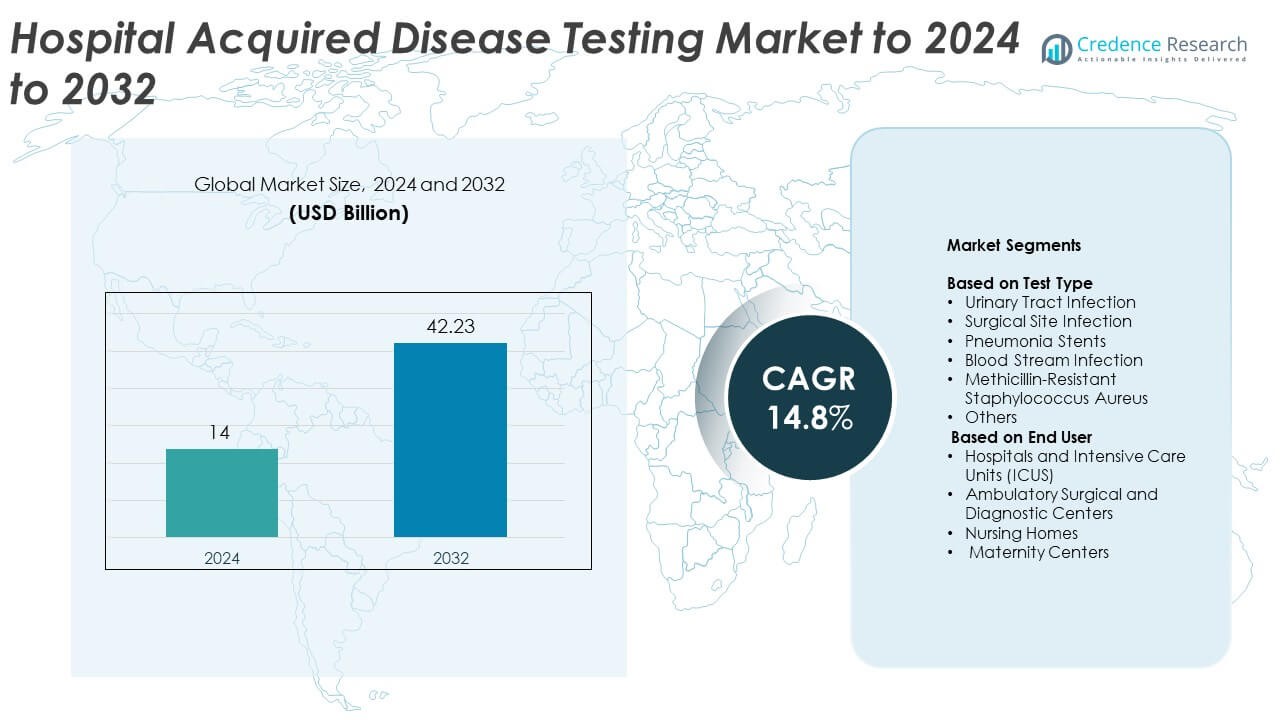
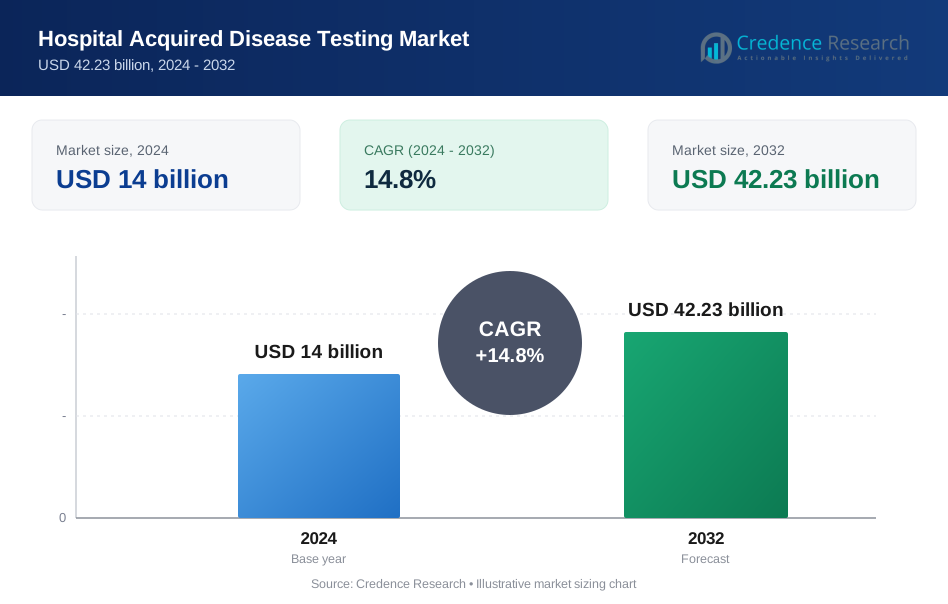
Hospital Acquired Disease Testing market size was valued at USD 14 billion in 2024 and is anticipated to reach USD 42.23 billion by 2032, at a CAGR of 14.8% during the forecast period.
| REPORT ATTRIBUTE | DETAILS |
|---|---|
| Historical Period | 2020-2023 |
| Base Year | 2024 |
| Forecast Period | 2025-2032 |
| Hospital Acquired Disease Testing Market Size 2024 | USD 14 Billion |
| Hospital Acquired Disease Testing Market, CAGR | 14.8% |
| Hospital Acquired Disease Testing Market Size 2032 | USD 42.23 Billion |
Leading companies in the Hospital Acquired Disease Testing market strengthen adoption through rapid molecular platforms, automated lab systems, and advanced pathogen-detection technologies. These players focus on improving turnaround time, expanding resistance-marker panels, and supporting infection-control programs in high-risk clinical units. Their solutions gain traction as hospitals work to reduce outbreaks and enhance surveillance accuracy. North America led the market in 2024 with a 38% share due to strong diagnostic infrastructure and strict regulatory standards. Europe followed with 30% share, supported by advanced healthcare systems, while Asia Pacific accounted for 24% share driven by rising hospital admissions and expanding ICU capacity.
Market Insights
- The Hospital Acquired Disease Testing market reached USD 14 billion in 2024 and is projected to hit USD 42.23 billion by 2032, growing at a CAGR of 14.8%.
- Strong demand grows as hospitals adopt rapid molecular tests to reduce infection spread and improve early detection, supporting high use in urinary tract infection testing, which held about 31% share in 2024.
- Trends include expansion of point-of-care diagnostics, increasing adoption of AI-enabled platforms, and wider use of multiplex resistance panels across critical care units.
- Leading companies compete through automation, advanced assay development, integration of antimicrobial resistance panels, and partnerships with healthcare networks to expand diagnostic capacity.
- North America held 38% share in 2024, followed by Europe at 30%, while Asia Pacific reached 24% and demonstrated the fastest growth due to rising hospital admissions and ICU expansion.
Market Segmentation Analysis:
By Test Type
Urinary tract infection led the test type segment in 2024 with about 31% share. Its strong lead came from high case prevalence in catheterized patients and routine screening needs in acute care units. Hospitals rely on rapid UTI panels to reduce diagnostic delays and prevent complications linked to prolonged catheter use. Surgical site infection and bloodstream infection tests also expanded with rising antimicrobial resistance, while MRSA testing gained wider adoption due to infection-control mandates. Pneumonia stent testing and other panels grew steadily as respiratory-linked hospital infections increased in critical care settings.
- For instance, BD’s BACTEC FX stack configuration uses four drawers with 100 vials each, giving capacity for 400 blood culture vials in a common hospital setup.
By End User
Hospitals and intensive care units dominated the end-user segment in 2024 with nearly 54% share. Their lead stems from high patient density, invasive procedures, and greater exposure to multidrug-resistant pathogens. ICUs adopt rapid diagnostic platforms to shorten detection time and limit outbreak spread. Ambulatory surgical and diagnostic centers increased use of screening tests to comply with safety protocols, while nursing homes expanded adoption due to rising infection-control requirements. Maternity centers contributed modest growth as prenatal and postnatal units strengthened preventive testing for high-risk infections.
- For instance, bioMérieux’s BioFire Pneumonia Panel detects 33 respiratory targets in about 1 hour, covering bacteria, viruses, and resistance genes for ICU pneumonia cases.
Key Growth Drivers
Rising burden of hospital acquired infections
Hospitals face growing clinical pressure as infection rates rise across critical care units. Higher use of catheters, ventilators, and surgical implants increases exposure to pathogens, which boosts demand for faster diagnostic tools. Hospitals adopt advanced tests to prevent outbreaks, cut care delays, and meet safety standards. The rising need for early and accurate detection strengthens adoption of automated and molecular testing platforms, allowing care teams to control infection spread.
- For instance, Abbott’s ID NOW COVID-19 assay delivers molecular results for SARS-CoV-2 in 13 minutes or less, helping emergency units act faster on suspected hospital infections.
Expansion of rapid molecular diagnostic technologies
Rapid molecular systems offer shorter turnaround times and high accuracy for detecting resistant organisms. Hospitals choose these platforms to support timely treatment decisions and reduce broad-spectrum antibiotic use. Many facilities integrate point-of-care molecular technologies into infection-control workflows to improve patient outcomes. Faster detection also helps lower hospitalization duration, which encourages wider investment in high-throughput assays and automated lab solutions.
- For instance, Cepheid’s Xpert Xpress SARS-CoV-2 test reports nucleic acid results in about 45 minutes on the GeneXpert system, combining sample prep and amplification in a single cartridge.
Growing regulatory focus on infection prevention
Governments and health agencies continue to tighten standards around infection surveillance and reporting. Mandatory screening protocols push hospitals to increase testing frequency for high-risk cases. Compliance with quality audits and accreditation programs drives adoption of modern diagnostic panels. Stronger enforcement of safety rules supports market growth as facilities allocate higher budget shares for infection prevention and diagnostic upgrades.
Key Trends & Opportunities
Adoption of AI-enabled testing platforms
AI tools help labs detect patterns in infection spread and optimize testing workflows. These platforms support faster review of diagnostic data and provide predictive insights for outbreak management. Hospitals explore AI systems that enhance test interpretation and reduce manual errors. Integration of smart analytics with molecular platforms offers new opportunities for improving infection surveillance efficiency.
- For instance, Philips’ IntelliVue Guardian Solution with automated early warning scoring has been deployed across 3 Lakeland Health hospitals, using continuous vital-sign analytics to flag clinical deterioration earlier.
Growth of decentralized and point-of-care testing models
Care providers shift toward decentralized testing to reduce pressure on central labs and speed up clinical decisions. Point-of-care systems support rapid screening in emergency units, ICUs, and surgical wards. This trend opens opportunities for compact, automated devices that work with minimal sample preparation. Strong interest in bedside testing encourages manufacturers to deliver more portable and user-friendly diagnostic solutions.
- For instance, QuidelOrtho’s Sofia 2 Flu + SARS Antigen FIA produces automated results for influenza A, influenza B, and SARS-CoV-2 in 15 minutes at the point of care.
Rising demand for antimicrobial resistance panels
Pathogen resistance continues to increase, creating strong need for panels that detect multiple resistance markers. Hospitals use these tests to guide targeted therapies and reduce misuse of antibiotics. Expanded adoption of multiplex assays offers opportunities for companies to introduce broader panels. This trend supports improved infection management in high-risk clinical environments.
Key Challenges
High cost of advanced diagnostic systems
Modern molecular platforms and automated systems require significant upfront investment, which limits adoption in smaller facilities. Ongoing maintenance, consumable expenses, and skilled staff needs increase operational cost. Many providers struggle to balance cost with diagnostic accuracy, slowing the transition from conventional methods. Budget constraints remain a major barrier in developing economies.
Shortage of trained laboratory professionals
Healthcare systems face difficulty in maintaining skilled staff capable of handling advanced diagnostic tools. Limited training resources slow integration of new technologies and increase test turnaround times. Workforce gaps strain labs during infection surges, reducing system efficiency. The shortage of qualified personnel challenges sustained and widespread adoption of high-complexity testing platforms.
Regional Analysis
North America
North America led the Hospital Acquired Disease Testing market in 2024 with about 38% share. The region benefits from strong adoption of rapid molecular tests, strict infection-control policies, and high hospital spending. Large healthcare networks use automated diagnostic platforms to reduce detection time and manage antimicrobial resistance. Growing reporting obligations further increase testing volumes. The United States contributes most of the demand due to advanced clinical infrastructure and widespread ICU capacity. Canada adds steady growth through national infection-surveillance programs and greater use of point-of-care screening solutions across acute care facilities.
Europe
Europe followed with nearly 30% share in 2024, supported by robust infection-prevention frameworks and strong regulatory oversight. Hospitals in major markets such as Germany, the United Kingdom, and France rely on rapid diagnostic panels to maintain clinical safety standards. Increased focus on antimicrobial stewardship drives demand for resistance-specific assays. Investment in laboratory automation enhances testing output across public and private hospitals. Expansion of centralized diagnostic networks in Nordic and Western European countries also supports sustained adoption. Eastern Europe records emerging growth as facilities upgrade testing capabilities and align with European healthcare quality guidelines.
Asia Pacific
Asia Pacific held about 24% share in 2024 and recorded the fastest growth due to rising hospital admissions and higher incidence of device-associated infections. Expanding ICU capacity across China and India increases demand for rapid pathogen identification tools. Hospitals shift toward molecular testing to manage resistant organisms and reduce mortality linked to late diagnosis. Government programs promoting infection surveillance improve adoption across public hospitals. Growing private healthcare investment in Southeast Asia supports new diagnostic installations. Partnerships between global manufacturers and regional distributors accelerate access to advanced testing systems in developing markets.
Latin America
Latin America accounted for around 5% share in 2024, driven by gradual improvement in healthcare infrastructure and increased awareness of infection-control practices. Major countries such as Brazil and Mexico invest in modernizing diagnostic labs to manage rising hospital infection cases. Adoption of rapid tests grows as hospitals work to reduce treatment delays and strengthen surveillance efforts. However, budget limitations slow adoption of high-cost molecular systems. Public health agencies support training programs to improve diagnostic competency and expand use of standardized testing protocols across regional healthcare networks.
Middle East and Africa
The Middle East and Africa held nearly 3% share in 2024, supported by selective investments in advanced hospital diagnostics in the Gulf countries. Nations such as Saudi Arabia and the UAE adopt rapid infection-testing tools to enhance clinical quality and reduce ICU-related risks. Broader regional adoption remains limited due to infrastructure gaps and financial constraints across low-income countries. Infection-prevention programs and international partnerships help improve testing access in select African markets. Gradual expansion of private hospitals and medical tourism in the Middle East also supports higher adoption of modern diagnostic platforms.
Market Segmentations:
By Test Type
- Urinary Tract Infection
- Surgical Site Infection
- Pneumonia Stents
- Blood Stream Infection
- Methicillin-Resistant Staphylococcus Aureus
- Others
By End User
- Hospitals and Intensive Care Units (ICUS)
- Ambulatory Surgical and Diagnostic Centers
- Nursing Homes
- Maternity Centers
By Geography
- North America
- U.S.
- Canada
- Mexico
- Europe
- Germany
- France
- U.K.
- Italy
- Spain
- Rest of Europe
- Asia Pacific
- China
- Japan
- India
- South Korea
- South-east Asia
- Rest of Asia Pacific
- Latin America
- Brazil
- Argentina
- Rest of Latin America
- Middle East & Africa
- GCC Countries
- South Africa
- Rest of the Middle East and Africa
Competitive Landscape
BD (U.S.), BIOMÉRIEUX (France), Meridian Bioscience, Inc. (U.S.), Eurofins Scientific (Luxembourg), Siemens Healthcare Private Limited (Germany), F. Hoffmann-La Roche Ltd (Switzerland), QIAGEN (Germany), Thermo Fisher Scientific Inc. (U.S.), Hologic, Inc. (U.S.), Cantel Medical (U.S.), and Abbott (U.S.) lead the competitive landscape of the Hospital Acquired Disease Testing market. These companies compete through advanced molecular technologies, rapid diagnostic panels, and integrated infection-surveillance solutions. Their strategies focus on improving detection speed, expanding antimicrobial resistance testing, and strengthening laboratory automation. Many players invest in AI-driven analytics to support early outbreak identification and enhance result accuracy. Product portfolios continue to broaden with multiplex assays, point-of-care platforms, and automated lab instruments designed to handle rising test volumes. Partnerships with healthcare facilities and research institutions help increase adoption across high-risk care units. Strong regulatory compliance capabilities and global distribution networks further reinforce competitive strength in this evolving market.
Key Player Analysis
- BD (U.S.)
- BIOMÉRIEUX (France)
- Meridian Bioscience, Inc. (U.S.)
- Eurofins Scientific (Luxembourg)
- Siemens Healthcare Private Limited (Germany)
- F. Hoffmann-La Roche Ltd (Switzerland)
- QIAGEN (Germany)
- Thermo Fisher Scientific Inc. (U.S.)
- Hologic, Inc. (U.S.)
- Cantel Medical (U.S.)
- Abbott (U.S.)
Recent Developments
- In 2025, Roche received FDA clearance and CLIA waiver for its cobas liat sexually transmitted infection (STI) multiplex assay panels, including CT/NG and CT/NG/MG.
- In 2024, bioMérieux SA Acquired the LUMED start-up to leverage data in the fight against antimicrobial resistance (AMR).
- In 2023, Thermo Fisher Scientific unveiled real-time PCR kits in India for the detection of infectious diseases
Report Coverage
The research report offers an in-depth analysis based on Test Type, End-User and Geography. It details leading market players, providing an overview of their business, product offerings, investments, revenue streams, and key applications. Additionally, the report includes insights into the competitive environment, SWOT analysis, current market trends, as well as the primary drivers and constraints. Furthermore, it discusses various factors that have driven market expansion in recent years. The report also explores market dynamics, regulatory scenarios, and technological advancements that are shaping the industry. It assesses the impact of external factors and global economic changes on market growth. Lastly, it provides strategic recommendations for new entrants and established companies to navigate the complexities of the market.
Future Outlook
- Demand for rapid molecular testing will rise as hospitals prioritize faster diagnosis.
- Automated platforms will gain wider use to improve accuracy and reduce manual workload.
- AI-driven analytics will support early outbreak prediction and better infection surveillance.
- Point-of-care testing will expand across ICUs and emergency departments for quicker decisions.
- Adoption of antimicrobial resistance panels will increase to guide targeted therapy.
- Hospitals will invest more in integrated lab systems to meet regulatory compliance needs.
- Decentralized testing models will grow to reduce pressure on central laboratories.
- Emerging economies will upgrade diagnostic infrastructure to lower infection-related mortality.
- Partnerships between hospitals and diagnostic companies will rise to improve test access.
- Innovation in multiplex assays will drive broader detection of hospital-based pathogens.
Request a Free Sample
Fill in your details and we'll send you a free sample report.
- Sample data tables & charts
- Research methodology
Market Dynamics
Rising burden of hospital acquired infections
Increasing rates of infections in hospitals, especially in critical care units, are driving demand for faster and more accurate diagnostic tools to prevent outbreaks and improve patient outcomes.
Expansion of rapid molecular diagnostic technologies
Hospitals are adopting rapid molecular systems for their high accuracy and quick turnaround times, enabling timely treatment decisions and reducing the misuse of broad-spectrum antibiotics.
Growing regulatory focus on infection prevention
Stricter government and health agency standards around infection surveillance and reporting are pushing hospitals to increase testing frequency and invest in advanced diagnostic panels to comply with quality audits.
Adoption of AI-enabled and automated testing platforms
Integration of AI and automation in diagnostic workflows enhances test interpretation, reduces manual errors, and supports early outbreak detection, making these technologies increasingly attractive to healthcare providers.
Rising demand for antimicrobial resistance panels
The growing prevalence of multidrug-resistant pathogens is fueling the need for multiplex assays that can detect multiple resistance markers, supporting targeted therapy and improved infection management in high-risk environments.
Need a Custom Version of This Report?
Tailor the scope, geography, or segments to your exact requirements.
- Custom geography or segment scope
- Direct access to our analyst team
Frequently Asked Questions
What is the current market size for Hospital Acquired Disease Testing Market, and what is its projected size in 2032?
At what Compound Annual Growth Rate is the Hospital Acquired Disease Testing Market projected to grow between 2025 and 2032?
Which Hospital Acquired Disease Testing Market segment held the largest share in 2024?
What are the primary factors fueling the growth of the Hospital Acquired Disease Testing Market?
Who are the leading companies in the Hospital Acquired Disease Testing Market?
Which region commanded the largest share of the Hospital Acquired Disease Testing Market in 2024?
Table of Content
Chapter 1 Market Segmentation
- 1.1 Segmentation Framework
- 1.1.1 Product and Service Classification
- 1.1.2 Application and End-Use Classification
- 1.1.3 Technology and Solution Classification
- 1.1.4 Customer and Distribution Channel Classification
- 1.1.5 Geographic Segmentation
- 1.1.6 Market Segment Definitions and Boundaries
- 1.2 By End User
- 1.2.1 Hospitals and Intensive Care Units (ICUs)
- 1.2.2 Ambulatory Surgical and Diagnostic Centers
- 1.2.3 Nursing Homes
- 1.2.4 Maternity Centers
- 1.3 By Test Type
- 1.3.1 Urinary Tract Infection
- 1.3.2 Surgical Site Infection
- 1.3.3 Pneumonia Stents
- 1.3.4 Blood Stream Infection
- 1.3.5 Methicillin-Resistant Staphylococcus Aureus
- 1.3.6 Others
Chapter 2 Introduction
- 2.1 Report Objectives and Scope
- 2.2 Product Definition and Industry Terminology
- 2.3 Market Inclusions and Exclusions
- 2.4 Research Process
- 2.4.1 Primary Research and Expert Interviews
- 2.4.2 Secondary Research and Source Review
- 2.4.3 Top-Down and Bottom-Up Estimation
- 2.4.4 Data Triangulation and Verification
- 2.5 Market Size Measurement Basis
- 2.5.1 2024: USD 14 billion → 2032: USD 42.23 billion
- 2.6 Historical and Forecast Reference Periods
- 2.6.1 Base Year: 2024
- 2.6.2 Forecast Period: 2024-2032
- 2.7 Research Assumptions and Limitations
Chapter 3 Executive Summary
- 3.1 Market Snapshot and Key Findings
- 3.2 Base-Year Market Size, 2024
- 3.3 Forecast Market Size, 2032
- 3.4 Revenue and Volume Growth Outlook
- 3.5 Key Demand and Supply Indicators
- 3.6 Leading Market Segments
- 3.7 Fastest-Growing Market Opportunities
- 3.8 Regional Performance Highlights
- 3.9 Technology and Industry Transformation
- 3.10 Competitive Landscape Summary
- 3.11 Analyst View and Strategic Implications
Chapter 4 Global Hospital Acquired Disease Testing Market Trends and Developments
- 4.1 Historical Industry Development
- 4.2 Recent Market Trends and Developments
- 4.3 Demand and Customer Behavior Trends
- 4.4 Technology and Product Innovation
- 4.5 Artificial Intelligence, Automation and Digitalization
- 4.6 Local Manufacturing and Supply Chain Realignment
- 4.7 Industry Partnerships, Mergers and Acquisitions
- 4.8 Sustainability and Circular Economy Developments
- 4.9 Government and Private Sector Investment Trends
- 4.10 Emerging Business Models and Commercialization
- 4.11 Industry Developments and Announcements
Chapter 5 Global Hospital Acquired Disease Testing Market Production, Supply and Demand Analysis
- 5.1 Demand Trend and Consumption Analysis
- 5.2 Demand Forecast, 2024-2032
- 5.3 Production and Output Trend
- 5.4 Production and Output Forecast, 2024-2032
- 5.5 Installed Capacity and Capacity Utilization
- 5.6 Company-Wise Production Plants and Statistics
- 5.6.1 Installed Production Capacity
- 5.6.2 Actual Production
- 5.6.3 Planned Capacity and Expansion Targets
- 5.7 Supply Chain Structure and Procurement Trends
- 5.8 Supply-Demand Gap and Bottlenecks
- 5.9 Import Dependence and Sourcing Structure
- 5.10 Contract Manufacturing and Outsourcing
- 5.11 Regional Supply and Demand Concentration
Chapter 6 Global Hospital Acquired Disease Testing Market Pricing Analysis
- 6.1 Pricing Structure and Measurement
- 6.2 Historical Pricing Trends
- 6.3 Pricing Outlook, 2024-2032
- 6.4 Average Selling Price and Unit Economics
- 6.5 Pricing by Product and Market Segment
- 6.6 Geographic Pricing Differences
- 6.7 Key Input, Energy, Labor and Logistics Costs
- 6.8 Contract Pricing and Purchasing Models
- 6.9 Pricing Sensitivity and Competitive Positioning
- 6.10 Price, Margin and Profitability Implications
Chapter 7 Global Hospital Acquired Disease Testing Market Dynamics
- 7.1 Market Growth Drivers
- 7.1.1 Demand-Side Drivers
- 7.1.2 Technology and Innovation Drivers
- 7.1.3 Infrastructure and Investment Drivers
- 7.1.4 Regulatory and Policy Drivers
- 7.2 Market Restraints
- 7.2.1 Cost and Affordability Constraints
- 7.2.2 Technology and Adoption Barriers
- 7.2.3 Supply Chain and Operational Constraints
- 7.3 Market Challenges
- 7.3.1 Competitive Pressure and Margin Erosion
- 7.3.2 Skills, Infrastructure and Implementation Gaps
- 7.4 Emerging Market Opportunities
- 7.5 Market Dynamics Impact and Time-Horizon Assessment
Chapter 8 Global Hospital Acquired Disease Testing Value Chain Analysis
- 8.1 Industry Value Chain Overview
- 8.2 Upstream Suppliers and Critical Inputs
- 8.3 Technology and Component Providers
- 8.4 Manufacturing or Service Delivery
- 8.5 Distribution, Channel Partners and Integrators
- 8.6 Downstream Applications and End Users
- 8.7 Value Addition and Profit Pools
- 8.8 Vertical Integration and Outsourcing
- 8.9 Supplier Concentration and Risk
- 8.10 Supply Chain Localization and Resilience
Chapter 9 Global Hospital Acquired Disease Testing Market Regulations and Policies
- 9.1 Relevant Laws, Standards and Compliance Frameworks
- 9.2 Product, Service, Safety and Quality Requirements
- 9.3 Government Policies, Incentives and Subsidies
- 9.4 Imports, Exports and Trade Barriers
- 9.5 Public Procurement and Local Content Requirements
- 9.6 Environmental and Sustainability Compliance
- 9.7 Upcoming Policy Changes and Market Implications
Chapter 10 Global Hospital Acquired Disease Testing Market Hotspots and Opportunities
- 10.1 Market Opportunity Mapping and Growth Hotspots
- 10.2 High-Growth Applications and Customer Groups
- 10.3 Underserved Markets and White-Space Opportunities
- 10.4 Emerging Technology and Product Opportunities
- 10.5 New Capacity and Investment Hotspots
- 10.6 Market Entry and Expansion Opportunities
- 10.7 Distribution and Partnership Opportunities
- 10.8 Near-Term and Long-Term Commercial Potential
- 10.9 Opportunity Attractiveness and Execution Risks
Chapter 11 Global Hospital Acquired Disease Testing Market Outlook, 2024-2032
- 11.1 Market Size and Analysis
- 11.1.1 Revenue (Market Measurement: 2024: USD 14 billion → 2032: USD 42.23 billion)
- 11.1.2 Market Volume and Quantity Sold
- 11.1.3 Historical Market Size
- 11.1.4 Base-Year Market Size, 2024
- 11.2 Market Forecast, 2024-2032
- 11.2.1 Revenue Forecast to 2032
- 11.2.2 Volume Forecast to 2032
- 11.2.3 CAGR and Year-on-Year Growth
- 11.2.4 Incremental Revenue Opportunity
- 11.3 Forecast Assumptions and Scenario Analysis
- 11.3.1 Base-Case Forecast
- 11.3.2 Optimistic and Conservative Scenarios
- 11.3.3 Technology, Pricing and Policy Sensitivities
- 11.4 Market Attractiveness and Growth Outlook
Chapter 12 Global Hospital Acquired Disease Testing Market Segmentation and Outlook
- 12.1 Segmentation Summary and Market Shares, 2024
- 12.2 Largest and Fastest-Growing Segments
- 12.3 By End User - Market Size and Forecast, 2024-2032
- 12.3.1 Segment Definition and Scope
- 12.3.2 Historical Market Size
- 12.3.3 Revenue Forecast, 2024-2032
- 12.3.4 Volume Forecast, 2024-2032
- 12.3.5 Base-Year Market Share, 2024
- 12.3.6 Segment CAGR and Growth Drivers
- 12.3.7 Subsegment Market Size and Forecast
- 12.3.7.1 Hospitals and Intensive Care Units (ICUs)
- 12.3.7.2 Ambulatory Surgical and Diagnostic Centers
- 12.3.7.3 Nursing Homes
- 12.3.7.4 Maternity Centers
- 12.3.8 Subsegment Pricing and Adoption Trends
- 12.3.9 Leading Suppliers and Competition
- 12.3.10 Regional Demand and Opportunities
- 12.4 By Test Type - Market Size and Forecast, 2024-2032
- 12.4.1 Segment Definition and Scope
- 12.4.2 Historical Market Size
- 12.4.3 Revenue Forecast, 2024-2032
- 12.4.4 Volume Forecast, 2024-2032
- 12.4.5 Base-Year Market Share, 2024
- 12.4.6 Segment CAGR and Growth Drivers
- 12.4.7 Subsegment Market Size and Forecast
- 12.4.7.1 Urinary Tract Infection
- 12.4.7.2 Surgical Site Infection
- 12.4.7.3 Pneumonia Stents
- 12.4.7.4 Blood Stream Infection
- 12.4.7.5 Methicillin-Resistant Staphylococcus Aureus
- 12.4.7.6 Others
- 12.4.8 Subsegment Pricing and Adoption Trends
- 12.4.9 Leading Suppliers and Competition
- 12.4.10 Regional Demand and Opportunities
- 12.5 Segment Growth Comparison
- 12.6 Segment Attractiveness and Priority Matrix
Chapter 13 Global Hospital Acquired Disease Testing End-Use and Application Market Outlook
- 13.1 End-Use Industry and Customer Demand Structure
- 13.2 Leading Applications and Customer Groups
- 13.3 End-Use Market Size, Share and Forecast
- 13.4 Major End-Use Industry Deep Dives
- 13.4.1 Customer Requirements and Use Cases
- 13.4.2 Demand and Replacement Cycles
- 13.4.3 Technical and Regulatory Considerations
- 13.4.4 Purchasing and Procurement Models
- 13.4.5 Leading Vendors and Distribution Channels
- 13.4.6 Forecast and Commercial Opportunities
- 13.5 Emerging Applications and Cross-Segment Demand
- 13.6 End-Use Industry Investment Priorities
Chapter 14 Global Hospital Acquired Disease Testing Geographic Market Outlook, 2024-2032
- 14.1 Regional Market Size and Share, 2024
- 14.2 Regional Market Forecast, 2024-2032
- 14.3 Regional Pricing, Production and Demand Differences
- 14.4 North America
- 14.4.1 United States
- 14.4.2 Canada
- 14.4.3 Mexico
- 14.5 Europe
- 14.5.1 Germany
- 14.5.2 France
- 14.5.3 Italy
- 14.5.4 United Kingdom
- 14.5.5 Spain
- 14.5.6 Poland
- 14.5.7 Russia
- 14.5.8 Netherlands
- 14.5.9 Belgium
- 14.5.10 Sweden
- 14.5.11 Denmark
- 14.5.12 Norway
- 14.5.13 Rest of Europe
- 14.6 Asia Pacific
- 14.6.1 China
- 14.6.2 India
- 14.6.3 Japan
- 14.6.4 South Korea
- 14.6.5 Thailand
- 14.6.6 Indonesia
- 14.6.7 Vietnam
- 14.6.8 Malaysia
- 14.6.9 Australia
- 14.6.10 Rest of Asia Pacific
- 14.7 Latin America
- 14.7.1 Brazil
- 14.7.2 Argentina
- 14.7.3 Colombia
- 14.7.4 Chile
- 14.7.5 Rest of Latin America
- 14.8 Middle East
- 14.8.1 Saudi Arabia
- 14.8.2 United Arab Emirates
- 14.8.3 Turkey
- 14.8.4 Israel
- 14.8.5 Iran
- 14.8.6 Rest of the Middle East
- 14.9 Africa
- 14.9.1 South Africa
- 14.9.2 Egypt
- 14.9.3 Nigeria
- 14.9.4 Morocco
- 14.9.5 Rest of Africa
- 14.10 Regional Investment, Policy and Supply Chain Differences
- 14.11 Regional Competitive Landscape
- 14.12 Geographic Growth Hotspots
Chapter 15 Global Hospital Acquired Disease Testing Technology, Innovation and Sustainability Outlook
- 15.1 Technology Landscape and Maturity
- 15.2 Product, Process and Service Innovation
- 15.3 AI, Automation and Digital Tools in the Industry
- 15.4 Technology Adoption and Performance Benchmarking
- 15.5 Innovation Pipeline and R&D Investment
- 15.6 Patent and Intellectual Property Trends
- 15.7 Energy Efficiency and Resource Management
- 15.8 Sustainability, Recycling and Circularity
- 15.9 Technology Roadmap, 2024-2032
- 15.10 Risks of Obsolescence and Technology Substitution
Chapter 16 Global Hospital Acquired Disease Testing Market Key Strategic Imperatives
- 16.1 Growth and Market Entry Priorities
- 16.2 High-Return Products and Segments
- 16.3 Pricing, Profitability and Cost Optimization
- 16.4 Technology Investment and Product Differentiation
- 16.5 Supply Chain Localization and Resilience
- 16.6 Distribution and Customer Acquisition
- 16.7 Partnership, Acquisition and Capacity Strategy
- 16.8 Regional Expansion Priorities
- 16.9 Short-, Medium- and Long-Term Actions
Chapter 17 Competition Outlook
- 17.1 Industry Competition Characteristics
- 17.2 Market Structure and Concentration
- 17.3 Market Share and Competitive Positioning, 2024
- 17.4 Company-Wise Revenue and Product Benchmarking
- 17.5 Production and Service Capacity Benchmarking
- 17.6 Technology, Pricing and Differentiation
- 17.7 Regional Footprint and Distribution Strength
- 17.8 Mergers, Acquisitions and Strategic Alliances
- 17.9 New Entrants and Competitive Threats
- 17.10 Porter's Five Forces and Industry Attractiveness
- 17.11 Competitive Outlook, 2024-2032
Chapter 18 Company Profiles
- 18.1 Company Coverage and Selection Criteria
- 18.2 BD (Becton, Dickinson and Company)
- 18.2.1 Business Description
- 18.2.2 Company Ownership and Geographic Presence
- 18.2.3 Product and Service Portfolio
- 18.2.4 Manufacturing and Operating Footprint
- 18.2.5 Production Capacity and Expansion Plans
- 18.2.6 Financial Performance and Investment
- 18.2.7 Market Share and Competitive Position
- 18.2.8 Technology and Innovation Capabilities
- 18.2.9 Strategic Alliances or Partnerships
- 18.2.10 Recent Developments
- 18.2.11 Growth Strategy and Outlook
- 18.3 bioMérieux
- 18.4 Meridian Bioscience, Inc.
- 18.5 Eurofins Scientific
- 18.6 Siemens Healthcare Private Limited
- 18.7 F. Hoffmann-La Roche Ltd
- 18.8 QIAGEN
- 18.9 Thermo Fisher Scientific Inc.
- 18.10 Hologic, Inc.
- 18.11 Abbott
- 18.12 Other Relevant Market Participants
Note: Every listed company is profiled on the structure shown under the first company. The company list is preliminary and may change based on research findings, market developments, data availability and client requirements.
Chapter 19 Disclaimer
- 19.1 Research and Forecast Disclaimer
- 19.2 Data Source and Estimation Limitations
Note: The depth of individual sections depends on data availability for this market. Volume, capacity, trade and other unit-based metrics are included where applicable.

