
Market Overview:
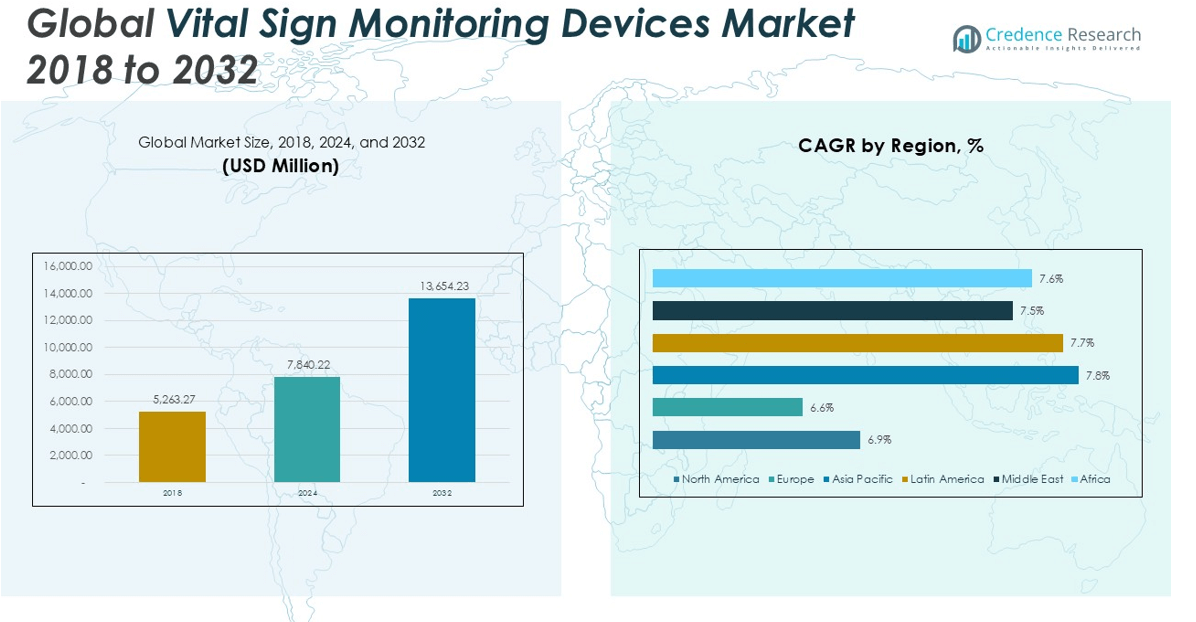
The Vital Sign Monitoring Devices market size was valued at USD 5,263.27 million in 2018, increased to USD 7,840.22 million in 2024, and is anticipated to reach USD 13,654.23 million by 2032, at a CAGR of 7.23% during the forecast period.
| REPORT ATTRIBUTE | DETAILS |
|---|---|
| Historical Period | 2020-2023 |
| Base Year | 2024 |
| Forecast Period | 2025-2032 |
| Vital Sign Monitoring Devices Market Size 2024 | USD 7,840.22 million |
| Vital Sign Monitoring Devices Market, CAGR | 7.23% |
| Vital Sign Monitoring Devices Market Size 2032 | USD 13,654.23 million |
The Vital Sign Monitoring Devices market is led by key players such as Koninklijke Philips N.V., Medtronic, Nihon Kohden Corporation, Masimo, GE Healthcare, and Omron Healthcare, who collectively hold a dominant share due to their robust product portfolios, global distribution networks, and continuous investment in technological innovation. These companies are actively expanding their presence through strategic partnerships and advanced digital health solutions. Regionally, Asia Pacific emerged as the leading market in 2024, accounting for 32.4% of the global market share, driven by rising healthcare expenditure, a growing elderly population, and increasing adoption of remote monitoring technologies across China, India, and Southeast Asia.
Market Insights
- The Vital Sign Monitoring Devices market was valued at USD 7,840.22 million in 2024 and is projected to reach USD 13,654.23 million by 2032, growing at a CAGR of 7.23% during the forecast period.
- Rising prevalence of chronic diseases, an aging global population, and increased demand for home-based and remote patient monitoring are key drivers fueling market expansion.
- Technological trends such as AI-enabled monitoring, wearable devices, and integration with telehealth platforms are transforming the landscape, enhancing accuracy and patient engagement.
- The market is dominated by players like Koninklijke Philips N.V., Medtronic, Nihon Kohden, and GE Healthcare, with competition intensifying through innovation, product launches, and strategic partnerships.
- Regionally, Asia Pacific leads with a 32.4% market share, followed by Europe (28.5%) and North America (24.4%); among product segments, digital blood pressure monitors and pulse oximeters hold the highest shares due to ease of use and rising chronic illness cases.
Market Segmentation Analysis:
By Product
In the Vital Sign Monitoring Devices market, blood pressure monitors represent a major share, driven by the increasing prevalence of hypertension and cardiovascular diseases. Among these, digital blood pressure monitors hold the dominant sub-segment due to their ease of use, portability, and integration with smartphone applications. The rising elderly population and growing demand for home-based monitoring further fuel their adoption. Within body temperature monitoring devices, digital thermometers, especially tympanic and forehead types, lead due to their accuracy and non-invasiveness. Respiratory monitoring devices also contribute significantly to market growth, particularly due to heightened awareness post-COVID-19. Within this category, the pulse oximeter sub-segment dominates the market, accounting for a substantial share owing to its widespread application in monitoring oxygen saturation in hospitals, homes, and emergency care settings. The increased use of these devices for chronic respiratory conditions and post-operative care has further boosted demand.
- For instance, Masimo’s Signal Extraction Technology (SET®) pulse oximeters are used in over 200 clinical studies and are deployed in more than 200 countries, with over 200 million patients monitored globally, demonstrating robust clinical performance and adoption.
By End Use
Hospitals constitute the leading end-use segment in the vital sign monitoring devices market, holding the largest market share due to the high volume of patient admissions and demand for continuous monitoring. The availability of advanced infrastructure, trained professionals, and multi-parameter monitoring systems further supports hospital dominance. Home healthcare is emerging as the fastest-growing segment, fueled by the aging population, rising healthcare costs, and growing preference for remote monitoring. The shift toward personalized care and the increasing use of user-friendly digital devices such as pulse oximeters and digital blood pressure monitors at home are accelerating this trend.
- For instance, Omron Healthcare has sold over 300 million blood pressure monitors worldwide, supporting its leadership in the home healthcare segment and reinforcing consumer trust in at-home vital sign monitoring.
Key Growth Drivers
Rising Prevalence of Chronic Diseases
The increasing global burden of chronic diseases such as hypertension, diabetes, and respiratory disorders significantly drives the demand for vital sign monitoring devices. As these conditions require regular monitoring of blood pressure, temperature, and oxygen saturation, healthcare providers and patients are increasingly adopting digital monitoring solutions for early detection and continuous management. The aging population further amplifies this demand, as older adults are more susceptible to chronic health issues, necessitating consistent tracking of vital signs to improve treatment outcomes and reduce hospital readmissions.
- For instance, Koninklijke Philips N.V. has installed over 1.4 million connected care monitoring devices globally, providing hospitals and home users with tools for managing chronic conditions effectively.
Expansion of Home Healthcare Services
The rapid shift toward home-based care is a major growth driver for the vital sign monitoring devices market. Growing healthcare costs, overcrowded hospitals, and the preference for patient-centric care are encouraging the adoption of portable, easy-to-use devices for home monitoring. Technological advancements such as Bluetooth-enabled and smartphone-integrated devices allow patients to monitor their health in real-time and share data with healthcare providers remotely. This expansion not only improves patient convenience but also supports early diagnosis and timely medical intervention, contributing to improved healthcare efficiency and reduced operational costs.
- For instance, Nihon Kohden has distributed over 500,000 home-use electrocardiographs and patient monitors, highlighting the increasing adoption of professional-grade monitoring in domestic care environments.
Technological Advancements in Monitoring Devices
Continuous innovation in sensor technology, wireless connectivity, and data analytics is fueling the development of smarter, more accurate vital sign monitoring devices. Wearable devices, artificial intelligence integration, and cloud-based platforms enable real-time data tracking, automated alerts, and predictive analytics for proactive patient care. These advancements improve diagnostic accuracy and reduce human error, making vital sign monitors more reliable and effective across healthcare settings. The push toward miniaturized and multi-parameter devices is also expanding application scope, particularly in ambulatory care and telemedicine.
Key Trends & Opportunities
Growth of Telehealth and Remote Patient Monitoring
The rise of telehealth services has opened new opportunities for the vital sign monitoring devices market. As healthcare systems increasingly adopt virtual consultations and remote monitoring programs, there is growing demand for connected devices that can transmit real-time patient data. This trend is particularly prominent in managing chronic conditions and post-operative care. The integration of cloud-based platforms with wearable monitors facilitates seamless data exchange between patients and physicians, enhancing care coordination and treatment adherence while reducing the need for in-person visits.
- For instance, GE Healthcare’s Mural Virtual Care Solution has supported over 3,000 intensive care beds across multiple global healthcare systems, enabling scalable remote monitoring and improving care coordination.
Integration of AI and IoT in Healthcare Monitoring
Artificial intelligence (AI) and the Internet of Things (IoT) are transforming the landscape of vital sign monitoring. Devices equipped with AI algorithms can analyze large volumes of patient data to detect abnormalities, predict health risks, and support clinical decision-making. IoT-enabled monitoring systems allow for continuous, wireless data transmission across healthcare networks, supporting timely interventions. This trend is creating significant opportunities for manufacturers to develop intelligent monitoring solutions that align with personalized and preventive healthcare models.
- For instance, Medtronic’s AI-powered Guardian Connect system uses predictive alerts and has demonstrated the ability to forecast glucose events up to 60 minutes in advance, enhancing proactive diabetic care through real-time insights.
Key Challenges
Data Security and Privacy Concerns
As vital sign monitoring devices increasingly rely on digital platforms and wireless connectivity, data security and privacy have become pressing concerns. The transmission and storage of sensitive patient health data over cloud-based systems expose it to potential cyberattacks and unauthorized access. Regulatory compliance with healthcare data protection laws such as HIPAA and GDPR is essential but challenging, particularly for smaller device manufacturers. Ensuring robust cybersecurity measures and user trust remains a critical hurdle for market participants.
Limited Access in Low-Resource Settings
Despite technological advancements, access to vital sign monitoring devices remains limited in low- and middle-income countries due to cost constraints and inadequate healthcare infrastructure. The lack of trained personnel, electricity supply, and digital connectivity hampers the widespread adoption of these devices in rural or underserved areas. This disparity poses a significant challenge in ensuring equitable healthcare and restricts market growth potential in emerging regions.
Device Accuracy and Calibration Issues
Accuracy and consistency in vital sign monitoring remain a concern, particularly for low-cost or home-use devices. Inaccurate readings due to poor calibration, user error, or environmental factors can lead to misdiagnosis or delayed treatment. The challenge is amplified in multi-parameter and wearable devices where simultaneous monitoring increases complexity. Manufacturers must ensure rigorous quality control and provide user education to improve reliability and promote widespread adoption.
Regional Analysis
North America
North America accounted for a significant share of the global vital sign monitoring devices market, with a market size of USD 1,914.13 million in 2024, rising from USD 1,310.03 million in 2018. It is projected to reach USD 3,246.98 million by 2032, growing at a CAGR of 6.9% during the forecast period. In 2024, the region held approximately 24.4% of the global market. The presence of advanced healthcare infrastructure, high adoption of digital monitoring technologies, and growing prevalence of lifestyle-related diseases continue to drive demand in the U.S. and Canada, along with rising investment in remote patient monitoring solutions.
Europe
Europe held around 28.5% of the global vital sign monitoring devices market in 2024, with its value increasing from USD 1,550.03 million in 2018 to USD 2,236.03 million in 2024. It is projected to reach USD 3,724.87 million by 2032, expanding at a CAGR of 6.6%. The regional growth is supported by well-established public healthcare systems, rising geriatric population, and proactive government initiatives toward preventive healthcare. Increasing demand for non-invasive and continuous monitoring solutions, especially in countries like Germany, France, and the UK, further supports the adoption of vital sign monitoring technologies across both hospital and homecare settings.
Asia Pacific
Asia Pacific emerged as the largest regional market, contributing approximately 32.4% of the global market share in 2024. The market grew from USD 1,648.98 million in 2018 to USD 2,538.66 million in 2024 and is expected to reach USD 4,612.40 million by 2032, registering the highest CAGR of 7.8%. Rapid urbanization, growing healthcare investments, and the rising burden of chronic diseases are fueling demand for monitoring technologies across China, India, and Southeast Asia. Government efforts to expand healthcare access and the proliferation of mobile health technologies also drive market expansion across both urban and rural healthcare sectors.
Latin America
Latin America represented 8.7% of the global market in 2024, with the market size increasing from USD 444.75 million in 2018 to USD 681.99 million in 2024. It is projected to reach USD 1,232.98 million by 2032, growing at a CAGR of 7.7%. The region's growth is primarily driven by rising healthcare awareness, increased government spending, and the growing adoption of home-based care solutions in countries like Brazil and Mexico. Additionally, the expansion of telemedicine and mobile health services in underserved areas is facilitating access to vital sign monitoring devices, improving disease management and early diagnosis rates.
Middle East
The Middle East market is projected to grow at a CAGR of 7.5%, with its value rising from USD 203.69 million in 2018 to USD 308.46 million in 2024 and expected to reach USD 548.90 million by 2032. Holding approximately 3.9% of the global market share in 2024, regional growth is attributed to increasing investments in digital health infrastructure and the expansion of private healthcare services. Countries such as Saudi Arabia and the UAE are actively adopting smart medical technologies and remote monitoring devices to support chronic disease management, especially as part of their long-term healthcare digitization and modernization strategies.
Africa
Africa accounted for around 2.0% of the global market in 2024, with its value increasing from USD 105.79 million in 2018 to USD 160.95 million in 2024. The market is expected to reach USD 288.10 million by 2032, expanding at a CAGR of 7.6%. Although the region represents a smaller share, it holds considerable growth potential due to the rising prevalence of infectious and non-communicable diseases and the gradual improvement in healthcare infrastructure. International health initiatives and increasing penetration of mobile and telehealth services are creating opportunities for wider adoption of vital sign monitoring devices across underserved rural populations.
Market Segmentations:
By Product
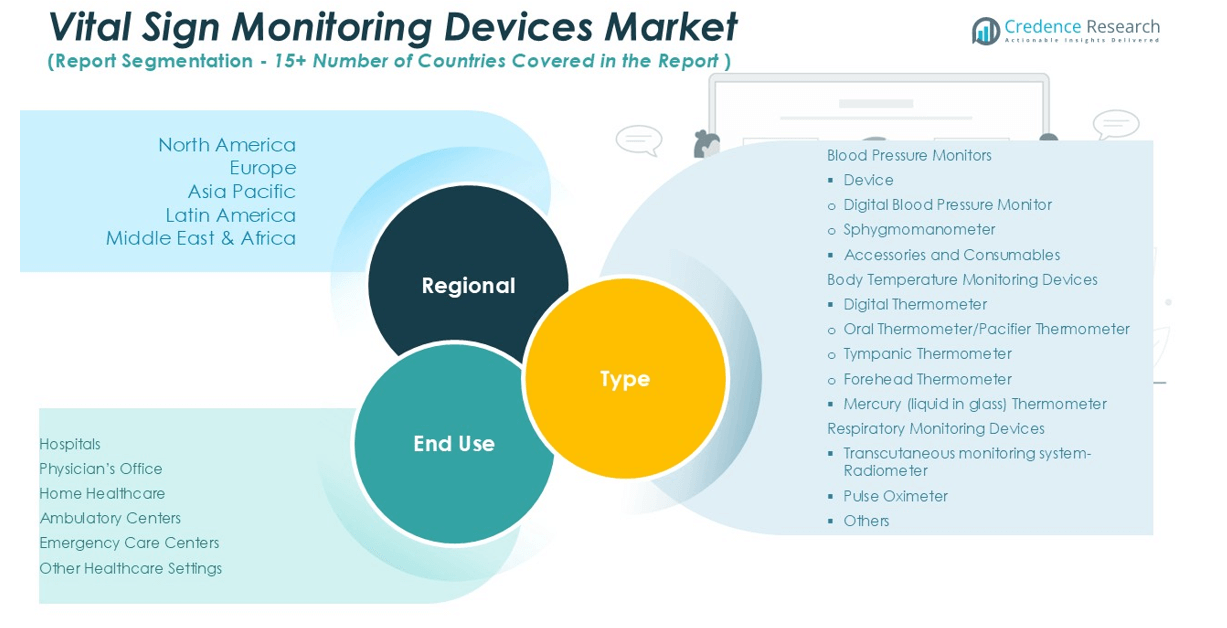
- Blood Pressure Monitors
- Device
- Digital Blood Pressure Monitor
- Sphygmomanometer
- Accessories and Consumables
- Device
- Body Temperature Monitoring Devices
- Digital Thermometer
- Oral Thermometer / Pacifier Thermometer
- Tympanic Thermometer
- Forehead Thermometer
- Mercury (Liquid-in-Glass) Thermometer
- Digital Thermometer
- Respiratory Monitoring Devices
- Transcutaneous Monitoring System – Radiometer
- Pulse Oximeter
- Others
By End Use
- Hospitals
- Physician’s Office
- Home Healthcare
- Ambulatory Centers
- Emergency Care Centers
- Other Healthcare Settings
By Geography
- North America
- U.S.
- Canada
- Mexico
- Europe
- Germany
- France
- U.K.
- Italy
- Spain
- Rest of Europe
- Asia Pacific
- China
- Japan
- India
- South Korea
- South-east Asia
- Rest of Asia Pacific
- Latin America
- Brazil
- Argentina
- Rest of Latin America
- Middle East & Africa
- GCC Countries
- South Africa
- Rest of the Middle East and Africa
Competitive Landscape
The competitive landscape of the vital sign monitoring devices market is characterized by the presence of several prominent players focusing on innovation, strategic collaborations, and geographic expansion. Leading companies such as Koninklijke Philips N.V., Medtronic, Nihon Kohden Corporation, and GE Healthcare dominate the market with their extensive product portfolios, strong global presence, and continuous R&D investments. These firms leverage advanced technologies like artificial intelligence, IoT integration, and cloud-based platforms to offer real-time, accurate monitoring solutions. Emerging players such as Contec Medical Systems, Rossmax International Ltd., and Ozeri are gaining traction in price-sensitive markets by offering cost-effective and portable solutions. Additionally, strategic mergers and acquisitions are shaping market dynamics, with companies aiming to enhance their capabilities and product reach. The growing demand for home-based and remote patient monitoring solutions is prompting manufacturers to develop user-friendly, connected devices tailored to both clinical and consumer settings. The competitive intensity is expected to rise as digital healthcare adoption accelerates globally.
Key Player Analysis
- Koninklijke Philips N.V.
- Medtronic
- Nihon Kohden Corporation
- Masimo
- Omron Healthcare
- Contec Medical Systems Co., Ltd.
- SunTech Medical, Inc.
- GE Healthcare
- Rossmax International Ltd.
- Ozeri
Recent Developments
- In July 2025, Philips announced a significant expansion of its open patient monitoring ecosystem, focusing on enhanced connectivity and data sharing between its devices and those of other manufacturers. This initiative aims to foster a more integrated and "smarter" clinical environment, allowing for improved data flow and management across various devices and platforms.
- In May 2025, Medtronic's HealthCast™ intelligent patient monitoring solution was recognized with the 2025 MedTech Breakthrough Award for "Best Overall Medical Device Solution". This award acknowledges HealthCast™ for its continuous multi-parameter monitoring capabilities, addressing the limitations of spot checks and offering connectivity, remote monitoring, and early warning alerts. The solution is designed to potentially reduce unplanned ICU admissions and improve patient outcomes.
- In November 2024, Philips and OMNIVISION unveiled a prototype for the first in-cabin automotive well-being monitoring system. This system utilizes Philips' clinically validated vital signs algorithms and OMNIVISION's image sensors to track a driver's pulse and breathing rate inside a vehicle. The data collected can then be used to personalize the driving experience, for example, by adjusting climate control, lighting, or entertainment systems based on the driver's well-being.
- In May 2024, The HealthCast™ system previously earned a MedTech Breakthrough Award for “Best New Technology Solution – Monitoring,” citing its ability to streamline workflow, integrate with EMRs, and automate vital signs charting, saving clinical time. The system supports continuous monitoring across hospital locations and is intended to improve patient safety and personalized care.
- In March 2024, Nihon Kohden released new patient monitors that continuously display core vital signs like ECG, temperature, and SpO2, while also offering network integration and customizable features to help with early warning and risk detection within clinical workflows. These monitors are designed to be versatile, suitable for various settings from operating rooms to general wards, and can be tailored to specific patient needs.
Market Concentration & Characteristics
The Vital Sign Monitoring Devices market exhibits moderate to high market concentration, with a few global players accounting for a significant share of total revenue. Leading companies such as Koninklijke Philips N.V., Medtronic, Nihon Kohden Corporation, Masimo, and GE Healthcare dominate due to their technological capabilities, established distribution networks, and extensive product portfolios. It features a mix of established brands and emerging regional manufacturers that cater to varying price points and clinical requirements. The market favors companies that can deliver accurate, user-friendly, and connected solutions for both hospital and home use. Demand is largely driven by the need for real-time monitoring, chronic disease management, and the shift toward remote healthcare. It continues to evolve through innovations in sensor technology, wireless integration, and AI-based analytics. Competitive dynamics depend on product innovation, regulatory approvals, and geographic reach. While developed regions focus on advanced multi-parameter devices, emerging economies show strong demand for affordable and portable solutions.
Report Coverage
The research report offers an in-depth analysis based on Product, End Use and Geography. It details leading market players, providing an overview of their business, product offerings, investments, revenue streams, and key applications. Additionally, the report includes insights into the competitive environment, SWOT analysis, current market trends, as well as the primary drivers and constraints. Furthermore, it discusses various factors that have driven market expansion in recent years. The report also explores market dynamics, regulatory scenarios, and technological advancements that are shaping the industry. It assesses the impact of external factors and global economic changes on market growth. Lastly, it provides strategic recommendations for new entrants and established companies to navigate the complexities of the market.
Future Outlook
- The market will continue to expand steadily, driven by the rising global burden of chronic diseases.
- Demand for home-based and remote monitoring devices is expected to increase significantly.
- Wearable technologies and smart monitoring tools will gain wider adoption in both clinical and personal settings.
- Integration of artificial intelligence and data analytics will enhance diagnostic accuracy and predictive capabilities.
- Emerging markets in Asia Pacific, Latin America, and Africa will offer strong growth opportunities due to improving healthcare infrastructure.
- Regulatory support and government initiatives will promote the use of non-invasive monitoring solutions.
- Companies will invest more in cloud-based platforms to enable real-time patient data sharing.
- Product innovation will focus on compact, multi-parameter devices with wireless connectivity.
- Competitive intensity will rise as new entrants introduce cost-effective and portable solutions.
- Partnerships between technology firms and healthcare providers will shape the future of digital patient monitoring.
Request a Free Sample
Fill in your details and we'll send you a free sample report.
- Sample data tables & charts
- Research methodology
Need a Custom Version of This Report?
Tailor the scope, geography, or segments to your exact requirements.
- Custom geography or segment scope
- Direct access to our analyst team
Frequently Asked Questions
What is the current size of the Vital Sign Monitoring Devices Market?
What is the projected growth rate of the Vital Sign Monitoring Devices Market?
What are the key segments within the Vital Sign Monitoring Devices Market?
Who are the major players in the Vital Sign Monitoring Devices Market?
Table of Content
Chapter 1. Report Introduction
- 1.1 Report Description & Purpose
- 1.1.1 Report Title & Market Definition
- 1.1.2 Unique Selling Propositions (USP) & Key Differentiators
- 1.1.3 Value Proposition for Stakeholders
- 1.2 Research Objectives
- 1.2.1 Market Sizing Objectives (Volume & Revenue)
- 1.2.2 Segmentation Objectives
- 1.2.3 Competitive Intelligence Objectives
- 1.2.4 Forecast & Scenario Objectives
- 1.3 Report Scope
- 1.3.1 Vital Signs Monitoring Devices Scope – Types & Subtypes Covered
- 1.3.2 Geographic Scope – Regions & Countries Covered
- 1.3.3 Historical Period, Base Year & Forecast Period (the historical period; forecast to the forecast period)
- 1.3.4 Inclusions & Exclusions
- 1.4 HS Code & Classification Framework
- 1.5 Currency, Units & Pricing Basis
- 1.6 Target Stakeholders
- 1.7 Limitations & Assumptions
Chapter 2. Executive Summary
- 2.1 Global Vital Signs Monitoring Devices Market Snapshot
- 2.1.1 Market Size – Historical (the historical period) & Forecast (the forecast period) (base year: NULL → forecast year: NULL)
- 2.1.2 Volume & Revenue – Global Totals
- 2.1.3 Key Market Highlights – Top Five Facts
- 2.2 Vital Signs Monitoring Devices Market Segmentation Snapshot
- 2.2.1 Market Split by Region – vs.
- 2.3 Competitive Snapshot
- 2.3.1 Top 10 Players by Revenue Share –
- 2.3.2 Top 10 Players by Volume Share –
- 2.3.3 Recent Strategic Developments (18-Month Summary)
- 2.4 Key Investment Highlights & Strategic Conclusions
Chapter 3. Vital Signs Monitoring Devices Market Dynamics & Industry Analysis
- 3.1 Market Overview & Context
- 3.1.1 Vital Signs Monitoring Devices Market Position in the Broader Automotive Value Chain
- 3.1.2 OEM vs. Replacement Market Dynamics
- 3.1.3 Market Maturity & Development Stage by Region
- 3.2 Vital Signs Monitoring Devices Market Drivers
- 3.3 Vital Signs Monitoring Devices Market Restraints & Challenges
- 3.4 Vital Signs Monitoring Devices Market Opportunities
- 3.5 Porter's Five Forces Analysis
- 3.5.1 Threat of New Entrants
- 3.5.2 Bargaining Power of Suppliers
- 3.5.3 Bargaining Power of Buyers
- 3.5.4 Threat of Substitutes
- 3.5.5 Competitive Rivalry – Intensity Assessment
- 3.6 Vital Signs Monitoring Devices Value Chain Analysis
- 3.6.1 Upstream – Raw Material/Input Suppliers
- 3.6.1.1 Raw Material/Input 1
- 3.6.1.2 Raw Material/Input 2
- 3.6.1.3 Raw Material/Input 3
- 3.6.2 Midstream – Production/Manufacturing/Service Delivery
- 3.6.2.1 Production/Process Overview
- 3.6.2.2 Key Facility Locations & Capacity by Manufacturer
- 3.6.3 Downstream – Distribution & End Consumer
- 3.6.3.1 Primary Channel – B2B/OEM
- 3.6.3.2 Secondary Channels – Dealer, Retail, Online, Direct
- 3.6.4 Value Chain Profitability Analysis
- 3.6.1 Upstream – Raw Material/Input Suppliers
- 3.7 PESTEL Analysis
- 3.7.1 Political Factors
- 3.7.2 Economic Factors
- 3.7.3 Social Factors
- 3.7.4 Technological Factors
- 3.7.5 Environmental Factors
- 3.7.6 Legal Factors
- 3.8 Vital Signs Monitoring Devices Supply Chain Analysis
- 3.8.1 Raw Material/Input Supply Risk Assessment
- 3.8.2 Manufacturing Concentration Risk (Geographic Exposure)
- 3.8.3 Trade Disruption Impact Analysis
- 3.9 Regulatory & Policy Landscape
Note: The regulatory and policy landscape section covers regulations based on their applicability to the market, Vital Signs Monitoring Devices category, geography, and scope of the study. Only regulatory frameworks with a material impact on operations, compliance, trade, sustainability, or market access are analyzed in detail.
Chapter 4. Key Investment Pockets & Opportunity Analysis
- 4.1 Vital Signs Monitoring Devices Market Attractiveness Analysis
- 4.1.1 By Region – Investment Attractiveness Matrix (Volume × CAGR)
- 4.2 Absolute Revenue Growth Opportunity
- 4.2.1 By Region – Absolute USD Growth Through the forecast period
- 4.3 Incremental Volume Opportunity
- 4.3.1 By Region – Incremental Volume Through the forecast period
- 4.3.2 Segment – Incremental Volume
- 4.4 Emerging Submarket Opportunity Deep Dive (Subject to Applicability)
- 4.5 Emerging Market Opportunity Scorecards
- 4.5.1 United States
- 4.5.2 Europe
- 4.5.3 Asia
- 4.5.4 Middle East & Africa
Note: Emerging Market Opportunity Scorecards will be included based on relevance and strategic importance. Regions listed are indicative and may vary depending on data availability and market dynamics.
Chapter 5. Vital Signs Monitoring Devices Import-Export Analysis & Trade Flows
- 5.1 Global Trade Overview
- 5.1.1 Global Export Value by Country (the historical period)
- 5.1.2 Global Export Volume by Country (the historical period)
- 5.1.3 Global Import Value by Country (the historical period)
- 5.1.4 Global Import Volume by Country (the historical period)
- 5.1.5 Net Trade Balance by Country (the historical period)
- 5.2 Export Analysis – Segment
- 5.2.1 Type 1 (HS Code)
- 5.2.2 Type 2 (HS Code)
- 5.2.3 Type 3 (HS Code)
- 5.2.4 Type 4 (HS Code)
- 5.2.5 Type 5 (HS Code)
- 5.3 Import Analysis – Segment
- 5.3.1 Type 1 (HS Code)
- 5.3.2 Type 2 (HS Code)
- 5.3.3 Type 3 (HS Code)
- 5.3.4 Type 4 (HS Code)
- 5.3.5 Type 5 (HS Code)
- 5.4 Average Unit Trade Prices
- 5.4.1 Average Export Price – Segment & Country
- 5.4.2 Average Import Price – Segment & Source Country
- 5.4.3 Price Trends (the historical period)
- 5.5 Key Trade Route Analysis
- 5.5.1 Trade Route 1
- 5.5.2 Trade Route 2
- 5.5.3 Trade Route 3
- 5.5.4 Trade Route 4
- 5.5.5 Trade Route 5
- 5.6 Trade Policy Impact Assessment
- 5.6.1 US Anti-Dumping & Section 301 Tariffs
- 5.6.2 EU Customs Union Impact
- 5.6.3 Major Free Trade Agreements
- 5.6.4 USMCA Rules of Origin
Note: Trade policy analysis will be included only where relevant to the Vital Signs Monitoring Devices market.
Chapter 6. Competitive Landscape & Company Benchmarking
- 6.1 Vital Signs Monitoring Devices Market Concentration & Structure
- 6.1.1 Herfindahl-Hirschman Index (HHI) – vs.
- 6.1.2 Tier 1, Tier 2 & Tier 3 Market Structure
- 6.1.3 Global, Regional & Local Player Dynamics
- 6.2 Vital Signs Monitoring Devices Market Share Analysis –
- 6.2.1 Global Revenue Share by Company
- 6.2.2 Global Volume Share by Company
- 6.2.3 Regional Revenue Share
- 6.2.4 Market Share Evolution ( vs. )
- 6.2.5 OEM Segment Share by Company
- 6.2.6 Replacement Segment Share by Company
- 6.3 Production/Delivery Capacity & Facility Analysis
- 6.3.1 Global Installed Capacity
- 6.3.2 Capacity Utilization Rates
- 6.3.3 Production/Output Volume
- 6.3.4 Facility Locations & Capacity Map
- 6.3.5 Planned Capacity Additions
- 6.4 Vital Signs Monitoring Devices Competitive Benchmarking Matrix
- 6.4.1 Revenue, Volume, CAGR & Profitability Comparison
- 6.4.2 Channel Revenue Mix
- 6.4.3 Geographic Revenue Exposure
- 6.4.4 R&D Intensity
- 6.4.5 Sustainability Maturity
- 6.5 Strategic Developments in Vital Signs Monitoring Devices (Last 24 Months)
- 6.5.1 Mergers, Acquisitions & Divestments
- 6.5.2 New Vital Signs Monitoring Devices Launches
- 6.5.3 Facility Expansions
- 6.5.4 Strategic Alliances, Joint Ventures & Partnerships
- 6.5.5 Distribution Expansion & Market Entry
- 6.5.6 Sustainability & ESG Initiatives
- 6.6 Competitive Strategy Mapping
- 6.6.1 Leader, Challenger, Follower & Niche Classification
- 6.6.2 Pricing Strategy Comparison
- 6.6.3 Channel Strategy Matrix
Note: Strategic developments are included based on their materiality and the availability of reliable information.
Chapter 7. Global Vital Signs Monitoring Devices Market – By Distribution Channel
- 7.1 Segment Overview
- 7.1.1 Volume & Revenue Split by Channel ( & )
- 7.1.2 Channel Mix Evolution (the forecast period)
Chapter 8. Regional Market Analysis – Global Overview
- 8.1 Global Regional Overview
- 8.1.1 Regional Volume Share
- 8.1.2 Regional Revenue Share
- 8.1.3 Regional Volume by Region
- 8.1.4 Regional Revenue by Region
- 8.1.5 Regional Forecast Through the forecast period
- 8.2 Cross-Regional Segment Analysis
- 8.2.1 By Distribution Channel
- 8.2.2 By Brand/Price Tier
Chapter 9. North America Vital Signs Monitoring Devices Market
- 9.1 United States
- 9.2 Canada
- 9.3 Mexico
Chapter 10. Europe Vital Signs Monitoring Devices Market
- 10.1 Germany
- 10.2 France
- 10.3 Italy
- 10.4 United Kingdom
- 10.5 Spain
- 10.6 Poland
- 10.7 Russia
- 10.8 Netherlands
- 10.9 Belgium
- 10.10 Sweden
- 10.11 Denmark
- 10.12 Norway
- 10.13 Rest of Europe
Chapter 11. Asia Pacific Vital Signs Monitoring Devices Market
- 11.1 China
- 11.2 India
- 11.3 Japan
- 11.4 South Korea
- 11.5 Thailand
- 11.6 Indonesia
- 11.7 Vietnam
- 11.8 Malaysia
- 11.9 Australia
- 11.10 Rest of Asia Pacific
Chapter 12. Latin America Vital Signs Monitoring Devices Market
- 12.1 Brazil
- 12.2 Argentina
- 12.3 Colombia
- 12.4 Chile
- 12.5 Rest of Latin America
Chapter 13. Middle East Vital Signs Monitoring Devices Market
- 13.1 Saudi Arabia
- 13.2 United Arab Emirates
- 13.3 Turkey
- 13.4 Israel
- 13.5 Iran
- 13.6 Rest of the Middle East
Chapter 14. Africa Vital Signs Monitoring Devices Market
- 14.1 South Africa
- 14.2 Egypt
- 14.3 Nigeria
- 14.4 Morocco
- 14.5 Rest of Africa
Chapter 15. Vital Signs Monitoring Devices Company Profiles
- 15.1 [Company 01]
- 15.1.1 Company Overview
- 15.1.2 Key Management Personnel
- 15.1.3 Products & Services Portfolio
- 15.1.4 Financial Performance
- 15.1.5 Key Market Focus & Geographic Presence
- 15.1.6 Recent Developments & Strategic Initiatives
Note: The company profile list is preliminary and may change based on research findings, market developments, data availability, and client requirements.
Chapter 16. Appendices
- Appendix A – List of Abbreviations & Acronyms
- Appendix B – Industry Classification Code Reference – Full Series
- Appendix C – Production & Capacity Data Tables
- Appendix D – End-Use & Demand Base Tables
- Appendix E – Consumption & Replacement Rate Assumptions
- Appendix F – ASP Reference Tables
- Appendix G – Manufacturing & Facility Database
- Appendix H – Import-Export Data Tables
- Appendix I – Regulatory Summary Tables
- Appendix J – Primary Research Participant List (Anonymized)
- Appendix K – Primary Research Questionnaire Framework
- Appendix L – Data Sources & Bibliography
- Appendix M – Market Size Divergence & Source Comparison
Chapter 17. Research Methodology
- 17.1 Research Framework & Philosophy
- 17.2 Secondary Research – Sources, Hierarchy & Data Extraction
- 17.3 Data Modeling – Bottom-Up & Top-Down Market Sizing
- 17.4 Primary Research – Stakeholder Framework, LOI & Sample Sizes
- 17.5 Forecast Methodology – Regression, Scenario & Sensitivity Analysis
- 17.6 Quality Control – Four-Layer Validation Framework
- 17.7 Limitations & Standard Assumptions
- 17.8 Disclaimer
