
Acute Bacterial Skin and Skin Structure Infection Market Overview:
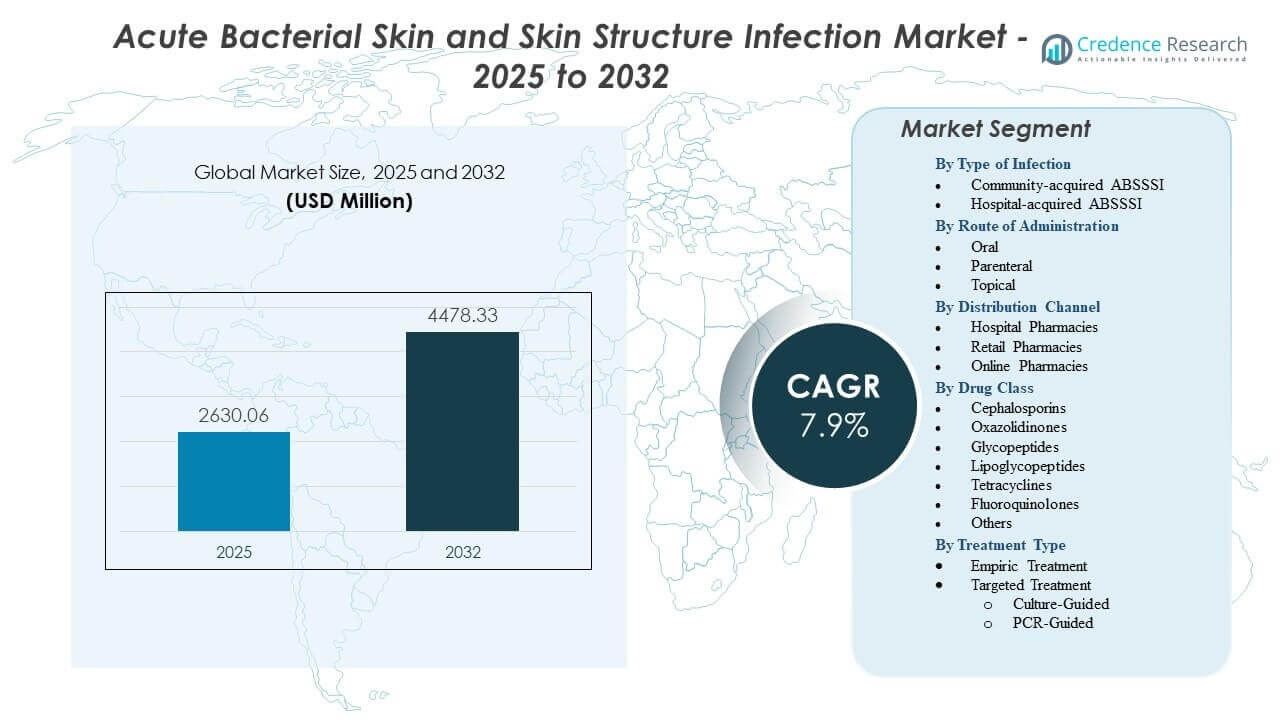
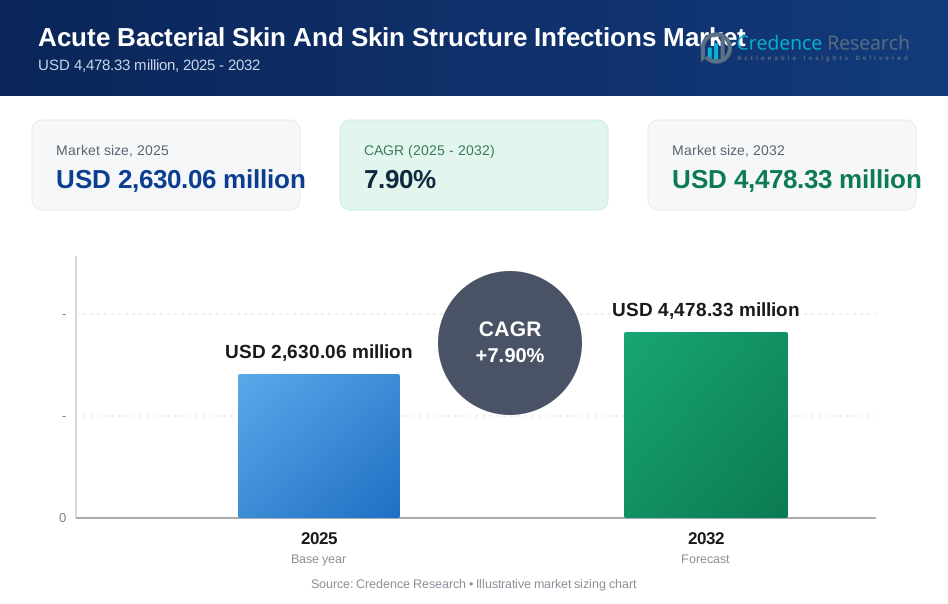
The Acute Bacterial Skin and Skin Structure Infection Market is projected to grow from USD 2,630.06 million in 2025 to an estimated USD 4,478.33 million by 2032, with a compound annual growth rate (CAGR) of 7.9% from 2025 to 2032.
| RT ATTRIBUTE | DETAILS |
|---|---|
| Historical Period | 2020-2023 |
| Base Year | 2024 |
| Forecast Period | 2025-2032 |
| Acute Bacterial Skin and Skin Structure Infection Market Size 2025 | USD 2,630.06 million |
| Acute Bacterial Skin and Skin Structure Infection Market, CAGR | 7.9% |
| Acute Bacterial Skin and Skin Structure Infection Market Size 2032 | USD 4,478.33 million |
Acute Bacterial Skin and Skin Structure Infection Market Insights:
- Strong infection prevalence, rising surgical procedures, and demand for targeted antibacterial therapies continue to drive market expansion across inpatient and outpatient settings.
- Resistance challenges and limited access to advanced drugs in low-resource regions restrain growth by slowing treatment efficiency and limiting therapeutic adoption.
- North America leads the market due to advanced diagnostics and strong clinical infrastructure, followed by Europe with structured antimicrobial management programs.
- Asia Pacific emerges as the fastest-growing region, supported by rising infection loads, expanding hospital capacity, and broader use of precision-guided therapies.
Acute Bacterial Skin and Skin Structure Infection Market Drivers
Rising Need for Effective Therapies to Address Growing Infection Burden
The Acute Bacterial Skin and Skin Structure Infection Market expands due to rising patient loads linked to urban density and weak hygiene practices. Demand grows in hospitals where clinicians require fast-acting options that reduce treatment delays. New pathogens circulate in high-risk zones and push healthcare systems to upgrade standard protocols. It supports providers who aim to reduce severe complications in vulnerable groups. Growth accelerates when early detection improves patient pathways. Hospitals adopt more advanced diagnostic tools to speed therapeutic decisions. Innovation aligns with global programs focused on lowering hospital stays. The Acute Bacterial Skin and Skin Structure Infection Market reflects these clinical pressures through strong adoption patterns.
Growing Preference for Targeted Antibacterial Solutions Improving Clinical Outcomes
Clinicians prefer targeted drugs that reduce broad antimicrobial exposure and protect healthy flora. It helps teams curb treatment failures and reduce recurring infection cases. Adoption increases when precision therapies shorten symptom progression timelines. Hospitals invest in solutions that enhance dosing accuracy and reduce trial-and-error steps. Demand strengthens where patient monitoring frameworks gain maturity. New delivery formats support smoother workflows across inpatient and outpatient settings. Product lines evolve as research uncovers new bacterial behaviors. The Acute Bacterial Skin and Skin Structure Infection Market benefits from strong clinical interest in targeted interventions.
Rapid Diagnostics Supporting Early Therapeutic Action in High-Risk Infection Groups
Rapid testing platforms help clinicians confirm infection type within short windows. It reduces uncertainty during first-line treatment and limits exposure to ineffective options. Hospitals deploy compact systems that improve operational speed. Adoption rises in emergency care units that treat complex wounds. It strengthens antibiotic stewardship by guiding timely decisions. Market growth aligns with global pushes for point-of-care expansion. Diagnostic upgrades help improve disease containment in crowded regions. The Acute Bacterial Skin and Skin Structure Infection Market gains momentum through heightened focus on rapid test integration.
- For instance, Danaher Corporation’s Cepheid Xpert MRSA NxG test provides results in approximately 66 minutes with a 98.7% negative predictive value, enabling immediate isolation and targeted therapy decisions.
Advances in Antibacterial Research Enhancing Drug Potency and Reducing Resistance Risk
Researchers introduce advanced molecules that target multiple bacterial structures with greater precision. It supports developers aiming to limit rapid resistance formation. Hospitals value therapies that deliver stable results across diverse patient profiles. Adoption grows when clinical trials confirm improved tolerance. Demand strengthens in regions with heavy resistance loads. New formulations help reduce dosing cycles and enhance patient adherence. Innovation in antibiotic engineering shapes long-term growth. The Acute Bacterial Skin and Skin Structure Infection Market captures strong interest due to steady R&D expansion.
- For instance, Melinta Therapeutics’ Kimyrsa (oritavancin) is engineered with a long half-life of 245 hours, allowing a single 1,200 mg dose to provide a full course of therapy and eliminate the adherence risks associated with multi-day regimens.
Acute Bacterial Skin and Skin Structure Infection Market Trends
Shift Toward Combination Regimens to Improve Treatment Reliability Across Complex Cases
Combination regimens gain support for patients with severe or mixed bacterial loads. It helps clinicians reduce treatment gaps during intensive care episodes. Hospitals deploy these regimens to lower the risk of clinical setbacks. Adoption increases where resistant strains dominate. New guidelines encourage unified dosing programs for high-risk groups. Growth follows improved understanding of bacterial pathways. Pharmaceutical firms refine combinations to reduce toxicity. The Acute Bacterial Skin and Skin Structure Infection Market integrates this shift through expanded therapeutic portfolios.
Growing Investment in Advanced Wound Care Platforms to Support Faster Healing Cycles
Innovative wound care products enhance moisture balance and help control bacterial spread. It boosts treatment efficiency in chronic and acute wounds. Providers adopt dressings with embedded antibacterial coatings. Growth accelerates when clinical outcomes improve in diabetic foot care and trauma cases. Hospitals shift toward integrated wound management ecosystems. New designs reduce manual handling time for nursing teams. Adoption grows in outpatient clinics seeking faster recovery rates. The Acute Bacterial Skin and Skin Structure Infection Market incorporates advanced wound care solutions into broader treatment strategies.
- For instance, Smith & Nephew demonstrated that its ACTICOAT antimicrobial dressings reduced bacterial bioburden by over 99% within 30 minutes due to nanocrystalline silver technology.
Increased Use of Digital Monitoring Tools to Track Treatment Response and Reduce Complications
Healthcare teams leverage digital systems to predict infection progress and guide dosage adjustments. It helps optimize patient pathways and reduce unnecessary interventions. Remote platforms track wound size, inflammation markers, and response speed. Adoption expands across clinics that manage recurring infections. Growth strengthens where digital health policies mature. Tools integrate with hospital records to improve decision support. Providers value higher visibility into patient adherence. The Acute Bacterial Skin and Skin Structure Infection Market reflects a growing push toward technology-driven management.
- For instance, 3M Health Care validated that its digital wound monitoring system reduced assessment time by nearly 35% while improving documentation accuracy across large outpatient networks.
Surging Clinical Focus on Narrow-Spectrum Antibiotics to Strengthen Stewardship Programs
Narrow-spectrum therapies gain momentum because they reduce collateral impact on healthy microbes. It supports stewardship goals across regulated healthcare systems. Hospitals prefer drugs that limit resistance triggers. Growth rises when clinical evidence confirms stable cure rates. Developers refine molecules to target specific bacterial families. Providers align prescribing habits with new stewardship frameworks. Adoption gains traction in specialized infection units. The Acute Bacterial Skin and Skin Structure Infection Market shows rising interest in targeted stewardship-linked innovation.
Acute Bacterial Skin and Skin Structure Infection Market Challenges Analysis
Escalating Antimicrobial Resistance Undermining Current Drug Effectiveness Across Treatment Settings
Antimicrobial resistance reduces the reliability of commonly used therapies and forces clinicians to shift strategies. It increases treatment complexity for hospitals that manage diverse infection types. Resistant strains spread across dense populations and weaken first-line interventions. Providers struggle when limited alternatives slow clinical progress. Growth slows in regions where drug misuse drives rapid resistance spikes. Hospitals require strict surveillance programs to manage rising cases. Research pipelines face pressure to deliver new molecules within shorter timelines. The Acute Bacterial Skin and Skin Structure Infection Market experiences operational strain where resistance patterns accelerate.
High Cost Burden and Limited Access Constraining Adoption in Under-Resourced Healthcare Systems
High treatment costs restrict patient access in regions with weak reimbursement support. It challenges providers who manage high infection loads with limited budgets. Diagnostic shortages slow timely intervention. Rural hospitals struggle to secure advanced wound care tools. Growth weakens where supply chains fail to maintain consistent drug availability. Clinicians face difficulty implementing stewardship plans without modern equipment. Patients experience longer recovery cycles due to treatment delays. The Acute Bacterial Skin and Skin Structure Infection Market encounters access barriers across low-income environments.
Acute Bacterial Skin and Skin Structure Infection Market Opportunities
Expansion of Next-Generation Antibiotics Designed to Deliver Higher Precision and Stronger Clinical Durability
Next-generation molecules help address resistance concerns by targeting bacterial structures more effectively. It supports clinicians seeking durable outcomes across complex cases. Research groups explore multi-pathway mechanisms to improve potency. Hospitals adopt these therapies when evidence confirms superior response rates. Growth rises where governments fund antibiotic innovation programs. Developers gain traction with designs that reduce toxicity. Opportunities expand as healthcare systems prioritize advanced infection care. The Acute Bacterial Skin and Skin Structure Infection Market gains value through strong innovation pipelines.
Growing Potential for AI-Enabled Decision Support, Rapid Diagnostics, and Integrated Wound Ecosystems
AI tools guide clinicians toward optimal therapy selection based on real-time data patterns. It improves treatment accuracy in high-risk scenarios. Rapid testing shortens decision cycles and reduces clinical uncertainty. Hospitals gain efficiency through integrated platforms that connect diagnostics and wound monitoring. Market players invest in partnerships that expand digital capabilities. Providers adopt systems that help reduce long recovery periods. Growth strengthens when digital literacy advances across healthcare settings. The Acute Bacterial Skin and Skin Structure Infection Market holds strong opportunity in the shift toward data-driven infection management.
Acute Bacterial Skin and Skin Structure Infection Market Segmentation Analysis:
By Type of Infection
The Acute Bacterial Skin and Skin Structure Infection Market sees strong adoption across community-acquired and hospital-acquired cases due to rising patient loads in both settings. Community-acquired infections dominate where hygiene gaps and delayed care increase symptomatic severity. It drives higher use of fast-acting drugs that support early intervention. Hospital-acquired infections rise in surgical wards and intensive care units where complex wounds require stronger antibacterial coverage. Providers focus on advanced drugs that lower complication risks in high-risk groups. Growing awareness supports better screening programs across both infection types. Hospitals upgrade diagnostic capability to identify resistant strains more quickly. Market players introduce tailored regimens that address distinct bacterial profiles.
By Route of Administration
The Acute Bacterial Skin and Skin Structure Infection Market uses oral, parenteral, and topical routes to match varied clinical needs across patient types. Oral therapies support moderate infections treated in outpatient settings, and it helps improve adherence. Parenteral routes dominate severe cases that require rapid systemic action. Hospitals favor intravenous options when clinicians need tight dosing control. Topical treatments support early-stage or localized infections. Growth in outpatient care encourages wider use of oral formats that lower hospital dependency. Market players refine formulations to strengthen absorption and tolerability. The segment benefits from expanded access across primary and specialty care units.
- For instance, omadacycline by Paratek Pharmaceuticals demonstrated bioequivalence between oral and IV dosing in clinical studies, enabling seamless transition from inpatient to outpatient therapy.
By Distribution Channel
The Acute Bacterial Skin and Skin Structure Infection Market flows through hospital pharmacies, retail pharmacies, and online platforms that serve different patient pathways. Hospital pharmacies lead due to high treatment volumes in inpatient environments where severe infections need rapid supply access. It ensures uninterrupted availability of first-line and second-line drugs. Retail pharmacies support community-level care and treat mild to moderate cases. Online pharmacies gain traction where convenience and digital prescriptions improve access. Growth rises in regions with strong e-health frameworks. Hospital networks invest in controlled distribution to avoid shortages. Retail chains expand antibiotic stewardship programs. Digital channels widen reach across underserved locations.
By Drug Class
The Acute Bacterial Skin and Skin Structure Infection Market features cephalosporins, oxazolidinones, glycopeptides, lipoglycopeptides, tetracyclines, fluoroquinolones, and other classes to address diverse bacterial patterns. Cephalosporins maintain broad use due to stable efficacy and clinician familiarity. It strengthens standard treatment protocols. Oxazolidinones support resistant cases where narrow targeting improves results. Glycopeptides and lipoglycopeptides remain critical for MRSA and complex wound infections. Tetracyclines serve outpatient cases with predictable response rates. Fluoroquinolones support rapid symptom control in select patient groups. Developers refine newer agents to reduce resistance triggers. Hospitals expand formularies to support varied infection challenges.
By Treatment Type
The Acute Bacterial Skin and Skin Structure Infection Market divides treatment into empiric and targeted approaches that guide therapeutic decisions. Empiric treatment remains common during early stages when clinicians must act before lab results confirm the bacterial profile. It supports acute care units that prioritize fast stabilization. Targeted treatment gains ground through culture-guided and PCR-guided methods that deliver higher accuracy. Culture-guided pathways help identify strain-level details for better drug selection. PCR-guided testing shortens diagnostic timelines and improves outcome predictability. Hospitals invest in rapid tools that reduce misalignment between diagnosis and therapy. The segment grows as precision medicine expands across infection care.
- For instance, the Xpert MRSA/SA SSTI PCR test from Cepheid identifies MRSA and MSSA directly from wound specimens in under 1 hour, reducing inappropriate empiric antibiotic use.
Segmentation:
By Type of Infection
- Community-acquired ABSSSI
- Hospital-acquired ABSSSI
By Route of Administration
- Oral
- Parenteral
- Topical
By Distribution Channel
- Hospital Pharmacies
- Retail Pharmacies
- Online Pharmacies
By Drug Class
- Cephalosporins
- Oxazolidinones
- Glycopeptides
- Lipoglycopeptides
- Tetracyclines
- Fluoroquinolones
- Others
By Treatment Type
- Empiric Treatment
- Targeted Treatment
- Culture-Guided
- PCR-Guided
By Region
- North America
- U.S.
- Canada
- Mexico
- Europe
- Germany
- France
- U.K.
- Italy
- Spain
- Rest of Europe
- Asia Pacific
- China
- Japan
- India
- South Korea
- South-east Asia
- Rest of Asia Pacific
- Latin America
- Brazil
- Argentina
- Rest of Latin America
- Middle East & Africa
- GCC Countries
- South Africa
- Rest of the Middle East and Africa
Regional Analysis:
North America holds the largest share of the Acute Bacterial Skin and Skin Structure Infection Market with nearly 38%, supported by strong clinical infrastructure and high diagnostic awareness across outpatient and inpatient settings. The region benefits from rapid adoption of advanced antibacterial drugs and strong stewardship frameworks. It records high treatment volumes driven by chronic disease prevalence and surgical infection risks. Hospitals deploy rapid diagnostics that support early therapy alignment. It maintains leadership through consistent R&D investments and broad access to branded and generic options. Market growth stays stable due to strong reimbursement support.
Europe captures nearly 32% of the Acute Bacterial Skin and Skin Structure Infection Market, with steady adoption driven by structured antibiotic policies and organized healthcare systems. Providers rely on targeted regimens supported by strong lab networks and well-defined stewardship programs. It benefits from rising cases tied to aging populations and increased surgical loads. Regional demand strengthens due to advanced wound care adoption across major economies. Hospitals integrate narrow-spectrum antibiotics to maintain resistance control. Growth remains balanced due to strict regulatory oversight and broader acceptance of precision-guided therapies.
Asia Pacific accounts for nearly 22% of the Acute Bacterial Skin and Skin Structure Infection Market, driven by rising urban populations and improving healthcare access. High infection prevalence accelerates demand for both empiric and targeted therapy options. It gains momentum through expansions in hospital capacity and wider distribution of branded generics. Emerging economies invest in rapid testing tools to address rising resistance concerns. Growth strengthens where governments prioritize infection control programs. The region shows the highest long-term potential due to improving clinical capability and expanding antibiotic portfolios.
Key Player Analysis:
- Merck & Co., Inc.
- Pfizer Inc.
- Melinta Therapeutics, Inc.
- Allergan plc
- Paratek Pharmaceuticals, Inc.
- Cumberland Pharmaceuticals Inc.
- Teva Pharmaceutical Industries Ltd.
- GlaxoSmithKline plc
- AbbVie
- Basilea Pharmaceutica
Competitive Analysis:
The Acute Bacterial Skin and Skin Structure Infection Market features strong competition driven by established pharmaceutical leaders and emerging antibiotic innovators. Companies such as Merck & Co., Pfizer, AbbVie, Teva, and GlaxoSmithKline maintain wide portfolios that support high-volume hospital use. It highlights competitive strength through advanced antibacterial pipelines, strong distribution networks, and active clinical research programs. Specialized players like Melinta Therapeutics, Paratek Pharmaceuticals, Basilea Pharmaceutica, and Cumberland Pharmaceuticals focus on targeted molecules designed to address resistant strains. Competitive activity increases where firms expand PCR-guided and culture-guided therapy support. Partnerships with diagnostic companies strengthen treatment precision and improve patient outcomes. Market consolidation shapes long-term competition as major companies invest in next-generation formulations and stewardship-focused solutions.
Recent Developments:
- In September 2025, CorMedix completed the acquisition of Melinta Therapeutics, further strengthening its position in the hospital-focused infectious disease market, including therapies applicable to acute bacterial skin and skin structure infections.
- In August 2025, CorMedix announced a definitive agreement to acquire Melinta Therapeutics, significantly expanding its portfolio with six marketed infectious disease products relevant to ABSSSI treatment, including BAXDELA (delafloxacin), KIMYRSA and ORBACTIV (oritavancin), MINOCIN for injection (minocycline), and VABOMERE (meropenem and vaborbactam).
Report Coverage:
The research report offers an in-depth analysis based on Type of Infection, Route of Administration, Distribution Channel, Drug Class, Treatment Type and Region. It details leading market players, providing an overview of their business, product offerings, investments, revenue streams, and key applications. Additionally, the report includes insights into the competitive environment, SWOT analysis, current market trends, as well as the primary drivers and constraints. Furthermore, it discusses various factors that have driven market expansion in recent years. The report also explores market dynamics, regulatory scenarios, and technological advancements that are shaping the industry. It assesses the impact of external factors and global economic changes on market growth. Lastly, it provides strategic recommendations for new entrants and established companies to navigate the complexities of the market.
Future Outlook:
- Rising infection prevalence will increase treatment demand and drive wider uptake of precision-guided therapies across diverse care settings.
- Stronger diagnostic integration will shorten treatment cycles and improve drug selection accuracy in high-risk patient groups.
- Advanced antibacterial R&D will introduce new molecules that support better resistance control and long-term therapeutic stability.
- Hospitals will adopt digital tools that improve monitoring, reduce dosing errors, and streamline infection-management pathways.
- Growth in outpatient care will expand reliance on oral therapies and improve access for moderate infection cases.
- Targeted treatments will gain traction as PCR and culture-based diagnostics become standard in major clinical networks.
- Manufacturers will refine formulations that support improved tolerability and faster clinical response.
- Wound care innovations will integrate with systemic therapies to support faster recovery in chronic and trauma-related cases.
- Stewardship programs will influence drug selection, creating stronger demand for narrow-spectrum and resistance-safe options.
- Expansion in Asia Pacific will accelerate due to improved hospital capacity, higher diagnostic capability, and broader therapy availability.
Request a Free Sample
Fill in your details and we'll send you a free sample report.
- Sample data tables & charts
- Research methodology
Need a Custom Version of This Report?
Tailor the scope, geography, or segments to your exact requirements.
- Custom geography or segment scope
- Direct access to our analyst team
Frequently Asked Questions
What is the current market size for the Acute Bacterial Skin and Skin Structure Infection Market, and what is its projected size in 2032?
At what Compound Annual Growth Rate is the Acute Bacterial Skin and Skin Structure Infection Market projected to grow between 2025 and 2032?
Which segment held the largest share of the Acute Bacterial Skin and Skin Structure Infection Market in 2025?
What are the primary factors fueling the growth of the Acute Bacterial Skin and Skin Structure Infection Market?
Who are the leading companies in the Acute Bacterial Skin and Skin Structure Infection Market?
Who are the leading companies in the Acute Bacterial Skin and Skin Structure Infection Market?
Which region commanded the largest share of the Acute Bacterial Skin and Skin Structure Infection Market in 2025?
Table of Content
Chapter 1. Report Introduction
- 1.1 Report Description & Purpose
- 1.1.1 Report Title & Market Definition
- 1.1.2 Unique Selling Propositions (USP) & Key Differentiators
- 1.1.3 Value Proposition for Stakeholders
- 1.2 Research Objectives
- 1.2.1 Market Sizing Objectives (Volume & Revenue)
- 1.2.2 Segmentation Objectives
- 1.2.3 Competitive Intelligence Objectives
- 1.2.4 Forecast & Scenario Objectives
- 1.3 Report Scope
- 1.3.1 Acute Bacterial Skin And Skin Structure Infections Scope – Types & Subtypes Covered
- 1.3.2 Geographic Scope – Regions & Countries Covered
- 1.3.3 Historical Period, Base Year & Forecast Period (2025; forecast to 2032)
- 1.3.4 Inclusions & Exclusions
- 1.4 HS Code & Classification Framework
- 1.5 Currency, Units & Pricing Basis
- 1.6 Target Stakeholders
- 1.7 Limitations & Assumptions
Chapter 2. Executive Summary
- 2.1 Global Acute Bacterial Skin And Skin Structure Infections Market Snapshot
- 2.1.1 Market Size – Historical (2025) & Forecast (2025-2032) (2025: USD 2,630.06 million → 2032: USD 4,478.33 million)
- 2.1.2 Volume & Revenue – Global Totals
- 2.1.3 Key Market Highlights – Top Five Facts
- 2.2 Acute Bacterial Skin And Skin Structure Infections Market Segmentation Snapshot
- 2.2.1 Market Split by Region – 2025 vs. 2032
- 2.3 Competitive Snapshot
- 2.3.1 Top 10 Players by Revenue Share – 2025
- 2.3.2 Top 10 Players by Volume Share – 2025
- 2.3.3 Recent Strategic Developments (18-Month Summary)
- 2.4 Key Investment Highlights & Strategic Conclusions
Chapter 3. Acute Bacterial Skin And Skin Structure Infections Market Dynamics & Industry Analysis
- 3.1 Market Overview & Context
- 3.1.1 Acute Bacterial Skin And Skin Structure Infections Market Position in the Broader Automotive Value Chain
- 3.1.2 OEM vs. Replacement Market Dynamics
- 3.1.3 Market Maturity & Development Stage by Region
- 3.2 Acute Bacterial Skin And Skin Structure Infections Market Drivers
- 3.3 Acute Bacterial Skin And Skin Structure Infections Market Restraints & Challenges
- 3.4 Acute Bacterial Skin And Skin Structure Infections Market Opportunities
- 3.5 Porter's Five Forces Analysis
- 3.5.1 Threat of New Entrants
- 3.5.2 Bargaining Power of Suppliers
- 3.5.3 Bargaining Power of Buyers
- 3.5.4 Threat of Substitutes
- 3.5.5 Competitive Rivalry – Intensity Assessment
- 3.6 Acute Bacterial Skin And Skin Structure Infections Value Chain Analysis
- 3.6.1 Upstream – Raw Material/Input Suppliers
- 3.6.1.1 Raw Material/Input 1
- 3.6.1.2 Raw Material/Input 2
- 3.6.1.3 Raw Material/Input 3
- 3.6.2 Midstream – Production/Manufacturing/Service Delivery
- 3.6.2.1 Production/Process Overview
- 3.6.2.2 Key Facility Locations & Capacity by Manufacturer
- 3.6.3 Downstream – Distribution & End Consumer
- 3.6.3.1 Primary Channel – B2B/OEM
- 3.6.3.2 Secondary Channels – Dealer, Retail, Online, Direct
- 3.6.4 Value Chain Profitability Analysis
- 3.6.1 Upstream – Raw Material/Input Suppliers
- 3.7 PESTEL Analysis
- 3.7.1 Political Factors
- 3.7.2 Economic Factors
- 3.7.3 Social Factors
- 3.7.4 Technological Factors
- 3.7.5 Environmental Factors
- 3.7.6 Legal Factors
- 3.8 Acute Bacterial Skin And Skin Structure Infections Supply Chain Analysis
- 3.8.1 Raw Material/Input Supply Risk Assessment
- 3.8.2 Manufacturing Concentration Risk (Geographic Exposure)
- 3.8.3 Trade Disruption Impact Analysis
- 3.9 Regulatory & Policy Landscape
Note: The regulatory and policy landscape section covers regulations based on their applicability to the market, Acute Bacterial Skin And Skin Structure Infections category, geography, and scope of the study. Only regulatory frameworks with a material impact on operations, compliance, trade, sustainability, or market access are analyzed in detail.
Chapter 4. Key Investment Pockets & Opportunity Analysis
- 4.1 Acute Bacterial Skin And Skin Structure Infections Market Attractiveness Analysis
- 4.1.1 By Region – Investment Attractiveness Matrix (Volume × CAGR)
- 4.2 Absolute Revenue Growth Opportunity
- 4.2.1 By Region – Absolute USD Growth Through 2032
- 4.3 Incremental Volume Opportunity
- 4.3.1 By Region – Incremental Volume Through 2032
- 4.3.2 Segment – Incremental Volume
- 4.4 Emerging Submarket Opportunity Deep Dive (Subject to Applicability)
- 4.5 Emerging Market Opportunity Scorecards
- 4.5.1 United States
- 4.5.2 Europe
- 4.5.3 Asia
- 4.5.4 Middle East & Africa
Note: Emerging Market Opportunity Scorecards will be included based on relevance and strategic importance. Regions listed are indicative and may vary depending on data availability and market dynamics.
Chapter 5. Acute Bacterial Skin And Skin Structure Infections Import-Export Analysis & Trade Flows
- 5.1 Global Trade Overview
- 5.1.1 Global Export Value by Country (2025)
- 5.1.2 Global Export Volume by Country (2025)
- 5.1.3 Global Import Value by Country (2025)
- 5.1.4 Global Import Volume by Country (2025)
- 5.1.5 Net Trade Balance by Country (2025)
- 5.2 Export Analysis – Segment
- 5.2.1 Type 1 (HS Code)
- 5.2.2 Type 2 (HS Code)
- 5.2.3 Type 3 (HS Code)
- 5.2.4 Type 4 (HS Code)
- 5.2.5 Type 5 (HS Code)
- 5.3 Import Analysis – Segment
- 5.3.1 Type 1 (HS Code)
- 5.3.2 Type 2 (HS Code)
- 5.3.3 Type 3 (HS Code)
- 5.3.4 Type 4 (HS Code)
- 5.3.5 Type 5 (HS Code)
- 5.4 Average Unit Trade Prices
- 5.4.1 Average Export Price – Segment & Country
- 5.4.2 Average Import Price – Segment & Source Country
- 5.4.3 Price Trends (2025)
- 5.5 Key Trade Route Analysis
- 5.5.1 Trade Route 1
- 5.5.2 Trade Route 2
- 5.5.3 Trade Route 3
- 5.5.4 Trade Route 4
- 5.5.5 Trade Route 5
- 5.6 Trade Policy Impact Assessment
- 5.6.1 US Anti-Dumping & Section 301 Tariffs
- 5.6.2 EU Customs Union Impact
- 5.6.3 Major Free Trade Agreements
- 5.6.4 USMCA Rules of Origin
Note: Trade policy analysis will be included only where relevant to the Acute Bacterial Skin And Skin Structure Infections market.
Chapter 6. Competitive Landscape & Company Benchmarking
- 6.1 Acute Bacterial Skin And Skin Structure Infections Market Concentration & Structure
- 6.1.1 Herfindahl-Hirschman Index (HHI) – vs. 2025
- 6.1.2 Tier 1, Tier 2 & Tier 3 Market Structure
- 6.1.3 Global, Regional & Local Player Dynamics
- 6.2 Acute Bacterial Skin And Skin Structure Infections Market Share Analysis – 2025
- 6.2.1 Global Revenue Share by Company
- 6.2.2 Global Volume Share by Company
- 6.2.3 Regional Revenue Share
- 6.2.4 Market Share Evolution ( vs. 2025)
- 6.2.5 OEM Segment Share by Company
- 6.2.6 Replacement Segment Share by Company
- 6.3 Production/Delivery Capacity & Facility Analysis
- 6.3.1 Global Installed Capacity
- 6.3.2 Capacity Utilization Rates
- 6.3.3 Production/Output Volume
- 6.3.4 Facility Locations & Capacity Map
- 6.3.5 Planned Capacity Additions
- 6.4 Acute Bacterial Skin And Skin Structure Infections Competitive Benchmarking Matrix
- 6.4.1 Revenue, Volume, CAGR & Profitability Comparison
- 6.4.2 Channel Revenue Mix
- 6.4.3 Geographic Revenue Exposure
- 6.4.4 R&D Intensity
- 6.4.5 Sustainability Maturity
- 6.5 Strategic Developments in Acute Bacterial Skin And Skin Structure Infections (Last 24 Months)
- 6.5.1 Mergers, Acquisitions & Divestments
- 6.5.2 New Acute Bacterial Skin And Skin Structure Infections Launches
- 6.5.3 Facility Expansions
- 6.5.4 Strategic Alliances, Joint Ventures & Partnerships
- 6.5.5 Distribution Expansion & Market Entry
- 6.5.6 Sustainability & ESG Initiatives
- 6.6 Competitive Strategy Mapping
- 6.6.1 Leader, Challenger, Follower & Niche Classification
- 6.6.2 Pricing Strategy Comparison
- 6.6.3 Channel Strategy Matrix
Note: Strategic developments are included based on their materiality and the availability of reliable information.
Chapter 7. Global Acute Bacterial Skin And Skin Structure Infections Market – By Distribution Channel
- 7.1 Segment Overview
- 7.1.1 Volume & Revenue Split by Channel (2025 & 2032)
- 7.1.2 Channel Mix Evolution (2025-2032)
Chapter 8. Regional Market Analysis – Global Overview
- 8.1 Global Regional Overview
- 8.1.1 Regional Volume Share
- 8.1.2 Regional Revenue Share
- 8.1.3 Regional Volume by Region
- 8.1.4 Regional Revenue by Region
- 8.1.5 Regional Forecast Through 2032
- 8.2 Cross-Regional Segment Analysis
- 8.2.1 By Distribution Channel
- 8.2.2 By Brand/Price Tier
Chapter 9. North America Acute Bacterial Skin And Skin Structure Infections Market
- 9.1 United States
- 9.2 Canada
- 9.3 Mexico
Chapter 10. Europe Acute Bacterial Skin And Skin Structure Infections Market
- 10.1 Germany
- 10.2 France
- 10.3 Italy
- 10.4 United Kingdom
- 10.5 Spain
- 10.6 Poland
- 10.7 Russia
- 10.8 Netherlands
- 10.9 Belgium
- 10.10 Sweden
- 10.11 Denmark
- 10.12 Norway
- 10.13 Rest of Europe
Chapter 11. Asia Pacific Acute Bacterial Skin And Skin Structure Infections Market
- 11.1 China
- 11.2 India
- 11.3 Japan
- 11.4 South Korea
- 11.5 Thailand
- 11.6 Indonesia
- 11.7 Vietnam
- 11.8 Malaysia
- 11.9 Australia
- 11.10 Rest of Asia Pacific
Chapter 12. Latin America Acute Bacterial Skin And Skin Structure Infections Market
- 12.1 Brazil
- 12.2 Argentina
- 12.3 Colombia
- 12.4 Chile
- 12.5 Rest of Latin America
Chapter 13. Middle East Acute Bacterial Skin And Skin Structure Infections Market
- 13.1 Saudi Arabia
- 13.2 United Arab Emirates
- 13.3 Turkey
- 13.4 Israel
- 13.5 Iran
- 13.6 Rest of the Middle East
Chapter 14. Africa Acute Bacterial Skin And Skin Structure Infections Market
- 14.1 South Africa
- 14.2 Egypt
- 14.3 Nigeria
- 14.4 Morocco
- 14.5 Rest of Africa
Chapter 15. Acute Bacterial Skin And Skin Structure Infections Company Profiles
- 15.1 [Company 01]
- 15.1.1 Company Overview
- 15.1.2 Key Management Personnel
- 15.1.3 Products & Services Portfolio
- 15.1.4 Financial Performance
- 15.1.5 Key Market Focus & Geographic Presence
- 15.1.6 Recent Developments & Strategic Initiatives
Note: The company profile list is preliminary and may change based on research findings, market developments, data availability, and client requirements.
Chapter 16. Appendices
- Appendix A – List of Abbreviations & Acronyms
- Appendix B – Industry Classification Code Reference – Full Series
- Appendix C – Production & Capacity Data Tables
- Appendix D – End-Use & Demand Base Tables
- Appendix E – Consumption & Replacement Rate Assumptions
- Appendix F – ASP Reference Tables
- Appendix G – Manufacturing & Facility Database
- Appendix H – Import-Export Data Tables
- Appendix I – Regulatory Summary Tables
- Appendix J – Primary Research Participant List (Anonymized)
- Appendix K – Primary Research Questionnaire Framework
- Appendix L – Data Sources & Bibliography
- Appendix M – Market Size Divergence & Source Comparison
Chapter 17. Research Methodology
- 17.1 Research Framework & Philosophy
- 17.2 Secondary Research – Sources, Hierarchy & Data Extraction
- 17.3 Data Modeling – Bottom-Up & Top-Down Market Sizing
- 17.4 Primary Research – Stakeholder Framework, LOI & Sample Sizes
- 17.5 Forecast Methodology – Regression, Scenario & Sensitivity Analysis
- 17.6 Quality Control – Four-Layer Validation Framework
- 17.7 Limitations & Standard Assumptions
- 17.8 Disclaimer
