
| REPORT ATTRIBUTE | DETAILS |
|---|---|
| Historical Period | 2019-2022 |
| Base Year | 2023 |
| Forecast Period | 2024-2032 |
| Adipic Acid Market Size 2023 | USD 7984.2 Million |
| Adipic Acid Market, CAGR | 5.50% |
| Adipic Acid Market Size 2032 | USD 12927.1 Million |
Market Insights
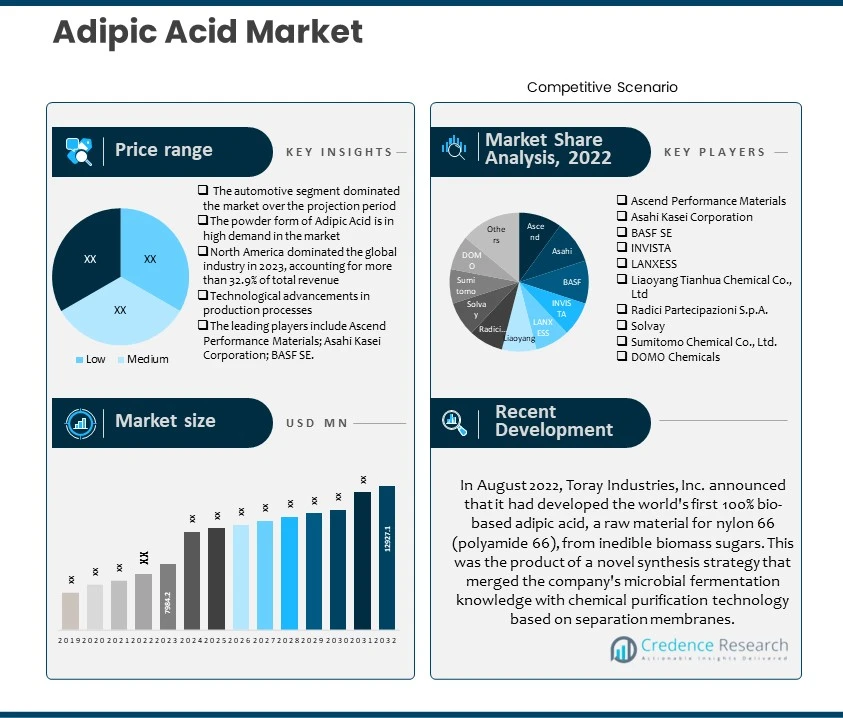
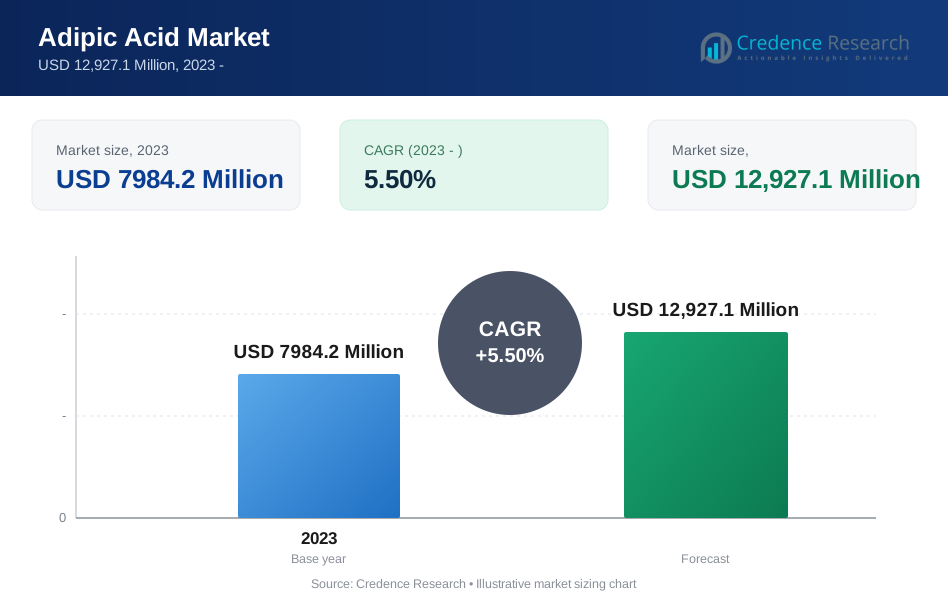
- The global demand for Adipic Acid market was valued at USD 7984.2 Million in 2023 and is expected to reach USD 12927.1 Million in 2032, growing at a CAGR of 5.50% between 2024 and 2032.
- In 2023, the nylon production, six fiber application segment dominated the market, accounting for 53.1% of the total revenue, while polyurethane production has a continuous growth potential due to its use in a variety of end-use industries.
- During the forecast period, the automobile segment dominated the market, while the food and beverage industry sector gained a considerable share.
- Adipic Acid in powder form is in high demand in the market.
- Food grade is the fastest-growing segment of the Adipic Acid Market.
- Cyclohexane had the greatest market share in 2023, while cyclohexanone is predicted to grow at the quickest CAGR of 8.5% over the forecast period.
- North America dominated the global industry in 2023, accounting for more than 32.9% of total revenue, while Asia Pacific is anticipated to be the fastest-growing regional market.
- Increased adoption of 3-D printing technology propels market expansion.
- Various adverse effects of adipic acid may impede market expansion.
Executive Summary
Market Definition
Adipic acid, a dicarboxylic acid, is employed in a variety of end-user industries around the world. In most synthetic fiber production sectors, adipic acid is typically created through the oxidation of cyclohexane or another petroleum-based feedstock. It is naturally found in red beet juice and sugar, and synthesizing adipic acid from renewable carbon sources such as cellulose or glucose generated from starch is a viable alternative. High-purity adipic acid (AA) and higher grades are typically utilized in the synthesis of nylon 66, while low-purity adipic acid is used to produce polyurethanes. It has numerous applications in the chemical industry and is commonly used in the manufacture of paints, coatings, and detergents.
Market Overview
The global Adipic Acid Market has witnessed steady growth in recent years and is expected to grow at a CAGR of 5.50% between 2024 and 2032. The market was valued at USD 7984.2 million in 2023 and is expected to reach USD 12927.1 million in 2032.
The primary markets for adipic acid include automotive, electronics, food and beverage, textiles, personal care, and medicines. The majority of adipic acid produced worldwide is utilized in the manufacturing of nylon 66. This nylon is widely utilized in a variety of industries, including automotive, home furnishings, and the textile industry. Adipic acid is also utilized in the manufacture of polyester polyols and nylon polymers, which are employed in hot melt adhesives. Sugarcanes and beets contain food-grade adipic acid. In the food and beverage business, adipic acid can be used as a buffering agent and is widely added to bottled drinks to give them a fizzy appearance.
Segmentation by Application
- In 2023, the nylon production, six fiber application segment dominated the market, accounting for 53.1% of the total revenue. Its significant market share is driven by the expanding use of nylon 6, 6 as a metal alternative in automotive, electrical, and electronic devices, among other things. Nylon 6,6 fiber is also commonly used in technical components such as gears, nuts, bolts, bearings, powder tool casings, rivets and wheels, and rocker box covers. The properties of nylon 6,6 fiber, such as moisture and mildew resistance, high melting temperature, outstanding durability, and improved strength, are predicted to push its employment in a variety of applications in the coming years.
- Polyurethane Production also has a consistent growth potential due to its use in a variety of end-use industries.
Segmentation by End-Use Industry
- The automotive segment dominated the market over the projection period. The automotive industry mostly uses nylon 66, which is manufactured from adipic acid, due to its superior mechanical, temperature-resistant, and lightweight properties. Adipic acid is commonly used as a monomer in the production of polyamide 6.6 pellets and other polyamides or polymers for engineering plastics, as well as polyurethane for flexible and semi-rigid foam.
- However, the food and beverage industry sector has gained significant market share.
Segmentation by Form
- The powder form of Adipic Acid is in high demand in the market. Adipic acid powder is widely utilized in a variety of industries, including textiles, automobiles, and food. It is preferred for its portability, storage, and transportation. The powder form enables exact dosing, making it suited for a variety of applications. In addition, the powder form is more stable and has a longer shelf life than the liquid version.
Segmentation by Purity
- Food Grade is the fastest-growing section of the Adipic Acid Market. Adipic Acid is becoming increasingly popular in the food business due to its numerous possibilities as a food ingredient. In food and beverage items, adipic acid is used to regulate acidity and increase flavor.
Segmentation by Production Process
- Cyclohexane held the largest market share in 2023. Almost all commercial adipic acid is made from cyclohexane. It is commonly utilized as an intermediate chemical in a variety of processes, with around 54% of its output used to produce adipic acid for nylon-66.
- However, cyclohexanone is expected to increase at the fastest CAGR of 8.5% throughout the projection period.
Segmentation by Region
- North America dominated the global industry in 2023, accounting for more than 32.9% of total revenue
- Asia Pacific is predicted to be the fastest-growing regional market
- The rest of the world, including Latin America, the Middle East, and Africa, supplies the remaining demand for Adipic Acid.
In 2023, North America dominated the adipic acid market. The strong demand in North America is driven by the growing use of nylon 6, 6 fiber in the automobile industry in the United States and Canada. The vast majority of North Americans in the United States and Canada commute by car rather than public transportation. Furthermore, solid economic stability in the United States, Canada, and Mexico has increased individuals' purchasing power. High individual disposable income is increasing demand for autos, propelling the expansion of adipic acid in North America.
Asia Pacific is predicted to provide lucrative growth possibilities as polyurethane usage grows in industries such as automotive, construction, and electronics. Increasing construction spending in response to the development of sustainable infrastructure is likely to boost market expansion. According to Oxford Economics, the United States, India, and China account for approximately 58% of global construction sector growth, with China responsible for approximately 26.1% in 2020. Furthermore, infrastructure construction in India is expected to rise at the fastest rate of 9.8% between 2023 and 2032.
Key Highlights of the Report
Application, End-Use Industry, Form, Purity, Production Process, and region segment of the global Adipic Acid Market. Cyclohexane had the biggest market share in 2023, with the automotive category dominating the market. In addition, the powder form of Adipic Acid is in high demand in the market, with Food Grade being the fastest-growing segment. Also, cyclohexanone has the highest CAGR, with North America leading the market growth.
The market is being driven by rising demand for nylon goods in a variety of industries, including the growing automotive industry and the requirement for lightweight materials, as well as the growing emphasis on sustainable and environmentally friendly materials. Furthermore, fluctuating raw material prices, which have an impact on production costs, stringent environmental restrictions and worries about carbon emissions, and competition from alternative materials and substitutes are major market barriers.
Nonetheless, In 2023, North America dominated the adipic acid market. The increased usage of nylon 6, 6 fiber in the vehicle industry in the United States and Canada is driving the high demand in North America. Furthermore, Asia-Pacific is expected to be the fastest-growing regional market. Also, it is projected to have attractive growth potential as polyurethane consumption expands in areas such as automotive, construction, and electronics. Increased construction spending in response to the development of sustainable infrastructure is expected to promote market growth.
What Are The Main Drivers Of The Global Adipic Acid Market?
Several important drivers are propelling the Adipic Acid Market. There is an increasing need for nylon products in a variety of industries, including textiles and automotive. Nylon, generated from Adipic Acid, is known for its toughness and adaptability, making it a popular material option. Additionally, there is a growing emphasis on sustainable materials, and Adipic Acid provides an environmentally benign alternative. As environmental concerns grow, Adipic Acid is predicted to become a more popular sustainable element. Furthermore, technical developments in manufacturing methods have increased the efficiency and cost-effectiveness of Adipic Acid production, accelerating market expansion.
What Are The Major Challenges Faced By The Global Adipic Acid Market?
While the Adipic Acid Market has bright future opportunities, it also confronts some challenges. Raw material price fluctuations are one of the most significant challenges. Adipic acid manufacturing is dependent on specific raw materials, and price variations can affect production costs and profitability. Furthermore, there are strict environmental rules in place, with an emphasis on lowering carbon emissions. Production of adipic acid can emit carbon dioxide, and market participants may face difficulties in complying with these restrictions. Furthermore, competition from alternative materials and substitutes may affect Adipic Acid demand in a variety of applications.
What Are The Growth Opportunities In The Global Adipic Acid Market?
The Adipic Acid Market provides numerous potential for growth and innovation. First, there is an increasing need for bio-based Adipic Acid. With an increased emphasis on sustainability, bio-based alternatives provide a renewable and environmentally friendly solution. This creates an opportunity for market participants to develop and commercialize bio-based Adipic Acid solutions. Second, the growth of the textile industry in emerging economies represents a substantial opportunity for Adipic Acid. As the textile industry expands, so will the demand for nylon fibers generated from adipic acid. Finally, Adipic Acid is finding new applications in the food and beverage industry. Adipic acid is a food ingredient that regulates acidity and enhances flavor. This creates a fresh opportunity for market expansion and diversification.
Market Drivers
Several factors drive the global Adipic Acid Market. The following are the key drivers of the global Adipic Acid Market:
Increased Use of Nylon 66 in the Automobile Sector
The automotive industry accounts for the vast majority of global demand for nylon 66. Current environmental and economic considerations make developing more fuel-efficient vehicles a primary focus in the automobile industry. Substituting nylon 66 for the metal in manifolds saves production costs by up to 30%, part weight by up to 50%, and system costs through parts integration, which adds to increased fuel efficiency. Thus, the increased use of nylon 66 in the automotive industry is expected to fuel market expansion.
Increased Adoption of 3-D Printing Technology
The increased demand for 3-D printing is driving the adipic acid market CAGR. Adipic acids are ideal for 3D printing due to their excellent properties, which include high flexibility and durability. Because of their malleability, they are far more durable than other typical thermoplastics such as PLA and ABS. These polymers may replace other materials as the preferred material for 3D printers. PA has excellent chemical resistance and mechanical properties that are similar to ABS. It is a potential material of choice for industrial manufacturing components due to its significantly higher impact resistance than ABS. Additionally, the ability to absorb moisture facilitates post-processing with spray paint and fabric dyes. The flexibility and resilience of adipic acid make it suitable for 3D printing products with thin walls. It has a higher melting point and a lower coefficient of friction, making it more abrasion-resistant. As a result, it can be used to print functional components such as interlocking gears. The use of polyamide in industrial 3D printing procedures is expected to grow as 3D printing technology advances.
Market Restraints
The global Adipic Acid Market faces some challenges that may hinder its growth. These include the following:
Various Negative Effects of Adipic Acid
Adipic acid can cause eye discomfort, so it is only utilized in industries after many safety precautions have been taken. It also has a drying effect on the skin, causing dermatitis. Workers who are exposed to adipic acid during analysis, sampling, maintenance operations, mixing, and unloading may experience long-term health consequences. Thus, the risk of exposure and numerous health concerns associated with adipic acid are expected to impede market expansion.
Serious environmental risks
Adipic acid poses significant environmental risks, including harm to algae and invertebrates and poisoning to fish and daphnia. Thus, several precautions should be followed prior to industrial aqueous emission of adipic acid. Recycling, treatment, and suitable environmental restrictions are only a few of the safety measures that should be implemented to reduce environmental threats.
Opportunities
The global Adipic Acid Market offers significant growth opportunities. These include the following:
Increasing Research and Development Activities to Create Bio-adipic Acid
Increased R&D initiatives to generate bioadipic acid are expected to provide future market growth prospects. Many vendors are spending extensively in R&D operations to produce bio-based adipic acid. The widespread use of adipic acid in numerous industries has prompted the development of alternate methods for producing bio-based adipic acid. Bioadipic acid can be derived from natural sources such as sugarcane and plant oils.
Competitive Landscape
Key Players
The global Adipic Acid Market is highly competitive, with several key players. Some of the major players in the market and their market share are as follows:
- Ascend Performance Materials
- Asahi Kasei Corporation
- BASF SE
- INVISTA
- LANXESS
- Liaoyang Tianhua Chemical Co., Ltd
- Radici Partecipazioni S.p.A.
- Solvay
- Sumitomo Chemical Co., Ltd.
- DOMO Chemicals
These organizations prioritize product innovation, Form expansion, and mergers and acquisitions to stay competitive.
The global Adipic Acid Market's key players continually seek to stay ahead by offering new products and developments.
In January 2019, Ascend Performance Materials reported that due to increased demand for adipic acid, the business plans to increase its manufacturing capacity by 10 to 15% to meet rising client demand.
In January 2020, BASF SE announced the acquisition of Solvay's polyamide division, which would enhance BASF's polyamide capabilities with innovative and well-known products like Technyl. This acquisition is expected to expand the company's customer portfolio by providing stronger engineering plastics solutions, such as for autonomous driving and e-mobility.
In August 2023, Lanxess announced that it will invest in the development of novel adipic acid manufacturing methods. The company intends to create more sustainable and efficient production methods.
In September 2023, Celanese announced that it would collaborate with Anellotech to create a novel technology for manufacturing adipic acid from biomass. The new approach is projected to be more environmentally friendly and efficient than previous production methods.
In November 2020, Huabei oil field company in China has been working on developing environmentally friendly adipic acid processing, as traditional petrochemical processing of adipic acid from KA oil using nitric acid as a catalyst pollutes the environment significantly. The scientists pioneered the manufacture of adipic acid from nonrenewable feedstocks.
Summary of Key Findings
- Increasing research and development efforts to produce bio-adipic acid
- Market segmented by Application, End-Use Industry, Form, Purity, Production Process, and region.
- Clinical chemistry is the leading segment of the Adipic Acid industry
- The Complete Blood Count (CBC) is a significant portion of the Adipic Acid Market.
- North America is leading market growth; the market is highly competitive with key players including Ascend Performance Materials; Asahi Kasei Corporation; BASF SE; INVISTA and Others.
Future Outlook
- Increasing demand for nylon products
- Growing automotive industry
- Rising focus on sustainable materials
- Technological advancements in production processes
- Emerging applications in the food and beverages sector
How CXOs Can Benefit from the Credence Research Adipic Acid Market Report
The Credence Research Adipic Acid Market Report provides CXOs with a comprehensive overview of the market, including:
- Market size and growth forecast: The report provides detailed estimates of the global Adipic Acid Market size, segmented by Application, Application, End-Use Industry, Form, Purity, Production Process and region. It also includes forecasts for the market through 2032 based on key trends and drivers.
- Market segmentation: The report segments the Adipic Acid Market by Application, End-Use Industry, Form, Purity, Production Process and region. This segmentation provides CXOs with a granular understanding of the market and the opportunities in each segment.
- Competitive Landscape: The report profiles the key players in the Adipic Acid Market and provides insights into their strategies, product offerings, and financial performance. This information can help CXOs to identify and assess their competition.
- Key trends and drivers: The report identifies and analyzes the key trends and drivers that are shaping the Adipic Acid Market. This information can help CXOs to make informed decisions about their investments and strategies.
CXOs can use the insights from the Credence Research Adipic Acid Market Report to:
- Identify growth opportunities: The report can help CXOs to identify new growth opportunities in the Adipic Acid Market. For example, the report can provide insights into emerging applications of Adipic Acid, such as its use in sustainable materials or renewable energy sectors.
- Make informed investment decisions: The report can help CXOs to make informed investment decisions about Adipic Acid. For example, it can provide valuable insights into market trends, growth potential, and key players in the industry.
- Develop competitive strategies: The report can help CXOs to develop competitive strategies for their Adipic Acid businesses. For example, the report identifies the key strategies that dark fiber providers are using to differentiate themselves from their competitors.
- Track market developments: The report can help CXOs to track market developments and stay ahead of the curve. For example, the report provides insights into the latest trends and innovations in the Adipic Acid Market.
Overall, the Credence Research Adipic Acid Market Report is a valuable resource for CXOs who are looking to gain a deeper understanding of the market and identify opportunities for growth.
Segmentation
By Application:- Nylon Production
- Polyurethane Production
- Adipate Esters
- Food Additives
- Textile Industry
- Automotive Industry
- Construction Industry
- Food and Beverage Industry
- Powder Form
- Liquid Form
- Technical Grade
- Food Grade
- Cyclohexane-Based Process
- Cyclohexanol/Cyclohexanone-Based Process
- North America
- The U.S.
- Canada
- Mexico
- Europe
- Germany
- France
- The U.K.
- Italy
- Spain
- Rest of Europe
- Asia Pacific
- China
- Japan
- India
- South Korea
- South-east Asia
- Rest of Asia Pacific
- Latin America
- Brazil
- Argentina
- Rest of Latin America
- Middle East & Africa
- GCC Countries
- South Africa
- Rest of Middle East and Africa
Request a Free Sample
Fill in your details and we'll send you a free sample report.
- Sample data tables & charts
- Research methodology
Need a Custom Version of This Report?
Tailor the scope, geography, or segments to your exact requirements.
- Custom geography or segment scope
- Direct access to our analyst team
Frequently Asked Questions
What is the current size of the global Adipic Acid Market?
What is the expected growth rate of the Adipic Acid Market between 2024 and 2032?
Which segment is leading the market share in terms of Application?
Which Form segment governs the demand for Adipic Acid in the world?
Who are the major players in the global Adipic Acid Market?
Table of Content
Chapter 1. Report Introduction
- 1.1 Report Description & Purpose
- 1.1.1 Report Title & Market Definition
- 1.1.2 Unique Selling Propositions (USP) & Key Differentiators
- 1.1.3 Value Proposition for Stakeholders
- 1.2 Research Objectives
- 1.2.1 Market Sizing Objectives (Volume & Revenue)
- 1.2.2 Segmentation Objectives
- 1.2.3 Competitive Intelligence Objectives
- 1.2.4 Forecast & Scenario Objectives
- 1.3 Report Scope
- 1.3.1 Adipic Acid Scope – Types & Subtypes Covered
- 1.3.2 Geographic Scope – Regions & Countries Covered
- 1.3.3 Historical Period, Base Year & Forecast Period (2023; forecast to the forecast period)
- 1.3.4 Inclusions & Exclusions
- 1.4 HS Code & Classification Framework
- 1.5 Currency, Units & Pricing Basis
- 1.6 Target Stakeholders
- 1.7 Limitations & Assumptions
Chapter 2. Executive Summary
- 2.1 Global Adipic Acid Market Snapshot
- 2.1.1 Market Size – Historical (2023) & Forecast (the forecast period) (2023: USD 7984.2 Million → forecast year: USD 12,927.1 Million)
- 2.1.2 Volume & Revenue – Global Totals
- 2.1.3 Key Market Highlights – Top Five Facts
- 2.2 Adipic Acid Market Segmentation Snapshot
- 2.2.1 Market Split by Region – 2023 vs.
- 2.3 Competitive Snapshot
- 2.3.1 Top 10 Players by Revenue Share – 2023
- 2.3.2 Top 10 Players by Volume Share – 2023
- 2.3.3 Recent Strategic Developments (18-Month Summary)
- 2.4 Key Investment Highlights & Strategic Conclusions
Chapter 3. Adipic Acid Market Dynamics & Industry Analysis
- 3.1 Market Overview & Context
- 3.1.1 Adipic Acid Market Position in the Broader Automotive Value Chain
- 3.1.2 OEM vs. Replacement Market Dynamics
- 3.1.3 Market Maturity & Development Stage by Region
- 3.2 Adipic Acid Market Drivers
- 3.3 Adipic Acid Market Restraints & Challenges
- 3.4 Adipic Acid Market Opportunities
- 3.5 Porter's Five Forces Analysis
- 3.5.1 Threat of New Entrants
- 3.5.2 Bargaining Power of Suppliers
- 3.5.3 Bargaining Power of Buyers
- 3.5.4 Threat of Substitutes
- 3.5.5 Competitive Rivalry – Intensity Assessment
- 3.6 Adipic Acid Value Chain Analysis
- 3.6.1 Upstream – Raw Material/Input Suppliers
- 3.6.1.1 Raw Material/Input 1
- 3.6.1.2 Raw Material/Input 2
- 3.6.1.3 Raw Material/Input 3
- 3.6.2 Midstream – Production/Manufacturing/Service Delivery
- 3.6.2.1 Production/Process Overview
- 3.6.2.2 Key Facility Locations & Capacity by Manufacturer
- 3.6.3 Downstream – Distribution & End Consumer
- 3.6.3.1 Primary Channel – B2B/OEM
- 3.6.3.2 Secondary Channels – Dealer, Retail, Online, Direct
- 3.6.4 Value Chain Profitability Analysis
- 3.6.1 Upstream – Raw Material/Input Suppliers
- 3.7 PESTEL Analysis
- 3.7.1 Political Factors
- 3.7.2 Economic Factors
- 3.7.3 Social Factors
- 3.7.4 Technological Factors
- 3.7.5 Environmental Factors
- 3.7.6 Legal Factors
- 3.8 Adipic Acid Supply Chain Analysis
- 3.8.1 Raw Material/Input Supply Risk Assessment
- 3.8.2 Manufacturing Concentration Risk (Geographic Exposure)
- 3.8.3 Trade Disruption Impact Analysis
- 3.9 Regulatory & Policy Landscape
Note: The regulatory and policy landscape section covers regulations based on their applicability to the market, Adipic Acid category, geography, and scope of the study. Only regulatory frameworks with a material impact on operations, compliance, trade, sustainability, or market access are analyzed in detail.
Chapter 4. Key Investment Pockets & Opportunity Analysis
- 4.1 Adipic Acid Market Attractiveness Analysis
- 4.1.1 By Region – Investment Attractiveness Matrix (Volume × CAGR)
- 4.2 Absolute Revenue Growth Opportunity
- 4.2.1 By Region – Absolute USD Growth Through the forecast period
- 4.3 Incremental Volume Opportunity
- 4.3.1 By Region – Incremental Volume Through the forecast period
- 4.3.2 Segment – Incremental Volume
- 4.4 Emerging Submarket Opportunity Deep Dive (Subject to Applicability)
- 4.5 Emerging Market Opportunity Scorecards
- 4.5.1 United States
- 4.5.2 Europe
- 4.5.3 Asia
- 4.5.4 Middle East & Africa
Note: Emerging Market Opportunity Scorecards will be included based on relevance and strategic importance. Regions listed are indicative and may vary depending on data availability and market dynamics.
Chapter 5. Adipic Acid Import-Export Analysis & Trade Flows
- 5.1 Global Trade Overview
- 5.1.1 Global Export Value by Country (2023)
- 5.1.2 Global Export Volume by Country (2023)
- 5.1.3 Global Import Value by Country (2023)
- 5.1.4 Global Import Volume by Country (2023)
- 5.1.5 Net Trade Balance by Country (2023)
- 5.2 Export Analysis – Segment
- 5.2.1 Type 1 (HS Code)
- 5.2.2 Type 2 (HS Code)
- 5.2.3 Type 3 (HS Code)
- 5.2.4 Type 4 (HS Code)
- 5.2.5 Type 5 (HS Code)
- 5.3 Import Analysis – Segment
- 5.3.1 Type 1 (HS Code)
- 5.3.2 Type 2 (HS Code)
- 5.3.3 Type 3 (HS Code)
- 5.3.4 Type 4 (HS Code)
- 5.3.5 Type 5 (HS Code)
- 5.4 Average Unit Trade Prices
- 5.4.1 Average Export Price – Segment & Country
- 5.4.2 Average Import Price – Segment & Source Country
- 5.4.3 Price Trends (2023)
- 5.5 Key Trade Route Analysis
- 5.5.1 Trade Route 1
- 5.5.2 Trade Route 2
- 5.5.3 Trade Route 3
- 5.5.4 Trade Route 4
- 5.5.5 Trade Route 5
- 5.6 Trade Policy Impact Assessment
- 5.6.1 US Anti-Dumping & Section 301 Tariffs
- 5.6.2 EU Customs Union Impact
- 5.6.3 Major Free Trade Agreements
- 5.6.4 USMCA Rules of Origin
Note: Trade policy analysis will be included only where relevant to the Adipic Acid market.
Chapter 6. Competitive Landscape & Company Benchmarking
- 6.1 Adipic Acid Market Concentration & Structure
- 6.1.1 Herfindahl-Hirschman Index (HHI) – vs. 2023
- 6.1.2 Tier 1, Tier 2 & Tier 3 Market Structure
- 6.1.3 Global, Regional & Local Player Dynamics
- 6.2 Adipic Acid Market Share Analysis – 2023
- 6.2.1 Global Revenue Share by Company
- 6.2.2 Global Volume Share by Company
- 6.2.3 Regional Revenue Share
- 6.2.4 Market Share Evolution ( vs. 2023)
- 6.2.5 OEM Segment Share by Company
- 6.2.6 Replacement Segment Share by Company
- 6.3 Production/Delivery Capacity & Facility Analysis
- 6.3.1 Global Installed Capacity
- 6.3.2 Capacity Utilization Rates
- 6.3.3 Production/Output Volume
- 6.3.4 Facility Locations & Capacity Map
- 6.3.5 Planned Capacity Additions
- 6.4 Adipic Acid Competitive Benchmarking Matrix
- 6.4.1 Revenue, Volume, CAGR & Profitability Comparison
- 6.4.2 Channel Revenue Mix
- 6.4.3 Geographic Revenue Exposure
- 6.4.4 R&D Intensity
- 6.4.5 Sustainability Maturity
- 6.5 Strategic Developments in Adipic Acid (Last 24 Months)
- 6.5.1 Mergers, Acquisitions & Divestments
- 6.5.2 New Adipic Acid Launches
- 6.5.3 Facility Expansions
- 6.5.4 Strategic Alliances, Joint Ventures & Partnerships
- 6.5.5 Distribution Expansion & Market Entry
- 6.5.6 Sustainability & ESG Initiatives
- 6.6 Competitive Strategy Mapping
- 6.6.1 Leader, Challenger, Follower & Niche Classification
- 6.6.2 Pricing Strategy Comparison
- 6.6.3 Channel Strategy Matrix
Note: Strategic developments are included based on their materiality and the availability of reliable information.
Chapter 7. Global Adipic Acid Market – By Distribution Channel
- 7.1 Segment Overview
- 7.1.1 Volume & Revenue Split by Channel (2023 & )
- 7.1.2 Channel Mix Evolution (the forecast period)
Chapter 8. Regional Market Analysis – Global Overview
- 8.1 Global Regional Overview
- 8.1.1 Regional Volume Share
- 8.1.2 Regional Revenue Share
- 8.1.3 Regional Volume by Region
- 8.1.4 Regional Revenue by Region
- 8.1.5 Regional Forecast Through the forecast period
- 8.2 Cross-Regional Segment Analysis
- 8.2.1 By Distribution Channel
- 8.2.2 By Brand/Price Tier
Chapter 9. North America Adipic Acid Market
- 9.1 United States
- 9.2 Canada
- 9.3 Mexico
Chapter 10. Europe Adipic Acid Market
- 10.1 Germany
- 10.2 France
- 10.3 Italy
- 10.4 United Kingdom
- 10.5 Spain
- 10.6 Poland
- 10.7 Russia
- 10.8 Netherlands
- 10.9 Belgium
- 10.10 Sweden
- 10.11 Denmark
- 10.12 Norway
- 10.13 Rest of Europe
Chapter 11. Asia Pacific Adipic Acid Market
- 11.1 China
- 11.2 India
- 11.3 Japan
- 11.4 South Korea
- 11.5 Thailand
- 11.6 Indonesia
- 11.7 Vietnam
- 11.8 Malaysia
- 11.9 Australia
- 11.10 Rest of Asia Pacific
Chapter 12. Latin America Adipic Acid Market
- 12.1 Brazil
- 12.2 Argentina
- 12.3 Colombia
- 12.4 Chile
- 12.5 Rest of Latin America
Chapter 13. Middle East Adipic Acid Market
- 13.1 Saudi Arabia
- 13.2 United Arab Emirates
- 13.3 Turkey
- 13.4 Israel
- 13.5 Iran
- 13.6 Rest of the Middle East
Chapter 14. Africa Adipic Acid Market
- 14.1 South Africa
- 14.2 Egypt
- 14.3 Nigeria
- 14.4 Morocco
- 14.5 Rest of Africa
Chapter 15. Adipic Acid Company Profiles
- 15.1 [Company 01]
- 15.1.1 Company Overview
- 15.1.2 Key Management Personnel
- 15.1.3 Products & Services Portfolio
- 15.1.4 Financial Performance
- 15.1.5 Key Market Focus & Geographic Presence
- 15.1.6 Recent Developments & Strategic Initiatives
Note: The company profile list is preliminary and may change based on research findings, market developments, data availability, and client requirements.
Chapter 16. Appendices
- Appendix A – List of Abbreviations & Acronyms
- Appendix B – Industry Classification Code Reference – Full Series
- Appendix C – Production & Capacity Data Tables
- Appendix D – End-Use & Demand Base Tables
- Appendix E – Consumption & Replacement Rate Assumptions
- Appendix F – ASP Reference Tables
- Appendix G – Manufacturing & Facility Database
- Appendix H – Import-Export Data Tables
- Appendix I – Regulatory Summary Tables
- Appendix J – Primary Research Participant List (Anonymized)
- Appendix K – Primary Research Questionnaire Framework
- Appendix L – Data Sources & Bibliography
- Appendix M – Market Size Divergence & Source Comparison
Chapter 17. Research Methodology
- 17.1 Research Framework & Philosophy
- 17.2 Secondary Research – Sources, Hierarchy & Data Extraction
- 17.3 Data Modeling – Bottom-Up & Top-Down Market Sizing
- 17.4 Primary Research – Stakeholder Framework, LOI & Sample Sizes
- 17.5 Forecast Methodology – Regression, Scenario & Sensitivity Analysis
- 17.6 Quality Control – Four-Layer Validation Framework
- 17.7 Limitations & Standard Assumptions
- 17.8 Disclaimer
