
Market Overview
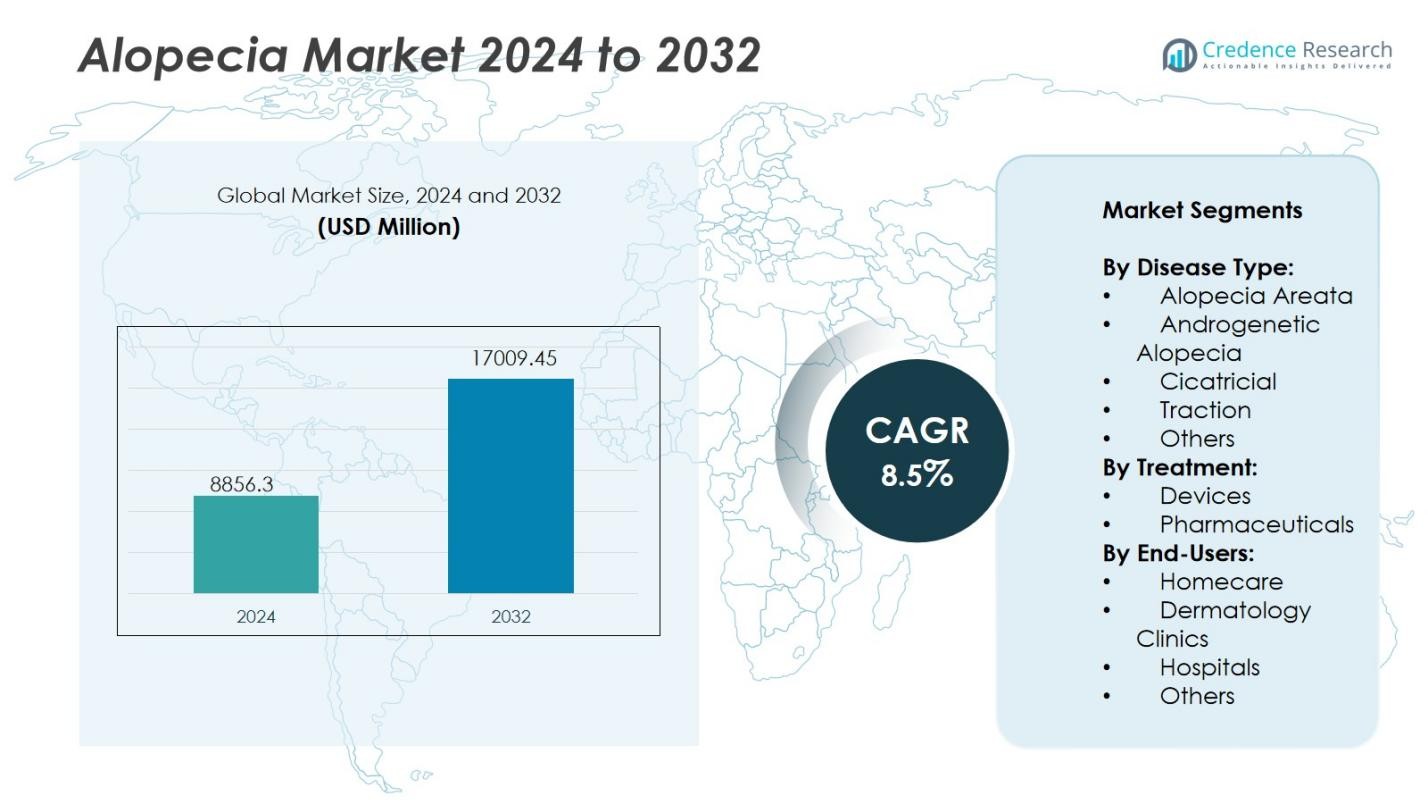
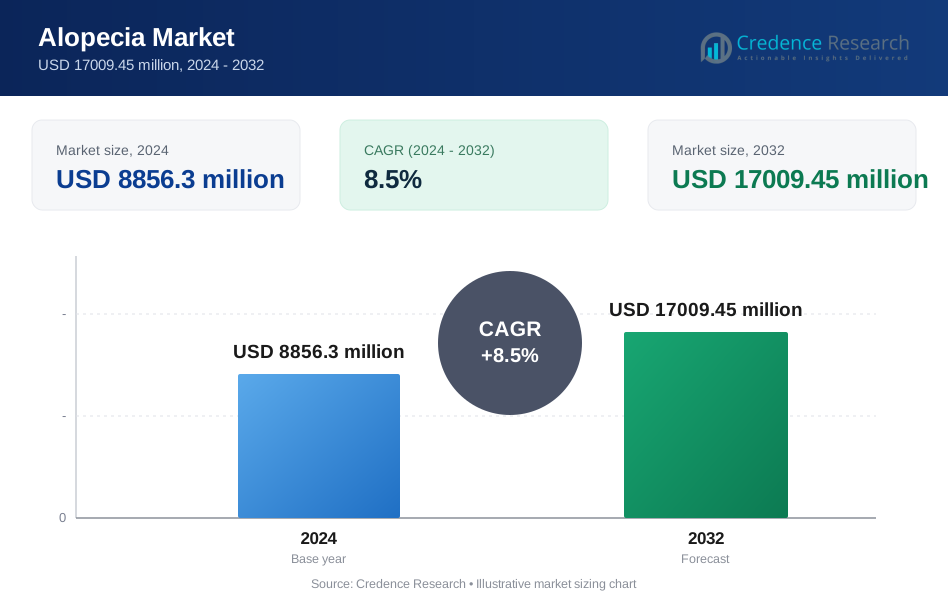
The Global Alopecia Market size was valued at USD 8856.3 million in 2024, and is anticipated to reach USD 17009.45 million by 2032, expanding at a CAGR of 8.5% during the forecast period.
| REPORT ATTRIBUTE | DETAILS |
|---|---|
| Historical Period | 2020-2023 |
| Base Year | 2024 |
| Forecast Period | 2025-2032 |
| Alopecia Market Size 2024 | USD 8856.3 Million |
| Alopecia Market, CAGR | 8.5% |
| Alopecia Market Size 2032 | USD 17009.45 Million |
The competitive landscape of the Alopecia Market is shaped by key players including AbbVie Inc., Allergan, Lupin, Sanofi, Cipla Inc., Bayer AG, Merck & Co. Inc., Eli Lilly and Company, Mylan N.V., GlaxoSmithKline, Abbott, and F. Hoffmann-La Roche Ltd. These companies lead the market through innovations in pharmaceutical therapies, biologics, and non-invasive treatment devices. They are expanding clinical research for JAK inhibitors, stem cell therapies, and peptide-based formulations to enhance treatment efficacy. North America remains the leading region, holding a 38% market share in 2024, supported by advanced healthcare infrastructure, high treatment awareness, and strong R&D activities across the U.S. and Canada.
Market Insights
- The Global Alopecia Market was valued at USD 8856.3 million in 2024 and is projected to reach USD 45 million by 2032, growing at a CAGR of 8.5% during the forecast period.
- Rising cases of androgenetic alopecia and increasing awareness about early treatment are driving market demand, supported by improved access to dermatological care and advanced treatment options.
- Key trends include growing use of JAK inhibitors, stem cell therapy, and home-use laser devices that provide effective, non-invasive treatment solutions for patients.
- The market is competitive, with leading players such as AbbVie, Allergan, Bayer AG, Merck & Co. Inc., and Sanofi focusing on product innovation, R&D, and strategic collaborations to expand global reach.
- Regionally, North America leads with a 38% market share, followed by Europe at 27% and Asia-Pacific at 22%, while the pharmaceuticals segment holds a dominant 65% share due to high adoption of topical and oral treatments.
 Market Segmentation Analysis:
By Disease Type:
The Alopecia market is segmented into Alopecia Areata, Androgenetic Alopecia, Cicatricial, Traction, and Others. Androgenetic Alopecia dominates the segment, accounting for over 42% of the total market share in 2024. Its strong prevalence among both men and women and the rising adoption of advanced therapeutic options such as minoxidil and finasteride drive segment growth. Increased awareness of early treatment and growing aesthetic concerns further support its dominance. Meanwhile, Alopecia Areata is projected to show notable growth due to expanding R&D in autoimmune treatment approaches.
For instance,Nektar Therapeutics initiated a Phase 2b clinical trial in 2024 for rezpegaldesleukin, a novel biologic targeting immune system dysfunction in severe Alopecia Areata patients.
By Treatment:
Based on treatment, the market is classified into Devices and Pharmaceuticals. The Pharmaceuticals segment leads with a market share 65% in 2024, driven by the wide availability of topical, oral, and injectable formulations. The growing demand for FDA-approved drugs, such as JAK inhibitors and corticosteroids, supports expansion in this segment. Increasing prescription rates from dermatologists and new clinical trials for targeted therapies continue to strengthen pharmaceutical sales. Conversely, the devices segment, including laser therapy systems, is gaining attention for non-invasive and home-based treatment applications.
For instance, Sun Pharma's oral JAK inhibitor Leqselvi received FDA approval in July 2024 for severe alopecia areata, marking a key development in targeted therapies.
By End Users:
The end-user segmentation includes Homecare, Dermatology Clinics, Hospitals, and Others. Dermatology Clinics dominate with 48% market share in 2024, attributed to specialized diagnostic facilities and professional treatment guidance. Patients prefer clinics for advanced hair restoration procedures, PRP therapies, and laser treatments offering higher efficacy. The availability of experienced dermatologists and customized therapy programs further fuels this dominance. The Homecare segment, however, is expanding rapidly due to the convenience of over-the-counter products, portable laser devices, and rising online retail availability.
Key Growth Drivers
Rising Prevalence of Hair Loss Disorders
The Alopecia market experiences strong growth due to a rising global incidence of hair loss. Factors such as stress, hormonal imbalance, pollution, and aging contribute to the growing number of cases worldwide. Studies show that androgenetic alopecia affects nearly half of men and a quarter of women by midlife. Expanding access to dermatological care and early diagnosis fuels treatment adoption. Increasing awareness campaigns and social acceptance of treatment options further support sustained market expansion.
For instance, Sun Pharmaceutical Industries launched LEQSELVI (deuruxolitinib) in the US in 2025, an FDA-approved oral treatment for severe alopecia areata, with clinical trials showing that nearly one-third of patients achieved almost complete hair regrowth within 24 weeks.
Advancements in Treatment Technologies
Rapid innovation in medical devices and pharmaceuticals continues to drive the Alopecia market. Developments in JAK inhibitors, stem cell therapy, and low-level laser devices improve hair regrowth outcomes and patient experience. Modern technologies enable targeted and less invasive treatments with minimal side effects. The introduction of portable home-use laser caps and AI-guided treatment programs enhances convenience and accessibility. These advancements strengthen consumer trust, accelerating adoption across both clinical and homecare segments.
For instance, Shiseido has successfully developed and clinically validated a hair regenerative therapy using autologous dermal stem cells (S-DSC®), which was launched in Japan in July 2024 to promote hair regrowth in patients with pattern baldness.
Increasing Cosmetic and Psychological Awareness
Rising concern about appearance and confidence loss due to hair thinning boosts market demand. Growing awareness about the psychological effects of alopecia encourages individuals to pursue timely treatment. Media influence and celebrity endorsements normalize discussions about hair loss, driving higher product usage. Expanding social media marketing and aesthetic wellness trends have significantly increased the demand for hair restoration solutions. This shift is especially strong among young professionals seeking visible and non-invasive treatments.
Key Trends & Opportunities
Growing Demand for Personalized Therapies
Personalized medicine presents a major opportunity in the Alopecia market. Advanced genetic and molecular diagnostics help physicians design customized treatment plans for better outcomes. AI-driven analysis of patient profiles enables precision targeting of drugs and devices. This approach reduces side effects, improves satisfaction, and enhances long-term adherence. The trend is prompting pharmaceutical companies and clinics to expand offerings focused on individualized hair restoration programs.
For instance, Alys Pharmaceuticals is advancing ALY-101, an intradermal injectable JAK1 siRNA-lipid conjugate, through a phase 2a trial for Alopecia Areata, marking the first clinical study of a genetic medicine program in dermatology and aiming to address the root causes of autoimmune hair loss.
Expansion of Homecare Treatment Solutions
Consumer preference for convenient, at-home treatments is rapidly expanding. Portable laser devices, topical foams, and prescription-free products are increasingly popular due to affordability and privacy. The rise of e-commerce and digital health platforms makes access to such solutions easier. Smart connected devices that monitor progress are also gaining popularity. This shift toward self-managed care provides manufacturers opportunities to introduce innovative, user-friendly products with proven results.
For instance, Cutera’s AviClear acne device received FDA clearance as a prescription-free laser treatment that reduces acne and future breakout severity without pain mitigation.
Key Challenges
High Cost of Advanced Therapies
High treatment costs remain a major barrier to widespread market adoption. Advanced therapies such as PRP, stem cell procedures, and biologics involve expensive equipment and specialized expertise. In most countries, these procedures lack insurance reimbursement, making them inaccessible for many patients. The financial burden discourages long-term adherence and limits penetration in emerging economies. Reducing costs through technological efficiency and broader coverage is essential for future growth.
Limited Long-Term Treatment Efficacy
Sustaining hair regrowth remains challenging, as many therapies show inconsistent long-term outcomes. Patients often experience relapse once treatments stop, lowering confidence in existing solutions. The unpredictable nature of alopecia, driven by autoimmune and genetic factors, complicates clinical management. Limited understanding of disease mechanisms restricts breakthrough innovation. Continuous research into root causes and multi-modal therapies is needed to improve reliability and patient retention.
Regional Analysis
North America
North America leads the Alopecia market with a market share of 38% in 2024, driven by high disease awareness, advanced healthcare infrastructure, and widespread access to dermatological treatments. The region benefits from strong adoption of FDA-approved drugs, innovative devices, and early integration of biotechnology-based therapies. Increasing consumer spending on aesthetic treatments and the strong presence of key pharmaceutical companies further fuel growth. The U.S. dominates regional sales due to robust R&D funding, supportive reimbursement frameworks, and rising demand for non-invasive and home-use treatment solutions.
Europe
Europe holds a market share of 27% in 2024, supported by strong healthcare systems and growing emphasis on clinical dermatology. Demand for alopecia treatments is rising across the United Kingdom, Germany, France, and Italy due to expanding access to prescription drugs and regenerative therapies. The increasing popularity of cosmetic and minimally invasive procedures also contributes to growth. European pharmaceutical manufacturers are investing heavily in stem cell and peptide-based solutions. Rising aging populations and social acceptance of medical aesthetics further drive the regional market outlook.
Asia-Pacific
The Asia-Pacific region accounts for 22% of the market share in 2024, emerging as the fastest-growing regional segment. Rising disposable incomes, expanding medical tourism, and growing awareness of hair restoration treatments contribute to strong market performance. Countries like China, Japan, South Korea, and India are witnessing increasing adoption of laser therapies, topical formulations, and hair transplant procedures. Local manufacturers are entering the market with cost-effective and herbal-based solutions. Rapid urbanization, coupled with lifestyle-related hair loss and government focus on healthcare modernization, boosts the regional demand.
Latin America
Latin America captures a market share of 8% in 2024, supported by increasing awareness of aesthetic treatments and improving healthcare infrastructure. Brazil and Mexico are key contributors due to growing demand for affordable pharmaceuticals and clinical hair restoration procedures. The rise in disposable incomes and social acceptance of cosmetic care encourage adoption of both professional and at-home solutions. Expanding dermatology clinics and local product availability drive the market’s gradual expansion. Strategic partnerships between global brands and regional distributors are enhancing accessibility across emerging Latin American economies.
Middle East & Africa
The Middle East & Africa region represents a market share of 5% in 2024, with steady growth led by improving healthcare standards and increasing interest in cosmetic enhancement. Wealthy urban centers such as the UAE and Saudi Arabia are major demand hubs for advanced treatment devices and clinical services. Rising hair loss cases due to climatic conditions and dietary factors are driving awareness initiatives. Expanding private healthcare investments and the entry of multinational cosmetic brands strengthen product reach. However, limited affordability and uneven access to specialized care remain key challenges in rural areas.
Market Segmentations:
By Disease Type:
- Alopecia Areata
- Androgenetic Alopecia
- Cicatricial
- Traction
- Others
By Treatment:
- Devices
- Pharmaceuticals
By End-Users:
- Homecare
- Dermatology Clinics
- Hospitals
- Others
By Region
- North America
- U.S.
- Canada
- Mexico
- Europe
- Germany
- France
- U.K.
- Italy
- Spain
- Rest of Europe
- Asia Pacific
- China
- Japan
- India
- South Korea
- South-east Asia
- Rest of Asia Pacific
- Latin America
- Brazil
- Argentina
- Rest of Latin America
- Middle East & Africa
- GCC Countries
- South Africa
- Rest of the Middle East and Africa
Competitive Landscape
The competitive landscape of the Alopecia Market includes major players such as AbbVie Inc., Allergan, Lupin, Sanofi, Cipla Inc., Bayer AG, Merck & Co. Inc., Eli Lilly and Company, Mylan N.V., GlaxoSmithKline, Abbott, and F. Hoffmann-La Roche Ltd. These companies focus on developing advanced therapies, including JAK inhibitors, stem cell-based solutions, and biologics aimed at achieving higher treatment efficacy with fewer side effects. Strategic mergers, acquisitions, and product innovations are driving competitive intensity in the market. Firms are investing heavily in research and clinical trials to expand their product pipelines and secure regulatory approvals. Many players are also leveraging digital health platforms and e-commerce networks to enhance patient reach and improve therapy adherence. The increasing emphasis on cost-effective, patient-centric, and non-invasive treatment options further shapes the competition, positioning innovation and affordability as key success factors in the global Alopecia market.
Key Player Analysis
- AbbVie Inc.
- Allergan
- Lupin
- Sanofi
- Cipla Inc.
- Bayer AG
- Merck & Co. Inc.
- Eli Lilly and Company
- Mylan N.V.
- GlaxoSmithKline
- Abbott
- Hoffmann-La Roche Ltd.
Recent Developments
- In July 2025, Sun Pharmaceutical Industries launched Leqselvi (deuruxolitinib) in the United States for adults suffering from severe alopecia areata.
- In October 2025, Pelage Pharmaceuticals secured USD 120 million in Series B funding to advance its topical hair-regrowth drug PP405 targeting androgenetic alopecia.
- In October 2025, Veradermics completed an oversubscribed USD 150 million Series C round to progress VDPHL01, a potential first non-hormonal oral therapy for hair regrowth in both men and women.
Report Coverage
The research report offers an in-depth analysis based on Disease Type, Treatment, End User and Region. It details leading market players, providing an overview of their business, product offerings, investments, revenue streams, and key applications. Additionally, the report includes insights into the competitive environment, SWOT analysis, current market trends, as well as the primary drivers and constraints. Furthermore, it discusses various factors that have driven market expansion in recent years. The report also explores market dynamics, regulatory scenarios, and technological advancements that are shaping the industry. It assesses the impact of external factors and global economic changes on market growth. Lastly, it provides strategic recommendations for new entrants and established companies to navigate the complexities of the market.
Future Outlook
- The Alopecia market will experience steady growth driven by increasing global awareness and early diagnosis.
- Pharmaceutical innovation focusing on JAK inhibitors and stem cell therapies will expand treatment choices.
- Demand for personalized and genetic-based therapies will shape future product development.
- Non-invasive and home-use devices will become preferred solutions for many consumers.
- Digital health platforms will improve patient monitoring and access to dermatological consultations.
- Collaborations between pharmaceutical firms and biotech startups will accelerate R&D efforts.
- Emerging economies will see faster adoption due to growing healthcare investments.
- Focus on gender-neutral treatment options will attract broader consumer segments.
- Companies will emphasize cost-effective formulations to increase accessibility in developing regions.
- Regulatory approvals for new biologics and innovative therapies will strengthen market confidence.
Request a Free Sample
Fill in your details and we'll send you a free sample report.
- Sample data tables & charts
- Research methodology
Need a Custom Version of This Report?
Tailor the scope, geography, or segments to your exact requirements.
- Custom geography or segment scope
- Direct access to our analyst team
Frequently Asked Questions
What is the current market size for the Alopecia market, and what is its projected size in 2032?
At what Compound Annual Growth Rate is the Alopecia market projected to grow between 2025 and 2032?2032?
Which Alopecia market segment held the largest share in 2024?
What are the primary factors fueling the growth of the Alopecia market?
Who are the leading companies in the Alopecia market?
Which region commanded the largest share of the Alopecia market in 2024?
Table of Content
Chapter 1. Report Introduction
- 1.1 Report Description & Purpose
- 1.1.1 Report Title & Market Definition
- 1.1.2 Unique Selling Propositions (USP) & Key Differentiators
- 1.1.3 Value Proposition for Stakeholders
- 1.2 Research Objectives
- 1.2.1 Market Sizing Objectives (Volume & Revenue) (Volume Where Applicable)
- 1.2.2 Segmentation Objectives
- 1.2.3 Competitive Intelligence Objectives
- 1.2.4 Forecast & Scenario Objectives
- 1.3 Report Scope
- 1.3.1 Alopecia Scope – Segments & Subsegments Covered
- 1.3.2 Geographic Scope – Regions & Countries Covered
- 1.3.3 Historical Period, Base Year & Forecast Period (2024; forecast to 2032)
- 1.3.4 Inclusions & Exclusions
- 1.4 Industry Classification & Applicable Codes
- 1.5 Currency, Measurement Units & Valuation Basis
- 1.6 Target Stakeholders
- 1.7 Limitations & Assumptions
Chapter 2. Executive Summary
- 2.1 Global Alopecia Market Snapshot
- 2.1.1 Market Size – Historical (2024) & Forecast (2024-2032) (2024: USD 8856.3 million → 2032: USD 17009.45 million)
- 2.1.2 Volume & Revenue – Global Totals (Volume Where Applicable)
- 2.1.3 Key Market Highlights – Top Five Facts
- 2.2 Alopecia Market Segmentation Snapshot
- 2.2.1 Market Split by Region – 2024 vs. 2032
- 2.3 Competitive Snapshot
- 2.3.1 Top 10 Players by Revenue Share – 2024
- 2.3.2 Top 10 Players by Volume Share – 2024 (Volume Where Applicable)
- 2.3.3 Recent Strategic Developments (18-Month Summary)
- 2.4 Key Investment Highlights & Strategic Conclusions
Chapter 3. Alopecia Market Dynamics & Industry Analysis
- 3.1 Market Overview & Context
- 3.1.1 Alopecia Market Position in the Broader Industry Value Chain
- 3.1.2 Demand Structure & Purchasing Dynamics
- 3.1.3 Market Maturity & Development Stage by Region
- 3.2 Alopecia Market Drivers
- 3.3 Alopecia Market Restraints & Challenges
- 3.4 Alopecia Market Opportunities
- 3.5 Porter's Five Forces Analysis
- 3.5.1 Threat of New Entrants
- 3.5.2 Bargaining Power of Suppliers
- 3.5.3 Bargaining Power of Buyers
- 3.5.4 Threat of Substitutes
- 3.5.5 Competitive Rivalry – Intensity Assessment
- 3.6 Alopecia Value Chain Analysis
- 3.6.1 Upstream – Key Inputs, Resources & Suppliers
- 3.6.1.1 Key Input/Resource 1
- 3.6.1.2 Key Input/Resource 2
- 3.6.1.3 Key Input/Resource 3
- 3.6.2 Midstream – Core Operations & Value Creation
- 3.6.2.1 Operating Model & Process Overview
- 3.6.2.2 Key Operating Locations & Capabilities by Company
- 3.6.3 Downstream – Market Channels & End Users
- 3.6.3.1 Direct Sales & Customer Engagement Channels
- 3.6.3.2 Indirect Sales, Intermediaries & Partner Channels
- 3.6.4 Value Chain Profitability Analysis
- 3.6.1 Upstream – Key Inputs, Resources & Suppliers
- 3.7 PESTEL Analysis
- 3.7.1 Political Factors
- 3.7.2 Economic Factors
- 3.7.3 Social Factors
- 3.7.4 Technological Factors
- 3.7.5 Environmental Factors
- 3.7.6 Legal Factors
- 3.8 Alopecia Supply Chain Analysis
- 3.8.1 Critical Input & Resource Availability Risk Assessment
- 3.8.2 Supplier & Operational Concentration Risk (Geographic Exposure)
- 3.8.3 Supply & Service Disruption Impact Analysis
- 3.9 Regulatory & Policy Landscape
Note: The regulatory and policy landscape section covers regulations based on their applicability to the market, Alopecia category, geography, and scope of the study. Only regulatory frameworks with a material impact on operations, compliance, trade, sustainability, or market access are analyzed in detail.
Chapter 4. Key Investment Pockets & Opportunity Analysis
- 4.1 Alopecia Market Attractiveness Analysis
- 4.1.1 By Region – Investment Attractiveness Matrix (Market Size × CAGR)
- 4.2 Absolute Revenue Growth Opportunity
- 4.2.1 By Region – Absolute Revenue Growth Through 2032
- 4.3 Incremental Demand Opportunity
- 4.3.1 By Region – Incremental Demand Through 2032
- 4.3.2 Segment – Incremental Demand
- 4.4 Emerging Submarket Opportunity Deep Dive (Subject to Applicability)
- 4.5 Priority Market Opportunity Scorecards
- 4.5.1 United States
- 4.5.2 Europe
- 4.5.3 Asia
- 4.5.4 Middle East & Africa
Note: Priority market opportunity scorecards reflect the geographic scope and strategic relevance of the study. Listed markets are indicative and may be adapted to the industry.
Chapter 5. Alopecia Cross-Border Trade & Market Access Analysis
- 5.1 International Trade & Cross-Border Activity Overview
- 5.1.1 Global Export Value by Country (2024)
- 5.1.2 Global Export Volume by Country (2024) (Volume Where Applicable)
- 5.1.3 Global Import Value by Country (2024)
- 5.1.4 Global Import Volume by Country (2024) (Volume Where Applicable)
- 5.1.5 Net Trade Balance by Country (2024)
- 5.2 Export Analysis – Segment
- 5.2.1 Category 1 (Applicable Classification Code)
- 5.2.2 Category 2 (Applicable Classification Code)
- 5.2.3 Category 3 (Applicable Classification Code)
- 5.2.4 Category 4 (Applicable Classification Code)
- 5.2.5 Category 5 (Applicable Classification Code)
- 5.3 Import Analysis – Segment
- 5.3.1 Category 1 (Applicable Classification Code)
- 5.3.2 Category 2 (Applicable Classification Code)
- 5.3.3 Category 3 (Applicable Classification Code)
- 5.3.4 Category 4 (Applicable Classification Code)
- 5.3.5 Category 5 (Applicable Classification Code)
- 5.4 Cross-Border Pricing & Transaction Benchmarks
- 5.4.1 Export Pricing – Segment & Country
- 5.4.2 Import Pricing – Segment & Source Country
- 5.4.3 Price Trends (2024)
- 5.5 Key Cross-Border Trade & Delivery Routes
- 5.5.1 Cross-Border Trade/Delivery Route 1
- 5.5.2 Cross-Border Trade/Delivery Route 2
- 5.5.3 Cross-Border Trade/Delivery Route 3
- 5.5.4 Cross-Border Trade/Delivery Route 4
- 5.5.5 Cross-Border Trade/Delivery Route 5
- 5.6 Trade Policy & Market Access Impact Assessment
- 5.6.1 Tariff & Non-Tariff Barriers
- 5.6.2 Regional Trade & Economic Integration Frameworks
- 5.6.3 Bilateral & Multilateral Trade Agreements
- 5.6.4 Cross-Border Operating, Licensing & Localization Requirements
Note: This chapter applies where cross-border trade or delivery is relevant to Alopecia. Goods, services, and digital offerings are assessed using applicable classifications and transaction measures. Import-export volumes, trade balances, and route analyses are included only where meaningful to the market.
Chapter 6. Competitive Landscape & Company Benchmarking
- 6.1 Alopecia Market Concentration & Structure
- 6.1.1 Herfindahl-Hirschman Index (HHI) – vs. 2024
- 6.1.2 Leading, Mid-Sized & Emerging Player Structure
- 6.1.3 Global, Regional & Local Player Dynamics
- 6.2 Alopecia Market Share Analysis – 2024
- 6.2.1 Global Revenue Share by Company
- 6.2.2 Global Volume Share by Company (Volume Where Applicable)
- 6.2.3 Regional Revenue Share
- 6.2.4 Market Share Evolution ( vs. 2024)
- 6.2.5 Company Market Share by Key Segment
- 6.2.6 Company Market Share by Customer Group
- 6.3 Operating Scale, Capacity & Infrastructure Analysis
- 6.3.1 Global Operating Scale & Supply Capacity
- 6.3.2 Resource Utilization & Operating Efficiency
- 6.3.3 Output, Service Delivery & Activity Metrics
- 6.3.4 Operating Footprint & Infrastructure Map
- 6.3.5 Planned Operational & Capacity Expansion
- 6.4 Alopecia Competitive Benchmarking Matrix
- 6.4.1 Revenue, Growth, Profitability & Operating Metric Comparison
- 6.4.2 Channel Revenue Mix
- 6.4.3 Geographic Revenue Exposure
- 6.4.4 R&D Intensity
- 6.4.5 Sustainability Maturity
- 6.5 Strategic Developments in Alopecia (Last 24 Months)
- 6.5.1 Mergers, Acquisitions & Divestments
- 6.5.2 New Products, Services & Solutions in Alopecia
- 6.5.3 Operational & Infrastructure Expansions
- 6.5.4 Strategic Alliances, Joint Ventures & Partnerships
- 6.5.5 Distribution Expansion & Market Entry
- 6.5.6 Sustainability & ESG Initiatives
- 6.6 Competitive Strategy Mapping
- 6.6.1 Leader, Challenger, Follower & Niche Classification
- 6.6.2 Pricing Strategy Comparison
- 6.6.3 Channel Strategy Matrix
Note: Strategic developments are included based on their materiality and the availability of reliable information.
Chapter 7. Global Alopecia Market – By Sales & Delivery Channel
- 7.1 Segment Overview
- 7.1.1 Volume & Revenue Split by Channel (2024 & 2032) (Volume Where Applicable)
- 7.1.2 Channel Mix Evolution (2024-2032)
Chapter 8. Regional Market Analysis – Global Overview
- 8.1 Global Regional Overview
- 8.1.1 Regional Volume Share (Volume Where Applicable)
- 8.1.2 Regional Revenue Share
- 8.1.3 Regional Volume by Region (Volume Where Applicable)
- 8.1.4 Regional Revenue by Region
- 8.1.5 Regional Forecast Through 2032
- 8.2 Cross-Regional Segment Analysis
- 8.2.1 By Sales & Delivery Channel
- 8.2.2 By Competitive Positioning & Price Tier
Chapter 9. North America Alopecia Market
- 9.1 United States
- 9.2 Canada
- 9.3 Mexico
Chapter 10. Europe Alopecia Market
- 10.1 Germany
- 10.2 France
- 10.3 Italy
- 10.4 United Kingdom
- 10.5 Spain
- 10.6 Poland
- 10.7 Russia
- 10.8 Netherlands
- 10.9 Belgium
- 10.10 Sweden
- 10.11 Denmark
- 10.12 Norway
- 10.13 Rest of Europe
Chapter 11. Asia Pacific Alopecia Market
- 11.1 China
- 11.2 India
- 11.3 Japan
- 11.4 South Korea
- 11.5 Thailand
- 11.6 Indonesia
- 11.7 Vietnam
- 11.8 Malaysia
- 11.9 Australia
- 11.10 Rest of Asia Pacific
Chapter 12. Latin America Alopecia Market
- 12.1 Brazil
- 12.2 Argentina
- 12.3 Colombia
- 12.4 Chile
- 12.5 Rest of Latin America
Chapter 13. Middle East Alopecia Market
- 13.1 Saudi Arabia
- 13.2 United Arab Emirates
- 13.3 Turkey
- 13.4 Israel
- 13.5 Iran
- 13.6 Rest of the Middle East
Chapter 14. Africa Alopecia Market
- 14.1 South Africa
- 14.2 Egypt
- 14.3 Nigeria
- 14.4 Morocco
- 14.5 Rest of Africa
Chapter 15. Alopecia Company Profiles
- 15.1 [Company 01]
- 15.1.1 Company Overview
- 15.1.2 Key Management Personnel
- 15.1.3 Products & Services Portfolio
- 15.1.4 Financial Performance
- 15.1.5 Key Market Focus & Geographic Presence
- 15.1.6 Recent Developments & Strategic Initiatives
Note: The company profile list is preliminary and may change based on research findings, market developments, data availability, and client requirements.
Chapter 16. Appendices
- Appendix A – List of Abbreviations & Acronyms
- Appendix B – Industry Classification Code Reference – Full Series
- Appendix C – Supply, Output & Operating Capacity Data Tables
- Appendix D – End-Use & Demand Base Tables
- Appendix E – Demand, Adoption & Usage Assumptions
- Appendix F – Pricing & Revenue Metric Reference Tables
- Appendix G – Company Operations & Infrastructure Database
- Appendix H – Cross-Border Trade & Activity Data Tables (Where Applicable)
- Appendix I – Regulatory Summary Tables
- Appendix J – Primary Research Participant List (Anonymized)
- Appendix K – Primary Research Questionnaire Framework
- Appendix L – Data Sources & Bibliography
- Appendix M – Market Size Divergence & Source Comparison
Chapter 17. Research Methodology
- 17.1 Research Framework & Philosophy
- 17.2 Secondary Research – Sources, Hierarchy & Data Extraction
- 17.3 Data Modeling – Bottom-Up & Top-Down Market Sizing
- 17.4 Primary Research – Stakeholder Framework, LOI & Sample Sizes
- 17.5 Forecast Methodology – Regression, Scenario & Sensitivity Analysis
- 17.6 Quality Control – Four-Layer Validation Framework
- 17.7 Limitations & Standard Assumptions
- 17.8 Disclaimer
