
| REPORT ATTRIBUTE | DETAILS |
|---|---|
| Historical Period | 2019-2022 |
| Base Year | 2023 |
| Forecast Period | 2024-2032 |
| Angioedema Treatment Market Size 2023 | USD 4315.2 million |
| Angioedema Treatment Market, CAGR | 17.20% |
| Angioedema Treatment Market Size 2032 | USD 18003.18 million |
Market Insights
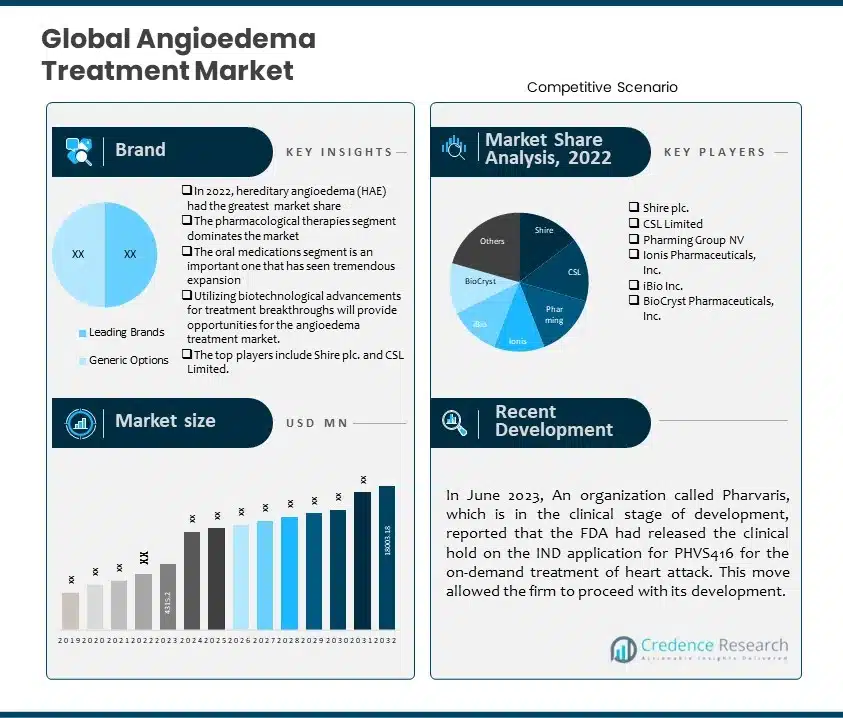
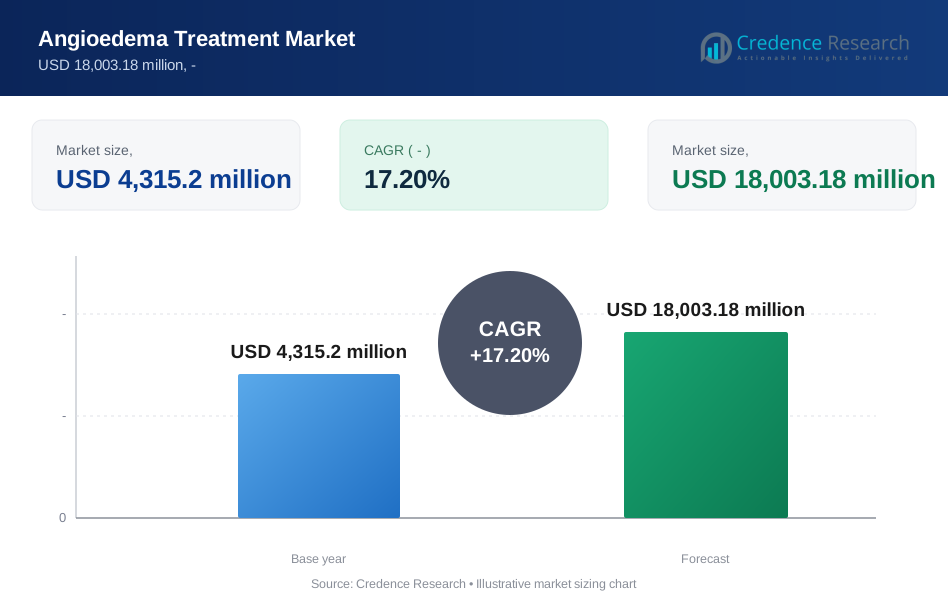
- Between 2024 and 2032, the global angioedema treatment market is expected to develop at a compound annual growth rate (CAGR) of 17.20%, from its estimated USD 4315.2 million in 2023 to USD 18003.18 million in 2032.
- The largest type of angioedema category is hereditary angioedema (HAE). On the other hand, acquired angioedema is expected to grow at a strong CAGR.
- The leading treatment modalities segment is pharmacological therapies.
- The CAGR for oral medications is expected to be the highest during the projection period.
- The hospitals and clinics will have the highest CAGR throughout the prediction period.
- The pediatric population is estimated to have the greatest CAGR during the forecast period.
- The allergic angioedema category is predicted to grow fastest over the projection period.
- The standard therapies category is expected to increase quickly over the forecasted time.
- During the estimated duration, the category with the strongest growth is expected to be the leading brand.
- North America dominated the angioedema treatment market.
- Regarding the market share of angioedema treatment, Europe is expected to come second.
- In the angioedema treatment market, Asia Pacific is anticipated to grow fastest.
- The market's growth is driven by innovative drug formulations and delivery systems, therapies and treatment options, advances in diagnostic and treatment technologies, and technological integration in healthcare.
- The application of biotechnological advances for treatment innovations, expanding access to remote healthcare services, and streamlining drug administration procedures for better patient behavior influence the angioedema treatment market.
Executive Summary
Market Definition
Angioedema is an uncommon illness that results in non-pitting swelling of the skin and mucous membranes. While it usually doesn't cause much trouble, in certain cases, it can be a recurrent condition and even potentially fatal if it interferes with breathing. Treatment can typically keep swelling under control. The hands, feet, lips, tongue, area surrounding the eyes, and genitalia are the most common areas affected by edema. In more severe cases, angioedema can also result in respiratory issues. Angioedema is divided into two categories: acquired angioedema and hereditary angioedema, depending on the underlying causes.
Market Overview
The angioedema treatment sector is estimated to develop at a 17.20% compound annual growth rate (CAGR) between 2024 and 2032, maintaining its current upward trend. The market will keep developing, rising from its estimated value of USD 4315.2 million in 2023 to USD 18003.18 million in 2032.
Research groups and pharmaceutical companies process new medications and supportive therapies for angioedema. These drugs enhance health insurance, medical facilities, and cutting-edge technology. As a result, the market for treatments for edema will grow in the upcoming years. People are adopting angioedema treatment solutions because they are more aware of the disease and its complications and because they take the treatment seriously. According to cutting-edge research, CRISPR therapy makes it simple to control swelling in people with hereditary angioedema. In patients with hereditary angioedema, the frequency of attacks is decreased by the recently discovered CRISPR genome editing technology. Thus, the market for angioedema treatment benefits from the high-end research initiatives started by public and private organizations.
The mainstay of treatment for ACEI-AAE involves stopping the triggering medication and managing airway symptoms. The time frame for resolution is between 24 and 72 hours. Due to their needs in various angioedema cases, antihistamines, steroids, and adrenaline are in greater demand. The market for angioedema treatment is growing as a result of healthcare facilities' increased involvement in treating mid-level diseases more quickly to save as much money as possible for chronic diseases. About 30% of adults and 40% of children suffer from allergies, and the number is rising daily. It affects about 50 million people in the US and is the fifth most common cause of chronic illnesses. One common condition brought on by allergies is angioedema, which manifests as abrupt skin swelling.
These hives are undoubtedly the most life-threatening; they can attack the hands, feet, lips, eyelids, and genitalia. Four distinct forms of angioedema exist: drug-induced angioedema, hereditary angioedema, idiopathic angioedema, and allergic angioedema. Even though angioedema cannot be cured with medication, regular doses can help patients avoid attacks. One possible treatment for angioedema is a routine physical examination. Combination medications can be used to help reduce swelling in both idiopathic and allergic edema. Steroid injections may be required in cases of severe angioedema.
Segmentation by Type of Angioedema
- Hereditary angioedema (HAE) is the market leader by type of angioedema. Angioedema, or severe swelling in different parts of the body, occurs frequently in people with hereditary angioedema (HAE), a rare genetic disorder. C1 inhibitor, a protein involved in controlling the complement system, which affects inflammation and the immune system, is either lacking in this condition or functioning improperly.
- The acquired angioedema category will exhibit a sizable CAGR during the projected period. Rapid swelling of the skin's deeper layers, usually around the lips and eyes, is the hallmark of acquired angioedema (AAE), a rare kind of angioedema. The actual form of angioedema is either acquired or hereditary, with acquired forms being less common.
Segmentation by Treatment Modalities
- The main treatment modality is pharmacological therapy. The underlying cause of the angioedema, the degree of symptoms, and specific patient factors all influence the choice of pharmacological treatment. It's critical that medical practitioners customize treatment regimens to meet the unique requirements of every patient.
- The C1 inhibitors replacement therapy category will likely register a significant CAGR during forecasting. Administering C1-INH proteins to patients suffering from angioedema, especially those with HAE, is known as C1 Inhibitors Replacement Therapy. With treatment, the frequency and intensity of angioedema attacks should decrease as the defective or dysfunctional C1-INH levels are restored.
- Other treatment modalities, such as bradykinin receptor antagonists, also contribute to the demand for angioedema treatments.
Segmentation by Route of Administration
- It is projected that the oral medications category will grow at the fastest rate over the projection period. Due to its affordability, high patient compliance, and ease of use, oral medication delivery is the most popular method of drug administration.
- The need for angioedema treatment is also influenced by another route of administration, including injectable therapies and topical treatments.
Segmentation by End-User
- The hospitals and clinics category will likely have the highest CAGR during the projection period. Angioedema is diagnosed by medical personnel at clinics and hospitals using a variety of diagnostic tests, physical examinations, and reviews of the patient's medical history.
- Other end-users, such as homecare settings and specialized treatment centers, also contribute to the demand for angioedema treatments.
Segmentation by Age Group
- The pediatric population will be expected to have the foremost CAGR during the prediction period. Patients in their pediatric years grow and develop quickly. This affects the distribution, metabolism, and excretion of drugs. To get the best therapeutic results, treatment plans need to account for these age-related changes.
- Other age group, such as adult population, also contribute to the demand for angioedema treatments.
Segmentation by Cause of Angioedema
- Over the projected time frame, allergic angioedema is anticipated to have the highest CAGR. Angioedema is a condition that causes sudden and noticeable swelling of the deeper layers of skin. It is commonly seen in the face, lips, tongue, throat, and genitalia. One particular type of angioedema is allergic angioedema.
- Other causes of angioedema, such as non-allergic angioedema, also contribute to the demand for angioedema treatment.
Segmentation by Price Range
- The highest CAGR is anticipated throughout the forecast period for standard therapies. The standard therapy recommendations aim to raise the requirements for clinical practice and give the general population better, more affordable healthcare.
- Other price ranges, such as specialty therapies, also contribute to the demand for angioedema treatment.
Segmentation by Brand
- It is estimated that the category of leading brands will have the most significant CAGR during the anticipated period. Due to its novelty, relative innovation, and frequent use in treating hard-to-treat illnesses, branded medications are more costly. However, these same cutting-edge medications eventually turn into generics.
- Generic options also contribute to the demand for the angioedema treatment market.
Segmentation by Region
- North America leads the angioedema treatment industry. This is because of the existence of significant players, expanding research organizations and awareness campaigns about the condition's treatment, and an established healthcare system in North America.
- Europe is estimated to rank second in market size for angioedema treatment.
- The angioedema treatment industry is predicted to flourish rapidly in Asia Pacific.
- The remaining requirement for angioedema treatment is covered by world regions such as Africa, the Middle East, and Latin America.
Pharmaceutical companies and healthcare providers are running aggressive marketing campaigns to raise awareness of angioedema treatments among patients and medical professionals. With the help of education campaigns and training initiatives, patients are growing more accustomed to self-administration, contributing to the rise in angioedema treatments.
Based on projections, the market for angioedema treatment is dominated by North America for several reasons. This leadership is ascribed to the increasing occurrence of hereditary angioedema, the increasing attention paid to the condition's treatment alternatives, and a robust healthcare system. With no discernible differences in incidence by ethnic group, the American Osteopathic Association estimates that 1 in 50,000 people in the US suffer from HAE. Every year, between 15,000 and 30,000 visits to emergency rooms are caused by HAE attacks in the US alone. Rapid product approvals and innovative therapies are beneficial for managing HAE attacks in this region. Angioedema attacks of the face and abdomen in adults and adolescents were approved by the FDA in 2009 to treat human plasma-derived C1 INH concentrate (Berinert). Additionally, the FDA approved Berinert's label expansion, enabling self-administration and the management of HAE acute laryngeal attacks.
The angioedema treatment market in Asia Pacific is anticipated to expand fastest throughout the forecast. In the Asia-Pacific region, more people may seek medical attention for symptoms and receive a diagnosis as awareness of hereditary angioedema increases. Improved healthcare infrastructure, educational initiatives, and awareness campaigns help people recognize the condition more clearly, increasing patient involvement. Pharmaceutical and healthcare companies can increase their market share in the Asia-Pacific region by taking advantage of the growing patient awareness and introducing innovative therapies. Companies looking to take advantage of the growing demand for solutions for managing hereditary angioedema may consider joint ventures, collaborations, and market expansion tactics.
Key Highlights of the Report
The global angioedema treatments market is segmented by type of angioedema, treatment modalities, route of administration, end-user, age group, cause of angioedema, price range, brand, and region. Regarding the type of angioedema, hereditary angioedema (HAE) is the market spearhead. Allergic angioedema is the top cause of angioedema. The pharmacological therapies category is anticipated to increase at the highest CAGR throughout the projection period. The hospitals and clinics category will experience the highest CAGR during the forecast period. The angioedema treatment market is expanding mostly in North America.
An increasing number of activities aimed at raising public awareness is one of the factors driving the expansion of the angioedema treatment market. Every year on May 16th, HAEday is observed. Supported by patient organizations worldwide, HAE International (HAEi) is an international patient organization for people with hereditary angioedema. The effort intends to speed up diagnosis and give patients the best possible care and treatment.
The North American region is expected to account for the largest angioedema treatment market globally. Increased access to medical services and higher healthcare spending per person in North America lead to a larger market for angioedema treatment. Patients with this financial capacity can afford novel and possibly costly therapies. The Asia Pacific is also assumed to have the market's sharpest growth. Government programs, policies, and supportive regulations can encourage the advancement and accessibility of angioedema treatments. A faster rate of market growth is achieved by regulatory bodies that simplify the approval processes for new therapies.
Which Key Factors Are Driving The Global Angioedema Treatments Market?
The increasing senior population, an increasing trend in home healthcare use, and the developments in medication formulations are the main factors propelling the market for angioedema treatments.
What Are The Main Challenges Confronting The Angioedema Treatments Market Globally?
A potential misdiagnosis of hereditary angioedema and the high price of the medications used to treat angioedema are the main issues impeding the growth of the global market for angioedema treatment.
What Market Opportunities Exist For Angioedema Treatments Globally?
The opportunities for the angioedema treatment market are created by improvements in diagnostic tools for precise and timely detection, the application of biotechnological advancements for treatment breakthroughs, and a focus on creating therapies that prevent angioedema attacks.
Market Drivers
Multiple factors propel the angioedema treatment industry across the globe. The primary factors propelling the global angioedema treatment market are as follows:
Growing Awareness and Prevalence of Hereditary Angioedema
A rare genetic disease called hereditary angioedema (HAE) is typified by recurrent episodes of swelling in the hands, feet, face, gastrointestinal tract, and airways, among other body areas. Stress or trauma can cause the swelling, or it can occur on its own. The disorder is brought on by a lack of or malfunctioning C1 inhibitor protein, which causes the complement system to activate uncontrollably and release bradykinin, which causes swelling. Identification of people with hereditary angioedema has become simpler due to advancements in genetic testing technologies. Healthcare providers can customize treatment regimens to the precise genetic mutations linked to the disorder due to genetic testing, which enables early and accurate diagnosis. Growing knowledge of the underlying causes of hereditary angioedema has made the development of targeted medicines possible. The demand for angioedema treatments has been further supported by introducing new and more effective treatments, which has led to market growth. Knowledge about rare diseases has been easier to disseminate due to increased globalization and internet accessibility. Healthcare professionals can better identify and treat illnesses like hereditary angioedema because people are more knowledgeable about their health. These factors drive the expansion of the angioedema treatment market.
Market Restraints
There are several obstacles that the global angioedema treatment market must overcome to continue growing. Among them are the following:
Expensive Medications Used to Treat Angioedema
Extensive research and development (R&D) is necessary to develop new medications, and this process can be costly and time-consuming. Pharmaceutical companies make significant investments in testing, clinical trials, and regulatory procedures to guarantee the efficacy and safety of their products. Customers are frequently charged for these expenses. When compared to more prevalent illnesses, edema is a comparatively uncommon condition. Higher per-patient costs result from the smaller patient population because fewer people must bear the full burden of drug development and production. The manufacturing of medications to treat angioedema might necessitate specialized facilities and processes. Drug prices may rise due to increased production costs brought on by these specialized facilities and equipment.
Opportunities
There are plenty of potential prospects in the global angioedema treatment industry. Among these are the following:
Development of Cutting-Edge Technologies and Treatments
New treatments may be more effective at treating the symptoms of angioedema, bringing about quicker relief and lessening the degree and duration of swelling. Improved safety profiles of novel treatments can reduce adverse effects, guaranteeing patients a more positive experience. As the important causes and mechanisms of angioedema are better understood, more specialized treatments might be created. More precise and effective treatments may arise from focusing on particular molecules or pathways associated with the condition. Utilizing biotechnological methods to treat angioedema at the molecular level and address the underlying causes of the illness, such as gene therapies, RNA-based therapies, or monoclonal antibodies, can lead to new possibilities. The amalgamation of digital health solutions and telemedicine can improve patient education, support, and monitoring. This can help patients participate more actively in their care and enhance overall disease management. By drawing in new participants and boosting competition, launching innovative treatments can encourage market expansion. This may eventually lead to a more creative and dynamic competitive environment, which may help patients by offering a greater range of treatment options.
Competitive Landscape
Key Players
Several major competitors exist in the fiercely competitive global angioedema treatment market. The following are a few of the leading market participants and their market shares:
- Shire plc.
- CSL Limited
- Pharming Group NV
- Ionis Pharmaceuticals, Inc.
- iBio Inc.
- BioCryst Pharmaceuticals, Inc.
- Others
These companies prioritize product innovation, distribution channel expansion, mergers, and acquisitions to remain competitive.
The largest suppliers in the global angioedema treatment market continuously work to keep one step ahead of the competition by developing innovative concepts and products.
In March 2023, The US Food and Drug Administration authorized NTLA-2002, an investigational new drug (IND) developed by clinical-stage biotechnology company Intellia Therapeutics, to treat hereditary angioedema. This makes it possible for the US to be included in the global Phase 2 portion of the company's ongoing Phase 1/2 trial.
In February 2022, The FDA approved TAKHZYRO (lanadelumab-flyo) by Takeda, with the goal of enhancing the general patient experience. For adult and pediatric patients, it is a single-dose prefilled Syringe injection that helps prevent attacks of hereditary angioedema.
Summary of Key Findings
- The growing expense of healthcare is driving the market for angioedema treatments.
- The market is segmented by type of angioedema, treatment modalities, route of administration, end-user, age group, cause of angioedema, price range, brand, and region.
- The most popular type of angioedema in the market is hereditary angioedema (HAE).
- Allergic angioedema is the foremost cause of the angioedema category.
- Leading brands are expected to grow fastest regarding CAGR during the forecast period.
- The category for oral medications will likely see the highest CAGR during the anticipated time frame.
- North America is leading market development; the market is highly competitive with key players including Shire plc., CSL Limited, Pharming Group NV, Ionis Pharmaceuticals, Inc., iBio Inc., BioCryst Pharmaceuticals, Inc., and Others.
Future Outlook
- The angioedema treatment industry is expected to increase significantly in North America and has a positive outlook worldwide.
- The new treatments and technologies are contributing to the global market's expansion.
- Patient affordability issues resulting from high treatment costs are one of the key factors expected to hinder the market's growth for angioedema treatment during the anticipated period.
- To stay ahead of the competition, key enterprises must develop new products, expand their market reach, and keep their prices competitive.
How CXOs Can Benefit from the Credence Research Angioedema Treatment Market Report
CXOs may get a detailed picture of the market in the Credence Research Angioedema Treatment Market Report, which includes:
- Market size and growth forecast: The report provides detailed estimates of the global angioedema treatment market size, segmented by type of angioedema, treatment modalities, route of administration, end-user, age group, cause of angioedema, price range, brand, and region. It also includes forecasts for the market through 2032 based on key trends and drivers.
- Market segmentation: The research report breaks down the market for angioedema treatment into segments based on type of angioedema, treatment modalities, route of administration, end-user, age group, cause of angioedema, price range, brand, and region. This segmentation provides CXOs with a granular understanding of the market and the opportunities in each segment.
- Competitive landscape: The research report offers a detailed analysis of the major companies in the angioedema treatment industry, including information on their business plans, line of products, and earnings. CXOs can use this information to evaluate and identify their competitors.
- Key trends and drivers: The research report identifies and evaluates the main trends and factors influencing the market for angioedema treatment. CXOs can use this information to make well-informed choices regarding their plans and investments.
CXOs can use the insights from the Credence Research Angioedema Treatment Market Report to:
- Identify growth opportunities: With the help of this analysis, CXOs may identify new growth opportunities in the angioedema treatment sector. For example, the report identifies the growing demand for angioedema treatments from hospitals and clinics as a key opportunity.
- Make informed investment decisions: With the help of the report, CXOs can choose angioedema treatment wisely. For example, the research study provides information on the critical factors to consider while selecting angioedema treatment solutions and evaluating angioedema treatment suppliers.
- Develop competitive strategies: The research report can be used by CXOs to develop competitive strategies for their angioedema treatment businesses. For example, the research paper outlines the main strategies suppliers of angioedema treatment utilize to differentiate themselves from competitors.
- Track market developments: CXOs may stay ahead of the curve by tracking market developments with the aid of this research report. For instance, the research report offers insights into the most recent developments and trends in the market for angioedema treatment.
In general, CXOs seeking to expand their industry knowledge and spot growth prospects will find the Credence Research Angioedema Treatment Market Report a useful tool.
Segmentation
- By Type of Angioedema
- Hereditary Angioedema (HAE)
- Acquired Angioedema
- By Treatment Modalities
- Pharmacological Therapies
- C1 Inhibitors Replacement Therapy
- Bradykinin Receptor Antagonists
- By Route of Administration
- Oral Medications
- Injectable Therapies
- Topical Treatments
- By End-User
- Hospitals and Clinics
- Homecare Settings
- Specialized Treatment Centers
- By Age Group
- Pediatric Population
- Adult Population
- By Cause of Angioedema
- Allergic Angioedema
- Non-Allergic Angioedema
- By Price Range
- Standard Therapies
- Specialty Therapies
- By Brand
- Leading Brands
- Generic Options
- By Region
- North America
- United States
- Canada
- Mexico
- Europe
- Germany
- United Kingdom
- France
- Italy
- Spain
- Rest of Europe
- Asia Pacific
- China
- Japan
- India
- South Korea
- Australia
- Rest of Asia Pacific
- Latin America
- Brazil
- Argentina
- Rest of Latin America
- Middle East & Africa
- GCC Countries
- South Africa
- Rest of Middle East and Africa
- North America
Request a Free Sample
Fill in your details and we'll send you a free sample report.
- Sample data tables & charts
- Research methodology
Need a Custom Version of This Report?
Tailor the scope, geography, or segments to your exact requirements.
- Custom geography or segment scope
- Direct access to our analyst team
Frequently Asked Questions
How much does the global market currently hold for angioedema treatment?
What is the angioedema treatment market's projected growth rate between 2024 and 2032?
In terms of the type of angioedema, which market category is leading?
Regarding the treatment modalities, which market category is in the lead?
Who are the main players in the global angioedema treatment industry?
Table of Content
Chapter 1. Report Introduction
- 1.1 Report Description & Purpose
- 1.1.1 Report Title & Market Definition
- 1.1.2 Unique Selling Propositions (USP) & Key Differentiators
- 1.1.3 Value Proposition for Stakeholders
- 1.2 Research Objectives
- 1.2.1 Market Sizing Objectives (Volume & Revenue)
- 1.2.2 Segmentation Objectives
- 1.2.3 Competitive Intelligence Objectives
- 1.2.4 Forecast & Scenario Objectives
- 1.3 Report Scope
- 1.3.1 Angioedema Treatment Scope – Types & Subtypes Covered
- 1.3.2 Geographic Scope – Regions & Countries Covered
- 1.3.3 Historical Period, Base Year & Forecast Period (the historical period; forecast to the forecast period)
- 1.3.4 Inclusions & Exclusions
- 1.4 HS Code & Classification Framework
- 1.5 Currency, Units & Pricing Basis
- 1.6 Target Stakeholders
- 1.7 Limitations & Assumptions
Chapter 2. Executive Summary
- 2.1 Global Angioedema Treatment Market Snapshot
- 2.1.1 Market Size – Historical (the historical period) & Forecast (the forecast period) (base year: USD 4,315.2 million → forecast year: USD 18,003.18 million)
- 2.1.2 Volume & Revenue – Global Totals
- 2.1.3 Key Market Highlights – Top Five Facts
- 2.2 Angioedema Treatment Market Segmentation Snapshot
- 2.2.1 Market Split by Region – vs.
- 2.3 Competitive Snapshot
- 2.3.1 Top 10 Players by Revenue Share –
- 2.3.2 Top 10 Players by Volume Share –
- 2.3.3 Recent Strategic Developments (18-Month Summary)
- 2.4 Key Investment Highlights & Strategic Conclusions
Chapter 3. Angioedema Treatment Market Dynamics & Industry Analysis
- 3.1 Market Overview & Context
- 3.1.1 Angioedema Treatment Market Position in the Broader Automotive Value Chain
- 3.1.2 OEM vs. Replacement Market Dynamics
- 3.1.3 Market Maturity & Development Stage by Region
- 3.2 Angioedema Treatment Market Drivers
- 3.3 Angioedema Treatment Market Restraints & Challenges
- 3.4 Angioedema Treatment Market Opportunities
- 3.5 Porter's Five Forces Analysis
- 3.5.1 Threat of New Entrants
- 3.5.2 Bargaining Power of Suppliers
- 3.5.3 Bargaining Power of Buyers
- 3.5.4 Threat of Substitutes
- 3.5.5 Competitive Rivalry – Intensity Assessment
- 3.6 Angioedema Treatment Value Chain Analysis
- 3.6.1 Upstream – Raw Material/Input Suppliers
- 3.6.1.1 Raw Material/Input 1
- 3.6.1.2 Raw Material/Input 2
- 3.6.1.3 Raw Material/Input 3
- 3.6.2 Midstream – Production/Manufacturing/Service Delivery
- 3.6.2.1 Production/Process Overview
- 3.6.2.2 Key Facility Locations & Capacity by Manufacturer
- 3.6.3 Downstream – Distribution & End Consumer
- 3.6.3.1 Primary Channel – B2B/OEM
- 3.6.3.2 Secondary Channels – Dealer, Retail, Online, Direct
- 3.6.4 Value Chain Profitability Analysis
- 3.6.1 Upstream – Raw Material/Input Suppliers
- 3.7 PESTEL Analysis
- 3.7.1 Political Factors
- 3.7.2 Economic Factors
- 3.7.3 Social Factors
- 3.7.4 Technological Factors
- 3.7.5 Environmental Factors
- 3.7.6 Legal Factors
- 3.8 Angioedema Treatment Supply Chain Analysis
- 3.8.1 Raw Material/Input Supply Risk Assessment
- 3.8.2 Manufacturing Concentration Risk (Geographic Exposure)
- 3.8.3 Trade Disruption Impact Analysis
- 3.9 Regulatory & Policy Landscape
Note: The regulatory and policy landscape section covers regulations based on their applicability to the market, Angioedema Treatment category, geography, and scope of the study. Only regulatory frameworks with a material impact on operations, compliance, trade, sustainability, or market access are analyzed in detail.
Chapter 4. Key Investment Pockets & Opportunity Analysis
- 4.1 Angioedema Treatment Market Attractiveness Analysis
- 4.1.1 By Region – Investment Attractiveness Matrix (Volume × CAGR)
- 4.2 Absolute Revenue Growth Opportunity
- 4.2.1 By Region – Absolute USD Growth Through the forecast period
- 4.3 Incremental Volume Opportunity
- 4.3.1 By Region – Incremental Volume Through the forecast period
- 4.3.2 Segment – Incremental Volume
- 4.4 Emerging Submarket Opportunity Deep Dive (Subject to Applicability)
- 4.5 Emerging Market Opportunity Scorecards
- 4.5.1 United States
- 4.5.2 Europe
- 4.5.3 Asia
- 4.5.4 Middle East & Africa
Note: Emerging Market Opportunity Scorecards will be included based on relevance and strategic importance. Regions listed are indicative and may vary depending on data availability and market dynamics.
Chapter 5. Angioedema Treatment Import-Export Analysis & Trade Flows
- 5.1 Global Trade Overview
- 5.1.1 Global Export Value by Country (the historical period)
- 5.1.2 Global Export Volume by Country (the historical period)
- 5.1.3 Global Import Value by Country (the historical period)
- 5.1.4 Global Import Volume by Country (the historical period)
- 5.1.5 Net Trade Balance by Country (the historical period)
- 5.2 Export Analysis – Segment
- 5.2.1 Type 1 (HS Code)
- 5.2.2 Type 2 (HS Code)
- 5.2.3 Type 3 (HS Code)
- 5.2.4 Type 4 (HS Code)
- 5.2.5 Type 5 (HS Code)
- 5.3 Import Analysis – Segment
- 5.3.1 Type 1 (HS Code)
- 5.3.2 Type 2 (HS Code)
- 5.3.3 Type 3 (HS Code)
- 5.3.4 Type 4 (HS Code)
- 5.3.5 Type 5 (HS Code)
- 5.4 Average Unit Trade Prices
- 5.4.1 Average Export Price – Segment & Country
- 5.4.2 Average Import Price – Segment & Source Country
- 5.4.3 Price Trends (the historical period)
- 5.5 Key Trade Route Analysis
- 5.5.1 Trade Route 1
- 5.5.2 Trade Route 2
- 5.5.3 Trade Route 3
- 5.5.4 Trade Route 4
- 5.5.5 Trade Route 5
- 5.6 Trade Policy Impact Assessment
- 5.6.1 US Anti-Dumping & Section 301 Tariffs
- 5.6.2 EU Customs Union Impact
- 5.6.3 Major Free Trade Agreements
- 5.6.4 USMCA Rules of Origin
Note: Trade policy analysis will be included only where relevant to the Angioedema Treatment market.
Chapter 6. Competitive Landscape & Company Benchmarking
- 6.1 Angioedema Treatment Market Concentration & Structure
- 6.1.1 Herfindahl-Hirschman Index (HHI) – vs.
- 6.1.2 Tier 1, Tier 2 & Tier 3 Market Structure
- 6.1.3 Global, Regional & Local Player Dynamics
- 6.2 Angioedema Treatment Market Share Analysis –
- 6.2.1 Global Revenue Share by Company
- 6.2.2 Global Volume Share by Company
- 6.2.3 Regional Revenue Share
- 6.2.4 Market Share Evolution ( vs. )
- 6.2.5 OEM Segment Share by Company
- 6.2.6 Replacement Segment Share by Company
- 6.3 Production/Delivery Capacity & Facility Analysis
- 6.3.1 Global Installed Capacity
- 6.3.2 Capacity Utilization Rates
- 6.3.3 Production/Output Volume
- 6.3.4 Facility Locations & Capacity Map
- 6.3.5 Planned Capacity Additions
- 6.4 Angioedema Treatment Competitive Benchmarking Matrix
- 6.4.1 Revenue, Volume, CAGR & Profitability Comparison
- 6.4.2 Channel Revenue Mix
- 6.4.3 Geographic Revenue Exposure
- 6.4.4 R&D Intensity
- 6.4.5 Sustainability Maturity
- 6.5 Strategic Developments in Angioedema Treatment (Last 24 Months)
- 6.5.1 Mergers, Acquisitions & Divestments
- 6.5.2 New Angioedema Treatment Launches
- 6.5.3 Facility Expansions
- 6.5.4 Strategic Alliances, Joint Ventures & Partnerships
- 6.5.5 Distribution Expansion & Market Entry
- 6.5.6 Sustainability & ESG Initiatives
- 6.6 Competitive Strategy Mapping
- 6.6.1 Leader, Challenger, Follower & Niche Classification
- 6.6.2 Pricing Strategy Comparison
- 6.6.3 Channel Strategy Matrix
Note: Strategic developments are included based on their materiality and the availability of reliable information.
Chapter 7. Global Angioedema Treatment Market – By Distribution Channel
- 7.1 Segment Overview
- 7.1.1 Volume & Revenue Split by Channel ( & )
- 7.1.2 Channel Mix Evolution (the forecast period)
Chapter 8. Regional Market Analysis – Global Overview
- 8.1 Global Regional Overview
- 8.1.1 Regional Volume Share
- 8.1.2 Regional Revenue Share
- 8.1.3 Regional Volume by Region
- 8.1.4 Regional Revenue by Region
- 8.1.5 Regional Forecast Through the forecast period
- 8.2 Cross-Regional Segment Analysis
- 8.2.1 By Distribution Channel
- 8.2.2 By Brand/Price Tier
Chapter 9. North America Angioedema Treatment Market
- 9.1 United States
- 9.2 Canada
- 9.3 Mexico
Chapter 10. Europe Angioedema Treatment Market
- 10.1 Germany
- 10.2 France
- 10.3 Italy
- 10.4 United Kingdom
- 10.5 Spain
- 10.6 Poland
- 10.7 Russia
- 10.8 Netherlands
- 10.9 Belgium
- 10.10 Sweden
- 10.11 Denmark
- 10.12 Norway
- 10.13 Rest of Europe
Chapter 11. Asia Pacific Angioedema Treatment Market
- 11.1 China
- 11.2 India
- 11.3 Japan
- 11.4 South Korea
- 11.5 Thailand
- 11.6 Indonesia
- 11.7 Vietnam
- 11.8 Malaysia
- 11.9 Australia
- 11.10 Rest of Asia Pacific
Chapter 12. Latin America Angioedema Treatment Market
- 12.1 Brazil
- 12.2 Argentina
- 12.3 Colombia
- 12.4 Chile
- 12.5 Rest of Latin America
Chapter 13. Middle East Angioedema Treatment Market
- 13.1 Saudi Arabia
- 13.2 United Arab Emirates
- 13.3 Turkey
- 13.4 Israel
- 13.5 Iran
- 13.6 Rest of the Middle East
Chapter 14. Africa Angioedema Treatment Market
- 14.1 South Africa
- 14.2 Egypt
- 14.3 Nigeria
- 14.4 Morocco
- 14.5 Rest of Africa
Chapter 15. Angioedema Treatment Company Profiles
- 15.1 [Company 01]
- 15.1.1 Company Overview
- 15.1.2 Key Management Personnel
- 15.1.3 Products & Services Portfolio
- 15.1.4 Financial Performance
- 15.1.5 Key Market Focus & Geographic Presence
- 15.1.6 Recent Developments & Strategic Initiatives
Note: The company profile list is preliminary and may change based on research findings, market developments, data availability, and client requirements.
Chapter 16. Appendices
- Appendix A – List of Abbreviations & Acronyms
- Appendix B – Industry Classification Code Reference – Full Series
- Appendix C – Production & Capacity Data Tables
- Appendix D – End-Use & Demand Base Tables
- Appendix E – Consumption & Replacement Rate Assumptions
- Appendix F – ASP Reference Tables
- Appendix G – Manufacturing & Facility Database
- Appendix H – Import-Export Data Tables
- Appendix I – Regulatory Summary Tables
- Appendix J – Primary Research Participant List (Anonymized)
- Appendix K – Primary Research Questionnaire Framework
- Appendix L – Data Sources & Bibliography
- Appendix M – Market Size Divergence & Source Comparison
Chapter 17. Research Methodology
- 17.1 Research Framework & Philosophy
- 17.2 Secondary Research – Sources, Hierarchy & Data Extraction
- 17.3 Data Modeling – Bottom-Up & Top-Down Market Sizing
- 17.4 Primary Research – Stakeholder Framework, LOI & Sample Sizes
- 17.5 Forecast Methodology – Regression, Scenario & Sensitivity Analysis
- 17.6 Quality Control – Four-Layer Validation Framework
- 17.7 Limitations & Standard Assumptions
- 17.8 Disclaimer
