
Market Overview
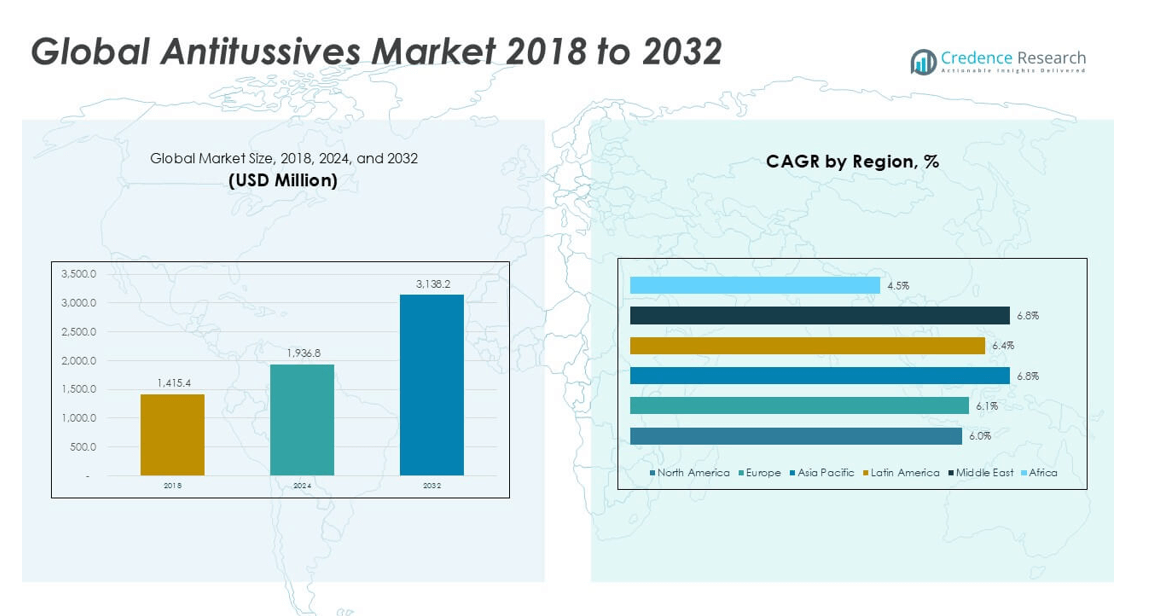
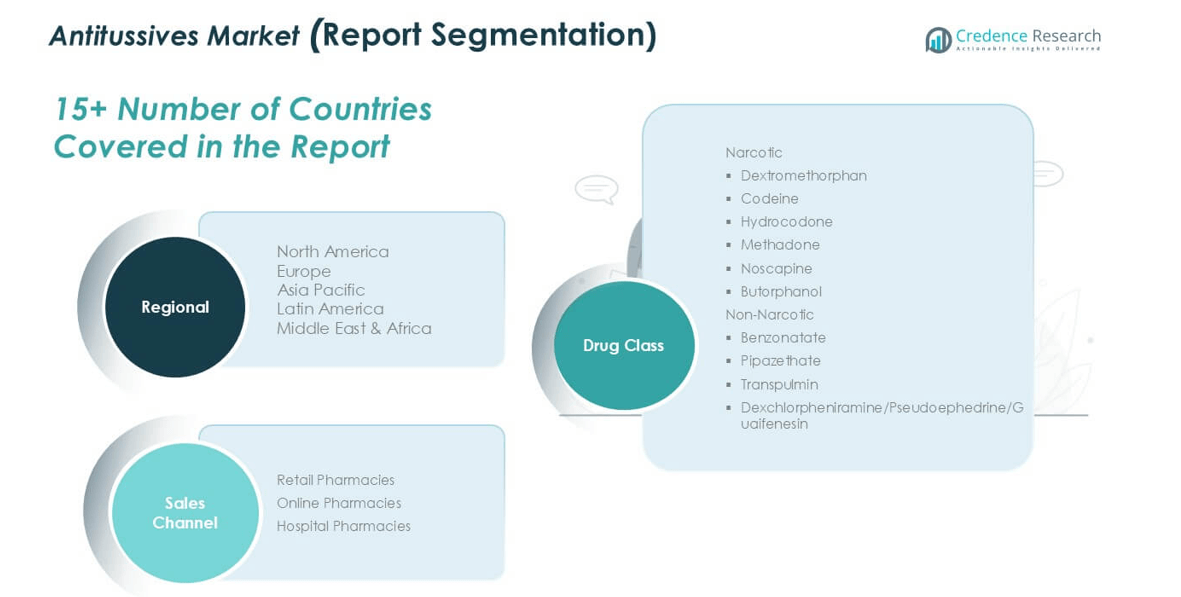
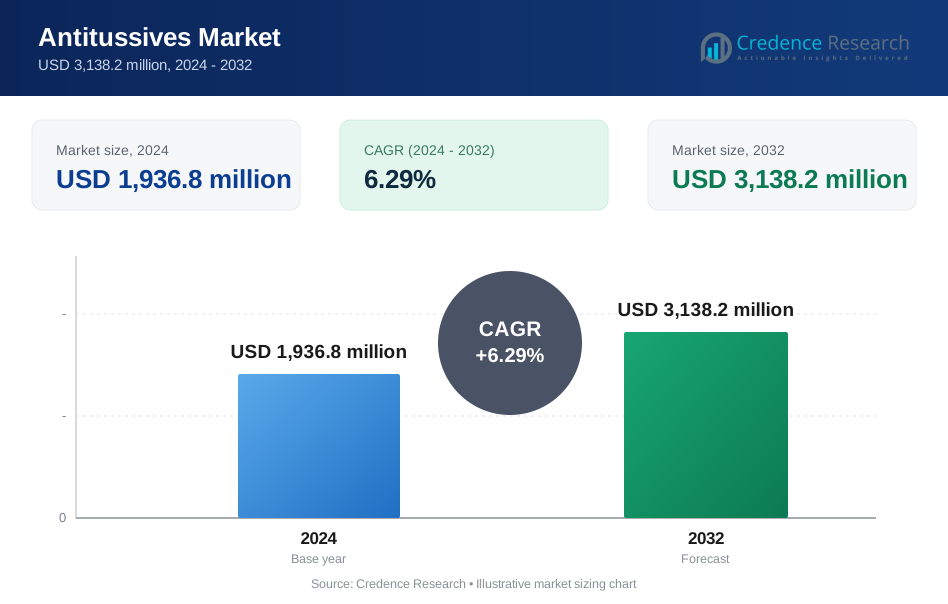
Global Antitussives market size was valued at USD 1,415.4 million in 2018 to USD 1,936.8 million in 2024 and is anticipated to reach USD 3,138.2 million by 2032, at a CAGR of 6.29% during the forecast period.
| REPORT ATTRIBUTE | DETAILS |
|---|---|
| Historical Period | 2020-2023 |
| Base Year | 2024 |
| Forecast Period | 2025-2032 |
| Antitussives Market Size 2024 | USD 1,936.8 million |
| Antitussives Market , CAGR | 6.29% |
| Antitussives Market Size 2032 | USD 3,138.2 million |
The Global Antitussives market is led by major pharmaceutical companies with strong brand portfolios. Johnson & Johnson, Pfizer, Novartis, AstraZeneca, and Merck & Co. hold strong positions through OTC and prescription products. Cipla, Alkem Laboratories, Glenmark Pharmaceuticals, Zydus Cadila, and Biophar Lifesciences strengthen competition in cost-sensitive markets. North America leads the market with an exact share of 34.1%, supported by high OTC usage and retail pharmacy reach. Europe follows with a 26.7% share, driven by strong healthcare systems. Asia Pacific accounts for 23.2% share, supported by population scale and rising access. These regions shape global revenue leadership.
Market Insights
- Global Antitussives market reached USD 1,936.8 million in 2024 and is projected to grow at a CAGR of 6.29% through 2032, supported by steady cough treatment demand across OTC and prescription channels.
- Rising respiratory infections, pollution exposure, smoking habits, and chronic conditions drive sustained antitussive use, with OTC products supporting self-medication and faster symptom relief across adult and pediatric populations.
- Non-narcotic drugs gain traction due to safety preference, while dextromethorphan remains the leading segment by share, supported by wide OTC availability and strong consumer familiarity.
- Competition remains intense, led by Johnson & Johnson, Pfizer, Novartis, and AstraZeneca, while Cipla, Alkem, Glenmark, and Zydus Cadila strengthen presence in generic and emerging markets.
- North America leads with about 34.1% share, followed by Europe at 26.7% and Asia Pacific at 23.2%, supported by retail pharmacy dominance and expanding healthcare access.
Market Segmentation Analysis:
By Drug Class
The Global Antitussives market shows clear dominance of the narcotic drug class. Narcotic antitussives hold the largest market share, driven by strong cough suppression efficacy. Dextromethorphan leads this segment, accounting for the highest share due to wide OTC use. Codeine and hydrocodone maintain demand in prescription settings for severe cough. Noscapine gains traction in markets favoring non-opioid narcotics. Non-narcotic drugs show steady growth, led by benzonatate. Demand rises from safety concerns, regulatory scrutiny on opioids, and preference for lower abuse potential therapies.
- For instance, the U.S. FDA approves dextromethorphan for OTC use at single doses up to 30 mg, while benzonatate capsules are prescribed at 100 mg or 200 mg per dose for cough suppression.
By Sales Channel
Retail pharmacies dominate the Global Antitussives market by sales channel, holding the largest revenue share. Easy access, pharmacist guidance, and strong OTC availability drive this dominance. High consumer footfall supports repeat purchases during seasonal cough outbreaks. Online pharmacies show rapid growth due to home delivery and price discounts. Digital prescriptions also support online sales. Hospital pharmacies serve acute and prescription-heavy treatments, including narcotic antitussives. Growth drivers include rising respiratory infections, self-medication trends, expanding pharmacy networks, and improved distribution efficiency across urban and semi-urban regions.
- For instance, Walgreens operates approximately 8,500 retail pharmacy locations in the United States, stocking multiple over-the-counter (OTC) antitussive brands. Similarly, CVS Health operates over 9,000 pharmacy outlets, dispensing a full range of medications, including both OTC antitussives and prescription-strength, and sometimes narcotic, antitussives.
Key Growth Drivers
Rising Prevalence of Respiratory Infections and Chronic Cough Conditions
Respiratory infections remain common across all age groups worldwide. Seasonal flu, colds, and bronchitis increase cough incidence. Urban pollution worsens airway irritation and cough frequency. Smoking and passive smoke exposure add long-term respiratory stress. Chronic diseases such as asthma and COPD raise persistent cough cases. Aging populations show higher vulnerability to respiratory illnesses. The Global Antitussives market benefits from this sustained clinical need. Physicians prescribe antitussives to improve patient comfort and sleep quality. OTC antitussives support early symptom control. Public awareness of cough management continues to rise. Healthcare visits for respiratory symptoms remain high. This driver supports stable demand across acute and chronic care settings.
- For instance, the World Health Organization reports around 262 million people living with asthma globally, while chronic obstructive pulmonary disease affects over 300 million patients, both conditions often requiring cough management therapies.
Strong Demand for Over-the-Counter Cough Medications
Consumers prefer quick relief for mild to moderate cough symptoms. OTC antitussives enable self-care without physician visits. Retail pharmacies promote easy access to cough syrups and tablets. Brand familiarity influences repeat purchases. Pediatric and adult formulations expand consumer choice. The Global Antitussives market gains from high-volume OTC sales. Dextromethorphan-based products dominate shelves globally. Non-prescription availability improves treatment adherence. Busy lifestyles support self-medication trends. Packaging innovation improves dosing accuracy. Marketing campaigns educate consumers on symptom relief. This driver strengthens steady sales across urban and rural markets.
- For instance, Johnson & Johnson’s Benylin and GSK’s Robitussin product lines distribute millions of cough syrup bottles annually across global retail markets, with standard pack sizes ranging from 100 mL to 250 mL to support short-term home treatment needs.
Expansion of Healthcare Access and Pharmacy Networks
Healthcare infrastructure continues to expand in emerging economies. Governments invest in primary care and retail pharmacy coverage. Rural access improves through chain pharmacies and digital platforms. Hospital networks increase outpatient treatment capacity. The Global Antitussives market benefits from broader drug availability. Prescription fulfillment rates improve across regions. Pharmacist-led counseling supports appropriate product selection. Supply chain efficiency reduces stock shortages. Insurance coverage increases access to prescription antitussives. This driver supports consistent volume growth. Improved distribution channels enhance market penetration. Healthcare modernization sustains long-term demand stability.
Key Trends & Opportunities
Shift Toward Non-Narcotic and Safer Cough Therapies
Safety concerns influence antitussive prescribing behavior. Regulators tighten controls on opioid-based cough medicines. Physicians prefer non-narcotic alternatives for routine treatment. Benzonatate and pipazethate gain clinical acceptance. The Global Antitussives market reflects this safety-driven shift. Parents favor non-opioid products for pediatric use. Abuse risk awareness affects prescribing decisions. Manufacturers invest in reformulation and safety labeling. This trend creates opportunities for safer drug development. Non-narcotic portfolios support long-term growth. Regulatory alignment improves market confidence.
- For instance, benzonatate is prescribed in capsule strengths of 100 mg and 200 mg, while the U.S. FDA mandates boxed warnings for codeine cough products, restricting use in children under 18 years.
Growth of Online Pharmacies and Digital Health Platforms
Digital health adoption reshapes medicine purchasing behavior. Online pharmacies expand rapidly across developed and emerging markets. Home delivery improves convenience for cough treatment. The Global Antitussives market benefits from digital sales channels. E-prescriptions support compliant narcotic dispensing online. Price transparency attracts cost-sensitive consumers. Subscription models encourage repeat purchases. Telemedicine increases early cough diagnosis. This trend opens new revenue channels. Data analytics improve inventory planning. Digital platforms strengthen patient engagement and access.
Key Challenges
Regulatory Restrictions on Narcotic Antitussives
Strict regulations limit opioid-based cough drug usage. Authorities impose tighter prescription controls. Compliance costs increase for manufacturers. The Global Antitussives market faces reduced narcotic volumes. Physician hesitation affects prescribing rates. Monitoring requirements raise operational complexity. Some markets restrict pediatric use completely. This challenge pressures traditional product portfolios. Companies must adapt with safer alternatives. Regulatory delays impact product launches. Market players face uneven regional policies.
Risk of Misuse and Public Safety Concerns
Misuse of cough syrups raises public health concerns. Recreational abuse attracts regulatory attention. Public campaigns warn against improper consumption. The Global Antitussives market faces reputational risks. Retailers enforce stricter sales monitoring. Prescription verification becomes mandatory in many regions. Youth misuse concerns affect brand perception. Manufacturers invest in abuse-deterrent formulations. This challenge increases development costs. Balancing access and control remains complex. Long-term trust depends on responsible market practices.
Regional Analysis
North America
North America held the largest share of the Global Antitussives market in 2018. The region accounted for about 34.1% market share, valued at USD 482.95 million. High respiratory infection incidence supports demand. Strong OTC product penetration drives volume sales. Retail pharmacy dominance improves accessibility. Physicians widely prescribe antitussives for chronic cough. In 2024, the market reached USD 649.72 million. It is projected to reach USD 1,028.70 million by 2032. The region is expected to grow at a CAGR of 6.0%. Product innovation and brand loyalty support sustained growth.
Europe
Europe represented around 26.7% of the Global Antitussives market in 2018. Market size reached USD 378.35 million during that year. Strong public healthcare systems support treatment access. High awareness of cough management sustains steady demand. Non-narcotic antitussives gain preference due to safety focus. In 2024, the market expanded to USD 512.48 million. It is forecast to reach USD 819.07 million by 2032. Europe is projected to grow at a CAGR of 6.1%. Aging populations and seasonal respiratory infections remain key growth drivers across major countries.
Asia Pacific
Asia Pacific accounted for nearly 23.2% market share in 2018. The regional market was valued at USD 328.67 million. Large population bases drive high cough incidence volumes. Rapid urbanization increases pollution-related respiratory conditions. OTC drug usage remains strong in developing economies. The market reached USD 464.50 million in 2024. It is expected to reach USD 784.55 million by 2032. Asia Pacific shows a CAGR of 6.8%, the highest among regions. Expanding pharmacy networks and rising healthcare spending continue to support long-term growth momentum.
Latin America
Latin America held about 10.2% of the Global Antitussives market in 2018. The market size stood at USD 144.38 million. Respiratory infections remain common across urban centers. Retail pharmacies act as primary distribution points. Self-medication trends support OTC antitussive demand. In 2024, the market reached USD 198.72 million. It is projected to grow to USD 324.49 million by 2032. The region is expected to record a CAGR of 6.4%. Improving healthcare access and rising awareness support steady regional expansion.
Middle East
The Middle East accounted for roughly 4.3% market share in 2018. Market size reached USD 61.43 million during that year. Hot climate conditions increase respiratory irritation cases. Urban pollution supports cough treatment demand. Hospital pharmacies play a key distribution role. The market expanded to USD 86.80 million in 2024. It is forecast to reach USD 146.55 million by 2032. The region is projected to grow at a CAGR of 6.8%. Healthcare infrastructure investments and pharmacy expansion support consistent market development.
Africa
Africa held a smaller share of the Global Antitussives market in 2018. The region accounted for around 1.4% market share, valued at USD 19.67 million. Limited healthcare access restricts treatment penetration. Respiratory infections remain underdiagnosed in rural areas. OTC products dominate urban demand. The market reached USD 24.60 million in 2024. It is expected to reach USD 34.83 million by 2032. Africa is projected to grow at a CAGR of 4.5%. Public health programs and pharmacy expansion gradually support market growth.
Market Segmentations:
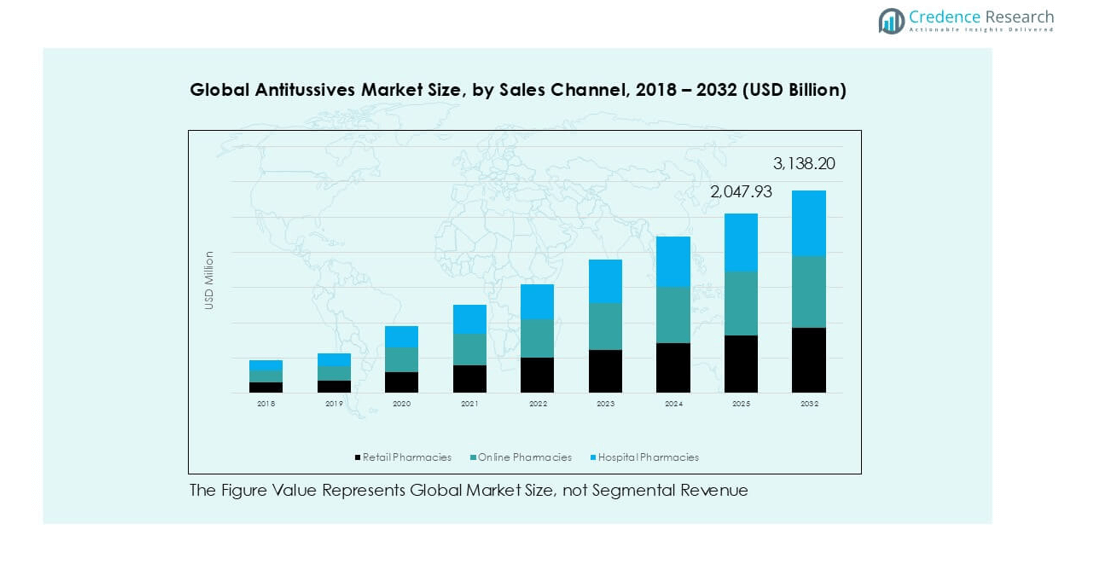
By Drug Class
- Narcotic
- Dextromethorphan
- Codeine
- Hydrocodone
- Methadone
- Noscapine
- Butorphanol
- Non-Narcotic
- Benzonatate
- Pipazethate
- Transpulmin
By Sales Channel
- Retail Pharmacies
- Online Pharmacies
- Hospital Pharmacies
By Geography
- North America
- U.S.
- Canada
- Mexico
- Europe
- Germany
- France
- U.K.
- Italy
- Spain
- Rest of Europe
- Asia Pacific
- China
- Japan
- India
- South Korea
- South-east Asia
- Rest of Asia Pacific
- Latin America
- Brazil
- Argentina
- Rest of Latin America
- Middle East & Africa
- GCC Countries
- South Africa
- Rest of the Middle East and Africa
Competitive Landscape
The Global Antitussives market features strong competition among multinational and regional pharmaceutical companies. Leading players focus on broad OTC and prescription portfolios. Companies such as Johnson & Johnson, Pfizer, Novartis, and AstraZeneca leverage strong brand recognition. These firms maintain wide retail and hospital distribution networks. Generic manufacturers such as Cipla, Alkem Laboratories, Glenmark Pharmaceuticals, and Zydus Cadila compete on cost efficiency. Product differentiation centers on formulation safety and taste. Non-narcotic antitussives gain higher focus due to regulatory pressure. Companies invest in pediatric-friendly syrups and dosage formats. Strategic partnerships support market expansion. Mergers and licensing agreements strengthen regional presence. Continuous product launches improve shelf visibility. Competitive intensity remains high due to price sensitivity. Regulatory compliance and supply reliability shape long-term positioning.
Key Player Analysis
- Biophar Lifesciences
- AstraZeneca
- Alkem Laboratories
- Cipla Ltd
- Glenmark Pharmaceuticals
- Johnson & Johnson Services Inc.
- Merck & Co.
- Novartis AG
- Pfizer, Inc.
- Zydus Cadila
Recent Developments
- In November 2024, Pfizer Inc. entered a strategic collaboration with Zai Lab for the novel antibacterial drug XACDURO® (sulbactam-durlobactam) in mainland China, where Pfizer’s affiliates gained exclusive rights to commercialization activities through November 2028, aiming to accelerate patient access using Pfizer’s anti-infective infrastructure.
- In May 2023, the Indian government initiated a new rule to ensure that cough syrups exported from the country are safe for consumption. The new rule that has been set in since 1st June 2023 required cough syrup manufacturers to undergo product testing at specific government laboratories before they receive permits for exporting the products.
- In 2023, GlaxoSmithKline plc (GSK) acquired Bellus Health for $2 billion to gain camlipixant, a Phase 3 P2X3 inhibitor for chronic cough as an antitussive rival to Merck’s gefapixant, with data expected in 2024-2025 and potential launch in 2026 offering better efficacy and tolerability
Report Coverage
The research report offers an in-depth analysis based on Drug Class, Sales Channel and Geography. It details leading market players, providing an overview of their business, product offerings, investments, revenue streams, and key applications. Additionally, the report includes insights into the competitive environment, SWOT analysis, current market trends, as well as the primary drivers and constraints. Furthermore, it discusses various factors that have driven market expansion in recent years. The report also explores market dynamics, regulatory scenarios, and technological advancements that are shaping the industry. It assesses the impact of external factors and global economic changes on market growth. Lastly, it provides strategic recommendations for new entrants and established companies to navigate the complexities of the market.
Future Outlook
- Demand will remain steady due to recurring respiratory infections and seasonal cough conditions.
- Non-narcotic antitussives will gain wider acceptance due to safety and regulatory preference.
- OTC products will continue to dominate volume sales across retail pharmacies.
- Online pharmacy channels will expand through digital prescriptions and home delivery.
- Pediatric-friendly formulations will support long-term consumer adoption.
- Emerging markets will show faster growth due to healthcare access expansion.
- Product reformulation will focus on taste, dosing accuracy, and safety profiles.
- Regulatory oversight will shape portfolio strategies for narcotic drugs.
- Brand trust and pharmacist recommendations will influence purchase decisions.
- Competitive intensity will remain high due to generic competition and pricing pressure.
Request a Free Sample
Fill in your details and we'll send you a free sample report.
- Sample data tables & charts
- Research methodology
Need a Custom Version of This Report?
Tailor the scope, geography, or segments to your exact requirements.
- Custom geography or segment scope
- Direct access to our analyst team
Frequently Asked Questions
What is the current market size for the Antitussives Market, and what is its projected size in 2032?
At what Compound Annual Growth Rate is the Antitussives Market projected to grow between 2025 and 2032?
Which Antitussives Market segment held the largest share in 2024?
Who are the leading companies in the Antitussives Market?
Who are the major players in this market?
Table of Content
Chapter 1. Report Introduction
- 1.1 Report Description & Purpose
- 1.1.1 Report Title & Market Definition
- 1.1.2 Unique Selling Propositions (USP) & Key Differentiators
- 1.1.3 Value Proposition for Stakeholders
- 1.2 Research Objectives
- 1.2.1 Market Sizing Objectives (Volume & Revenue)
- 1.2.2 Segmentation Objectives
- 1.2.3 Competitive Intelligence Objectives
- 1.2.4 Forecast & Scenario Objectives
- 1.3 Report Scope
- 1.3.1 Antitussives Scope – Types & Subtypes Covered
- 1.3.2 Geographic Scope – Regions & Countries Covered
- 1.3.3 Historical Period, Base Year & Forecast Period (2024; forecast to 2032)
- 1.3.4 Inclusions & Exclusions
- 1.4 HS Code & Classification Framework
- 1.5 Currency, Units & Pricing Basis
- 1.6 Target Stakeholders
- 1.7 Limitations & Assumptions
Chapter 2. Executive Summary
- 2.1 Global Antitussives Market Snapshot
- 2.1.1 Market Size – Historical (2024) & Forecast (2024-2032) (2024: USD 1,936.8 million → 2032: USD 3,138.2 million)
- 2.1.2 Volume & Revenue – Global Totals
- 2.1.3 Key Market Highlights – Top Five Facts
- 2.2 Antitussives Market Segmentation Snapshot
- 2.2.1 Market Split by Region – 2024 vs. 2032
- 2.3 Competitive Snapshot
- 2.3.1 Top 10 Players by Revenue Share – 2024
- 2.3.2 Top 10 Players by Volume Share – 2024
- 2.3.3 Recent Strategic Developments (18-Month Summary)
- 2.4 Key Investment Highlights & Strategic Conclusions
Chapter 3. Antitussives Market Dynamics & Industry Analysis
- 3.1 Market Overview & Context
- 3.1.1 Antitussives Market Position in the Broader Automotive Value Chain
- 3.1.2 OEM vs. Replacement Market Dynamics
- 3.1.3 Market Maturity & Development Stage by Region
- 3.2 Antitussives Market Drivers
- 3.3 Antitussives Market Restraints & Challenges
- 3.4 Antitussives Market Opportunities
- 3.5 Porter's Five Forces Analysis
- 3.5.1 Threat of New Entrants
- 3.5.2 Bargaining Power of Suppliers
- 3.5.3 Bargaining Power of Buyers
- 3.5.4 Threat of Substitutes
- 3.5.5 Competitive Rivalry – Intensity Assessment
- 3.6 Antitussives Value Chain Analysis
- 3.6.1 Upstream – Raw Material/Input Suppliers
- 3.6.1.1 Raw Material/Input 1
- 3.6.1.2 Raw Material/Input 2
- 3.6.1.3 Raw Material/Input 3
- 3.6.2 Midstream – Production/Manufacturing/Service Delivery
- 3.6.2.1 Production/Process Overview
- 3.6.2.2 Key Facility Locations & Capacity by Manufacturer
- 3.6.3 Downstream – Distribution & End Consumer
- 3.6.3.1 Primary Channel – B2B/OEM
- 3.6.3.2 Secondary Channels – Dealer, Retail, Online, Direct
- 3.6.4 Value Chain Profitability Analysis
- 3.6.1 Upstream – Raw Material/Input Suppliers
- 3.7 PESTEL Analysis
- 3.7.1 Political Factors
- 3.7.2 Economic Factors
- 3.7.3 Social Factors
- 3.7.4 Technological Factors
- 3.7.5 Environmental Factors
- 3.7.6 Legal Factors
- 3.8 Antitussives Supply Chain Analysis
- 3.8.1 Raw Material/Input Supply Risk Assessment
- 3.8.2 Manufacturing Concentration Risk (Geographic Exposure)
- 3.8.3 Trade Disruption Impact Analysis
- 3.9 Regulatory & Policy Landscape
Note: The regulatory and policy landscape section covers regulations based on their applicability to the market, Antitussives category, geography, and scope of the study. Only regulatory frameworks with a material impact on operations, compliance, trade, sustainability, or market access are analyzed in detail.
Chapter 4. Key Investment Pockets & Opportunity Analysis
- 4.1 Antitussives Market Attractiveness Analysis
- 4.1.1 By Region – Investment Attractiveness Matrix (Volume × CAGR)
- 4.2 Absolute Revenue Growth Opportunity
- 4.2.1 By Region – Absolute USD Growth Through 2032
- 4.3 Incremental Volume Opportunity
- 4.3.1 By Region – Incremental Volume Through 2032
- 4.3.2 Segment – Incremental Volume
- 4.4 Emerging Submarket Opportunity Deep Dive (Subject to Applicability)
- 4.5 Emerging Market Opportunity Scorecards
- 4.5.1 United States
- 4.5.2 Europe
- 4.5.3 Asia
- 4.5.4 Middle East & Africa
Note: Emerging Market Opportunity Scorecards will be included based on relevance and strategic importance. Regions listed are indicative and may vary depending on data availability and market dynamics.
Chapter 5. Antitussives Import-Export Analysis & Trade Flows
- 5.1 Global Trade Overview
- 5.1.1 Global Export Value by Country (2024)
- 5.1.2 Global Export Volume by Country (2024)
- 5.1.3 Global Import Value by Country (2024)
- 5.1.4 Global Import Volume by Country (2024)
- 5.1.5 Net Trade Balance by Country (2024)
- 5.2 Export Analysis – Segment
- 5.2.1 Type 1 (HS Code)
- 5.2.2 Type 2 (HS Code)
- 5.2.3 Type 3 (HS Code)
- 5.2.4 Type 4 (HS Code)
- 5.2.5 Type 5 (HS Code)
- 5.3 Import Analysis – Segment
- 5.3.1 Type 1 (HS Code)
- 5.3.2 Type 2 (HS Code)
- 5.3.3 Type 3 (HS Code)
- 5.3.4 Type 4 (HS Code)
- 5.3.5 Type 5 (HS Code)
- 5.4 Average Unit Trade Prices
- 5.4.1 Average Export Price – Segment & Country
- 5.4.2 Average Import Price – Segment & Source Country
- 5.4.3 Price Trends (2024)
- 5.5 Key Trade Route Analysis
- 5.5.1 Trade Route 1
- 5.5.2 Trade Route 2
- 5.5.3 Trade Route 3
- 5.5.4 Trade Route 4
- 5.5.5 Trade Route 5
- 5.6 Trade Policy Impact Assessment
- 5.6.1 US Anti-Dumping & Section 301 Tariffs
- 5.6.2 EU Customs Union Impact
- 5.6.3 Major Free Trade Agreements
- 5.6.4 USMCA Rules of Origin
Note: Trade policy analysis will be included only where relevant to the Antitussives market.
Chapter 6. Competitive Landscape & Company Benchmarking
- 6.1 Antitussives Market Concentration & Structure
- 6.1.1 Herfindahl-Hirschman Index (HHI) – vs. 2024
- 6.1.2 Tier 1, Tier 2 & Tier 3 Market Structure
- 6.1.3 Global, Regional & Local Player Dynamics
- 6.2 Antitussives Market Share Analysis – 2024
- 6.2.1 Global Revenue Share by Company
- 6.2.2 Global Volume Share by Company
- 6.2.3 Regional Revenue Share
- 6.2.4 Market Share Evolution ( vs. 2024)
- 6.2.5 OEM Segment Share by Company
- 6.2.6 Replacement Segment Share by Company
- 6.3 Production/Delivery Capacity & Facility Analysis
- 6.3.1 Global Installed Capacity
- 6.3.2 Capacity Utilization Rates
- 6.3.3 Production/Output Volume
- 6.3.4 Facility Locations & Capacity Map
- 6.3.5 Planned Capacity Additions
- 6.4 Antitussives Competitive Benchmarking Matrix
- 6.4.1 Revenue, Volume, CAGR & Profitability Comparison
- 6.4.2 Channel Revenue Mix
- 6.4.3 Geographic Revenue Exposure
- 6.4.4 R&D Intensity
- 6.4.5 Sustainability Maturity
- 6.5 Strategic Developments in Antitussives (Last 24 Months)
- 6.5.1 Mergers, Acquisitions & Divestments
- 6.5.2 New Antitussives Launches
- 6.5.3 Facility Expansions
- 6.5.4 Strategic Alliances, Joint Ventures & Partnerships
- 6.5.5 Distribution Expansion & Market Entry
- 6.5.6 Sustainability & ESG Initiatives
- 6.6 Competitive Strategy Mapping
- 6.6.1 Leader, Challenger, Follower & Niche Classification
- 6.6.2 Pricing Strategy Comparison
- 6.6.3 Channel Strategy Matrix
Note: Strategic developments are included based on their materiality and the availability of reliable information.
Chapter 7. Global Antitussives Market – By Distribution Channel
- 7.1 Segment Overview
- 7.1.1 Volume & Revenue Split by Channel (2024 & 2032)
- 7.1.2 Channel Mix Evolution (2024-2032)
Chapter 8. Regional Market Analysis – Global Overview
- 8.1 Global Regional Overview
- 8.1.1 Regional Volume Share
- 8.1.2 Regional Revenue Share
- 8.1.3 Regional Volume by Region
- 8.1.4 Regional Revenue by Region
- 8.1.5 Regional Forecast Through 2032
- 8.2 Cross-Regional Segment Analysis
- 8.2.1 By Distribution Channel
- 8.2.2 By Brand/Price Tier
Chapter 9. North America Antitussives Market
- 9.1 United States
- 9.2 Canada
- 9.3 Mexico
Chapter 10. Europe Antitussives Market
- 10.1 Germany
- 10.2 France
- 10.3 Italy
- 10.4 United Kingdom
- 10.5 Spain
- 10.6 Poland
- 10.7 Russia
- 10.8 Netherlands
- 10.9 Belgium
- 10.10 Sweden
- 10.11 Denmark
- 10.12 Norway
- 10.13 Rest of Europe
Chapter 11. Asia Pacific Antitussives Market
- 11.1 China
- 11.2 India
- 11.3 Japan
- 11.4 South Korea
- 11.5 Thailand
- 11.6 Indonesia
- 11.7 Vietnam
- 11.8 Malaysia
- 11.9 Australia
- 11.10 Rest of Asia Pacific
Chapter 12. Latin America Antitussives Market
- 12.1 Brazil
- 12.2 Argentina
- 12.3 Colombia
- 12.4 Chile
- 12.5 Rest of Latin America
Chapter 13. Middle East Antitussives Market
- 13.1 Saudi Arabia
- 13.2 United Arab Emirates
- 13.3 Turkey
- 13.4 Israel
- 13.5 Iran
- 13.6 Rest of the Middle East
Chapter 14. Africa Antitussives Market
- 14.1 South Africa
- 14.2 Egypt
- 14.3 Nigeria
- 14.4 Morocco
- 14.5 Rest of Africa
Chapter 15. Antitussives Company Profiles
- 15.1 [Company 01]
- 15.1.1 Company Overview
- 15.1.2 Key Management Personnel
- 15.1.3 Products & Services Portfolio
- 15.1.4 Financial Performance
- 15.1.5 Key Market Focus & Geographic Presence
- 15.1.6 Recent Developments & Strategic Initiatives
Note: The company profile list is preliminary and may change based on research findings, market developments, data availability, and client requirements.
Chapter 16. Appendices
- Appendix A – List of Abbreviations & Acronyms
- Appendix B – Industry Classification Code Reference – Full Series
- Appendix C – Production & Capacity Data Tables
- Appendix D – End-Use & Demand Base Tables
- Appendix E – Consumption & Replacement Rate Assumptions
- Appendix F – ASP Reference Tables
- Appendix G – Manufacturing & Facility Database
- Appendix H – Import-Export Data Tables
- Appendix I – Regulatory Summary Tables
- Appendix J – Primary Research Participant List (Anonymized)
- Appendix K – Primary Research Questionnaire Framework
- Appendix L – Data Sources & Bibliography
- Appendix M – Market Size Divergence & Source Comparison
Chapter 17. Research Methodology
- 17.1 Research Framework & Philosophy
- 17.2 Secondary Research – Sources, Hierarchy & Data Extraction
- 17.3 Data Modeling – Bottom-Up & Top-Down Market Sizing
- 17.4 Primary Research – Stakeholder Framework, LOI & Sample Sizes
- 17.5 Forecast Methodology – Regression, Scenario & Sensitivity Analysis
- 17.6 Quality Control – Four-Layer Validation Framework
- 17.7 Limitations & Standard Assumptions
- 17.8 Disclaimer
