
| REPORT ATTRIBUTE | DETAILS |
|---|---|
| Historical Period | 2019-2022 |
| Base Year | 2023 |
| Forecast Period | 2024-2032 |
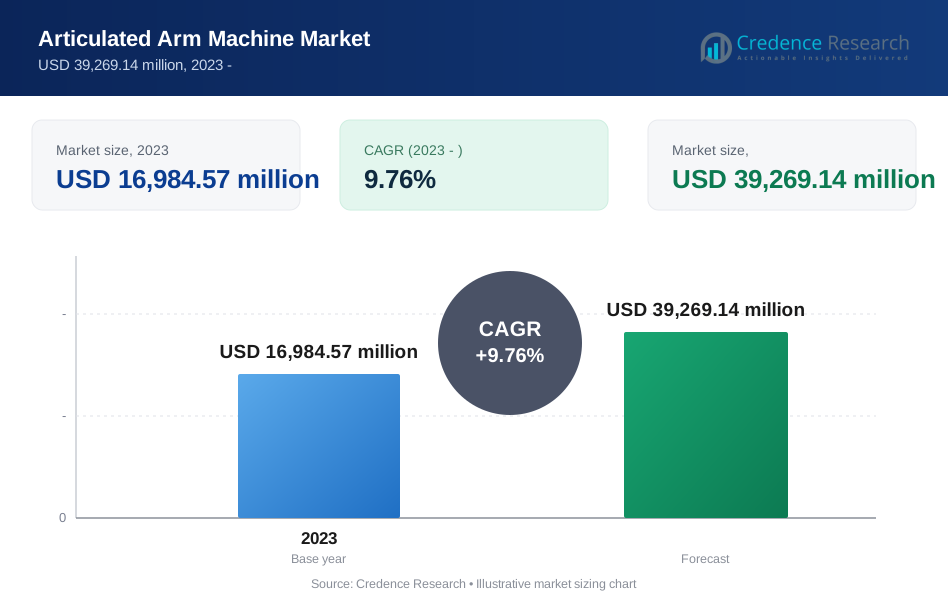
| Articulated Arm Machine Market Size 2023 | USD 16,984.57 Million |
| Articulated Arm Machine Market, CAGR | 9.76% |
| Articulated Arm Machine Market Size 2032 | USD 39,269.14 Million |
Market Insights
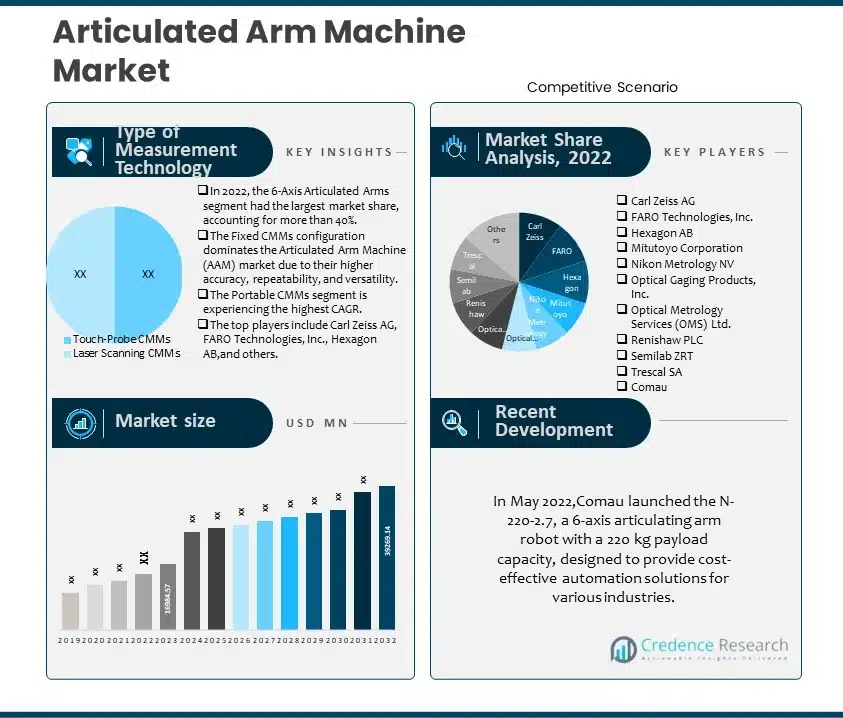
- Touch-Probe CMMs hold the largest market share in the Articulated Arm Machine market, accounting for approximately 70-75% of the global market. This dominance is attributed to their lower cost, versatility, and established technology, making them suitable for various industries and applications.
- Fixed CMMs dominate the Articulated Arm Machine market in terms of configuration, due to their higher accuracy, repeatability, and versatility. They are ideal for high-precision applications in aerospace, medical devices, automotive components, and research & development.
- 6-Axis articulated arms currently hold the largest market share, accounting for more than 40%. They offer a good balance of flexibility, payload capacity, and cost, making them well-suited for various industrial applications like welding, material handling, assembly, and painting.
- The automotive manufacturing sector dominates the Articulated Arm Machine market with a share of 30-35% in 2022. The segment's growth is fueled by high demand for automation, complex production lines, and emphasis on quality control.
- The electronics industry is expected to witness the highest CAGR in the Articulated Arm Machine market due to the miniaturization of electronic components, rapid growth of semiconductor and consumer electronics sectors, and increasing adoption of automated assembly lines.
- Standard accuracy articulated arms hold the largest market share, more than 35%, in the Articulated Arm Machine market. Their cost-effectiveness and suitability for various applications contribute to their popularity in sectors like general manufacturing, automotive assembly, and quality control.
- North America holds the largest market share of about 35-40% in the Articulated Arm Machine market, driven by its strong presence of key industries, high focus on automation, and established infrastructure supporting research, development, and manufacturing of these machines.
- The primary drivers of the global Articulated Arm Machine market include increasing demand across various industries, technological advancements, and the growing importance of automation.
Executive Summary
Market Definition
An articulated arm machine, also known as an articulated robot, is a type of machine that closely resembles a human arm. It is widely used in various industries for its versatility and flexibility. The typical six-axis articulated arm has a design similar to the human arm, allowing it to perform a wide range of tasks, including part removal from injection molding machines, machine tending, and other applications that require reaching into non-parallel planes or under obstructions. Articulated arms are known for their ability to excel in clean and dirty environments, their high speed, and their capability to be mounted on various surfaces, making them suitable for a wide range of working options. In the market, the portable articulated arm CMM (Coordinate Measuring Machine) is known for its user-friendly and quick measurement capabilities, holding a significant share in the CMM market. The use of articulated arm machines is prevalent in industries such as automotive, aerospace, and heavy machinery, where they provide quick and accurate measurements and are expected to experience significant growth in the coming years.
Market Overview
The global Articulated Arm Machine market has undergone significant expansion in recent years and is forecasted to demonstrate a substantial CAGR of 9.76% between 2024 and 2032. With a market valuation of USD 16,984.57 million in 2023, it is expected to reach USD 39,269.14 million by 2032.
A pivotal driver fueling the growth of the Articulated Arm Machine market is the widespread recognition of articulated arm machines as versatile and indispensable tools in various industries. This surge in acceptance is attributed to the machines' ability to mimic human arm movements, offering versatility, flexibility, and precision in tasks ranging from manufacturing to quality control. Articulated arm machines are gaining prominence due to their advantages, including high speed, accuracy, and suitability for clean and dirty environments.
Furthermore, the Articulated Arm Machine market is actively propelled by its capacity to address challenges encountered in industries, such as the need for precise measurements, complex manipulations, and the ability to operate in non-parallel planes. The market is poised for substantial growth during the forecast period, fueled by the increasing adoption of articulated arm machines across diverse applications.
In addition to their application in traditional industries, the Articulated Arm Machine market is exploring new opportunities in innovative technologies, responding to the demand for automation, increased accuracy, and adaptability. Collaborations between technology providers and end-users are fostering advancements in articulated arm machine technologies and expanding their applications in various industries.
The ongoing developments in sensor technology, miniaturization, and data processing are contributing to the market's evolution, making articulated arm machines an integral component in the pursuit of efficiency, productivity, and innovation across industries.
Segmentation by Type of Measurement Technology
- Touch-Probe CMMs hold the largest market share, accounting for approximately 70-75% of the global CMM market. Touch-probe CMMs lead the market due to their lower cost, versatility, and established technology. They are suitable for various industries and applications, have a wide range of measuring capabilities, and benefit from a large user base and support infrastructure.
- Laser Scanning CMMs are expected to experience rapid CAGR growth due to advancements in technology, increased demand for automation, and improved accuracy and speed. Their ability to measure complex parts quickly and accurately makes them ideal for automotive, aerospace, and other precision-oriented industries.
Segmentation by Configuration
- Fixed CMMs dominate the AAM market due to their higher accuracy, repeatability, and versatility. They are ideal for high-precision applications in aerospace, medical devices, automotive components, and research & development. Established infrastructure and investment in fixed CMMs also contribute to their popularity, making them a preferred choice over portable alternatives.
- Portable CMMs will experience the highest CAGR due to their flexibility, technological advancements, and cost-effectiveness. They cater to on-site inspections, small production lines, and reverse engineering needs. Advancements in sensors, miniaturization, and data processing enhance their accuracy and capabilities, making them an attractive option for smaller companies or specific applications.
Segmentation by Number of Axes
- 6-Axis articulated arms currently hold the largest market share about more than 40%. They offer a good balance of flexibility, payload capacity, and cost, making them well-suited for various industrial applications like welding, material handling, assembly, and painting.
- The 7-axis articulated arm market is expected highest CAGR due to increasing demand for precise and dexterous robotic manipulation in industries such as manufacturing and healthcare. Technological advancements have made these robots more compact, affordable, and user-friendly, leading to growing awareness and adoption in new applications.
Segmentation by Application
- The automotive manufacturing sector dominates the articulated arm machine marketwith share of 30-35%in 2022. The segment growth due to its high demand for automation, complex production lines, and emphasis on quality control. Articulated arms provide precision, flexibility, and speed, making them ideal for tasks like welding, painting, and assembly. They also excel at navigating intricate environments and perform quality control tasks like dimensional inspection and defect detection, ensuring production quality.
- Aerospace Industry currently holding a smaller market share, the aerospace industry is also expected to experience significant growth due to the increasing demand for lightweight and complex aircraft components. Articulated arms are well-suited for tasks like composite material handling and automated assembly in this sector.
- General Manufacturing segment encompasses a diverse range of applications across various industries. While individual applications might not hold a substantial share, their collective demand contributes significantly to the overall market size.
Segmentation by End-User Industry
- The electronics industry is expected to witness the highest CAGR due to the miniaturization of electronic components, rapid growth of semiconductor and consumer electronics sectors, and increasing adoption of automated assembly lines in electronics manufacturing. High-precision tools are required for assembly and inspection, driving the demand for articulated robots.
- Heavy Machinery segment has moderate growth, mainly used for inspection and maintenance of large equipment in industries like construction and mining.
Segmentation by Accuracy Level
- Standard accuracy articulated arms hold the largest market share more then 35% due to their cost-effectiveness and suitability for various applications. They are more affordable than high and ultra-high accuracy options, making them accessible to a wider range of users. Additionally, their accuracy level is sufficient for many tasks in sectors like general manufacturing, automotive assembly, and quality control.
- The ultra-high accuracy articulated arm segment is expected to witness the highest CAGR due to growing demand for precision in industries like aerospace, medical device manufacturing, and robotics. Technological advancements in sensor technology, material science, and robotics enable the creation of even more accurate and reliable articulated arms, further driving their adoption in automation processes.
Segmentation by Region
- North America holds largest market share of about 35-40% of the articulated arm machine market due to its strong presence of key industries, high focus on automation, and established infrastructure. Major players in automotive, aerospace, and manufacturing rely on articulated arm machines for tasks like inspection, measurement, and assembly. Companies are investing in automation, and articulated arm machines are a valuable tool for improving efficiency and productivity. The region's well-developed infrastructure supports research, development, and manufacturing of these machines.
- Asia Pacific and Europe collectively account for just under 55% share in 2023, with Europe holding over 18% share in the same year.
- Asia Pacific is a significant market for articulated arm machines due to rapid industrialization, cost-effectiveness, and rising disposable incomes. The region's industrial growth creates a demand for automation solutions, while the machines' cost-effectiveness makes them attractive to manufacturers. Increasing disposable incomes drive the need for efficient manufacturing processes, further boosting the market.
- The rest of the world, including Latin America, the Middle East, and Africa, supplies the remaining demand for Articulated Arm Machine.
The growth of the articulated arm machines market in North America can be attributed to several factors. Firstly, the region has witnessed significant technological advancements, which have led to the development of more advanced and efficient articulated arm machine. Secondly, the increasing demand for industrial automation in North America has contributed to the growth of the market. Thirdly, the presence of key market players in the region has also played a significant role in driving the growth of the market. For instance, in February 2023, Kuka has launched a new range of Fortec industrial robotic arms designed to meet the needs of the electromobility sector. The KR Fortec ultra family includes five robot variants capable of handling high payloads and moments of inertia, ideal for applications such as battery production and vehicle assembly. Finally, the rising demand for articulated arm machines in various applications, such as manufacturing, automotive, electrical and electronics, energy and power, and aerospace, has further contributed to the expansion of the market in North America.
The growth of the articulated arm machines market in the Asia Pacific region is driven by several factors, including the increasing demand for advanced robotics, the rising need for articulated arms in industries such as automotive, aerospace, industrial, and power generation, and the escalating demand for portable Coordinate Measuring Machines (CMM) across different industries. Additionally, the market growth is supported by the expanding applications of articulated arm machines in various sectors. For instance, in December 2023,Yamaha Motor introduced the YK-XEC series, a new line of clean SCARA robots that meet ISO Class 4 cleanliness standards, ideal for use in clean rooms. The robots offer high operational performance and cost efficiency, featuring a standard cycle time of 0.42 sec and maximum payload capabilities identical to the YK-XE series. The YK-XEC series aims to improve productivity and reduce labor costs in various manufacturing plants, particularly those producing semiconductors, hard disk drives, food, and medical equipment.
Key Highlights of the Report
The global Articulated Arm Machine market is extensively segmented based on measurement technology, configuration, number of axes, application, end-user industry, accuracy level, and region. Touch-Probe CMMs dominate the market share, driven by their lower cost, versatility, and established technology. Fixed CMMs hold a significant position in the market, preferred for their higher accuracy and repeatability in high-precision applications.
The market exhibits dominance in the automotive manufacturing sector, accounting for a substantial share, attributed to the demand for automation and precision in tasks like welding, painting, and assembly. The electronics industry is anticipated to witness the highest CAGR, driven by the miniaturization of electronic components and the adoption of automated assembly lines. Portable CMMs are poised for the highest CAGR in the market, owing to their flexibility, technological advancements, and cost-effectiveness.
6-Axis articulated arms hold the largest market share among the number of axes, offering a balance of flexibility, payload capacity, and cost. North America commands the largest market share, driven by a strong presence of key industries, high automation focus, and well-developed infrastructure supporting research and development.
The major driver for the Articulated Arm Machine market is the increasing demand across various industries, fueled by technological advancements and the growing significance of automation. The market's ability to provide precision, flexibility, and speed in tasks across diverse applications contributes to its significant growth.
What Are The Main Drivers Of The Global Articulated Arm Machine Market?
The main drivers of the global articulated arm machine market include the increasing demand across various industries, technological advancements, and the growing importance of automation.
What Are The Major Challenges Faced By The Global Articulated Arm Machine Market?
The major challenges faced by the global articulated arm machine market include the lack of awareness about the features of articulated arm machines, the absence of a skilled workforce, the lack of standards and protocols for the usage of articulated arm solutions, and the need for product differentiation and innovation to avoid competing solely on price, which affects profit margins.
What Are The Growth Opportunities In The Global Articulated Arm Machine Market?
The increasing demand for portable CMM (Coordinate Measuring Machine) across different industries, such as automotive, aerospace, industrial, power generation, medical, electronics, and packaging & logistics, is anticipated to create market opportunities.
Market Drivers
The global Articulated Arm Machine market is driven by several factors. The following are the key drivers of the global Articulated Arm Machine market:
Increasing Demand For Automation
The demand for automation in various industries like manufacturing, logistics, and healthcare is driving the growth of the articulated arm machine market. Companies like Skyline Robotics, Hexagon, and others are developing robots that can perform tasks with precision, speed, and reliability. For instance, in January 2024, Skyline Robotics, developed Ozmo, the world's first high-rise window-cleaning robot, has been granted a patent in Japan for automating facade work using robotic arms, adding to their existing patent in Singapore for their robotic window cleaning system. This trend towards automation is expected to continue, leading to further growth in the articulated arm machine market.
Market Restraints
The global Articulated Arm Machine market faces some challenges that may hinder its growth. These include the following:
Limited Customization
Articulated arm machines are robots that are designed to perform specific tasks, but they may not always fit perfectly into every situation. Customization options are available, but they have limitations. For instance, a company may want to use an articulated arm machine to assemble a unique product, but the machine's reach or grip may not be adjustable enough to handle the specific parts or components. Similarly, an articulated arm machine used in a cleanroom setting may need to be modified to meet strict sanitation requirements, but the modifications may not be possible due to the machine's design. In such cases, the lack of customization options can limit the versatility of the articulated arm machine, making it less effective or even useless for the intended purpose.
Opportunities
The global Articulated Arm Machine market offers significant growth opportunities. These include the following:
Remote Monitoring And Predictive Maintenance
Articulated arm machines are robots designed for specific tasks. They are now being equipped with remote monitoring and predictive maintenance technologies. This means that the machines can be monitored in real time, and potential issues can be detected before they cause a breakdown. For instance, sensors can keep an eye on the machine's temperature and vibration, alerting maintenance staff to possible problems. Predictive maintenance algorithms can also analyze data over time to identify patterns and trends, allowing maintenance teams to address issues before they become major problems. These technologies help reduce downtime, improve efficiency, and cut costs for articulated arm machine users.
Competitive Landscape
Key Players
The global Articulated Arm Machine market is highly competitive, with several key players. Some of the major players in the market and their market share are as follows:
- Carl Zeiss AG
- FARO Technologies, Inc.
- Hexagon AB
- Mitutoyo Corporation
- Nikon Metrology NV
- Optical Gaging Products, Inc.
- Optical Metrology Services (OMS) Ltd.
- Renishaw PLC
- Semilab ZRT
- Trescal SA
- Others
These organizations prioritize product innovation, distribution channel expansion, and mergers and acquisitions to stay competitive.
The global Articulated Arm Machine market's key players continually seek to stay ahead by offering new products and developments.
In May 2022,Comau launched the N-220-2.7, a 6-axis articulating arm robot with a 220 kg payload capacity, designed to provide cost-effective automation solutions for various industries. The robot offers ease-of-use, streamlined integration, and reduced maintenance needs, resulting in lower operating costs and improved Mean Time To Repair (MTTR).
In September 2021, Hexagon AB released HxGN Robotic Automation, software that enables non-specialists to program industrial robots for fully automated quality inspections, aiming to ease staffing shortages and enhance manufacturing efficiency amidst Industry 4.0 challenges.
In September 2020, Igus, a German company expanded its product portfolio with the introduction of its 7th axis solution for Universal Robots and robolink bots, providing greater movement range for automation applications.
Summary of Key Findings
- The Articulated Arm Machine market is experiencing heightened demand driven by its versatility, precision, and flexibility across various industries, providing quick and accurate measurements and automation solutions.
- The market is segmented based on measurement technology, configuration, number of axes, application, end-user industry, accuracy level, and region.
- Touch-Probe CMMs lead the market, favored for their lower cost, versatility, and established technology. Fixed CMMs dominate in terms of configuration, offering higher accuracy and repeatability in precision applications.
- The automotive manufacturing sector holds a substantial share, showcasing the market's prevalence in automation and precision tasks such as welding, painting, and assembly.
- Portable CMMs are expected to experience the highest growth due to their flexibility, technological advancements, and cost-effectiveness, catering to on-site inspections and specific applications.
- North America commands the largest market share, driven by a strong presence of key industries, a focus on automation, and well-established infrastructure.
Future Outlook
- The Articulated Arm Machine market exhibits a positive outlook, with significant growth potential, especially with the increasing demand for automation across industries.
- Continued technological advancements, product innovation, and expanding applications are expected to drive the market's growth during the forecast period.
- Challenges such as the need for skilled workforce and standards for articulated arm solutions should be addressed to unlock further market potential.
- Key players should focus on innovation, market expansion, and competitive pricing to maintain a strong position in the competitive landscape of the Articulated Arm Machine market.
How CXOs Can Benefit from the Credence Research Articulated Arm Machine Market Report
The Credence Research Articulated Arm Machine Market Report provides CXOs with a comprehensive overview of the market, including:
- Market size and growth forecast: The report provides detailed estimates of the global Articulated Arm Machine market size, segmented by fiber type, network type, application, and region. It also includes forecasts for the market through 2032, based on key trends and drivers.
- Market segmentation: The report segments the Articulated Arm Machine market by fiber type, network type, application, and region. This segmentation provides CXOs with a granular understanding of the market and the opportunities in each segment.
- Competitive landscape :The report profiles the key players in the Articulated Arm Machine market and provides insights into their strategies, product offerings, and financial performance. This information can help CXOs to identify and assess their competition.
- Key trends and drivers: The report identifies and analyzes the key trends and drivers that are shaping the Articulated Arm Machine market. This information can help CXOs to make informed decisions about their investments and strategies.
CXOs can use the insights from the Credence Research Articulated Arm Machine Market Report to:
- Identify growth opportunities: The report can help CXOs to identify new growth opportunities in the Articulated Arm Machine market. For example, the report identifies the growing demand for Articulated Arm Machine from cloud computing providers and telecom companies as a key opportunity.
- Make informed investment decisions: The report can help CXOs to make informed investment decisions about Articulated Arm Machine. For example, the report provides insights into the key factors to consider when evaluating dark fiber providers and selecting dark fiber solutions.
- Develop competitive strategies: The report can help CXOs to develop competitive strategies for their Articulated Arm Machine businesses. For example, the report identifies the key strategies that dark fiber providers are using to differentiate themselves from their competitors.
- Track market developments: The report can help CXOs to track market developments and stay ahead of the curve. For example, the report provides insights into the latest trends and innovations in the Articulated Arm Machine market.
Overall, the Credence Research Articulated Arm Machine Market Report is a valuable resource for CXOs who are looking to gain a deeper understanding of the market and identify opportunities for growth.
Segmentation
By Type of Measurement Technology:- Touch-Probe CMMs
- Laser Scanning CMMs
- Portable CMMs
- Fixed CMMs
- 6-Axis Articulated Arms
- 7-Axis Articulated Arms
- Automotive Manufacturing
- Aerospace Industry
- Medical Device Manufacturing
- General Manufacturing
- Automotive
- Aerospace
- Electronics
- Medical Devices
- Heavy Machinery
- Standard Accuracy Articulated Arms
- High Accuracy Articulated Arms
- Ultra-High Accuracy Articulated Arms
- North America
- United States
- Canada
- Mexico
- Europe
- Germany
- United Kingdom
- France
- Italy
- Spain
- Rest of Europe
- Asia Pacific
- China
- Japan
- India
- South Korea
- Australia
- Rest of Asia Pacific
- Latin America
- Brazil
- Argentina
- Rest of Latin America
- Middle East & Africa
- GCC Countries
- South Africa
- Rest of Middle East and Africa
Request a Free Sample
Fill in your details and we'll send you a free sample report.
- Sample data tables & charts
- Research methodology
Need a Custom Version of This Report?
Tailor the scope, geography, or segments to your exact requirements.
- Custom geography or segment scope
- Direct access to our analyst team
Frequently Asked Questions
What is the current size of the global Articulated Arm Machine market?
What is the expected growth rate of the Articulated Arm Machine market between 2024 and 2032?
Which segment is leading the market share in terms of Type of Measurement Technology?
Which Configuration segment governs the demand for Articulated Arm Machine in the world?
Who are the major players in the global Articulated Arm Machine market?
Table of Content
Chapter 1. Report Introduction
- 1.1 Report Description & Purpose
- 1.1.1 Report Title & Market Definition
- 1.1.2 Unique Selling Propositions (USP) & Key Differentiators
- 1.1.3 Value Proposition for Stakeholders
- 1.2 Research Objectives
- 1.2.1 Market Sizing Objectives (Volume & Revenue)
- 1.2.2 Segmentation Objectives
- 1.2.3 Competitive Intelligence Objectives
- 1.2.4 Forecast & Scenario Objectives
- 1.3 Report Scope
- 1.3.1 Articulated Arm Machine Scope – Types & Subtypes Covered
- 1.3.2 Geographic Scope – Regions & Countries Covered
- 1.3.3 Historical Period, Base Year & Forecast Period (2023; forecast to the forecast period)
- 1.3.4 Inclusions & Exclusions
- 1.4 HS Code & Classification Framework
- 1.5 Currency, Units & Pricing Basis
- 1.6 Target Stakeholders
- 1.7 Limitations & Assumptions
Chapter 2. Executive Summary
- 2.1 Global Articulated Arm Machine Market Snapshot
- 2.1.1 Market Size – Historical (2023) & Forecast (the forecast period) (2023: USD 16,984.57 million → forecast year: USD 39,269.14 million)
- 2.1.2 Volume & Revenue – Global Totals
- 2.1.3 Key Market Highlights – Top Five Facts
- 2.2 Articulated Arm Machine Market Segmentation Snapshot
- 2.2.1 Market Split by Region – 2023 vs.
- 2.3 Competitive Snapshot
- 2.3.1 Top 10 Players by Revenue Share – 2023
- 2.3.2 Top 10 Players by Volume Share – 2023
- 2.3.3 Recent Strategic Developments (18-Month Summary)
- 2.4 Key Investment Highlights & Strategic Conclusions
Chapter 3. Articulated Arm Machine Market Dynamics & Industry Analysis
- 3.1 Market Overview & Context
- 3.1.1 Articulated Arm Machine Market Position in the Broader Automotive Value Chain
- 3.1.2 OEM vs. Replacement Market Dynamics
- 3.1.3 Market Maturity & Development Stage by Region
- 3.2 Articulated Arm Machine Market Drivers
- 3.3 Articulated Arm Machine Market Restraints & Challenges
- 3.4 Articulated Arm Machine Market Opportunities
- 3.5 Porter's Five Forces Analysis
- 3.5.1 Threat of New Entrants
- 3.5.2 Bargaining Power of Suppliers
- 3.5.3 Bargaining Power of Buyers
- 3.5.4 Threat of Substitutes
- 3.5.5 Competitive Rivalry – Intensity Assessment
- 3.6 Articulated Arm Machine Value Chain Analysis
- 3.6.1 Upstream – Raw Material/Input Suppliers
- 3.6.1.1 Raw Material/Input 1
- 3.6.1.2 Raw Material/Input 2
- 3.6.1.3 Raw Material/Input 3
- 3.6.2 Midstream – Production/Manufacturing/Service Delivery
- 3.6.2.1 Production/Process Overview
- 3.6.2.2 Key Facility Locations & Capacity by Manufacturer
- 3.6.3 Downstream – Distribution & End Consumer
- 3.6.3.1 Primary Channel – B2B/OEM
- 3.6.3.2 Secondary Channels – Dealer, Retail, Online, Direct
- 3.6.4 Value Chain Profitability Analysis
- 3.6.1 Upstream – Raw Material/Input Suppliers
- 3.7 PESTEL Analysis
- 3.7.1 Political Factors
- 3.7.2 Economic Factors
- 3.7.3 Social Factors
- 3.7.4 Technological Factors
- 3.7.5 Environmental Factors
- 3.7.6 Legal Factors
- 3.8 Articulated Arm Machine Supply Chain Analysis
- 3.8.1 Raw Material/Input Supply Risk Assessment
- 3.8.2 Manufacturing Concentration Risk (Geographic Exposure)
- 3.8.3 Trade Disruption Impact Analysis
- 3.9 Regulatory & Policy Landscape
Note: The regulatory and policy landscape section covers regulations based on their applicability to the market, Articulated Arm Machine category, geography, and scope of the study. Only regulatory frameworks with a material impact on operations, compliance, trade, sustainability, or market access are analyzed in detail.
Chapter 4. Key Investment Pockets & Opportunity Analysis
- 4.1 Articulated Arm Machine Market Attractiveness Analysis
- 4.1.1 By Region – Investment Attractiveness Matrix (Volume × CAGR)
- 4.2 Absolute Revenue Growth Opportunity
- 4.2.1 By Region – Absolute USD Growth Through the forecast period
- 4.3 Incremental Volume Opportunity
- 4.3.1 By Region – Incremental Volume Through the forecast period
- 4.3.2 Segment – Incremental Volume
- 4.4 Emerging Submarket Opportunity Deep Dive (Subject to Applicability)
- 4.5 Emerging Market Opportunity Scorecards
- 4.5.1 United States
- 4.5.2 Europe
- 4.5.3 Asia
- 4.5.4 Middle East & Africa
Note: Emerging Market Opportunity Scorecards will be included based on relevance and strategic importance. Regions listed are indicative and may vary depending on data availability and market dynamics.
Chapter 5. Articulated Arm Machine Import-Export Analysis & Trade Flows
- 5.1 Global Trade Overview
- 5.1.1 Global Export Value by Country (2023)
- 5.1.2 Global Export Volume by Country (2023)
- 5.1.3 Global Import Value by Country (2023)
- 5.1.4 Global Import Volume by Country (2023)
- 5.1.5 Net Trade Balance by Country (2023)
- 5.2 Export Analysis – Segment
- 5.2.1 Type 1 (HS Code)
- 5.2.2 Type 2 (HS Code)
- 5.2.3 Type 3 (HS Code)
- 5.2.4 Type 4 (HS Code)
- 5.2.5 Type 5 (HS Code)
- 5.3 Import Analysis – Segment
- 5.3.1 Type 1 (HS Code)
- 5.3.2 Type 2 (HS Code)
- 5.3.3 Type 3 (HS Code)
- 5.3.4 Type 4 (HS Code)
- 5.3.5 Type 5 (HS Code)
- 5.4 Average Unit Trade Prices
- 5.4.1 Average Export Price – Segment & Country
- 5.4.2 Average Import Price – Segment & Source Country
- 5.4.3 Price Trends (2023)
- 5.5 Key Trade Route Analysis
- 5.5.1 Trade Route 1
- 5.5.2 Trade Route 2
- 5.5.3 Trade Route 3
- 5.5.4 Trade Route 4
- 5.5.5 Trade Route 5
- 5.6 Trade Policy Impact Assessment
- 5.6.1 US Anti-Dumping & Section 301 Tariffs
- 5.6.2 EU Customs Union Impact
- 5.6.3 Major Free Trade Agreements
- 5.6.4 USMCA Rules of Origin
Note: Trade policy analysis will be included only where relevant to the Articulated Arm Machine market.
Chapter 6. Competitive Landscape & Company Benchmarking
- 6.1 Articulated Arm Machine Market Concentration & Structure
- 6.1.1 Herfindahl-Hirschman Index (HHI) – vs. 2023
- 6.1.2 Tier 1, Tier 2 & Tier 3 Market Structure
- 6.1.3 Global, Regional & Local Player Dynamics
- 6.2 Articulated Arm Machine Market Share Analysis – 2023
- 6.2.1 Global Revenue Share by Company
- 6.2.2 Global Volume Share by Company
- 6.2.3 Regional Revenue Share
- 6.2.4 Market Share Evolution ( vs. 2023)
- 6.2.5 OEM Segment Share by Company
- 6.2.6 Replacement Segment Share by Company
- 6.3 Production/Delivery Capacity & Facility Analysis
- 6.3.1 Global Installed Capacity
- 6.3.2 Capacity Utilization Rates
- 6.3.3 Production/Output Volume
- 6.3.4 Facility Locations & Capacity Map
- 6.3.5 Planned Capacity Additions
- 6.4 Articulated Arm Machine Competitive Benchmarking Matrix
- 6.4.1 Revenue, Volume, CAGR & Profitability Comparison
- 6.4.2 Channel Revenue Mix
- 6.4.3 Geographic Revenue Exposure
- 6.4.4 R&D Intensity
- 6.4.5 Sustainability Maturity
- 6.5 Strategic Developments in Articulated Arm Machine (Last 24 Months)
- 6.5.1 Mergers, Acquisitions & Divestments
- 6.5.2 New Articulated Arm Machine Launches
- 6.5.3 Facility Expansions
- 6.5.4 Strategic Alliances, Joint Ventures & Partnerships
- 6.5.5 Distribution Expansion & Market Entry
- 6.5.6 Sustainability & ESG Initiatives
- 6.6 Competitive Strategy Mapping
- 6.6.1 Leader, Challenger, Follower & Niche Classification
- 6.6.2 Pricing Strategy Comparison
- 6.6.3 Channel Strategy Matrix
Note: Strategic developments are included based on their materiality and the availability of reliable information.
Chapter 7. Global Articulated Arm Machine Market – By Distribution Channel
- 7.1 Segment Overview
- 7.1.1 Volume & Revenue Split by Channel (2023 & )
- 7.1.2 Channel Mix Evolution (the forecast period)
Chapter 8. Regional Market Analysis – Global Overview
- 8.1 Global Regional Overview
- 8.1.1 Regional Volume Share
- 8.1.2 Regional Revenue Share
- 8.1.3 Regional Volume by Region
- 8.1.4 Regional Revenue by Region
- 8.1.5 Regional Forecast Through the forecast period
- 8.2 Cross-Regional Segment Analysis
- 8.2.1 By Distribution Channel
- 8.2.2 By Brand/Price Tier
Chapter 9. North America Articulated Arm Machine Market
- 9.1 United States
- 9.2 Canada
- 9.3 Mexico
Chapter 10. Europe Articulated Arm Machine Market
- 10.1 Germany
- 10.2 France
- 10.3 Italy
- 10.4 United Kingdom
- 10.5 Spain
- 10.6 Poland
- 10.7 Russia
- 10.8 Netherlands
- 10.9 Belgium
- 10.10 Sweden
- 10.11 Denmark
- 10.12 Norway
- 10.13 Rest of Europe
Chapter 11. Asia Pacific Articulated Arm Machine Market
- 11.1 China
- 11.2 India
- 11.3 Japan
- 11.4 South Korea
- 11.5 Thailand
- 11.6 Indonesia
- 11.7 Vietnam
- 11.8 Malaysia
- 11.9 Australia
- 11.10 Rest of Asia Pacific
Chapter 12. Latin America Articulated Arm Machine Market
- 12.1 Brazil
- 12.2 Argentina
- 12.3 Colombia
- 12.4 Chile
- 12.5 Rest of Latin America
Chapter 13. Middle East Articulated Arm Machine Market
- 13.1 Saudi Arabia
- 13.2 United Arab Emirates
- 13.3 Turkey
- 13.4 Israel
- 13.5 Iran
- 13.6 Rest of the Middle East
Chapter 14. Africa Articulated Arm Machine Market
- 14.1 South Africa
- 14.2 Egypt
- 14.3 Nigeria
- 14.4 Morocco
- 14.5 Rest of Africa
Chapter 15. Articulated Arm Machine Company Profiles
- 15.1 [Company 01]
- 15.1.1 Company Overview
- 15.1.2 Key Management Personnel
- 15.1.3 Products & Services Portfolio
- 15.1.4 Financial Performance
- 15.1.5 Key Market Focus & Geographic Presence
- 15.1.6 Recent Developments & Strategic Initiatives
Note: The company profile list is preliminary and may change based on research findings, market developments, data availability, and client requirements.
Chapter 16. Appendices
- Appendix A – List of Abbreviations & Acronyms
- Appendix B – Industry Classification Code Reference – Full Series
- Appendix C – Production & Capacity Data Tables
- Appendix D – End-Use & Demand Base Tables
- Appendix E – Consumption & Replacement Rate Assumptions
- Appendix F – ASP Reference Tables
- Appendix G – Manufacturing & Facility Database
- Appendix H – Import-Export Data Tables
- Appendix I – Regulatory Summary Tables
- Appendix J – Primary Research Participant List (Anonymized)
- Appendix K – Primary Research Questionnaire Framework
- Appendix L – Data Sources & Bibliography
- Appendix M – Market Size Divergence & Source Comparison
Chapter 17. Research Methodology
- 17.1 Research Framework & Philosophy
- 17.2 Secondary Research – Sources, Hierarchy & Data Extraction
- 17.3 Data Modeling – Bottom-Up & Top-Down Market Sizing
- 17.4 Primary Research – Stakeholder Framework, LOI & Sample Sizes
- 17.5 Forecast Methodology – Regression, Scenario & Sensitivity Analysis
- 17.6 Quality Control – Four-Layer Validation Framework
- 17.7 Limitations & Standard Assumptions
- 17.8 Disclaimer
