
| REPORT ATTRIBUTE | DETAILS |
|---|---|
| Historical Period | 2019-2022 |
| Base Year | 2023 |
| Forecast Period | 2024-2032 |
| Artificial Lift Systems Market Size 2023 | USD 13581.2 Million |
| Artificial Lift Systems Market, CAGR | 8.00% |
| Artificial Lift Systems Market Size 2032 | USD 27148.8 Million |
Market Insights
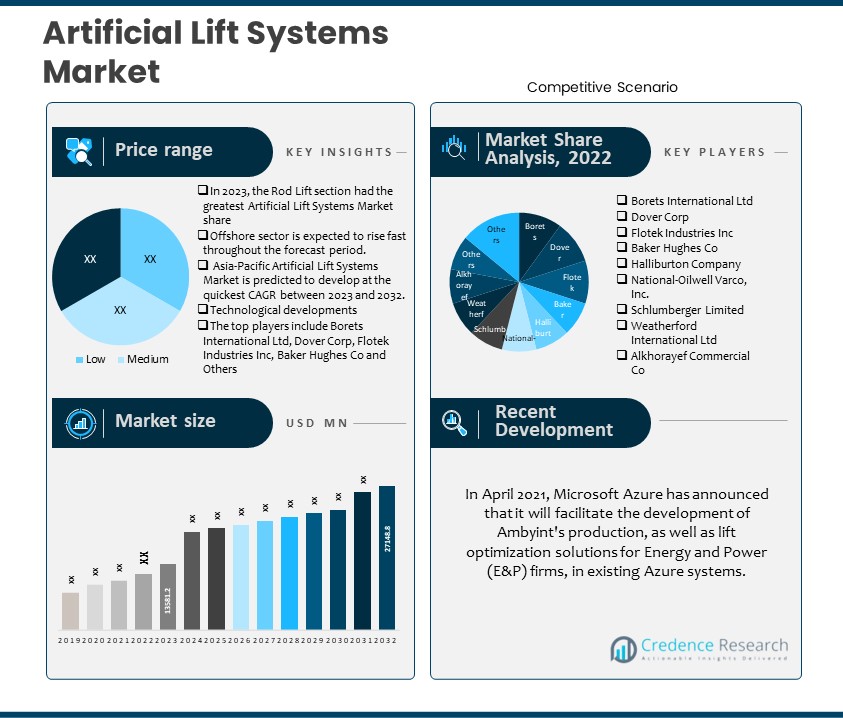
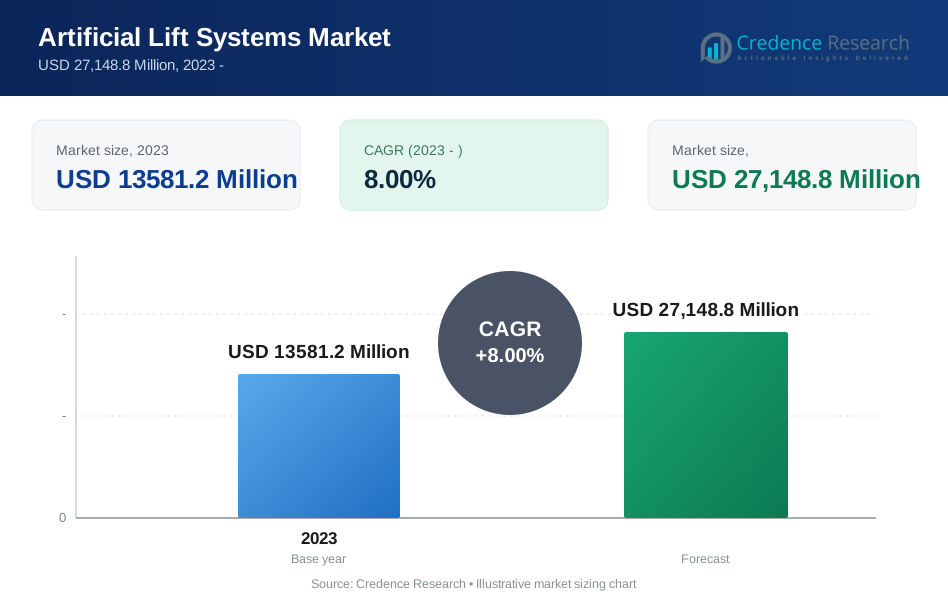
- The global demand for Artificial Lift Systems was valued at USD 13581.2 Million in 2023 and is expected to reach USD 27148.8 Million in 2032, growing at a CAGR of 8.00% between 2024 and 2032.
- In 2023, the Rod Lift segment held the greatest proportion of the Artificial Lift Systems Market, followed by the Electrical Submersible Pumps sector.
- In 2023, the Onshore segment held the bulk of the Artificial Lift Systems Market, while the Offshore sector is expected to rise fast throughout the forecast period.
- In 2023, the North America Artificial Lift Systems Market was responsible for 45.80% of the market. Furthermore, the European Artificial Lift Systems Market holds the second-largest market share. At the same time, the Asia-Pacific Artificial Lift Systems Market is predicted to develop at the quickest CAGR between 2023 and 2032.
- Rising oil demand will fuel market growth.
- The artificial lift systems market's growth is limited by the high initial capital investment required.
Executive Summary
Market Definition
Artificial lift is the employment of artificial ways to enhance pressure within a reservoir and urge oil or water from the production well to the surface. It is mostly used in situations where the reservoir's inherent drive energy is insufficient to force oil or water to the surface. Artificial lift systems are made up of numerous components, including downhole pumps, surface equipment, and control and monitoring systems. The Artificial Lift Systems Market is a key aspect of the oil and gas sector, with a significant impact on hydrocarbon extraction from wells. It includes a wide range of methods and equipment for increasing oil and gas production from wells.
Market Overview
The global Artificial Lift Systems Market has witnessed steady growth in recent years and is expected to grow at a CAGR of 8.00% between 2024 and 2032. The market was valued at USD 13581.2 million in 2023 and is expected to reach USD 27148.8 million in 2032.
The artificial lift can be used to generate flow from a dry well or to improve the rate of flow from a pumping well. Many oil and gas wells require artificial lift at some point in their life cycle to extract liquids from the formation and allow gas to flow more quickly. The artificial lift systems market is predicted to expand in response to increased energy demand, industrialization, population growth, and urbanization. Increased energy use leads to greater reliance on traditional energy sources. The overexploitation of natural resources has led to their depletion. These factors have boosted the requirement for modern artificial lift systems for oil exploration from reserves, which is expected to drive artificial lift market demand throughout the forecast period.
With the rapid expansion of the industrial production and transportation sectors, worldwide oil consumption demand has expanded significantly. To meet the expanding worldwide demand for oil and other natural resources, there is a demand for artificial lift systems. Artificial lift devices are used in continuous drilling to boost production. However, the reservoir pressure in existing wells is insufficient to transport fluids to the surface. The majority of wells across the world require assistance to transport hydrocarbons to the surface. The artificial lift system is a technology used to test oil wells under high reservoir oil pressure. Artificial lift systems help to boost efficiency by 85-90% while also augmenting and sustaining reservoir pressure.
Segmentation By Type of Artificial Lift Systems
- The Rod Lift segment had the biggest Artificial Lift Systems Market share of around 39% in 2023 and is predicted to expand quickly during the forecast period. This is due to the popularity of rod lift systems, which are versatile and have long been used in the industry. Many operators favor them since they are simple and easy to maintain.
- The Electrical Submersible Pumps sector had the second-largest market share in 2023, accounting for around 31%. This is related to the versatility of Electrical Submersible Pumps, which makes them a go-to solution for many operators trying to maximize output rates.
Segmentation by Application
- In 2023, the Onshore segment held the majority of the Artificial Lift Systems Market, accounting for almost 64%. The growing emphasis on heavy oil reservoirs, combined with an increasing number of aged fields, is likely to drive market expansion. In 2023, World Oil reported a 25% increase in onshore wells drilled in Brazil, compared to 251 in 2021.
- The Offshore segment is predicted to increase rapidly during the forecast period. This is due to the move in North America and Europe towards offshore exploration, which is driving its expansion.
Segmentation by Region
- In 2023, the North America Artificial Lift Systems Market accounted for 45.80% of the market.
- The Europe Artificial Lift Systems Market has the second-largest market share, while the Asia-Pacific Artificial Lift Systems Market is expected to grow at the fastest CAGR during 2023-2032.
- The rest of the world, including Latin America, the Middle East, and Africa, supplies the remaining demand for Artificial Lift Systems.
The North American Artificial Lift Systems Market had the greatest market share in 2023 and is predicted to develop quickly over the forecast period. The U.S. Artificial Lift Systems market is expected to grow significantly because of the presence of low-pressure oil wells and an ongoing increase in oil consumption. According to one of the industry heavyweights, US crude oil consumption climbed from 18.5 MMbbl/d in 2012 to 19.6 MMbbl/d by 2023. The presence of untapped reserves in the country would help to drive company growth.
Europe's Artificial Lift market has the second-largest market share because of an increasing number of mature fields and fluctuating price swings, generating favorable conditions for firm growth. Furthermore, the German Artificial Lift market had the highest market share, while the UK Artificial Lift market was the fastest expanding in the European Region.
Moreover, the Asia-Pacific Artificial Lift Market is predicted to expand at the quickest CAGR between 2023 and 2032. This is owing to an increase in production output from existing fields, particularly in the Siberian region. Furthermore, China's Artificial Lift market had the highest market share, while India's Artificial Lift market was the fastest-growing in the Asia-Pacific region.
Key Highlights of the Report
Type of Solvent, End-Use Industry, Application, and Region segment the global Artificial Lift Systems Market. In 2023, The Rod Lift section dominated the Artificial Lift Systems market, with the Electrical Submersible Pumps sector coming in second. In addition, the offshore segment is expected to grow substantially over the projection period, and North America leading the market growth.
Increasing global demand for oil and gas, technological developments in artificial lift systems, and a focus on improving production efficiency are the market's primary drivers. In addition, fluctuating oil prices have an impact on investment decisions, as do environmental concerns and laws, as well as the high initial expenditures of constructing artificial lift systems. Moreover, the market's significant opportunities include the growing focus on unconventional oil and gas resources, the expansion of the market in emerging nations, and the adoption of digital technology for greater monitoring and control..
The North American Artificial Lift Systems Market has the largest market share in 2023 and is expected to grow rapidly during the forecast period. Europe's Artificial Lift market has the second-largest share. Furthermore, the Asia-Pacific Artificial Lift Market is expected to grow at the fastest CAGR between 2023 and 2032.
What Are The Main Drivers Of The Global Artificial Lift Systems Market?
The Artificial Lift Systems Market is being driven by rising global demand for oil and gas, necessitating more efficient production methods. Technological improvements in artificial lift systems are also helping to improve production capabilities and optimize operations. Furthermore, there is a growing emphasis on increasing production efficiency, which has led to the use of modern artificial lift technologies to satisfy the increased need for energy resources.
What Are The Major Challenges Faced By The Global Artificial Lift Systems Market?
The Artificial Lift Systems Market faces some constraints that may stymie its progress. Fluctuating oil prices have a substantial impact on industrial investment decisions and the adoption of artificial lift systems. Furthermore, rigorous environmental rules and concerns present obstacles for market players in terms of compliance and sustainability.
What Are The Growth Opportunities In The Global Artificial Lift Systems Market?
The Artificial Lift Systems Market has numerous chances for growth and development. The sector is shifting towards the exploitation of unconventional oil and gas resources, which presents new opportunities for artificial lift system companies to increase their market reach. Furthermore, the market is poised for growth in emerging nations, where rising energy demands necessitate efficient production solutions.
Market Drivers
Several factors drive the global Artificial Lift Systems Market. The following are the key drivers of the global Artificial Lift Systems Market:
Rising Oil Demand
The increase in oil production is likely to drive future growth in the artificial lift systems industry. Artificial lift systems are used in oil wells to boost pressure within reservoirs and transfer oil to the surface. These systems are often utilized in oil production wells when natural drive energy is insufficient to accelerate the transport of oil to the surface. Though oil wells have the necessary natural pressure during the early phases of production, the pressure diminishes over time, increasing the need for artificial lift systems for optimal production.
Market Restraints
The global Artificial Lift Systems Market faces some challenges that may hinder its growth. These include the following:
High Initial Capital Investment
Artificial lift technologies demand a considerable initial expenditure. This financial barrier is intimidating, particularly for smaller oil and gas businesses or those working under difficult economic conditions. This causes a delay in the adoption of these systems. Artificial lift systems are also operationally complicated. They need particular knowledge and skills to manage efficiently. Well-trained individuals are necessary to maintain and optimize these systems, and certain countries face a skilled professional shortage. Small businesses and operators in impoverished nations have limited access to powerful artificial lift systems. This technology divide reduces their ability to compete effectively and optimize production.
Opportunities
The global Artificial Lift Systems Market offers significant growth opportunities. These include the following:
Rising Demand For Shale Gas
The increasing demand for shale gas is projected to drive the growth of the artificial lift systems market in the future. Shale gas is natural gas that is trapped within shale rock formations under the earth's surface. Shale gas reservoirs frequently generate both gas and liquids (condensate, water). ALS enables separate control of gas and liquid production, improving flow and preventing liquid loading, which can cut off gas output. For example, in October 2023, the Energy Information Administration, a US-based government body, reported that US dry natural gas production grew by approximately 1.29 trillion cubic feet in 2022 compared to the previous year. As a result, rising shale gas consumption is driving the expansion of the artificial lift systems industry.
Competitive Landscape
Key Players
The global Artificial Lift Systems Market is highly competitive, with several key players. Some of the major players in the market and their market share are as follows:
- Borets International Ltd
- Dover Corp
- Flotek Industries Inc
- Baker Hughes Co
- Halliburton Company
- National-Oilwell Varco, Inc.
- Schlumberger Limited
- Weatherford International Ltd
- Alkhorayef Commercial Co
These organizations prioritize product innovation, distribution channel expansion, and mergers and acquisitions to stay competitive.
The global Artificial Lift Systems Market's key players continually seek to stay ahead by offering new products and developments.
In January, 2022, Unbridled ESP Systems, a subsidiary of ChampionX, introduced High Rise series pumps to reduce carbon emissions during ESP operations. This substance is used for unconventional well completion operations.
In November, 2021, Halliburton and Cairn Gas & Oil have signed a Memorandum of Understanding. Under the terms of this agreement, both firms will collaborate to develop innovative technologies to assist Cairn Oil & Gas in meeting its goal of expanding recoverable reserves from 30 to 300 million barrels of oil equivalent.
In October 2021, In King Salman Energy Park, Baker Hughes constructed a regional oilfield services (OFS) center (SPARK). By supporting continuing client operations for three Oilfield Services product lines, the new facility will guarantee high-quality service delivery and set BHGE up for future expansion in the area.
In August 2021, ChampionX Technologies launched XSPOC production optimization software to improve well efficiencies for artificial lift.
In January 2019, Baker Hughes and ESP partnered to develop an effective and bespoke artificial lift system for the Bouri Field's wells.
Summary of Key Findings
- The increasing demand for shale gas is likely to boost market expansion.
- Market segmented By Type of Artificial Lift Systems, Application, and region.
- Electrical Submersible Pumps sector had the second-largest share.
- Offshore sector is expected to grow fast during the forecast period.
- North America is leading in market growth; the market is highly competitive with key players, including Borets International Ltd, Dover Corp, Flotek Industries Inc, Baker Hughes Co and Others.
Future Outlook
- Technological developments will fuel innovation in artificial lift systems.
- Rising need for oil and gas production will drive the industry.
- A focus on improving manufacturing efficiency will drive market expansion.
How CXOs Can Benefit from the Credence Research Artificial Lift Systems Market Report
The Credence Research Artificial Lift Systems Market Report provides CXOs with a comprehensive overview of the market, including:
- Market size and growth forecast: The report provides detailed estimates of the global Artificial Lift Systems Market size, segmented By Type of Solvent, End-Use Industry, Application, and region. It also includes forecasts for the market through 2032 based on key trends and drivers.
- Market segmentation: The report segments the Artificial Lift Systems Market By Type, End-Use Industry, Application, and region. This segmentation provides CXOs with a granular understanding of the market and the opportunities in each segment.
- Competitive Landscape: The report profiles the key players in the Artificial Lift Systems Market and provides insights into their strategies, product offerings, and financial performance. This information can help CXOs to identify and assess their competition.
- Key trends and drivers: The report identifies and analyzes the key trends and drivers that are shaping the Artificial Lift Systems Market. This information can help CXOs to make informed decisions about their investments and strategies.
CXOs can use the insights from the Credence Research Artificial Lift Systems Market Report to:
- Identify growth opportunities: The report can help CXOs to identify new growth opportunities in the Artificial Lift Systems Market. For example, it can pinpoint emerging trends in industries like aerospace and automotive, helping executives make informed decisions on expanding their product lines or entering new market segments where Artificial Lift Systems's properties can be leveraged for success.
- Make informed investment decisions: The report can help CXOs make informed investment decisions about Artificial Lift Systems. For example, it can provide crucial insights into market trends, competitive landscape, and potential growth areas, empowering executives to allocate resources strategically and seize opportunities for maximizing returns on investments in the Artificial Lift Systems sector.
- Develop competitive strategies: The report can help CXOs develop competitive strategies for their Artificial Lift Systems businesses. For example, it can offer valuable insights into market trends, competitor analysis, and innovative applications of Artificial Lift Systems, enabling executives to stay ahead of the competition and drive business growth in this dynamic industry.
- Track market developments: The report can help CXOs monitor market developments and stay ahead of the curve. For example, it provides insights into the latest trends and innovations in the Artificial Lift Systems Market.
Overall, the Credence Research Artificial Lift Systems Market Report is a valuable resource for CXOs who are looking to gain a deeper understanding of the market and identify opportunities for growth.
Segmentation
- By Type of Artificial Lift Systems:
- Rod Pumping
- Electric Submersible Pump (ESP
- Gas Lift
- Progressive Cavity Pump (PCP)
- Hydraulic Pumping
- Plunger Lift
- Jet Pump
- Surface Jet Pump
- By Application Segmentation:
- Onshore
- Offshore
- By Region
- North America
- The U.S.
- Canada
- Mexico
- Europe
- Germany
- France
- The U.K.
- Italy
- Spain
- Rest of Europe
- Asia Pacific
- China
- Japan
- India
- South Korea
- South-east Asia
- Rest of Asia Pacific
- Latin America
- Brazil
- Argentina
- Rest of Latin America
- Middle East & Africa
- GCC Countries
- South Africa
- Rest of the Middle East and Africa
- North America
Request a Free Sample
Fill in your details and we'll send you a free sample report.
- Sample data tables & charts
- Research methodology
Need a Custom Version of This Report?
Tailor the scope, geography, or segments to your exact requirements.
- Custom geography or segment scope
- Direct access to our analyst team
Frequently Asked Questions
What is the current size of the global Artificial Lift Systems Market?
What is the expected growth rate of the Artificial Lift Systems Market between 2024 and 2032?
Which segment is leading the market share in terms of the Type of Artificial Lift Systems?
Which region is fueling the growth of the Artificial Lift Systems industry?
Who are the major players in the global Artificial Lift Systems Market?
Table of Content
Chapter 1. Report Introduction
- 1.1 Report Description & Purpose
- 1.1.1 Report Title & Market Definition
- 1.1.2 Unique Selling Propositions (USP) & Key Differentiators
- 1.1.3 Value Proposition for Stakeholders
- 1.2 Research Objectives
- 1.2.1 Market Sizing Objectives (Volume & Revenue)
- 1.2.2 Segmentation Objectives
- 1.2.3 Competitive Intelligence Objectives
- 1.2.4 Forecast & Scenario Objectives
- 1.3 Report Scope
- 1.3.1 Artificial Lift Systems Scope – Types & Subtypes Covered
- 1.3.2 Geographic Scope – Regions & Countries Covered
- 1.3.3 Historical Period, Base Year & Forecast Period (2023; forecast to the forecast period)
- 1.3.4 Inclusions & Exclusions
- 1.4 HS Code & Classification Framework
- 1.5 Currency, Units & Pricing Basis
- 1.6 Target Stakeholders
- 1.7 Limitations & Assumptions
Chapter 2. Executive Summary
- 2.1 Global Artificial Lift Systems Market Snapshot
- 2.1.1 Market Size – Historical (2023) & Forecast (the forecast period) (2023: USD 13581.2 Million → forecast year: USD 27,148.8 Million)
- 2.1.2 Volume & Revenue – Global Totals
- 2.1.3 Key Market Highlights – Top Five Facts
- 2.2 Artificial Lift Systems Market Segmentation Snapshot
- 2.2.1 Market Split by Region – 2023 vs.
- 2.3 Competitive Snapshot
- 2.3.1 Top 10 Players by Revenue Share – 2023
- 2.3.2 Top 10 Players by Volume Share – 2023
- 2.3.3 Recent Strategic Developments (18-Month Summary)
- 2.4 Key Investment Highlights & Strategic Conclusions
Chapter 3. Artificial Lift Systems Market Dynamics & Industry Analysis
- 3.1 Market Overview & Context
- 3.1.1 Artificial Lift Systems Market Position in the Broader Automotive Value Chain
- 3.1.2 OEM vs. Replacement Market Dynamics
- 3.1.3 Market Maturity & Development Stage by Region
- 3.2 Artificial Lift Systems Market Drivers
- 3.3 Artificial Lift Systems Market Restraints & Challenges
- 3.4 Artificial Lift Systems Market Opportunities
- 3.5 Porter's Five Forces Analysis
- 3.5.1 Threat of New Entrants
- 3.5.2 Bargaining Power of Suppliers
- 3.5.3 Bargaining Power of Buyers
- 3.5.4 Threat of Substitutes
- 3.5.5 Competitive Rivalry – Intensity Assessment
- 3.6 Artificial Lift Systems Value Chain Analysis
- 3.6.1 Upstream – Raw Material/Input Suppliers
- 3.6.1.1 Raw Material/Input 1
- 3.6.1.2 Raw Material/Input 2
- 3.6.1.3 Raw Material/Input 3
- 3.6.2 Midstream – Production/Manufacturing/Service Delivery
- 3.6.2.1 Production/Process Overview
- 3.6.2.2 Key Facility Locations & Capacity by Manufacturer
- 3.6.3 Downstream – Distribution & End Consumer
- 3.6.3.1 Primary Channel – B2B/OEM
- 3.6.3.2 Secondary Channels – Dealer, Retail, Online, Direct
- 3.6.4 Value Chain Profitability Analysis
- 3.6.1 Upstream – Raw Material/Input Suppliers
- 3.7 PESTEL Analysis
- 3.7.1 Political Factors
- 3.7.2 Economic Factors
- 3.7.3 Social Factors
- 3.7.4 Technological Factors
- 3.7.5 Environmental Factors
- 3.7.6 Legal Factors
- 3.8 Artificial Lift Systems Supply Chain Analysis
- 3.8.1 Raw Material/Input Supply Risk Assessment
- 3.8.2 Manufacturing Concentration Risk (Geographic Exposure)
- 3.8.3 Trade Disruption Impact Analysis
- 3.9 Regulatory & Policy Landscape
Note: The regulatory and policy landscape section covers regulations based on their applicability to the market, Artificial Lift Systems category, geography, and scope of the study. Only regulatory frameworks with a material impact on operations, compliance, trade, sustainability, or market access are analyzed in detail.
Chapter 4. Key Investment Pockets & Opportunity Analysis
- 4.1 Artificial Lift Systems Market Attractiveness Analysis
- 4.1.1 By Region – Investment Attractiveness Matrix (Volume × CAGR)
- 4.2 Absolute Revenue Growth Opportunity
- 4.2.1 By Region – Absolute USD Growth Through the forecast period
- 4.3 Incremental Volume Opportunity
- 4.3.1 By Region – Incremental Volume Through the forecast period
- 4.3.2 Segment – Incremental Volume
- 4.4 Emerging Submarket Opportunity Deep Dive (Subject to Applicability)
- 4.5 Emerging Market Opportunity Scorecards
- 4.5.1 United States
- 4.5.2 Europe
- 4.5.3 Asia
- 4.5.4 Middle East & Africa
Note: Emerging Market Opportunity Scorecards will be included based on relevance and strategic importance. Regions listed are indicative and may vary depending on data availability and market dynamics.
Chapter 5. Artificial Lift Systems Import-Export Analysis & Trade Flows
- 5.1 Global Trade Overview
- 5.1.1 Global Export Value by Country (2023)
- 5.1.2 Global Export Volume by Country (2023)
- 5.1.3 Global Import Value by Country (2023)
- 5.1.4 Global Import Volume by Country (2023)
- 5.1.5 Net Trade Balance by Country (2023)
- 5.2 Export Analysis – Segment
- 5.2.1 Type 1 (HS Code)
- 5.2.2 Type 2 (HS Code)
- 5.2.3 Type 3 (HS Code)
- 5.2.4 Type 4 (HS Code)
- 5.2.5 Type 5 (HS Code)
- 5.3 Import Analysis – Segment
- 5.3.1 Type 1 (HS Code)
- 5.3.2 Type 2 (HS Code)
- 5.3.3 Type 3 (HS Code)
- 5.3.4 Type 4 (HS Code)
- 5.3.5 Type 5 (HS Code)
- 5.4 Average Unit Trade Prices
- 5.4.1 Average Export Price – Segment & Country
- 5.4.2 Average Import Price – Segment & Source Country
- 5.4.3 Price Trends (2023)
- 5.5 Key Trade Route Analysis
- 5.5.1 Trade Route 1
- 5.5.2 Trade Route 2
- 5.5.3 Trade Route 3
- 5.5.4 Trade Route 4
- 5.5.5 Trade Route 5
- 5.6 Trade Policy Impact Assessment
- 5.6.1 US Anti-Dumping & Section 301 Tariffs
- 5.6.2 EU Customs Union Impact
- 5.6.3 Major Free Trade Agreements
- 5.6.4 USMCA Rules of Origin
Note: Trade policy analysis will be included only where relevant to the Artificial Lift Systems market.
Chapter 6. Competitive Landscape & Company Benchmarking
- 6.1 Artificial Lift Systems Market Concentration & Structure
- 6.1.1 Herfindahl-Hirschman Index (HHI) – vs. 2023
- 6.1.2 Tier 1, Tier 2 & Tier 3 Market Structure
- 6.1.3 Global, Regional & Local Player Dynamics
- 6.2 Artificial Lift Systems Market Share Analysis – 2023
- 6.2.1 Global Revenue Share by Company
- 6.2.2 Global Volume Share by Company
- 6.2.3 Regional Revenue Share
- 6.2.4 Market Share Evolution ( vs. 2023)
- 6.2.5 OEM Segment Share by Company
- 6.2.6 Replacement Segment Share by Company
- 6.3 Production/Delivery Capacity & Facility Analysis
- 6.3.1 Global Installed Capacity
- 6.3.2 Capacity Utilization Rates
- 6.3.3 Production/Output Volume
- 6.3.4 Facility Locations & Capacity Map
- 6.3.5 Planned Capacity Additions
- 6.4 Artificial Lift Systems Competitive Benchmarking Matrix
- 6.4.1 Revenue, Volume, CAGR & Profitability Comparison
- 6.4.2 Channel Revenue Mix
- 6.4.3 Geographic Revenue Exposure
- 6.4.4 R&D Intensity
- 6.4.5 Sustainability Maturity
- 6.5 Strategic Developments in Artificial Lift Systems (Last 24 Months)
- 6.5.1 Mergers, Acquisitions & Divestments
- 6.5.2 New Artificial Lift Systems Launches
- 6.5.3 Facility Expansions
- 6.5.4 Strategic Alliances, Joint Ventures & Partnerships
- 6.5.5 Distribution Expansion & Market Entry
- 6.5.6 Sustainability & ESG Initiatives
- 6.6 Competitive Strategy Mapping
- 6.6.1 Leader, Challenger, Follower & Niche Classification
- 6.6.2 Pricing Strategy Comparison
- 6.6.3 Channel Strategy Matrix
Note: Strategic developments are included based on their materiality and the availability of reliable information.
Chapter 7. Global Artificial Lift Systems Market – By Distribution Channel
- 7.1 Segment Overview
- 7.1.1 Volume & Revenue Split by Channel (2023 & )
- 7.1.2 Channel Mix Evolution (the forecast period)
Chapter 8. Regional Market Analysis – Global Overview
- 8.1 Global Regional Overview
- 8.1.1 Regional Volume Share
- 8.1.2 Regional Revenue Share
- 8.1.3 Regional Volume by Region
- 8.1.4 Regional Revenue by Region
- 8.1.5 Regional Forecast Through the forecast period
- 8.2 Cross-Regional Segment Analysis
- 8.2.1 By Distribution Channel
- 8.2.2 By Brand/Price Tier
Chapter 9. North America Artificial Lift Systems Market
- 9.1 United States
- 9.2 Canada
- 9.3 Mexico
Chapter 10. Europe Artificial Lift Systems Market
- 10.1 Germany
- 10.2 France
- 10.3 Italy
- 10.4 United Kingdom
- 10.5 Spain
- 10.6 Poland
- 10.7 Russia
- 10.8 Netherlands
- 10.9 Belgium
- 10.10 Sweden
- 10.11 Denmark
- 10.12 Norway
- 10.13 Rest of Europe
Chapter 11. Asia Pacific Artificial Lift Systems Market
- 11.1 China
- 11.2 India
- 11.3 Japan
- 11.4 South Korea
- 11.5 Thailand
- 11.6 Indonesia
- 11.7 Vietnam
- 11.8 Malaysia
- 11.9 Australia
- 11.10 Rest of Asia Pacific
Chapter 12. Latin America Artificial Lift Systems Market
- 12.1 Brazil
- 12.2 Argentina
- 12.3 Colombia
- 12.4 Chile
- 12.5 Rest of Latin America
Chapter 13. Middle East Artificial Lift Systems Market
- 13.1 Saudi Arabia
- 13.2 United Arab Emirates
- 13.3 Turkey
- 13.4 Israel
- 13.5 Iran
- 13.6 Rest of the Middle East
Chapter 14. Africa Artificial Lift Systems Market
- 14.1 South Africa
- 14.2 Egypt
- 14.3 Nigeria
- 14.4 Morocco
- 14.5 Rest of Africa
Chapter 15. Artificial Lift Systems Company Profiles
- 15.1 [Company 01]
- 15.1.1 Company Overview
- 15.1.2 Key Management Personnel
- 15.1.3 Products & Services Portfolio
- 15.1.4 Financial Performance
- 15.1.5 Key Market Focus & Geographic Presence
- 15.1.6 Recent Developments & Strategic Initiatives
Note: The company profile list is preliminary and may change based on research findings, market developments, data availability, and client requirements.
Chapter 16. Appendices
- Appendix A – List of Abbreviations & Acronyms
- Appendix B – Industry Classification Code Reference – Full Series
- Appendix C – Production & Capacity Data Tables
- Appendix D – End-Use & Demand Base Tables
- Appendix E – Consumption & Replacement Rate Assumptions
- Appendix F – ASP Reference Tables
- Appendix G – Manufacturing & Facility Database
- Appendix H – Import-Export Data Tables
- Appendix I – Regulatory Summary Tables
- Appendix J – Primary Research Participant List (Anonymized)
- Appendix K – Primary Research Questionnaire Framework
- Appendix L – Data Sources & Bibliography
- Appendix M – Market Size Divergence & Source Comparison
Chapter 17. Research Methodology
- 17.1 Research Framework & Philosophy
- 17.2 Secondary Research – Sources, Hierarchy & Data Extraction
- 17.3 Data Modeling – Bottom-Up & Top-Down Market Sizing
- 17.4 Primary Research – Stakeholder Framework, LOI & Sample Sizes
- 17.5 Forecast Methodology – Regression, Scenario & Sensitivity Analysis
- 17.6 Quality Control – Four-Layer Validation Framework
- 17.7 Limitations & Standard Assumptions
- 17.8 Disclaimer
