
Market Introduction of Automated Microbiology Market
Utilizing products from the worldwide automated microbiology market provides a special technique to effectively obtain quicker, more accurate, and automated findings from microbiological testing. The worldwide automated microbiology market products help automate several crucial tasks in lab settings, including collecting, identifying, evaluating, and separating diverse microorganisms. The manufacturers and market participants operating in the global automated microbiology market provide a range of testing options based on various technologies, including monoclonal antibodies, DNA sequencing, immunoassays, DNA and RNA probe technologies, and detecting methods, among others.
What is the Market Size of Automated Microbiology in terms of value?
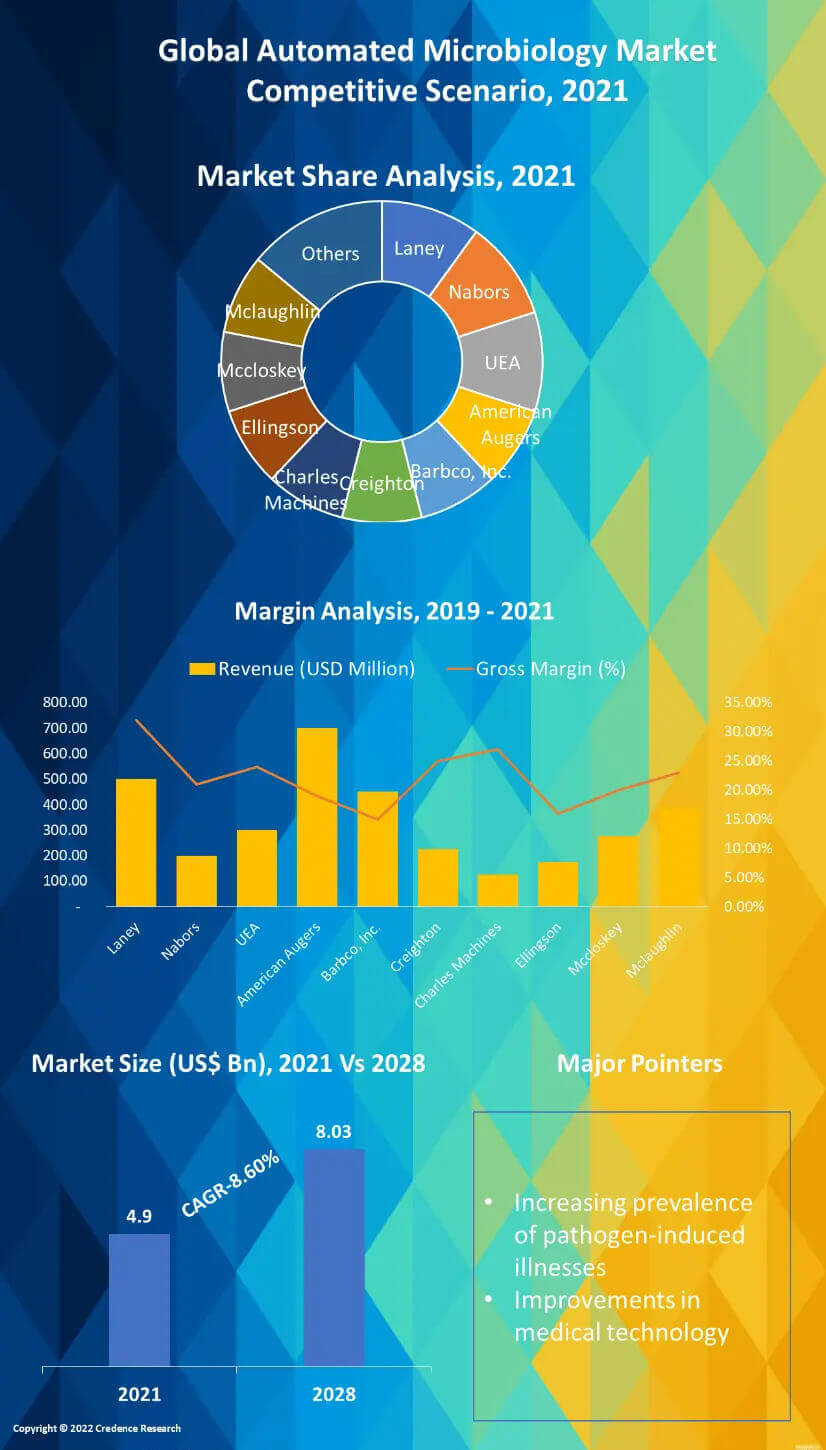
Over the coming years, the automated microbiology market is anticipated to expand rapidly with a CAGR of 8.60%. According to estimates, the global market for automated microbiology would be worth USD 4.9 billion in 2021 and USD 8.03 billion in 2028. It is projected that demand for automated microbiology would rise significantly in the approaching years. It is estimated to provide revenue potential around USD 3.13 billion for the top industry players between 2022 and 2028.
Which is the key Technology segment in the Automated Microbiology Market?
The DNA Sequencing segment registered a revenue share of over 55.0% of the total Automated Microbiology in 2021. DNA sequencing is the process of determining the nucleic acid in a DNA molecule. Now that this technology exists, scientists can study how genes work. In immunoassays, a type of biochemical test that aids in figuring out how many small molecules are present in a specific solution, an antibody, or an antigen is utilized. In this experiment, several labels that change the antibody are applied. Some labels that are widely used include enzymes, electro-chemiluminescent tags, radioactive isotopes, DNA reporters, and fluorogenic reporters. White blood cells are cloned in a lab to create monoclonal antibodies. Most typically, these antibodies are used to treat a variety of disorders, drug abuse, poisoning, septicemia, viral infections, cancer, asthma, autoimmune diseases, and other conditions.
Interesting Facts about Automated Microbiology Industry
- The top countries in the Automated Microbiology market are the US, Mexico, Canada, China, India, Japan, and Germany.
- The major driving factor of the growth and expansion of the worldwide automated microbiology market is the increasing prevalence of pathogen-induced illnesses.
- The key restraint of the global Automated Microbiology market, which is projected to hamper the market growth, includes the advanced technologies needed for automated microbiology tests because clinical testing equipment is expensive and difficult to operate without qualified researchers.
- In terms of volume and value, the North America region dominated the global Automated Microbiology market in 2021.
- DNA Sequencing technique to witness high growth during the forecast period.
Who are the Top players/companies in the Automated Microbiology market regarding value?
The leading companies in the worldwide Automated Microbiology market include the following Agilent Technologies, Beckman Coulter, Becton Dickinson and Company, Affymetrix, Inc, bioMerieux, Inc., Gene-Probe, Inc, QIAGEN GmbH, Bio-Rad Laboratories, and Abbott Laboratories. These large corporations are concentrating on new product developments and technological advancements in order to boost their Automated Microbiology output and win a sizable market share globally. Several local and global businesses are also making big investments to broaden their product lines and increase sales. For instance, in January 2021, an automated RNA extraction procedure was introduced by HiMedia Laboratories. With this kit, scientists can analyze 96 samples in just 11 minutes.
Who are the Top 10 Countries in the Automated Microbiology Market?
The major countries in the global Automated Microbiology market are China, India, the U.S., Canada, the U.K., Germany, France, Italy, Brazil, and Japan. The largest share of the global market for automated microbiology will be held by the United States in 2021. Automated microbiology is a cutting-edge technique in microbiological research and development operations that produces more accurate, timely, and efficient test results. In the ecological, biological, and food industries, this technology automates crucial activities such as classifying, detecting, isolating, and measuring microorganisms.
Which is the key End Use used in the Automated Microbiology Market?
The Clinical Laboratories category dominated the Automated Microbiology market in 2021. The market for microbiological testing is anticipated to be dominated by the Clinical Laboratories sector. Increasing healthcare expenses, the prevalence of infectious diseases, and technological advancements are some of the key factors supporting the growth of this market sector. The increasing prevalence of infectious diseases is one of the key factors fueling the segment's expansion. The primary diagnosis for 15.5 million doctor visits in 2017 was an infectious or parasitic disease, according to the Centers for Disease Control and Prevention. With COVID-19, the category's popularity has surged in recent months. The Clinical Laboratories section is predicted to dominate due to well-established and widely accepted legislation that regulates the assessment of microbiological contamination throughout pharmaceutical manufacture and raw material procurement activities.
What are the Major Driving Factors for Automated Microbiology Market?
The rising incidence of diseases brought on by pathogens is one of the primary factors driving the growth and expansion of the global automated microbiology market. Improvements in medical technology also fuel the expansion of the worldwide automated microbiology market. Shortly, the worldwide automated microbiology market is expected to experience substantial growth due to the growing number of microbiology research projects and activities being carried out worldwide.
What are the Major Restraints for Automated Microbiology Market?
The key restraint of the global Automated Microbiology market, which is projected to hamper the market growth, includes the advanced technologies needed for automated microbiology tests because clinical testing equipment is expensive and difficult to operate without qualified researchers. Over the projection period, high upfront costs and a shortage of qualified personnel may somewhat impede market expansion.
Which Region Dominated the World Automated Microbiology Market?
In 2021, North America dominated the global Automated Microbiology market and accounted for a major market revenue share. The North American region's dominant position in the global automated microbiology market was attributed to several factors, including the region's rising use of cutting-edge technologies in the life sciences and healthcare sectors and the rising volume of developments in testing for molecular diagnostics genetic probe tests. The global automated microbiology market may experience the fastest growth rate in the upcoming years in the Asia Pacific region. This tendency can be linked to the quick advancements in local healthcare infrastructure and services and the escalating demand from the local populace for technologically improved goods. Adopting cutting-edge technology and rapid advancements in molecular diagnostics are two key elements boosting the market's revenue growth.
The main drivers influencing market revenue growth are the increasing emphasis on error-free microbiological test findings, rising adoption of automation technologies, growing demand to cut testing time, and significant prevalence of infectious diseases globally. Automated microbiology is a cutting-edge technique in microbiological research and development operations that produces more accurate, timely, and efficient test results. In the ecological, biological, and food industries, this technology automates crucial activities such as detecting, isolating, classifying, and measuring microorganisms. The region's market is expanding due to easy access to and high adoption of new diagnostic technologies, favorable government regulations, and the US and Canadian governments' large yearly per capita healthcare expenditures.
Segmentation of Global Automated Microbiology Market-
Global Automated Microbiology Market – By Technology
- DNA Sequencing
- DNA and RNA Probe Technology
- Detection Technology
Global Automated Microbiology Market – By End Use
- Clinical Laboratories
- Biotechnology Industries
- Others
Global Automated Microbiology Market – By Region
- North America
- U.S.
- Canada
- Europe
- Germany
- France
- U.K.
- Italy
- Spain
- Rest of Europe
- Asia Pacific
- China
- Japan
- India
- South Korea
- South-east Asia
- Rest of Asia Pacific
- Latin America
- Brazil
- Mexico
- Rest of Latin America
- Middle East & Africa & Africa
- GCC Countries
- South Africa
- Rest of Middle East & Africa and Africa
Request a Free Sample
Fill in your details and we'll send you a free sample report.
- Sample data tables & charts
- Research methodology
Need a Custom Version of This Report?
Tailor the scope, geography, or segments to your exact requirements.
- Custom geography or segment scope
- Direct access to our analyst team
Frequently Asked Questions
How does COVID-19 Impact the global Automated Microbiology market?
Which is the leading market for Automated Microbiology?
What are the key drivers for the growth of the Automated Microbiology market?
Which is the major segment in the Automated Microbiology Market by Technology?
Which is the major segment in Automated Microbiology Market by End Use?
Table of Content
Chapter 1. Report Introduction
- 1.1 Report Description & Purpose
- 1.1.1 Report Title & Market Definition
- 1.1.2 Unique Selling Propositions (USP) & Key Differentiators
- 1.1.3 Value Proposition for Stakeholders
- 1.2 Research Objectives
- 1.2.1 Market Sizing Objectives (Volume & Revenue) (Volume Where Applicable)
- 1.2.2 Segmentation Objectives
- 1.2.3 Competitive Intelligence Objectives
- 1.2.4 Forecast & Scenario Objectives
- 1.3 Report Scope
- 1.3.1 Global Automated Microbiology Scope – Segments & Subsegments Covered
- 1.3.2 Geographic Scope – Regions & Countries Covered
- 1.3.3 Historical Period, Base Year & Forecast Period (the historical period; forecast to the forecast period)
- 1.3.4 Inclusions & Exclusions
- 1.4 Industry Classification & Applicable Codes
- 1.5 Currency, Measurement Units & Valuation Basis
- 1.6 Target Stakeholders
- 1.7 Limitations & Assumptions
Chapter 2. Executive Summary
- 2.1 Global Global Automated Microbiology Market Snapshot
- 2.1.1 Market Size – Historical (the historical period) & Forecast (the forecast period) (base year: NULL → forecast year: NULL)
- 2.1.2 Volume & Revenue – Global Totals (Volume Where Applicable)
- 2.1.3 Key Market Highlights – Top Five Facts
- 2.2 Global Automated Microbiology Market Segmentation Snapshot
- 2.2.1 Market Split by Region – vs.
- 2.3 Competitive Snapshot
- 2.3.1 Top 10 Players by Revenue Share –
- 2.3.2 Top 10 Players by Volume Share – (Volume Where Applicable)
- 2.3.3 Recent Strategic Developments (18-Month Summary)
- 2.4 Key Investment Highlights & Strategic Conclusions
Chapter 3. Global Automated Microbiology Market Dynamics & Industry Analysis
- 3.1 Market Overview & Context
- 3.1.1 Global Automated Microbiology Market Position in the Broader Industry Value Chain
- 3.1.2 Demand Structure & Purchasing Dynamics
- 3.1.3 Market Maturity & Development Stage by Region
- 3.2 Global Automated Microbiology Market Drivers
- 3.3 Global Automated Microbiology Market Restraints & Challenges
- 3.4 Global Automated Microbiology Market Opportunities
- 3.5 Porter's Five Forces Analysis
- 3.5.1 Threat of New Entrants
- 3.5.2 Bargaining Power of Suppliers
- 3.5.3 Bargaining Power of Buyers
- 3.5.4 Threat of Substitutes
- 3.5.5 Competitive Rivalry – Intensity Assessment
- 3.6 Global Automated Microbiology Value Chain Analysis
- 3.6.1 Upstream – Key Inputs, Resources & Suppliers
- 3.6.1.1 Key Input/Resource 1
- 3.6.1.2 Key Input/Resource 2
- 3.6.1.3 Key Input/Resource 3
- 3.6.2 Midstream – Core Operations & Value Creation
- 3.6.2.1 Operating Model & Process Overview
- 3.6.2.2 Key Operating Locations & Capabilities by Company
- 3.6.3 Downstream – Market Channels & End Users
- 3.6.3.1 Direct Sales & Customer Engagement Channels
- 3.6.3.2 Indirect Sales, Intermediaries & Partner Channels
- 3.6.4 Value Chain Profitability Analysis
- 3.6.1 Upstream – Key Inputs, Resources & Suppliers
- 3.7 PESTEL Analysis
- 3.7.1 Political Factors
- 3.7.2 Economic Factors
- 3.7.3 Social Factors
- 3.7.4 Technological Factors
- 3.7.5 Environmental Factors
- 3.7.6 Legal Factors
- 3.8 Global Automated Microbiology Supply Chain Analysis
- 3.8.1 Critical Input & Resource Availability Risk Assessment
- 3.8.2 Supplier & Operational Concentration Risk (Geographic Exposure)
- 3.8.3 Supply & Service Disruption Impact Analysis
- 3.9 Regulatory & Policy Landscape
Note: The regulatory and policy landscape section covers regulations based on their applicability to the market, Global Automated Microbiology category, geography, and scope of the study. Only regulatory frameworks with a material impact on operations, compliance, trade, sustainability, or market access are analyzed in detail.
Chapter 4. Key Investment Pockets & Opportunity Analysis
- 4.1 Global Automated Microbiology Market Attractiveness Analysis
- 4.1.1 By Region – Investment Attractiveness Matrix (Market Size × CAGR)
- 4.2 Absolute Revenue Growth Opportunity
- 4.2.1 By Region – Absolute Revenue Growth Through the forecast period
- 4.3 Incremental Demand Opportunity
- 4.3.1 By Region – Incremental Demand Through the forecast period
- 4.3.2 Segment – Incremental Demand
- 4.4 Emerging Submarket Opportunity Deep Dive (Subject to Applicability)
- 4.5 Priority Market Opportunity Scorecards
- 4.5.1 United States
- 4.5.2 Europe
- 4.5.3 Asia
- 4.5.4 Middle East & Africa
Note: Priority market opportunity scorecards reflect the geographic scope and strategic relevance of the study. Listed markets are indicative and may be adapted to the industry.
Chapter 5. Global Automated Microbiology Cross-Border Trade & Market Access Analysis
- 5.1 International Trade & Cross-Border Activity Overview
- 5.1.1 Global Export Value by Country (the historical period)
- 5.1.2 Global Export Volume by Country (the historical period) (Volume Where Applicable)
- 5.1.3 Global Import Value by Country (the historical period)
- 5.1.4 Global Import Volume by Country (the historical period) (Volume Where Applicable)
- 5.1.5 Net Trade Balance by Country (the historical period)
- 5.2 Export Analysis – Segment
- 5.2.1 Category 1 (Applicable Classification Code)
- 5.2.2 Category 2 (Applicable Classification Code)
- 5.2.3 Category 3 (Applicable Classification Code)
- 5.2.4 Category 4 (Applicable Classification Code)
- 5.2.5 Category 5 (Applicable Classification Code)
- 5.3 Import Analysis – Segment
- 5.3.1 Category 1 (Applicable Classification Code)
- 5.3.2 Category 2 (Applicable Classification Code)
- 5.3.3 Category 3 (Applicable Classification Code)
- 5.3.4 Category 4 (Applicable Classification Code)
- 5.3.5 Category 5 (Applicable Classification Code)
- 5.4 Cross-Border Pricing & Transaction Benchmarks
- 5.4.1 Export Pricing – Segment & Country
- 5.4.2 Import Pricing – Segment & Source Country
- 5.4.3 Price Trends (the historical period)
- 5.5 Key Cross-Border Trade & Delivery Routes
- 5.5.1 Cross-Border Trade/Delivery Route 1
- 5.5.2 Cross-Border Trade/Delivery Route 2
- 5.5.3 Cross-Border Trade/Delivery Route 3
- 5.5.4 Cross-Border Trade/Delivery Route 4
- 5.5.5 Cross-Border Trade/Delivery Route 5
- 5.6 Trade Policy & Market Access Impact Assessment
- 5.6.1 Tariff & Non-Tariff Barriers
- 5.6.2 Regional Trade & Economic Integration Frameworks
- 5.6.3 Bilateral & Multilateral Trade Agreements
- 5.6.4 Cross-Border Operating, Licensing & Localization Requirements
Note: This chapter applies where cross-border trade or delivery is relevant to Global Automated Microbiology. Goods, services, and digital offerings are assessed using applicable classifications and transaction measures. Import-export volumes, trade balances, and route analyses are included only where meaningful to the market.
Chapter 6. Competitive Landscape & Company Benchmarking
- 6.1 Global Automated Microbiology Market Concentration & Structure
- 6.1.1 Herfindahl-Hirschman Index (HHI) – vs.
- 6.1.2 Leading, Mid-Sized & Emerging Player Structure
- 6.1.3 Global, Regional & Local Player Dynamics
- 6.2 Global Automated Microbiology Market Share Analysis –
- 6.2.1 Global Revenue Share by Company
- 6.2.2 Global Volume Share by Company (Volume Where Applicable)
- 6.2.3 Regional Revenue Share
- 6.2.4 Market Share Evolution ( vs. )
- 6.2.5 Company Market Share by Key Segment
- 6.2.6 Company Market Share by Customer Group
- 6.3 Operating Scale, Capacity & Infrastructure Analysis
- 6.3.1 Global Operating Scale & Supply Capacity
- 6.3.2 Resource Utilization & Operating Efficiency
- 6.3.3 Output, Service Delivery & Activity Metrics
- 6.3.4 Operating Footprint & Infrastructure Map
- 6.3.5 Planned Operational & Capacity Expansion
- 6.4 Global Automated Microbiology Competitive Benchmarking Matrix
- 6.4.1 Revenue, Growth, Profitability & Operating Metric Comparison
- 6.4.2 Channel Revenue Mix
- 6.4.3 Geographic Revenue Exposure
- 6.4.4 R&D Intensity
- 6.4.5 Sustainability Maturity
- 6.5 Strategic Developments in Global Automated Microbiology (Last 24 Months)
- 6.5.1 Mergers, Acquisitions & Divestments
- 6.5.2 New Products, Services & Solutions in Global Automated Microbiology
- 6.5.3 Operational & Infrastructure Expansions
- 6.5.4 Strategic Alliances, Joint Ventures & Partnerships
- 6.5.5 Distribution Expansion & Market Entry
- 6.5.6 Sustainability & ESG Initiatives
- 6.6 Competitive Strategy Mapping
- 6.6.1 Leader, Challenger, Follower & Niche Classification
- 6.6.2 Pricing Strategy Comparison
- 6.6.3 Channel Strategy Matrix
Note: Strategic developments are included based on their materiality and the availability of reliable information.
Chapter 7. Global Global Automated Microbiology Market – By Sales & Delivery Channel
- 7.1 Segment Overview
- 7.1.1 Volume & Revenue Split by Channel ( & ) (Volume Where Applicable)
- 7.1.2 Channel Mix Evolution (the forecast period)
Chapter 8. Regional Market Analysis – Global Overview
- 8.1 Global Regional Overview
- 8.1.1 Regional Volume Share (Volume Where Applicable)
- 8.1.2 Regional Revenue Share
- 8.1.3 Regional Volume by Region (Volume Where Applicable)
- 8.1.4 Regional Revenue by Region
- 8.1.5 Regional Forecast Through the forecast period
- 8.2 Cross-Regional Segment Analysis
- 8.2.1 By Sales & Delivery Channel
- 8.2.2 By Competitive Positioning & Price Tier
Chapter 9. North America Global Automated Microbiology Market
- 9.1 United States
- 9.2 Canada
- 9.3 Mexico
Chapter 10. Europe Global Automated Microbiology Market
- 10.1 Germany
- 10.2 France
- 10.3 Italy
- 10.4 United Kingdom
- 10.5 Spain
- 10.6 Poland
- 10.7 Russia
- 10.8 Netherlands
- 10.9 Belgium
- 10.10 Sweden
- 10.11 Denmark
- 10.12 Norway
- 10.13 Rest of Europe
Chapter 11. Asia Pacific Global Automated Microbiology Market
- 11.1 China
- 11.2 India
- 11.3 Japan
- 11.4 South Korea
- 11.5 Thailand
- 11.6 Indonesia
- 11.7 Vietnam
- 11.8 Malaysia
- 11.9 Australia
- 11.10 Rest of Asia Pacific
Chapter 12. Latin America Global Automated Microbiology Market
- 12.1 Brazil
- 12.2 Argentina
- 12.3 Colombia
- 12.4 Chile
- 12.5 Rest of Latin America
Chapter 13. Middle East Global Automated Microbiology Market
- 13.1 Saudi Arabia
- 13.2 United Arab Emirates
- 13.3 Turkey
- 13.4 Israel
- 13.5 Iran
- 13.6 Rest of the Middle East
Chapter 14. Africa Global Automated Microbiology Market
- 14.1 South Africa
- 14.2 Egypt
- 14.3 Nigeria
- 14.4 Morocco
- 14.5 Rest of Africa
Chapter 15. Global Automated Microbiology Company Profiles
- 15.1 [Company 01]
- 15.1.1 Company Overview
- 15.1.2 Key Management Personnel
- 15.1.3 Products & Services Portfolio
- 15.1.4 Financial Performance
- 15.1.5 Key Market Focus & Geographic Presence
- 15.1.6 Recent Developments & Strategic Initiatives
Note: The company profile list is preliminary and may change based on research findings, market developments, data availability, and client requirements.
Chapter 16. Appendices
- Appendix A – List of Abbreviations & Acronyms
- Appendix B – Industry Classification Code Reference – Full Series
- Appendix C – Supply, Output & Operating Capacity Data Tables
- Appendix D – End-Use & Demand Base Tables
- Appendix E – Demand, Adoption & Usage Assumptions
- Appendix F – Pricing & Revenue Metric Reference Tables
- Appendix G – Company Operations & Infrastructure Database
- Appendix H – Cross-Border Trade & Activity Data Tables (Where Applicable)
- Appendix I – Regulatory Summary Tables
- Appendix J – Primary Research Participant List (Anonymized)
- Appendix K – Primary Research Questionnaire Framework
- Appendix L – Data Sources & Bibliography
- Appendix M – Market Size Divergence & Source Comparison
Chapter 17. Research Methodology
- 17.1 Research Framework & Philosophy
- 17.2 Secondary Research – Sources, Hierarchy & Data Extraction
- 17.3 Data Modeling – Bottom-Up & Top-Down Market Sizing
- 17.4 Primary Research – Stakeholder Framework, LOI & Sample Sizes
- 17.5 Forecast Methodology – Regression, Scenario & Sensitivity Analysis
- 17.6 Quality Control – Four-Layer Validation Framework
- 17.7 Limitations & Standard Assumptions
- 17.8 Disclaimer
