
| REPORT ATTRIBUTE | DETAILS |
|---|---|
| Historical Period | 2019-2022 |
| Base Year | 2023 |
| Forecast Period | 2024-2032 |
| Automotive HVAC (Heating, Ventilation, and Air Conditioning) Market Size 2023 | USD 63154.2 Million |
| Automotive HVAC (Heating, Ventilation, and Air Conditioning) Market, CAGR | 7.00% |
| Automotive HVAC (Heating, Ventilation, and Air Conditioning) Market Size 2032 | USD 116106.4 Million |
Market Insights
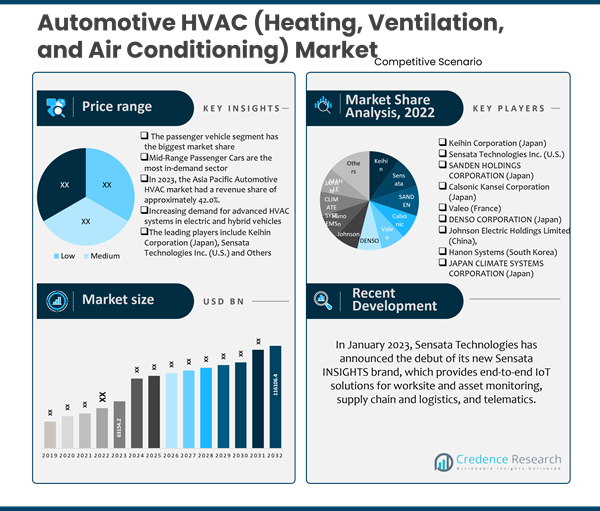
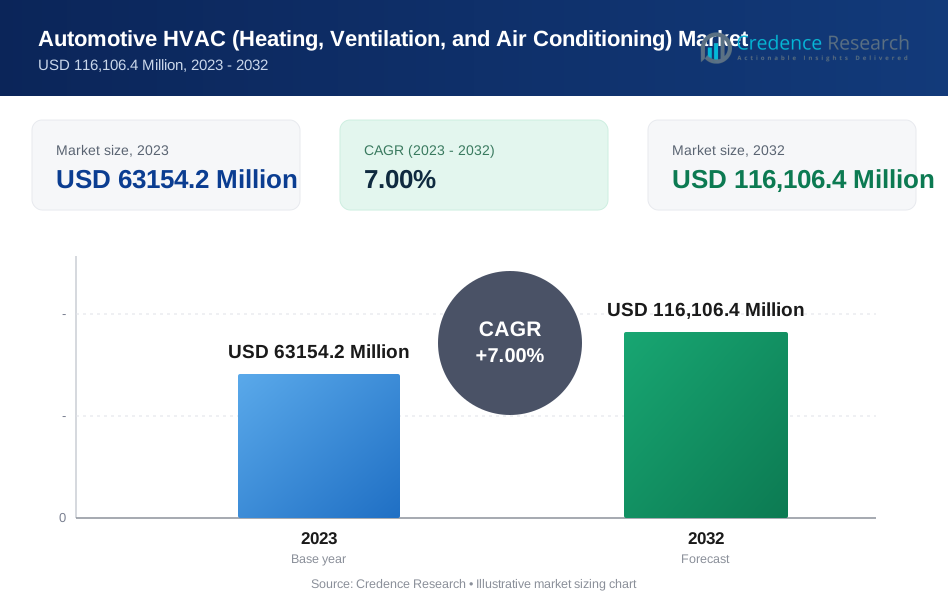
- The global demand for Automotive HVAC (Heating, Ventilation, and Air Conditioning) was valued at USD 63154.2 Million in 2023 and is expected to reach USD 116106.4 Million in 2032, growing at a CAGR of 7.00% between 2024 and 2032.
- Compressors will dominate the market in 2023.
- The passenger vehicle segment has the largest market share and is predicted to see the greatest CAGR over the forecast period.
- During the anticipated period, the Automatic HVAC System segment will account for the majority of the market, while the Manual HVAC System segment is expected to have a high CAGR of approximately 15.0% over the next few years.
- R1234yf is an increasingly common section.
- The OEM segment has the biggest demand in the automotive HVAC market.
- Mid-Range Passenger Cars are the most in-demand sector in the Automotive HVAC Market, while Luxury Passenger Cars are the fastest growing segment of the market.
- The Automatic/Climate-Controlled HVAC Systems industry controls a sizable portion of the market.
- The market's fastest growing category is air conditioning.
- Aluminum is the highest market demand segment in the Automotive HVAC Market.
- In 2023, the Asia Pacific Automotive HVAC market had a revenue share of around 42.0%. North America's market had the second-largest market share, while Europe's market is predicted to develop at the fastest CAGR from 2023 to 2032.
- Increased demand for thermal systems and autonomous climate control features in autos propels market expansion.
- High maintenance costs limit market growth.
Executive Summary
Market Definition
The Automotive HVAC (Heating, Ventilation, and Air Conditioning) Market is the industry that manufactures and sells heating, ventilation, and air conditioning systems for automobiles. These systems are intended to provide comfort and manage temperature inside automobiles, resulting in a pleasant driving experience for passengers. Heaters, air conditioners, fans, and controls are all part of an automotive HVAC system, and they work together to regulate the temperature, humidity, and airflow inside the car. Factors driving the automotive HVAC systems market include rising demand for passenger comfort, technological improvements, and a growing automotive sector.
Market Overview
The global Automotive HVAC (Heating, Ventilation, and Air Conditioning) Markethas witnessed steady growth in recent years and is expected to grow at a CAGR of 7.00% between 2024 and 2032. The market was valued at USD 63154.2 million in 2023 and is expected to reach USD 116106.4 million in 2032.
The Automotive HVAC industry is expanding rapidly as a result of rising passenger comfort demands and increased global automotive production. Factors driving the market include the growing automotive industry, technological developments in HVAC systems, and rising consumer disposable income. The requirement for effective temperature management, air quality, and overall cabin comfort in automobiles has prompted the development of modern HVAC systems that include automatic temperature control, multi-zone climate control, and air purification. Furthermore, the growing popularity of electric and hybrid vehicles is helping to expand the Automotive HVAC market, since these vehicles demand efficient heating and cooling systems.
Segmentation by Component Type
- The compressor category will dominate the market in 2023, accounting for the largest market share. It is a belt-driven pump that is connected to the engine. The compressor helps to compress and transmit refrigerant gas. When hot pressurized gases are delivered to the top of a condenser, they are rapidly cooled, and once cooled, they condense and leave from the bottom as a high-pressure fluid.
Segmentation by Vehicle Type
- The passenger vehicle segment has the biggest market share and is expected to see the highest CAGR over the forecast period. Factors such as rising disposable income and the availability of numerous financing options are driving up demand in this market.
Segmentation by Technology
- During the forecasted period, the Automatic HVAC System segment will account for the majority of the Automotive HVAC market growth. The expanding demand for automated automobile HVAC systems can be attributed to changing client preferences and the increasing popularity of premium vehicles.
- The Manual HVAC System segment is expected to see a significant CAGR of roughly 15.0% over the next several years.
Segmentation by Type of Refrigerant
- R1234yf is becoming increasingly popular as an environmentally friendly refrigerant with a decreased global warming potential.
Segmentation by Sales Channel
- The OEM category has the highest demand in the Automotive HVAC Market. OEMs are manufacturers who make HVAC systems as part of the original equipment installed in automobiles during manufacturing.
Segmentation by End-User
- Mid-Range Passenger Cars are the most in-demand sector in the Automotive HVAC Market. These automobiles are popular with a wide spectrum of buyers because they strike a mix between price and amenities.
- On the other hand, Luxury Passenger Cars are the fastest expanding section of the Automotive HVAC Market.
Segmentation by Technology Level
- The Automatic/Climate-Controlled HVAC Systems sector holds a large part of the Automotive HVAC Market. These systems include advanced features and technologies that automatically regulate the temperature, airflow, and other settings in the vehicle's HVAC system.
Segmentation by Application
- The market's fastest expanding category is air conditioning. As temperatures rise and weather patterns shift, there is an increasing demand for effective and economical air conditioning systems in automobiles. Consumers like comfortable and pleasant cabin settings, particularly during hot weather.
Segmentation by Material Type (for components)
- Aluminium is the greatest market demand sector in the Automotive HVAC Market. Aluminum is commonly utilized in the production of HVAC components due to its lightweight, durability, and good heat transfer qualities. It is a popular material for heat exchangers, condensers, and evaporators in vehicle HVAC units.
- Plastic is a major part of the Automotive HVAC Market.
Segmentation by Region
- In 2023, the Asia Pacific Automotive HVAC market had a revenue share of approximately 42.0%.
- North America's Automotive HVAC market had the second-largest market share.
- Europe's Automotive HVAC market is expected to grow at the quickest CAGR from 2023 to 2032.
- The rest of the world, including Latin America, the Middle East, and Africa, supplies the remaining demand for Automotive HVAC (Heating, Ventilation, and Air Conditioning).
The Asia Pacific Automotive HVAC market was valued at USD 22.30 billion in 2023 and is predicted to develop at a substantial CAGR over the study period. The Asia-Pacific region, the world's fastest-growing region, has had a positive impact on the Automotive HVAC industry. The Asia-Pacific Automotive HVAC market is expected to increase significantly due to the proximity of major manufacturers, substantial automobile manufacturing, and increasing demand for vehicles in countries where they are produced, such as China, South Korea, and India.
North America's automotive HVAC market will account for the second-largest market share in 2023 and is expected to grow rapidly in the coming years. The increase in research and development operations in North America is attributed to the market expansion there. The demand for HVAC systems in luxury car manufacturing is increasing, accelerating the growth of the global automotive HVAC industry.
Additionally, Europe's automotive HVAC market is predicted to develop at the fastest CAGR from 2023 to 2032. This market has grown tremendously and is anticipated to continue doing so. Furthermore, the U.K. Automotive HVAC industry increased the fastest in Europe, with Germany having the largest market share.
Key Highlights of the Report
The global Automotive HVAC (Heating, Ventilation, and Air Conditioning) Marketis segmented by Component Type, Vehicle Type, Technology, Type of Refrigerant, Sales Channel, End-User, Technology Level, Application, Material Type (for components), and region. The compressor category will lead the market in 2023, with the OEM category seeing the most demand. Additionally, air conditioning is the market's fastest growing category, with the passenger car segment having the greatest CAGR. Also, luxury passenger cars are the fastest growing segment of the automotive HVAC market, with Asia Pacific leading the market growth.
The market's primary drivers are rising demand for passenger comfort and an improved driving experience, technological improvements that lead to more efficient and advanced HVAC systems, and increased worldwide automotive production and sales. Furthermore, high initial costs associated with modern HVAC systems, stringent regulations and emission requirements for automotive HVAC systems, and fluctuating raw material prices affecting production costs are the main limitations of the market.
Nonetheless, The Asia Pacific Automotive HVAC market was estimated at USD 22.30 billion in 2023, and it is expected to grow at a significant CAGR throughout the study period. Furthermore, North America's automotive HVAC industry will have the second-largest market share in 2023. Furthermore, the European automotive HVAC market is expected to grow at the quickest CAGR from 2023 to 2032.
What Are The Main Drivers Of The Global Automotive HVAC (Heating, Ventilation, and Air Conditioning) Market?
One of the main drivers of the Automotive HVAC Market is the increasing demand for passenger comfort and an enhanced driving experience. As consumers seek more comfortable and enjoyable journeys, the demand for advanced HVAC systems in vehicles continues to rise. Additionally, technological advancements in the field have led to the development of more efficient and advanced HVAC systems, further driving the market growth.
What Are The Major Challenges Faced By The Global Automotive HVAC (Heating, Ventilation, and Air Conditioning) Market?
There are a few restraints that impact the Automotive HVAC Market. The high initial costs associated with advanced HVAC systems can be a barrier to widespread adoption. While these systems offer enhanced features and performance, their higher price can discourage some consumers. Also, stringent regulations and emission standards for automotive HVAC systems pose challenges for manufacturers. Compliance with these standards requires continuous innovation and investment in research and development.
What Are The Growth Opportunities In The Global Automotive HVAC (Heating, Ventilation, and Air Conditioning) Market?
The Automotive HVAC Market presents several opportunities for growth and development. Firstly, the increasing demand for electric and hybrid vehicles creates an opportunity for efficient HVAC systems tailored for these vehicles. As the market for electric and hybrid vehicles expands, the need for effective heating, ventilation, and air conditioning becomes crucial. Secondly, the integration of smart and connected technologies in automotive HVAC systems opens up new possibilities. Features like remote control, personalized settings, and connectivity with other vehicle systems enhance the overall user experience.
Market Drivers
Increased Demand For Thermal Systems And Automatic Climate Control Features In Automobiles
Thermal comfort in automobiles is regarded as one of the most essential considerations when selecting a vehicle. Installing an HVAC system provides an ambient thermal condition for both the driver and the passenger. The HVAC system not only increases temperature comfort but also improves air-cooling efficiency, resulting in fuel savings. A properly functioning heating, ventilation, and air conditioning (HVAC) system ensures that the temperature in a car is just right. This can increase passenger comfort, fuel efficiency, and other factors. The vehicle HVAC industry is also rising because more individuals are utilizing automated air conditioning, which automatically regulates the temperature inside the car regardless of the weather. The vehicle HVAC industry is also expanding as more individuals utilize automated air conditioning, which regulates the temperature inside the car regardless of the outside temperature and humidity. As a result, the worldwide vehicle HVAC market is expected to grow due to increased demand for thermal comfort and an increase in the number of cars equipped with automatic HVAC systems.
Market Restraints
High Maintenance Cost
If the HVAC system unit fails, it is extremely expensive to install and repair. Installing an HVAC unit in a car raises its overall cost. Compressors, condensers, evaporators, and other Vehicle Types make up an automotive HVAC unit. Regular maintenance is required to keep these Vehicle Types in excellent operating order, which is somewhat costly. The compressor is the most expensive Vehicle Type of the system, and it requires the proper amount of gas and cleaning to avoid premature failure. As a result, the high cost of maintaining all HVAC system Vehicle Types is likely to hinder the growth of the global vehicle HVAC market.
Opportunities
Adoption Of Environmentally Friendly Refrigerants
Putting R744/CO2 and other ecologically benign refrigerants in cars would not only expand the market for vehicle HVAC systems, but it would also assist the environment. Using alternative refrigerants such as R744 and CO2 would lead cars to use less gas and produce less smog, which would assist the environment. Sanden Automotive Vehicle Types Corporation, for instance, completed the production and development of compressors for CO2 gas-powered automotive air conditioning systems in May 2017. As a result, adopting environmentally friendly refrigerants in automobiles represents a significant potential opportunity for the market's leading players.
Competitive Landscape
Key Players
The global Automotive HVAC (Heating, Ventilation, and Air Conditioning) Market is highly competitive, with several key players. Some of the major players in the market and their market share are as follows:
- Keihin Corporation (Japan)
- Sensata Technologies Inc. (U.S.)
- SANDEN HOLDINGS CORPORATION (Japan)
- Calsonic Kansei Corporation (Japan)
- Valeo (France)
- DENSO CORPORATION (Japan)
- Johnson Electric Holdings Limited (China),
- Hanon Systems (South Korea)
- JAPAN CLIMATE SYSTEMS CORPORATION (Japan)
- MAHLE GmbH (Germany)
- MITSUBISHI HEAVY INDUSTRIES LTD. (Japan)
- OMEGA Environmental Technologies (U.S.)
- Trans/Air Manufacturing Corp. (U.S.)
- Kongsberg Automotive (Switzerland)
- Imasen Electric Industrial Co. Ltd. (Japan)
- Eberspächer (Germany)
- Air International Thermal Systems (Thailand)
- Delphi Technologies (U.K.)
- Brose Fahrzeugteile GmbH & Co. (Germany)
- TOYOTA INDUSTRIES CORPORATION (Japan)
- Xiezhong International Holdings Limited (China)
- GENTHERM (U.S.), among others
These organizations prioritize product innovation, distribution channel expansion, and mergers and acquisitions to stay competitive.
The global Automotive HVAC (Heating, Ventilation, and Air Conditioning) Market's key players continually seek to stay ahead by offering new products and developments.
In April, 2023, Calsonic Kansei Corporation developed a new automotive HVAC system that employs a more environmentally friendly refrigerant than older refrigerants. The new refrigerant contributes less to global warming, making it a better option for automobile HVAC systems.
In May 2023, Johnson Controls International PLC purchased Sanden Holdings Corporation's automobile HVAC division. With this acquisition, Johnson Controls will become the world's leading automotive HVAC company.
Summary of Key Findings
- Adoption of environmentally friendly refrigerants is the main opportunity.
- Market segmented by Component Type, Vehicle Type, Technology, Type of Refrigerant, Sales Channel, End-User, Technology Level, Application, Material Type (for components), and region.
- The OEM segment has the biggest demand in the Automotive HVAC Market.
- During the anticipated period, the Automatic HVAC System segment will account for the majority of the market
- Asia Pacific is leading market growth; the market is highly competitive with key players including Keihin Corporation (Japan), Sensata Technologies Inc. (U.S.), SANDEN HOLDINGS CORPORATION (Japan), Calsonic Kansei Corporation (Japan), Valeo (France) and Others.
Future Outlook
- Increasing demand for advanced HVAC systems in electric and hybrid vehicles
- Technological advancements leading to more efficient and eco-friendly HVAC solutions
- Growing focus on improving air quality and cabin comfort in vehicles
- Rising disposable income driving the adoption of premium HVAC features
How CXOs Can Benefit from the Credence Research Automotive HVAC (Heating, Ventilation, and Air Conditioning) Market Report
The Credence Research Automotive HVAC (Heating, Ventilation, and Air Conditioning) Market Report provides CXOs with a comprehensive overview of the market, including:
- Market size and growth forecast: The report provides detailed estimates of the global Automotive HVAC (Heating, Ventilation, and Air Conditioning) Market size, segmented by Component Type, Vehicle Type, Technology, Type of Refrigerant, Sales Channel, End-User, Technology Level, Application, Material Type (for components), and region. It also includes forecasts for the market through 2032, based on key trends and drivers.
- Market segmentation: The report segments the Automotive HVAC (Heating, Ventilation, and Air Conditioning) Market by Component Type, Vehicle Type, Technology, Type of Refrigerant, Sales Channel, End-User, Technology Level, Application, Material Type (for components), and region. This segmentation provides CXOs with a granular understanding of the market and the opportunities in each segment.
- Competitive landscape: The report profiles the key players in the Automotive HVAC (Heating, Ventilation, and Air Conditioning) Market and provides insights into their strategies, product offerings, and financial performance. This information can help CXOs to identify and assess their competition.
- Key trends and drivers: The report identifies and analyzes the key trends and drivers that are shaping the Automotive HVAC (Heating, Ventilation, and Air Conditioning) Market. This information can help CXOs to make informed decisions about their investments and strategies.
CXOs can use the insights from the Credence Research Automotive HVAC (Heating, Ventilation, and Air Conditioning) Market Report to:
- Identify growth opportunities: The report can help CXOs to identify new growth opportunities in the Automotive HVAC (Heating, Ventilation, and Air Conditioning) Market. For example, it can provide insights into emerging technologies, market trends, and key market players.
- Make informed investment decisions: The report can help CXOs to make informed investment decisions about Automotive HVAC (Heating, Ventilation, and Air Conditioning). For example, t can provide insights into market trends, growth potential, competitive landscape, and key players in the industry.
- Develop competitive strategies: The report can help CXOs to develop competitive strategies for their Automotive HVAC (Heating, Ventilation, and Air Conditioning) businesses. For example, the report identifies the key strategies that dark fiber providers are using to differentiate themselves from their competitors.
- Track market developments: The report can help CXOs to track market developments and stay ahead of the curve. For example, the report provides insights into the latest trends and innovations in the Automotive HVAC (Heating, Ventilation, and Air Conditioning) Market.
Overall, the Credence Research Automotive HVAC (Heating, Ventilation, and Air Conditioning) MarketReport is a valuable resource for CXOs who are looking to gain a deeper understanding of the market and identify opportunities for growth.
Segmentation
By Vehicle Type Sales Channel:
- Compressor
- Evaporator
- Condenser
- Expansion Device
- Control Panel
- Others
By Vehicle Type:
- Passenger Cars
- Light Commercial Vehicles (LCVs)
- Heavy Commercial Vehicles (HCVs)
- Electric Vehicles (EVs)
By Technology:
- Manual HVAC System
- Automatic HVAC System
By Type of Refrigerant:
- R134a
- R1234yf
- Others
By Sales Channel:
- OEMs (Original Equipment Manufacturers)
- Aftermarket
By Technology:
- Economic Passenger Cars
- Mid-Range Passenger Cars
- Luxury Passenger Cars
By Technology Level:
- Manual HVAC Systems
- Automatic/Climate-Controlled HVAC Systems
By End-User:
- Heating
- Ventilation
- Air Conditioning
By Material Sales Channel (for Vehicle Types):
- Aluminum
- Copper
- Plastic
- Others
By Region
- North America
- US
- Canada
- Mexico
- Europe
- Germany
- France
- UK
- Italy
- Spain
- Rest of Europe
- Asia Pacific
- China
- Japan
- India
- South Korea
- South-east Asia
- Rest of Asia Pacific
- Latin America
- Brazil
- Argentina
- Rest of Latin America
- Middle East & Africa
- GCC Countries
- South Africa
- Rest of Middle East and Africa
Adjacent Markets
In the Automotive HVAC (Heating, Ventilation, and Air Conditioning) Market, several adjacent markets have high revenue growth opportunities. The key adjacent markets for Automotive HVAC (Heating, Ventilation, and Air Conditioning) Market–
Adjacent Markets |
||
| Residential HVAC Market | Marine HVAC Market | Construction HVAC Market |
| Commercial HVAC Market | Aerospace HVAC Market | Data Center HVAC Market |
| Industrial HVAC Market | Railway HVAC Market | Agricultural HVAC Market |
Request a Free Sample
Fill in your details and we'll send you a free sample report.
- Sample data tables & charts
- Research methodology
Need a Custom Version of This Report?
Tailor the scope, geography, or segments to your exact requirements.
- Custom geography or segment scope
- Direct access to our analyst team
Frequently Asked Questions
What is the current size of the global Automotive HVAC (Heating, Ventilation, andAir Conditioning) Market?
What is the expected growth rate of the Automotive HVAC (Heating, Ventilation, andAir Conditioning) Market between 2024 and 2032?
Which segment is leading the market share in terms of Technology?
Which Sales Channel segment governs the demand for Automotive HVAC (Heating,Ventilation, and Air Conditioning) in the world?
Which Vehicle Type segment is expected to post the highest CAGR during the forecastperiod?
Which region is fueling the growth of the Automotive HVAC (Heating, Ventilation, andAir Conditioning) industry?
Who are the major players in the global Automotive HVAC (Heating, Ventilation, andAir Conditioning) Market?
What are the major market drivers of the Automotive HVAC (Heating, Ventilation, andAir Conditioning) industry?
Table of Content
Chapter 1. Report Introduction
- 1.1 Report Description & Purpose
- 1.1.1 Report Title & Market Definition
- 1.1.2 Unique Selling Propositions (USP) & Key Differentiators
- 1.1.3 Value Proposition for Stakeholders
- 1.2 Research Objectives
- 1.2.1 Market Sizing Objectives (Volume & Revenue) (Volume Where Applicable)
- 1.2.2 Segmentation Objectives
- 1.2.3 Competitive Intelligence Objectives
- 1.2.4 Forecast & Scenario Objectives
- 1.3 Report Scope
- 1.3.1 Automotive HVAC (Heating, Ventilation, and Air Conditioning) Scope – Segments & Subsegments Covered
- 1.3.2 Geographic Scope – Regions & Countries Covered
- 1.3.3 Historical Period, Base Year & Forecast Period (2023; forecast to 2032)
- 1.3.4 Inclusions & Exclusions
- 1.4 Industry Classification & Applicable Codes
- 1.5 Currency, Measurement Units & Valuation Basis
- 1.6 Target Stakeholders
- 1.7 Limitations & Assumptions
Chapter 2. Executive Summary
- 2.1 Global Automotive HVAC (Heating, Ventilation, and Air Conditioning) Market Snapshot
- 2.1.1 Market Size – Historical (2023) & Forecast (2023-2032) (2023: USD 63154.2 Million → 2032: USD 116,106.4 Million)
- 2.1.2 Volume & Revenue – Global Totals (Volume Where Applicable)
- 2.1.3 Key Market Highlights – Top Five Facts
- 2.2 Automotive HVAC (Heating, Ventilation, and Air Conditioning) Market Segmentation Snapshot
- 2.2.1 Market Split by Region – 2023 vs. 2032
- 2.3 Competitive Snapshot
- 2.3.1 Top 10 Players by Revenue Share – 2023
- 2.3.2 Top 10 Players by Volume Share – 2023 (Volume Where Applicable)
- 2.3.3 Recent Strategic Developments (18-Month Summary)
- 2.4 Key Investment Highlights & Strategic Conclusions
Chapter 3. Automotive HVAC (Heating, Ventilation, and Air Conditioning) Market Dynamics & Industry Analysis
- 3.1 Market Overview & Context
- 3.1.1 Automotive HVAC (Heating, Ventilation, and Air Conditioning) Market Position in the Broader Industry Value Chain
- 3.1.2 Demand Structure & Purchasing Dynamics
- 3.1.3 Market Maturity & Development Stage by Region
- 3.2 Automotive HVAC (Heating, Ventilation, and Air Conditioning) Market Drivers
- 3.3 Automotive HVAC (Heating, Ventilation, and Air Conditioning) Market Restraints & Challenges
- 3.4 Automotive HVAC (Heating, Ventilation, and Air Conditioning) Market Opportunities
- 3.5 Porter's Five Forces Analysis
- 3.5.1 Threat of New Entrants
- 3.5.2 Bargaining Power of Suppliers
- 3.5.3 Bargaining Power of Buyers
- 3.5.4 Threat of Substitutes
- 3.5.5 Competitive Rivalry – Intensity Assessment
- 3.6 Automotive HVAC (Heating, Ventilation, and Air Conditioning) Value Chain Analysis
- 3.6.1 Upstream – Key Inputs, Resources & Suppliers
- 3.6.1.1 Key Input/Resource 1
- 3.6.1.2 Key Input/Resource 2
- 3.6.1.3 Key Input/Resource 3
- 3.6.2 Midstream – Core Operations & Value Creation
- 3.6.2.1 Operating Model & Process Overview
- 3.6.2.2 Key Operating Locations & Capabilities by Company
- 3.6.3 Downstream – Market Channels & End Users
- 3.6.3.1 Direct Sales & Customer Engagement Channels
- 3.6.3.2 Indirect Sales, Intermediaries & Partner Channels
- 3.6.4 Value Chain Profitability Analysis
- 3.6.1 Upstream – Key Inputs, Resources & Suppliers
- 3.7 PESTEL Analysis
- 3.7.1 Political Factors
- 3.7.2 Economic Factors
- 3.7.3 Social Factors
- 3.7.4 Technological Factors
- 3.7.5 Environmental Factors
- 3.7.6 Legal Factors
- 3.8 Automotive HVAC (Heating, Ventilation, and Air Conditioning) Supply Chain Analysis
- 3.8.1 Critical Input & Resource Availability Risk Assessment
- 3.8.2 Supplier & Operational Concentration Risk (Geographic Exposure)
- 3.8.3 Supply & Service Disruption Impact Analysis
- 3.9 Regulatory & Policy Landscape
Note: The regulatory and policy landscape section covers regulations based on their applicability to the market, Automotive HVAC (Heating, Ventilation, and Air Conditioning) category, geography, and scope of the study. Only regulatory frameworks with a material impact on operations, compliance, trade, sustainability, or market access are analyzed in detail.
Chapter 4. Key Investment Pockets & Opportunity Analysis
- 4.1 Automotive HVAC (Heating, Ventilation, and Air Conditioning) Market Attractiveness Analysis
- 4.1.1 By Region – Investment Attractiveness Matrix (Market Size × CAGR)
- 4.2 Absolute Revenue Growth Opportunity
- 4.2.1 By Region – Absolute Revenue Growth Through 2032
- 4.3 Incremental Demand Opportunity
- 4.3.1 By Region – Incremental Demand Through 2032
- 4.3.2 Segment – Incremental Demand
- 4.4 Emerging Submarket Opportunity Deep Dive (Subject to Applicability)
- 4.5 Priority Market Opportunity Scorecards
- 4.5.1 United States
- 4.5.2 Europe
- 4.5.3 Asia
- 4.5.4 Middle East & Africa
Note: Priority market opportunity scorecards reflect the geographic scope and strategic relevance of the study. Listed markets are indicative and may be adapted to the industry.
Chapter 5. Automotive HVAC (Heating, Ventilation, and Air Conditioning) Cross-Border Trade & Market Access Analysis
- 5.1 International Trade & Cross-Border Activity Overview
- 5.1.1 Global Export Value by Country (2023)
- 5.1.2 Global Export Volume by Country (2023) (Volume Where Applicable)
- 5.1.3 Global Import Value by Country (2023)
- 5.1.4 Global Import Volume by Country (2023) (Volume Where Applicable)
- 5.1.5 Net Trade Balance by Country (2023)
- 5.2 Export Analysis – Segment
- 5.2.1 Category 1 (Applicable Classification Code)
- 5.2.2 Category 2 (Applicable Classification Code)
- 5.2.3 Category 3 (Applicable Classification Code)
- 5.2.4 Category 4 (Applicable Classification Code)
- 5.2.5 Category 5 (Applicable Classification Code)
- 5.3 Import Analysis – Segment
- 5.3.1 Category 1 (Applicable Classification Code)
- 5.3.2 Category 2 (Applicable Classification Code)
- 5.3.3 Category 3 (Applicable Classification Code)
- 5.3.4 Category 4 (Applicable Classification Code)
- 5.3.5 Category 5 (Applicable Classification Code)
- 5.4 Cross-Border Pricing & Transaction Benchmarks
- 5.4.1 Export Pricing – Segment & Country
- 5.4.2 Import Pricing – Segment & Source Country
- 5.4.3 Price Trends (2023)
- 5.5 Key Cross-Border Trade & Delivery Routes
- 5.5.1 Cross-Border Trade/Delivery Route 1
- 5.5.2 Cross-Border Trade/Delivery Route 2
- 5.5.3 Cross-Border Trade/Delivery Route 3
- 5.5.4 Cross-Border Trade/Delivery Route 4
- 5.5.5 Cross-Border Trade/Delivery Route 5
- 5.6 Trade Policy & Market Access Impact Assessment
- 5.6.1 Tariff & Non-Tariff Barriers
- 5.6.2 Regional Trade & Economic Integration Frameworks
- 5.6.3 Bilateral & Multilateral Trade Agreements
- 5.6.4 Cross-Border Operating, Licensing & Localization Requirements
Note: This chapter applies where cross-border trade or delivery is relevant to Automotive HVAC (Heating, Ventilation, and Air Conditioning). Goods, services, and digital offerings are assessed using applicable classifications and transaction measures. Import-export volumes, trade balances, and route analyses are included only where meaningful to the market.
Chapter 6. Competitive Landscape & Company Benchmarking
- 6.1 Automotive HVAC (Heating, Ventilation, and Air Conditioning) Market Concentration & Structure
- 6.1.1 Herfindahl-Hirschman Index (HHI) – vs. 2023
- 6.1.2 Leading, Mid-Sized & Emerging Player Structure
- 6.1.3 Global, Regional & Local Player Dynamics
- 6.2 Automotive HVAC (Heating, Ventilation, and Air Conditioning) Market Share Analysis – 2023
- 6.2.1 Global Revenue Share by Company
- 6.2.2 Global Volume Share by Company (Volume Where Applicable)
- 6.2.3 Regional Revenue Share
- 6.2.4 Market Share Evolution ( vs. 2023)
- 6.2.5 Company Market Share by Key Segment
- 6.2.6 Company Market Share by Customer Group
- 6.3 Operating Scale, Capacity & Infrastructure Analysis
- 6.3.1 Global Operating Scale & Supply Capacity
- 6.3.2 Resource Utilization & Operating Efficiency
- 6.3.3 Output, Service Delivery & Activity Metrics
- 6.3.4 Operating Footprint & Infrastructure Map
- 6.3.5 Planned Operational & Capacity Expansion
- 6.4 Automotive HVAC (Heating, Ventilation, and Air Conditioning) Competitive Benchmarking Matrix
- 6.4.1 Revenue, Growth, Profitability & Operating Metric Comparison
- 6.4.2 Channel Revenue Mix
- 6.4.3 Geographic Revenue Exposure
- 6.4.4 R&D Intensity
- 6.4.5 Sustainability Maturity
- 6.5 Strategic Developments in Automotive HVAC (Heating, Ventilation, and Air Conditioning) (Last 24 Months)
- 6.5.1 Mergers, Acquisitions & Divestments
- 6.5.2 New Products, Services & Solutions in Automotive HVAC (Heating, Ventilation, and Air Conditioning)
- 6.5.3 Operational & Infrastructure Expansions
- 6.5.4 Strategic Alliances, Joint Ventures & Partnerships
- 6.5.5 Distribution Expansion & Market Entry
- 6.5.6 Sustainability & ESG Initiatives
- 6.6 Competitive Strategy Mapping
- 6.6.1 Leader, Challenger, Follower & Niche Classification
- 6.6.2 Pricing Strategy Comparison
- 6.6.3 Channel Strategy Matrix
Note: Strategic developments are included based on their materiality and the availability of reliable information.
Chapter 7. Global Automotive HVAC (Heating, Ventilation, and Air Conditioning) Market – By Sales & Delivery Channel
- 7.1 Segment Overview
- 7.1.1 Volume & Revenue Split by Channel (2023 & 2032) (Volume Where Applicable)
- 7.1.2 Channel Mix Evolution (2023-2032)
Chapter 8. Regional Market Analysis – Global Overview
- 8.1 Global Regional Overview
- 8.1.1 Regional Volume Share (Volume Where Applicable)
- 8.1.2 Regional Revenue Share
- 8.1.3 Regional Volume by Region (Volume Where Applicable)
- 8.1.4 Regional Revenue by Region
- 8.1.5 Regional Forecast Through 2032
- 8.2 Cross-Regional Segment Analysis
- 8.2.1 By Sales & Delivery Channel
- 8.2.2 By Competitive Positioning & Price Tier
Chapter 9. North America Automotive HVAC (Heating, Ventilation, and Air Conditioning) Market
- 9.1 United States
- 9.2 Canada
- 9.3 Mexico
Chapter 10. Europe Automotive HVAC (Heating, Ventilation, and Air Conditioning) Market
- 10.1 Germany
- 10.2 France
- 10.3 Italy
- 10.4 United Kingdom
- 10.5 Spain
- 10.6 Poland
- 10.7 Russia
- 10.8 Netherlands
- 10.9 Belgium
- 10.10 Sweden
- 10.11 Denmark
- 10.12 Norway
- 10.13 Rest of Europe
Chapter 11. Asia Pacific Automotive HVAC (Heating, Ventilation, and Air Conditioning) Market
- 11.1 China
- 11.2 India
- 11.3 Japan
- 11.4 South Korea
- 11.5 Thailand
- 11.6 Indonesia
- 11.7 Vietnam
- 11.8 Malaysia
- 11.9 Australia
- 11.10 Rest of Asia Pacific
Chapter 12. Latin America Automotive HVAC (Heating, Ventilation, and Air Conditioning) Market
- 12.1 Brazil
- 12.2 Argentina
- 12.3 Colombia
- 12.4 Chile
- 12.5 Rest of Latin America
Chapter 13. Middle East Automotive HVAC (Heating, Ventilation, and Air Conditioning) Market
- 13.1 Saudi Arabia
- 13.2 United Arab Emirates
- 13.3 Turkey
- 13.4 Israel
- 13.5 Iran
- 13.6 Rest of the Middle East
Chapter 14. Africa Automotive HVAC (Heating, Ventilation, and Air Conditioning) Market
- 14.1 South Africa
- 14.2 Egypt
- 14.3 Nigeria
- 14.4 Morocco
- 14.5 Rest of Africa
Chapter 15. Automotive HVAC (Heating, Ventilation, and Air Conditioning) Company Profiles
- 15.1 [Company 01]
- 15.1.1 Company Overview
- 15.1.2 Key Management Personnel
- 15.1.3 Products & Services Portfolio
- 15.1.4 Financial Performance
- 15.1.5 Key Market Focus & Geographic Presence
- 15.1.6 Recent Developments & Strategic Initiatives
Note: The company profile list is preliminary and may change based on research findings, market developments, data availability, and client requirements.
Chapter 16. Appendices
- Appendix A – List of Abbreviations & Acronyms
- Appendix B – Industry Classification Code Reference – Full Series
- Appendix C – Supply, Output & Operating Capacity Data Tables
- Appendix D – End-Use & Demand Base Tables
- Appendix E – Demand, Adoption & Usage Assumptions
- Appendix F – Pricing & Revenue Metric Reference Tables
- Appendix G – Company Operations & Infrastructure Database
- Appendix H – Cross-Border Trade & Activity Data Tables (Where Applicable)
- Appendix I – Regulatory Summary Tables
- Appendix J – Primary Research Participant List (Anonymized)
- Appendix K – Primary Research Questionnaire Framework
- Appendix L – Data Sources & Bibliography
- Appendix M – Market Size Divergence & Source Comparison
Chapter 17. Research Methodology
- 17.1 Research Framework & Philosophy
- 17.2 Secondary Research – Sources, Hierarchy & Data Extraction
- 17.3 Data Modeling – Bottom-Up & Top-Down Market Sizing
- 17.4 Primary Research – Stakeholder Framework, LOI & Sample Sizes
- 17.5 Forecast Methodology – Regression, Scenario & Sensitivity Analysis
- 17.6 Quality Control – Four-Layer Validation Framework
- 17.7 Limitations & Standard Assumptions
- 17.8 Disclaimer
