
| REPORT ATTRIBUTE | DETAILS |
|---|---|
| Historical Period | 2020-2023 |
| Base Year | 2024 |
| Forecast Period | 2025-2032 |
| Automotive Turbocharger Market Size 2024 | USD15,250 million |
| Automotive Turbocharger Market, CAGR | 6.7% |
| Automotive Turbocharger Market Size 2032 | USD25,620 million |
Market Overview
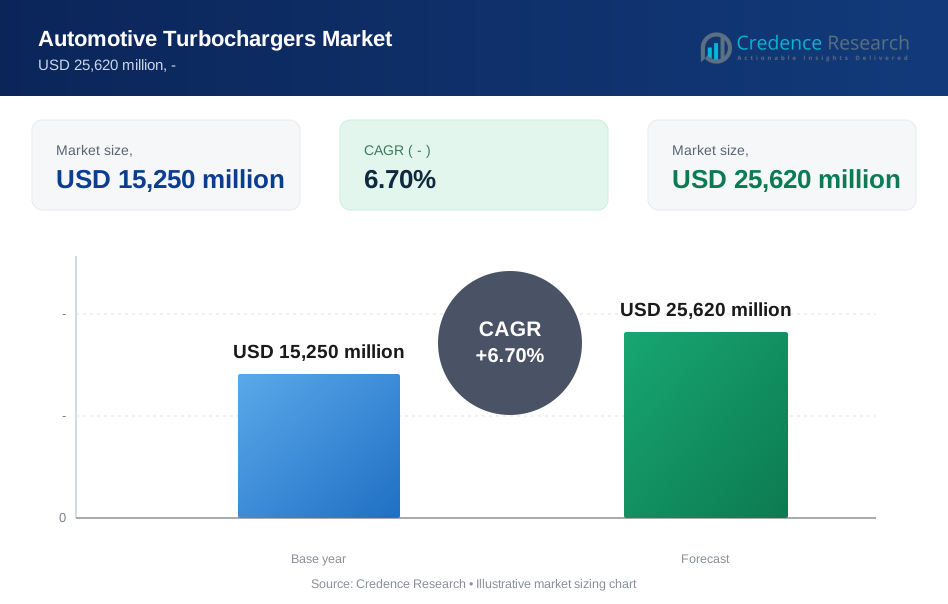
The Global Automotive Turbocharger Market is projected to grow from USD15,250 million in 2024 to an estimated USD25,620 million based on 2032, with a compound annual growth rate (CAGR) of 6.7% from 2025 to 2032.
Market drivers include growing emphasis on reducing vehicle emissions and improving fuel economy without compromising performance. Turbochargers enable smaller engine displacement while maintaining or enhancing power output, aligning with global fuel efficiency regulations. Trends in automotive downsizing and hybridization are supporting the adoption of advanced turbocharger technologies, including variable geometry turbochargers and electric-assist systems. The rising popularity of SUVs and light trucks, especially in North America and parts of Asia, further fuels demand for high-performance turbocharged engines.
Geographically, Europe dominates the market due to its stringent emission standards and strong automotive manufacturing base. Asia Pacific is emerging as a significant growth region, driven by increasing vehicle production in China, India, and Southeast Asia. North America also holds a substantial share due to the rising adoption of turbochargers in light trucks and SUVs. Key players operating in the global automotive turbocharger market include Honeywell International Inc., BorgWarner Inc., Cummins Inc., Mitsubishi Heavy Industries Ltd., and Continental AG.
Market Insights
- The Automotive Turbocharger Market is projected to grow from USD15,250 million in 2024 to USD25,620 million by 2032, registering a CAGR of 6.7% from 2025 to 2032.
- Turbochargers enable smaller engines to deliver higher power output, supporting global efforts to reduce fuel consumption and vehicle emissions.
- Turbocharging technology is widely adopted in passenger cars, light commercial vehicles, and heavy-duty trucks to meet performance and efficiency expectations.
- Stringent emission standards worldwide are prompting automakers to integrate turbochargers to comply with environmental regulations.
- Advanced materials and complex engineering raise production costs, posing challenges for adoption in low-cost vehicle segments and small-scale manufacturers.
- Europe dominates the market with a 32% share, driven by emission norms, premium vehicle demand, and strong OEM presence.
- Asia Pacific is the fastest-growing region, supported by expanding vehicle production in China, India, and Southeast Asia.
Market Drivers
Stringent Emission Regulations Driving Turbocharger Adoption
Governments across the globe are enforcing strict emission norms to curb greenhouse gas emissions and improve air quality. These regulations are pushing automakers to incorporate fuel-efficient and low-emission technologies. The Global Automotive Turbocharger Market benefits from this shift, as turbochargers improve combustion efficiency and reduce overall CO₂ emissions. Turbocharging allows smaller engines to produce higher power output, which supports vehicle downsizing without performance compromise. This aligns with regulatory compliance goals and contributes to reduced fuel consumption. Automakers are integrating advanced turbocharging systems to meet Euro 6, BS VI, and China VI standards.
- For instance, Asia-Pacific has seen a surge in turbocharger adoption due to stringent emission norms and increased production of mild hybrid vehicles.
Rising Demand for Fuel-Efficient and High-Performance Vehicles
Consumers are increasingly favoring vehicles that deliver strong performance with better fuel economy. Turbochargers enable enhanced engine performance by increasing the air-fuel mixture in the combustion chamber. This allows smaller engines to generate more power, meeting consumer expectations for acceleration and responsiveness. The Global Automotive Turbocharger Market leverages this preference by offering solutions that improve fuel efficiency and power simultaneously. It is supported by technological innovations that reduce turbo lag and optimize boost pressure across engine speeds. This trend is particularly evident in the passenger car and SUV segments.
- For instance, approximately 60% of passenger cars now incorporate turbocharged engines, reflecting a substantial rise in adoption.
Accelerated Adoption in Hybrid and Gasoline Engines
The shift from diesel to gasoline and hybrid powertrains is expanding the application of turbochargers. Gasoline turbochargers are becoming more common as OEMs develop smaller, cleaner-burning engines. The Global Automotive Turbocharger Market gains traction through innovations such as electric turbochargers and variable geometry turbochargers suited for hybrids. It meets the dual challenge of improving fuel economy while delivering strong torque characteristics. Turbochargers also help hybrid vehicles maintain power delivery while managing battery efficiency. This adoption trend reflects a broader industry move toward electrification without sacrificing engine performance.
Technological Advancements Supporting Market Growth
Advances in material science, aerodynamics, and electronic control systems have significantly enhanced turbocharger efficiency and durability. Manufacturers are developing lightweight and compact turbochargers that improve engine performance while reducing thermal stress. The Global Automotive Turbocharger Market is evolving with innovations like twin-scroll turbochargers, which optimize exhaust gas flow for better boost response. It also benefits from integration with engine control units for real-time performance management. These technologies extend the lifecycle of turbochargers and improve reliability under diverse operating conditions. The continuous development of smart and electric turbo systems is fueling future demand.
Market Trends
Increased Penetration of Gasoline Turbochargers in Passenger Vehicles
The transition from diesel to gasoline engines in several key markets is boosting demand for gasoline turbochargers. Automakers are scaling down engine displacement to meet fuel efficiency targets while maintaining performance levels. Turbochargers allow gasoline engines to deliver higher torque and power, making them ideal for compact and mid-sized vehicles. The Global Automotive Turbocharger Market is seeing a shift in product portfolios to support gasoline-powered applications. It is also responding to consumer demand for vehicles that offer dynamic performance with lower fuel consumption. Major OEMs are deploying turbochargers across new vehicle models to align with changing regulatory and consumer expectations.
- For instance, automakers are integrating variable geometry turbochargers to enhance throttle response and thermal efficiency, supporting the transition to smaller, high-performance gasoline engines.
Growth of Electric Turbocharger Integration in Hybrid Vehicles
Electrification trends in the automotive industry are accelerating the adoption of electric turbochargers. These systems eliminate turbo lag and offer improved responsiveness by using electric motors to drive the turbine. The Global Automotive Turbocharger Market is evolving to accommodate hybrid and plug-in hybrid vehicles, which require efficient power delivery across varying load conditions. Electric turbochargers enable smoother acceleration and improve fuel economy in low-emission vehicle platforms. Manufacturers are investing in R\&D to enhance the integration of electric boost systems with battery management and engine control modules. This trend reflects the broader goal of reducing tailpipe emissions while preserving driving performance.
- For instance, manufacturers are deploying electric turbocharging systems in hybrid vehicles to improve acceleration and fuel economy while reducing emissions
Advancement in Turbo Materials and Design Efficiency
Material innovation plays a crucial role in boosting turbocharger efficiency and durability. The use of advanced alloys and ceramic composites allows turbochargers to withstand higher thermal loads and rotational speeds. The Global Automotive Turbocharger Market is incorporating lightweight materials to reduce system inertia and improve throttle response. It benefits from precision manufacturing techniques that enhance aerodynamic performance and reduce energy losses. These innovations enable compact turbochargers to deliver high boost pressure without increasing engine strain. Continuous improvement in material science is contributing to the long-term reliability and efficiency of modern turbo systems.
Expansion of Turbocharger Applications Beyond Traditional Segments
Turbocharger use is expanding beyond premium and performance vehicles into economy and entry-level segments. OEMs are introducing turbocharged variants in hatchbacks, compact SUVs, and crossovers to appeal to budget-conscious consumers. The Global Automotive Turbocharger Market is widening its application base, reflecting the growing need for affordable fuel-efficient solutions. It supports vehicle platforms that prioritize low operating costs and environmental compliance. Regional markets in Asia and Latin America are seeing faster adoption of turbochargers in mass-market vehicles. This trend indicates a democratization of turbocharging technology across the global automotive landscape.
Market Challenges
High Manufacturing Costs and Complex Integration
The design and production of turbochargers require precision engineering and advanced materials, which increase overall manufacturing costs. Turbochargers must endure extreme pressure and temperature conditions, demanding high-performance alloys and complex machining processes. The Global Automotive Turbocharger Market faces challenges in balancing cost efficiency with performance reliability. It also deals with integration issues, especially when aligning turbo systems with varied engine configurations and emission control technologies. Smaller manufacturers struggle to adopt these systems due to the cost-intensive nature of R\&D and customization. OEMs must invest in technical training and diagnostics to ensure seamless integration and long-term performance.
- For instance, 37% of engines in U.S. passenger vehicles for the 2023 model year were turbocharged, reflecting the industry's shift toward fuel-efficient and high-performance engines
Concerns Over Turbo Lag and Maintenance Requirements
Despite advancements, turbo lag remains a concern for some consumers, particularly in lower-cost models where performance tuning is limited. Delayed throttle response can affect driving comfort and reduce perceived performance quality. The Global Automotive Turbocharger Market must address consumer expectations for instant acceleration and smoother transitions. It also contends with higher maintenance demands, including the need for specialized components and servicing expertise. Turbochargers are sensitive to oil quality and temperature control, increasing the risk of mechanical failure if not properly maintained. These challenges can limit adoption in regions where service infrastructure and user awareness remain underdeveloped.
Market Opportunities
Rising Demand for Turbochargers in Emerging Automotive Markets
Expanding vehicle production in emerging economies creates significant growth potential for turbocharger manufacturers. Rapid urbanization and growing disposable incomes in countries such as India, Brazil, and Indonesia are driving demand for fuel-efficient vehicles. The Global Automotive Turbocharger Market stands to benefit as automakers introduce compact, turbocharged models tailored to local needs. It supports the push for cleaner mobility solutions in regions adopting stricter emission norms. The rising preference for small cars with improved mileage makes turbochargers an attractive addition. Increased government focus on reducing air pollution strengthens the case for widespread turbocharger adoption.
Innovation in Lightweight and Electrified Turbocharging Systems
Advances in electric turbochargers and lightweight materials present new opportunities for product differentiation. Manufacturers developing compact and efficient systems will gain a competitive edge in hybrid and electric vehicle segments. The Global Automotive Turbocharger Market can leverage this trend by offering solutions that align with evolving vehicle platforms and powertrain architectures. It allows OEMs to enhance performance while maintaining regulatory compliance. Demand for next-generation systems that reduce turbo lag and improve fuel economy is accelerating innovation. Companies investing in smart turbocharger technologies can capture untapped potential in performance and eco-friendly automotive categories.
Market Segmentation Analysis
By Technology Type
The Global Automotive Turbocharger Market segments by technology into Variable Geometry Turbochargers (VGT), Wastegate Turbochargers, and Electric Turbochargers. Variable Geometry Turbochargers dominate the segment due to their ability to adjust vane angles, offering improved boost control and performance across different engine speeds. Wastegate Turbochargers maintain a strong presence in cost-sensitive applications, especially in gasoline vehicles, due to their simpler design and lower cost. Electric Turbochargers are gaining momentum with the growth of hybrid vehicles, eliminating turbo lag and improving engine responsiveness. This subsegment is expected to witness the fastest growth, driven by increasing electrification and performance demands.
By Fuel Type
The market is divided into Gasoline and Diesel fuel types. Diesel engines have historically led turbocharger adoption due to their inherent need for forced induction to improve power and efficiency. However, the gasoline segment is expanding rapidly due to a shift in consumer preference and tightening emission regulations. Turbochargers in gasoline engines enable engine downsizing without compromising performance. The Global Automotive Turbocharger Market sees increased innovation and deployment in this segment, especially for compact passenger vehicles and hybrid powertrains.
By Vehicle Type
Turbocharger adoption spans across Passenger Cars, Light Commercial Vehicles (LCVs), and Heavy Commercial Vehicles (HCVs). Passenger cars hold the largest market share due to high production volumes and widespread demand for fuel-efficient performance. LCVs are increasingly integrating turbochargers to balance power and fuel economy for urban logistics. HCVs rely heavily on turbochargers for high torque output and emission compliance, making them essential for long-haul and freight applications. Each vehicle category contributes to market expansion through tailored turbocharging solutions.
Segments
Based on Technology Type
- Variable Geometry Turbocharger / Variable Nozzle Turbine
- Wastegate Turbocharger
- Electric Turbocharger
Based on Fuel Type
- Gasoline
- Diesel
Based on Vehicle Type
- Passenger Cars
- Light Commercial Vehicles (LCV)
- Heavy Commercial Vehicles (HCV)
Based on Region
- North America
- U.S.
- Canada
- Mexico
- Europe
- UK
- France
- Germany
- Italy
- Spain
- Russia
- Belgium
- Netherlands
- Austria
- Sweden
- Poland
- Denmark
- Switzerland
- Rest of Europe
- Asia Pacific
- China
- Japan
- South Korea
- India
- Australia
- Thailand
- Indonesia
- Vietnam
- Malaysia
- Philippines
- Taiwan
- Rest of Asia Pacific
- Latin America
- Brazil
- Argentina
- Peru
- Chile
- Colombia
- Rest of Latin America
- Middle East
- UAE
- KSA
- Israel
- Turkey
- Iran
- Rest of Middle East
- Africa
- Egypt
- Nigeria
- Algeria
- Morocco
- Rest of Africa
Regional Analysis
Europe Automotive Turbocharger Market
Europe holds a dominant position in the Automotive Turbocharger Market, accounting for 32% of the global market share in 2024. Strong regulatory frameworks, including Euro 6 emission norms, continue to drive turbocharger adoption across vehicle segments. Automakers in Germany, France, and the UK are integrating advanced turbo technologies in both diesel and gasoline vehicles to meet efficiency targets. The region’s mature automotive manufacturing base and high demand for premium vehicles support market expansion. Electric turbochargers are gaining traction as OEMs accelerate hybrid and EV development. Europe remains a hub for R\&D and deployment of lightweight, high-efficiency turbo systems.
Asia Pacific Automotive Turbocharger Market
Asia Pacific captures 28% of the global Automotive Turbocharger Market and is poised for the fastest growth through 2032. China, India, Japan, and South Korea are major contributors, supported by rising vehicle production and stringent emission norms. Governments in the region are pushing for fuel-efficient and low-emission mobility solutions, accelerating turbocharger integration. It benefits from expanding middle-class populations and increasing demand for passenger cars and light commercial vehicles. Domestic automakers are incorporating turbocharged engines to meet consumer expectations for performance and economy. Asia Pacific is becoming a manufacturing and export hub for turbocharger components.
North America Automotive Turbocharger Market
North America holds a 20% share in the global Automotive Turbocharger Market, driven by increasing adoption in SUVs and light trucks. Automakers in the United States and Canada are integrating turbocharged engines to achieve fuel economy targets under CAFÉ standards. Consumer preference for high-performance vehicles supports the use of turbochargers in gasoline applications. It is seeing growth in electric turbochargers, especially in hybrid platforms. The region also hosts major turbocharger suppliers and a robust automotive aftermarket. Emphasis on clean technologies is expected to further enhance regional adoption rates.
Latin America Automotive Turbocharger Market
Latin America represents 8% of the global market share, with Brazil and Mexico leading regional adoption. The region is gradually shifting toward cleaner vehicle technologies, supported by government emission targets and economic reforms. Automakers are incorporating turbochargers to improve fuel efficiency and meet evolving consumer preferences. It faces challenges related to cost sensitivity and limited infrastructure for advanced vehicle systems. However, rising demand for compact SUVs and commercial vehicles presents growth opportunities. Strategic collaborations and local manufacturing may accelerate adoption in the coming years.
Middle East and Africa Automotive Turbocharger Market
The Middle East and Africa account for 6% of the Automotive Turbocharger Market. Growth is moderate but steady, driven by infrastructure development and rising automotive demand in Gulf countries and parts of North Africa. OEMs are introducing turbocharged models to cater to long-distance driving conditions and fuel economy needs. It benefits from increasing demand for durable commercial vehicles in logistics and mining operations. Local governments are introducing fuel efficiency standards, prompting gradual market penetration. The aftermarket segment plays a key role in sustaining turbocharger demand across older vehicle fleets.
Key players
- Garrett Motion
- Continental GT
- Aptiv PLC
- Turbonetics
- ABB
- Cummins Inc.
- Ningbo Motor Industrial Co. Ltd.
- Precision Turbo and Engine Inc.
- Robert Bosch GmbH
- Mahle
- Rotomaster International
- Mitsubishi Heavy Industries Ltd.
- IHI Corporation
- Kompressorenbau Bannewitz GmbH
- Fuyuan Turbocharger Co. Ltd.
- Marelli Corporation
- Turbo Dynamics
Competitive Analysis
The Automotive Turbocharger Market features a mix of global giants and specialized manufacturers competing across OEM and aftermarket segments. Established players such as Garrett Motion, Mitsubishi Heavy Industries, and BorgWarner lead through technological innovation, expansive product lines, and strong OEM partnerships. Companies like Cummins Inc. and ABB leverage their engine and powertrain expertise to offer integrated turbo solutions. Regional players such as Fuyuan Turbocharger and Ningbo Motor Industrial Co. Ltd. focus on cost-effective manufacturing and local market penetration. It remains highly competitive with firms investing in electric turbocharger technologies, advanced materials, and smart boost systems. Mergers, acquisitions, and R\&D collaborations continue to shape the strategic landscape.
Recent Developments
- In April 2025, Garrett Motion showcased electrification and turbocharging innovations at Auto Shanghai 2025, including advanced solutions for commercial and passenger vehicles.
- In June 2024, Bentley (Continental GT) unveiled the 2025 GT Speed model with a hybrid V8 delivering 782PS and 1,000Nm torque.
- In April 2025, Aptiv PLC reported Q1 financials, including its ASR program.
- In May 2025, IHI Corporation announced a strong financial rebound with increased investment in turbocharger-linked businesses.
Market Concentration and Characteristics
The Automotive Turbocharger Market shows a moderately concentrated structure, with a few major players controlling a significant share of global revenue. It features strong presence of established manufacturers with extensive OEM collaborations and advanced technological capabilities. Companies such as Garrett Motion, Mitsubishi Heavy Industries, and BorgWarner maintain leadership through consistent innovation and global supply networks. The market exhibits high entry barriers due to complex engineering requirements, strict emission compliance standards, and long development cycles. It also displays strong product differentiation based on performance, fuel efficiency, and integration with hybrid systems. The presence of regional players offering cost-effective alternatives creates competitive pressure, particularly in emerging markets.
Report Coverage
The research report offers an in-depth analysis based on Technology Type, Fuel Type, Vehicle Type and Region. It details leading market players, providing an overview of their business, product offerings, investments, revenue streams, and key applications. Additionally, the report includes insights into the competitive environment, SWOT analysis, current market trends, as well as the primary drivers and constraints. Furthermore, it discusses various factors that have driven market expansion in recent years. The report also explores market dynamics, regulatory scenarios, and technological advancements that are shaping the industry. It assesses the impact of external factors and global economic changes on market growth. Lastly, it provides strategic recommendations for new entrants and established companies to navigate the complexities of the market.
Future Outlook
- Automakers will increase adoption of electric turbochargers to enhance throttle response and fuel efficiency in hybrid and downsized engines.
- Turbochargers will penetrate budget-friendly vehicle categories, driven by demand for fuel-efficient models in emerging economies.
- Turbochargers will play a key role in meeting future emission norms by supporting cleaner combustion and exhaust gas recirculation technologies.
- The global aftermarket segment will expand as aging vehicle fleets and performance tuning trends boost demand for replacement and upgraded turbo systems.
- Key players will pursue mergers and partnerships to expand geographic reach, enhance R\&D capabilities, and access new powertrain technologies.
- Manufacturers will focus on using advanced alloys and composites to produce compact, high-performance turbochargers with reduced thermal stress.
- The need for torque, durability, and fuel savings in heavy-duty trucks will drive turbocharger usage across global logistics and transport sectors.
- Turbochargers will increasingly include smart sensors for performance monitoring, enabling predictive maintenance and improved lifecycle management.
- Subsidies and incentives for low-emission vehicles will support wider deployment of turbochargers as part of fuel-saving powertrain configurations.
- Local manufacturers from China, India, and South Korea will strengthen their presence with cost-competitive products and growing OEM partnerships.
Request a Free Sample
Fill in your details and we'll send you a free sample report.
- Sample data tables & charts
- Research methodology
Need a Custom Version of This Report?
Tailor the scope, geography, or segments to your exact requirements.
- Custom geography or segment scope
- Direct access to our analyst team
Frequently Asked Questions
What is the projected growth rate of the global automotive turbochargers market?
What drives the demand for automotive turbochargers?
Which region is expected to grow the fastest?
What challenges does the automotive turbocharger market face?
Table of Content
Chapter 1. Report Introduction
- 1.1 Report Description & Purpose
- 1.1.1 Report Title & Market Definition
- 1.1.2 Unique Selling Propositions (USP) & Key Differentiators
- 1.1.3 Value Proposition for Stakeholders
- 1.2 Research Objectives
- 1.2.1 Market Sizing Objectives (Volume & Revenue)
- 1.2.2 Segmentation Objectives
- 1.2.3 Competitive Intelligence Objectives
- 1.2.4 Forecast & Scenario Objectives
- 1.3 Report Scope
- 1.3.1 Automotive Turbochargers Scope – Types & Subtypes Covered
- 1.3.2 Geographic Scope – Regions & Countries Covered
- 1.3.3 Historical Period, Base Year & Forecast Period (the historical period; forecast to the forecast period)
- 1.3.4 Inclusions & Exclusions
- 1.4 HS Code & Classification Framework
- 1.5 Currency, Units & Pricing Basis
- 1.6 Target Stakeholders
- 1.7 Limitations & Assumptions
Chapter 2. Executive Summary
- 2.1 Global Automotive Turbochargers Market Snapshot
- 2.1.1 Market Size – Historical (the historical period) & Forecast (the forecast period) (base year: USD 15,250 million → forecast year: USD 25,620 million)
- 2.1.2 Volume & Revenue – Global Totals
- 2.1.3 Key Market Highlights – Top Five Facts
- 2.2 Automotive Turbochargers Market Segmentation Snapshot
- 2.2.1 Market Split by Region – vs.
- 2.3 Competitive Snapshot
- 2.3.1 Top 10 Players by Revenue Share –
- 2.3.2 Top 10 Players by Volume Share –
- 2.3.3 Recent Strategic Developments (18-Month Summary)
- 2.4 Key Investment Highlights & Strategic Conclusions
Chapter 3. Automotive Turbochargers Market Dynamics & Industry Analysis
- 3.1 Market Overview & Context
- 3.1.1 Automotive Turbochargers Market Position in the Broader Automotive Value Chain
- 3.1.2 OEM vs. Replacement Market Dynamics
- 3.1.3 Market Maturity & Development Stage by Region
- 3.2 Automotive Turbochargers Market Drivers
- 3.3 Automotive Turbochargers Market Restraints & Challenges
- 3.4 Automotive Turbochargers Market Opportunities
- 3.5 Porter's Five Forces Analysis
- 3.5.1 Threat of New Entrants
- 3.5.2 Bargaining Power of Suppliers
- 3.5.3 Bargaining Power of Buyers
- 3.5.4 Threat of Substitutes
- 3.5.5 Competitive Rivalry – Intensity Assessment
- 3.6 Automotive Turbochargers Value Chain Analysis
- 3.6.1 Upstream – Raw Material/Input Suppliers
- 3.6.1.1 Raw Material/Input 1
- 3.6.1.2 Raw Material/Input 2
- 3.6.1.3 Raw Material/Input 3
- 3.6.2 Midstream – Production/Manufacturing/Service Delivery
- 3.6.2.1 Production/Process Overview
- 3.6.2.2 Key Facility Locations & Capacity by Manufacturer
- 3.6.3 Downstream – Distribution & End Consumer
- 3.6.3.1 Primary Channel – B2B/OEM
- 3.6.3.2 Secondary Channels – Dealer, Retail, Online, Direct
- 3.6.4 Value Chain Profitability Analysis
- 3.6.1 Upstream – Raw Material/Input Suppliers
- 3.7 PESTEL Analysis
- 3.7.1 Political Factors
- 3.7.2 Economic Factors
- 3.7.3 Social Factors
- 3.7.4 Technological Factors
- 3.7.5 Environmental Factors
- 3.7.6 Legal Factors
- 3.8 Automotive Turbochargers Supply Chain Analysis
- 3.8.1 Raw Material/Input Supply Risk Assessment
- 3.8.2 Manufacturing Concentration Risk (Geographic Exposure)
- 3.8.3 Trade Disruption Impact Analysis
- 3.9 Regulatory & Policy Landscape
Note: The regulatory and policy landscape section covers regulations based on their applicability to the market, Automotive Turbochargers category, geography, and scope of the study. Only regulatory frameworks with a material impact on operations, compliance, trade, sustainability, or market access are analyzed in detail.
Chapter 4. Key Investment Pockets & Opportunity Analysis
- 4.1 Automotive Turbochargers Market Attractiveness Analysis
- 4.1.1 By Region – Investment Attractiveness Matrix (Volume × CAGR)
- 4.2 Absolute Revenue Growth Opportunity
- 4.2.1 By Region – Absolute USD Growth Through the forecast period
- 4.3 Incremental Volume Opportunity
- 4.3.1 By Region – Incremental Volume Through the forecast period
- 4.3.2 Segment – Incremental Volume
- 4.4 Emerging Submarket Opportunity Deep Dive (Subject to Applicability)
- 4.5 Emerging Market Opportunity Scorecards
- 4.5.1 United States
- 4.5.2 Europe
- 4.5.3 Asia
- 4.5.4 Middle East & Africa
Note: Emerging Market Opportunity Scorecards will be included based on relevance and strategic importance. Regions listed are indicative and may vary depending on data availability and market dynamics.
Chapter 5. Automotive Turbochargers Import-Export Analysis & Trade Flows
- 5.1 Global Trade Overview
- 5.1.1 Global Export Value by Country (the historical period)
- 5.1.2 Global Export Volume by Country (the historical period)
- 5.1.3 Global Import Value by Country (the historical period)
- 5.1.4 Global Import Volume by Country (the historical period)
- 5.1.5 Net Trade Balance by Country (the historical period)
- 5.2 Export Analysis – Segment
- 5.2.1 Type 1 (HS Code)
- 5.2.2 Type 2 (HS Code)
- 5.2.3 Type 3 (HS Code)
- 5.2.4 Type 4 (HS Code)
- 5.2.5 Type 5 (HS Code)
- 5.3 Import Analysis – Segment
- 5.3.1 Type 1 (HS Code)
- 5.3.2 Type 2 (HS Code)
- 5.3.3 Type 3 (HS Code)
- 5.3.4 Type 4 (HS Code)
- 5.3.5 Type 5 (HS Code)
- 5.4 Average Unit Trade Prices
- 5.4.1 Average Export Price – Segment & Country
- 5.4.2 Average Import Price – Segment & Source Country
- 5.4.3 Price Trends (the historical period)
- 5.5 Key Trade Route Analysis
- 5.5.1 Trade Route 1
- 5.5.2 Trade Route 2
- 5.5.3 Trade Route 3
- 5.5.4 Trade Route 4
- 5.5.5 Trade Route 5
- 5.6 Trade Policy Impact Assessment
- 5.6.1 US Anti-Dumping & Section 301 Tariffs
- 5.6.2 EU Customs Union Impact
- 5.6.3 Major Free Trade Agreements
- 5.6.4 USMCA Rules of Origin
Note: Trade policy analysis will be included only where relevant to the Automotive Turbochargers market.
Chapter 6. Competitive Landscape & Company Benchmarking
- 6.1 Automotive Turbochargers Market Concentration & Structure
- 6.1.1 Herfindahl-Hirschman Index (HHI) – vs.
- 6.1.2 Tier 1, Tier 2 & Tier 3 Market Structure
- 6.1.3 Global, Regional & Local Player Dynamics
- 6.2 Automotive Turbochargers Market Share Analysis –
- 6.2.1 Global Revenue Share by Company
- 6.2.2 Global Volume Share by Company
- 6.2.3 Regional Revenue Share
- 6.2.4 Market Share Evolution ( vs. )
- 6.2.5 OEM Segment Share by Company
- 6.2.6 Replacement Segment Share by Company
- 6.3 Production/Delivery Capacity & Facility Analysis
- 6.3.1 Global Installed Capacity
- 6.3.2 Capacity Utilization Rates
- 6.3.3 Production/Output Volume
- 6.3.4 Facility Locations & Capacity Map
- 6.3.5 Planned Capacity Additions
- 6.4 Automotive Turbochargers Competitive Benchmarking Matrix
- 6.4.1 Revenue, Volume, CAGR & Profitability Comparison
- 6.4.2 Channel Revenue Mix
- 6.4.3 Geographic Revenue Exposure
- 6.4.4 R&D Intensity
- 6.4.5 Sustainability Maturity
- 6.5 Strategic Developments in Automotive Turbochargers (Last 24 Months)
- 6.5.1 Mergers, Acquisitions & Divestments
- 6.5.2 New Automotive Turbochargers Launches
- 6.5.3 Facility Expansions
- 6.5.4 Strategic Alliances, Joint Ventures & Partnerships
- 6.5.5 Distribution Expansion & Market Entry
- 6.5.6 Sustainability & ESG Initiatives
- 6.6 Competitive Strategy Mapping
- 6.6.1 Leader, Challenger, Follower & Niche Classification
- 6.6.2 Pricing Strategy Comparison
- 6.6.3 Channel Strategy Matrix
Note: Strategic developments are included based on their materiality and the availability of reliable information.
Chapter 7. Global Automotive Turbochargers Market – By Distribution Channel
- 7.1 Segment Overview
- 7.1.1 Volume & Revenue Split by Channel ( & )
- 7.1.2 Channel Mix Evolution (the forecast period)
Chapter 8. Regional Market Analysis – Global Overview
- 8.1 Global Regional Overview
- 8.1.1 Regional Volume Share
- 8.1.2 Regional Revenue Share
- 8.1.3 Regional Volume by Region
- 8.1.4 Regional Revenue by Region
- 8.1.5 Regional Forecast Through the forecast period
- 8.2 Cross-Regional Segment Analysis
- 8.2.1 By Distribution Channel
- 8.2.2 By Brand/Price Tier
Chapter 9. North America Automotive Turbochargers Market
- 9.1 United States
- 9.2 Canada
- 9.3 Mexico
Chapter 10. Europe Automotive Turbochargers Market
- 10.1 Germany
- 10.2 France
- 10.3 Italy
- 10.4 United Kingdom
- 10.5 Spain
- 10.6 Poland
- 10.7 Russia
- 10.8 Netherlands
- 10.9 Belgium
- 10.10 Sweden
- 10.11 Denmark
- 10.12 Norway
- 10.13 Rest of Europe
Chapter 11. Asia Pacific Automotive Turbochargers Market
- 11.1 China
- 11.2 India
- 11.3 Japan
- 11.4 South Korea
- 11.5 Thailand
- 11.6 Indonesia
- 11.7 Vietnam
- 11.8 Malaysia
- 11.9 Australia
- 11.10 Rest of Asia Pacific
Chapter 12. Latin America Automotive Turbochargers Market
- 12.1 Brazil
- 12.2 Argentina
- 12.3 Colombia
- 12.4 Chile
- 12.5 Rest of Latin America
Chapter 13. Middle East Automotive Turbochargers Market
- 13.1 Saudi Arabia
- 13.2 United Arab Emirates
- 13.3 Turkey
- 13.4 Israel
- 13.5 Iran
- 13.6 Rest of the Middle East
Chapter 14. Africa Automotive Turbochargers Market
- 14.1 South Africa
- 14.2 Egypt
- 14.3 Nigeria
- 14.4 Morocco
- 14.5 Rest of Africa
Chapter 15. Automotive Turbochargers Company Profiles
- 15.1 [Company 01]
- 15.1.1 Company Overview
- 15.1.2 Key Management Personnel
- 15.1.3 Products & Services Portfolio
- 15.1.4 Financial Performance
- 15.1.5 Key Market Focus & Geographic Presence
- 15.1.6 Recent Developments & Strategic Initiatives
Note: The company profile list is preliminary and may change based on research findings, market developments, data availability, and client requirements.
Chapter 16. Appendices
- Appendix A – List of Abbreviations & Acronyms
- Appendix B – Industry Classification Code Reference – Full Series
- Appendix C – Production & Capacity Data Tables
- Appendix D – End-Use & Demand Base Tables
- Appendix E – Consumption & Replacement Rate Assumptions
- Appendix F – ASP Reference Tables
- Appendix G – Manufacturing & Facility Database
- Appendix H – Import-Export Data Tables
- Appendix I – Regulatory Summary Tables
- Appendix J – Primary Research Participant List (Anonymized)
- Appendix K – Primary Research Questionnaire Framework
- Appendix L – Data Sources & Bibliography
- Appendix M – Market Size Divergence & Source Comparison
Chapter 17. Research Methodology
- 17.1 Research Framework & Philosophy
- 17.2 Secondary Research – Sources, Hierarchy & Data Extraction
- 17.3 Data Modeling – Bottom-Up & Top-Down Market Sizing
- 17.4 Primary Research – Stakeholder Framework, LOI & Sample Sizes
- 17.5 Forecast Methodology – Regression, Scenario & Sensitivity Analysis
- 17.6 Quality Control – Four-Layer Validation Framework
- 17.7 Limitations & Standard Assumptions
- 17.8 Disclaimer
