
| REPORT ATTRIBUTE | DETAILS |
|---|---|
| Historical Period | 2019-2022 |
| Base Year | 2023 |
| Forecast Period | 2024-2032 |
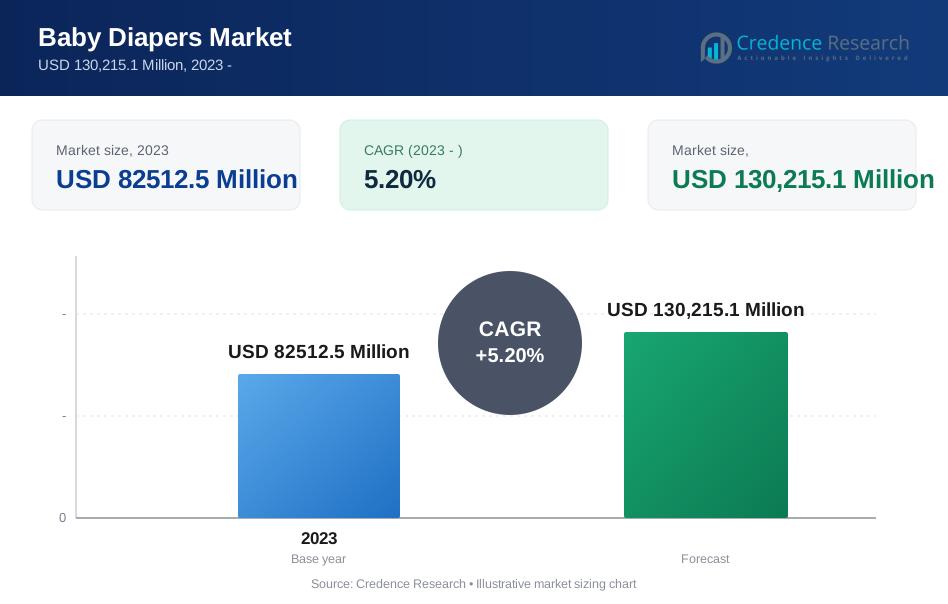
| Baby Diapers Market Size 2023 | USD 82512.5 Million |
| Baby Diapers Market, CAGR | 5.20% |
| Baby Diapers Market Size 2032 | USD 130215.1 Million |
Market Insights
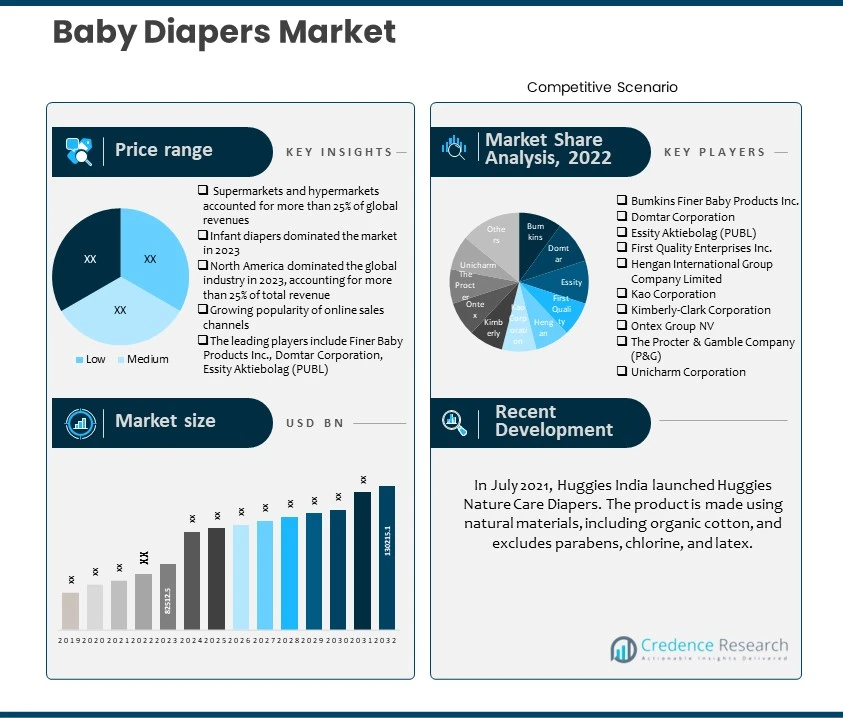
- The global demand for Baby Diapers was valued at USD 82512.5 Million in 2023 and is expected to reach USD 130215.1 Million in 2032, growing at a CAGR of 5.20% between 2024 and 2032.
- Disposable diapers had the largest market share in 2023, accounting for more than 50%, while biodegradable diapers are predicted to have the greatest CAGR during the forecast period.
- Size 3 (16-28 lbs) is the most popular and significant market segment for baby diapers.
- Supermarkets and hypermarkets accounted for more than 25% of global revenues, and online distribution is likely to grow the fastest during the projected period.
- The Unisex Diapers sector accounts for a large share of the infant diapers market.
- Infant diapers led the market in 2023, accounting for more than 40% of global sales. Diapers for toddlers are expected to grow at the fastest CAGR during the projection period.
- The disposable diapers sector is the major contributor to the market, expanding at a 5.1% CAGR throughout the projected period. The second-largest segment, cloth diapers, is expected to increase at a CAGR of 6.2% throughout the projection period.
- Fragrance-free diapers are the most popular segment, while organic diapers represent another important part of the infant diaper industry.
- Organic diapers are another important segment of the infant diaper market.
- North America dominated the global industry in 2023, accounting for more than 25% of total revenue, while Asia Pacific is projected to have the fastest CAGR throughout the forecast period.
- The growing demand for eco-friendly and biodegradable diapers will drive market expansion.
- The negative impact on the surrounding environment limits market growth.
Executive Summary
Market Definition
The Baby Diapers Market refers to the industry that manufactures, distributes, and sells diapers made specifically for newborns and young children. This store sells a variety of diapers, including disposable diapers, cloth diapers, and biodegradable diapers. The Baby Diapers Market is driven by factors such as rising birth rates, increased hygiene awareness, and the convenience that diapers provide for parents and caregivers. It is a sizable global market, with several brands and goods catering to the needs of infants and toddlers.
Market Overview
The global Baby Diapers Market has witnessed steady growth in recent years and is expected to grow at a CAGR of 5.20% between 2024 and 2032. The market was valued at USD 82512.5 million in 2023 and is expected to reach USD 130215.1 million in 2032.
This industry is booming due to factors like as rising birth rates, increased hygiene awareness, and the convenience diapers provide to parents and caregivers. There are several options available, including disposable diapers, cloth diapers, and biodegradable diapers. It's a global market with many companies and goods competing to suit the needs of infants and toddlers.
Segmentation by Product Type
- Disposable diapers had the biggest market share in 2023, accounting for more than 50%. Working parents prefer disposable diapers because they do not need to be washed, saving them time and effort.
- Biodegradable diapers are expected to have the highest CAGR over the projection period.
Segmentation by Size
- Size 3 (16-28 lbs) is the most popular and major market category for baby diapers. This size range is often used for babies who have outgrown newborn and size 1 diapers but are not yet ready for bigger sizes.
Segmentation by Distribution Channel
- Supermarkets and hypermarkets accounted for more than 25% of global revenues. Due to their greater client base and global distribution network, most manufacturers distribute their baby products through supermarkets and hypermarkets such as Walmart, Tesco, Carrefour, and Target.
- The online distribution channel is likely to grow the fastest during the projected period, driven by shifting client buying behaviors.
Segmentation by Gender
- The Unisex Diapers segment holds a significant share of the baby diapers market. Unisex diapers are intended to be appropriate for both baby girls and newborn boys. They provide ease and versatility for parents who want a gender-neutral choice or have many children of different genders. The popularity of unisex diapers has surged as more parents embrace gender-neutral parenting and seek inclusive options for their children.
Segmentation by Age Group
- Infant diapers dominated the market in 2023, accounting for more than 40% of worldwide sales. Infants and newborns require diaper changes more frequently than other age groups because they empty their bladders numerous times per day.
- Diapers designed for toddlers are predicted to expand at the fastest CAGR throughout the forecast period due to the growing demand for diapers among this age group.
Segmentation by Material
- The disposable diapers sector is the largest contributor to the market, rising at a 5.1% CAGR over the projection period. Stretch diapers, which allow for greater ease of movement for the baby and are manufactured by the market's major companies, are among the items sold.
- The second-largest segment, cloth diapers, is predicted to increase at a CAGR of 6.2% throughout the projection period.
Segmentation by Features
- The most in-demand segment is fragrance-free diapers. Many parents prefer fragrance-free diapers because they do not have added odors or aromas, which reduces the risk of skin irritation and allergies. They offer a mild and hypoallergenic solution for babies with sensitive skin.
- Organic diapers are another key section of the baby diaper business. Organic diapers are created from natural and sustainable components, with little or no chemicals, additions, or synthetic elements.
Segmentation by Brand
- The popular category in the baby diapers industry is Major Brands. The term major brands refers to well-known and established enterprises that manufacture and sell newborn diapers. In the diaper sector, these companies are frequently known for their high quality, dependability, and innovation. Many parents rely on and choose big brands for their baby's diapering needs because of their proven track record and widespread availability.
Segmentation by Region
- North America dominated the global industry in 2023, accounting for more than 25% of total revenue
- Asia Pacific is predicted to have the quickest CAGR throughout the forecast period.
- The rest of the world, including Latin America, the Middle East, and Africa, supplies the remaining demand for Baby Diapers.
In 2023, North America had a largest market share. The presence of significant players in the areas has resulted in high purchasing power and the availability of a diverse variety of products, which is boosting the market. Consumers in this region are looking for items with claims like natural, biodegradable, chemical-free, and others because they are concerned about their babies' sensitive skin as well as the environment.
Asia Pacific is expected to expand the quickest over the forecast period, with a CAGR of 5.2% between 2024 and 2032, owing to expansion and product launches in the area. The increasing economic upliftment and increase in living standards are boosting the need for baby diapers in this region. Furthermore, as millennial parents become more aware of the importance of baby care products, an increasing number of customers are investing in them. Furthermore, the movement in consumer choice from cloth diapers to biodegradable diapers is projected to drive market expansion.
Key Highlights of the Report
Product Type, Size, Distribution Channel, Gender, Type, Material, Features, Brand, and region segment of the global Baby Diapers Market. In 2023, infant diapers dominated the market, and fragrance-free diapers were the most popular sector. Major Brands are the most popular category in the baby diapers industry, with biodegradable diapers predicted to have the greatest CAGR during the forecast period. Additionally, the Unisex Diapers category has a large stake, with North America leading the market growth.
The market is being driven by rising birth rates and population growth, increased awareness of cleanliness and health concerns, and rising demand for easy and time-saving infant care products. Furthermore, environmental concerns and the need for sustainable diaper solutions, price sensitivity and affordability for particular customer segments, and intense rivalry among existing and rising competitors are the primary limitations of the market.
Nonetheless, In 2023, North America held the largest market share. The presence of major firms in the areas has resulted in increased purchasing power and the availability of a varied range of items, hence strengthening the market. Furthermore, Asia Pacific is predicted to grow the fastest during the projection period, with a CAGR of 5.2% between 2024 and 2032.
What Are The Main Drivers Of The Global Baby Diapers Market?
The Baby Diapers Market is driven by a number of factors that influence growth and demand. To begin, rising birth rates and population expansion are important factors propelling the market ahead. As the world's population grows, the need for infant diapers automatically rises. Second, there is a greater awareness of cleanliness and health issues among parents and caregivers. They recognize the necessity of keeping their babies clean and dry, which fuels the need for diapers.
What Are The Major Challenges Faced By The Global Baby Diapers Market?
While the Baby Diapers Market has enormous potential, some limitations must be recognized. One of the significant constraints is the increased environmental awareness and demand for sustainable diaper solutions. As people grow more concerned about their environmental impact, there is a greater need for biodegradable and eco-friendly diaper materials. Another constraint is price sensitivity and affordability for specific market categories. Diapers can be an ongoing burden for families, and some may struggle to purchase premium diaper brands.
What Are The Growth Opportunities In The Global Baby Diapers Market?
The baby diaper market offers numerous prospects for expansion and innovation. One opportunity is the development of biodegradable and environmentally friendly diaper materials. As environmental consciousness grows, there is a greater demand for diapers with a low environmental impact. This brings up opportunities for the study and development of environmentally friendly diaper choices. Another possibility is to expand into undeveloped markets with strong growth potential. As disposable incomes rise in emerging economies, the demand for newborn diapers expands.
Market Drivers
Several factors drive the global Baby Diapers Market. The following are the key drivers of the global Baby Diapers Market:
Rising demand for eco-friendly and biodegradable diapers will boost market growth
People's awareness of chemical-containing personal care products has grown significantly, increasing the demand for products made with organic ingredients. As a result, wood vinegar has become increasingly popular in recent years. In contrast, it is expected that the number of people utilizing wood vinegar as an ingredient in personal care products will increase in the coming years. Wood vinegar is used in a variety of unusual care items, including sunscreen lotion, soap, and more. Nowadays, parents are looking for newborn diapers that are better for the environment, protect their children from rashes, keep them dry, and use less landfill.
In addition, numerous firms are working on novel alternatives, such as biodegradable baby diapers. These diapers are made of latex and contain no chlorine and no dyes to meet the growing consumer demand for environmentally friendly baby diapers. Furthermore, producers are producing cornstarch-based baby diapers as an alternative to plastic, as well as chlorine-based bleaching, which discharges pollutants into the environment. This is being done to limit the amount of pollution released into the environment.
Furthermore, firms such as diapers are focused on creating cutting-edge technologies like as nanotechnology, which have the potential to reduce the negative environmental impact of disposable baby diapers. Furthermore, pant-style baby diapers are gaining popularity in the baby diaper industry because they feature unique air channels that allow the baby's skin to breathe while remaining dry. The trousers include an aloe vera-based baby lotion that helps keep the baby's skin smooth and free of rashes. As a result, the availability of biodegradable and pant-style baby diapers helps to drive up demand in the baby diaper industry.
Market Restraints
The global Baby Diapers Market faces some challenges that may hinder its growth. These include the following:
Negative Impact on the Surrounding Environment Restricts Market Growth
Using baby diapers generates a huge amount of trash in the environment. Furthermore, while disposable diapers appear to be more effective than cloth diapers, their environmental impact is severe. They account for a significant amount of the waste delivered to landfills that cannot be recycled. They include a wide range of potentially dangerous compounds that are released into the environment. They generate a considerable quantity of waste while preventing the use of dangerous substances such as tributyltin (TBT), dioxins, adhesives, synthetic dyes, fragrances, sodium polyacrylate, and volatile organic compounds (VOCs) like xylene, ethyl benzene, toluene, and others. As a result, the growing number of environmental issues raised by the use of infant diapers stifles market growth.
Opportunities
The global Baby Diapers Market offers significant growth opportunities. These include the following:
The rise of innovative products will boost market opportunities
The disposable diaper market has seen innovation in the form of intelligent diapers. There is a little patch attached to the front of the diaper. It comprises of four little squares of varying colors. It behaves variably depending on whether it is exposed to specific proteins, microorganisms, or how much water is present. The fact that these intelligent diapers need parents to change their child's diapers far less frequently than standard diapers helps to ease some of the stress they face. In addition, the producers have created a smartphone app that alerts parents when their children wet their diapers. A sensor is inserted in the infant's diaper, and using an app on the parent's smartphone, it detects and informs the parent to the level of moisture in the air.
Furthermore, as the number of creative baby diaper designs has increased, the industry's environmental impact has improved. Throughout the product development and distribution stages, the leading manufacturers introduce smaller diapers, less packing, and superior efficiency. As a result, the market for baby diapers is being boosted in part by the proliferation of more complex diaper designs and the growing popularity of smart diapers.
Competitive Landscape
Key Players
The global Baby Diapers Market is highly competitive, with several key players. Some of the major players in the market and their market share are as follows:
- Bumkins Finer Baby Products Inc.
- Domtar Corporation
- Essity Aktiebolag (PUBL)
- First Quality Enterprises Inc.
- Hengan International Group Company Limited
- Kao Corporation
- Ontex Group NV
- The Procter & Gamble Company (P&G)
- Kimberly-Clark Corporation
- Hengan International
- Unicharm Corporation
- Johnson & Johnson
These organizations prioritize product innovation, Distribution Channel expansion, and mergers and acquisitions to stay competitive.
The global Baby Diapers Market's key players continually seek to stay ahead by offering new products and developments.
In August 2022, Hayat Kimya debuted Bebem with Natural Essences Baby Diapers. The goods are created using sustainably sourced natural bamboo fibers and organic cotton extracts.
In April 2022, Domtar partners with the Nature Conservancy of Canada to establish the largest private land conservation agreement in Canadian history.
In April, 2022, Kao and Nissin Agree to Collaborate on the Virtual Human Body Generative Model.
Summary of Key Findings
- The emergence of novel items will increase market potential.
- Market segmented by Product Type, Size, Distribution Channel, Gender, Type, Material, Features , Brand and region.
- Supermarkets and hypermarkets accounted for more than 25% of global revenue
- Organic diapers are another important aspect of the infant diaper industry.
- Fragrance-free diapers are the most popular segment
- North America is leading market growth; the market is highly competitive with key players including Bumkins Finer Baby Products Inc., Domtar Corporation, Essity Aktiebolag (PUBL) and Others.
Future Outlook
- Increasing demand for eco-friendly and sustainable diaper options
- Technological advancements leading to innovative diaper designs
- Growing popularity of online sales channels
- Rising focus on baby comfort and skin health
- Expansion into emerging markets
- Introduction of smart diapers with monitoring capabilities
How CXOs Can Benefit from the Credence Research Baby Diapers Market Report
The Credence Research Baby Diapers Market Report provides CXOs with a comprehensive overview of the market, including:
- Market size and growth forecast:The report provides detailed estimates of the global Baby Diapers Market size, segmented by Product Type, Size, Distribution Channel, Gender, Type, Material, Features , Brand and region. It also includes forecasts for the market through 2032, based on key trends and drivers.
- Market segmentation: The report segments the Baby Diapers Market by Product Type, Size, Distribution Channel, Gender, Type, Material, Features , Brand and region. This segmentation provides CXOs with a granular understanding of the market and the opportunities in each segment.
- Competitive landscape: The report profiles the key players in the Baby Diapers Market and provides insights into their strategies, product offerings, and financial performance. This information can help CXOs to identify and assess their competition.
- Key trends and drivers: The report identifies and analyzes the key trends and drivers that are shaping the Baby Diapers Market. This information can help CXOs to make informed decisions about their investments and strategies.
CXOs can use the insights from the Credence Research Baby Diapers Market Report to:
- Identify growth opportunities: The report can help CXOs to identify new growth opportunities in the Baby Diapers Market. For example, it can provide insights into emerging technologies, market trends, and key market players.
- Make informed investment decisions: The report can help CXOs to make informed investment decisions about Baby Diapers. For example, it can provide insights into market trends, growth potential, competitive landscape, and key players in the industry.
- Develop competitive strategies: The report can help CXOs to develop competitive strategies for their Baby Diapers businesses. For example, the report identifies the key strategies that dark fiber providers are using to differentiate themselves from their competitors.
- Track market developments: The .report can help CXOs to track market developments and stay ahead of the curve. For example, the report provides insights into the latest trends and innovations in the Baby Diapers Market.
Overall, the Credence Research Breast Cancer .Treatment Market Report is a valuable resource for CXOs who are looking to gain a deeper understanding of the market and identify opportunities for growth.
Segmentation
By Product Type:- Disposable Diapers
- Ultra-Absorbent Diapers
- Regular Diapers
- Biodegradable Diapers
- Cloth Diapers
- Training Pants or Pull-ups
- Swim Diapers
- Biodegradable Diapers
- Others
- Newborn (Up to 6 lbs)
- Size 1 (8-14 lbs)
- Size 2 (12-18 lbs)
- Size 3 (16-28 lbs)
- Size 4 (22-37 lbs)
- Size 5 (Over 27 lbs)
- Size 6 (Over 35 lbs)
- Others
- Supermarkets/Hypermarkets
- Pharmacies/Drugstores
- Online Retail
- Specialty Stores
- Others
- Baby Girl Diapers
- Baby Boy Diapers
- Unisex Diapers
- Brand:
- Infant Diapers
- Toddler Diapers
- Disposable Diapers
- Superabsorbent Polymer (SAP)
- Polypropylene (PP)
- Polyethylene (PE)
- Others
- Cloth Diapers
- Cotton
- Microfiber
- Bamboo
- Others
- Fragrance-Free Diapers
- Hypoallergenic Diapers
- Wetness Indicator Diapers
- Organic Diapers
- Others
- Major Brands
- Private Labels
- North America
- The U.S.
- Canada
- Mexico
- Europe
- Germany
- France
- The U.K.
- Italy
- Spain
- Rest of Europe
- Asia Pacific
- China
- Japan
- India
- South Korea
- South-east Asia
- Rest of Asia Pacific
- Latin America
- Brazil
- Argentina
- Rest of Latin America
- Middle East & Africa
- GCC Countries
- South Africa
- Rest of Middle East and Africa
Request a Free Sample
Fill in your details and we'll send you a free sample report.
- Sample data tables & charts
- Research methodology
Need a Custom Version of This Report?
Tailor the scope, geography, or segments to your exact requirements.
- Custom geography or segment scope
- Direct access to our analyst team
Frequently Asked Questions
What is the current size of the global Baby Diapers Market?
What is the expected growth rate of the Baby Diapers Market between 2024 and 2032?
Which segment is leading the market share in terms of Age Group?
Which Features segment governs the demand for Baby Diapers in the world?
Who are the major players in the global Baby Diapers Market?
Table of Content
Chapter 1. Report Introduction
- 1.1 Report Description & Purpose
- 1.1.1 Report Title & Market Definition
- 1.1.2 Unique Selling Propositions (USP) & Key Differentiators
- 1.1.3 Value Proposition for Stakeholders
- 1.2 Research Objectives
- 1.2.1 Market Sizing Objectives (Volume & Revenue)
- 1.2.2 Segmentation Objectives
- 1.2.3 Competitive Intelligence Objectives
- 1.2.4 Forecast & Scenario Objectives
- 1.3 Report Scope
- 1.3.1 Baby Diapers Scope – Types & Subtypes Covered
- 1.3.2 Geographic Scope – Regions & Countries Covered
- 1.3.3 Historical Period, Base Year & Forecast Period (2023; forecast to the forecast period)
- 1.3.4 Inclusions & Exclusions
- 1.4 HS Code & Classification Framework
- 1.5 Currency, Units & Pricing Basis
- 1.6 Target Stakeholders
- 1.7 Limitations & Assumptions
Chapter 2. Executive Summary
- 2.1 Global Baby Diapers Market Snapshot
- 2.1.1 Market Size – Historical (2023) & Forecast (the forecast period) (2023: USD 82512.5 Million → forecast year: USD 130,215.1 Million)
- 2.1.2 Volume & Revenue – Global Totals
- 2.1.3 Key Market Highlights – Top Five Facts
- 2.2 Baby Diapers Market Segmentation Snapshot
- 2.2.1 Market Split by Region – 2023 vs.
- 2.3 Competitive Snapshot
- 2.3.1 Top 10 Players by Revenue Share – 2023
- 2.3.2 Top 10 Players by Volume Share – 2023
- 2.3.3 Recent Strategic Developments (18-Month Summary)
- 2.4 Key Investment Highlights & Strategic Conclusions
Chapter 3. Baby Diapers Market Dynamics & Industry Analysis
- 3.1 Market Overview & Context
- 3.1.1 Baby Diapers Market Position in the Broader Automotive Value Chain
- 3.1.2 OEM vs. Replacement Market Dynamics
- 3.1.3 Market Maturity & Development Stage by Region
- 3.2 Baby Diapers Market Drivers
- 3.3 Baby Diapers Market Restraints & Challenges
- 3.4 Baby Diapers Market Opportunities
- 3.5 Porter's Five Forces Analysis
- 3.5.1 Threat of New Entrants
- 3.5.2 Bargaining Power of Suppliers
- 3.5.3 Bargaining Power of Buyers
- 3.5.4 Threat of Substitutes
- 3.5.5 Competitive Rivalry – Intensity Assessment
- 3.6 Baby Diapers Value Chain Analysis
- 3.6.1 Upstream – Raw Material/Input Suppliers
- 3.6.1.1 Raw Material/Input 1
- 3.6.1.2 Raw Material/Input 2
- 3.6.1.3 Raw Material/Input 3
- 3.6.2 Midstream – Production/Manufacturing/Service Delivery
- 3.6.2.1 Production/Process Overview
- 3.6.2.2 Key Facility Locations & Capacity by Manufacturer
- 3.6.3 Downstream – Distribution & End Consumer
- 3.6.3.1 Primary Channel – B2B/OEM
- 3.6.3.2 Secondary Channels – Dealer, Retail, Online, Direct
- 3.6.4 Value Chain Profitability Analysis
- 3.6.1 Upstream – Raw Material/Input Suppliers
- 3.7 PESTEL Analysis
- 3.7.1 Political Factors
- 3.7.2 Economic Factors
- 3.7.3 Social Factors
- 3.7.4 Technological Factors
- 3.7.5 Environmental Factors
- 3.7.6 Legal Factors
- 3.8 Baby Diapers Supply Chain Analysis
- 3.8.1 Raw Material/Input Supply Risk Assessment
- 3.8.2 Manufacturing Concentration Risk (Geographic Exposure)
- 3.8.3 Trade Disruption Impact Analysis
- 3.9 Regulatory & Policy Landscape
Note: The regulatory and policy landscape section covers regulations based on their applicability to the market, Baby Diapers category, geography, and scope of the study. Only regulatory frameworks with a material impact on operations, compliance, trade, sustainability, or market access are analyzed in detail.
Chapter 4. Key Investment Pockets & Opportunity Analysis
- 4.1 Baby Diapers Market Attractiveness Analysis
- 4.1.1 By Region – Investment Attractiveness Matrix (Volume × CAGR)
- 4.2 Absolute Revenue Growth Opportunity
- 4.2.1 By Region – Absolute USD Growth Through the forecast period
- 4.3 Incremental Volume Opportunity
- 4.3.1 By Region – Incremental Volume Through the forecast period
- 4.3.2 Segment – Incremental Volume
- 4.4 Emerging Submarket Opportunity Deep Dive (Subject to Applicability)
- 4.5 Emerging Market Opportunity Scorecards
- 4.5.1 United States
- 4.5.2 Europe
- 4.5.3 Asia
- 4.5.4 Middle East & Africa
Note: Emerging Market Opportunity Scorecards will be included based on relevance and strategic importance. Regions listed are indicative and may vary depending on data availability and market dynamics.
Chapter 5. Baby Diapers Import-Export Analysis & Trade Flows
- 5.1 Global Trade Overview
- 5.1.1 Global Export Value by Country (2023)
- 5.1.2 Global Export Volume by Country (2023)
- 5.1.3 Global Import Value by Country (2023)
- 5.1.4 Global Import Volume by Country (2023)
- 5.1.5 Net Trade Balance by Country (2023)
- 5.2 Export Analysis – Segment
- 5.2.1 Type 1 (HS Code)
- 5.2.2 Type 2 (HS Code)
- 5.2.3 Type 3 (HS Code)
- 5.2.4 Type 4 (HS Code)
- 5.2.5 Type 5 (HS Code)
- 5.3 Import Analysis – Segment
- 5.3.1 Type 1 (HS Code)
- 5.3.2 Type 2 (HS Code)
- 5.3.3 Type 3 (HS Code)
- 5.3.4 Type 4 (HS Code)
- 5.3.5 Type 5 (HS Code)
- 5.4 Average Unit Trade Prices
- 5.4.1 Average Export Price – Segment & Country
- 5.4.2 Average Import Price – Segment & Source Country
- 5.4.3 Price Trends (2023)
- 5.5 Key Trade Route Analysis
- 5.5.1 Trade Route 1
- 5.5.2 Trade Route 2
- 5.5.3 Trade Route 3
- 5.5.4 Trade Route 4
- 5.5.5 Trade Route 5
- 5.6 Trade Policy Impact Assessment
- 5.6.1 US Anti-Dumping & Section 301 Tariffs
- 5.6.2 EU Customs Union Impact
- 5.6.3 Major Free Trade Agreements
- 5.6.4 USMCA Rules of Origin
Note: Trade policy analysis will be included only where relevant to the Baby Diapers market.
Chapter 6. Competitive Landscape & Company Benchmarking
- 6.1 Baby Diapers Market Concentration & Structure
- 6.1.1 Herfindahl-Hirschman Index (HHI) – vs. 2023
- 6.1.2 Tier 1, Tier 2 & Tier 3 Market Structure
- 6.1.3 Global, Regional & Local Player Dynamics
- 6.2 Baby Diapers Market Share Analysis – 2023
- 6.2.1 Global Revenue Share by Company
- 6.2.2 Global Volume Share by Company
- 6.2.3 Regional Revenue Share
- 6.2.4 Market Share Evolution ( vs. 2023)
- 6.2.5 OEM Segment Share by Company
- 6.2.6 Replacement Segment Share by Company
- 6.3 Production/Delivery Capacity & Facility Analysis
- 6.3.1 Global Installed Capacity
- 6.3.2 Capacity Utilization Rates
- 6.3.3 Production/Output Volume
- 6.3.4 Facility Locations & Capacity Map
- 6.3.5 Planned Capacity Additions
- 6.4 Baby Diapers Competitive Benchmarking Matrix
- 6.4.1 Revenue, Volume, CAGR & Profitability Comparison
- 6.4.2 Channel Revenue Mix
- 6.4.3 Geographic Revenue Exposure
- 6.4.4 R&D Intensity
- 6.4.5 Sustainability Maturity
- 6.5 Strategic Developments in Baby Diapers (Last 24 Months)
- 6.5.1 Mergers, Acquisitions & Divestments
- 6.5.2 New Baby Diapers Launches
- 6.5.3 Facility Expansions
- 6.5.4 Strategic Alliances, Joint Ventures & Partnerships
- 6.5.5 Distribution Expansion & Market Entry
- 6.5.6 Sustainability & ESG Initiatives
- 6.6 Competitive Strategy Mapping
- 6.6.1 Leader, Challenger, Follower & Niche Classification
- 6.6.2 Pricing Strategy Comparison
- 6.6.3 Channel Strategy Matrix
Note: Strategic developments are included based on their materiality and the availability of reliable information.
Chapter 7. Global Baby Diapers Market – By Distribution Channel
- 7.1 Segment Overview
- 7.1.1 Volume & Revenue Split by Channel (2023 & )
- 7.1.2 Channel Mix Evolution (the forecast period)
Chapter 8. Regional Market Analysis – Global Overview
- 8.1 Global Regional Overview
- 8.1.1 Regional Volume Share
- 8.1.2 Regional Revenue Share
- 8.1.3 Regional Volume by Region
- 8.1.4 Regional Revenue by Region
- 8.1.5 Regional Forecast Through the forecast period
- 8.2 Cross-Regional Segment Analysis
- 8.2.1 By Distribution Channel
- 8.2.2 By Brand/Price Tier
Chapter 9. North America Baby Diapers Market
- 9.1 United States
- 9.2 Canada
- 9.3 Mexico
Chapter 10. Europe Baby Diapers Market
- 10.1 Germany
- 10.2 France
- 10.3 Italy
- 10.4 United Kingdom
- 10.5 Spain
- 10.6 Poland
- 10.7 Russia
- 10.8 Netherlands
- 10.9 Belgium
- 10.10 Sweden
- 10.11 Denmark
- 10.12 Norway
- 10.13 Rest of Europe
Chapter 11. Asia Pacific Baby Diapers Market
- 11.1 China
- 11.2 India
- 11.3 Japan
- 11.4 South Korea
- 11.5 Thailand
- 11.6 Indonesia
- 11.7 Vietnam
- 11.8 Malaysia
- 11.9 Australia
- 11.10 Rest of Asia Pacific
Chapter 12. Latin America Baby Diapers Market
- 12.1 Brazil
- 12.2 Argentina
- 12.3 Colombia
- 12.4 Chile
- 12.5 Rest of Latin America
Chapter 13. Middle East Baby Diapers Market
- 13.1 Saudi Arabia
- 13.2 United Arab Emirates
- 13.3 Turkey
- 13.4 Israel
- 13.5 Iran
- 13.6 Rest of the Middle East
Chapter 14. Africa Baby Diapers Market
- 14.1 South Africa
- 14.2 Egypt
- 14.3 Nigeria
- 14.4 Morocco
- 14.5 Rest of Africa
Chapter 15. Baby Diapers Company Profiles
- 15.1 [Company 01]
- 15.1.1 Company Overview
- 15.1.2 Key Management Personnel
- 15.1.3 Products & Services Portfolio
- 15.1.4 Financial Performance
- 15.1.5 Key Market Focus & Geographic Presence
- 15.1.6 Recent Developments & Strategic Initiatives
Note: The company profile list is preliminary and may change based on research findings, market developments, data availability, and client requirements.
Chapter 16. Appendices
- Appendix A – List of Abbreviations & Acronyms
- Appendix B – Industry Classification Code Reference – Full Series
- Appendix C – Production & Capacity Data Tables
- Appendix D – End-Use & Demand Base Tables
- Appendix E – Consumption & Replacement Rate Assumptions
- Appendix F – ASP Reference Tables
- Appendix G – Manufacturing & Facility Database
- Appendix H – Import-Export Data Tables
- Appendix I – Regulatory Summary Tables
- Appendix J – Primary Research Participant List (Anonymized)
- Appendix K – Primary Research Questionnaire Framework
- Appendix L – Data Sources & Bibliography
- Appendix M – Market Size Divergence & Source Comparison
Chapter 17. Research Methodology
- 17.1 Research Framework & Philosophy
- 17.2 Secondary Research – Sources, Hierarchy & Data Extraction
- 17.3 Data Modeling – Bottom-Up & Top-Down Market Sizing
- 17.4 Primary Research – Stakeholder Framework, LOI & Sample Sizes
- 17.5 Forecast Methodology – Regression, Scenario & Sensitivity Analysis
- 17.6 Quality Control – Four-Layer Validation Framework
- 17.7 Limitations & Standard Assumptions
- 17.8 Disclaimer
