
Market Overview:
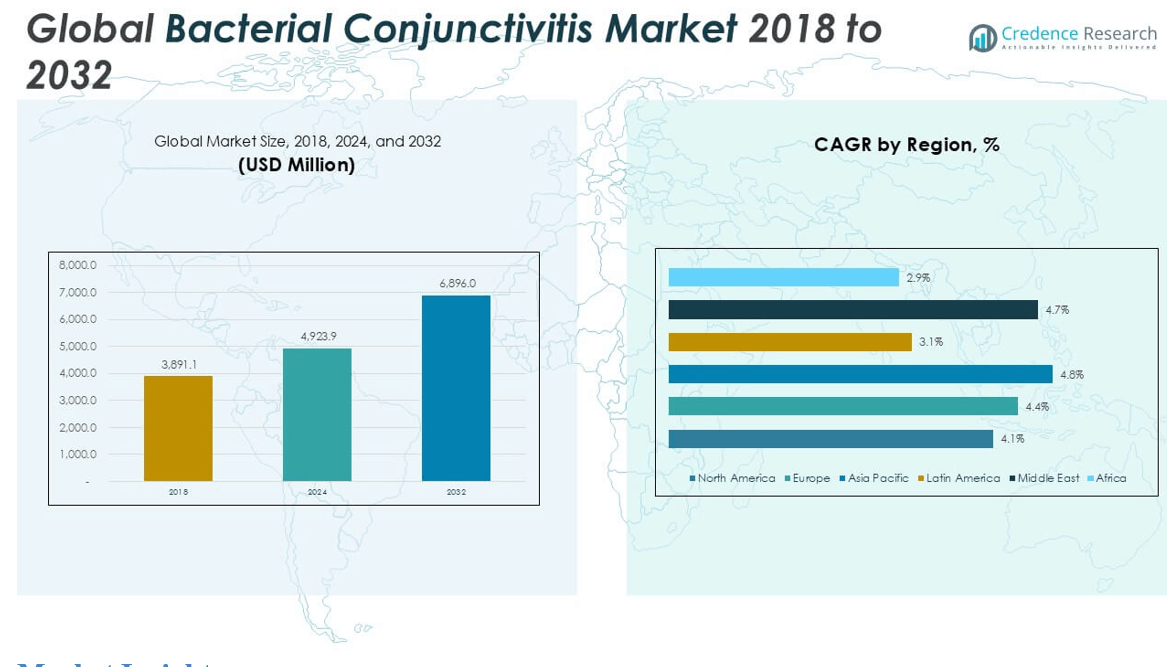
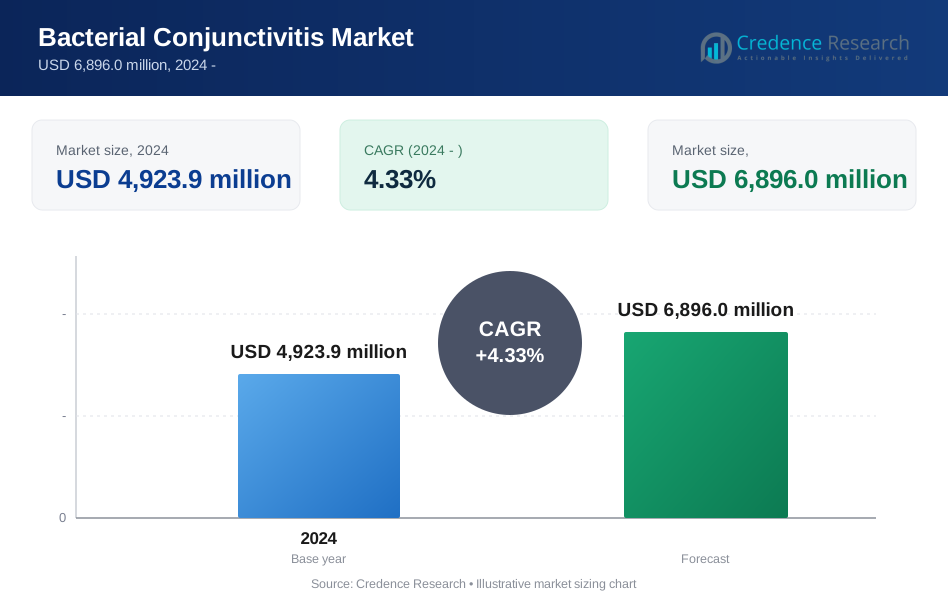
The Bacterial Conjunctivitis market size was valued at USD 3,891.1 million in 2018 and increased to USD 4,923.9 million in 2024. It is anticipated to reach USD 6,896.0 million by 2032, growing at a CAGR of 4.33% during the forecast period.
| REPORT ATTRIBUTE | DETAILS |
|---|---|
| Historical Period | 2020-2023 |
| Base Year | 2024 |
| Forecast Period | 2025-2032 |
| Bacterial Conjunctivitis Market Size 2024 | USD 4,923.9 million |
| Bacterial Conjunctivitis Market, CAGR | 4.33% |
| Bacterial Conjunctivitis Market Size 2032 | USD 6,896.0 million |
The bacterial conjunctivitis market is highly competitive, with key players including Actavis Plc., Akorn, Inc., Bayer AG, F. Hoffmann-La Roche Ltd., Merck & Co., Inc., Novartis AG, Pfizer, Inc., Santen Pharmaceutical Co., Ltd., and Cipla Ltd. These companies drive market growth through robust product portfolios, strategic mergers, and continuous R&D in ophthalmic antibiotics. Novartis AG and Pfizer, Inc. maintain a strong presence globally due to their extensive distribution networks and advanced formulations. Asia Pacific emerged as the leading region in 2024, accounting for 32.4% of the global market share, fueled by high population density, rising infection rates, and improved healthcare access. North America and Europe followed, supported by early diagnosis practices and widespread availability of branded therapies.
Market Insights
- The Bacterial Conjunctivitis market was valued at USD 3,891.1 million in 2018, reached USD 4,923.9 million in 2024, and is projected to grow to USD 6,896.0 million by 2032, at a CAGR of 4.33% during the forecast period.
- Market growth is driven by increasing incidence of bacterial eye infections, rising awareness of eye hygiene, and the growing demand for fast-acting topical antibiotics.
- Key trends include the shift toward preservative-free formulations and growing adoption of online pharmacies and e-prescription services across developed and developing countries.
- The market is competitive with leading players such as Novartis AG, Pfizer, Bayer AG, and Cipla Ltd. focusing on new product development, strategic collaborations, and global expansion; however, rising antibiotic resistance and misuse pose major restraints.
- Asia Pacific held the largest regional share at 32.4% in 2024, while fluoroquinolones dominated the drug class segment due to their broad-spectrum efficacy.
Market Segmentation Analysis:
By Drug Class
The Fluoroquinolones segment holds the dominant position in the Bacterial Conjunctivitis market, accounting for the largest market share in 2024. Within this class, Moxifloxacin is the most widely prescribed due to its broad-spectrum activity, rapid bactericidal action, and low resistance profile. Other popular fluoroquinolones include Levofloxacin and Ciprofloxacin, which are often used in acute cases. The increasing prevalence of antibiotic-resistant bacterial strains is driving demand for newer-generation fluoroquinolones. Meanwhile, Macrolides such as Azithromycin are preferred in pediatric patients due to better tolerability. Aminoglycosides remain effective in hospital settings, but their use is more limited due to potential toxicity.
- For instance, Alcon’s Vigamox (Moxifloxacin 0.5% ophthalmic solution), launched in the U.S., reported over 2 million prescriptions filled annually during its peak usage years, demonstrating its clinical preference in outpatient treatments.
By Dosage Form
Topical formulations dominate the dosage form segment of the Bacterial Conjunctivitis market, holding the largest revenue share in 2024. Eye drops and ointments are widely preferred due to their localized application, faster therapeutic response, and reduced systemic side effects. The topical route ensures high drug concentration at the site of infection, which enhances clinical outcomes and reduces the risk of systemic resistance. Oral formulations are mainly used for severe or recurrent infections, especially when associated with systemic conditions. The “Others” category, including injectable forms, represents a minor share and is used only in rare, complicated cases.
- For instance, Bausch + Lomb’s Besivance (besifloxacin ophthalmic suspension 0.6%) achieved over 500,000 prescriptions within the first 18 months of its U.S. launch, validating strong adoption of topical fluoroquinolone formulations.
By Distribution Channel
Retail pharmacies represent the leading distribution channel in the Bacterial Conjunctivitis market, capturing the largest market share in 2024. This dominance is attributed to easy accessibility, widespread availability of over-the-counter antibiotic eye drops, and the preference of patients for walk-in purchases. Hospital pharmacies follow, especially in inpatient or emergency care scenarios where prescriptions are dispensed immediately. Online pharmacies are witnessing steady growth due to increased digitalization, rising consumer convenience, and discounts offered on prescription medications. Hypermarkets and supermarkets hold a smaller share, typically limited to OTC products, while the “Others” category remains relatively niche.
Market Overview
Rising Incidence of Bacterial Eye Infections
The increasing global prevalence of bacterial conjunctivitis, particularly in densely populated and developing regions, is a key growth driver for the market. Poor hygiene practices, high pollution levels, and seasonal outbreaks contribute to the frequent occurrence of eye infections. Additionally, school-going children and the elderly population are more susceptible to these infections, which amplifies the demand for effective treatment solutions. As awareness grows around early diagnosis and treatment, the demand for antibacterial eye drops and ointments continues to surge, boosting market expansion.
- For instance, in 2023, Cipla Ltd. reported the production of over 82 million units of ophthalmic antibiotic formulations from its Indore and Goa facilities alone, reflecting its aggressive scaling in response to rising demand across South Asia and Africa.
Advancements in Antibiotic Therapies
Ongoing advancements in antibiotic formulations, including the development of broad-spectrum and low-resistance drugs, are significantly driving market growth. Pharmaceutical companies are investing in R&D to introduce next-generation fluoroquinolones and macrolides with enhanced efficacy and reduced side effects. These innovations cater to both acute and chronic bacterial eye infections, improving patient compliance and outcomes. The availability of combination therapies and preservative-free eye drops also expands treatment options, thereby encouraging healthcare providers to recommend newer, more effective solutions to a wider range of patients.
- For instance, Santen Pharmaceutical Co., Ltd. invested ¥12.3 billion in R&D in FY2023, a portion of which supported the clinical trials of its preservative-free antibiotic-corticosteroid combination eyedrop, STN1013001, currently in Phase III trials across Europe and Asia.
Growing Accessibility to Healthcare and Pharmacies
Improved access to healthcare infrastructure and pharmacy services, particularly in emerging economies, supports market growth. The expansion of retail and online pharmacies allows patients to obtain treatments conveniently and affordably. Government initiatives aimed at enhancing eye care services, along with the proliferation of telemedicine and e-prescriptions, have made it easier for patients to seek timely interventions. This increased accessibility drives the overall demand for conjunctivitis medications and encourages early treatment, reducing complications and improving disease management rates across regions.
Key Trends & Opportunities
Rising Preference for Preservative-Free Formulations
A growing trend in the market is the shift toward preservative-free antibiotic eye drops, which are gaining popularity due to better safety profiles and lower risk of ocular surface damage with prolonged use. These formulations are especially beneficial for patients with chronic conjunctivitis or sensitive eyes, expanding their applicability. Manufacturers are seizing this opportunity by developing single-dose units and preservative-free multi-use bottles, which are expected to capture significant market share as consumer awareness about eye health increases.
- For instance, Théa Pharmaceuticals’ Hyabak eye drops, which are preservative-free, reached distribution in over 70 countries, with annual sales exceeding 15 million units, showcasing global demand for safer alternatives.
Growth of Online Pharmacies and E-prescription Platforms
The rapid expansion of digital health services and online pharmacies presents a major opportunity in the Bacterial Conjunctivitis market. Consumers are increasingly turning to e-commerce platforms for the convenience of home delivery and access to a wider range of products. E-prescription systems further streamline the process, enabling physicians to directly prescribe medications, which patients can quickly purchase online. This trend is particularly strong in urban areas and among younger demographics, offering pharmaceutical companies a lucrative distribution channel to tap into.
- For instance, 1mg (now Tata 1mg) in India reported over 100,000 monthly orders for ophthalmic products in 2023, indicating the rapid digital shift in drug accessibility for conditions like conjunctivitis.
Key Challenges
Antibiotic Resistance and Misuse
The growing concern over antibiotic resistance poses a major challenge to the Bacterial Conjunctivitis market. Overprescription, self-medication, and inappropriate use of antibiotics have contributed to reduced drug efficacy, prompting regulatory scrutiny and restricted usage. Healthcare professionals are under increasing pressure to follow antibiotic stewardship protocols, which may limit the indiscriminate use of commonly prescribed treatments. This challenge necessitates continuous innovation and monitoring of drug effectiveness to maintain therapeutic relevance.
Lack of Awareness and Delayed Diagnosis
In many low-income and rural regions, a lack of awareness about bacterial conjunctivitis symptoms and the importance of early treatment delays diagnosis and intervention. Patients often misidentify symptoms or resort to traditional remedies, exacerbating the condition. This delay not only affects recovery but can also increase the risk of complications and disease spread. Public health campaigns and better patient education are critical to overcoming this challenge and ensuring prompt access to appropriate medical care.
Regulatory and Approval Hurdles
Obtaining regulatory approvals for new ophthalmic formulations can be time-consuming and complex, especially in highly regulated markets like the U.S. and Europe. Stringent safety and efficacy standards, along with costly clinical trials, create entry barriers for new players and delay product launches. These regulatory constraints can limit market growth and discourage smaller companies from investing in innovative treatments, ultimately slowing the pace of therapeutic advancement in the sector.
Regional Analysis
North America
North America accounted for the largest regional share in the bacterial conjunctivitis market, valued at USD 1,072.38 million in 2018, and is projected to reach USD 1,843.29 million by 2032, growing at a CAGR of 4.1%. The region held approximately 27.2% of the global market in 2024, driven by advanced healthcare infrastructure, high awareness levels, and the widespread availability of prescription medications. The United States leads the market due to robust diagnosis rates, insurance coverage, and access to ophthalmic care. Continued innovations in topical antibiotics and a strong pharmaceutical presence further support regional market expansion.
Europe
Europe represented a significant share in the bacterial conjunctivitis market, with a market value of USD 921.02 million in 2018, reaching USD 1,648.13 million by 2032, at a CAGR of 4.4%. In 2024, the region contributed to around 23.8% of the global market. The demand is supported by increasing cases of eye infections, aging population, and adoption of preservative-free ophthalmic formulations. Germany, the UK, and France are key contributors, benefiting from efficient healthcare systems and regulatory support for safe antibiotic use. Growth is further bolstered by rising telemedicine practices and access to over-the-counter eye care products.
Asia Pacific
Asia Pacific emerged as the fastest-growing regional market for bacterial conjunctivitis, with a market size of USD 1,223.74 million in 2018, expanding to USD 2,328.07 million by 2032, at a robust CAGR of 4.8%. The region accounted for the largest market share of 32.4% in 2024, driven by high population density, growing healthcare awareness, and increasing cases of infectious diseases. Countries like China, India, and Japan are leading the demand due to the expansion of ophthalmology clinics, rising healthcare investments, and improved access to retail pharmacies. Government initiatives to improve eye health are also supporting regional market growth.
Latin America
Latin America held a modest share in the bacterial conjunctivitis market, valued at USD 397.28 million in 2018 and expected to reach USD 597.88 million by 2032, registering a CAGR of 3.1%. In 2024, the region captured around 9.6% of the global market. Growth in the region is supported by improving healthcare infrastructure and increased availability of affordable antibiotics. Brazil and Mexico remain the key markets, driven by urban population growth and rising awareness of ocular health. However, market expansion is somewhat restrained by limited healthcare access in remote areas and lower diagnosis rates compared to developed regions.
Middle East
The Middle East bacterial conjunctivitis market stood at USD 185.99 million in 2018, with projections to reach USD 344.80 million by 2032, growing at a CAGR of 4.7%. The region contributed approximately 4.9% of the global market share in 2024. The growth is primarily fueled by rising demand for ophthalmic treatments, urbanization, and increased availability of branded and generic eye care products. Gulf countries like the UAE and Saudi Arabia are investing in healthcare modernization, which supports early diagnosis and treatment of eye infections. Rising digital pharmacy services and medical tourism are also enhancing market penetration in the region.
Africa
Africa accounted for the smallest share of the bacterial conjunctivitis market, with a value of USD 90.66 million in 2018, expected to reach USD 133.78 million by 2032, growing at a CAGR of 2.9%. In 2024, the region held roughly 2.2% of the global market share. Limited access to eye care services, lack of awareness, and a shortage of healthcare professionals continue to hinder growth. However, non-governmental health initiatives, public awareness campaigns, and improving retail pharmacy networks are gradually contributing to better market outreach. South Africa leads in regional sales, followed by Nigeria and Kenya, supported by improving urban healthcare infrastructure.
Market Segmentations:
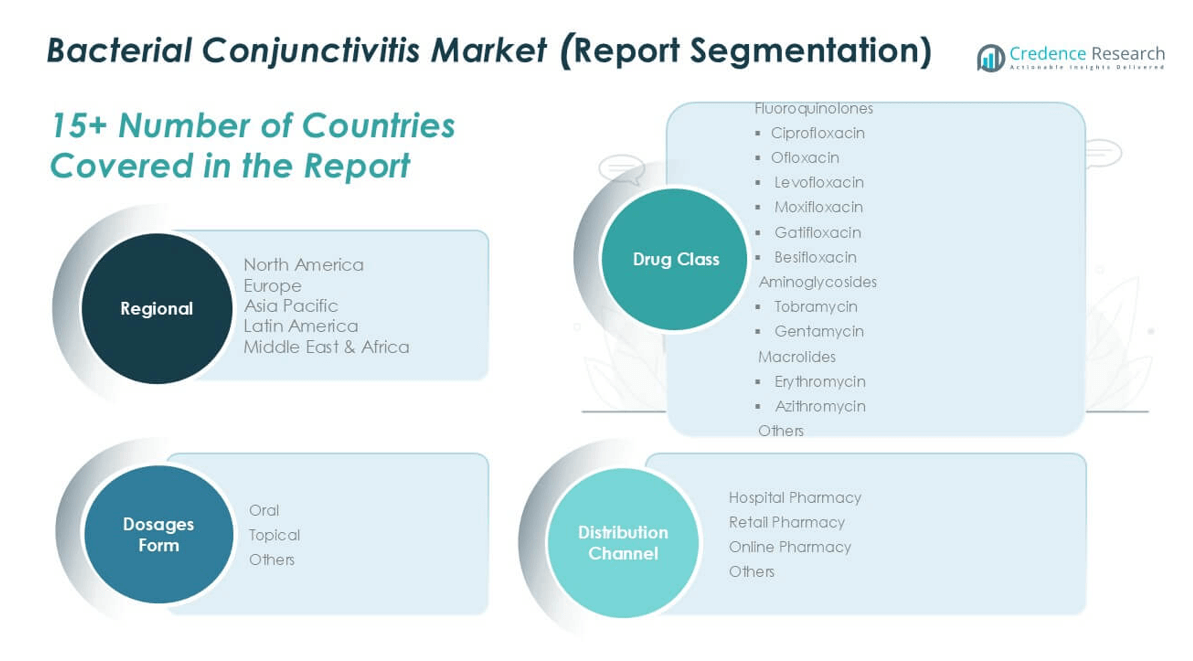
By Drug Class
- Fluoroquinolones
- Ciprofloxacin
- Ofloxacin
- Levofloxacin
- Moxifloxacin
- Gatifloxacin
- Besifloxacin
- Aminoglycosides
- Tobramycin
- Gentamycin
- Macrolides
- Erythromycin
- Azithromycin
- Others
By Dosage Form
- Oral
- Topical
- Others
By Distribution Channel
- Hypermarkets and Supermarkets
- Hospital Pharmacy
- Retail Pharmacy
- Online Pharmacy
- Others
By Geography
- North America
- U.S.
- Canada
- Mexico
- Europe
- Germany
- France
- U.K.
- Italy
- Spain
- Rest of Europe
- Asia Pacific
- China
- Japan
- India
- South Korea
- South-east Asia
- Rest of Asia Pacific
- Latin America
- Brazil
- Argentina
- Rest of Latin America
- Middle East & Africa
- GCC Countries
- South Africa
- Rest of the Middle East and Africa
Competitive Landscape
The competitive landscape of the bacterial conjunctivitis market is characterized by the presence of several established pharmaceutical companies actively engaged in developing, manufacturing, and marketing ophthalmic antibiotics. Key players such as Actavis Plc., Akorn, Inc., Bayer AG, F. Hoffmann-La Roche Ltd., Merck & Co., Inc., Novartis AG, Pfizer, Inc., Santen Pharmaceutical Co., Ltd., and Cipla Ltd. dominate the market through robust product portfolios and global distribution networks. These companies focus on expanding their presence via strategic collaborations, product launches, and R&D investments aimed at developing next-generation antibiotics with reduced resistance profiles. The market also witnesses increasing emphasis on preservative-free formulations and combination therapies to improve treatment outcomes and patient compliance. Furthermore, competition is intensifying due to the entry of generic drug manufacturers offering cost-effective alternatives, especially in price-sensitive regions. Innovation, brand recognition, and regulatory approvals remain key differentiators as companies strive to gain a competitive edge in this evolving and highly fragmented market.
Key Player Analysis
- Actavis Plc.
- Akorn, Inc.
- Bayer AG
- Hoffmann-La Roche Ltd.
- Merck & Co., Inc.
- Novartis AG
- Pfizer, Inc.
- Santen Pharmaceutical Co., Ltd.
- Cipla Ltd.
Recent Developments
- In January 2023, Harrow Health acquired the U.S. commercial rights to five Novartis ophthalmic products, including a bacterial conjunctivitis treatment, for a total of $175 million. The deal involved an upfront payment of $130 million and a potential $45 million milestone payment related to TRIESENCE. The acquired products include VIGAMOX(bacterial conjunctivitis treatment), MAXIDEX (steroid eye drop), and TRIESENCE (steroid injection).
- In May 2022, Santen Pharmaceutical's legal entity was granted approval by the National Medical Products Administration (NMPA) in China to use Verkazia for the treatment of severe vernal keratoconjunctivitis (VKC) in children and adolescents aged four years and older.
Market Concentration & Characteristics
The Bacterial Conjunctivitis Market exhibits moderate market concentration, with a mix of global pharmaceutical giants and regional players. Leading companies such as Novartis AG, Pfizer, Bayer AG, and Cipla Ltd. hold significant market shares due to their established product portfolios, broad geographic presence, and strong distribution networks. It features a high degree of therapeutic standardization, with fluoroquinolones dominating treatment protocols due to their broad-spectrum efficacy. The market remains prescription-driven in developed economies, while over-the-counter availability is more common in developing regions. Product differentiation is limited, making pricing and brand reputation key competitive factors. Regulatory compliance and antibiotic stewardship influence market dynamics, especially in Europe and North America. Growth in the sector stems from rising infection rates, improved healthcare access, and expanding retail and online pharmacy networks. Market players focus on topical formulations, particularly preservative-free solutions, to meet patient preferences and address safety concerns. While the market benefits from recurring demand and wide applicability across age groups, challenges such as antibiotic resistance and regulatory hurdles impact growth potential.
Report Coverage
The research report offers an in-depth analysis based on Drug Class, Dosage Form, Distribution Channel and Geography. It details leading market players, providing an overview of their business, product offerings, investments, revenue streams, and key applications. Additionally, the report includes insights into the competitive environment, SWOT analysis, current market trends, as well as the primary drivers and constraints. Furthermore, it discusses various factors that have driven market expansion in recent years. The report also explores market dynamics, regulatory scenarios, and technological advancements that are shaping the industry. It assesses the impact of external factors and global economic changes on market growth. Lastly, it provides strategic recommendations for new entrants and established companies to navigate the complexities of the market.
Future Outlook
- The bacterial conjunctivitis market is expected to witness steady growth driven by increasing prevalence of eye infections globally.
- Demand for topical antibiotics will continue to dominate due to their ease of application and rapid therapeutic response.
- Fluoroquinolones will remain the preferred drug class owing to their broad-spectrum antibacterial activity and low resistance profile.
- Preservative-free and combination eye drop formulations are likely to gain wider acceptance among both patients and healthcare providers.
- Asia Pacific is projected to lead market expansion due to rising healthcare investments and increasing awareness of ocular hygiene.
- Online pharmacies and e-prescription platforms will play a greater role in distribution, enhancing accessibility and convenience.
- Key players are expected to focus on strategic collaborations, product innovation, and emerging market penetration to strengthen their market position.
- Regulatory emphasis on antibiotic stewardship will influence prescribing patterns and promote responsible drug use.
- Pediatric and elderly patient populations will drive demand for safer and more tolerable ophthalmic formulations.
- Technological advancements in diagnostic tools will enable early detection and prompt treatment, supporting overall market growth.
Request a Free Sample
Fill in your details and we'll send you a free sample report.
- Sample data tables & charts
- Research methodology
Need a Custom Version of This Report?
Tailor the scope, geography, or segments to your exact requirements.
- Custom geography or segment scope
- Direct access to our analyst team
Frequently Asked Questions
What is the current size of the Bacterial Conjunctivitis Market?
What factors are driving the growth of the Bacterial Conjunctivitis Market?
What are some challenges faced by the Bacterial Conjunctivitis Market?
Who are the major players in the Bacterial Conjunctivitis Market?
Table of Content
Chapter 1. Report Introduction
- 1.1 Report Description & Purpose
- 1.1.1 Report Title & Market Definition
- 1.1.2 Unique Selling Propositions (USP) & Key Differentiators
- 1.1.3 Value Proposition for Stakeholders
- 1.2 Research Objectives
- 1.2.1 Market Sizing Objectives (Volume & Revenue)
- 1.2.2 Segmentation Objectives
- 1.2.3 Competitive Intelligence Objectives
- 1.2.4 Forecast & Scenario Objectives
- 1.3 Report Scope
- 1.3.1 Bacterial Conjunctivitis Scope – Types & Subtypes Covered
- 1.3.2 Geographic Scope – Regions & Countries Covered
- 1.3.3 Historical Period, Base Year & Forecast Period (2024; forecast to the forecast period)
- 1.3.4 Inclusions & Exclusions
- 1.4 HS Code & Classification Framework
- 1.5 Currency, Units & Pricing Basis
- 1.6 Target Stakeholders
- 1.7 Limitations & Assumptions
Chapter 2. Executive Summary
- 2.1 Global Bacterial Conjunctivitis Market Snapshot
- 2.1.1 Market Size – Historical (2024) & Forecast (the forecast period) (2024: USD 4,923.9 million → forecast year: USD 6,896.0 million)
- 2.1.2 Volume & Revenue – Global Totals
- 2.1.3 Key Market Highlights – Top Five Facts
- 2.2 Bacterial Conjunctivitis Market Segmentation Snapshot
- 2.2.1 Market Split by Region – 2024 vs.
- 2.3 Competitive Snapshot
- 2.3.1 Top 10 Players by Revenue Share – 2024
- 2.3.2 Top 10 Players by Volume Share – 2024
- 2.3.3 Recent Strategic Developments (18-Month Summary)
- 2.4 Key Investment Highlights & Strategic Conclusions
Chapter 3. Bacterial Conjunctivitis Market Dynamics & Industry Analysis
- 3.1 Market Overview & Context
- 3.1.1 Bacterial Conjunctivitis Market Position in the Broader Automotive Value Chain
- 3.1.2 OEM vs. Replacement Market Dynamics
- 3.1.3 Market Maturity & Development Stage by Region
- 3.2 Bacterial Conjunctivitis Market Drivers
- 3.3 Bacterial Conjunctivitis Market Restraints & Challenges
- 3.4 Bacterial Conjunctivitis Market Opportunities
- 3.5 Porter's Five Forces Analysis
- 3.5.1 Threat of New Entrants
- 3.5.2 Bargaining Power of Suppliers
- 3.5.3 Bargaining Power of Buyers
- 3.5.4 Threat of Substitutes
- 3.5.5 Competitive Rivalry – Intensity Assessment
- 3.6 Bacterial Conjunctivitis Value Chain Analysis
- 3.6.1 Upstream – Raw Material/Input Suppliers
- 3.6.1.1 Raw Material/Input 1
- 3.6.1.2 Raw Material/Input 2
- 3.6.1.3 Raw Material/Input 3
- 3.6.2 Midstream – Production/Manufacturing/Service Delivery
- 3.6.2.1 Production/Process Overview
- 3.6.2.2 Key Facility Locations & Capacity by Manufacturer
- 3.6.3 Downstream – Distribution & End Consumer
- 3.6.3.1 Primary Channel – B2B/OEM
- 3.6.3.2 Secondary Channels – Dealer, Retail, Online, Direct
- 3.6.4 Value Chain Profitability Analysis
- 3.6.1 Upstream – Raw Material/Input Suppliers
- 3.7 PESTEL Analysis
- 3.7.1 Political Factors
- 3.7.2 Economic Factors
- 3.7.3 Social Factors
- 3.7.4 Technological Factors
- 3.7.5 Environmental Factors
- 3.7.6 Legal Factors
- 3.8 Bacterial Conjunctivitis Supply Chain Analysis
- 3.8.1 Raw Material/Input Supply Risk Assessment
- 3.8.2 Manufacturing Concentration Risk (Geographic Exposure)
- 3.8.3 Trade Disruption Impact Analysis
- 3.9 Regulatory & Policy Landscape
Note: The regulatory and policy landscape section covers regulations based on their applicability to the market, Bacterial Conjunctivitis category, geography, and scope of the study. Only regulatory frameworks with a material impact on operations, compliance, trade, sustainability, or market access are analyzed in detail.
Chapter 4. Key Investment Pockets & Opportunity Analysis
- 4.1 Bacterial Conjunctivitis Market Attractiveness Analysis
- 4.1.1 By Region – Investment Attractiveness Matrix (Volume × CAGR)
- 4.2 Absolute Revenue Growth Opportunity
- 4.2.1 By Region – Absolute USD Growth Through the forecast period
- 4.3 Incremental Volume Opportunity
- 4.3.1 By Region – Incremental Volume Through the forecast period
- 4.3.2 Segment – Incremental Volume
- 4.4 Emerging Submarket Opportunity Deep Dive (Subject to Applicability)
- 4.5 Emerging Market Opportunity Scorecards
- 4.5.1 United States
- 4.5.2 Europe
- 4.5.3 Asia
- 4.5.4 Middle East & Africa
Note: Emerging Market Opportunity Scorecards will be included based on relevance and strategic importance. Regions listed are indicative and may vary depending on data availability and market dynamics.
Chapter 5. Bacterial Conjunctivitis Import-Export Analysis & Trade Flows
- 5.1 Global Trade Overview
- 5.1.1 Global Export Value by Country (2024)
- 5.1.2 Global Export Volume by Country (2024)
- 5.1.3 Global Import Value by Country (2024)
- 5.1.4 Global Import Volume by Country (2024)
- 5.1.5 Net Trade Balance by Country (2024)
- 5.2 Export Analysis – Segment
- 5.2.1 Type 1 (HS Code)
- 5.2.2 Type 2 (HS Code)
- 5.2.3 Type 3 (HS Code)
- 5.2.4 Type 4 (HS Code)
- 5.2.5 Type 5 (HS Code)
- 5.3 Import Analysis – Segment
- 5.3.1 Type 1 (HS Code)
- 5.3.2 Type 2 (HS Code)
- 5.3.3 Type 3 (HS Code)
- 5.3.4 Type 4 (HS Code)
- 5.3.5 Type 5 (HS Code)
- 5.4 Average Unit Trade Prices
- 5.4.1 Average Export Price – Segment & Country
- 5.4.2 Average Import Price – Segment & Source Country
- 5.4.3 Price Trends (2024)
- 5.5 Key Trade Route Analysis
- 5.5.1 Trade Route 1
- 5.5.2 Trade Route 2
- 5.5.3 Trade Route 3
- 5.5.4 Trade Route 4
- 5.5.5 Trade Route 5
- 5.6 Trade Policy Impact Assessment
- 5.6.1 US Anti-Dumping & Section 301 Tariffs
- 5.6.2 EU Customs Union Impact
- 5.6.3 Major Free Trade Agreements
- 5.6.4 USMCA Rules of Origin
Note: Trade policy analysis will be included only where relevant to the Bacterial Conjunctivitis market.
Chapter 6. Competitive Landscape & Company Benchmarking
- 6.1 Bacterial Conjunctivitis Market Concentration & Structure
- 6.1.1 Herfindahl-Hirschman Index (HHI) – vs. 2024
- 6.1.2 Tier 1, Tier 2 & Tier 3 Market Structure
- 6.1.3 Global, Regional & Local Player Dynamics
- 6.2 Bacterial Conjunctivitis Market Share Analysis – 2024
- 6.2.1 Global Revenue Share by Company
- 6.2.2 Global Volume Share by Company
- 6.2.3 Regional Revenue Share
- 6.2.4 Market Share Evolution ( vs. 2024)
- 6.2.5 OEM Segment Share by Company
- 6.2.6 Replacement Segment Share by Company
- 6.3 Production/Delivery Capacity & Facility Analysis
- 6.3.1 Global Installed Capacity
- 6.3.2 Capacity Utilization Rates
- 6.3.3 Production/Output Volume
- 6.3.4 Facility Locations & Capacity Map
- 6.3.5 Planned Capacity Additions
- 6.4 Bacterial Conjunctivitis Competitive Benchmarking Matrix
- 6.4.1 Revenue, Volume, CAGR & Profitability Comparison
- 6.4.2 Channel Revenue Mix
- 6.4.3 Geographic Revenue Exposure
- 6.4.4 R&D Intensity
- 6.4.5 Sustainability Maturity
- 6.5 Strategic Developments in Bacterial Conjunctivitis (Last 24 Months)
- 6.5.1 Mergers, Acquisitions & Divestments
- 6.5.2 New Bacterial Conjunctivitis Launches
- 6.5.3 Facility Expansions
- 6.5.4 Strategic Alliances, Joint Ventures & Partnerships
- 6.5.5 Distribution Expansion & Market Entry
- 6.5.6 Sustainability & ESG Initiatives
- 6.6 Competitive Strategy Mapping
- 6.6.1 Leader, Challenger, Follower & Niche Classification
- 6.6.2 Pricing Strategy Comparison
- 6.6.3 Channel Strategy Matrix
Note: Strategic developments are included based on their materiality and the availability of reliable information.
Chapter 7. Global Bacterial Conjunctivitis Market – By Distribution Channel
- 7.1 Segment Overview
- 7.1.1 Volume & Revenue Split by Channel (2024 & )
- 7.1.2 Channel Mix Evolution (the forecast period)
Chapter 8. Regional Market Analysis – Global Overview
- 8.1 Global Regional Overview
- 8.1.1 Regional Volume Share
- 8.1.2 Regional Revenue Share
- 8.1.3 Regional Volume by Region
- 8.1.4 Regional Revenue by Region
- 8.1.5 Regional Forecast Through the forecast period
- 8.2 Cross-Regional Segment Analysis
- 8.2.1 By Distribution Channel
- 8.2.2 By Brand/Price Tier
Chapter 9. North America Bacterial Conjunctivitis Market
- 9.1 United States
- 9.2 Canada
- 9.3 Mexico
Chapter 10. Europe Bacterial Conjunctivitis Market
- 10.1 Germany
- 10.2 France
- 10.3 Italy
- 10.4 United Kingdom
- 10.5 Spain
- 10.6 Poland
- 10.7 Russia
- 10.8 Netherlands
- 10.9 Belgium
- 10.10 Sweden
- 10.11 Denmark
- 10.12 Norway
- 10.13 Rest of Europe
Chapter 11. Asia Pacific Bacterial Conjunctivitis Market
- 11.1 China
- 11.2 India
- 11.3 Japan
- 11.4 South Korea
- 11.5 Thailand
- 11.6 Indonesia
- 11.7 Vietnam
- 11.8 Malaysia
- 11.9 Australia
- 11.10 Rest of Asia Pacific
Chapter 12. Latin America Bacterial Conjunctivitis Market
- 12.1 Brazil
- 12.2 Argentina
- 12.3 Colombia
- 12.4 Chile
- 12.5 Rest of Latin America
Chapter 13. Middle East Bacterial Conjunctivitis Market
- 13.1 Saudi Arabia
- 13.2 United Arab Emirates
- 13.3 Turkey
- 13.4 Israel
- 13.5 Iran
- 13.6 Rest of the Middle East
Chapter 14. Africa Bacterial Conjunctivitis Market
- 14.1 South Africa
- 14.2 Egypt
- 14.3 Nigeria
- 14.4 Morocco
- 14.5 Rest of Africa
Chapter 15. Bacterial Conjunctivitis Company Profiles
- 15.1 [Company 01]
- 15.1.1 Company Overview
- 15.1.2 Key Management Personnel
- 15.1.3 Products & Services Portfolio
- 15.1.4 Financial Performance
- 15.1.5 Key Market Focus & Geographic Presence
- 15.1.6 Recent Developments & Strategic Initiatives
Note: The company profile list is preliminary and may change based on research findings, market developments, data availability, and client requirements.
Chapter 16. Appendices
- Appendix A – List of Abbreviations & Acronyms
- Appendix B – Industry Classification Code Reference – Full Series
- Appendix C – Production & Capacity Data Tables
- Appendix D – End-Use & Demand Base Tables
- Appendix E – Consumption & Replacement Rate Assumptions
- Appendix F – ASP Reference Tables
- Appendix G – Manufacturing & Facility Database
- Appendix H – Import-Export Data Tables
- Appendix I – Regulatory Summary Tables
- Appendix J – Primary Research Participant List (Anonymized)
- Appendix K – Primary Research Questionnaire Framework
- Appendix L – Data Sources & Bibliography
- Appendix M – Market Size Divergence & Source Comparison
Chapter 17. Research Methodology
- 17.1 Research Framework & Philosophy
- 17.2 Secondary Research – Sources, Hierarchy & Data Extraction
- 17.3 Data Modeling – Bottom-Up & Top-Down Market Sizing
- 17.4 Primary Research – Stakeholder Framework, LOI & Sample Sizes
- 17.5 Forecast Methodology – Regression, Scenario & Sensitivity Analysis
- 17.6 Quality Control – Four-Layer Validation Framework
- 17.7 Limitations & Standard Assumptions
- 17.8 Disclaimer
