
| REPORT ATTRIBUTE | DETAILS |
|---|---|
| Historical Period | 2019-2022 |
| Base Year | 2023 |
| Forecast Period | 2024-2032 |
| Base Oil Market Size 2023 | USD 29515.2 Million |
| Base Oil Market, CAGR | 5.2% |
| Base Oil Market Size 2032 | USD 46578.7 Million |
Market Insights
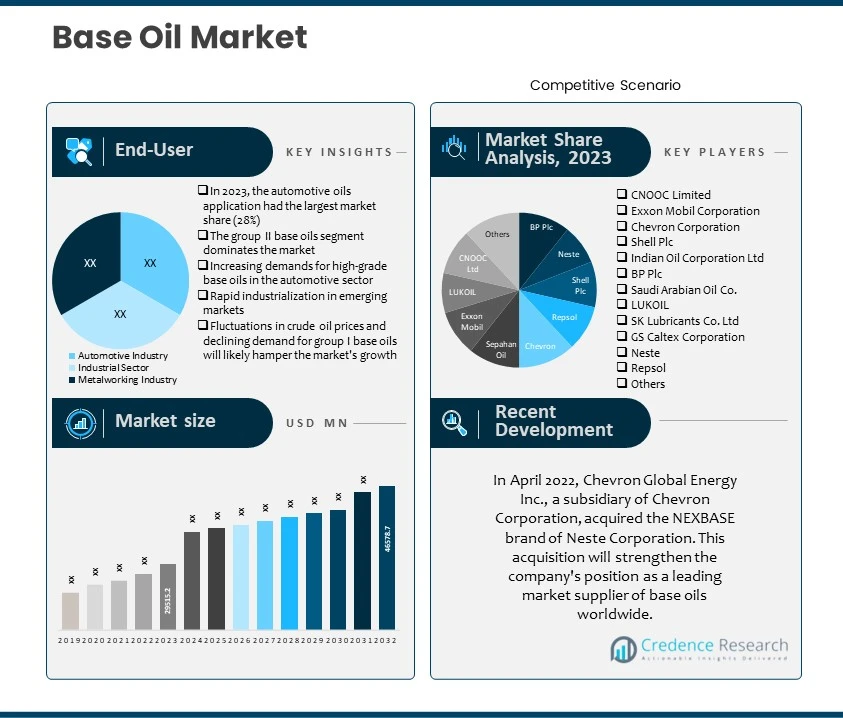
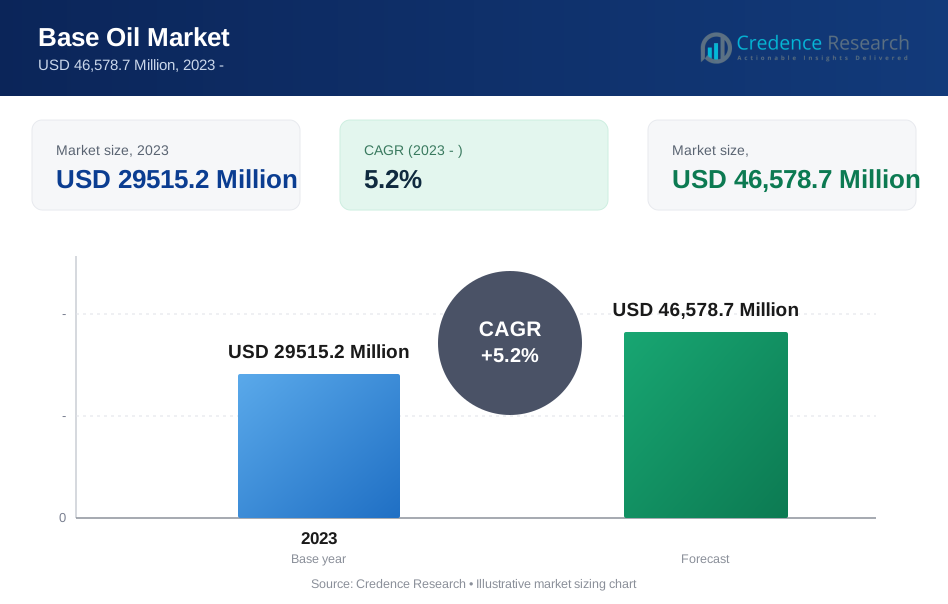
- The global demand for base oil was valued at USD 29515.2 Million in 2023 and is expected to reach USD 46578.7 Million in 2032, growing at a CAGR of 5.2% between 2024 and 2032.
- The Group II base oils are the market leader by product type, accounting for more than 25% of total value in 2023, while the Group IV base oils (Polyalphaolefins - PAO) category is predicted to increase substantially over the forecast time frame.
- The automotive industry dominates the global need for base oils, accounting for more than 30% in 2023, and is anticipated to grow at an elevated CAGR.
- Over the projection period, the metalworking application segment is expected to expand at the highest rate, while the automotive oils (engine oils, transmission fluids) category dominated the market in 2023 with a 28% share.
- The onshore category dominated the market with 55% of the total revenue share by the application method segment. In contrast, the offshore category will expand fastest in the projected period.
- With an impressive market share of more than 58% by 2023 and estimates for considerable CAGR growth, the high viscosity index (HVI) base oils will likely continue to lead the market needs.
- Asia Pacific is fueling the growth of the base oil industry with over one-third share in 2023, while Europe and North America collectively account for just under 55% share in 2023. Europe held over 20% share in 2023.
- The BRIC nations (Brazil, Russia, India, and China) will likely be attractive lubricant markets across the forecasted period. As per the World Bank estimates, the BRIC countries account for around 41% of the global population, which is anticipated to grow further.
Executive Summary
Market Definition
Base oils serve as the foundation for lubricant formulations. They have an essential effect on the performance and longevity of various industrial and automotive engines. Base oils are typically produced by refining crude extracts at different temperatures and pressures. The boiling point of base oil ranges from 550 to 1050 degrees Fahrenheit. The quality of the lubricant produced is determined by the type of base oil used for refining or the process utilized to create the base oil. These oils are broadly categorized into groups based on fundamental characteristics such as temperature and viscosity correlation, each having a unique application across various industries. They are the most important elements of lubricants as they provide heat dissipation, lubrication, and corrosion protection.
Market Overview
The global base oil market has witnessed continuous growth over recent years and is likely to grow at a CAGR of 5.2% between 2024 and 2032. The market was valued at USD 29515.2 million in 2023 and is expected to reach USD 46578.7 million in 2032.
Base oils are lubrication-grade oils used to make motor oil, lubricating greases, and metalworking fluids. Base oil is obtained by refining crude oil or by chemical synthesis. It is made by extracting and processing high-viscosity material from narrow distillation cuts of vacuum gas oil (VGO) or residue, necessitating special processing through several units. It helps to form a thin coating that improves heat transfer and reduces tension between moving parts. Engine oils are commonly utilized to lubricate internal combustion engines, with 75-90% basic oils and 10-25% additives. Nowadays, lubricants are used in truck and car engines to a large extent, helping to drive up the need for base oil globally.
The global base oil sector is a thriving and critical part of the petroleum industry, with products utilized in industries like automobiles, industrial, and aerospace. The base oil market landscape has changed dramatically in recent years due to technology breakthroughs, stringent regulatory regulations, and a shift in customer preferences for more sustainable and environmentally friendly products. Thus, base oil manufacturers and end users seek novel solutions that fulfill performance standards while emphasizing sustainability and resource conservation.
Segmentation by Product Type
- In 2023, Group II base oils emerged as the dominant product type, capturing over 25% of the market share by value. This segment's prominence can be attributed to its superior performance characteristics, meeting stringent industry standards, and promoting widespread adoption across various applications.
- The Group IV base oils, specifically Polyalphaolefins (PAO), are anticipated to exhibit a noteworthy CAGR in the market. This trajectory is fueled by the increasing demand for high-performance lubricants, where PAO's synthetic nature provides enhanced stability and performance.
Segmentation by Application
- The automotive oils (engine oils, transmission fluids) segment governs the global demand for base oils, holding a massive market share of over 28% in 2023. Its large market share is due to rising demand for greases, gear, engines, and other automotive components lubricants. Truck engines and vehicles are the largest consumers of lubricants worldwide, accounting for more than 20 million tonnes per year, or over half of total lubricant use.
- The metalworking application segment substantially contributes to the overall demand for base oils. This indicates the essential role base oils play in lubricating machinery and processes within the metalworking industry.
Segmentation by End-User
- The industrial sectors will likely post the fastest CAGR over the projection period. Increased industrial activities and the demand for specialized lubricants in manufacturing processes fuel this category's growth.
- Leading the market share with over 30% in 2023, the automotive industry segment remains a dominant end-user, owing to the continuous demand for base oils in automotive lubricants.
Segmentation by Viscosity Index
- In 2023, the high viscosity index (HVI) base oils category held a substantial market share of nearly 58%. This dominance can be attributed to the increased preference for HVI base oils in applications with significant temperature variations, showcasing their versatility and adaptability across industries.
- The low viscosity index (LVI) base oils segment will likely register the largest CAGR, owing to rising demand for base oils with specific viscosity characteristics in certain applications.
Segmentation by Application Method
- The onshore application method dominates the global base oil market, accounting for more than 55% in 2023. This dominance is projected to continue, owing to the prevalent use of base oils in onshore industrial operations.
- The offshore application method represents the remaining market demand for base oils. While constituting a smaller share, it remains a leading segment, particularly in marine and offshore drilling operations.
Segmentation by Region
- In 2023, Asia Pacific emerged as a key driver, propelling the base oil industry's growth with a commanding share of over one-third. This surge is due to the robust industrialization, burgeoning automotive sector, and increased lubricant demand across diverse regional applications.
- Europe and North America collectively constituted just under 55% of the market share in 2023. Europe, contributing over 20% in the same year, stands out as a significant market within these regions. The well-established industrial base and stringent quality standards contribute to the steady demand for base oils.
- The rest of the world, encompassing regions like Latin America, the Middle East, and Africa, plays a crucial role in supplying the remaining demand for base oil.
The rise in lubricant utilization across different industries, the surge in worldwide demand for group II and III base oils, and substantial investments in the flourishing automotive sector all contribute to the base oil market revenue growth.
Asia Pacific dominated the global market with the most revenue share in 2023. This is due to the presence of expanding economies and rising disposable income in the region, making it an appealing market for lubricant manufacturers. Asia Pacific is one of the world's largest base oils product markets, with China dominating the region. The country's dominance is attributable to increased automotive use and strong growth in its manufacturing sector. The market in China is additionally supported by raw material availability, increased foreign investment, rapid industrialization, and an expanding population. Similarly, the Indian market is predicted to expand strongly owing to the substantial presence of multiple base oil producers and the government's speedy infrastructural development initiatives.
Europe contributed the second-largest base oil market revenue share globally in 2023. Lubricant consumption is seen as a primary driver of market expansion in Europe, as lubricants are mostly formed of base oil. The increased European demand for base oil is closely related to expanding the industrial and transportation industries. North America is predicted to be the fastest-growing market for base oils. The upsurge of demands for lubricants in the United States, prompted by the implementation of rigorous emission standards and automation technology research, is increasing market share value in North America.
Key Highlights of the Report
The global base oil market is segmented by product type, application, end-user, viscosity index, application method, and region. Group II base oils category emerged as the market leader, widely adopted for superior performance attributes. More than 90% of all lubricants can be manufactured from group II compounds. Within applications, automotive oils, including engine oils and transmission fluids, command a substantial market share, propelled by the expanding automotive industry.
The base oil market leads the lubricants industry, delivering for the efficient functioning of a wide range of machinery and vehicle engines worldwide. Rapid industrialization is a main contributor to base oil industry revenues. The expansion is linked to the increased use of engine oils in the automotive, metallurgy, heavy equipment, chemicals, and power generation industries. The automobile industry is one of the largest contributors of base oils worldwide. The automobile industry's need for lubricants is predicted to continue growing. However, the rise in electric vehicles has slowed the after-sale growth of some lubricants.
Developing economies like India, China, and Indonesia propel the global manufacturing industry forward. According to the World Bank, the manufacturing sector's value added to GDP in 2021 was around 14%, up from the previous year. In 2021, global automotive sales climbed in the world's key regions. With sales up 6.6% to more than 21 million vehicles, China remains the world's biggest and best-performing major single-country automotive market. Raw material availability, lower infrastructural and labor costs, and increased labor supply contribute to growth. As a result of these considerations, base oil manufacturers are expanding and improving their production facilities in developing countries.
What Are The Main Drivers Of The Global Base Oil Market?
The global base oil market is primarily driven by the escalating demand for high-quality lubricants across diverse industries, including automotive, manufacturing, and power generation. Increasing industrialization and stringent performance and emission standards promote the market need for advanced base oils. Moreover, the growth in automotive production, technological shifts towards higher-grade base oils, and a focus on sustainable and bio-based alternatives contribute to the market's sustained expansion.
What Are The Major Challenges Faced By The Global Base Oil Market?
The global base oil market faces challenges stemming from the volatility in crude oil prices, which directly influences production costs. Besides, the transition to electric and hybrid vehicles poses a threat, as these technologies alter lubricant requirements, potentially impacting base oil market demand from the automotive sector. Environmental concerns and evolving regulations necessitate continuous adaptation to sustainable practices, adding complexity to the industry's landscape.
What Are The Growth Opportunities In The Global Base Oil Market?
The global base oil market presents promising growth opportunities driven by the increasing demand for high-performance lubricants in emerging economies. Growing emphasis on sustainable and bio-based feedstocks and advancements in base oil technologies create avenues for market expansion. Furthermore, the development of specialized formulations for applications in electric vehicles, industrial machinery, and aerospace represents additional growth prospects in the evolving landscape of the base oil market.
Market Drivers
Several factors drive the global base oil market. The following are the key drivers of the global base oil market:
Increasing Automotive Production and Consumption
One of the primary drivers for the base oil market share is the steady growth in automotive production and consumption worldwide. As the automotive industry expands, there is a parallel increase in the demand for lubricants, which heavily rely on base oils. Base oils are a crucial component in formulating engine oils, transmission fluids, and other lubricants essential for the proper functioning of vehicles.
The rise in disposable income, urbanization, and industrialization in developing economies has led to an uptick in automotive sales, contributing significantly to the demand for base oils. According to the OICA (International Organisation of Automobile Manufacturers), new vehicle sales climbed from 88.6 million in 2014 to 98.2 million in 2019. This increase in sales is likely due to sustained microeconomic development, effective and affordable vehicle manufacturing technology, and rising middle-class customer demand. Moreover, the evolving regulatory landscape, focusing on fuel efficiency and emissions reduction, further drives the need for higher-quality lubricants, thus positively influencing the demand for advanced base oils.
Market Restraints
The global base oil market faces some challenges that may limit its growth. These include the following:
Shift Towards Electric Vehicles (EVs)
The emerging global adoption of electric vehicles (EVs) represents a key restraint for the base oil market. EVs typically have different lubricant requirements compared to traditional internal combustion engine vehicles. The reduced need for certain types of lubricants, such as engine oils, in electric vehicles leads to a decline in overall demand for base oils from the automotive sector.
As the automotive industry gradually shifts towards electric propulsion technologies, base oil manufacturers face the challenge of aligning their product offerings with the market's evolving needs. The potential decrease in demand for traditional automotive lubricants may necessitate diversification of product portfolios and strategic adjustments to cater to the changing landscape of the transportation sector.
Opportunities
The global base oil market offers significant growth opportunities. These include the following:
Rapid Industrialization of Emerging Economies
The rapid industrialization observed in emerging economies presents a substantial global base oil market opportunity. As these economies experience robust growth in manufacturing, construction, and infrastructure development, there is an increased demand for lubricants, driving the need for base oils. Industrial lubricants, including those used in heavy machinery, hydraulic systems, and metalworking, contribute extensively to the overall demand for base oils.
Manufacturers can leverage this opportunity by strategically expanding their presence in emerging markets and customizing their product offerings to meet the specific requirements of diverse industrial applications. Establishing strong distribution networks and collaborations with local partners can enhance accessibility and market penetration in regions experiencing rapid industrialization.
Competitive Landscape
Key Players
The competitive landscape of the base oil market is characterized by intense competition among key players striving for global market share and product differentiation. The following are a few of the most prominent market players and their market shares:
- CNOOC Limited
- PetroCanada Lubricants Inc.
- Petroleum & Chemical Corp. (SINOPEC)
- PETRONAS Lubricants International
- PT Pertamina (Persero)
- PetroChina Co. Ltd
- Exxon Mobil Corporation
- Abu Dhabi National Oil Company
- Chevron Corporation
- Shell Plc
- Indian Oil Corporation Ltd
- BP Plc
- Saudi Arabian Oil Co.
- Sepahan Oil
- Bahrain Lube Base Oil Company
- LUKOIL
- SK Lubricants Co. Ltd
- H&R OWS Chemie GmbH & Co. KG
- Bharat Petroleum Corporation Ltd
- GS Caltex Corporation
- Neste
- Repsol
- Others
These key players within the industry are engaged in continuous R&D activities to enhance their product portfolios, introducing advanced formulations to meet evolving customer demands. Collaborations, mergers, and acquisitions are common market strategies as firms seek to strengthen their global market presence and diversify product offerings.
In September 2023, Petronas and Pertamina agreed to investigate the feasibility of the two firms constructing a base oil facility at Pertamina's fuel refinery in Cilacap, Indonesia.
In September 2022, Indian Oil Corporation Limited (IOCL) awarded ThyssenKrupp Industrial Solutions India Private Ltd a USD 75 million engineering, procurement, and construction contract for 270 kilotons per annum (KTPA) Catalytic Dewaxing Unit (CDWU) utilized in the production of lube base oils at its Gujarat refinery.
In August 2019, ExxonMobil Chemical Co., a subsidiary of ExxonMobil Corp., chose Synergy Additives Company S.A. de C.V. (Mexico) to distribute Group IV/V base stocks (synthetic base stocks) across Mexico, Central America, and the Caribbean. The development improved the company's geographical presence.
Summary of Key Findings
- The global base oil market has experienced remarkable expansion over recent years, attributed to the increasing industrialization, automotive production, and overall economic expansion.
- The market is segmented by product type, application, end-user, viscosity index, application method, and region.
- The market is further segmented into different base oil grades, including Group I, Group II, Group III, and others, each with specific performance characteristics. Group II base oils are often favored due to their improved properties over Group I.
- The automotive industry remains a major consumer of base oils, with increased lubricant demand fueled by growing vehicle sales and maintenance requirements.
- The Asia-Pacific region, particularly China and India, has emerged as a dominant market for base oils. Rapid industrialization, urbanization, and increased automotive production in the region contribute to the high demand.
- The base oil market is subject to supply chain challenges, including fluctuations in crude oil prices, geopolitical factors, and disruptions in the refining industry.
Future Outlook
- Emerging awareness of environmental sustainability has led to R&D in bio-based base oils, creating new market opportunities and addressing concerns about the environmental impact of traditional base oils.
- The integration of digital technologies and Industry 4.0 concepts is impacting the base oil manufacturing process. Automation, real-time monitoring, and predictive maintenance are becoming integral to optimizing production efficiency.
- Ongoing research into novel base oil production technologies, such as advanced catalytic processes and unconventional feedstocks, may influence the market landscape in the coming years.
How CXOs Can Benefit from the Credence Research Base Oil Market Report
The Credence Research Base Oil Market Report provides CXOs with a comprehensive overview of the market, including:
- Market size and growth forecast: The report provides detailed estimates of the global base oil market size, segmented by product type, application, end-user, viscosity index, application method, and region. It also includes forecasts for the market through 2032 based on key trends and drivers.
- Market segmentation: The report segments the base oil market by product type, application, end-user, viscosity index, application method, and region. This segmentation provides CXOs with a granular understanding of the market and the opportunities in each segment.
- Competitive Landscape: The report profiles the leading players in the base oil market and provides insights into their strategies, product offerings, and financial performance. This information can help CXOs to identify and assess their competition.
- Key trends and drivers: The report identifies and analyses the key trends and drivers shaping the base oil market. This information can help CXOs to make informed decisions about their investments and strategies.
CXOs can use the insights from the Credence Research Base Oil Market Report to:
- Identify growth opportunities: The report can help CXOs identify new growth opportunities in the base oil market. For example, the report identifies the growing demand for base oil from the automotive and metalworking industries as a key opportunity.
- Make informed investment decisions: The report can help CXOs make informed investment decisions about base oil. For example, the report provides insights into the key factors to consider when evaluating base oil providers and selecting base oil applications.
- Develop competitive strategies: The report can help CXOs develop competitive strategies for their base oil businesses. For example, the report identifies the key strategies that base oil providers use to differentiate themselves from their competitors.
- Track market developments: The report can help CXOs to track market developments and stay ahead of the curve. For example, the report provides insights into the latest trends and innovations in the base oil market.
Overall, the Credence Research Base Oil Market Report is a valuable resource for CXOs looking to gain a deeper understanding of the market and identify growth opportunities.
Segmentation
- By Product Type
- Group I Base Oils
- Group II Base Oils
- Group III Base Oils
- Group IV Base Oils (Polyalphaolefins - PAO)
- Group V Base Oils (including Esters, Polyalkylene Glycols, and Others)
- By Application
- Automotive Oils (Engine Oils, Transmission Fluids)
- Industrial Oils (Hydraulic Oils, Process Oils, Metalworking Fluids)
- Greases
- Metalworking
- Others
- By End-User
- Automotive Industry
- Industrial Sector
- Metalworking Industry
- Others
- By Viscosity Index
- High Viscosity Index (HVI) Base Oils
- Low Viscosity Index (LVI) Base Oils
- By Application Method
- Onshore
- Offshore
- By Region
- North America
- The U.S.
- Canada
- Mexico
- Europe
- Germany
- France
- The U.K.
- Italy
- Spain
- Rest of Europe
- Asia Pacific
- China
- Japan
- India
- South Korea
- South-east Asia
- Rest of Asia Pacific
- Latin America
- Brazil
- Argentina
- Rest of Latin America
- Middle East & Africa
- GCC Countries
- South Africa
- Rest of the Middle East and Africa
- North America
Request a Free Sample
Fill in your details and we'll send you a free sample report.
- Sample data tables & charts
- Research methodology
Need a Custom Version of This Report?
Tailor the scope, geography, or segments to your exact requirements.
- Custom geography or segment scope
- Direct access to our analyst team
Frequently Asked Questions
What is the current size of the global base oil market?
What is the expected growth rate of the base oil market between 2024 and 2032?
Which category is leading the market share in terms of product type?
Which end-user segment governs the demand for base oil globally?
Who are the major players in the global base oil market?
Table of Content
Chapter 1. Report Introduction
- 1.1 Report Description & Purpose
- 1.1.1 Report Title & Market Definition
- 1.1.2 Unique Selling Propositions (USP) & Key Differentiators
- 1.1.3 Value Proposition for Stakeholders
- 1.2 Research Objectives
- 1.2.1 Market Sizing Objectives (Volume & Revenue)
- 1.2.2 Segmentation Objectives
- 1.2.3 Competitive Intelligence Objectives
- 1.2.4 Forecast & Scenario Objectives
- 1.3 Report Scope
- 1.3.1 Base Oil Scope – Types & Subtypes Covered
- 1.3.2 Geographic Scope – Regions & Countries Covered
- 1.3.3 Historical Period, Base Year & Forecast Period (2023; forecast to the forecast period)
- 1.3.4 Inclusions & Exclusions
- 1.4 HS Code & Classification Framework
- 1.5 Currency, Units & Pricing Basis
- 1.6 Target Stakeholders
- 1.7 Limitations & Assumptions
Chapter 2. Executive Summary
- 2.1 Global Base Oil Market Snapshot
- 2.1.1 Market Size – Historical (2023) & Forecast (the forecast period) (2023: USD 29515.2 Million → forecast year: USD 46,578.7 Million)
- 2.1.2 Volume & Revenue – Global Totals
- 2.1.3 Key Market Highlights – Top Five Facts
- 2.2 Base Oil Market Segmentation Snapshot
- 2.2.1 Market Split by Region – 2023 vs.
- 2.3 Competitive Snapshot
- 2.3.1 Top 10 Players by Revenue Share – 2023
- 2.3.2 Top 10 Players by Volume Share – 2023
- 2.3.3 Recent Strategic Developments (18-Month Summary)
- 2.4 Key Investment Highlights & Strategic Conclusions
Chapter 3. Base Oil Market Dynamics & Industry Analysis
- 3.1 Market Overview & Context
- 3.1.1 Base Oil Market Position in the Broader Automotive Value Chain
- 3.1.2 OEM vs. Replacement Market Dynamics
- 3.1.3 Market Maturity & Development Stage by Region
- 3.2 Base Oil Market Drivers
- 3.3 Base Oil Market Restraints & Challenges
- 3.4 Base Oil Market Opportunities
- 3.5 Porter's Five Forces Analysis
- 3.5.1 Threat of New Entrants
- 3.5.2 Bargaining Power of Suppliers
- 3.5.3 Bargaining Power of Buyers
- 3.5.4 Threat of Substitutes
- 3.5.5 Competitive Rivalry – Intensity Assessment
- 3.6 Base Oil Value Chain Analysis
- 3.6.1 Upstream – Raw Material/Input Suppliers
- 3.6.1.1 Raw Material/Input 1
- 3.6.1.2 Raw Material/Input 2
- 3.6.1.3 Raw Material/Input 3
- 3.6.2 Midstream – Production/Manufacturing/Service Delivery
- 3.6.2.1 Production/Process Overview
- 3.6.2.2 Key Facility Locations & Capacity by Manufacturer
- 3.6.3 Downstream – Distribution & End Consumer
- 3.6.3.1 Primary Channel – B2B/OEM
- 3.6.3.2 Secondary Channels – Dealer, Retail, Online, Direct
- 3.6.4 Value Chain Profitability Analysis
- 3.6.1 Upstream – Raw Material/Input Suppliers
- 3.7 PESTEL Analysis
- 3.7.1 Political Factors
- 3.7.2 Economic Factors
- 3.7.3 Social Factors
- 3.7.4 Technological Factors
- 3.7.5 Environmental Factors
- 3.7.6 Legal Factors
- 3.8 Base Oil Supply Chain Analysis
- 3.8.1 Raw Material/Input Supply Risk Assessment
- 3.8.2 Manufacturing Concentration Risk (Geographic Exposure)
- 3.8.3 Trade Disruption Impact Analysis
- 3.9 Regulatory & Policy Landscape
Note: The regulatory and policy landscape section covers regulations based on their applicability to the market, Base Oil category, geography, and scope of the study. Only regulatory frameworks with a material impact on operations, compliance, trade, sustainability, or market access are analyzed in detail.
Chapter 4. Key Investment Pockets & Opportunity Analysis
- 4.1 Base Oil Market Attractiveness Analysis
- 4.1.1 By Region – Investment Attractiveness Matrix (Volume × CAGR)
- 4.2 Absolute Revenue Growth Opportunity
- 4.2.1 By Region – Absolute USD Growth Through the forecast period
- 4.3 Incremental Volume Opportunity
- 4.3.1 By Region – Incremental Volume Through the forecast period
- 4.3.2 Segment – Incremental Volume
- 4.4 Emerging Submarket Opportunity Deep Dive (Subject to Applicability)
- 4.5 Emerging Market Opportunity Scorecards
- 4.5.1 United States
- 4.5.2 Europe
- 4.5.3 Asia
- 4.5.4 Middle East & Africa
Note: Emerging Market Opportunity Scorecards will be included based on relevance and strategic importance. Regions listed are indicative and may vary depending on data availability and market dynamics.
Chapter 5. Base Oil Import-Export Analysis & Trade Flows
- 5.1 Global Trade Overview
- 5.1.1 Global Export Value by Country (2023)
- 5.1.2 Global Export Volume by Country (2023)
- 5.1.3 Global Import Value by Country (2023)
- 5.1.4 Global Import Volume by Country (2023)
- 5.1.5 Net Trade Balance by Country (2023)
- 5.2 Export Analysis – Segment
- 5.2.1 Type 1 (HS Code)
- 5.2.2 Type 2 (HS Code)
- 5.2.3 Type 3 (HS Code)
- 5.2.4 Type 4 (HS Code)
- 5.2.5 Type 5 (HS Code)
- 5.3 Import Analysis – Segment
- 5.3.1 Type 1 (HS Code)
- 5.3.2 Type 2 (HS Code)
- 5.3.3 Type 3 (HS Code)
- 5.3.4 Type 4 (HS Code)
- 5.3.5 Type 5 (HS Code)
- 5.4 Average Unit Trade Prices
- 5.4.1 Average Export Price – Segment & Country
- 5.4.2 Average Import Price – Segment & Source Country
- 5.4.3 Price Trends (2023)
- 5.5 Key Trade Route Analysis
- 5.5.1 Trade Route 1
- 5.5.2 Trade Route 2
- 5.5.3 Trade Route 3
- 5.5.4 Trade Route 4
- 5.5.5 Trade Route 5
- 5.6 Trade Policy Impact Assessment
- 5.6.1 US Anti-Dumping & Section 301 Tariffs
- 5.6.2 EU Customs Union Impact
- 5.6.3 Major Free Trade Agreements
- 5.6.4 USMCA Rules of Origin
Note: Trade policy analysis will be included only where relevant to the Base Oil market.
Chapter 6. Competitive Landscape & Company Benchmarking
- 6.1 Base Oil Market Concentration & Structure
- 6.1.1 Herfindahl-Hirschman Index (HHI) – vs. 2023
- 6.1.2 Tier 1, Tier 2 & Tier 3 Market Structure
- 6.1.3 Global, Regional & Local Player Dynamics
- 6.2 Base Oil Market Share Analysis – 2023
- 6.2.1 Global Revenue Share by Company
- 6.2.2 Global Volume Share by Company
- 6.2.3 Regional Revenue Share
- 6.2.4 Market Share Evolution ( vs. 2023)
- 6.2.5 OEM Segment Share by Company
- 6.2.6 Replacement Segment Share by Company
- 6.3 Production/Delivery Capacity & Facility Analysis
- 6.3.1 Global Installed Capacity
- 6.3.2 Capacity Utilization Rates
- 6.3.3 Production/Output Volume
- 6.3.4 Facility Locations & Capacity Map
- 6.3.5 Planned Capacity Additions
- 6.4 Base Oil Competitive Benchmarking Matrix
- 6.4.1 Revenue, Volume, CAGR & Profitability Comparison
- 6.4.2 Channel Revenue Mix
- 6.4.3 Geographic Revenue Exposure
- 6.4.4 R&D Intensity
- 6.4.5 Sustainability Maturity
- 6.5 Strategic Developments in Base Oil (Last 24 Months)
- 6.5.1 Mergers, Acquisitions & Divestments
- 6.5.2 New Base Oil Launches
- 6.5.3 Facility Expansions
- 6.5.4 Strategic Alliances, Joint Ventures & Partnerships
- 6.5.5 Distribution Expansion & Market Entry
- 6.5.6 Sustainability & ESG Initiatives
- 6.6 Competitive Strategy Mapping
- 6.6.1 Leader, Challenger, Follower & Niche Classification
- 6.6.2 Pricing Strategy Comparison
- 6.6.3 Channel Strategy Matrix
Note: Strategic developments are included based on their materiality and the availability of reliable information.
Chapter 7. Global Base Oil Market – By Distribution Channel
- 7.1 Segment Overview
- 7.1.1 Volume & Revenue Split by Channel (2023 & )
- 7.1.2 Channel Mix Evolution (the forecast period)
Chapter 8. Regional Market Analysis – Global Overview
- 8.1 Global Regional Overview
- 8.1.1 Regional Volume Share
- 8.1.2 Regional Revenue Share
- 8.1.3 Regional Volume by Region
- 8.1.4 Regional Revenue by Region
- 8.1.5 Regional Forecast Through the forecast period
- 8.2 Cross-Regional Segment Analysis
- 8.2.1 By Distribution Channel
- 8.2.2 By Brand/Price Tier
Chapter 9. North America Base Oil Market
- 9.1 United States
- 9.2 Canada
- 9.3 Mexico
Chapter 10. Europe Base Oil Market
- 10.1 Germany
- 10.2 France
- 10.3 Italy
- 10.4 United Kingdom
- 10.5 Spain
- 10.6 Poland
- 10.7 Russia
- 10.8 Netherlands
- 10.9 Belgium
- 10.10 Sweden
- 10.11 Denmark
- 10.12 Norway
- 10.13 Rest of Europe
Chapter 11. Asia Pacific Base Oil Market
- 11.1 China
- 11.2 India
- 11.3 Japan
- 11.4 South Korea
- 11.5 Thailand
- 11.6 Indonesia
- 11.7 Vietnam
- 11.8 Malaysia
- 11.9 Australia
- 11.10 Rest of Asia Pacific
Chapter 12. Latin America Base Oil Market
- 12.1 Brazil
- 12.2 Argentina
- 12.3 Colombia
- 12.4 Chile
- 12.5 Rest of Latin America
Chapter 13. Middle East Base Oil Market
- 13.1 Saudi Arabia
- 13.2 United Arab Emirates
- 13.3 Turkey
- 13.4 Israel
- 13.5 Iran
- 13.6 Rest of the Middle East
Chapter 14. Africa Base Oil Market
- 14.1 South Africa
- 14.2 Egypt
- 14.3 Nigeria
- 14.4 Morocco
- 14.5 Rest of Africa
Chapter 15. Base Oil Company Profiles
- 15.1 [Company 01]
- 15.1.1 Company Overview
- 15.1.2 Key Management Personnel
- 15.1.3 Products & Services Portfolio
- 15.1.4 Financial Performance
- 15.1.5 Key Market Focus & Geographic Presence
- 15.1.6 Recent Developments & Strategic Initiatives
Note: The company profile list is preliminary and may change based on research findings, market developments, data availability, and client requirements.
Chapter 16. Appendices
- Appendix A – List of Abbreviations & Acronyms
- Appendix B – Industry Classification Code Reference – Full Series
- Appendix C – Production & Capacity Data Tables
- Appendix D – End-Use & Demand Base Tables
- Appendix E – Consumption & Replacement Rate Assumptions
- Appendix F – ASP Reference Tables
- Appendix G – Manufacturing & Facility Database
- Appendix H – Import-Export Data Tables
- Appendix I – Regulatory Summary Tables
- Appendix J – Primary Research Participant List (Anonymized)
- Appendix K – Primary Research Questionnaire Framework
- Appendix L – Data Sources & Bibliography
- Appendix M – Market Size Divergence & Source Comparison
Chapter 17. Research Methodology
- 17.1 Research Framework & Philosophy
- 17.2 Secondary Research – Sources, Hierarchy & Data Extraction
- 17.3 Data Modeling – Bottom-Up & Top-Down Market Sizing
- 17.4 Primary Research – Stakeholder Framework, LOI & Sample Sizes
- 17.5 Forecast Methodology – Regression, Scenario & Sensitivity Analysis
- 17.6 Quality Control – Four-Layer Validation Framework
- 17.7 Limitations & Standard Assumptions
- 17.8 Disclaimer
