
| REPORT ATTRIBUTE | DETAILS |
|---|---|
| Historical Period | 2019-2022 |
| Base Year | 2023 |
| Forecast Period | 2024-2032 |
| Breakfast Cereals Market Size 2023 | USD 60281.2 Million |
| Breakfast Cereals Market, CAGR | 6.20% |
| Breakfast Cereals Market Size 2032 | USD 103586.35 Million |
Market Insights
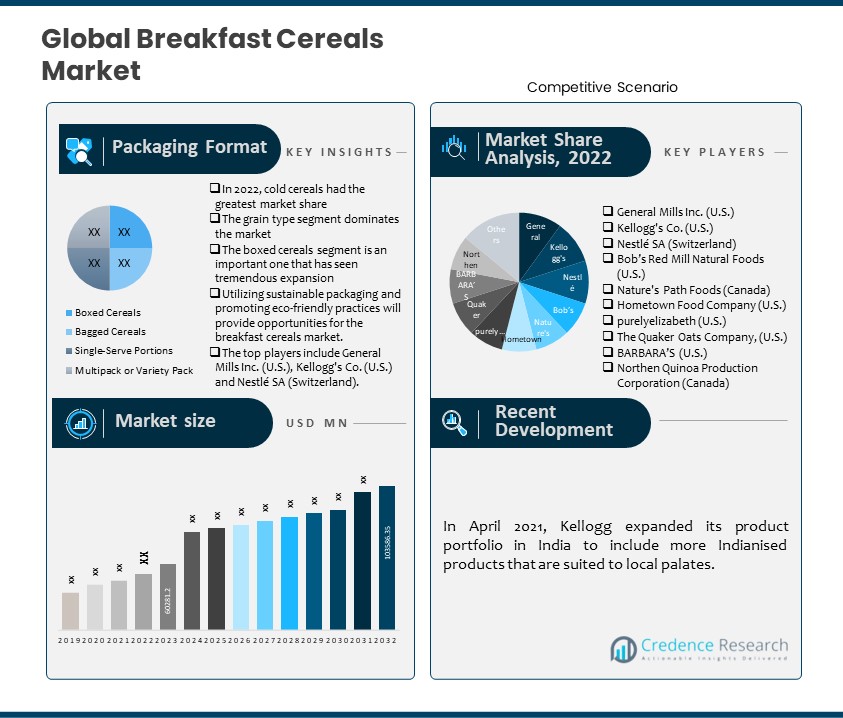
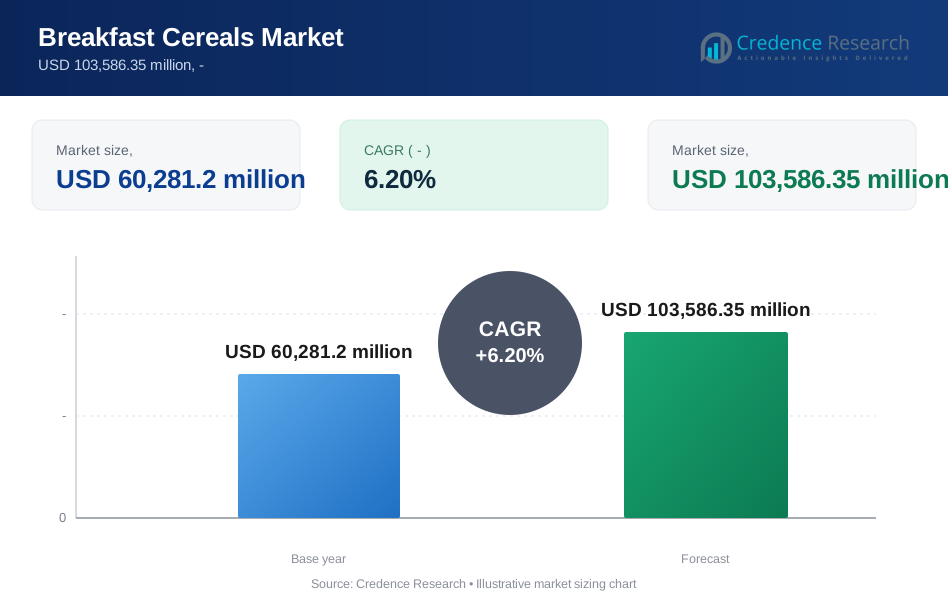
- The global market for breakfast cereals is expected to develop at a compound annual growth rate (CAGR) of 6.20% between 2024 and 2032, from its estimated USD 60281.2 million in 2023 to USD 103586.35 million in 2032.
- The largest category of cereals is cold cereals. Hot cereals, on the other hand, are expected to grow at a strong CAGR.
- The grain type category will expand at a rapid rate of growth.
- The CAGR for boxed cereals is expected to be the highest during the projection period.
- The children's cereals category will have the highest CAGR throughout the prediction period.
- North America dominated the breakfast cereals market.
- Regarding the market share of breakfast cereals, Europe is expected to come second.
- In the breakfast cereals market, Asia Pacific is anticipated to grow fastest.
- The expansion of retail channels, advertising and promotional activities, and new cereal varieties and flavors influence the breakfast cereal market.
- Developing healthier and more useful morning cereal options to satisfy consumers who are concerned about their health, as well as utilizing sustainable packaging and encouraging eco-friendly behaviors, are opportunities for the breakfast cereal sector.
Executive Summary
Market Definition
The breakfast cereals market is the area of the food industry focused on producing, promoting, and distributing ready-to-eat cereals that are usually eaten for breakfast. These goods, which frequently cater to customers looking for quick and wholesome breakfast options, are distinguished by their variety, convenience, and nutritional value. There are many different varieties of cereal available in the market, such as flakes, puffs, granola, oats, and muesli. Some of these varieties can be enhanced with vitamins, minerals, and other beneficial components.
Market Overview
The breakfast cereals sector is estimated to develop at a 6.20% compound annual growth rate (CAGR) between 2024 and 2032, maintaining its current upward trend. The market will continue to develop, rising from its estimated USD 60281.2 million in 2023 to USD 103586.35 million in 2032.
Breakfast cereal sales are growing as a result of changing customer tastes and an increase in the need for healthful, quick breakfast options. Nowadays, a lot of consumers lead stressful lifestyles while balancing duties to their families, careers, and society. As a result, there is a growing need for easy-to-prepare breakfast options that are quick and straightforward. Because they offer a quick and simple meal that can be had on the go, breakfast cereals are an excellent approach to satisfy this desire. There is a wide variety of flavors, textures, and formulas for breakfast cereals, so consumers can choose the ones that best suit their unique tastes and nutritional needs. This customization appeals to customers seeking breakfast selections that suit their interests.
Consumers are actively looking for breakfast options that are convenient and nutritious as awareness of the value of good eating habits continues to grow. A lot of breakfast cereals are easy ways for customers to reach their daily dietary requirements because they are supplemented with important vitamins, minerals, and fiber. Also, in response to consumer demand, cereal producers are providing healthier options like whole grain, low-sugar, and protein- and other functional ingredient-fortified types. For their products to remain competitive and satisfy changing consumer demands, breakfast cereal manufacturers constantly innovate. To highlight the ease of use, deliciousness, and health benefits of their products, they do this by adding novel flavors, using current ingredients, and utilizing marketing techniques. These factors are anticipated to boost the growth of the breakfast cereals market.
Segmentation by Type of Cereal
- Cold cereals dominate the market in terms of cereal type. They come in a wide array of varieties, tastes, forms, and sizes. Grains such as rice, oats, wheat, and corn can be used to make them. Some are shredded, puffy, flaky, or arranged into clusters.
- The hot cereals category will exhibit a sizable CAGR during the projected period. Among the several types of morning cereals, hot cereals are those that are usually served hot or warm, while cold cereals are consumed cold or at room temperature. Hot cereals are often produced using grains like corn, wheat, rice, or oats that are cooked in milk or water before being eaten.
- Other types of cereal, including granola and muesli, instant cereals, and specialty and functional cereals, influence the need for breakfast cereals.
Segmentation by Ingredient Composition
- Grain type is considered the best ingredient composition category. Grain type refers to the kind of grains utilized as the main ingredients in breakfast cereal manufacturing. A variety of grains, each with unique nutritional qualities, flavors, and textures, are usually used to make breakfast cereals.
- The flavor varieties category will likely register a significant CAGR during forecasting. Classic tastes like chocolate, honey, vanilla, and cinnamon are well-liked options that satisfy the desires of a broad spectrum of customers seeking comfortable and well-known flavors.
- Other ingredient compositions influence the need for breakfast cereals, including nut and seed add-ins, dried fruit inclusions, and sweeteners and flavorings.
Segmentation by Packaging Format
- The boxed cereal category is projected to grow faster over the projection period. The ease of use of boxed cereals contributes to their popularity. They provide a quick and simple breakfast choice for families or people who are on the go. Customers who lead busy lives will find the cereal to be a convenient option because it is easy to pour into a bowl, add milk, and consume.
- Other packaging formats, including bagged cereals, single-serve portions, and multipack or variety packs, influence the need for breakfast cereals.
Segmentation by Target Consumer Demographics
- The children's cereals category will likely have the highest CAGR during the projection period. Cereals for kids mostly rely on kid-friendly marketing techniques like bright packaging, mascots, and partnerships with well-known films or TV series. To draw in children, the branding frequently emphasizes excitement, fun, and adventure.
- Other target consumer demographics, such as adult cereals, family-friendly options, and athletic and fitness cereals, also contribute to the demand for breakfast cereals.
Segmentation by Region
- North America leads the breakfast cereals industry. This is due to the American population's growing health concerns, which are changing dietary tastes and encouraging the adoption of healthy diets.
- Europe is estimated to rank second in market size for breakfast cereals.
- The breakfast cereals industry is predicted to flourish rapidly in Asia Pacific.
- Regions such as Africa, the Middle East, and Latin America cover the remaining requirement for breakfast cereals.
Due to globalization, urbanization, and the expansion of Western media and advertising, Western eating patterns, which frequently include breakfast cereals as a staple, have become more and more popular worldwide. With increased exposure to Western lifestyles, consumers are more likely to include cereals and other breakfast options in their daily routines. Manufacturers of breakfast cereals constantly adapt to cater to changing dietary trends and consumer preferences. In addition to meeting particular dietary requirements like gluten-free, organic, or non-GMO alternatives, this also entails creating novel flavors, textures, and formulations. Major cereal makers' aggressive marketing strategies and advertising have been significant in influencing customer attitudes and increasing demand. These advertisements frequently highlight the morning cereals' nutritional value, flavor, and ease of use, which helps to drive the market.
Based on projections, the breakfast cereals market is anticipated to be controlled by North America. The distribution networks of North American cereal firms are firmly established, guaranteeing the wide availability of their products throughout the continent. They dominate the market because of their wide distribution network, which facilitates customers' access to their preferred cereals. Due to the inventions of pioneers like C.W. Post and John Harvey Kellogg in the late 19th and early 20th centuries, the modern breakfast cereal industry began in the United States. In terms of creating and promoting breakfast cereals, North American businesses benefited greatly from this early start. In spite of some criticism about the nutritional content of some cereals, several American companies have responded to shifting consumer tastes by introducing healthier options such as whole grain and low-sugar alternatives. Maintaining this flexibility in response to changes in dietary and health trends has enabled.
The breakfast cereals market in Asia Pacific is anticipated to expand fastest throughout the forecast. Breakfast cereals are still relatively new in many regions of Asia despite being well-established in countries such as North America and Europe. Companies can reach a large pool of potential customers who still need to make morning cereal a regular part of their diet by expanding their marketing campaigns and distribution networks in the area. Whole grain cereals enhanced with vitamins and minerals are among the healthier breakfast options that are becoming more popular as people become more conscious of the value of a balanced diet and the necessity of nourishing meal options. The Asia Pacific market for breakfast cereals is predicted to grow as more people place a higher priority on their health.
Key Highlights of the Report
The global breakfast cereals market is segmented by type of cereal, ingredient composition, packaging format, target consumer demographics, and region. As far as the type of cereal is concerned, Cold cereals are the market spearhead. Grain type is the top ingredient composition category. The boxed cereals category is anticipated to increase at the highest CAGR throughout the projection period. The children's cereals category will experience the highest CAGR during the forecast period. The breakfast cereals market is expanding mostly in North America.
The demand for healthy, low-calorie breakfast options is predicted to rise due to the sharp rise in the number of people with chronic illnesses, which will propel the expansion of the global breakfast cereal market over the forecast period. It is projected that in the upcoming years, the market will develop due to a rise in the introduction of new goods and the introduction of products, including unusual and healthful ingredients like chia seeds, flax seeds, and oats. Additionally, it is anticipated that the market for breakfast cereals will expand favorably due to the growing demand for these products in the preparation of baby food.
North America is anticipated to have the top position in the global breakfast cereals market. The global expansion of numerous North American cereal businesses has strengthened their leadership in the sector. They may take advantage of economies of scale and access a variety of international markets due to their global presence. The Asia Pacific region is also assumed to have the market's sharpest growth. The demand for convenience foods, such as breakfast cereals, has surged due to the growing spending power of the middle class in nations like China and India. The growth of the market will be aided by consumers spending more on packaged breakfast goods as more people in the area move into the middle class.
Which Key Factors Are Driving The Global Breakfast Cereals Market?
The availability of fortified and functional breakfast cereals, the adoption of online and e-commerce platforms for product sales, and other factors are propelling the expansion of the breakfast cereals market. Health and wellness trends are also driving demand for nutritious breakfast options.
What Are The Main Challenges Confronting The Global Breakfast Cereals Market?
The most significant challenges affecting the breakfast cereal industry are price volatility, the perception of processed foods, and competition from alternative breakfast options.
What Market Opportunities Exist For Breakfast Cereals Globally?
The utilization of eco-friendly packaging, the encouragement of eco-friendly activities, and the positioning of morning cereals as a versatile ingredient for recipes and culinary applications have all contributed to the growth of the breakfast cereal market.
Market Drivers
Multiple factors propel the breakfast cereals industry across the globe. The primary factors propelling the global breakfast cereals market are as follows:
Growing Health Awareness Accelerates
The dietary preferences of consumers worldwide have a significant impact on the breakfast cereal business. Breakfast continues to be the key mealtime for cereal consumption, as 79% of consumers worldwide usually have it in the morning. However, there is a growing trend of cereal being eaten as a snack throughout the day, which gives manufacturers a chance to improve the flavors, messaging, and packaging they offer for this particular occasion. Nowadays, cereal is eaten for lunch and dinner in addition to being taken as a snack in the morning at over 28%, in the afternoon at almost 25%, and in the evening at roughly 19%. Demand for breakfast cereals has risen significantly, as reported by 23% of consumers globally who said they consumed more cereal last year. Over 50% of these customers credit their higher consumption to health-related factors, underscoring the growing significance of health-conscious options in the marketplace. Asia is home to the majority of the nations with the most recent increases in cereal consumption, including Thailand (35%), Saudi Arabia (36%), Vietnam (47%), and India (39%). This suggests that there is a good chance for cereal producers in this area to grow.
Market Restraints
There are several obstacles that the global breakfast cereals market must overcome to continue growing. Among them are the following:
High Competition from Alternatives
The market for breakfast cereals faces stiff competition from other breakfast options, which limits its potential for expansion. The rise of breakfast bars and grab-and-go breakfast options is one illustration of this competition. Granola bars, protein bars, and meal replacement bars are examples of breakfast bars that provide customers with a quick and portable breakfast option. These bars are popular among people looking for quick and wholesome breakfast options since they frequently promote health advantages like high protein, fiber, and whole grains. In addition, a lot of breakfast bars are advertised as having no artificial ingredients and little added sugar to ease worries about the nutritional content of conventional breakfast cereals.
Market share for traditional morning cereals should be shifted away from them as breakfast bars and related alternatives become more popular. The convenience, portability, and perceived health benefits of these substitutes lead consumers to select them, which restricts the market's potential for growth in the breakfast cereal segment. Grocery stores frequently feature breakfast bars on their shelves and heavily promote them as a component of a well-balanced meal. This increased exposure and marketing initiatives exacerbate the rivalry that traditional morning cereals confront. Smoothies and yogurt parfaits are becoming more and more popular morning options, especially among consumers who are health-conscious, giving the breakfast cereal sector fierce competition. These factors restrain the growth of the global breakfast cereals market.
Opportunities
There are plenty of potential prospects in the global breakfast cereals industry. Among these are the following:
Diversification of Product Offerings Generates Profitable Development Prospects
In the breakfast cereal industry, diversifying product offerings offers a calculated route to successful expansion. Through diversifying their cereal offerings, organizations are able to efficiently cater to a broader spectrum of consumer preferences and demands. They can target various demographics with this segmentation, ranging from health-conscious people searching for wholesome options to those craving decadent pleasures. Additionally, by diversifying their business, organizations may quickly adapt to changing consumer demands and keep ahead of new trends. Innovative ingredients, distinctive flavors, or functional benefits like extra vitamins all help brands stay current and competitive. Limited edition and seasonal products often create buzz and draw in customers looking for something new—cereal companies' entry into the gluten-free market to satisfy customers with particular dietary needs or preferences. Kellogg's, a prominent player in the breakfast cereal industry, acknowledged the increasing need for gluten-free products among consumers who adopt a gluten-free diet for health-related reasons or who have celiac disease or gluten sensitivity. These factors will create opportunities for the global market.
Competitive Landscape
Key Players
Several major competitors exist in the fiercely competitive global breakfast cereals market. The following are a few of the leading market participants and their market shares:
- General Mills Inc. (U.S.)
- Kellogg's Co. (U.S.)
- Nestlé SA (Switzerland)
- Bob’s Red Mill Natural Foods (U.S.)
- Nature's Path Foods (Canada)
- Hometown Food Company (U.S.)
- purelyelizabeth (U.S.)
- The Quaker Oats Company (U.S.)
- BARBARA’S (U.S.)
- Northen Quinoa Production Corporation (Canada)
- LOVEGROWN INC. (U.S.)
- Gluten-Free Prairie (U.S.)
- Avena Foods, Limited, (Canada)
- Others
These companies prioritize product innovation, distribution channel expansion, mergers, and acquisitions to remain competitive.
The largest suppliers in the global breakfast cereals market continuously work to stay one step ahead of the competition by developing innovative concepts and products.
In January 2023, PepsiCo declared the release of a redesigned, exceptionally tasty Pepsi Zero Sugar. Customers will have the chance to redeem up to 10 million complimentary Pepsi Zero Sugar bottles or cans, beginning during the NFL Playoffs and ending with the Super Bowl, as the brand proves to them via taste and trial that zero sugar has never tasted so delicious.
In June 2022, The Post-Consumer Brands division of Post Holdings, Inc. revealed plans to invest up to US$110 million to increase the facility's capacity for producing cereal in Sparks, U.S. In addition to addressing capacity issues and improving customer satisfaction by increasing production volume, the proposed expansion will save transportation expenses and improve service to West Coast clients.
How are Companies Performing in the Breakfast Cereals Market?
The substantial performance of companies in the breakfast cereal sector can be attributed to some noteworthy reasons. Major multinational companies are prioritizing their investments in research and development endeavors in order to introduce enhanced products for end users and sustain their market share. Renowned companies are offering vegetable-infused morning cereals, which reduce preparation time and provide nutritional value for customers. These cereals come in various serving sizes to facilitate easy and convenient consumption.
Companies in the market are drawing customers in by developing creative morning cereals with unique flavors and components. The Indian government has initiated the process of educating the public about the significance of grains in daily diets. The government is working with top companies and utilizing online channels to promote its initiatives. As an example, Pepsico India and United Way Delhi collaborated to begin an awareness initiative in March 2021 about the value of whole grains and a balanced diet.
The most prominent companies in the Breakfast cereals area, such as Kellogg Company, General Mills Inc., Nestle SA, Post Holdings Inc., and Campbell Soup Company, are concentrating on keeping customers interested and draw in new ones, try introducing novel flavors, inventive formulas, and innovative packaging. To keep up with shifting consumer preferences and nutritional trends, they make significant investments in research and development.
Companies in the breakfast cereals sector have flourished because they provide a large selection of goods to meet a variety of dietary requirements, tastes, and nutritional demands. Almost every consumer can find something they like, from classic flakes and puffs to granolas, mueslis, and oatmeal.
Summary of Key Findings
- The availability of breakfast cereals in many retail formats, such as supermarkets, hypermarkets, and online platforms drives the market growth.
- The market is segmented by type of cereal, ingredient composition, packaging format, target consumer demographics, and region.
- In the market, cold cereals are the most widely used type of cereal.
- Grain type is the foremost category.
- Boxed cereals are expected to grow at the fastest CAGR during the forecast period.
- The children's cereals category will likely see the highest CAGR during the anticipated time frame.
- North America is leading market development; the market is highly competitive with key players including General Mills Inc. (U.S.), Kellogg's Co. (U.S.), Nestlé SA (Switzerland), Bob’s Red Mill Natural Foods (U.S.), Nature's Path Foods (Canada), Hometown Food Company (U.S.), purelyelizabeth (U.S.), The Quaker Oats Company, (U.S.), BARBARA’S (U.S.), Northen Quinoa Production Corporation (Canada), LOVEGROWN INC. (U.S.), Gluten-Free Prairie (U.S.), Avena Foods, Limited, (Canada), and Others.
Future Outlook
- The breakfast cereals industry is expected to increase significantly in North America, and its outlook is positive worldwide.
- Product endorsement agreements with fitness and wellness celebrities are driving growth in the breakfast cereal sector.
- The market for breakfast cereals may face difficulties as a result of price sensitivity and growing awareness of the sugar content and possible health hazards of particular breakfast cereals.
- To stay ahead of the competition, key enterprises must develop new products, expand their market reach, and keep their prices competitive.
How CXOs Can Benefit from the Credence Research Breakfast Cereals Market Report
CXOs may get a detailed picture of the market in the Credence Research Breakfast Cereals Market Report, which includes:
- Market size and growth forecast: The report provides detailed estimates of the global market size of breakfast cereals, segmented by type of cereal, ingredient composition, packaging format, target consumer demographics, and region. It also includes forecasts for the market through 2032 based on key trends and drivers.
- Market segmentation: The research report breaks down the breakfast cereals market into segments based on type of cereal, ingredient composition, packaging format, target consumer demographics, and region. This segmentation provides CXOs with a granular understanding of the market and the opportunities in each segment.
- Competitive landscape: The research report offers a detailed analysis of the major companies in the breakfast cereals industry, including information on their business plans, product lines, and earnings. CXOs can use this information to evaluate and identify their competitors.
- Key trends and drivers: The research report identifies and evaluates the main trends and factors influencing the breakfast cereals market. CXOs can use this information to make well-informed choices regarding their plans and investments.
CXOs can use the insights from the Credence Research Breakfast Cereals Market Report to:
- Identify growth opportunities: This analysis may help CXOs identify new growth opportunities in the breakfast cereals sector. For example, the report identifies the growing demand for breakfast cereals from the food industry as a key opportunity.
- Make informed investment decisions: The report helps CXOs make wise choices regarding breakfast cereals. For example, the research study provides information on the critical factors to consider when selecting breakfast cereal solutions and evaluating suppliers.
- Develop competitive strategies: CXOs can use the research report to develop competitive strategies for their breakfast cereals businesses. For example, the research paper outlines the main strategies that breakfast cereal suppliers utilize to differentiate themselves from competitors.
- Track market developments: This research report may help CXOs stay ahead of the curve by tracking market developments. For instance, it offers insights into the most recent developments and trends in the breakfast cereals market.
CXOs seeking to expand their industry knowledge and spot growth prospects will find the Credence Research Breakfast Cereals Market Report useful.
Segmentation
- By Type of Cereal
- Cold Cereals
- Hot Cereals
- Granola and Muesli
- Instant Cereals
- Specialty and Functional Cereals
- By Ingredient Composition
- Grain Type
- Flavor Varieties
- Nut and Seed Add-Ins
- Dried Fruit Inclusions
- Sweeteners and Flavorings
- By Packaging Format
- Boxed Cereals
- Bagged Cereals
- Single-Serve Portions
- Multipack or Variety Pack
- By Target Consumer Demographics
- Children's Cereals
- Adult Cereals
- Family-Friendly Options
- Athletic and Fitness Cereals
- By Region
- North America
- The U.S.
- Canada
- Mexico
- Europe
- Germany
- France
- The U.K.
- Italy
- Spain
- Rest of Europe
- Asia Pacific
- China
- Japan
- India
- South Korea
- South-east Asia
- Rest of Asia Pacific
- Latin America
- Brazil
- Argentina
- Rest of Latin America
- Middle East & Africa
- GCC Countries
- South Africa
- The Rest of the Middle East and Africa
- North America
Request a Free Sample
Fill in your details and we'll send you a free sample report.
- Sample data tables & charts
- Research methodology
Need a Custom Version of This Report?
Tailor the scope, geography, or segments to your exact requirements.
- Custom geography or segment scope
- Direct access to our analyst team
Frequently Asked Questions
How much does the global market currently hold for breakfast cereals?
What is the breakfast cereals market's projected growth rate between 2024 and 2032?
In terms of the type of cereal, which market category is leading?
Regarding the ingredient composition, which market category is in the lead?
Who are the main players in the global breakfast cereals industry?
Table of Content
Chapter 1. Report Introduction
- 1.1 Report Description & Purpose
- 1.1.1 Report Title & Market Definition
- 1.1.2 Unique Selling Propositions (USP) & Key Differentiators
- 1.1.3 Value Proposition for Stakeholders
- 1.2 Research Objectives
- 1.2.1 Market Sizing Objectives (Volume & Revenue)
- 1.2.2 Segmentation Objectives
- 1.2.3 Competitive Intelligence Objectives
- 1.2.4 Forecast & Scenario Objectives
- 1.3 Report Scope
- 1.3.1 Breakfast Cereals Scope – Types & Subtypes Covered
- 1.3.2 Geographic Scope – Regions & Countries Covered
- 1.3.3 Historical Period, Base Year & Forecast Period (the historical period; forecast to the forecast period)
- 1.3.4 Inclusions & Exclusions
- 1.4 HS Code & Classification Framework
- 1.5 Currency, Units & Pricing Basis
- 1.6 Target Stakeholders
- 1.7 Limitations & Assumptions
Chapter 2. Executive Summary
- 2.1 Global Breakfast Cereals Market Snapshot
- 2.1.1 Market Size – Historical (the historical period) & Forecast (the forecast period) (base year: USD 60,281.2 million → forecast year: USD 103,586.35 million)
- 2.1.2 Volume & Revenue – Global Totals
- 2.1.3 Key Market Highlights – Top Five Facts
- 2.2 Breakfast Cereals Market Segmentation Snapshot
- 2.2.1 Market Split by Region – vs.
- 2.3 Competitive Snapshot
- 2.3.1 Top 10 Players by Revenue Share –
- 2.3.2 Top 10 Players by Volume Share –
- 2.3.3 Recent Strategic Developments (18-Month Summary)
- 2.4 Key Investment Highlights & Strategic Conclusions
Chapter 3. Breakfast Cereals Market Dynamics & Industry Analysis
- 3.1 Market Overview & Context
- 3.1.1 Breakfast Cereals Market Position in the Broader Automotive Value Chain
- 3.1.2 OEM vs. Replacement Market Dynamics
- 3.1.3 Market Maturity & Development Stage by Region
- 3.2 Breakfast Cereals Market Drivers
- 3.3 Breakfast Cereals Market Restraints & Challenges
- 3.4 Breakfast Cereals Market Opportunities
- 3.5 Porter's Five Forces Analysis
- 3.5.1 Threat of New Entrants
- 3.5.2 Bargaining Power of Suppliers
- 3.5.3 Bargaining Power of Buyers
- 3.5.4 Threat of Substitutes
- 3.5.5 Competitive Rivalry – Intensity Assessment
- 3.6 Breakfast Cereals Value Chain Analysis
- 3.6.1 Upstream – Raw Material/Input Suppliers
- 3.6.1.1 Raw Material/Input 1
- 3.6.1.2 Raw Material/Input 2
- 3.6.1.3 Raw Material/Input 3
- 3.6.2 Midstream – Production/Manufacturing/Service Delivery
- 3.6.2.1 Production/Process Overview
- 3.6.2.2 Key Facility Locations & Capacity by Manufacturer
- 3.6.3 Downstream – Distribution & End Consumer
- 3.6.3.1 Primary Channel – B2B/OEM
- 3.6.3.2 Secondary Channels – Dealer, Retail, Online, Direct
- 3.6.4 Value Chain Profitability Analysis
- 3.6.1 Upstream – Raw Material/Input Suppliers
- 3.7 PESTEL Analysis
- 3.7.1 Political Factors
- 3.7.2 Economic Factors
- 3.7.3 Social Factors
- 3.7.4 Technological Factors
- 3.7.5 Environmental Factors
- 3.7.6 Legal Factors
- 3.8 Breakfast Cereals Supply Chain Analysis
- 3.8.1 Raw Material/Input Supply Risk Assessment
- 3.8.2 Manufacturing Concentration Risk (Geographic Exposure)
- 3.8.3 Trade Disruption Impact Analysis
- 3.9 Regulatory & Policy Landscape
Note: The regulatory and policy landscape section covers regulations based on their applicability to the market, Breakfast Cereals category, geography, and scope of the study. Only regulatory frameworks with a material impact on operations, compliance, trade, sustainability, or market access are analyzed in detail.
Chapter 4. Key Investment Pockets & Opportunity Analysis
- 4.1 Breakfast Cereals Market Attractiveness Analysis
- 4.1.1 By Region – Investment Attractiveness Matrix (Volume × CAGR)
- 4.2 Absolute Revenue Growth Opportunity
- 4.2.1 By Region – Absolute USD Growth Through the forecast period
- 4.3 Incremental Volume Opportunity
- 4.3.1 By Region – Incremental Volume Through the forecast period
- 4.3.2 Segment – Incremental Volume
- 4.4 Emerging Submarket Opportunity Deep Dive (Subject to Applicability)
- 4.5 Emerging Market Opportunity Scorecards
- 4.5.1 United States
- 4.5.2 Europe
- 4.5.3 Asia
- 4.5.4 Middle East & Africa
Note: Emerging Market Opportunity Scorecards will be included based on relevance and strategic importance. Regions listed are indicative and may vary depending on data availability and market dynamics.
Chapter 5. Breakfast Cereals Import-Export Analysis & Trade Flows
- 5.1 Global Trade Overview
- 5.1.1 Global Export Value by Country (the historical period)
- 5.1.2 Global Export Volume by Country (the historical period)
- 5.1.3 Global Import Value by Country (the historical period)
- 5.1.4 Global Import Volume by Country (the historical period)
- 5.1.5 Net Trade Balance by Country (the historical period)
- 5.2 Export Analysis – Segment
- 5.2.1 Type 1 (HS Code)
- 5.2.2 Type 2 (HS Code)
- 5.2.3 Type 3 (HS Code)
- 5.2.4 Type 4 (HS Code)
- 5.2.5 Type 5 (HS Code)
- 5.3 Import Analysis – Segment
- 5.3.1 Type 1 (HS Code)
- 5.3.2 Type 2 (HS Code)
- 5.3.3 Type 3 (HS Code)
- 5.3.4 Type 4 (HS Code)
- 5.3.5 Type 5 (HS Code)
- 5.4 Average Unit Trade Prices
- 5.4.1 Average Export Price – Segment & Country
- 5.4.2 Average Import Price – Segment & Source Country
- 5.4.3 Price Trends (the historical period)
- 5.5 Key Trade Route Analysis
- 5.5.1 Trade Route 1
- 5.5.2 Trade Route 2
- 5.5.3 Trade Route 3
- 5.5.4 Trade Route 4
- 5.5.5 Trade Route 5
- 5.6 Trade Policy Impact Assessment
- 5.6.1 US Anti-Dumping & Section 301 Tariffs
- 5.6.2 EU Customs Union Impact
- 5.6.3 Major Free Trade Agreements
- 5.6.4 USMCA Rules of Origin
Note: Trade policy analysis will be included only where relevant to the Breakfast Cereals market.
Chapter 6. Competitive Landscape & Company Benchmarking
- 6.1 Breakfast Cereals Market Concentration & Structure
- 6.1.1 Herfindahl-Hirschman Index (HHI) – vs.
- 6.1.2 Tier 1, Tier 2 & Tier 3 Market Structure
- 6.1.3 Global, Regional & Local Player Dynamics
- 6.2 Breakfast Cereals Market Share Analysis –
- 6.2.1 Global Revenue Share by Company
- 6.2.2 Global Volume Share by Company
- 6.2.3 Regional Revenue Share
- 6.2.4 Market Share Evolution ( vs. )
- 6.2.5 OEM Segment Share by Company
- 6.2.6 Replacement Segment Share by Company
- 6.3 Production/Delivery Capacity & Facility Analysis
- 6.3.1 Global Installed Capacity
- 6.3.2 Capacity Utilization Rates
- 6.3.3 Production/Output Volume
- 6.3.4 Facility Locations & Capacity Map
- 6.3.5 Planned Capacity Additions
- 6.4 Breakfast Cereals Competitive Benchmarking Matrix
- 6.4.1 Revenue, Volume, CAGR & Profitability Comparison
- 6.4.2 Channel Revenue Mix
- 6.4.3 Geographic Revenue Exposure
- 6.4.4 R&D Intensity
- 6.4.5 Sustainability Maturity
- 6.5 Strategic Developments in Breakfast Cereals (Last 24 Months)
- 6.5.1 Mergers, Acquisitions & Divestments
- 6.5.2 New Breakfast Cereals Launches
- 6.5.3 Facility Expansions
- 6.5.4 Strategic Alliances, Joint Ventures & Partnerships
- 6.5.5 Distribution Expansion & Market Entry
- 6.5.6 Sustainability & ESG Initiatives
- 6.6 Competitive Strategy Mapping
- 6.6.1 Leader, Challenger, Follower & Niche Classification
- 6.6.2 Pricing Strategy Comparison
- 6.6.3 Channel Strategy Matrix
Note: Strategic developments are included based on their materiality and the availability of reliable information.
Chapter 7. Global Breakfast Cereals Market – By Distribution Channel
- 7.1 Segment Overview
- 7.1.1 Volume & Revenue Split by Channel ( & )
- 7.1.2 Channel Mix Evolution (the forecast period)
Chapter 8. Regional Market Analysis – Global Overview
- 8.1 Global Regional Overview
- 8.1.1 Regional Volume Share
- 8.1.2 Regional Revenue Share
- 8.1.3 Regional Volume by Region
- 8.1.4 Regional Revenue by Region
- 8.1.5 Regional Forecast Through the forecast period
- 8.2 Cross-Regional Segment Analysis
- 8.2.1 By Distribution Channel
- 8.2.2 By Brand/Price Tier
Chapter 9. North America Breakfast Cereals Market
- 9.1 United States
- 9.2 Canada
- 9.3 Mexico
Chapter 10. Europe Breakfast Cereals Market
- 10.1 Germany
- 10.2 France
- 10.3 Italy
- 10.4 United Kingdom
- 10.5 Spain
- 10.6 Poland
- 10.7 Russia
- 10.8 Netherlands
- 10.9 Belgium
- 10.10 Sweden
- 10.11 Denmark
- 10.12 Norway
- 10.13 Rest of Europe
Chapter 11. Asia Pacific Breakfast Cereals Market
- 11.1 China
- 11.2 India
- 11.3 Japan
- 11.4 South Korea
- 11.5 Thailand
- 11.6 Indonesia
- 11.7 Vietnam
- 11.8 Malaysia
- 11.9 Australia
- 11.10 Rest of Asia Pacific
Chapter 12. Latin America Breakfast Cereals Market
- 12.1 Brazil
- 12.2 Argentina
- 12.3 Colombia
- 12.4 Chile
- 12.5 Rest of Latin America
Chapter 13. Middle East Breakfast Cereals Market
- 13.1 Saudi Arabia
- 13.2 United Arab Emirates
- 13.3 Turkey
- 13.4 Israel
- 13.5 Iran
- 13.6 Rest of the Middle East
Chapter 14. Africa Breakfast Cereals Market
- 14.1 South Africa
- 14.2 Egypt
- 14.3 Nigeria
- 14.4 Morocco
- 14.5 Rest of Africa
Chapter 15. Breakfast Cereals Company Profiles
- 15.1 [Company 01]
- 15.1.1 Company Overview
- 15.1.2 Key Management Personnel
- 15.1.3 Products & Services Portfolio
- 15.1.4 Financial Performance
- 15.1.5 Key Market Focus & Geographic Presence
- 15.1.6 Recent Developments & Strategic Initiatives
Note: The company profile list is preliminary and may change based on research findings, market developments, data availability, and client requirements.
Chapter 16. Appendices
- Appendix A – List of Abbreviations & Acronyms
- Appendix B – Industry Classification Code Reference – Full Series
- Appendix C – Production & Capacity Data Tables
- Appendix D – End-Use & Demand Base Tables
- Appendix E – Consumption & Replacement Rate Assumptions
- Appendix F – ASP Reference Tables
- Appendix G – Manufacturing & Facility Database
- Appendix H – Import-Export Data Tables
- Appendix I – Regulatory Summary Tables
- Appendix J – Primary Research Participant List (Anonymized)
- Appendix K – Primary Research Questionnaire Framework
- Appendix L – Data Sources & Bibliography
- Appendix M – Market Size Divergence & Source Comparison
Chapter 17. Research Methodology
- 17.1 Research Framework & Philosophy
- 17.2 Secondary Research – Sources, Hierarchy & Data Extraction
- 17.3 Data Modeling – Bottom-Up & Top-Down Market Sizing
- 17.4 Primary Research – Stakeholder Framework, LOI & Sample Sizes
- 17.5 Forecast Methodology – Regression, Scenario & Sensitivity Analysis
- 17.6 Quality Control – Four-Layer Validation Framework
- 17.7 Limitations & Standard Assumptions
- 17.8 Disclaimer
