
| REPORT ATTRIBUTE | DETAILS |
|---|---|
| Historical Period | 2019-2022 |
| Base Year | 2023 |
| Forecast Period | 2024-2032 |
| Breast Cancer Treatment Market Size 2023 | USD 27152.5 Million |
| Breast Cancer Treatment Market, CAGR | 9.80% |
| Breast Cancer Treatment Market Size 2032 | USD 62984.0 Million |
Market Insights
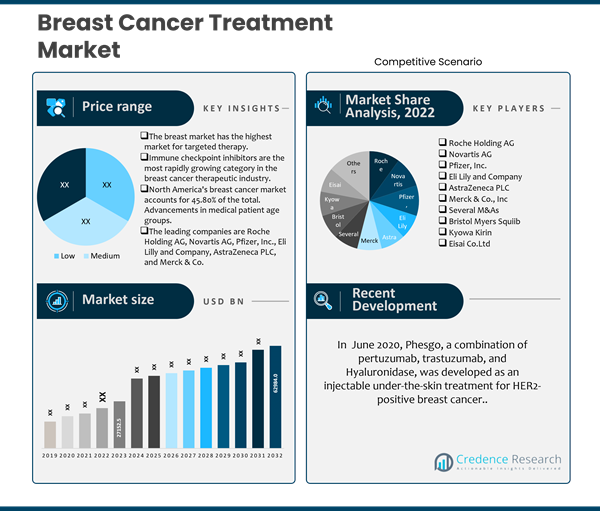
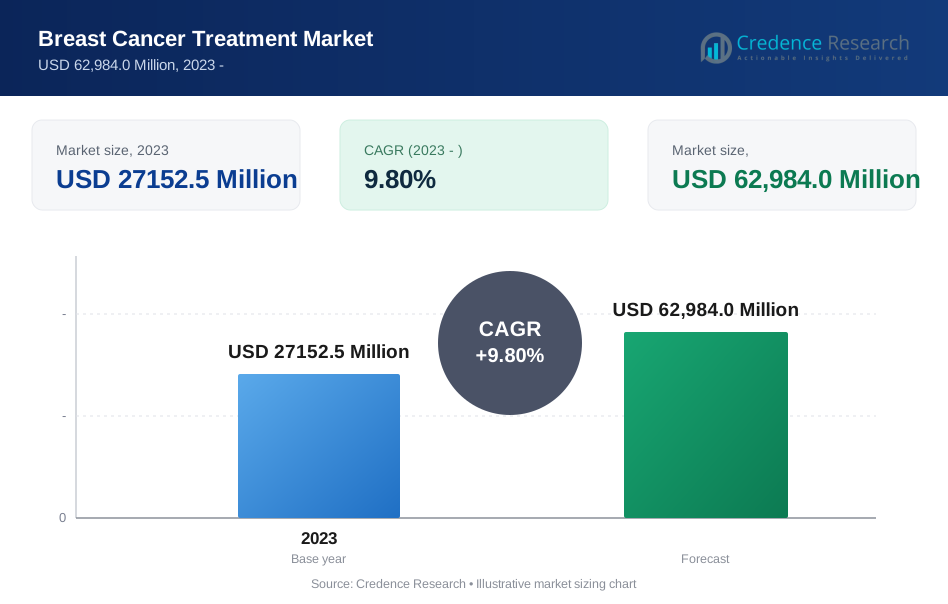
- The global demand for Breast Cancer Treatment was valued at USD 27152.5 Million in 2023 and is expected to reach USD 62984.0 Million in 2032, growing at a CAGR of 9.80% between 2024 and 2032.
- In the breast market, targeted therapy is the largest market, although immunotherapy has also obtained a greater market share.
- The breast cancer market is predicted to increase at the quickest rate in the hormone receptor over the forecast period. Hormone receptor HER2 lost market share.
- Hospitals have the largest market share, and the clinics category is predicted to experience a considerable CAGR.
- Immune checkpoint inhibitors are the fastest-growing area in the breast cancer treatment industry. Another significant part is monoclonal antibodies.
- Both early-stage and advanced/metastatic breast cancers are serious.
- Oral administration is the most important category in the Breast Cancer Treatment Market.
- First-line therapy stimulates market demand.
- Adults represent the largest market group for breast cancer treatment.
- In 2023, the imaging sector dominated the overall market, accounting for 52.74% of sales, while Genomic Testing was an equally popular area.
- North America's breast cancer market accounts for around 45.80% of the total, while Asia Pacific is expected to have the fastest CAGR over the forecast period.
- The rising prevalence of breast cancer in the population propels market expansion.
- An detrimental effect of the treatment for breast cancer impedes market growth
Executive Summary
Market Definition
The Breast Cancer Treatment Market refers to the industry that focuses on creating and offering various treatments for breast cancer, which begins in the cells of the breast. These therapies may include surgery, radiation therapy, chemotherapy, targeted therapy, and hormone therapy. The market is being pushed by the rising prevalence of breast cancer and advances in medical Patient Age Group. Its goal is to improve patient outcomes and quality of life by providing effective and individualized treatment options.
Market Overview
The global Breast Cancer Treatment Market has witnessed steady growth in recent years and is expected to grow at a CAGR of 9.80% between 2024 and 2032. The market was valued at USD 27152.5 million in 2023 and is expected to reach USD 62984.0 million in 2032.
The Breast Cancer Treatment Market is a large and rising segment of the healthcare industry. It includes a variety of products and services designed to diagnose, treat, and manage breast cancer. Factors driving the market include an increase in the global prevalence of breast cancer, advances in medical research, and greater awareness of early diagnosis and treatment options. Pharmaceutical companies, medical device makers, and healthcare providers are among the market's leading players. Surgery, radiation therapy, chemotherapy, targeted therapy, and hormone therapy are among of the therapeutic options available on the market. It is a dynamic and competitive market that is always researching and developing new ways to improve treatment outcomes and patient experiences.
Segmentation by Treatment Type
- Targeted therapy in the breast market is the largest market, with growing adoption of the therapy due to increased production and improved performance, as well as new medication launches helping to accelerate the breast cancer market. Targeted treatment medications include Kadcyla, Afinitor, Lynparza, and Zortress.
- Immunotherapy has also gained a larger market share in the breast market due to recent regulatory approvals.
Segmentation by Endocrine Receptor Status
- The breast cancer market is expected to grow at the fastest rate in the hormone receptor over the forecast period, with an increasing number of cases of breast cancer diagnosed each year and the development of new creative technologies to treat the illness.
- Hormone receptor HER2 dropped market share, although new launches in treating breast cancer may boost market growth during the forecast period, with a higher CAGR rate.
Segmentation by Distribution Channel
- Hospital with the biggest market share established their own pharmacies within the hospital. Patients' dependence on chemotherapy drugs has increased.
- The clinics segment is expected to see a significant CAGR of roughly 15.0% over the next several years.
Segmentation by Drug Class (for systemic treatments)
- Immune checkpoint inhibitors are the fastest-expanding sector in the breast cancer treatment market. These inhibitors function by preventing specific proteins that prevent the immune system from attacking cancer cells, thereby strengthening the body's natural fight against cancer.
- Another key element is Monoclonal Antibodies, which are designed proteins that specifically target cancer cells, hence inhibiting their growth and spread.
Segmentation by Stage of Cancer
- Both early-stage and advanced/metastatic breast cancer are significant. However, advanced or metastatic breast cancer is the part that often attracts the most attention and research funding. This is because advanced or metastatic breast cancer refers to cancer that has spread to other parts of the body, necessitating more aggressive treatment strategies.
Segmentation by Mode of Administration (for drug therapies)
- Oral administration is the most prominent segments in the Breast Cancer Treatment Market. Oral administration, or taking medication by mouth, is frequently preferred due to its simplicity and ease of usage.
Segmentation by Therapy Line
- First-line therapy drives market demand. First-line therapy is the first treatment offered to patients after they are diagnosed with breast cancer. It is usually the most effective and recommended treatment for the particular kind and stage of breast cancer. The goal of first-line therapy is to produce the best feasible results while potentially curing the malignancy.
Segmentation by Patient Age Group
- Adults are the most prominent market segment for breast cancer treatment. Breast cancer primarily affects adults, and the majority of research, treatments, and resources are geared toward treating adult patients. Breast cancer can affect children, but it is uncommon. Treatment techniques and concerns for pediatric breast cancer may differ from those for adult patients due to changes in biology, tumor features, and treatment response.
Segmentation by Diagnostic Tools
- In 2023, the imaging sector dominated the overall market, accounting for 52.74% of revenues. The breast cancer diagnostics market expanded significantly in 2023 due to the widespread use of imaging techniques like mammography, ultrasound, and MRI.
- However, Genomic Testing is equally popular segment in the market.
Segmentation by Region
- North America's breast cancer market, accounting for approximately 45.80% of the total
- Asia Pacific is predicted to have the quickest CAGR throughout the forecast period.
- The rest of the world, including Latin America, the Middle East, and Africa, supplies the remaining demand for Breast Cancer Treatment.
North America's breast cancer market has the greatest share in the industry and is expected to expand at a significant CAGR over the study period. Increased government involvement in the development of new treatments, increased medication efficacy, and improved results all contribute to market expansion. Advanced new technologies in the market, as well as a greater variety of treatments accessible for treating breast cancer with an increasing number of patients, all contribute to market expansion. Market organizations' primary tactics include new product creation, partnerships, expansions, mergers, and acquisitions.
The Asia Pacific Breast Cancer Market is predicted to expand at the quickest CAGR between 2023 and 2032. This is owing to an expanding patient population, increased demand for cutting-edge drugs, and rising healthcare expenses. For instance, F. Hoffmann-La Roche Ltd. has stated that atezolizumab, an immunotherapy drug, will be available in India in April 2020 to treat metastatic triple-negative breast cancer (TNBC). Furthermore, the Chinese breast cancer market had the highest market share, while India's breast cancer market was the fastest expanding in the region.
Key Highlights of the Report
The global Breast Cancer Treatment Market is segmented by Treatment Type, Endocrine Receptor Status, Distribution Channel, Drug Class (for systemic treatments), Type, Mode of Administration (for drug therapies), Therapy Line, Patient Age Group, Diagnostic Tools, and region. Hospitals have the largest market share, and immune checkpoint inhibitors are the fastest-growing industry. In addition, clinics are expected to increase at a rapid CAGR, and first-line therapy fuels market demand. Also, adults are the most important market group for breast cancer treatment., with North America leading the market growth.
The market is driven by the increasing global prevalence of breast cancer, advances in medical technology and treatment options, and growing awareness of the need of early detection and screening. Furthermore, the high cost of breast cancer therapies, side effects associated with some treatment modalities, and limited access to quality healthcare in certain locations are the primary limitations of the market.
Nonetheless, North America's breast cancer market is the largest in the sector and is predicted to grow at a substantial CAGR during the study period. higher government engagement in the development of novel medicines, higher pharmaceutical efficacy, and improved outcomes all help to expand the market. Furthermore, the Asia-Pacific Breast Cancer Market is expected to grow at the fastest CAGR between 2023 and 2032. This is due to an expanding patient population, increased demand for innovative treatments, and rising healthcare costs.
What Are The Main Drivers Of The Global Breast Cancer Treatment Market?
Several factors drive the Breast Cancer Treatment Market. Tthere has been an alarming increase in the prevalence of breast cancer globally. This rise in incidence has created a growing demand for effective treatment options. Additionally, advancements in medical Patient Age Group and treatment modalities have significantly improved the outcomes for breast cancer patients. From minimally invasive surgical techniques to targeted therapies, these innovations have revolutionized the way breast cancer is treated.
What Are The Major Challenges Faced By The Global Breast Cancer Treatment Market?
While numerous drivers are propelling the Breast Cancer Treatment Market, certain restraints need to be considered. The high cost of breast cancer treatments can be a significant barrier for patients, limiting their access to optimal care. Additionally, some treatment modalities may have associated side effects that can impact the quality of life for patients.
What Are The Growth Opportunities In The Global Breast Cancer Treatment Market?
The Breast Cancer Treatment Market presents several opportunities for further advancement. One promising opportunity lies in the development of targeted therapies and immunotherapies. These treatment options aim to specifically target cancer cells while minimizing damage to healthy tissues, offering improved efficacy and reduced side effects. Another opportunity is the integration of artificial intelligence and machine learning in treatment decision-making. These technologies can analyze vast amounts of patient data to provide personalized treatment recommendations, leading to more precise and tailored approaches.
Market Drivers
Increasing Prevalence Of Breast Cancer In The Population
The rising number of breast cancer patients is the primary driver of the breast cancer market across geographies, with an expanding number of drugs with maximum efficacy and efficiency. Improve a number of diagnostic methods that are becoming more common in everyday life for imaging and screening of the disorder, with faster results and increased accuracy of the procedures projected to propel the breast market to new heights. Due to increased demands from the medical sector and an increasing number of patients with breast cancer and requirements for efficient treatments for the person to enhance health and lengthen the life of the individuals these factor helps to grow the market for breast
Market Restraints
Adverse Effect Of The Treatment For Breast Cancer
Breast cancer treatment, such as chemotherapy, medicines, and targeted therapy, can cause a variety of side effects after the medication is administered via different methods. Adverse effects include vomiting, diarrhea, mouth ulcers, skin problems, high blood pressure, gastrointestinal problems, and many others. These factors may challenge the market's ability to expand to a greater extent while increasing severe adverse effects that may affect the individual's quality of life and weakness. Immunotherapy and targeted treatment chemotherapy are medications associated with higher adverse responses, which may impact market size.
Opportunities
Increased Research And Development
The advanced development of drugs used in breast cancer treatment. Increasing the quantity of therapies with higher efficiency and improving the production of treatments with positive effects. Developing chemotherapies for treating breast cancer with a rising market and increasing demands from the medical sector due to the spread of malignant cells that, if not treated in time, can harm other organs of the body. Increased market interest as a result of improved developments for treating the condition and better results. This is a fantastic opportunity that pushes the market.
Competitive Landscape
Key Players
The global Breast Cancer Treatment Market is highly competitive, with several key players. Some of the major players in the market and their market share are as follows:
- Roche Holding AG
- Novartis AG
- Pfizer, Inc.
- Eli Lily and Company
- AstraZeneca PLC
- Merck & Co., Inc
- Several M&As
- Bristol Myers Squiib
- Kyowa Kirin
- Eisai Co.Ltd
These organizations prioritize product innovation, distribution channel expansion, and mergers and acquisitions to stay competitive.
The global Breast Cancer Treatment Market's key players continually seek to stay ahead by offering new products and developments.
In September 2020, Natco Pharma's partnership with Lupin launched Lapatinib Tablets, 250mg, in the United States following FDA approval for the Abbreviated New Drug Mode of Administration (for drug therapies). Natco will be the first industry to introduce Lapatinib Tablet 250mg.
In September 2022, Novartis announced the results of a new pooled exploratory analysis across the entire MONALEESA Phase III program, which confirmed nearly one year of additional overall survival (OS) benefit in a subgroup of patients with aggressive forms of hormone receptor-positive, human epidermal growth factor receptor-2 negative (HR+/HER2-) advanced breast cancer (aBC).
Summary of Key Findings
- Increased research and development
- Market segmented by Treatment Type, Endocrine Receptor Status, Distribution Channel, Drug Class (for systemic treatments), Type, Mode of Administration (for drug therapies), Therapy Line, Patient Age Group, Diagnostic Tools, and region.
- Hospital has the largest market share
- In the breast market, targeted therapy is the largest market
- North America is leading market growth; the market is highly competitive with key players including Roche Holding AG, Novartis AG, Pfizer, Inc., Eli Lily and Company, AstraZeneca PLC, and Merck & Co., Inc. Several M&As, and Others.
Future Outlook
- Increasing prevalence of breast cancer
- Advancements in the medical Patient Age Group
- Growing focus on personalized treatment approaches
- Rising awareness about early detection and screening
- Integration of artificial intelligence and machine learning in treatment strategies
- Development of targeted therapies and immunotherapies
How CXOs Can Benefit from the Credence Research Breast Cancer Treatment Market Report
The Credence Research Breast Cancer Treatment Market Report provides CXOs with a comprehensive overview of the market, including:
- Market size and growth forecast: The report provides detailed estimates of the global Breast Cancer Treatment Market size, segmented by Treatment Type, Endocrine Receptor Status, Distribution Channel, Drug Class (for systemic treatments), Type, Mode of Administration (for drug therapies), Therapy Line, Patient Age Group, Diagnostic Tools, and region. It also includes forecasts for the market through 2032, based on key trends and drivers.
- Market segmentation: The report segments the Breast Cancer Treatment Market by Treatment Type, Endocrine Receptor Status, Distribution Channel, Drug Class (for systemic treatments), Type, Mode of Administration (for drug therapies), Therapy Line, Patient Age Group, Diagnostic Tools, and region. This segmentation provides CXOs with a granular understanding of the market and the opportunities in each segment.
- Competitive landscape: The report profiles the key players in the Breast Cancer Treatment Market and provides insights into their strategies, product offerings, and financial performance. This information can help CXOs to identify and assess their competition.
- Key trends and drivers: The report identifies and analyzes the key trends and drivers that are shaping the Breast Cancer Treatment Market. This information can help CXOs to make informed decisions about their investments and strategies.
CXOs can use the insights from the Credence Research Breast Cancer Treatment Market Report to:
- Identify growth opportunities: The report can help CXOs to identify new growth opportunities in the Breast Cancer Treatment Market. For example, it can provide insights into emerging technologies, market trends, and key market players.
- Make informed investment decisions: The report can help CXOs to make informed investment decisions about Breast Cancer Treatment. For example, t can provide insights into market trends, growth potential, competitive landscape, and key players in the industry.
- Develop competitive strategies: The report can help CXOs to develop competitive strategies for their Breast Cancer Treatment businesses. For example, the report identifies the key strategies that dark fiber providers are using to differentiate themselves from their competitors.
- Track market developments: The report can help CXOs to track market developments and stay ahead of the curve. For example, the report provides insights into the latest trends and innovations in the Breast Cancer Treatment Market.
Overall, the Credence Research Breast Cancer .Treatment Market Report is a valuable resource for CXOs who are looking to gain a deeper understanding of the market and identify opportunities for growth.
Segmentation
-
By Treatment Type:
- Surgery
- Lumpectomy
- Mastectomy
- Radiation Therapy
- External Beam Radiation
- Internal Radiation (Brachytherapy)
- Chemotherapy
- Hormone Therapy
- Targeted Therapy
- Immunotherapy
-
By Endocrine Receptor Status:
- Hormone Receptor-Positive
- HER2-Positive
- Triple-Negative Breast Cancer (TNBC)
-
By Distribution Channel:
- Hospitals
- Cancer Research Institutes
- Ambulatory Surgical Centers
- Clinics
-
By Drug Class (for systemic treatments):
- Cytotoxic Drugs
- Hormonal Agents
- Monoclonal Antibodies
- Tyrosine Kinase Inhibitors
- Immune Checkpoint Inhibitors
- PARP Inhibitors
-
By Stage of Cancer:
- Early-stage Breast Cancer
- Advanced or Metastatic Breast Cancer
-
By Mode of Administration (for drug therapies):
- Oral Administration
- Intravenous Administration
-
By Therapy Line:
- First-line Therapy
- Second-line Therapy
- Third-line and Beyond
-
By Patient Age Group:
- Adults
- Pediatrics (rare, but it can occur)
-
By Diagnostic Tools:
- Imaging (Mammography, MRI, CT)
- Biopsy (Core Needle Biopsy, Fine Needle Aspiration)
- Genomic Testing
-
By Region
- North America
- US
- Canada
- Mexico
- Europe
- Germany
- France
- UK
- Italy
- Spain
- Rest of Europe
- Asia Pacific
- China
- Japan
- India
- South Korea
- South-east Asia
- Rest of Asia Pacific
- Latin America
- Brazil
- Argentina
- Rest of Latin America
- Middle East & Africa
- GCC Countries
- South Africa
- Rest of Middle East and Africa
- North America
Adjacent Markets
In the Breast Cancer Treatment Market, several adjacent markets have high revenue growth opportunities. The key adjacent markets for Breast Cancer Treatment Market –
Adjacent Markets |
||
| Prostate Cancer Treatment Market | Lung Cancer Treatment Market | Colorectal Cancer Treatment Market |
| Ovarian Cancer Treatment Market | Pancreatic Cancer Treatment Market | Leukemia Treatment Market |
| Melanoma Treatment Market | Lymphoma Treatment Market | Brain Tumor Treatment Market |
Request a Free Sample
Fill in your details and we'll send you a free sample report.
- Sample data tables & charts
- Research methodology
Need a Custom Version of This Report?
Tailor the scope, geography, or segments to your exact requirements.
- Custom geography or segment scope
- Direct access to our analyst team
Frequently Asked Questions
What is the current size of the global Breast Cancer Treatment Market?
What is the expected growth rate of the Breast Cancer Treatment Market between 2024and 2032?
Which segment is leading the market share in terms of Treatment Type?
Which Therapy Line segment governs the demand for Breast Cancer Treatment in theworld?
Which Distribution Channel segment is expected to post the highest CAGR during theforecast period?
Which Region is fueling the growth of the Breast Cancer Treatment industry?
Who are the major players in the global Breast Cancer Treatment Market?
What are the major market drivers of the Breast Cancer Treatment industry?
What are the major market opportunities of the Breast Cancer Treatment industry?
Table of Content
Chapter 1. Report Introduction
- 1.1 Report Description & Purpose
- 1.1.1 Report Title & Market Definition
- 1.1.2 Unique Selling Propositions (USP) & Key Differentiators
- 1.1.3 Value Proposition for Stakeholders
- 1.2 Research Objectives
- 1.2.1 Market Sizing Objectives (Volume & Revenue)
- 1.2.2 Segmentation Objectives
- 1.2.3 Competitive Intelligence Objectives
- 1.2.4 Forecast & Scenario Objectives
- 1.3 Report Scope
- 1.3.1 Breast Cancer Treatment Scope – Types & Subtypes Covered
- 1.3.2 Geographic Scope – Regions & Countries Covered
- 1.3.3 Historical Period, Base Year & Forecast Period (2023; forecast to the forecast period)
- 1.3.4 Inclusions & Exclusions
- 1.4 HS Code & Classification Framework
- 1.5 Currency, Units & Pricing Basis
- 1.6 Target Stakeholders
- 1.7 Limitations & Assumptions
Chapter 2. Executive Summary
- 2.1 Global Breast Cancer Treatment Market Snapshot
- 2.1.1 Market Size – Historical (2023) & Forecast (the forecast period) (2023: USD 27152.5 Million → forecast year: USD 62,984.0 Million)
- 2.1.2 Volume & Revenue – Global Totals
- 2.1.3 Key Market Highlights – Top Five Facts
- 2.2 Breast Cancer Treatment Market Segmentation Snapshot
- 2.2.1 Market Split by Region – 2023 vs.
- 2.3 Competitive Snapshot
- 2.3.1 Top 10 Players by Revenue Share – 2023
- 2.3.2 Top 10 Players by Volume Share – 2023
- 2.3.3 Recent Strategic Developments (18-Month Summary)
- 2.4 Key Investment Highlights & Strategic Conclusions
Chapter 3. Breast Cancer Treatment Market Dynamics & Industry Analysis
- 3.1 Market Overview & Context
- 3.1.1 Breast Cancer Treatment Market Position in the Broader Automotive Value Chain
- 3.1.2 OEM vs. Replacement Market Dynamics
- 3.1.3 Market Maturity & Development Stage by Region
- 3.2 Breast Cancer Treatment Market Drivers
- 3.3 Breast Cancer Treatment Market Restraints & Challenges
- 3.4 Breast Cancer Treatment Market Opportunities
- 3.5 Porter's Five Forces Analysis
- 3.5.1 Threat of New Entrants
- 3.5.2 Bargaining Power of Suppliers
- 3.5.3 Bargaining Power of Buyers
- 3.5.4 Threat of Substitutes
- 3.5.5 Competitive Rivalry – Intensity Assessment
- 3.6 Breast Cancer Treatment Value Chain Analysis
- 3.6.1 Upstream – Raw Material/Input Suppliers
- 3.6.1.1 Raw Material/Input 1
- 3.6.1.2 Raw Material/Input 2
- 3.6.1.3 Raw Material/Input 3
- 3.6.2 Midstream – Production/Manufacturing/Service Delivery
- 3.6.2.1 Production/Process Overview
- 3.6.2.2 Key Facility Locations & Capacity by Manufacturer
- 3.6.3 Downstream – Distribution & End Consumer
- 3.6.3.1 Primary Channel – B2B/OEM
- 3.6.3.2 Secondary Channels – Dealer, Retail, Online, Direct
- 3.6.4 Value Chain Profitability Analysis
- 3.6.1 Upstream – Raw Material/Input Suppliers
- 3.7 PESTEL Analysis
- 3.7.1 Political Factors
- 3.7.2 Economic Factors
- 3.7.3 Social Factors
- 3.7.4 Technological Factors
- 3.7.5 Environmental Factors
- 3.7.6 Legal Factors
- 3.8 Breast Cancer Treatment Supply Chain Analysis
- 3.8.1 Raw Material/Input Supply Risk Assessment
- 3.8.2 Manufacturing Concentration Risk (Geographic Exposure)
- 3.8.3 Trade Disruption Impact Analysis
- 3.9 Regulatory & Policy Landscape
Note: The regulatory and policy landscape section covers regulations based on their applicability to the market, Breast Cancer Treatment category, geography, and scope of the study. Only regulatory frameworks with a material impact on operations, compliance, trade, sustainability, or market access are analyzed in detail.
Chapter 4. Key Investment Pockets & Opportunity Analysis
- 4.1 Breast Cancer Treatment Market Attractiveness Analysis
- 4.1.1 By Region – Investment Attractiveness Matrix (Volume × CAGR)
- 4.2 Absolute Revenue Growth Opportunity
- 4.2.1 By Region – Absolute USD Growth Through the forecast period
- 4.3 Incremental Volume Opportunity
- 4.3.1 By Region – Incremental Volume Through the forecast period
- 4.3.2 Segment – Incremental Volume
- 4.4 Emerging Submarket Opportunity Deep Dive (Subject to Applicability)
- 4.5 Emerging Market Opportunity Scorecards
- 4.5.1 United States
- 4.5.2 Europe
- 4.5.3 Asia
- 4.5.4 Middle East & Africa
Note: Emerging Market Opportunity Scorecards will be included based on relevance and strategic importance. Regions listed are indicative and may vary depending on data availability and market dynamics.
Chapter 5. Breast Cancer Treatment Import-Export Analysis & Trade Flows
- 5.1 Global Trade Overview
- 5.1.1 Global Export Value by Country (2023)
- 5.1.2 Global Export Volume by Country (2023)
- 5.1.3 Global Import Value by Country (2023)
- 5.1.4 Global Import Volume by Country (2023)
- 5.1.5 Net Trade Balance by Country (2023)
- 5.2 Export Analysis – Segment
- 5.2.1 Type 1 (HS Code)
- 5.2.2 Type 2 (HS Code)
- 5.2.3 Type 3 (HS Code)
- 5.2.4 Type 4 (HS Code)
- 5.2.5 Type 5 (HS Code)
- 5.3 Import Analysis – Segment
- 5.3.1 Type 1 (HS Code)
- 5.3.2 Type 2 (HS Code)
- 5.3.3 Type 3 (HS Code)
- 5.3.4 Type 4 (HS Code)
- 5.3.5 Type 5 (HS Code)
- 5.4 Average Unit Trade Prices
- 5.4.1 Average Export Price – Segment & Country
- 5.4.2 Average Import Price – Segment & Source Country
- 5.4.3 Price Trends (2023)
- 5.5 Key Trade Route Analysis
- 5.5.1 Trade Route 1
- 5.5.2 Trade Route 2
- 5.5.3 Trade Route 3
- 5.5.4 Trade Route 4
- 5.5.5 Trade Route 5
- 5.6 Trade Policy Impact Assessment
- 5.6.1 US Anti-Dumping & Section 301 Tariffs
- 5.6.2 EU Customs Union Impact
- 5.6.3 Major Free Trade Agreements
- 5.6.4 USMCA Rules of Origin
Note: Trade policy analysis will be included only where relevant to the Breast Cancer Treatment market.
Chapter 6. Competitive Landscape & Company Benchmarking
- 6.1 Breast Cancer Treatment Market Concentration & Structure
- 6.1.1 Herfindahl-Hirschman Index (HHI) – vs. 2023
- 6.1.2 Tier 1, Tier 2 & Tier 3 Market Structure
- 6.1.3 Global, Regional & Local Player Dynamics
- 6.2 Breast Cancer Treatment Market Share Analysis – 2023
- 6.2.1 Global Revenue Share by Company
- 6.2.2 Global Volume Share by Company
- 6.2.3 Regional Revenue Share
- 6.2.4 Market Share Evolution ( vs. 2023)
- 6.2.5 OEM Segment Share by Company
- 6.2.6 Replacement Segment Share by Company
- 6.3 Production/Delivery Capacity & Facility Analysis
- 6.3.1 Global Installed Capacity
- 6.3.2 Capacity Utilization Rates
- 6.3.3 Production/Output Volume
- 6.3.4 Facility Locations & Capacity Map
- 6.3.5 Planned Capacity Additions
- 6.4 Breast Cancer Treatment Competitive Benchmarking Matrix
- 6.4.1 Revenue, Volume, CAGR & Profitability Comparison
- 6.4.2 Channel Revenue Mix
- 6.4.3 Geographic Revenue Exposure
- 6.4.4 R&D Intensity
- 6.4.5 Sustainability Maturity
- 6.5 Strategic Developments in Breast Cancer Treatment (Last 24 Months)
- 6.5.1 Mergers, Acquisitions & Divestments
- 6.5.2 New Breast Cancer Treatment Launches
- 6.5.3 Facility Expansions
- 6.5.4 Strategic Alliances, Joint Ventures & Partnerships
- 6.5.5 Distribution Expansion & Market Entry
- 6.5.6 Sustainability & ESG Initiatives
- 6.6 Competitive Strategy Mapping
- 6.6.1 Leader, Challenger, Follower & Niche Classification
- 6.6.2 Pricing Strategy Comparison
- 6.6.3 Channel Strategy Matrix
Note: Strategic developments are included based on their materiality and the availability of reliable information.
Chapter 7. Global Breast Cancer Treatment Market – By Distribution Channel
- 7.1 Segment Overview
- 7.1.1 Volume & Revenue Split by Channel (2023 & )
- 7.1.2 Channel Mix Evolution (the forecast period)
Chapter 8. Regional Market Analysis – Global Overview
- 8.1 Global Regional Overview
- 8.1.1 Regional Volume Share
- 8.1.2 Regional Revenue Share
- 8.1.3 Regional Volume by Region
- 8.1.4 Regional Revenue by Region
- 8.1.5 Regional Forecast Through the forecast period
- 8.2 Cross-Regional Segment Analysis
- 8.2.1 By Distribution Channel
- 8.2.2 By Brand/Price Tier
Chapter 9. North America Breast Cancer Treatment Market
- 9.1 United States
- 9.2 Canada
- 9.3 Mexico
Chapter 10. Europe Breast Cancer Treatment Market
- 10.1 Germany
- 10.2 France
- 10.3 Italy
- 10.4 United Kingdom
- 10.5 Spain
- 10.6 Poland
- 10.7 Russia
- 10.8 Netherlands
- 10.9 Belgium
- 10.10 Sweden
- 10.11 Denmark
- 10.12 Norway
- 10.13 Rest of Europe
Chapter 11. Asia Pacific Breast Cancer Treatment Market
- 11.1 China
- 11.2 India
- 11.3 Japan
- 11.4 South Korea
- 11.5 Thailand
- 11.6 Indonesia
- 11.7 Vietnam
- 11.8 Malaysia
- 11.9 Australia
- 11.10 Rest of Asia Pacific
Chapter 12. Latin America Breast Cancer Treatment Market
- 12.1 Brazil
- 12.2 Argentina
- 12.3 Colombia
- 12.4 Chile
- 12.5 Rest of Latin America
Chapter 13. Middle East Breast Cancer Treatment Market
- 13.1 Saudi Arabia
- 13.2 United Arab Emirates
- 13.3 Turkey
- 13.4 Israel
- 13.5 Iran
- 13.6 Rest of the Middle East
Chapter 14. Africa Breast Cancer Treatment Market
- 14.1 South Africa
- 14.2 Egypt
- 14.3 Nigeria
- 14.4 Morocco
- 14.5 Rest of Africa
Chapter 15. Breast Cancer Treatment Company Profiles
- 15.1 [Company 01]
- 15.1.1 Company Overview
- 15.1.2 Key Management Personnel
- 15.1.3 Products & Services Portfolio
- 15.1.4 Financial Performance
- 15.1.5 Key Market Focus & Geographic Presence
- 15.1.6 Recent Developments & Strategic Initiatives
Note: The company profile list is preliminary and may change based on research findings, market developments, data availability, and client requirements.
Chapter 16. Appendices
- Appendix A – List of Abbreviations & Acronyms
- Appendix B – Industry Classification Code Reference – Full Series
- Appendix C – Production & Capacity Data Tables
- Appendix D – End-Use & Demand Base Tables
- Appendix E – Consumption & Replacement Rate Assumptions
- Appendix F – ASP Reference Tables
- Appendix G – Manufacturing & Facility Database
- Appendix H – Import-Export Data Tables
- Appendix I – Regulatory Summary Tables
- Appendix J – Primary Research Participant List (Anonymized)
- Appendix K – Primary Research Questionnaire Framework
- Appendix L – Data Sources & Bibliography
- Appendix M – Market Size Divergence & Source Comparison
Chapter 17. Research Methodology
- 17.1 Research Framework & Philosophy
- 17.2 Secondary Research – Sources, Hierarchy & Data Extraction
- 17.3 Data Modeling – Bottom-Up & Top-Down Market Sizing
- 17.4 Primary Research – Stakeholder Framework, LOI & Sample Sizes
- 17.5 Forecast Methodology – Regression, Scenario & Sensitivity Analysis
- 17.6 Quality Control – Four-Layer Validation Framework
- 17.7 Limitations & Standard Assumptions
- 17.8 Disclaimer
