
| REPORT ATTRIBUTE | DETAILS |
|---|---|
| Historical Period | 2019-2022 |
| Base Year | 2023 |
| Forecast Period | 2024-2032 |
| Burn Care Market Size 2024 | USD 2,599.5 Million |
| Burn Care Market, CAGR | 6.68% |
| Burn Care Market Size 2032 | USD 4,361.33 Million |
Market Overview
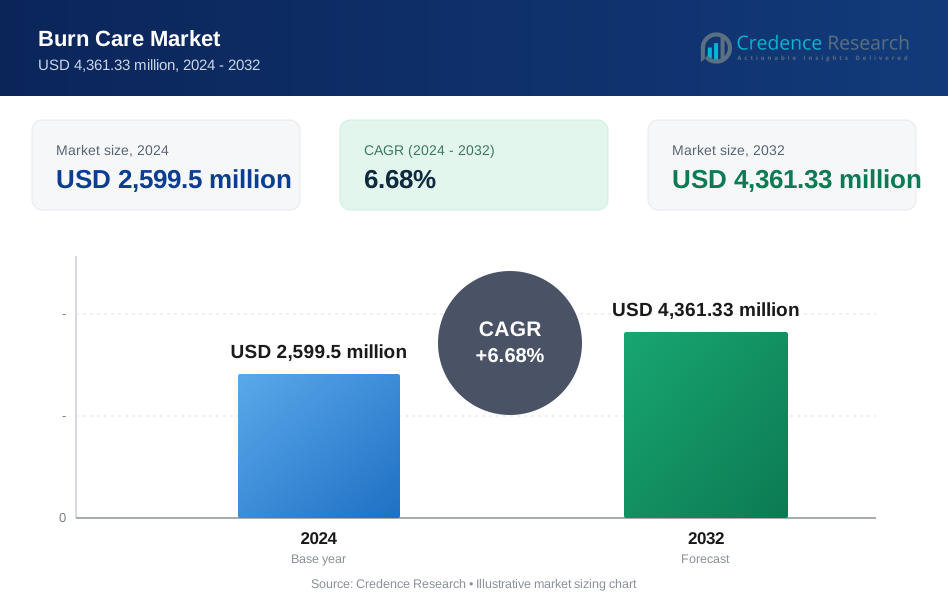
The Burn Care Market is projected to grow from USD 2,599.5 million in 2024 to USD 4,361.33 million by 2032, reflecting a compound annual growth rate (CAGR) of 6.68%.
The burn care market is driven by an increasing incidence of burn injuries, particularly in developing regions, and a growing awareness of advanced treatment options. Technological advancements in wound care management, such as bioengineered skin substitutes and innovative dressing materials, are enhancing recovery outcomes and driving demand. Additionally, the rise in surgical procedures and a greater emphasis on preventive measures contribute to market growth. Trends indicate a shift toward minimally invasive techniques and personalized treatment plans, reflecting a broader movement toward patient-centered care, ultimately improving the quality of life for burn patients.
The burn care market exhibits significant geographical variation, with North America leading in market share due to its advanced healthcare infrastructure and specialized treatment centers. The Asia-Pacific region is experiencing rapid growth, driven by rising burn injury incidents and increasing healthcare access. Key players in the burn care market include Johnson and Johnson Services, Inc., Coloplast A/S, and Acelity LP, known for their innovative products and comprehensive treatment solutions. Other notable companies include Cardinal Health, Medline Industries, and Dynarex Corporation, all contributing to advancements in burn care through research, development, and distribution of effective treatment options.
Market Drivers
Increasing Incidence of Burn Injuries
The rising incidence of burn injuries significantly impacts the burn care market. Accidental burns remain the most common cause, often resulting from household mishaps, workplace incidents, and vehicular accidents. For instance, the American Burn Association reported that there were 398,000 fire or burn-related injuries in 2021. Moreover, occupational burns are prevalent in industries such as manufacturing, construction, and oil and gas, where exposure to heat sources is a constant risk. Additionally, natural disasters like fires and earthquakes can lead to widespread burn injuries, underscoring the urgent need for effective burn care solutions.
Rising Demand for Advanced Burn Care Products
The growing demand for advanced burn care products is primarily driven by the necessity for skin grafts and substitutes to cover large burn wounds. This demand fuels innovation in skin graft technologies and advanced materials. For instance, advanced wound care products like Hydrofiber® Technology and AQUACEL® dressings have been developed to create an optimal environment for wound healing. Furthermore, the market sees an increasing need for innovative wound care products, including specialized dressings, ointments, and antimicrobial agents essential for treating burn wounds and preventing infections. Additionally, post-burn reconstructive surgery has become vital for restoring appearance and function, requiring specialized surgical techniques and implants.
Growing Awareness of Burn Care Treatment Options
Growing awareness of burn care treatment options plays a crucial role in market expansion. Public health campaigns aimed at educating the public about burn prevention and treatment encourage individuals to seek medical care early. For instance, approximately 500,000 patients seek medical care for burns every year in the United States, with roughly 92% treated as outpatients. Simultaneously, social media and online platforms provide valuable information about burn care, empowering patients and their families to make informed decisions regarding treatment options and resources available.
Favorable Government Initiatives and Reimbursement Policies
Favorable government initiatives and reimbursement policies also contribute to the growth of the burn care market. Healthcare reforms aimed at improving access and quality of care are crucial in facilitating treatment availability for burn victims. Additionally, favorable reimbursement policies for burn care treatments and procedures ensure that patients can access necessary medical services without financial burden. Together, these factors create a supportive environment for advancing burn care technology and treatment options.
Market Trends
Increasing Focus on Prevention and Rehabilitation
The burn care market is witnessing a significant trend towards prevention, driven by public health campaigns and workplace safety initiatives. Governments and healthcare organizations are emphasizing burn prevention through targeted educational campaigns and awareness programs, aiming to reduce the incidence of burn injuries across communities. For instance, the World Health Organization (WHO) reports that burns are a global public health problem, accounting for an estimated 180,000 deaths annually, with the majority occurring in low- and middle-income countries. In parallel, industries are adopting stricter safety measures to mitigate the occurrence of workplace burn injuries, ensuring a safer environment for employees. Additionally, there is an increasing emphasis on comprehensive rehabilitation and recovery programs. Early intervention in rehabilitation significantly enhances functional outcomes and improves the quality of life for burn survivors. Healthcare providers are also integrating mental health support services into burn care to address the psychological impact of injuries, recognizing that emotional well-being is crucial for overall recovery.
Advancements in Technology and Personalized Care
Advancements in wound care technology are transforming the treatment landscape, with bioengineered skin substitutes and antimicrobial dressings at the forefront. The development of these advanced materials enhances wound healing and reduces scarring, offering promising solutions for burn patients. Furthermore, healthcare providers are increasingly adopting personalized treatment plans tailored to individual patient needs, considering factors such as burn severity, location, and unique patient characteristics. This shift towards individualized care ensures more effective treatment outcomes. The integration of technology is also revolutionizing burn care, with telehealth services facilitating follow-up care and consultations. Remote monitoring of burn wounds through advanced wearable devices and sensors allows healthcare professionals to track vital signs and healing progress efficiently. Additionally, the growing role of regenerative medicine, particularly stem cell therapy and tissue engineering, is being explored to promote burn wound healing and tissue regeneration, further enhancing treatment options. As the burn care market expands globally, emerging economies are experiencing increased healthcare access and awareness of burn treatment options, driving market growth and innovation.
Market Challenges Analysis
Financial and Rehabilitation Barriers
The high cost of burn treatment presents another significant challenge, placing a substantial financial burden on patients and their families. The expense associated with burn care can be overwhelming, particularly when insurance coverage is inadequate or limited, leading to considerable out-of-pocket costs. For instance, a claims-based analysis from 2020 reported 698,555 burn-related insurance claims, highlighting the extensive interactions with the health system for burn care. Furthermore, burn survivors often endure long-term rehabilitation and recovery challenges, both physically and emotionally. Chronic pain, scarring, and psychological distress are common issues faced by these individuals, complicating their healing journey. Unfortunately, access to specialized rehabilitation services is often limited, hindering the recovery process and affecting patients' overall quality of life. Additionally, the financial constraints associated with ongoing rehabilitation can further impede progress, leaving many survivors without the support they need for effective recovery.
Research and Ethical Considerations
Limited research and development in burn care also pose significant challenges to the advancement of effective treatment options and technologies. Insufficient funding for research initiatives hampers innovation, while a lack of clinical trials to evaluate new therapies restricts the exploration of potentially effective interventions. This situation underscores the need for increased investment in burn care research to foster the development of improved treatment options. Furthermore, ethical considerations, particularly in resource-limited settings, complicate decisions about resource allocation for burn care. Balancing the needs of individual patients with the availability of resources can create ethical dilemmas that healthcare providers must navigate. Ensuring patient autonomy and informed consent is also challenging, especially in emergency situations, where timely decisions are crucial for patient survival and recovery.
Market Segmentation Analysis:
By Product Type:
The burn care market is segmented by product type into burn wound dressings and topical burn medications, each serving a vital role in effective treatment. Burn wound dressings are crucial for protecting the affected area, promoting healing, and preventing infections. These dressings come in various forms, including hydrocolloid, foam, and antimicrobial options, catering to different burn types and severities. The demand for advanced wound dressings is driven by their ability to facilitate faster healing and reduce complications. Topical burn medications, on the other hand, encompass ointments, gels, and creams designed to alleviate pain, reduce inflammation, and promote healing. These products are essential for managing discomfort and enhancing recovery for burn patients. The combination of these two product types addresses the multifaceted needs of burn care, ensuring comprehensive treatment options are available for healthcare providers.
By End-Use:
The burn care market is also categorized based on end-use, which includes households, hospitals, clinics, and other settings. In household settings, burn care products are essential for managing minor burns and injuries that occur in daily life, emphasizing the importance of accessible treatment options for the general public. Hospitals represent a significant segment, where specialized care and advanced treatment protocols are necessary for severe burn cases. The presence of burn units and specialized staff in hospitals enhances patient outcomes through comprehensive care. Clinics serve as another vital segment, providing outpatient services for burn treatment and rehabilitation. These facilities often cater to patients with varying degrees of burn injuries, ensuring timely care and follow-up. The "Others" category includes various settings such as long-term care facilities and home healthcare services, highlighting the diverse environments in which burn care is delivered. This segmentation underscores the need for tailored products and services that address the specific requirements of each end-user group, facilitating effective burn management across different contexts.
Segments:
Based on Product Type:
- Burn Wound Dressings
- Topical Burn Medications
Based on End Use:
- Household
- Hospitals
- Clinics
- Others
Based on Severity:
- First Degree Burns
- Second Degree Burns
- Third Degree Burns
Based on Sales Channel:
- Online Channel
- Offline Channel
Based on the Geography:
- North America
- U.S.
- Canada
- Mexico
- Europe
- Germany
- France
- U.K.
- Italy
- Spain
- Rest of Europe
- Asia Pacific
- China
- Japan
- India
- South Korea
- South-east Asia
- Rest of Asia Pacific
- Latin America
- Brazil
- Argentina
- Rest of Latin America
- Middle East & Africa
- GCC Countries
- South Africa
- Rest of the Middle East and Africa
Regional Analysis
North America
North America holds a significant share of the global burn care market, accounting for approximately 35% of the total market revenue. This dominance can be attributed to the presence of advanced healthcare infrastructure, a high prevalence of burn injuries due to industrial accidents and household incidents, and increased awareness of burn prevention and treatment. The United States, in particular, features specialized burn centers and comprehensive treatment protocols, which enhance patient outcomes. The region also benefits from a robust regulatory framework and significant investment in research and development, leading to innovative burn care products. Furthermore, the growing emphasis on rehabilitation and psychological support for burn survivors is driving market growth, as healthcare providers increasingly integrate these elements into their care plans.
Asia-Pacific
In contrast, the Asia-Pacific region is experiencing rapid growth in the burn care market, currently accounting for approximately 25% of the global market share. This expansion is driven by the rising incidence of burn injuries, particularly in emerging economies where industrial growth and urbanization are prevalent. Countries such as India and China are witnessing an increase in burn cases due to occupational hazards and domestic accidents, which is prompting greater demand for effective burn care solutions. Additionally, improvements in healthcare access and the establishment of specialized burn treatment centers are contributing to market growth in this region. Government initiatives aimed at enhancing healthcare infrastructure and public health campaigns focused on burn prevention are further fueling demand. As awareness of advanced treatment options increases, the Asia-Pacific region is poised for significant advancements in burn care, ensuring better outcomes for patients.
Key Player Analysis
- Acelity LP
- Areza Medical
- Acme United Corporation (First Aid Only)
- Boiron USA
- Cardinal Health, Inc.
- Coloplast A/S
- Derma Sciences Inc.
- Dynarex Corporation
- De Royal Industries, Inc.
- Johnson and Johnson Services, Inc.
- Medline Industries
- Safe n Simple, LLC
Competitive Analysis
The burn care market is highly competitive, with several leading players driving innovation and market growth. Key players include Johnson and Johnson Services, Inc., Coloplast A/S, Acelity LP, Cardinal Health, Medline Industries, Dynarex Corporation, Areza Medical, Boiron USA, De Royal Industries, Inc., and Safe n Simple, LLC. These companies leverage their strong research and development capabilities to introduce advanced products, such as bioengineered skin substitutes and innovative wound dressings, catering to the diverse needs of burn patients. Competitive strategies include forming strategic partnerships, expanding distribution networks, and enhancing product portfolios to improve patient outcomes. Additionally, companies are focusing on geographical expansion, particularly in emerging markets, to capitalize on the rising demand for burn care solutions. As the market evolves, these leading players are poised to maintain their positions through continued innovation and by addressing the growing challenges within the burn care segment.
Recent Developments
- In August 2024, Dynarex launched two new emergency product lines, DynaSafety and Code Blue Care, designed to meet the demands of emergency response and safety needs.
- In March 2023, Convatec received FDA clearance for its device designed to manage complex surgical wounds and burns. InnovaBurn placental extracellular matrix medical device will serve as advanced ECM technology for partial-thickness, second-degree burns.
- In January 2023, Convatec Group PLC launched Convafoam, an advanced foam dressing in the U.S. The product is designed to fulfill the needs of patients and healthcare providers. It can be used for various types of wounds at any stage of the wound, which makes it the simple dressing choice for skin protection and wound management.
- In December 2022, MediWound received FDA clearance for its NexoBrid. It is used for the treatment of severe thermal burns in adults.
- In June 2022, Smith & Nephew PLC announced the construction of a new manufacturing and R&D facility for its Advanced Wound Management in the UK. The company is also planning to invest over USD 100 Million to develop modern R&D, manufacturing & flexible office environment in the country.
Market Concentration & Characteristics
The burn care market exhibits moderate concentration, characterized by a mix of established multinational corporations and emerging players. Major companies such as Johnson and Johnson Services, Inc., Acelity LP, and Coloplast A/S dominate the market, leveraging their extensive research and development resources to innovate and enhance product offerings. This concentration fosters competitive advantages in terms of brand recognition, distribution networks, and advanced technology integration. Additionally, the market features diverse characteristics, including a wide range of products such as wound dressings, topical medications, and skin substitutes tailored to meet the varying needs of burn patients. The increasing focus on personalized treatment plans and rehabilitation services further reflects the market's responsiveness to patient needs. As healthcare providers strive to improve outcomes, the competitive landscape encourages continuous innovation, driving advancements in burn care technologies and treatment methodologies while also addressing emerging challenges within the industry.
Report Coverage
The research report offers an in-depth analysis based on Product Type, End-Use, Severity, Sales Channel and Geography. It details leading market players, providing an overview of their business, product offerings, investments, revenue streams, and key applications. Additionally, the report includes insights into the competitive environment, SWOT analysis, current market trends, as well as the primary drivers and constraints. Furthermore, it discusses various factors that have driven market expansion in recent years. The report also explores market dynamics, regulatory scenarios, and technological advancements that are shaping the industry. It assesses the impact of external factors and global economic changes on market growth. Lastly, it provides strategic recommendations for new entrants and established companies to navigate the complexities of the market.
Future Outlook
- The burn care market is expected to witness substantial growth due to increasing incidences of burn injuries globally.
- Technological advancements in wound care, such as bioengineered skin substitutes, will enhance treatment effectiveness and patient outcomes.
- Growing awareness of burn prevention and treatment options will drive demand for burn care products and services.
- Personalized treatment plans tailored to individual patient needs will become increasingly prevalent in burn care management.
- The integration of telehealth services will facilitate remote consultations and follow-ups, improving accessibility to care.
- Investment in research and development will lead to innovative therapies, including regenerative medicine and stem cell applications.
- Enhanced focus on mental health support for burn survivors will improve overall recovery experiences.
- Expansion into emerging markets will create new opportunities for growth in the burn care sector.
- Collaborative partnerships between key players will foster innovation and streamline the development of advanced treatment solutions.
- Regulatory support and favorable reimbursement policies will further bolster market growth and accessibility to burn care services.
Request a Free Sample
Fill in your details and we'll send you a free sample report.
- Sample data tables & charts
- Research methodology
Need a Custom Version of This Report?
Tailor the scope, geography, or segments to your exact requirements.
- Custom geography or segment scope
- Direct access to our analyst team
Frequently Asked Questions
What is the current size of the Burn Care market?
What factors are driving the growth of the Burn Care market?
What are the key segments within the Burn Care market?
What are some challenges faced by the Burn Care market?
Who are the major players in the Burn Care market?
Table of Content
Chapter 1. Report Introduction
- 1.1 Report Description & Purpose
- 1.1.1 Report Title & Market Definition
- 1.1.2 Unique Selling Propositions (USP) & Key Differentiators
- 1.1.3 Value Proposition for Stakeholders
- 1.2 Research Objectives
- 1.2.1 Market Sizing Objectives (Volume & Revenue) (Volume Where Applicable)
- 1.2.2 Segmentation Objectives
- 1.2.3 Competitive Intelligence Objectives
- 1.2.4 Forecast & Scenario Objectives
- 1.3 Report Scope
- 1.3.1 Burn Care Scope – Segments & Subsegments Covered
- 1.3.2 Geographic Scope – Regions & Countries Covered
- 1.3.3 Historical Period, Base Year & Forecast Period (2024; forecast to 2032)
- 1.3.4 Inclusions & Exclusions
- 1.4 Industry Classification & Applicable Codes
- 1.5 Currency, Measurement Units & Valuation Basis
- 1.6 Target Stakeholders
- 1.7 Limitations & Assumptions
Chapter 2. Executive Summary
- 2.1 Global Burn Care Market Snapshot
- 2.1.1 Market Size – Historical (2024) & Forecast (2024-2032) (2024: USD 2,599.5 million → 2032: USD 4,361.33 million)
- 2.1.2 Volume & Revenue – Global Totals (Volume Where Applicable)
- 2.1.3 Key Market Highlights – Top Five Facts
- 2.2 Burn Care Market Segmentation Snapshot
- 2.2.1 Market Split by Region – 2024 vs. 2032
- 2.3 Competitive Snapshot
- 2.3.1 Top 10 Players by Revenue Share – 2024
- 2.3.2 Top 10 Players by Volume Share – 2024 (Volume Where Applicable)
- 2.3.3 Recent Strategic Developments (18-Month Summary)
- 2.4 Key Investment Highlights & Strategic Conclusions
Chapter 3. Burn Care Market Dynamics & Industry Analysis
- 3.1 Market Overview & Context
- 3.1.1 Burn Care Market Position in the Broader Industry Value Chain
- 3.1.2 Demand Structure & Purchasing Dynamics
- 3.1.3 Market Maturity & Development Stage by Region
- 3.2 Burn Care Market Drivers
- 3.3 Burn Care Market Restraints & Challenges
- 3.4 Burn Care Market Opportunities
- 3.5 Porter's Five Forces Analysis
- 3.5.1 Threat of New Entrants
- 3.5.2 Bargaining Power of Suppliers
- 3.5.3 Bargaining Power of Buyers
- 3.5.4 Threat of Substitutes
- 3.5.5 Competitive Rivalry – Intensity Assessment
- 3.6 Burn Care Value Chain Analysis
- 3.6.1 Upstream – Key Inputs, Resources & Suppliers
- 3.6.1.1 Key Input/Resource 1
- 3.6.1.2 Key Input/Resource 2
- 3.6.1.3 Key Input/Resource 3
- 3.6.2 Midstream – Core Operations & Value Creation
- 3.6.2.1 Operating Model & Process Overview
- 3.6.2.2 Key Operating Locations & Capabilities by Company
- 3.6.3 Downstream – Market Channels & End Users
- 3.6.3.1 Direct Sales & Customer Engagement Channels
- 3.6.3.2 Indirect Sales, Intermediaries & Partner Channels
- 3.6.4 Value Chain Profitability Analysis
- 3.6.1 Upstream – Key Inputs, Resources & Suppliers
- 3.7 PESTEL Analysis
- 3.7.1 Political Factors
- 3.7.2 Economic Factors
- 3.7.3 Social Factors
- 3.7.4 Technological Factors
- 3.7.5 Environmental Factors
- 3.7.6 Legal Factors
- 3.8 Burn Care Supply Chain Analysis
- 3.8.1 Critical Input & Resource Availability Risk Assessment
- 3.8.2 Supplier & Operational Concentration Risk (Geographic Exposure)
- 3.8.3 Supply & Service Disruption Impact Analysis
- 3.9 Regulatory & Policy Landscape
Note: The regulatory and policy landscape section covers regulations based on their applicability to the market, Burn Care category, geography, and scope of the study. Only regulatory frameworks with a material impact on operations, compliance, trade, sustainability, or market access are analyzed in detail.
Chapter 4. Key Investment Pockets & Opportunity Analysis
- 4.1 Burn Care Market Attractiveness Analysis
- 4.1.1 By Region – Investment Attractiveness Matrix (Market Size × CAGR)
- 4.2 Absolute Revenue Growth Opportunity
- 4.2.1 By Region – Absolute Revenue Growth Through 2032
- 4.3 Incremental Demand Opportunity
- 4.3.1 By Region – Incremental Demand Through 2032
- 4.3.2 Segment – Incremental Demand
- 4.4 Emerging Submarket Opportunity Deep Dive (Subject to Applicability)
- 4.5 Priority Market Opportunity Scorecards
- 4.5.1 United States
- 4.5.2 Europe
- 4.5.3 Asia
- 4.5.4 Middle East & Africa
Note: Priority market opportunity scorecards reflect the geographic scope and strategic relevance of the study. Listed markets are indicative and may be adapted to the industry.
Chapter 5. Burn Care Cross-Border Trade & Market Access Analysis
- 5.1 International Trade & Cross-Border Activity Overview
- 5.1.1 Global Export Value by Country (2024)
- 5.1.2 Global Export Volume by Country (2024) (Volume Where Applicable)
- 5.1.3 Global Import Value by Country (2024)
- 5.1.4 Global Import Volume by Country (2024) (Volume Where Applicable)
- 5.1.5 Net Trade Balance by Country (2024)
- 5.2 Export Analysis – Segment
- 5.2.1 Category 1 (Applicable Classification Code)
- 5.2.2 Category 2 (Applicable Classification Code)
- 5.2.3 Category 3 (Applicable Classification Code)
- 5.2.4 Category 4 (Applicable Classification Code)
- 5.2.5 Category 5 (Applicable Classification Code)
- 5.3 Import Analysis – Segment
- 5.3.1 Category 1 (Applicable Classification Code)
- 5.3.2 Category 2 (Applicable Classification Code)
- 5.3.3 Category 3 (Applicable Classification Code)
- 5.3.4 Category 4 (Applicable Classification Code)
- 5.3.5 Category 5 (Applicable Classification Code)
- 5.4 Cross-Border Pricing & Transaction Benchmarks
- 5.4.1 Export Pricing – Segment & Country
- 5.4.2 Import Pricing – Segment & Source Country
- 5.4.3 Price Trends (2024)
- 5.5 Key Cross-Border Trade & Delivery Routes
- 5.5.1 Cross-Border Trade/Delivery Route 1
- 5.5.2 Cross-Border Trade/Delivery Route 2
- 5.5.3 Cross-Border Trade/Delivery Route 3
- 5.5.4 Cross-Border Trade/Delivery Route 4
- 5.5.5 Cross-Border Trade/Delivery Route 5
- 5.6 Trade Policy & Market Access Impact Assessment
- 5.6.1 Tariff & Non-Tariff Barriers
- 5.6.2 Regional Trade & Economic Integration Frameworks
- 5.6.3 Bilateral & Multilateral Trade Agreements
- 5.6.4 Cross-Border Operating, Licensing & Localization Requirements
Note: This chapter applies where cross-border trade or delivery is relevant to Burn Care. Goods, services, and digital offerings are assessed using applicable classifications and transaction measures. Import-export volumes, trade balances, and route analyses are included only where meaningful to the market.
Chapter 6. Competitive Landscape & Company Benchmarking
- 6.1 Burn Care Market Concentration & Structure
- 6.1.1 Herfindahl-Hirschman Index (HHI) – vs. 2024
- 6.1.2 Leading, Mid-Sized & Emerging Player Structure
- 6.1.3 Global, Regional & Local Player Dynamics
- 6.2 Burn Care Market Share Analysis – 2024
- 6.2.1 Global Revenue Share by Company
- 6.2.2 Global Volume Share by Company (Volume Where Applicable)
- 6.2.3 Regional Revenue Share
- 6.2.4 Market Share Evolution ( vs. 2024)
- 6.2.5 Company Market Share by Key Segment
- 6.2.6 Company Market Share by Customer Group
- 6.3 Operating Scale, Capacity & Infrastructure Analysis
- 6.3.1 Global Operating Scale & Supply Capacity
- 6.3.2 Resource Utilization & Operating Efficiency
- 6.3.3 Output, Service Delivery & Activity Metrics
- 6.3.4 Operating Footprint & Infrastructure Map
- 6.3.5 Planned Operational & Capacity Expansion
- 6.4 Burn Care Competitive Benchmarking Matrix
- 6.4.1 Revenue, Growth, Profitability & Operating Metric Comparison
- 6.4.2 Channel Revenue Mix
- 6.4.3 Geographic Revenue Exposure
- 6.4.4 R&D Intensity
- 6.4.5 Sustainability Maturity
- 6.5 Strategic Developments in Burn Care (Last 24 Months)
- 6.5.1 Mergers, Acquisitions & Divestments
- 6.5.2 New Products, Services & Solutions in Burn Care
- 6.5.3 Operational & Infrastructure Expansions
- 6.5.4 Strategic Alliances, Joint Ventures & Partnerships
- 6.5.5 Distribution Expansion & Market Entry
- 6.5.6 Sustainability & ESG Initiatives
- 6.6 Competitive Strategy Mapping
- 6.6.1 Leader, Challenger, Follower & Niche Classification
- 6.6.2 Pricing Strategy Comparison
- 6.6.3 Channel Strategy Matrix
Note: Strategic developments are included based on their materiality and the availability of reliable information.
Chapter 7. Global Burn Care Market – By Sales & Delivery Channel
- 7.1 Segment Overview
- 7.1.1 Volume & Revenue Split by Channel (2024 & 2032) (Volume Where Applicable)
- 7.1.2 Channel Mix Evolution (2024-2032)
Chapter 8. Regional Market Analysis – Global Overview
- 8.1 Global Regional Overview
- 8.1.1 Regional Volume Share (Volume Where Applicable)
- 8.1.2 Regional Revenue Share
- 8.1.3 Regional Volume by Region (Volume Where Applicable)
- 8.1.4 Regional Revenue by Region
- 8.1.5 Regional Forecast Through 2032
- 8.2 Cross-Regional Segment Analysis
- 8.2.1 By Sales & Delivery Channel
- 8.2.2 By Competitive Positioning & Price Tier
Chapter 9. North America Burn Care Market
- 9.1 United States
- 9.2 Canada
- 9.3 Mexico
Chapter 10. Europe Burn Care Market
- 10.1 Germany
- 10.2 France
- 10.3 Italy
- 10.4 United Kingdom
- 10.5 Spain
- 10.6 Poland
- 10.7 Russia
- 10.8 Netherlands
- 10.9 Belgium
- 10.10 Sweden
- 10.11 Denmark
- 10.12 Norway
- 10.13 Rest of Europe
Chapter 11. Asia Pacific Burn Care Market
- 11.1 China
- 11.2 India
- 11.3 Japan
- 11.4 South Korea
- 11.5 Thailand
- 11.6 Indonesia
- 11.7 Vietnam
- 11.8 Malaysia
- 11.9 Australia
- 11.10 Rest of Asia Pacific
Chapter 12. Latin America Burn Care Market
- 12.1 Brazil
- 12.2 Argentina
- 12.3 Colombia
- 12.4 Chile
- 12.5 Rest of Latin America
Chapter 13. Middle East Burn Care Market
- 13.1 Saudi Arabia
- 13.2 United Arab Emirates
- 13.3 Turkey
- 13.4 Israel
- 13.5 Iran
- 13.6 Rest of the Middle East
Chapter 14. Africa Burn Care Market
- 14.1 South Africa
- 14.2 Egypt
- 14.3 Nigeria
- 14.4 Morocco
- 14.5 Rest of Africa
Chapter 15. Burn Care Company Profiles
- 15.1 [Company 01]
- 15.1.1 Company Overview
- 15.1.2 Key Management Personnel
- 15.1.3 Products & Services Portfolio
- 15.1.4 Financial Performance
- 15.1.5 Key Market Focus & Geographic Presence
- 15.1.6 Recent Developments & Strategic Initiatives
Note: The company profile list is preliminary and may change based on research findings, market developments, data availability, and client requirements.
Chapter 16. Appendices
- Appendix A – List of Abbreviations & Acronyms
- Appendix B – Industry Classification Code Reference – Full Series
- Appendix C – Supply, Output & Operating Capacity Data Tables
- Appendix D – End-Use & Demand Base Tables
- Appendix E – Demand, Adoption & Usage Assumptions
- Appendix F – Pricing & Revenue Metric Reference Tables
- Appendix G – Company Operations & Infrastructure Database
- Appendix H – Cross-Border Trade & Activity Data Tables (Where Applicable)
- Appendix I – Regulatory Summary Tables
- Appendix J – Primary Research Participant List (Anonymized)
- Appendix K – Primary Research Questionnaire Framework
- Appendix L – Data Sources & Bibliography
- Appendix M – Market Size Divergence & Source Comparison
Chapter 17. Research Methodology
- 17.1 Research Framework & Philosophy
- 17.2 Secondary Research – Sources, Hierarchy & Data Extraction
- 17.3 Data Modeling – Bottom-Up & Top-Down Market Sizing
- 17.4 Primary Research – Stakeholder Framework, LOI & Sample Sizes
- 17.5 Forecast Methodology – Regression, Scenario & Sensitivity Analysis
- 17.6 Quality Control – Four-Layer Validation Framework
- 17.7 Limitations & Standard Assumptions
- 17.8 Disclaimer
