
| REPORT ATTRIBUTE | DETAILS |
|---|---|
| Historical Period | 2020-2023 |
| Base Year | 2024 |
| Forecast Period | 2025-2032 |
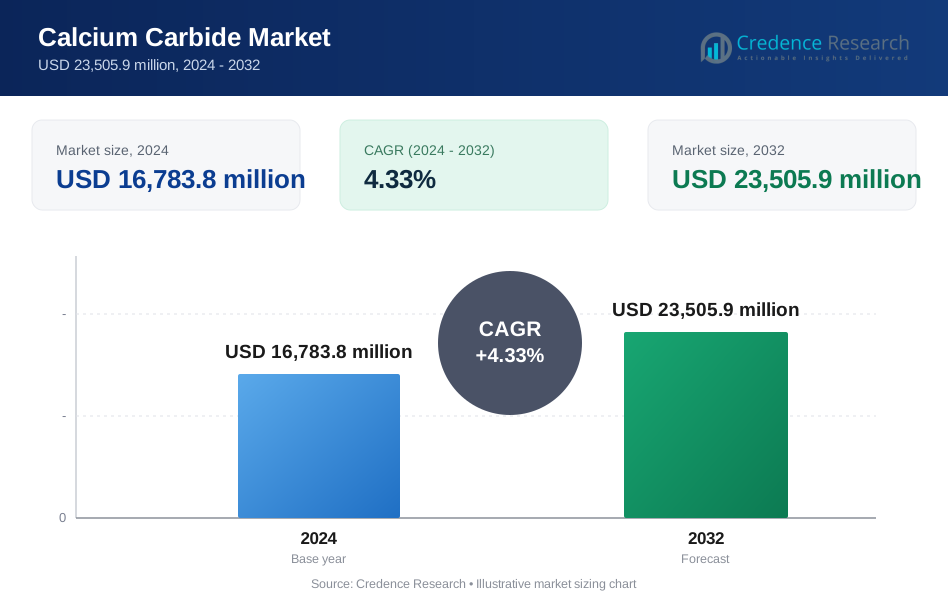
| Calcium Carbide Market Size 2023 | USD 16,783.8 Million |
| Calcium Carbide Market , CAGR | 4.33 % |
| Calcium Carbide Market Size 2032 | USD 23,505.9 Million |
Market Overview
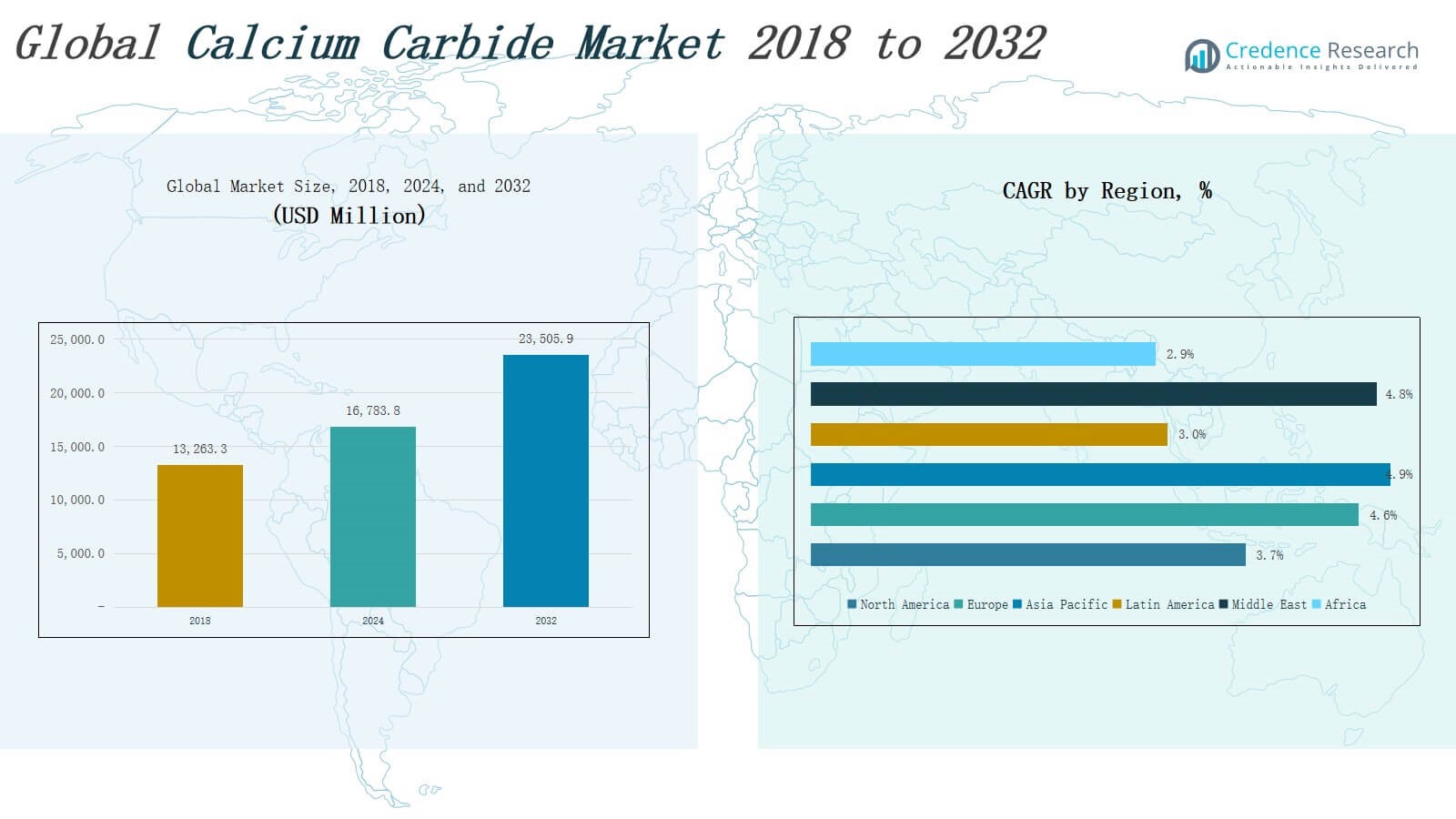
The Calcium Carbide Market size was valued at USD 13,263.3 million in 2018 to USD 16,783.8 million in 2024 and is anticipated to reach USD 23,505.9 million by 2032, at a CAGR of 4.33 % during the forecast period.
The Calcium Carbide Market is driven by strong demand from the metal industry, particularly in steelmaking, where it is used as a desulfurizing agent and in the production of acetylene gas for welding and cutting applications. Growth in infrastructure and construction sectors across emerging economies supports market expansion due to increased steel consumption. Additionally, rising use of calcium carbide in the production of PVC and other organic chemicals contributes to sustained industrial demand. On the trend front, manufacturers are focusing on cleaner production technologies and energy-efficient processes to meet tightening environmental regulations and reduce carbon emissions. The market is also witnessing a shift toward integrated supply chains to enhance raw material access and ensure consistent quality. Growing investments in research and development to improve yield and minimize byproduct generation are shaping long-term strategies. Asia Pacific remains the dominant regional market, led by China and India, owing to high industrial activity and strong demand from manufacturing and construction sectors.
The Calcium Carbide Market features a moderately consolidated landscape with a mix of global and regional players competing on price, product quality, and production capacity. Major companies such as Shizuishan Pengsheng Chemical, AlzChem AG, and DCM Shriram Ltd. maintain strong positions through integrated operations and consistent supply to key industries. The market benefits from long-term contracts, especially in steelmaking and chemical manufacturing sectors. It remains sensitive to raw material availability and energy costs, which impact profitability and regional competitiveness. Companies are investing in cleaner production technologies and capacity expansion to meet regulatory standards and rising demand. Strategic collaborations and geographic diversification are key focus areas for players aiming to maintain a stable market presence. The Calcium Carbide Market continues to evolve with advancements in process efficiency and product purity, offering opportunities for differentiation. Market leaders leverage established distribution networks and technical capabilities to strengthen customer relationships .
Market Insights
- The Calcium Carbide Market was valued at USD 13,263.3 million in 2018, reached USD 16,783.8 million in 2024, and is projected to hit USD 23,505.9 million by 2032, growing at a CAGR of 4.33%.
- Demand from the steel industry remains the core growth driver, where calcium carbide is used as a desulfurizing agent and for acetylene generation in welding and cutting operations.
- The market is expanding due to increasing consumption in PVC production and organic synthesis, driven by construction and infrastructure development in emerging economies.
- Asia Pacific leads the global market with over 38% share, followed by Europe (27%) and North America (17%), reflecting high industrial activity in China, India, Germany, and the U.S.
- Environmental regulations are prompting manufacturers to adopt energy-efficient processes and reduce carbon emissions, reshaping production standards and cost structures.
- Energy-intensive production and volatility in raw material prices remain major challenges, affecting profitability and regional competitiveness across Latin America and Africa.
- Key players including Shizuishan Pengsheng Chemical, AlzChem AG, and DCM Shriram Ltd. compete on scale, product quality, and regional reach, supported by long-term contracts and integrated operations.
Market Drivers
Steel Industry Demand Driving Core Consumption The Calcium Carbide Market is primarily driven by its essential role in the steelmaking process. It serves as a desulfurizing agent, helping remove impurities and enhance steel quality. The ongoing growth in global infrastructure and construction sectors is fueling steel demand, which directly increases calcium carbide consumption. Rapid industrialization in emerging markets further strengthens its use in metallurgical applications. It remains a critical input for steel plants, especially in high-output economies like China and India.
- For instance, Baosteel, one of China's largest steel producers, routinely uses calcium carbide to reduce sulfur content in its steel manufacturing operations, enhancing mechanical properties and overall product performance.
Acetylene Production Fueling Industrial Applications The widespread use of calcium carbide in generating acetylene gas significantly supports market growth. Acetylene is used in metal cutting, welding, and as a chemical feedstock in several manufacturing sectors. The expansion of fabrication, automotive, and machinery industries is boosting acetylene demand. This dependence reinforces the need for calcium carbide in both small- and large-scale operations. The Calcium Carbide Market benefits from being central to cost-effective acetylene generation, especially in regions lacking natural gas infrastructure.
- For instance, Donau Chemie AG has produced calcium carbide for over a century, supplying it primarily to acetylene gas producers and the steel industry to support various industrial processes, including metal fabrication and specialty chemical manufacturing.
Construction and Chemical Industries Expanding Scope The chemical industry’s use of calcium carbide to produce vinyl acetate, synthetic resins, and PVC enhances its market scope. PVC demand in pipes, profiles, and insulation materials is growing with urban development. The Calcium Carbide Market is also supported by the need for organic synthesis processes that rely on acetylene-based intermediates. Construction activities in developing nations are further increasing demand for chemicals derived from carbide processes. It plays a foundational role in several downstream chemical production chains.
Industrial Growth Across Asia Pacific Strengthening Demand High industrial output in Asia Pacific continues to drive the Calcium Carbide Market, with China as a major producer and consumer. Government-led infrastructure initiatives and manufacturing expansion create steady demand for steel and associated chemicals. It remains crucial for sustaining industrial operations in energy, materials, and construction sectors. Regional investments in chemical manufacturing plants are also contributing to higher calcium carbide use. Growing domestic consumption supports long-term supply chain integration and market stability.
Market Trends
Sustainable Manufacturing Processes Gaining Industry Focus Manufacturers in the Calcium Carbide Market are adopting cleaner and more energy-efficient production technologies. This shift addresses rising environmental concerns and regulatory pressure to lower emissions and minimize industrial waste. Companies are investing in process optimization to reduce carbon intensity and improve resource efficiency. It encourages adoption of closed-loop systems and advanced recovery techniques for byproducts. Sustainability-focused strategies are improving operational performance while aligning with global environmental goals. The trend is reshaping procurement and production decisions across key players.
- For instance, TYWH has adopted fully enclosed conveyor and dust removal systems in its production facilities to prevent dust emissions and maintain a cleaner environment; it also utilizes high-efficiency, low-energy equipment to cut energy consumption and extend equipment lifespan.
Expansion of Acetylene-Based Derivatives in End-Use Industries The demand for acetylene-based chemicals, derived from calcium carbide, is rising in synthetic rubber, solvents, and polymer production. Growth in pharmaceuticals, adhesives, and specialty chemicals is expanding the market’s downstream applications. The Calcium Carbide Market benefits from the versatility of acetylene, which serves as a key feedstock across multiple industries. This trend supports diversification into higher-value chemical segments. It enables suppliers to capture new revenue streams through chemical transformation and value chain integration. Innovation in formulation is further supporting this trend.
- For instance, in May 2023, Transform Materials and Denka collaborated on a low-carbon acetylene supply chain tailored for the metalworking industry, helping reduce the carbon footprint of essential fabrication processes.
Increased Regional Self-Sufficiency and Localization Efforts Countries in Asia and Latin America are reducing dependency on imports by investing in local calcium carbide production. This trend strengthens regional supply chains and supports industrial resilience. The Calcium Carbide Market is witnessing government-backed initiatives to scale domestic manufacturing capacity. It improves cost competitiveness and reduces supply disruptions linked to international trade policies. These efforts reflect a broader push for national self-reliance in core industrial materials. Localization also boosts employment and infrastructure development in manufacturing hubs.
Digitalization and Process Automation Enhancing Production Efficiency Digital technologies are transforming traditional calcium carbide manufacturing operations. Integration of real-time monitoring systems, predictive maintenance tools, and automated controls is improving yield and equipment uptime. It is helping manufacturers streamline workflows, reduce downtime, and manage energy consumption more effectively. The Calcium Carbide Market is adopting Industry 4.0 practices to maintain competitive advantage in a cost-sensitive landscape. Smart manufacturing enhances responsiveness to demand fluctuations. Digital innovation supports long-term operational resilience and productivity gains.
Market Challenges Analysis
Environmental Regulations and Emission Control Constraints Stringent environmental regulations pose a significant challenge to the Calcium Carbide Market. The production process generates large volumes of carbon dioxide and solid waste, prompting regulatory scrutiny across major producing regions. Governments are enforcing stricter emission control policies, which increase operational costs and require technology upgrades. Compliance with environmental standards limits production flexibility and affects profit margins for smaller manufacturers. The Calcium Carbide Market faces pressure to transition toward sustainable practices while maintaining production efficiency. It must address environmental concerns without compromising industrial supply.
Energy Intensity and Volatility in Raw Material Costs Calcium carbide production is highly energy-intensive, relying heavily on electricity and coke as primary inputs. Fluctuations in energy prices and raw material availability directly impact manufacturing costs and plant economics. The Calcium Carbide Market is vulnerable to supply chain disruptions, especially in regions with limited access to low-cost power or consistent raw material supply. It struggles to maintain stable pricing and profitability under such volatile conditions. Long-term competitiveness depends on energy management strategies and secure resource procurement.
Market Opportunities
Growth in Acetylene-Based Specialty Chemicals and Polymers Rising demand for acetylene-based specialty chemicals presents a strong opportunity for the Calcium Carbide Market. Industries producing solvents, pharmaceuticals, and synthetic resins are expanding their use of acetylene derivatives, creating new application areas. It supports the development of high-performance materials, especially in adhesives, coatings, and engineered plastics. Increased research in chemical synthesis pathways that utilize acetylene as a base feedstock is fueling investment interest. The Calcium Carbide Market can capitalize on this by expanding production capacity and improving purity levels. Targeting value-added chemical segments can improve margins and diversify revenue streams.
Infrastructure Development and Emerging Market Industrialization Rapid urbanization and infrastructure growth in Asia, Africa, and Latin America are driving long-term opportunities for the Calcium Carbide Market. Demand for steel, PVC pipes, and construction materials is rising sharply, supported by public and private investments. It plays a vital role in meeting the raw material needs of these sectors, especially where alternative feedstocks remain scarce. Establishing production facilities near high-demand zones can reduce logistical costs and strengthen supply chains. The market can benefit from local partnerships and government-led industrial development programs. Strategic expansion in these regions offers scalability and sustainable growth potential.
Market Segmentation Analysis:
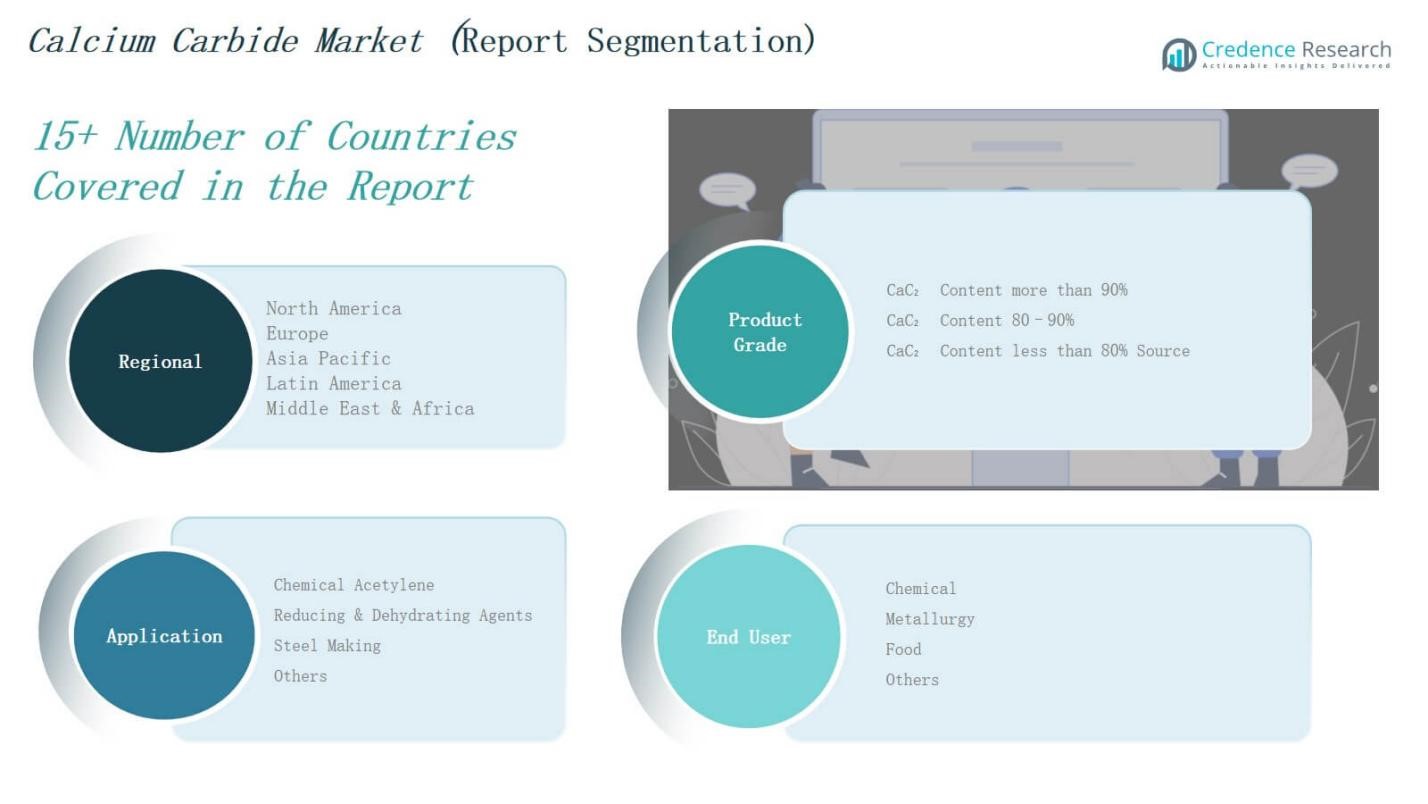
By Product Grade The Calcium Carbide Market is segmented by product grade into CaC₂ content > 90%, 80–90%, and < 80%. The segment with CaC₂ content > 90% holds the largest share due to its high efficiency in generating acetylene gas and its critical role in steelmaking processes. The 80–90% grade serves general industrial needs, offering a balance between cost and performance. The < 80% segment finds limited use in niche or localized applications where high purity is not required.
- For instance, AlzChem Group in Europe delivers calcium carbide with an average gas yield of 300 litres/kg, providing products in steel drums or specialized containers for use in secondary metallurgy—especially for desulfurization and deoxidation of steel.
By Application The Calcium Carbide Market is categorized by application into chemical acetylene, reducing and dehydrating agents, steelmaking, and others. Chemical acetylene leads the segment due to its wide use in welding, metal cutting, and as a precursor in chemical synthesis. Steelmaking represents a significant portion, where calcium carbide is used for deoxidation and desulfurization. Reducing and dehydrating agents serve specialized industrial processes, while the others category includes minor uses such as fruit ripening and carbide lamps.
- For instance, in chemical acetylene production, Air Liquide produces acetylene gas for industrial use by reacting calcium carbide with water, leveraging this process for applications in welding, metal cutting, and as a feedstock for organic synthesis.
By End User The Calcium Carbide Market is divided by end user into chemical, metallurgy, food, and others. The chemical sector dominates, driven by demand for acetylene derivatives in polymers, solvents, and specialty chemicals. Metallurgy follows, fueled by steel and metal processing needs. The food segment contributes a small share, mainly in the artificial ripening of fruits. Other end users include research institutions and custom industrial applications where carbide-based reactions are employed.
Segments:
Based on Product Grade
- CaC₂ Content > 90%
- CaC₂ Content 80–90%
- CaC₂ Content < 80%
Based on Application
- Chemical Acetylene
- Reducing and Dehydrating Agents
- Steelmaking
- Others
Based on End User
- Chemical
- Metallurgy
- Food
- Others
Based on Region
- North America
- Europe
- Asia Pacific
- Latin America
- Middle East
- Africa
Regional Analysis
North America The North America Calcium Carbide Market size was valued at USD 2,314.45 million in 2018 to USD 2,824.47 million in 2024 and is anticipated to reach USD 3,760.95 million by 2032, at a CAGR of 3.7% during the forecast period. The region holds approximately 17% of the global market share. Strong demand from the steel and chemical sectors, particularly in the United States, drives growth. The market benefits from established industrial infrastructure and consistent acetylene consumption across manufacturing and welding applications. It continues to adopt advanced production technologies to improve process efficiency. Regulatory compliance with environmental standards influences operational strategies. The Calcium Carbide Market in North America shows stable, industrial-driven expansion supported by reliable supply chains.
Europe The Europe Calcium Carbide Market size was valued at USD 3,410.00 million in 2018 to USD 4,392.08 million in 2024 and is anticipated to reach USD 6,294.89 million by 2032, at a CAGR of 4.6% during the forecast period. Europe accounts for nearly 27% of the global market share. The region is supported by robust chemical manufacturing and metallurgical industries, particularly in Germany, France, and Eastern Europe. It sees steady demand for acetylene-based chemicals and PVC precursors. Focus on clean technologies is reshaping production practices across the EU. The Calcium Carbide Market in Europe is also benefiting from modernization initiatives in steel plants. Demand from end-use sectors such as automotive and construction sustains market performance.
Asia Pacific The Asia Pacific Calcium Carbide Market size was valued at USD 4,612.98 million in 2018 to USD 6,037.37 million in 2024 and is anticipated to reach USD 8,828.83 million by 2032, at a CAGR of 4.9% during the forecast period. Asia Pacific dominates the global market with over 38% share. China leads both production and consumption, driven by large-scale steelmaking and acetylene demand in chemicals. India, Japan, and Southeast Asia contribute to regional growth through infrastructure development and industrial expansion. Cost-effective manufacturing and abundant raw materials support strong output. It continues to attract investments in chemical and metallurgical sectors. The Calcium Carbide Market in Asia Pacific benefits from regional integration and rising domestic consumption.
Latin America The Latin America Calcium Carbide Market size was valued at USD 1,415.20 million in 2018 to USD 1,670.71 million in 2024 and is anticipated to reach USD 2,115.53 million by 2032, at a CAGR of 3.0% during the forecast period. The region contributes around 10% of the global market. Brazil and Mexico remain key markets due to industrialization and construction activity. Demand stems from metal processing, acetylene production, and infrastructure development. Local production facilities serve domestic and nearby regional markets. It faces challenges from fluctuating energy prices and raw material imports. The Calcium Carbide Market in Latin America grows moderately, supported by expanding manufacturing sectors.
Middle East The Middle East Calcium Carbide Market size was valued at USD 676.43 million in 2018 to USD 878.99 million in 2024 and is anticipated to reach USD 1,274.02 million by 2032, at a CAGR of 4.8% during the forecast period. The region holds about 6% of the global share. GCC countries are investing in chemical diversification and steel production, increasing demand for calcium carbide. It serves acetylene gas applications in construction, maintenance, and pipeline industries. Regional growth is tied to industrial zone development and petrochemical investments. Access to competitive energy pricing supports production economics. The Calcium Carbide Market in the Middle East is expanding, driven by strategic infrastructure projects and industrial policies.
Africa The Africa Calcium Carbide Market size was valued at USD 834.26 million in 2018 to USD 980.17 million in 2024 and is anticipated to reach USD 1,231.71 million by 2032, at a CAGR of 2.9% during the forecast period. Africa accounts for nearly 5% of the global market. South Africa and Egypt lead in production and end-use demand. The market serves basic steelmaking, fruit ripening, and localized acetylene generation. Industrial growth remains gradual due to infrastructure and investment constraints. It continues to rely on imports for advanced chemical applications. The Calcium Carbide Market in Africa shows slow but steady growth, shaped by national development programs and limited industrial base.
Key Player Analysis
- Shizuishan Pengsheng Chemical Co., Ltd.
- Metaloides, SA de CV
- Denka Company Limited
- Carbide Industries LLC
- Mil-Spec Industries Corp.
- AlzChem AG
- KC Group
- Hudson Chemicals Corp.
- Opta Group LP
- Ghani Global Group
- NIPPON STEEL Chemical & Material Co., Ltd.
- DCM Shriram Ltd.
- Other Key Players
Competitive Analysis
The Calcium Carbide Market features a moderately consolidated landscape with a mix of global and regional players competing on price, product quality, and production capacity. Major companies such as Shizuishan Pengsheng Chemical, AlzChem AG, and DCM Shriram Ltd. maintain strong positions through integrated operations and consistent supply to key industries. The market benefits from long-term contracts, especially in steelmaking and chemical manufacturing sectors. It remains sensitive to raw material availability and energy costs, which impact profitability and regional competitiveness. Companies are investing in cleaner production technologies and capacity expansion to meet regulatory standards and rising demand. Strategic collaborations and geographic diversification are key focus areas for players aiming to maintain a stable market presence. The Calcium Carbide Market continues to evolve with advancements in process efficiency and product purity, offering opportunities for differentiation. Market leaders leverage established distribution networks and technical capabilities to strengthen customer relationships and secure long-term growth.
Recent Developments
- In May 2023, Denka Company Limited did initiate joint research with Transform Materials LLC to advance low-carbon acetylene production using microwave plasma technology.
- In March 2025, Ghani Chemical Industries Limited transferred its calcium carbide project to its wholly-owned subsidiary, Ghani ChemWorld Limited, following approval from the Lahore High Court.
- In July 2025, AlzChem Group AG received the Bavarian Environment and Climate Pact award for implementing sustainable practices in its calcium carbide operations.
Market Concentration & Characteristics
The Calcium Carbide Market exhibits moderate market concentration, with a mix of global and regional players operating across key production hubs. It is characterized by capacity-driven competition, price sensitivity, and strong linkage to downstream industries such as steelmaking and chemical manufacturing. Leading players maintain integrated supply chains and benefit from proximity to raw material sources and low-cost energy. The market favors long-term contracts and consistent product quality, especially in segments involving acetylene generation and desulfurization. It remains capital-intensive due to high energy requirements and environmental compliance costs. Regional production varies significantly, with Asia Pacific dominating output through large-scale manufacturing in China and India. The market features stable demand but faces regulatory pressure to modernize operations and reduce emissions. Companies are investing in efficiency improvements and cleaner technologies to retain competitive advantage. The Calcium Carbide Market continues to evolve as players pursue scale, operational reliability, and access to high-growth end-use sectors.
Report Coverage
The research report offers an in-depth analysis based on Product Grade, Application, End-User and Region. It details leading market players, providing an overview of their business, product offerings, investments, revenue streams, and key applications. Additionally, the report includes insights into the competitive environment, SWOT analysis, current market trends, as well as the primary drivers and constraints. Furthermore, it discusses various factors that have driven market expansion in recent years. The report also explores market dynamics, regulatory scenarios, and technological advancements that are shaping the industry. It assesses the impact of external factors and global economic changes on market growth. Lastly, it provides strategic recommendations for new entrants and established companies to navigate the complexities of the market.
Future Outlook
- Demand for calcium carbide will continue rising due to its essential role in steel desulfurization and acetylene production.
- Industrial growth in Asia Pacific will drive long-term consumption, particularly in China and India.
- Expansion of PVC and synthetic chemical manufacturing will support downstream market growth.
- Environmental regulations will push manufacturers to invest in cleaner and more energy-efficient technologies.
- Volatility in raw material and energy prices will influence production economics and pricing strategies.
- Steelmaking and chemical sectors will remain the dominant end-use industries over the forecast period.
- Local production in Latin America and Africa is expected to grow to reduce dependence on imports.
- Integrated supply chains and regional distribution networks will improve market stability and efficiency.
- Strategic partnerships and capacity expansions will be key to maintaining competitive advantage.
- Investment in R&D will increase to enhance product purity and minimize industrial byproducts.
Request a Free Sample
Fill in your details and we'll send you a free sample report.
- Sample data tables & charts
- Research methodology
Need a Custom Version of This Report?
Tailor the scope, geography, or segments to your exact requirements.
- Custom geography or segment scope
- Direct access to our analyst team
Frequently Asked Questions
Q: What is the current size of the Calcium Carbide Market?
Q: What factors are driving the growth of the Calcium Carbide Market?
Q: What are the key segments within the Calcium Carbide Market?
Q: What are some challenges faced by the Calcium Carbide Market?
Q: Who are the major players in the Calcium Carbide Market?
Table of Content
Chapter 1. Report Introduction
- 1.1 Report Description & Purpose
- 1.1.1 Report Title & Market Definition
- 1.1.2 Unique Selling Propositions (USP) & Key Differentiators
- 1.1.3 Value Proposition for Stakeholders
- 1.2 Research Objectives
- 1.2.1 Market Sizing Objectives (Volume & Revenue)
- 1.2.2 Segmentation Objectives
- 1.2.3 Competitive Intelligence Objectives
- 1.2.4 Forecast & Scenario Objectives
- 1.3 Report Scope
- 1.3.1 Calcium Carbide Scope – Types & Subtypes Covered
- 1.3.2 Geographic Scope – Regions & Countries Covered
- 1.3.3 Historical Period, Base Year & Forecast Period (2024; forecast to 2032)
- 1.3.4 Inclusions & Exclusions
- 1.4 HS Code & Classification Framework
- 1.5 Currency, Units & Pricing Basis
- 1.6 Target Stakeholders
- 1.7 Limitations & Assumptions
Chapter 2. Executive Summary
- 2.1 Global Calcium Carbide Market Snapshot
- 2.1.1 Market Size – Historical (2024) & Forecast (2024-2032) (2024: USD 16,783.8 million → 2032: USD 23,505.9 million)
- 2.1.2 Volume & Revenue – Global Totals
- 2.1.3 Key Market Highlights – Top Five Facts
- 2.2 Calcium Carbide Market Segmentation Snapshot
- 2.2.1 Market Split by Region – 2024 vs. 2032
- 2.3 Competitive Snapshot
- 2.3.1 Top 10 Players by Revenue Share – 2024
- 2.3.2 Top 10 Players by Volume Share – 2024
- 2.3.3 Recent Strategic Developments (18-Month Summary)
- 2.4 Key Investment Highlights & Strategic Conclusions
Chapter 3. Calcium Carbide Market Dynamics & Industry Analysis
- 3.1 Market Overview & Context
- 3.1.1 Calcium Carbide Market Position in the Broader Automotive Value Chain
- 3.1.2 OEM vs. Replacement Market Dynamics
- 3.1.3 Market Maturity & Development Stage by Region
- 3.2 Calcium Carbide Market Drivers
- 3.3 Calcium Carbide Market Restraints & Challenges
- 3.4 Calcium Carbide Market Opportunities
- 3.5 Porter's Five Forces Analysis
- 3.5.1 Threat of New Entrants
- 3.5.2 Bargaining Power of Suppliers
- 3.5.3 Bargaining Power of Buyers
- 3.5.4 Threat of Substitutes
- 3.5.5 Competitive Rivalry – Intensity Assessment
- 3.6 Calcium Carbide Value Chain Analysis
- 3.6.1 Upstream – Raw Material/Input Suppliers
- 3.6.1.1 Raw Material/Input 1
- 3.6.1.2 Raw Material/Input 2
- 3.6.1.3 Raw Material/Input 3
- 3.6.2 Midstream – Production/Manufacturing/Service Delivery
- 3.6.2.1 Production/Process Overview
- 3.6.2.2 Key Facility Locations & Capacity by Manufacturer
- 3.6.3 Downstream – Distribution & End Consumer
- 3.6.3.1 Primary Channel – B2B/OEM
- 3.6.3.2 Secondary Channels – Dealer, Retail, Online, Direct
- 3.6.4 Value Chain Profitability Analysis
- 3.6.1 Upstream – Raw Material/Input Suppliers
- 3.7 PESTEL Analysis
- 3.7.1 Political Factors
- 3.7.2 Economic Factors
- 3.7.3 Social Factors
- 3.7.4 Technological Factors
- 3.7.5 Environmental Factors
- 3.7.6 Legal Factors
- 3.8 Calcium Carbide Supply Chain Analysis
- 3.8.1 Raw Material/Input Supply Risk Assessment
- 3.8.2 Manufacturing Concentration Risk (Geographic Exposure)
- 3.8.3 Trade Disruption Impact Analysis
- 3.9 Regulatory & Policy Landscape
Note: The regulatory and policy landscape section covers regulations based on their applicability to the market, Calcium Carbide category, geography, and scope of the study. Only regulatory frameworks with a material impact on operations, compliance, trade, sustainability, or market access are analyzed in detail.
Chapter 4. Key Investment Pockets & Opportunity Analysis
- 4.1 Calcium Carbide Market Attractiveness Analysis
- 4.1.1 By Region – Investment Attractiveness Matrix (Volume × CAGR)
- 4.2 Absolute Revenue Growth Opportunity
- 4.2.1 By Region – Absolute USD Growth Through 2032
- 4.3 Incremental Volume Opportunity
- 4.3.1 By Region – Incremental Volume Through 2032
- 4.3.2 Segment – Incremental Volume
- 4.4 Emerging Submarket Opportunity Deep Dive (Subject to Applicability)
- 4.5 Emerging Market Opportunity Scorecards
- 4.5.1 United States
- 4.5.2 Europe
- 4.5.3 Asia
- 4.5.4 Middle East & Africa
Note: Emerging Market Opportunity Scorecards will be included based on relevance and strategic importance. Regions listed are indicative and may vary depending on data availability and market dynamics.
Chapter 5. Calcium Carbide Import-Export Analysis & Trade Flows
- 5.1 Global Trade Overview
- 5.1.1 Global Export Value by Country (2024)
- 5.1.2 Global Export Volume by Country (2024)
- 5.1.3 Global Import Value by Country (2024)
- 5.1.4 Global Import Volume by Country (2024)
- 5.1.5 Net Trade Balance by Country (2024)
- 5.2 Export Analysis – Segment
- 5.2.1 Type 1 (HS Code)
- 5.2.2 Type 2 (HS Code)
- 5.2.3 Type 3 (HS Code)
- 5.2.4 Type 4 (HS Code)
- 5.2.5 Type 5 (HS Code)
- 5.3 Import Analysis – Segment
- 5.3.1 Type 1 (HS Code)
- 5.3.2 Type 2 (HS Code)
- 5.3.3 Type 3 (HS Code)
- 5.3.4 Type 4 (HS Code)
- 5.3.5 Type 5 (HS Code)
- 5.4 Average Unit Trade Prices
- 5.4.1 Average Export Price – Segment & Country
- 5.4.2 Average Import Price – Segment & Source Country
- 5.4.3 Price Trends (2024)
- 5.5 Key Trade Route Analysis
- 5.5.1 Trade Route 1
- 5.5.2 Trade Route 2
- 5.5.3 Trade Route 3
- 5.5.4 Trade Route 4
- 5.5.5 Trade Route 5
- 5.6 Trade Policy Impact Assessment
- 5.6.1 US Anti-Dumping & Section 301 Tariffs
- 5.6.2 EU Customs Union Impact
- 5.6.3 Major Free Trade Agreements
- 5.6.4 USMCA Rules of Origin
Note: Trade policy analysis will be included only where relevant to the Calcium Carbide market.
Chapter 6. Competitive Landscape & Company Benchmarking
- 6.1 Calcium Carbide Market Concentration & Structure
- 6.1.1 Herfindahl-Hirschman Index (HHI) – vs. 2024
- 6.1.2 Tier 1, Tier 2 & Tier 3 Market Structure
- 6.1.3 Global, Regional & Local Player Dynamics
- 6.2 Calcium Carbide Market Share Analysis – 2024
- 6.2.1 Global Revenue Share by Company
- 6.2.2 Global Volume Share by Company
- 6.2.3 Regional Revenue Share
- 6.2.4 Market Share Evolution ( vs. 2024)
- 6.2.5 OEM Segment Share by Company
- 6.2.6 Replacement Segment Share by Company
- 6.3 Production/Delivery Capacity & Facility Analysis
- 6.3.1 Global Installed Capacity
- 6.3.2 Capacity Utilization Rates
- 6.3.3 Production/Output Volume
- 6.3.4 Facility Locations & Capacity Map
- 6.3.5 Planned Capacity Additions
- 6.4 Calcium Carbide Competitive Benchmarking Matrix
- 6.4.1 Revenue, Volume, CAGR & Profitability Comparison
- 6.4.2 Channel Revenue Mix
- 6.4.3 Geographic Revenue Exposure
- 6.4.4 R&D Intensity
- 6.4.5 Sustainability Maturity
- 6.5 Strategic Developments in Calcium Carbide (Last 24 Months)
- 6.5.1 Mergers, Acquisitions & Divestments
- 6.5.2 New Calcium Carbide Launches
- 6.5.3 Facility Expansions
- 6.5.4 Strategic Alliances, Joint Ventures & Partnerships
- 6.5.5 Distribution Expansion & Market Entry
- 6.5.6 Sustainability & ESG Initiatives
- 6.6 Competitive Strategy Mapping
- 6.6.1 Leader, Challenger, Follower & Niche Classification
- 6.6.2 Pricing Strategy Comparison
- 6.6.3 Channel Strategy Matrix
Note: Strategic developments are included based on their materiality and the availability of reliable information.
Chapter 7. Global Calcium Carbide Market – By Distribution Channel
- 7.1 Segment Overview
- 7.1.1 Volume & Revenue Split by Channel (2024 & 2032)
- 7.1.2 Channel Mix Evolution (2024-2032)
Chapter 8. Regional Market Analysis – Global Overview
- 8.1 Global Regional Overview
- 8.1.1 Regional Volume Share
- 8.1.2 Regional Revenue Share
- 8.1.3 Regional Volume by Region
- 8.1.4 Regional Revenue by Region
- 8.1.5 Regional Forecast Through 2032
- 8.2 Cross-Regional Segment Analysis
- 8.2.1 By Distribution Channel
- 8.2.2 By Brand/Price Tier
Chapter 9. North America Calcium Carbide Market
- 9.1 United States
- 9.2 Canada
- 9.3 Mexico
Chapter 10. Europe Calcium Carbide Market
- 10.1 Germany
- 10.2 France
- 10.3 Italy
- 10.4 United Kingdom
- 10.5 Spain
- 10.6 Poland
- 10.7 Russia
- 10.8 Netherlands
- 10.9 Belgium
- 10.10 Sweden
- 10.11 Denmark
- 10.12 Norway
- 10.13 Rest of Europe
Chapter 11. Asia Pacific Calcium Carbide Market
- 11.1 China
- 11.2 India
- 11.3 Japan
- 11.4 South Korea
- 11.5 Thailand
- 11.6 Indonesia
- 11.7 Vietnam
- 11.8 Malaysia
- 11.9 Australia
- 11.10 Rest of Asia Pacific
Chapter 12. Latin America Calcium Carbide Market
- 12.1 Brazil
- 12.2 Argentina
- 12.3 Colombia
- 12.4 Chile
- 12.5 Rest of Latin America
Chapter 13. Middle East Calcium Carbide Market
- 13.1 Saudi Arabia
- 13.2 United Arab Emirates
- 13.3 Turkey
- 13.4 Israel
- 13.5 Iran
- 13.6 Rest of the Middle East
Chapter 14. Africa Calcium Carbide Market
- 14.1 South Africa
- 14.2 Egypt
- 14.3 Nigeria
- 14.4 Morocco
- 14.5 Rest of Africa
Chapter 15. Calcium Carbide Company Profiles
- 15.1 [Company 01]
- 15.1.1 Company Overview
- 15.1.2 Key Management Personnel
- 15.1.3 Products & Services Portfolio
- 15.1.4 Financial Performance
- 15.1.5 Key Market Focus & Geographic Presence
- 15.1.6 Recent Developments & Strategic Initiatives
Note: The company profile list is preliminary and may change based on research findings, market developments, data availability, and client requirements.
Chapter 16. Appendices
- Appendix A – List of Abbreviations & Acronyms
- Appendix B – Industry Classification Code Reference – Full Series
- Appendix C – Production & Capacity Data Tables
- Appendix D – End-Use & Demand Base Tables
- Appendix E – Consumption & Replacement Rate Assumptions
- Appendix F – ASP Reference Tables
- Appendix G – Manufacturing & Facility Database
- Appendix H – Import-Export Data Tables
- Appendix I – Regulatory Summary Tables
- Appendix J – Primary Research Participant List (Anonymized)
- Appendix K – Primary Research Questionnaire Framework
- Appendix L – Data Sources & Bibliography
- Appendix M – Market Size Divergence & Source Comparison
Chapter 17. Research Methodology
- 17.1 Research Framework & Philosophy
- 17.2 Secondary Research – Sources, Hierarchy & Data Extraction
- 17.3 Data Modeling – Bottom-Up & Top-Down Market Sizing
- 17.4 Primary Research – Stakeholder Framework, LOI & Sample Sizes
- 17.5 Forecast Methodology – Regression, Scenario & Sensitivity Analysis
- 17.6 Quality Control – Four-Layer Validation Framework
- 17.7 Limitations & Standard Assumptions
- 17.8 Disclaimer
