
| REPORT ATTRIBUTE | DETAILS |
|---|---|
| Historical Period | 2019-2022 |
| Base Year | 2023 |
| Forecast Period | 2024-2032 |
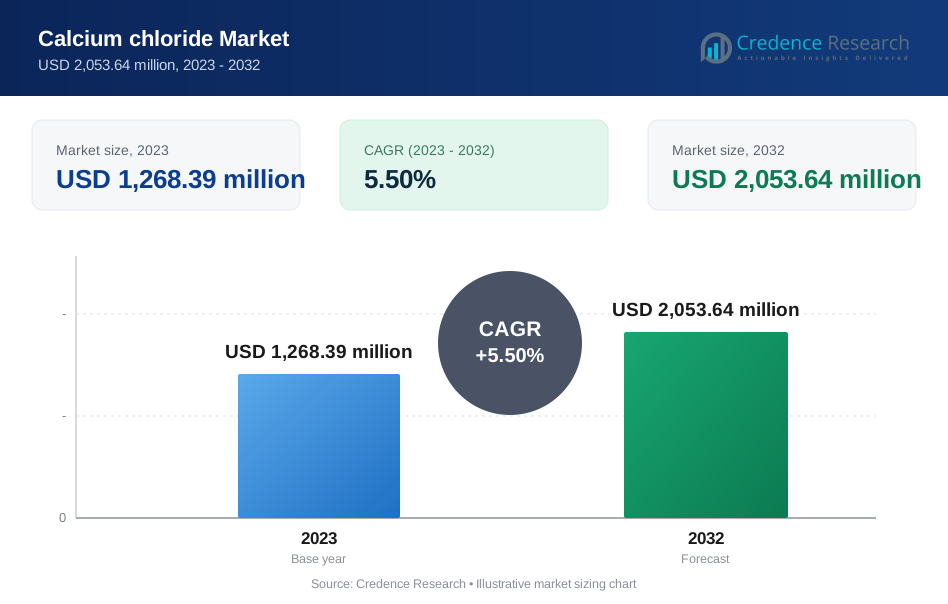
| Calcium Chloride Market Size 2023 | USD 1,268.39 Million |
| Calcium Chloride Market, CAGR | 5.50% |
| Calcium Chloride Market Size 2032 | USD 2,053.64 Million |
Market Overview
The Calcium Chloride market is projected to grow from USD 1,268.39 million in 2023 to an estimated USD 2,053.64 million by 2032, with a compound annual growth rate (CAGR) of 5.50% from 2024 to 2032. This robust growth is driven by the increasing demand for calcium chloride across various industries, including de-icing, dust control, and as a key ingredient in construction and food processing.
Market drivers for calcium chloride include its widespread use in de-icing applications, particularly in regions with harsh winter conditions, where it is preferred for its efficiency in melting ice and snow. Additionally, the product's role in dust control on unpaved roads, as well as its application in the oil and gas industry for drilling fluids, significantly contributes to its market demand. The increasing adoption of calcium chloride in food preservation and as a firming agent in the food industry further fuels market growth.
Geographically, North America dominates the calcium chloride market, driven by the high demand for de-icing solutions in the U.S. and Canada. Europe follows closely, with significant consumption in the food and beverage industry. The Asia-Pacific region is expected to witness substantial growth due to the expanding construction sector and increasing industrial activities in countries like China and India. Key players in the market include Occidental Chemical Corporation, TETRA Technologies, Inc., Solvay S.A., and Ward Chemical Ltd., who are focusing on strategic expansions and product innovations to maintain their market position.
Market Drivers
Growing Demand for De-Icing and Dust Control Applications:
The calcium chloride market is experiencing significant growth driven by increasing demand for de-icing and dust control applications. Government surveys have shown a substantial rise in the use of calcium chloride for winter road maintenance across North America and Europe. For instance, data from transportation departments indicates that calcium chloride usage for de-icing has doubled in some states over the past decade. This trend is attributed to its superior performance at lower temperatures compared to traditional rock salt. Additionally, municipalities report reduced overall winter maintenance costs when using calcium chloride, despite its higher upfront price. In dust control applications, environmental agencies have documented a marked increase in the use of calcium chloride on unpaved roads and construction sites. For example, one state's Department of Natural Resources found that calcium chloride treatment reduced airborne dust particles by over half compared to untreated roads. Construction companies increasingly favor calcium chloride for dust suppression due to its long-lasting effects and ability to improve worker safety and equipment longevity.
Increasing Use in the Oil and Gas Industry:
The oil and gas industry has become a major driver of calcium chloride market growth. Industry reports show a steady increase in calcium chloride consumption for drilling fluids, completion fluids, and cementing operations. For instance, data from oilfield service companies indicates that the volume of calcium chloride used per well has risen significantly over the past five years, particularly in unconventional drilling operations. Surveys of drilling engineers consistently rate calcium chloride-based fluids as highly effective for maintaining wellbore stability and preventing formation damage. In offshore drilling, where challenging conditions are common, the use of calcium chloride in completion fluids has become standard practice according to industry publications. Oil and gas producers report improved well productivity and reduced operational downtime when using calcium chloride-based solutions. Additionally, as the industry expands into more challenging reservoirs and deepwater environments, the demand for specialized calcium chloride formulations has grown, with suppliers reporting increased sales of high-purity grades tailored for these applications.
Expanding Application in the Food and Beverage Industry:
The food and beverage industry is emerging as a key growth sector for the calcium chloride market. Industry surveys reveal a growing trend of calcium chloride usage across various food processing applications. For instance, data from food manufacturers shows increased adoption of calcium chloride as a firming agent in canned vegetables, with some companies reporting a complete switch from other alternatives. In the dairy industry, cheese producers have reported improved yields and texture quality when using calcium chloride in their processes. Beverage manufacturers, particularly in the craft beer sector, are increasingly utilizing calcium chloride to adjust water profiles and enhance flavor characteristics. Consumer surveys indicate a growing preference for products with extended shelf life and improved texture, driving food processors to incorporate calcium chloride in their formulations. Additionally, regulatory bodies have reaffirmed the safety of calcium chloride as a food additive, further encouraging its use in the industry. As the demand for processed and convenience foods continues to rise globally, food industry analysts project sustained growth in calcium chloride consumption within this sector.
Rising Adoption in the Construction Industry:
The construction industry is another key driver of the calcium chloride market, where it is used in concrete acceleration and as an antifreeze agent. Calcium chloride acts as a concrete accelerator by reducing the setting time of cement, allowing construction activities to proceed more rapidly, especially in colder climates. This property is particularly beneficial in regions where construction needs to continue year-round despite seasonal weather challenges. By speeding up the hydration process, calcium chloride ensures that concrete achieves sufficient strength in a shorter period, reducing the time required for curing and enabling faster project completion. In addition to its role in concrete, calcium chloride is also used as an antifreeze agent in construction materials, preventing the formation of ice crystals that could compromise the structural integrity of the mix. As infrastructure development continues to grow globally, particularly in emerging economies where urbanization is accelerating, the demand for construction materials and additives like calcium chloride is expected to increase. The expansion of residential, commercial, and industrial construction projects is likely to drive the market further, as builders and contractors seek efficient solutions to enhance construction quality and speed.
Market Trends
Increasing Demand for Environmentally Friendly De-Icing Solutions
A major trend in the calcium chloride market is the growing demand for eco-friendly de-icing solutions. As awareness of environmental impacts rises, there is a shift away from traditional de-icers like sodium chloride towards more sustainable alternatives. Calcium chloride is gaining popularity due to its lower environmental footprint. It is effective at lower temperatures, requires smaller quantities, and has reduced impact on vegetation, soil, and water bodies. This trend is particularly strong in regions with strict environmental regulations, such as North America and Europe. For instance, a survey by the American Association of State Highway and Transportation Officials found that many state departments of transportation are increasing their use of calcium chloride-based de-icers to meet environmental goals. Similarly, the European Union's Winter Service and Road Safety report highlighted the growing adoption of calcium chloride in several member states as part of their sustainable winter road maintenance strategies. This shift towards sustainable practices is expected to drive the adoption of calcium chloride in de-icing applications, contributing to market growth.
Growing Utilization in Emerging Applications
Another key trend is the expanding use of calcium chloride in emerging applications beyond traditional sectors. While de-icing and dust control remain primary uses, calcium chloride is increasingly utilized in industries such as agriculture, wastewater treatment, and food processing. In agriculture, it is used as a soil amendment to improve structure and reduce salinity. The United States Department of Agriculture reports increased use of calcium chloride in precision agriculture practices, particularly in arid regions. In wastewater treatment, calcium chloride is employed for impurity removal and as a coagulant. The European Environment Agency's survey on wastewater treatment technologies noted a rise in calcium chloride usage for enhancing water purification efficiency. Additionally, its role in food processing is expanding, with applications in cheese making, brewing, and as a firming agent in canned foods. The Food and Drug Administration's food additive database shows an uptick in calcium chloride approvals for various food applications. This diversification of calcium chloride's uses demonstrates its versatility and is driving steady demand across multiple industries.
Market Restraints and Challenges
Environmental and Health Concerns:
Environmental and health concerns pose significant challenges for the calcium chloride market. For instance, government environmental agency surveys have found that prolonged use of calcium chloride for de-icing roads can lead to increased soil salinity and damage to roadside vegetation. Some municipalities have reported reductions in calcium chloride usage for winter road maintenance due to these environmental impacts. Additionally, occupational health studies conducted by chemical manufacturers have identified potential respiratory irritation in workers regularly exposed to calcium chloride dust, leading to stricter handling protocols. Public health departments in several states have issued advisories about potential skin and eye irritation from calcium chloride exposure. These concerns have prompted some local governments to explore alternative de-icing methods. Environmental impact assessments by regulatory bodies have also highlighted the effects of calcium chloride runoff on aquatic ecosystems, particularly in areas with heavy winter road treatment. As a result, certain regions have implemented more stringent regulations on calcium chloride application, affecting market demand. Industry surveys indicate that some food manufacturers are seeking alternatives to calcium chloride as a firming agent due to consumer preferences for "cleaner" labels, further challenging market growth in certain sectors.
Fluctuations in Raw Material Prices:
Raw material price volatility presents a major challenge for the calcium chloride market. For instance, industry reports from leading calcium chloride producers highlight significant fluctuations in limestone prices over recent years, directly impacting production costs. Government geological surveys have noted varying extraction rates of natural brine, another key raw material, affecting supply stability. Chemical industry associations have reported that hydrochloric acid, a critical input for calcium chloride production, has experienced price swings due to changes in chlor-alkali production levels. Energy price volatility, particularly natural gas, has led to unpredictable manufacturing costs for calcium chloride producers. Surveys of calcium chloride distributors indicate that these cost variations have made long-term pricing agreements with customers more challenging. Some end-users, particularly in the construction and road maintenance sectors, have reported difficulty in budgeting for calcium chloride purchases due to price instability. Industry forecasts suggest that ongoing geopolitical tensions and trade disputes could further exacerbate raw material price fluctuations. Additionally, market reports show that some calcium chloride manufacturers are exploring alternative production methods or raw material sources to mitigate these pricing challenges.
Market Segmentation Analysis
By Product
The calcium chloride market offers several product variations to meet diverse industry needs. Flakes 77% serve as an economical option for industrial processes requiring moderate concentrations. Flakes 94% see strong demand for de-icing and dust control applications, particularly in regions prone to harsh winters. For instance, a survey by the American Highway Users Alliance found that over 70% of state transportation departments use calcium chloride as a primary de-icing agent. Prills 94% are favored for precise industrial uses and oil/gas drilling operations. The U.S. Energy Information Administration reports that calcium chloride-based drilling fluids are used in approximately 40% of onshore oil wells. Pellets 94% provide slow-release benefits for extended effectiveness. The "Others" category, including liquid solutions and specialty blends, caters to niche markets like food processing and agriculture. According to the Food and Drug Administration, calcium chloride is approved as a firming agent in canned vegetables, with usage levels up to 0.2% permitted. This diverse product range allows calcium chloride manufacturers to serve a wide array of industries and applications effectively.
By Application
Calcium chloride finds extensive use across multiple sectors. De-icing represents its largest application, especially in North America and Europe. For example, the Ontario Ministry of Transportation reports using over 500,000 tons of calcium chloride annually for winter road maintenance. Dust control is another major application, with the U.S. Forest Service estimating that over 75% of unpaved roads in national forests are treated with calcium chloride for dust suppression. In the oil and gas industry, calcium chloride is crucial for drilling fluids. The International Association of Drilling Contractors notes that calcium chloride-based fluids are used in approximately 30% of offshore drilling operations globally. Industrial processing applications include concrete acceleration and wastewater treatment. For instance, the American Concrete Institute recognizes calcium chloride as an effective accelerating admixture for concrete, capable of reducing setting time by up to 50%. In agriculture, the compound serves as a soil amendment, with the U.S. Department of Agriculture reporting its use on over 2 million acres of farmland annually to improve soil structure and nutrient uptake.
Segments
Based on Product
- Flakes 77%
- Flakes 94%
- Prill 94%
- Pellets 94%
- Others
Based on Application
- De-icing
- Dust Control
- Drilling Fluids
- Industrial Processing
- Others
Based on Region
- North America
- The U.S
- Canada
- Mexico
- Europe
- Germany
- France
- The U.K.
- Italy
- Spain
- Rest of Europe
- Asia Pacific
- China
- Japan
- India
- South Korea
- South-east Asia
- Rest of Asia Pacific
- Latin America
- Brazil
- Argentina
- Rest of Latin America
- Middle East & Africa
- GCC Countries
- South Africa
- Rest of Middle East and Africa
Regional Analysis
North America (40%):
North America holds the largest share of the global calcium chloride market, accounting for approximately 40% of the market. According to industry surveys, the region's leadership is primarily driven by high demand for de-icing applications, particularly in the United States and Canada. For instance, the U.S. Department of Transportation reports extensive use of calcium chloride on highways and roads during winter months. The U.S. Geological Survey has documented widespread utilization for dust control on unpaved roads and in mining operations. Additionally, the American Petroleum Institute highlights calcium chloride's importance in oil and gas drilling fluids. The region's well-established infrastructure and regulatory frameworks further support consistent demand across various industrial applications.
Europe (30%):
Europe is the second-largest market for calcium chloride, contributing around 30% of the global market share. Industry reports indicate strong demand for de-icing solutions, especially in Northern and Eastern European countries. For instance, the European Salt Producers' Association has noted increased calcium chloride usage for winter road maintenance. The European Food Safety Authority recognizes calcium chloride as an approved food additive, driving its use as a firming agent and preservative in the food and beverage industry. Environmental agencies across Europe are promoting the development of sustainable calcium chloride products. For example, the European Chemicals Agency has documented efforts by manufacturers to produce eco-friendly formulations, gaining traction in both industrial and consumer markets.
Key players
- Occidental Petroleum Corp.
- Qingdao Huadong Calcium Producing Co.
- TETRA Technologies, Inc.
- Tiger Calcium
Competitive Analysis
The calcium chloride market is characterized by intense competition among key players, each striving to strengthen their market position through strategic initiatives. Occidental Petroleum Corp. is a leading player, leveraging its extensive resources and global presence to maintain a significant share of the market. Qingdao Huadong Calcium Producing Co. stands out in the Asia-Pacific region, offering a broad range of calcium chloride products and focusing on expanding its market reach through innovation and cost-effective production. TETRA Technologies, Inc. is recognized for its strong presence in the oil and gas sector, where it provides high-quality calcium chloride for drilling fluids and other applications, solidifying its position in this niche market. Tiger Calcium focuses on delivering premium-grade calcium chloride for de-icing and dust control, particularly in North America, where it has established a strong brand reputation. Together, these companies drive innovation and competition in the calcium chloride market.
Recent Developments
- In August 2023, Occidental Petroleum acquired Carbon Engineering, a direct air capture technology company, for $1.1 billion. While not directly related to calcium chloride, this acquisition demonstrates Occidental's focus on expanding its low-carbon initiatives, which could potentially impact its calcium chloride operations in the future.
- In January 2024, TETRA Technologies expanded its partnership with Eos Energy Enterprises, becoming their preferred strategic supplier for electrolyte products used in Eos' Z3 long duration energy storage cube. This agreement involves TETRA providing a minimum of 75% of Eos' total electrolyte demand, which may include calcium chloride-based solutions.
- In September 2024, Tiger Calcium introduced an enhanced version of their Formula 35 Premium Dust Control product. This calcium chloride-based solution offers improved dust suppression and soil stabilization properties for road maintenance and construction applications.
Market Concentration and Characteristics
The calcium chloride market is moderately concentrated, with a few major players dominating the global landscape, while numerous smaller companies cater to regional and niche markets. The market is characterized by a strong presence of established companies like Occidental Petroleum Corp. and TETRA Technologies, Inc., which have significant market shares due to their extensive distribution networks, advanced production capabilities, and diversified product portfolios. These key players benefit from economies of scale and invest heavily in research and development to innovate and meet the evolving demands of various industries. On the other hand, smaller and regional players, such as Qingdao Huadong Calcium Producing Co. and Tiger Calcium, focus on specific geographic markets or specialized applications, offering competitive pricing and localized customer support. This combination of global and regional competition drives both innovation and price competitiveness in the calcium chloride market, making it dynamic and resilient to market fluctuations.
Report Coverage
The research report offers an in-depth analysis based on Product, Application and Region. It details leading market players, providing an overview of their business, product offerings, investments, revenue streams, and key applications. Additionally, the report includes insights into the competitive environment, SWOT analysis, current market trends, as well as the primary drivers and constraints. Furthermore, it discusses various factors that have driven market expansion in recent years. The report also explores market dynamics, regulatory scenarios, and technological advancements that are shaping the industry. It assesses the impact of external factors and global economic changes on market growth. Lastly, it provides strategic recommendations for new entrants and established companies to navigate the complexities of the market.
Future Outlook
- The demand for calcium chloride in de-icing is expected to remain strong, particularly in North America and Europe, where winter road maintenance is critical.
- The Asia-Pacific region is projected to see significant growth in calcium chloride consumption due to rapid industrialization and infrastructure development in countries like China and India.
- The global oil and gas industry will continue to drive demand for calcium chloride, particularly in drilling and completion fluids, as exploration activities intensify.
- Growing environmental awareness will push the development and adoption of more sustainable calcium chloride products, especially in regions with stringent environmental regulations.
- Manufacturers are likely to invest in research and development to create new formulations of calcium chloride that are more effective and environmentally friendly, catering to diverse industry needs.
- The use of calcium chloride for dust control is expected to increase, particularly in the construction and mining industries, as these sectors expand globally.
- The food and beverage industry will likely see increased use of calcium chloride as a firming agent and preservative, driven by the growing demand for processed and convenience foods.
- Advancements in production technologies will enhance the efficiency and cost-effectiveness of calcium chloride manufacturing, contributing to market competitiveness and growth.
- Leading companies in the calcium chloride market are expected to diversify their operations geographically, targeting emerging markets to capitalize on new growth opportunities.
- The calcium chloride industry will place greater emphasis on building resilient supply chains to mitigate the impact of raw material price fluctuations and ensure consistent product availability.
Request a Free Sample
Fill in your details and we'll send you a free sample report.
- Sample data tables & charts
- Research methodology
Need a Custom Version of This Report?
Tailor the scope, geography, or segments to your exact requirements.
- Custom geography or segment scope
- Direct access to our analyst team
Frequently Asked Questions
What is the projected market size of the calcium chloride market in 2023 and 2032, and what is the expected CAGR?
What are the primary applications driving the demand for calcium chloride?
How does calcium chloride contribute to de-icing applications?
In which regions is calcium chloride most in demand?
What are some key trends influencing the calcium chloride market?
Table of Content
Chapter 1 Market Segmentation
- 1.1 Segmentation Framework
- 1.1.1 Product and Service Classification
- 1.1.2 Application and End-Use Classification
- 1.1.3 Technology and Solution Classification
- 1.1.4 Customer and Distribution Channel Classification
- 1.1.5 Geographic Segmentation
- 1.1.6 Market Segment Definitions and Boundaries
Chapter 2 Introduction
- 2.1 Report Objectives and Scope
- 2.2 Product Definition and Industry Terminology
- 2.3 Market Inclusions and Exclusions
- 2.4 Research Process
- 2.4.1 Primary Research and Expert Interviews
- 2.4.2 Secondary Research and Source Review
- 2.4.3 Top-Down and Bottom-Up Estimation
- 2.4.4 Data Triangulation and Verification
- 2.5 Market Size Measurement Basis
- 2.5.1 2023: USD 1,268.39 million → 2032: USD 2,053.64 million
- 2.6 Historical and Forecast Reference Periods
- 2.6.1 Base Year: 2023
- 2.6.2 Forecast Period: 2023-2032
- 2.7 Research Assumptions and Limitations
Chapter 3 Executive Summary
- 3.1 Market Snapshot and Key Findings
- 3.2 Base-Year Market Size, 2023
- 3.3 Forecast Market Size, 2032
- 3.4 Revenue and Volume Growth Outlook
- 3.5 Key Demand and Supply Indicators
- 3.6 Leading Market Segments
- 3.7 Fastest-Growing Market Opportunities
- 3.8 Regional Performance Highlights
- 3.9 Technology and Industry Transformation
- 3.10 Competitive Landscape Summary
- 3.11 Analyst View and Strategic Implications
Chapter 4 Global Calcium chloride Market Trends and Developments
- 4.1 Historical Industry Development
- 4.2 Recent Market Trends and Developments
- 4.3 Demand and Customer Behavior Trends
- 4.4 Technology and Product Innovation
- 4.5 Artificial Intelligence, Automation and Digitalization
- 4.6 Local Manufacturing and Supply Chain Realignment
- 4.7 Industry Partnerships, Mergers and Acquisitions
- 4.8 Sustainability and Circular Economy Developments
- 4.9 Government and Private Sector Investment Trends
- 4.10 Emerging Business Models and Commercialization
- 4.11 Industry Developments and Announcements
Chapter 5 Global Calcium chloride Market Production, Supply and Demand Analysis
- 5.1 Demand Trend and Consumption Analysis
- 5.2 Demand Forecast, 2023-2032
- 5.3 Production and Output Trend
- 5.4 Production and Output Forecast, 2023-2032
- 5.5 Installed Capacity and Capacity Utilization
- 5.6 Company-Wise Production Plants and Statistics
- 5.6.1 Installed Production Capacity
- 5.6.2 Actual Production
- 5.6.3 Planned Capacity and Expansion Targets
- 5.7 Supply Chain Structure and Procurement Trends
- 5.8 Supply-Demand Gap and Bottlenecks
- 5.9 Import Dependence and Sourcing Structure
- 5.10 Contract Manufacturing and Outsourcing
- 5.11 Regional Supply and Demand Concentration
Chapter 6 Global Calcium chloride Market Pricing Analysis
- 6.1 Pricing Structure and Measurement
- 6.2 Historical Pricing Trends
- 6.3 Pricing Outlook, 2023-2032
- 6.4 Average Selling Price and Unit Economics
- 6.5 Pricing by Product and Market Segment
- 6.6 Geographic Pricing Differences
- 6.7 Key Input, Energy, Labor and Logistics Costs
- 6.8 Contract Pricing and Purchasing Models
- 6.9 Pricing Sensitivity and Competitive Positioning
- 6.10 Price, Margin and Profitability Implications
Chapter 7 Global Calcium chloride Market Dynamics
- 7.1 Market Growth Drivers
- 7.1.1 Demand-Side Drivers
- 7.1.2 Technology and Innovation Drivers
- 7.1.3 Infrastructure and Investment Drivers
- 7.1.4 Regulatory and Policy Drivers
- 7.2 Market Restraints
- 7.2.1 Cost and Affordability Constraints
- 7.2.2 Technology and Adoption Barriers
- 7.2.3 Supply Chain and Operational Constraints
- 7.3 Market Challenges
- 7.3.1 Competitive Pressure and Margin Erosion
- 7.3.2 Skills, Infrastructure and Implementation Gaps
- 7.4 Emerging Market Opportunities
- 7.5 Market Dynamics Impact and Time-Horizon Assessment
Chapter 8 Global Calcium chloride Value Chain Analysis
- 8.1 Industry Value Chain Overview
- 8.2 Upstream Suppliers and Critical Inputs
- 8.3 Technology and Component Providers
- 8.4 Manufacturing or Service Delivery
- 8.5 Distribution, Channel Partners and Integrators
- 8.6 Downstream Applications and End Users
- 8.7 Value Addition and Profit Pools
- 8.8 Vertical Integration and Outsourcing
- 8.9 Supplier Concentration and Risk
- 8.10 Supply Chain Localization and Resilience
Chapter 9 Global Calcium chloride Market Regulations and Policies
- 9.1 Relevant Laws, Standards and Compliance Frameworks
- 9.2 Product, Service, Safety and Quality Requirements
- 9.3 Government Policies, Incentives and Subsidies
- 9.4 Imports, Exports and Trade Barriers
- 9.5 Public Procurement and Local Content Requirements
- 9.6 Environmental and Sustainability Compliance
- 9.7 Upcoming Policy Changes and Market Implications
Chapter 10 Global Calcium chloride Market Hotspots and Opportunities
- 10.1 Market Opportunity Mapping and Growth Hotspots
- 10.2 High-Growth Applications and Customer Groups
- 10.3 Underserved Markets and White-Space Opportunities
- 10.4 Emerging Technology and Product Opportunities
- 10.5 New Capacity and Investment Hotspots
- 10.6 Market Entry and Expansion Opportunities
- 10.7 Distribution and Partnership Opportunities
- 10.8 Near-Term and Long-Term Commercial Potential
- 10.9 Opportunity Attractiveness and Execution Risks
Chapter 11 Global Calcium chloride Market Outlook, 2023-2032
- 11.1 Market Size and Analysis
- 11.1.1 Revenue (Market Measurement: 2023: USD 1,268.39 million → 2032: USD 2,053.64 million)
- 11.1.2 Market Volume and Quantity Sold
- 11.1.3 Historical Market Size
- 11.1.4 Base-Year Market Size, 2023
- 11.2 Market Forecast, 2023-2032
- 11.2.1 Revenue Forecast to 2032
- 11.2.2 Volume Forecast to 2032
- 11.2.3 CAGR and Year-on-Year Growth
- 11.2.4 Incremental Revenue Opportunity
- 11.3 Forecast Assumptions and Scenario Analysis
- 11.3.1 Base-Case Forecast
- 11.3.2 Optimistic and Conservative Scenarios
- 11.3.3 Technology, Pricing and Policy Sensitivities
- 11.4 Market Attractiveness and Growth Outlook
Chapter 12 Global Calcium chloride Market Segmentation and Outlook
- 12.1 Segmentation Summary and Market Shares, 2023
- 12.2 Largest and Fastest-Growing Segments
- 12.3 Segment Growth Comparison
- 12.4 Segment Attractiveness and Priority Matrix
Chapter 13 Global Calcium chloride Geographic Market Outlook, 2023-2032
- 13.1 Regional Market Size and Share, 2023
- 13.2 Regional Market Forecast, 2023-2032
- 13.3 Regional Pricing, Production and Demand Differences
- 13.4 North America
- 13.4.1 United States
- 13.4.2 Canada
- 13.4.3 Mexico
- 13.5 Europe
- 13.5.1 Germany
- 13.5.2 France
- 13.5.3 Italy
- 13.5.4 United Kingdom
- 13.5.5 Spain
- 13.5.6 Poland
- 13.5.7 Russia
- 13.5.8 Netherlands
- 13.5.9 Belgium
- 13.5.10 Sweden
- 13.5.11 Denmark
- 13.5.12 Norway
- 13.5.13 Rest of Europe
- 13.6 Asia Pacific
- 13.6.1 China
- 13.6.2 India
- 13.6.3 Japan
- 13.6.4 South Korea
- 13.6.5 Thailand
- 13.6.6 Indonesia
- 13.6.7 Vietnam
- 13.6.8 Malaysia
- 13.6.9 Australia
- 13.6.10 Rest of Asia Pacific
- 13.7 Latin America
- 13.7.1 Brazil
- 13.7.2 Argentina
- 13.7.3 Colombia
- 13.7.4 Chile
- 13.7.5 Rest of Latin America
- 13.8 Middle East
- 13.8.1 Saudi Arabia
- 13.8.2 United Arab Emirates
- 13.8.3 Turkey
- 13.8.4 Israel
- 13.8.5 Iran
- 13.8.6 Rest of the Middle East
- 13.9 Africa
- 13.9.1 South Africa
- 13.9.2 Egypt
- 13.9.3 Nigeria
- 13.9.4 Morocco
- 13.9.5 Rest of Africa
- 13.10 Regional Investment, Policy and Supply Chain Differences
- 13.11 Regional Competitive Landscape
- 13.12 Geographic Growth Hotspots
Chapter 14 Global Calcium chloride Technology, Innovation and Sustainability Outlook
- 14.1 Technology Landscape and Maturity
- 14.2 Product, Process and Service Innovation
- 14.3 AI, Automation and Digital Tools in the Industry
- 14.4 Technology Adoption and Performance Benchmarking
- 14.5 Innovation Pipeline and R&D Investment
- 14.6 Patent and Intellectual Property Trends
- 14.7 Energy Efficiency and Resource Management
- 14.8 Sustainability, Recycling and Circularity
- 14.9 Technology Roadmap, 2023-2032
- 14.10 Risks of Obsolescence and Technology Substitution
Chapter 15 Global Calcium chloride Market Key Strategic Imperatives
- 15.1 Growth and Market Entry Priorities
- 15.2 High-Return Products and Segments
- 15.3 Pricing, Profitability and Cost Optimization
- 15.4 Technology Investment and Product Differentiation
- 15.5 Supply Chain Localization and Resilience
- 15.6 Distribution and Customer Acquisition
- 15.7 Partnership, Acquisition and Capacity Strategy
- 15.8 Regional Expansion Priorities
- 15.9 Short-, Medium- and Long-Term Actions
Chapter 16 Competition Outlook
- 16.1 Industry Competition Characteristics
- 16.2 Market Structure and Concentration
- 16.3 Market Share and Competitive Positioning, 2023
- 16.4 Company-Wise Revenue and Product Benchmarking
- 16.5 Production and Service Capacity Benchmarking
- 16.6 Technology, Pricing and Differentiation
- 16.7 Regional Footprint and Distribution Strength
- 16.8 Mergers, Acquisitions and Strategic Alliances
- 16.9 New Entrants and Competitive Threats
- 16.10 Porter's Five Forces and Industry Attractiveness
- 16.11 Competitive Outlook, 2023-2032
Chapter 17 Company Profiles
- 17.1 Company Coverage and Selection Criteria
- 17.2 Leading Market Participants – Standard Profile Structure
- 17.2.1 Business Description
- 17.2.2 Company Ownership and Geographic Presence
- 17.2.3 Product and Service Portfolio
- 17.2.4 Manufacturing and Operating Footprint
- 17.2.5 Production Capacity and Expansion Plans
- 17.2.6 Financial Performance and Investment
- 17.2.7 Market Share and Competitive Position
- 17.2.8 Technology and Innovation Capabilities
- 17.2.9 Strategic Alliances or Partnerships
- 17.2.10 Recent Developments
- 17.2.11 Growth Strategy and Outlook
- 17.3 Other Relevant Market Participants
Note: Every listed company is profiled on the structure shown under the first company. The company list is preliminary and may change based on research findings, market developments, data availability and client requirements.
Chapter 18 Disclaimer
- 18.1 Research and Forecast Disclaimer
- 18.2 Data Source and Estimation Limitations
Note: The depth of individual sections depends on data availability for this market. Volume, capacity, trade and other unit-based metrics are included where applicable.
