| REPORT ATTRIBUTE | DETAILS |
|---|---|
| Historical Period | 2019-2022 |
| Base Year | 2023 |
| Forecast Period | 2024-2032 |
| Cancer Supportive Care Market Size 2023 | USD 21581.2 Million |
| Cancer Supportive Care Market, CAGR | 2.50% |
| Cancer Supportive Care Market Size 2032 | USD 26951.9 Million |
Market Insights
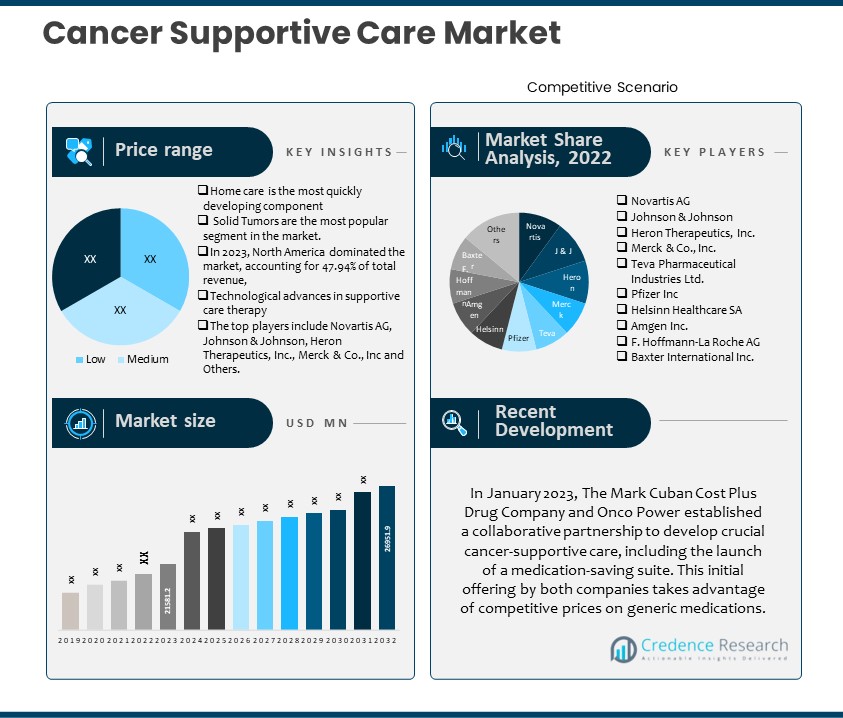
- The global demand for Cancer Supportive Care was valued at USD 21581.2 Million in 2023 and is expected to reach USD 26951.9 Million in 2032, growing at a CAGR of 2.50% between 2024 and 2032.
- Palliative Care is expected to be the most prominent segment in 2023, with nutritional support being another popular type of cancer supportive care in the market.
- Home care is the fastest growing component, and outpatient care is a significant sector.
- Adult cancer patients make up the majority of the Cancer Supportive Care Market, although pediatric cancer patients play an important role.
- Solid tumors are the most popular segment of the Cancer Supportive Care Market, and chemotherapy is another widely sought-after therapy.
- North America dominated the market in 2023, accounting for 47.94% of total revenue, while Asia Pacific is the fastest-growing area in the global cancer-supportive care market.
- Growing worry over chemotherapy's adverse effects on cancer patients fuels market expansion.
- Restrictive policies governing the definition of opioids impede market expansion.
Executive Summary
Market Definition
Cancer supportive care refers to care provided to patients suffering from various forms of cancer. Supportive care is aimed to alleviate patients' pain and improve their quality of life. Supportive care is intended to improve the patient's quality of life. Cancer is one of the most common fatal chronic diseases, with a high fatality rate due to its aggressive nature and protracted duration of illness. The rising frequency of cancer, expanding research and development, and increased investment in the biopharmaceutical industry are expected to fuel market expansion throughout the forecast period.
Market Overview
The global Cancer Supportive Care Market has witnessed steady growth in recent years and is expected to grow at a CAGR of 2.50% between 2024 and 2032. The market was valued at USD 21581.2 million in 2023 and is expected to reach USD 26951.9 million in 2032.
The expanding senior population, combined with a shift toward patient-centered treatment, is causing significant growth in the cancer-supportive care industry. As the older population grows, the demand for cancer-supportive care medications increases. Patient-centered care focuses on overall well-being, needing effective supporting therapies to improve quality of life during cancer treatment. This paradigm shift fits with the needs of the aging population, resulting in increased use of supportive care medications. The market responds by developing specialized solutions that address the unique needs of senior patients, moving the cancer-supportive care market forward through the convergence of demographic trends and a patient-centric approach to healthcare.
However, strict regulatory frameworks impede the speedy approval and commercialization of novel treatments. Stringent regulatory processes frequently require intense inspection, resulting in longer durations for drug research, approval, and market launch. Compliance with rigorous regulatory procedures is a difficulty for pharmaceutical companies, limiting their ability to deliver innovative and potentially more effective supportive care medications quickly. Delays in regulatory approvals can stifle market growth by limiting the availability of innovative therapies, influencing the prompt and improved control of adverse effects associated with cancer treatments.
Segmentation By Type of Supportive Care Products and Services
- In 2023, Palliative Care is the most dominant segment in the Cancer Supportive Care Market. Palliative care is a specialist medical treatment for those suffering from a serious illness, such as cancer or heart failure. Patients in palliative care may get medical care to alleviate their symptoms or palliative care in conjunction with treatment to cure their serious illness.
- Nutritional support is another common form of cancer support. Nutrition support therapy refers to the administration of formulated enteral or parenteral nutrients to restore nutritional status. When nutrition support therapy improves patients' quality of life, family physicians can provide it.
Segmentation By Treatment Setting
- Home Care is the most rapidly expanding component of the Cancer Supportive Care Market. Home care services enable cancer patients to get supportive care from the comfort of their own homes, emphasizing convenience and tailored care delivery.
- Outpatient Care is an important sector of the Cancer Supportive Care Market. Outpatient care enables cancer patients to get supportive therapies such as chemotherapy, radiation therapy, and supportive care services while remaining at home afterwards.
Segmentation by Target Population
- Adult cancer patients account for the largest part of the cancer supportive care market. Adult patients account for the vast majority of cancer diagnoses and treatments, creating an increased demand for supportive care services targeted to their individual requirements and problems throughout their cancer journey.
- Pediatric cancer patients provide a vital contribution to the Cancer Supportive Care Market.
Segmentation By Cancer Type and Treatment Modality
- Solid Tumors are the most popular section in the Cancer Supportive Care Market. They are formed when abnormal cells proliferate in areas such as the breast, lung, colon, and prostate and account for a major share of cancer diagnoses and therapies.
- Chemotherapy is another highly sought-after therapy in the cancer supportive care market. Chemotherapy is a medicinal treatment that employs potent chemicals to eliminate rapidly growing cells in your body. Chemotherapy is most commonly used to treat cancer because cancer cells grow and proliferate more faster than normal cells in the body.
Segmentation by Region
- North America dominated the market in 2023, accounting for 47.94% of total revenue.
- Asia Pacific is the fastest-growing region in the worldwide cancer-supportive care market.
- The rest of the world, including Latin America, the Middle East, and Africa, supplies the remaining demand for Cancer Supportive Care.
North America now maintains the greatest share of the worldwide cancer-supportive care market, and this dominance is likely to continue over the examined period. The quick adoption of pharmaceutical industry improvements has been identified as a crucial driver for the expansion of the cancer-supportive care medications market in North America. The presence of well-established vendors in the supporting care market would help North America continue its dominance in the cancer-supportive care pharmaceuticals market during the projection period. Furthermore, increased demands for supportive care among early-diagnosed cancer patients are driving market growth in North America. However, severe limits on opioid prescription and sale are a hurdle to the market's expansion.
Furthermore, Asia Pacific is the fastest-growing region in the worldwide cancer-supportive care market, driven by rising oncology demand. Chemotherapy is commonly utilized in the region to treat cancer patients. The increasing number of chemotherapies in metropolitan areas is expected to drive growth in Asia Pacific's cancer-supportive care pharmaceuticals market. Furthermore, increased vendor investments in oncology research will drive market expansion in Asia Pacific.
Key Highlights of the Report
Type of Supportive Care Products and Services, Treatment Setting, Target Population, Source, and Region segments of the global Cancer Supportive Care Market. Palliative care is expected to hold the largest market share in the cancer supportive care market by 2023, with home care growing at the fastest rate. Moreover, Solid Tumors is the most popular segment, and pediatric cancer sufferers make a significant contribution and North America, leading the market growth.
There is an increasing demand for Cancer Supportive Care Products and the introduction of new products. Furthermore, the loss of brand exclusivity for several generic pharmaceuticals is likely to impede the growth of the worldwide cancer-supportive care products market. In addition, the introduction of biosimilars is projected to slow the growth of the worldwide cancer-supportive care products market.
North America now holds the largest share of the global cancer-supportive care market, and this dominance is expected to continue over the study period. Moreover, Asia Pacific is the fastest-growing region in the global cancer-supportive care market, driven by increased oncology demand.
What Are The Main Drivers Of The Global Cancer Supportive Care Market?
The market's primary drivers include Increasing demand for the Cancer Supportive Care Product Market and the introduction of new items.
What Are The Major Challenges Faced By The Global Cancer Supportive Care Market?
The primary market obstacles include The loss of brand exclusivity for different generic medications is projected to impede the growth of the worldwide cancer-supportive care products market. Furthermore, the introduction of biosimilars is projected to slow the growth of the market..
What Are The Growth Opportunities In The Global Cancer Supportive Care Market?
The increased investment in the pharmaceutical sector is likely to provide lucrative growth prospects for participants in the worldwide cancer-supportive care products market. moroever, R&D in cancer pain care is likely to provide profitable growth prospects for participants in the global cancer supportive care products market are the market's significant opportunities.
Market Drivers
Several factors drive the global Cancer Supportive Care Market. The following are the key drivers of the global Cancer Supportive Care Market:
Growing Concern Regarding The Harmful Consequences Of Chemotherapy On Cancer Patients
Chemotherapy is the most commonly used treatment for cancer worldwide. Hair loss, skin infections, vomiting, nausea, lack of appetite, sore mouth, and anemia are some of the short-term or even long-term side effects of conventional chemotherapy. Supportive care medications for cancer patients considerably reduce the risk of side effects by protecting healthy cells and organs before they are impacted by cancer cells.
Cancer-supportive care medications increase tolerance to active therapy and lessen treatment side effects. According to a paper published by the Centers for Medicare and Medicaid Innovation (CMMI) in August 2021, people who received supportive care medications experienced fewer emergency, hospitalizations, and department visits. Such benefits of supportive cancer care drugs or medications are predicted to boost the growth of the cancer supportive care pharmaceuticals market, as people become more conscious of the side effects of chemotherapy.
Market Restraints
The global Cancer Supportive Care Market faces some challenges that may hinder its growth. These include the following:
Restrictive Policies Regarding The Description Of Opioids
Opioid medications are commonly used in cancer patients to treat severe pain. Opioids are also provided to cancer patients undergoing chemotherapy or other therapies as a form of supportive care. However, opioids are not prescribed due to the serious adverse effects they bring, which include respiratory troubles, depression, osteoporosis, the development of other severe conditions, neurological consequences, and lifelong brain damage.
Opioids may possibly cause coma or death. Multiple clinical studies suggest that long-term opiate use can lead to erectile dysfunction in males and infertility in women. With the ongoing public health crisis, numerous governments and health ministries are proposing tough rules and limitations to limit or even prohibit the prescription of opioids. Such restrictive opioid rules will most certainly stifle market expansion.
Opportunities
The global Cancer Supportive Care Market offers significant growth opportunities. These include the following:
Rising Government Focuses On Upgrading The Oncology Sector
With increased public health concerns, governments worldwide are focusing on upgrading the entire infrastructure of the oncology sector to provide better care to cancer patients. Many governments worldwide are investing in centralized procurement schemes and new cancer treatment centers. For example, England has developed a 10-year long-term plan for cancer that aims to increase cancer patient survival by 55% before 2032.
Furthermore, the Indian government is also focusing on increasing the number of linear accelerators required for radiation therapy. The increased government focus and funding on upgrading the oncology industry creates numerous chances for researchers to develop novel and sophisticated supportive care medications for cancer patients.
Competitive Landscape
Key Players
The global Cancer Supportive Care Market is highly competitive, with several key players. Some of the major players in the market and their market share are as follows:
- Novartis AG
- Johnson & Johnson
- Heron Therapeutics, Inc.
- Merck & Co., Inc.
- Teva Pharmaceutical Industries Ltd.
- Pfizer Inc
- Helsinn Healthcare SA
- Amgen Inc.
- Hoffmann-La Roche AG
- Baxter International Inc.
These organizations prioritize product innovation, Target Population expansion, and mergers and acquisitions to stay competitive.
The global Cancer Supportive Care Market's key players continually seek to stay ahead by offering new products and developments.
In February 2023, SOPHiA Genetics, a cloud-native healthcare software firm, announced today that Synergy Laboratories, a full-service diagnostic laboratory in Alabama, will now employ SOPHiA DDM to build advanced cancer profiling solutions. Synergy Laboratories intends to broaden its portfolio by introducing this novel platform for cancer research and clinical trials.
In December 2022, Mirati Therapeutics, a commercial-stage biotechnology startup, reported that the US Food and Drug Administration (FDA) had granted Breakthrough Therapy Designation (BTD) to adagrasib in conjunction with cetuximab. This shows potential therapeutic action for patients with KRAS-mutated advanced colorectal cancer.
In February 2023, TransCode Therapeutics, a leading RNA oncology business dedicated to giving cancer patients with support care medications, announced that its primary therapeutic candidate, TTX-MC138, for pancreatic cancer, has been designated as an Orphan Drug (ODD) by the United States Food and Drug Administration.
Summary of Key Findings
- The emerging government focuses on improving the oncology sector.
- The market is segmented by Type of Supportive Care Products and Services: Treatment Setting, Target Population, Source, and region.
- Nutritional support being another popular type of cancer supportive care in the market.
- Adult cancer patients make up the majority of the Cancer Supportive Care Market
- North America is leading in market growth; the market is highly competitive, with key players including International Novartis AG, Johnson & Johnson, Heron Therapeutics, Inc., Merck & Co., Inc and Others.
Future Outlook
- Growing emphasis on improving the quality of life for cancer patients.
- The rising prevalence of cancer drives need for supportive care services.
- Technological advances in supportive care therapy.
- Raising awareness about the value of supportive care in cancer treatment.
- Personalized and integrated supportive care approaches.
How CXOs Can Benefit from the Credence Research Cancer Supportive Care Market Report
The Credence Research Cancer Supportive Care Market Report provides CXOs with a comprehensive overview of the market, including:
- Market size and growth forecast: The report provides detailed estimates of the global Cancer Supportive Care Market size, segmented By Type of Supportive Care Products and Services, Treatment Setting, Target Population, Cancer Type and Treatment Modality, and region. It also includes forecasts for the market through 2032 based on key trends and drivers.
- Market segmentation: The report segments the Cancer Supportive Care Market By Type of Supportive Care Products and Services, Treatment Setting, Target Population, Cancer Type and Treatment Modality, and Region. This segmentation provides CXOs with a granular understanding of the market and the opportunities in each segment.
- Competitive Landscape: The report profiles the key players in the Cancer Supportive Care Market and provides insights into their strategies, product offerings, and financial performance. This information can help CXOs to identify and assess their competition.
- Key trends and drivers: The report identifies and analyzes the key trends and drivers shaping the Cancer Supportive Care Market. This information can help CXOs make informed decisions about their investments and strategies.
CXOs can use the insights from the Credence Research Cancer Supportive Care Market Report to:
- Identify growth opportunities: The report can help CXOs identify new growth opportunities in the Cancer Supportive Care Market. By analyzing the data and trends in the report, they can make informed decisions about where to invest and expand their business.
- Make informed investment decisions: The report can help CXOs make informed investment decisions about Cancer Supportive Care. For example, it may provide useful insights into market trends, customer preferences, the competitive landscape, and growth prospects in the mobile accessories business..
- Develop competitive strategies: The report can help CXOs develop competitive strategies for their Cancer Supportive Care businesses. For example, by analyzing market trends, client preferences, and the competitive environment mentioned in the report, CXOs can fine-tune their strategies, differentiate their offers, and effectively position their firms in the marketplace.
- Track market developments: The report can help CXOs monitor market developments and stay ahead of the curve. For example, it provides insights into the latest trends and innovations in the Cancer Supportive Care Market.
Overall, the Credence Research Cancer Supportive Care Market Report is a valuable source for CXOs who are looking to gain a deeper understanding of the market and identify opportunities for growth.
Segmentation
- By Type of Supportive Care Products and Services:
- Pharmaceuticals
- Nutritional Support
- Pain Management
- Psychosocial Support
- Rehabilitation Services
- Palliative Care
- Complementary and Alternative Medicine (CAM)
- Symptom Management Guidelines
- End-of-Life Care
- By Treatment Setting:
- Inpatient Care
- Outpatient Care
- Home Care
- Hospice Care
- By Target Population:
- Pediatric Cancer Patients
- Adult Cancer Patients
- Geriatric Cancer Patients
- By Cancer Type and Treatment Modality:
- Solid Tumors
- Hematologic Malignancies
- Surgery
- Chemotherapy
- Radiation Therapy
- By Region
- North America
- The U.S.
- Canada
- Mexico
- Europe
- Germany
- France
- The U.K.
- Italy
- Spain
- Rest of Europe
- Asia Pacific
- China
- Japan
- India
- South Korea
- South-east Asia
- Rest of Asia Pacific
- Latin America
- Brazil
- Argentina
- Rest of Latin America
- Middle East & Africa
- GCC Countries
- South Africa
- Rest of the Middle East and Africa
- North America

Request a Free Sample
Fill in your details and we'll send you a free sample report.
- Sample data tables & charts
- Research methodology
Market Dynamics
Growing Concern Over Chemotherapy Side Effects
The increasing awareness of the adverse effects associated with chemotherapy, such as nausea, pain, and immune suppression, is driving demand for supportive care products that help manage these symptoms and improve patient quality of life.
Aging Population and Higher Cancer Incidence
The expanding elderly population is leading to a higher prevalence of cancer diagnoses, which in turn increases the need for supportive care services and medications tailored to the unique needs of older adults.
Shift Toward Patient-Centered and Home-Based Care
There is a growing trend toward patient-centered care and home-based treatment settings, which boosts demand for supportive care solutions that can be administered outside traditional hospital environments, enhancing convenience and adherence.
Government and Institutional Investment in Oncology Infrastructure
Increased government focus and funding for oncology care, including the establishment of new cancer centers and procurement of advanced supportive care therapies, is expanding access and driving market growth.
Advancements in Supportive Care Therapies and R&D
Ongoing research and development in supportive care, including new pharmaceuticals and integrated care approaches, are resulting in more effective and personalized solutions for managing cancer treatment side effects.
Need a Custom Version of This Report?
Tailor the scope, geography, or segments to your exact requirements.
- Custom geography or segment scope
- Direct access to our analyst team
Frequently Asked Questions
What is the current size of the global Cancer Supportive Care Market?
What is the expected growth rate of the Cancer Supportive Care Market between 2024 and 2032?
Which segment is leading the market share in terms of Type of Supportive Care Products and Services?
Which Cancer Type and Treatment Modality segment governs the demand for Cancer Supportive Care in the world?
Who are the major players in the global Cancer Supportive Care Market?
Table of Content
Chapter 1 Market Segmentation
- 1.1 Segmentation Framework
- 1.1.1 Product and Service Classification
- 1.1.2 Application and End-Use Classification
- 1.1.3 Technology and Solution Classification
- 1.1.4 Customer and Distribution Channel Classification
- 1.1.5 Geographic Segmentation
- 1.1.6 Market Segment Definitions and Boundaries
- 1.2 By Target Population
- 1.2.1 Pediatric Cancer Patients
- 1.2.2 Adult Cancer Patients
- 1.2.3 Geriatric Cancer Patients
- 1.3 By Treatment Setting
- 1.3.1 Inpatient Care
- 1.3.2 Outpatient Care
- 1.3.3 Home Care
- 1.3.4 Hospice Care
- 1.4 By Cancer Type and Treatment Modality
- 1.4.1 Solid Tumors
- 1.4.2 Hematologic Malignancies
- 1.4.3 Chemotherapy
- 1.4.4 Radiation Therapy
- 1.5 By Type of Supportive Care Products and Services
- 1.5.1 Pharmaceuticals
- 1.5.2 Nutritional Support
- 1.5.3 Pain Management
- 1.5.4 Palliative Care
- 1.5.5 Psychosocial Support
Chapter 2 Introduction
- 2.1 Report Objectives and Scope
- 2.2 Product Definition and Industry Terminology
- 2.3 Market Inclusions and Exclusions
- 2.4 Research Process
- 2.4.1 Primary Research and Expert Interviews
- 2.4.2 Secondary Research and Source Review
- 2.4.3 Top-Down and Bottom-Up Estimation
- 2.4.4 Data Triangulation and Verification
- 2.5 Market Size Measurement Basis
- 2.5.1 2023: USD 21581.2 Million → 2032: USD 26,951.9 Million
- 2.6 Historical and Forecast Reference Periods
- 2.6.1 Base Year: 2023
- 2.6.2 Forecast Period: 2023-2032
- 2.7 Research Assumptions and Limitations
Chapter 3 Executive Summary
- 3.1 Market Snapshot and Key Findings
- 3.2 Base-Year Market Size, 2023
- 3.3 Forecast Market Size, 2032
- 3.4 Revenue and Volume Growth Outlook
- 3.5 Key Demand and Supply Indicators
- 3.6 Leading Market Segments
- 3.7 Fastest-Growing Market Opportunities
- 3.8 Regional Performance Highlights
- 3.9 Technology and Industry Transformation
- 3.10 Competitive Landscape Summary
- 3.11 Analyst View and Strategic Implications
Chapter 4 Global Cancer Supportive Care Market Trends and Developments
- 4.1 Historical Industry Development
- 4.2 Recent Market Trends and Developments
- 4.3 Demand and Customer Behavior Trends
- 4.4 Technology and Product Innovation
- 4.5 Artificial Intelligence, Automation and Digitalization
- 4.6 Local Manufacturing and Supply Chain Realignment
- 4.7 Industry Partnerships, Mergers and Acquisitions
- 4.8 Sustainability and Circular Economy Developments
- 4.9 Government and Private Sector Investment Trends
- 4.10 Emerging Business Models and Commercialization
- 4.11 Industry Developments and Announcements
Chapter 5 Global Cancer Supportive Care Market Production, Supply and Demand Analysis
- 5.1 Demand Trend and Consumption Analysis
- 5.2 Demand Forecast, 2023-2032
- 5.3 Production and Output Trend
- 5.4 Production and Output Forecast, 2023-2032
- 5.5 Installed Capacity and Capacity Utilization
- 5.6 Company-Wise Production Plants and Statistics
- 5.6.1 Installed Production Capacity
- 5.6.2 Actual Production
- 5.6.3 Planned Capacity and Expansion Targets
- 5.7 Supply Chain Structure and Procurement Trends
- 5.8 Supply-Demand Gap and Bottlenecks
- 5.9 Import Dependence and Sourcing Structure
- 5.10 Contract Manufacturing and Outsourcing
- 5.11 Regional Supply and Demand Concentration
Chapter 6 Global Cancer Supportive Care Market Pricing Analysis
- 6.1 Pricing Structure and Measurement
- 6.2 Historical Pricing Trends
- 6.3 Pricing Outlook, 2023-2032
- 6.4 Average Selling Price and Unit Economics
- 6.5 Pricing by Product and Market Segment
- 6.6 Geographic Pricing Differences
- 6.7 Key Input, Energy, Labor and Logistics Costs
- 6.8 Contract Pricing and Purchasing Models
- 6.9 Pricing Sensitivity and Competitive Positioning
- 6.10 Price, Margin and Profitability Implications
Chapter 7 Global Cancer Supportive Care Market Dynamics
- 7.1 Market Growth Drivers
- 7.1.1 Demand-Side Drivers
- 7.1.2 Technology and Innovation Drivers
- 7.1.3 Infrastructure and Investment Drivers
- 7.1.4 Regulatory and Policy Drivers
- 7.2 Market Restraints
- 7.2.1 Cost and Affordability Constraints
- 7.2.2 Technology and Adoption Barriers
- 7.2.3 Supply Chain and Operational Constraints
- 7.3 Market Challenges
- 7.3.1 Competitive Pressure and Margin Erosion
- 7.3.2 Skills, Infrastructure and Implementation Gaps
- 7.4 Emerging Market Opportunities
- 7.5 Market Dynamics Impact and Time-Horizon Assessment
Chapter 8 Global Cancer Supportive Care Value Chain Analysis
- 8.1 Industry Value Chain Overview
- 8.2 Upstream Suppliers and Critical Inputs
- 8.3 Technology and Component Providers
- 8.4 Manufacturing or Service Delivery
- 8.5 Distribution, Channel Partners and Integrators
- 8.6 Downstream Applications and End Users
- 8.7 Value Addition and Profit Pools
- 8.8 Vertical Integration and Outsourcing
- 8.9 Supplier Concentration and Risk
- 8.10 Supply Chain Localization and Resilience
Chapter 9 Global Cancer Supportive Care Market Regulations and Policies
- 9.1 Relevant Laws, Standards and Compliance Frameworks
- 9.2 Product, Service, Safety and Quality Requirements
- 9.3 Government Policies, Incentives and Subsidies
- 9.4 Imports, Exports and Trade Barriers
- 9.5 Public Procurement and Local Content Requirements
- 9.6 Environmental and Sustainability Compliance
- 9.7 Upcoming Policy Changes and Market Implications
Chapter 10 Global Cancer Supportive Care Market Hotspots and Opportunities
- 10.1 Market Opportunity Mapping and Growth Hotspots
- 10.2 High-Growth Applications and Customer Groups
- 10.3 Underserved Markets and White-Space Opportunities
- 10.4 Emerging Technology and Product Opportunities
- 10.5 New Capacity and Investment Hotspots
- 10.6 Market Entry and Expansion Opportunities
- 10.7 Distribution and Partnership Opportunities
- 10.8 Near-Term and Long-Term Commercial Potential
- 10.9 Opportunity Attractiveness and Execution Risks
Chapter 11 Global Cancer Supportive Care Market Outlook, 2023-2032
- 11.1 Market Size and Analysis
- 11.1.1 Revenue (Market Measurement: 2023: USD 21581.2 Million → 2032: USD 26,951.9 Million)
- 11.1.2 Market Volume and Quantity Sold
- 11.1.3 Historical Market Size
- 11.1.4 Base-Year Market Size, 2023
- 11.2 Market Forecast, 2023-2032
- 11.2.1 Revenue Forecast to 2032
- 11.2.2 Volume Forecast to 2032
- 11.2.3 CAGR and Year-on-Year Growth
- 11.2.4 Incremental Revenue Opportunity
- 11.3 Forecast Assumptions and Scenario Analysis
- 11.3.1 Base-Case Forecast
- 11.3.2 Optimistic and Conservative Scenarios
- 11.3.3 Technology, Pricing and Policy Sensitivities
- 11.4 Market Attractiveness and Growth Outlook
Chapter 12 Global Cancer Supportive Care Market Segmentation and Outlook
- 12.1 Segmentation Summary and Market Shares, 2023
- 12.2 Largest and Fastest-Growing Segments
- 12.3 By Target Population - Market Size and Forecast, 2023-2032
- 12.3.1 Segment Definition and Scope
- 12.3.2 Historical Market Size
- 12.3.3 Revenue Forecast, 2023-2032
- 12.3.4 Volume Forecast, 2023-2032
- 12.3.5 Base-Year Market Share, 2023
- 12.3.6 Segment CAGR and Growth Drivers
- 12.3.7 Subsegment Market Size and Forecast
- 12.3.7.1 Pediatric Cancer Patients
- 12.3.7.2 Adult Cancer Patients
- 12.3.7.3 Geriatric Cancer Patients
- 12.3.8 Subsegment Pricing and Adoption Trends
- 12.3.9 Leading Suppliers and Competition
- 12.3.10 Regional Demand and Opportunities
- 12.4 By Treatment Setting - Market Size and Forecast, 2023-2032
- 12.4.1 Segment Definition and Scope
- 12.4.2 Historical Market Size
- 12.4.3 Revenue Forecast, 2023-2032
- 12.4.4 Volume Forecast, 2023-2032
- 12.4.5 Base-Year Market Share, 2023
- 12.4.6 Segment CAGR and Growth Drivers
- 12.4.7 Subsegment Market Size and Forecast
- 12.4.7.1 Inpatient Care
- 12.4.7.2 Outpatient Care
- 12.4.7.3 Home Care
- 12.4.7.4 Hospice Care
- 12.4.8 Subsegment Pricing and Adoption Trends
- 12.4.9 Leading Suppliers and Competition
- 12.4.10 Regional Demand and Opportunities
- 12.5 By Cancer Type and Treatment Modality - Market Size and Forecast, 2023-2032
- 12.5.1 Segment Definition and Scope
- 12.5.2 Historical Market Size
- 12.5.3 Revenue Forecast, 2023-2032
- 12.5.4 Volume Forecast, 2023-2032
- 12.5.5 Base-Year Market Share, 2023
- 12.5.6 Segment CAGR and Growth Drivers
- 12.5.7 Subsegment Market Size and Forecast
- 12.5.7.1 Solid Tumors
- 12.5.7.2 Hematologic Malignancies
- 12.5.7.3 Chemotherapy
- 12.5.7.4 Radiation Therapy
- 12.5.8 Subsegment Pricing and Adoption Trends
- 12.5.9 Leading Suppliers and Competition
- 12.5.10 Regional Demand and Opportunities
- 12.6 By Type of Supportive Care Products and Services - Market Size and Forecast, 2023-2032
- 12.6.1 Segment Definition and Scope
- 12.6.2 Historical Market Size
- 12.6.3 Revenue Forecast, 2023-2032
- 12.6.4 Volume Forecast, 2023-2032
- 12.6.5 Base-Year Market Share, 2023
- 12.6.6 Segment CAGR and Growth Drivers
- 12.6.7 Subsegment Market Size and Forecast
- 12.6.7.1 Pharmaceuticals
- 12.6.7.2 Nutritional Support
- 12.6.7.3 Pain Management
- 12.6.7.4 Palliative Care
- 12.6.7.5 Psychosocial Support
- 12.6.8 Subsegment Pricing and Adoption Trends
- 12.6.9 Leading Suppliers and Competition
- 12.6.10 Regional Demand and Opportunities
- 12.7 Segment Growth Comparison
- 12.8 Segment Attractiveness and Priority Matrix
Chapter 13 Global Cancer Supportive Care Geographic Market Outlook, 2023-2032
- 13.1 Regional Market Size and Share, 2023
- 13.2 Regional Market Forecast, 2023-2032
- 13.3 Regional Pricing, Production and Demand Differences
- 13.4 North America
- 13.4.1 United States
- 13.4.2 Canada
- 13.4.3 Mexico
- 13.5 Europe
- 13.5.1 Germany
- 13.5.2 France
- 13.5.3 Italy
- 13.5.4 United Kingdom
- 13.5.5 Spain
- 13.5.6 Poland
- 13.5.7 Russia
- 13.5.8 Netherlands
- 13.5.9 Belgium
- 13.5.10 Sweden
- 13.5.11 Denmark
- 13.5.12 Norway
- 13.5.13 Rest of Europe
- 13.6 Asia Pacific
- 13.6.1 China
- 13.6.2 India
- 13.6.3 Japan
- 13.6.4 South Korea
- 13.6.5 Thailand
- 13.6.6 Indonesia
- 13.6.7 Vietnam
- 13.6.8 Malaysia
- 13.6.9 Australia
- 13.6.10 Rest of Asia Pacific
- 13.7 Latin America
- 13.7.1 Brazil
- 13.7.2 Argentina
- 13.7.3 Colombia
- 13.7.4 Chile
- 13.7.5 Rest of Latin America
- 13.8 Middle East
- 13.8.1 Saudi Arabia
- 13.8.2 United Arab Emirates
- 13.8.3 Turkey
- 13.8.4 Israel
- 13.8.5 Iran
- 13.8.6 Rest of the Middle East
- 13.9 Africa
- 13.9.1 South Africa
- 13.9.2 Egypt
- 13.9.3 Nigeria
- 13.9.4 Morocco
- 13.9.5 Rest of Africa
- 13.10 Regional Investment, Policy and Supply Chain Differences
- 13.11 Regional Competitive Landscape
- 13.12 Geographic Growth Hotspots
Chapter 14 Global Cancer Supportive Care Technology, Innovation and Sustainability Outlook
- 14.1 Technology Landscape and Maturity
- 14.2 Product, Process and Service Innovation
- 14.3 AI, Automation and Digital Tools in the Industry
- 14.4 Technology Adoption and Performance Benchmarking
- 14.5 Innovation Pipeline and R&D Investment
- 14.6 Patent and Intellectual Property Trends
- 14.7 Energy Efficiency and Resource Management
- 14.8 Sustainability, Recycling and Circularity
- 14.9 Technology Roadmap, 2023-2032
- 14.10 Risks of Obsolescence and Technology Substitution
Chapter 15 Global Cancer Supportive Care Market Key Strategic Imperatives
- 15.1 Growth and Market Entry Priorities
- 15.2 High-Return Products and Segments
- 15.3 Pricing, Profitability and Cost Optimization
- 15.4 Technology Investment and Product Differentiation
- 15.5 Supply Chain Localization and Resilience
- 15.6 Distribution and Customer Acquisition
- 15.7 Partnership, Acquisition and Capacity Strategy
- 15.8 Regional Expansion Priorities
- 15.9 Short-, Medium- and Long-Term Actions
Chapter 16 Competition Outlook
- 16.1 Industry Competition Characteristics
- 16.2 Market Structure and Concentration
- 16.3 Market Share and Competitive Positioning, 2023
- 16.4 Company-Wise Revenue and Product Benchmarking
- 16.5 Production and Service Capacity Benchmarking
- 16.6 Technology, Pricing and Differentiation
- 16.7 Regional Footprint and Distribution Strength
- 16.8 Mergers, Acquisitions and Strategic Alliances
- 16.9 New Entrants and Competitive Threats
- 16.10 Porter's Five Forces and Industry Attractiveness
- 16.11 Competitive Outlook, 2023-2032
Chapter 17 Company Profiles
- 17.1 Company Coverage and Selection Criteria
- 17.2 Novartis AG
- 17.2.1 Business Description
- 17.2.2 Company Ownership and Geographic Presence
- 17.2.3 Product and Service Portfolio
- 17.2.4 Manufacturing and Operating Footprint
- 17.2.5 Production Capacity and Expansion Plans
- 17.2.6 Financial Performance and Investment
- 17.2.7 Market Share and Competitive Position
- 17.2.8 Technology and Innovation Capabilities
- 17.2.9 Strategic Alliances or Partnerships
- 17.2.10 Recent Developments
- 17.2.11 Growth Strategy and Outlook
- 17.3 Johnson & Johnson
- 17.4 Heron Therapeutics, Inc.
- 17.5 Merck & Co., Inc.
- 17.6 Teva Pharmaceutical Industries Ltd.
- 17.7 Pfizer Inc.
- 17.8 Helsinn Healthcare SA
- 17.9 Amgen Inc.
- 17.10 Hoffmann-La Roche AG
- 17.11 Baxter International Inc.
- 17.12 Other Relevant Market Participants
Note: Every listed company is profiled on the structure shown under the first company. The company list is preliminary and may change based on research findings, market developments, data availability and client requirements.
Chapter 18 Disclaimer
- 18.1 Research and Forecast Disclaimer
- 18.2 Data Source and Estimation Limitations
Note: The depth of individual sections depends on data availability for this market. Volume, capacity, trade and other unit-based metrics are included where applicable.