
| REPORT ATTRIBUTE | DETAILS |
|---|---|
| Historical Period | 2019-2022 |
| Base Year | 2023 |
| Forecast Period | 2024-2032 |
| Carbon Fibers Market Size 2023 | USD 7251.2 Million |
| Carbon Fibers Market, CAGR | 13.20% |
| Carbon Fibers Market Size 2032 | USD 22132.4 Million |
Market Insights
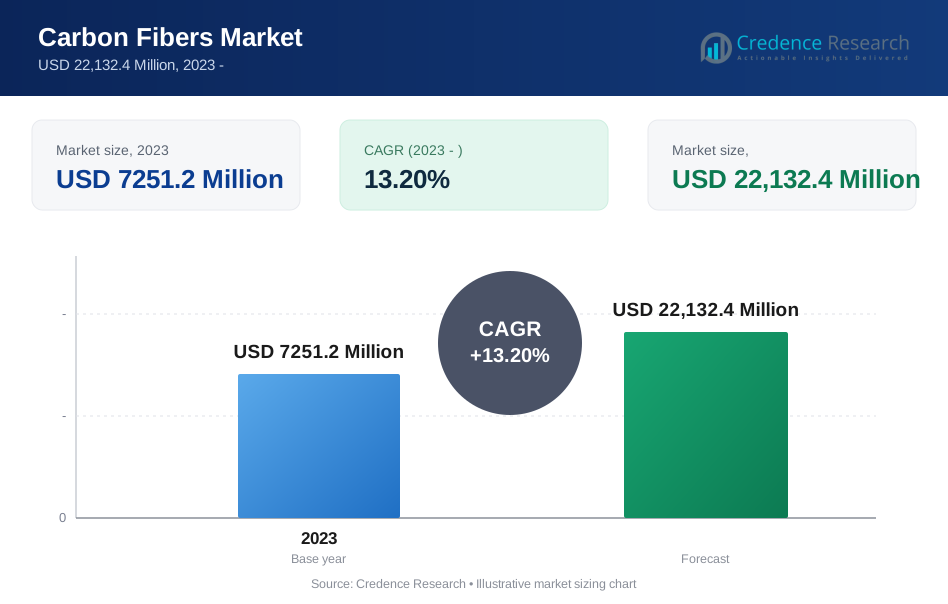
- The Carbon Fibers Market attained a valuation of USD 7251.2 Million in 2023 and is anticipated to escalate to USD 22132.4 Million by 2032, exhibiting a robust CAGR of 13.20% during the forecast period from 2024 to 2032.
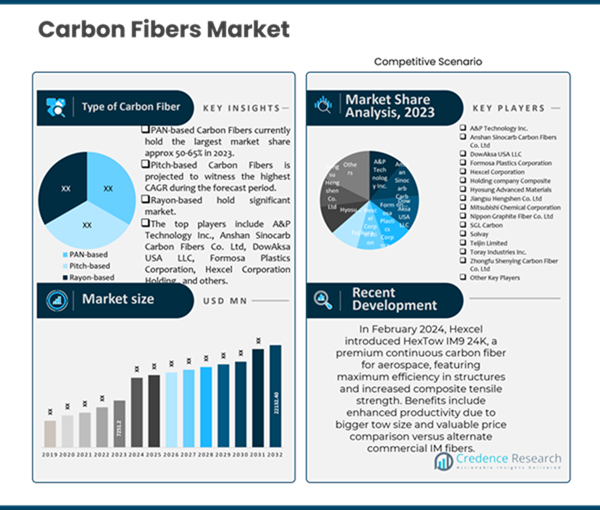
- Among the key segments, PAN-based Carbon Fibers currently hold the largest market share, comprising approximately 50-65% of the total market in 2023. However, Pitch-based Carbon Fibers are projected to witness the highest growth rate during the forecast period, driven by increased demand in the aerospace industry and technological advancements.
- Continuous Carbon Fibers currently dominate the market by form, holding approximately 40-45% of the market share in 2023. On the other hand, Carbon Fiber Reinforced Polymer (CFRP) Composites are expected to witness the highest growth rate, attributed to their increasing usage in lightweight and durable composite materials.
- Aerospace and Defense hold the largest share of the market by end-use industry, accounting for approximately 25-28% in 2023, due to the exceptional strength and rigidity of Carbon Fibers, crucial in aircraft manufacturing.
- North America held the largest share of the market in 2023, closely followed by Europe and Asia Pacific, collectively accounting for just under 55% of the market.
- The growing awareness about the environmental benefits of Carbon Fibers, along with stricter fuel efficiency regulations and increased demand across various industries, drives the growth of the Carbon Fibers Market.
- Key opportunities in the market include expanding applications in renewable energy, infrastructure development, and medical devices, along with continuous innovations in manufacturing processes and materials, fostering market expansion.
Executive Summary
Market Definition
Carbon Fibers represent a class of reinforcing elements composed primarily of carbon atoms arranged in microscopic filaments. With incredible strength and weight and outstanding thermal stability, these fibers are widely used in many industries, especially automotive, aerospace, sports equipment, and wind energy, their inherent properties in construction interior and electrical steel and glass composites with suitable processes, resulting in reduced weight feasibility, increased durability and reduced maintenance costs. Carbon fiber production usually involves the spinning of polyacrylonitrile (PAN) or pitch precursor micrometals, followed by pyrolysis in controlled environments. Postprocessing steps such as surface treatment and sizing additions, improving compatibility with matrix resins, and improving overall mechanical properties. The trend shows an increasing demand for carbon fiber with increased environmental awareness and stricter fuel efficiency regulations mandating reduced vehicle density and product development caused by the new things.
Market Overview
The Carbon Fibers Market has exhibited steady growth and is anticipated to maintain a robust Compound Annual Growth Rate (CAGR) of 13.20% from 2024 to 2032. Valued at USD 7251.2 million in 2023, this market is forecasted to reach USD 22132.4 million by 2032.
Among the primary segments, PAN-based Carbon Fibers dominated the market landscape by type of fiber, comprising approximately 50-65% of the total market share in 2023. However, Pitch-based Carbon Fibers are anticipated to observe the highest CAGR over the forecast period, driven by increased demand in the aerospace industry and technological advancements.
The Carbon Fiber Reinforcements segment captured around 35-38% of the market share in 2023, attributed to the superior mechanical properties they provide when added to various materials.
Aerospace and Defense emerged as the leading end-use industry segment in 2023, with a market share of about 25-28%, owing to the exceptional strength and rigidity of Carbon Fibers, vital in aircraft manufacturing.
Continuous Carbon Fibers currently hold the largest market share approx 40-45% in 2023. Continuous carbon fiber offers several advantages over short carbon fiber or spinning, including superior machining performance, consistent quality and greater design flexibility is ideal for use in composite materials.
Asia Pacific constituted a significant portion of the market in 2023, followed by North America and Europe, collectively representing just under 55% of the market share.
The rise in demand for Carbon Fibers is driven by factors such as increasing environmental awareness, stricter fuel efficiency regulations, and expanding applications across industries like automotive, aerospace, and renewable energy.
Continuous innovations in manufacturing processes, including technological advancements and improvements in production efficiency, are further driving the demand for Carbon Fibers, particularly in regions experiencing rapid economic growth and technological advancement.
Segmentation by Type of Carbon Fiber
- PAN-based Carbon Fibers currently hold the largest market share approx 50-65% in 2023 owing to their high usage in various end-use industries such as automotive, space & security, sports, and more.
- Pitch-based Carbon Fibers are projected to witness the highest CAGR during the forecast period. The growing demand for these fibers in composite materials used in the aerospace industry is primarily driving this growth. In addition, technological advances have enabled the production of pitch-based carbon fibers at low cost, further enhancing market expansion.
Segmentation by Form
- Continuous Carbon Fibers currently hold the largest market share approx 40-45% in 2023. Continuous carbon fiber offers several advantages over short carbon fiber or spinning, including superior machining performance, consistent quality, and greater design flexibility is ideal for use in composite materials.
- Carbon Fiber Reinforced Polymer (CFRP) Composites is projected to witness the highest CAGR during the forecast period. This rapid expansion is due to growing knowledge of its weight reduction in mechanical aspects of durability is mainly due to the strength provided by CFRP compared to conventional materials.
Segmentation by End-Use Industry
- Aerospace and Defense currently hold the largest market share approx 25-28% in 2023 owing to an excellent specific strength, rigidity, and structural stability carbon fiber plays an important role in the manufacture of aircraft parts.
- Medical is projected to witness the highest CAGR during the forecast period due to an increase in demand for advanced bone implants and prostheses using carbon fibers and components of carbon fibers make them suitable for medical applications devices.
Segmentation by Product Type
- Carbon Fiber Reinforcements currently hold the largest market share approximately 35-38% in 2023. Carbon fiber delivers superior mechanical properties when added to polymers, metals, or ceramics. Reinforcement enables engineers to develop efficient and sustainable products that meet modern requirements while reducing the environmental impact.
- Carbon Fiber Tubes/Pipes are projected to witness the highest CAGR during the forecast period owing to ongoing technological innovations set to improve manufacturing efficiency and lower production costs.
Segmentation by Region
- Asia Pacific held the largest share around 38-42% of the market in 2023. The presence of advanced technologies, and strong economic growth seen in emerging economies such as China and India plays an important role in boosting the demand for carbon fiber, especially in growing transportation, renewable energy, and consumer electronics.
- North America and Europe collectively account for just under 55% share in 2023, with North America holding over 20% share in the same year.
- The rest of the world, including Latin America, the Middle East, and Africa, supplies the remaining demand for Carbon Fibers.
The growing awareness about the environmental benefits of carbon fibers increased environmental awareness and stricter fuel efficiency regulations mandating reduced vehicle density and product development are also contributing to the market growth.
The Asia Pacific region holds the largest market share in the Carbon Fibers market. The presence of densely populated countries such as China and India drives the demand for carbon fibers in various end-use industries such as automotive, wind, aerospace, and wind energy. Both countries have rapid economic growth, creating a need for technologically advanced materials capable of increasing productivity and reducing environmental impact owing to these demands market players are setting up carbon fiber facilities to cater to the market growth. For instance, in January 2024, Reliance will set up India's first world-class carbon fiber facility in Gujarat, India as part of its commitment to make the state a global leader in green growth. Reliance has invested over $150 billion in the last 10 years, with more than a third of that in Gujarat, and plans to help the state meet half of its energy needs through renewables by 2030. However, companies in the country have increased productivity to meet increased demands, while investing in R&D programs aimed at refining existing processes and introducing new features designed for unique customer needs. For instance, in October 2023, Japanese firm Toray Industries revealed its US unit Zoltek would raise large-tow carbon fiber output by 54% in 2023. Costing $130m, the move targets the expanding market spurred by eco-friendly wind power generation and increasing demand for stronger, lighter blades utilizing lightweight, sturdy carbon fiber. Moreover, supportive government policies aimed at strengthening production act as a catalyst for growth in the carbon fiber market.
Europe holds a significant market share of the global Carbon Fibers market, due to several factors. The main reason is the European Union's stringent emissions regulations, which force original equipment manufacturers (OEMs) to drive vehicles with lightweight materials such as carbon fiber types to reduce carbon emissions and comply with legal mandates. Moreover, Europe has a strong position in luxury car manufacturing, with consumers wanting superior automotive performance achieved in part through increased use of carbon fiber. Europe also offers some well-known carbon fiber manufacturers who continue to invest in R&D efforts to cater to the demand. For instance, in March 2024, Jindal Advanced Materials partnered with Italy's MAE to build a $4.31 million carbon fiber plant with a 3,500 MT annual capacity. Establishing itself as a vital carbon fiber provider, the facility offers an array of intermediate products catering to varied industries, such as prepregs, fabrics, multi-axials, and carbon fiber composites. Another important aspect concerns the active implementation of policies that promote decarbonization goals and resource efficiency standards, governments across member states support cleaner technologies to drive the market.
Key Highlights of the Report
The Carbon Fibers Market is segmented by Type of Carbon Fiber, End-Use Industry, Form, and Region. The growing demand for carbon fibers is driven by factors such as increasing environmental awareness, stricter fuel efficiency regulations, and expanding applications across industries including automotive, aerospace, and renewable energy.
PAN-based Carbon Fibers dominate the segment, serving essential functions in various industries such as automotive, space & security, and sports due to their high strength and versatility. Carbon Fiber Reinforcements lead the product segment, offering superior mechanical properties when added to polymers, metals, or ceramics.
Aerospace and Defense hold a significant market share in the end-use industry segment, utilizing carbon fibers for their exceptional strength and rigidity in aircraft manufacturing. The Continuous Carbon Fibers segment is witnessing rapid growth, driven by their superior machining performance and consistent quality, making them ideal for use in composite materials.
Asia Pacific held the largest share of the Carbon Fibers market, supported by advanced technologies and strong economic growth in emerging economies such as China and India.
Key players such as Toray Industries and Reliance Industries focus on product innovation and strategic investments to meet the growing demand for carbon fibers and maintain their market position.
What Are The Main Drivers Of The Global Carbon Fibers Market?
The global Carbon Fibers market is driven by various factors such as increasing demand from end-use industries such as aerospace, automotive, sporting goods, recreation gear, and aircraft, as their lightweight characteristics, high strength, and corrosion resistance properties. Alongside a focus on fuel efficiency, stringent environmental regulations and advancements in the technology of carbon fibers further drive the market.
What Are The Major Challenges Faced By The Global Carbon Fibers Market?
The global Carbon Fibers market is mainly challenged by high manufacturing costs, limited availability of raw materials such as PAN (polyacrylonitrile), and energy-intensive manufacturing processes. Furthermore, ensuring consistent quality and reliability to meet stringent performance requirements is challenging. Moreover, the lack of widespread adoption in some industries due to cost and competition from new products hinders market growth.
What Are The Growth Opportunities In The Global Carbon Fibers Market?
The global Carbon Fibers market presents numerous growth opportunities including expansion of applications in emerging industries such as renewable energy, sports and leisure, and infrastructure development. Furthermore, increasing emphasis on sustainable and lightweight materials in automotive and aerospace industries, coupled with growing investments in research and development, provide opportunities for innovation and market penetration. Moreover, strategic partnerships, collaborations among m, market players, and investments in R&D can boost the market.
Market Drivers
Increasing Uses Of Carbon Fibers For Different Applications Such As Sporting Goods, Recreation Gear, And Aircraft
The global Carbon Fibers market has significant growth, driven by the increasing uses of carbon fibers for different applications such as sporting goods, recreation gear, and aircraft. Carbon fibers are lightweight, strong, and corrosion-resistant, making them ideal for use in applications requiring high-performance materials. Carbon fibers in sporting goods are used to manufacture tools such as tennis racquets, golf clubs, bicycles, etc. for increased performance and durability. Similarly, carbon fibers in recreational tools such as fishing rods and bows provide strength and flexibility to improve performance without the widespread use of carbon fibers in aircraft manufacturing due to the unique strength-to-weight ratio and overall performance Contributing to this is the wide range of carbon fibers that can be used and its superior quality makes it in high demand in various industries, leading to market growth. As demand grows, manufacturers are investing in research and development to further enhance the feasibility and affordability of carbon fiber products, ensuring continued growth and development innovations in the global carbon fiber market. For instance, in October 2023, Toray Industries launched TORAYCA T1200, now the world's strongest carbon fiber, providing 10% higher tensile strength than previous variants. Ideal for sporting goods, recreation gear, and aircraft, this breakthrough reduces environmental impact through weight reductions in carbon-fiber reinforced plastics, aligning with sustainability efforts.
Market Restraints
Limited Availability Of Raw Materials Such As PAN (Polyacrylonitrile)
Limited availability of raw materials such as PAN (polyacrylonitrile) restrained the demand for carbon fiber market. PAN are an important component of carbon fiber production, but their availability is restricted, posing challenges to meet the growing demand for carbon fiber products. PANs involve complex materials and require specific conditions, and it makes their production expensive and time-consuming. In addition, fluctuations in Pan supply can disrupt production planning and increase costs for manufacturers. Consequently, the carbon fiber industry faces uncertainty in finding the right fork to meet market demand.
Opportunities
Adoption Of Various Strategies Among Market Players
The adoption of various strategies among market players creates significant opportunities for the market. The major companies serving the global Carbon Fibers Market are V-Carbon, A&P Technology Inc., Anshan Sinocarb Carbon Fibers Co. Ltd, and DowAksa USA LLC, among others. The market players are considerably contributing to the market growth by the adoption of various strategies including mergers & acquisitions, collaborations, funding, and new product launches, to stay competitive in the market. For instance, in June 2023, Huntsman and V-Carbon partnered to address the lack of recycling methods for carbon fiber composites, prevalent in aviation, transport, and energy industries. The aim of this partnership are to focus on end-of-life recycling solutions seeks to minimize waste and promote sustainability within composite material usage.
Competitive Landscape
Key Players
The global Carbon Fibers market is highly competitive, with several key players. Some of the major players in the market and their market share are as follows:
- A&P Technology Inc.
- Anshan Sinocarb Carbon Fibers Co. Ltd
- DowAksa USA LLC
- Formosa Plastics Corporation
- Hexcel Corporation
- Holding company Composite
- Hyosung Advanced Materials
- Jiangsu Hengshen Co. Ltd
- Mitsubishi Chemical Corporation
- Nippon Graphite Fiber Co. Ltd
- SGL Carbon
- Solvay
- Teijin Limited
- Toray Industries Inc.
- Zhongfu Shenying Carbon Fiber Co. Ltd.
- Others
These organizations prioritize product innovation, distribution channel expansion, and mergers and acquisitions to stay competitive.
The global Carbon Fibers market's key players continually seek to stay ahead by offering new products and developments.
In February 2024, Hexcel introduced HexTow IM9 24K, a premium continuous carbon fiber for aerospace, featuring maximum efficiency in structures and increased composite tensile strength. Benefits include enhanced productivity due to bigger tow size and valuable price comparison versus alternate commercial IM fibers.
In March 2023, SGL Carbon extended its carbon fiber range with SIGRAFIL C T50-4.9/235, having high strength & elongation. This addition complements their already vast 50k carbon fiber selection. Customers gain access to wider choices, enabling optimal solutions for varying applications.
Summary of Key Findings
- The Carbon Fibers Market is experiencing significant growth, propelled by increasing environmental awareness and stricter fuel efficiency regulations driving demand across industries such as automotive, aerospace, and renewable energy. Key drivers contributing to this growth include the exceptional strength, lightweight characteristics, and durability of carbon fibers, meeting the evolving needs of various sectors.
- Market segmentation within the Carbon Fibers Market encompasses factors such as type of carbon fiber, end-use industry, form, product type and region, reflecting the diverse applications and uses of carbon fibers in different sectors.
- PAN-based Carbon Fibers emerge as the dominant segment, capturing a majority market share due to their versatility and high usage in industries such as automotive, space & security, and sports. Other segments such as Pitch-based Carbon Fibers and Continuous Carbon Fibers also play significant roles, catering to specific industry requirements.
- Aerospace and Defense emerge as the leading end-use industry segment, utilizing carbon fibers for their exceptional strength and rigidity in aircraft manufacturing. Carbon Fiber Reinforcements lead the product segment, offering superior mechanical properties when incorporated into various materials.
- Geographically, Asia Pacific holds the largest market share, driven by advanced technologies and strong economic growth in countries such as China and India. North America and Europe collectively represent a substantial share of the market, with North America leading due to its well-established aerospace and automotive industries.
Future Outlook
- The future outlook for the Carbon Fibers Market indicates promising growth opportunities, particularly within sectors such as automotive, aerospace, and renewable energy, fueled by increasing demand for lightweight and sustainable materials. However, anticipated challenges include high manufacturing costs, limited availability of raw materials, and competition from alternative materials.
- To maintain competitiveness in the Carbon Fibers Market, industry players should focus on continuous product innovation, strategic collaborations, and investments in research and development. Addressing environmental concerns, improving manufacturing efficiency, and exploring new applications in emerging industries will be crucial for sustaining growth amidst evolving market dynamics.
How CXOs Can Benefit from the Credence Research Carbon Fibers Networks Market Report
The Credence Research Carbon Fibers Networks Market Report provides CXOs with a comprehensive overview of the market, including:
- Market size and growth forecast: The report provides detailed estimates of the global Carbon Fibers networks market size, segmented by type of carbon fiber, end-use industry, form, product type, and region. It also includes forecasts for the market through 2032, based on key trends and drivers.
- Market segmentation: The report segments the Carbon fiber networks market by type of carbon fiber, end-use industry, form, product type, and region. The increasing demand for advanced solutions is driven. This segmentation provides CXOs with a granular understanding of the market and the opportunities in each segment.
- Competitive Landscape: The report profiles the key players in the Carbon fiber networks market and provides insights into their strategies, product offerings, and financial performance. This information can help CXOs to identify and assess their competition.
- Key trends and drivers: The report identifies and analyzes the key trends and drivers that are shaping the Carbon Fibers networks market. This information can help CXOs to make informed decisions about their investments and strategies.
CXOs can use the insights from the Credence Research Carbon Fibers Networks Market Report to:
- Identify growth opportunities: The report can help CXOs to identify new growth opportunities in the Carbon fiber networks market. For example, the report identifies the growing demand for Carbon fiber networks from cloud computing providers and telecom companies as a key opportunity.
- Make informed investment decisions: The report can help CXOs to make informed investment decisions about Carbon fiber networks. For example, the report provides insights into the key factors to consider when evaluating Carbon Fibers providers and selecting Carbon Fibers solutions.
- Develop competitive strategies: The report can help CXOs to develop competitive strategies for their Carbon fiber networks businesses. For example, the report identifies the key strategies that Carbon Fibers providers are using to differentiate themselves from their competitors.
- Track market developments: The report can help CXOs track market developments and stay ahead of the curve. For example, the report provides insights into the latest trends and innovations in the Carbon fiber networks market.
Overall, the Credence Research Carbon Fibers Networks Market Report is a valuable resource for CXOs who are looking to gain a deeper understanding of the market and identify opportunities for growth.
Segmentation
-
By Type of Carbon Fiber:
- PAN-based Carbon Fibers
- Pitch-based Carbon Fibers
- Rayon-based Carbon Fibers
-
By Form:
- Continuous Carbon Fibers
- Short Carbon Fibers
- Carbon Fiber Tow
- Carbon Fiber Cloth/Fabric
- Carbon Fiber Prepreg
- Carbon Fiber Reinforced Polymer (CFRP) Composites
-
By End-Use Industry:
- Aerospace and Defense
- Aircraft Components (e.g., wings, fuselage)
- Helicopter Components
- UAVs (Unmanned Aerial Vehicles)
- Missile Systems
- Spacecraft
- Armor Systems
- Others
- Automotive
- Body Panels
- Chassis and Structural Components
- Interior Components
- Racing Cars
- Electric Vehicles
- Luxury Vehicles
- Others
- Wind Energy
- Wind Turbine Blades
- Nacelles
- Tower Structures
- Others
- Sporting Goods
- Bicycles
- Tennis Rackets
- Golf Clubs
- Fishing Rods
- Ski Equipment
- Others
- Construction and Infrastructure
- Bridges
- Buildings
- Reinforcement Bars
- Infrastructure Repair
- Others
- Marine
- Boat Hulls
- Sailboat Masts
- Submarine Components
- Offshore Structures
- Others
- Electronics and Electrical
- Printed Circuit Boards (PCBs)
- Electrostatic Discharge (ESD) Protection
- Heat Sinks
- Others
- Medical
- Prosthetics
- Orthopedic Devices
- Surgical Instruments
- Imaging Equipment
- Others
- Aerospace and Automotive Interiors
- Oil and Gas
- Others
- Aerospace and Defense
-
By Product Type:
- Carbon Fiber Reinforcements
- Carbon Fiber Composite Parts
- Carbon Fiber Sheets/Plates
- Carbon Fiber Fabric/Textiles
- Carbon Fiber Tubes/Pipes
- Others
-
By Region
- North America
- US
- Canada
- Mexico
- Europe
- Germany
- France
- UK.
- Italy
- Spain
- Rest of Europe
- Asia Pacific
- China
- Japan
- India
- South Korea
- South-east Asia
- Rest of Asia Pacific
- Latin America
- Brazil
- Argentina
- Rest of Latin America
- Middle East & Africa
- GCC Countries
- South Africa
- Rest of Middle East and Africa
- North America
Adjacent Markets
In the Carbon Fibers market, there are several adjacent markets which have high revenue growth opportunities. The key adjacent markets for Carbon Fibers market -
Adjacent Markets |
||
| Composite Materials Market | Wind Turbine Composite Market | Marine Composites Market |
| Aerospace Composites Market | Sporting Goods Composite Market | Renewable Energy Composites Market |
| Automotive Composites Market | Construction Composites Market | Electronic Composites Market |
Request a Free Sample
Fill in your details and we'll send you a free sample report.
- Sample data tables & charts
- Research methodology
Need a Custom Version of This Report?
Tailor the scope, geography, or segments to your exact requirements.
- Custom geography or segment scope
- Direct access to our analyst team
Frequently Asked Questions
What is the current size of the global Carbon Fibers market?
What is the expected growth rate of the Carbon Fibers market between 2024 and 2032?
Which segment is leading the market share in terms of Type of Carbon Fibers?
Which Form segments govern the demand for Carbon fibers in the world?
Which Product Type segment is expected to post the highest CAGR during the forecast period?
Which region is fueling the growth of the Carbon fiber industry?
Who are the major players in the global Carbon Fibers market?
What are the major market drivers of the Carbon Fibers industry?
What are the major market restraints of the Carbon Fibers industry?
What are the major market opportunities of the Carbon Fibers industry?
Table of Content
Chapter 1. Report Introduction
- 1.1 Report Description & Purpose
- 1.1.1 Report Title & Market Definition
- 1.1.2 Unique Selling Propositions (USP) & Key Differentiators
- 1.1.3 Value Proposition for Stakeholders
- 1.2 Research Objectives
- 1.2.1 Market Sizing Objectives (Volume & Revenue)
- 1.2.2 Segmentation Objectives
- 1.2.3 Competitive Intelligence Objectives
- 1.2.4 Forecast & Scenario Objectives
- 1.3 Report Scope
- 1.3.1 Carbon Fibers Scope – Types & Subtypes Covered
- 1.3.2 Geographic Scope – Regions & Countries Covered
- 1.3.3 Historical Period, Base Year & Forecast Period (2023; forecast to the forecast period)
- 1.3.4 Inclusions & Exclusions
- 1.4 HS Code & Classification Framework
- 1.5 Currency, Units & Pricing Basis
- 1.6 Target Stakeholders
- 1.7 Limitations & Assumptions
Chapter 2. Executive Summary
- 2.1 Global Carbon Fibers Market Snapshot
- 2.1.1 Market Size – Historical (2023) & Forecast (the forecast period) (2023: USD 7251.2 Million → forecast year: USD 22,132.4 Million)
- 2.1.2 Volume & Revenue – Global Totals
- 2.1.3 Key Market Highlights – Top Five Facts
- 2.2 Carbon Fibers Market Segmentation Snapshot
- 2.2.1 Market Split by Region – 2023 vs.
- 2.3 Competitive Snapshot
- 2.3.1 Top 10 Players by Revenue Share – 2023
- 2.3.2 Top 10 Players by Volume Share – 2023
- 2.3.3 Recent Strategic Developments (18-Month Summary)
- 2.4 Key Investment Highlights & Strategic Conclusions
Chapter 3. Carbon Fibers Market Dynamics & Industry Analysis
- 3.1 Market Overview & Context
- 3.1.1 Carbon Fibers Market Position in the Broader Automotive Value Chain
- 3.1.2 OEM vs. Replacement Market Dynamics
- 3.1.3 Market Maturity & Development Stage by Region
- 3.2 Carbon Fibers Market Drivers
- 3.3 Carbon Fibers Market Restraints & Challenges
- 3.4 Carbon Fibers Market Opportunities
- 3.5 Porter's Five Forces Analysis
- 3.5.1 Threat of New Entrants
- 3.5.2 Bargaining Power of Suppliers
- 3.5.3 Bargaining Power of Buyers
- 3.5.4 Threat of Substitutes
- 3.5.5 Competitive Rivalry – Intensity Assessment
- 3.6 Carbon Fibers Value Chain Analysis
- 3.6.1 Upstream – Raw Material/Input Suppliers
- 3.6.1.1 Raw Material/Input 1
- 3.6.1.2 Raw Material/Input 2
- 3.6.1.3 Raw Material/Input 3
- 3.6.2 Midstream – Production/Manufacturing/Service Delivery
- 3.6.2.1 Production/Process Overview
- 3.6.2.2 Key Facility Locations & Capacity by Manufacturer
- 3.6.3 Downstream – Distribution & End Consumer
- 3.6.3.1 Primary Channel – B2B/OEM
- 3.6.3.2 Secondary Channels – Dealer, Retail, Online, Direct
- 3.6.4 Value Chain Profitability Analysis
- 3.6.1 Upstream – Raw Material/Input Suppliers
- 3.7 PESTEL Analysis
- 3.7.1 Political Factors
- 3.7.2 Economic Factors
- 3.7.3 Social Factors
- 3.7.4 Technological Factors
- 3.7.5 Environmental Factors
- 3.7.6 Legal Factors
- 3.8 Carbon Fibers Supply Chain Analysis
- 3.8.1 Raw Material/Input Supply Risk Assessment
- 3.8.2 Manufacturing Concentration Risk (Geographic Exposure)
- 3.8.3 Trade Disruption Impact Analysis
- 3.9 Regulatory & Policy Landscape
Note: The regulatory and policy landscape section covers regulations based on their applicability to the market, Carbon Fibers category, geography, and scope of the study. Only regulatory frameworks with a material impact on operations, compliance, trade, sustainability, or market access are analyzed in detail.
Chapter 4. Key Investment Pockets & Opportunity Analysis
- 4.1 Carbon Fibers Market Attractiveness Analysis
- 4.1.1 By Region – Investment Attractiveness Matrix (Volume × CAGR)
- 4.2 Absolute Revenue Growth Opportunity
- 4.2.1 By Region – Absolute USD Growth Through the forecast period
- 4.3 Incremental Volume Opportunity
- 4.3.1 By Region – Incremental Volume Through the forecast period
- 4.3.2 Segment – Incremental Volume
- 4.4 Emerging Submarket Opportunity Deep Dive (Subject to Applicability)
- 4.5 Emerging Market Opportunity Scorecards
- 4.5.1 United States
- 4.5.2 Europe
- 4.5.3 Asia
- 4.5.4 Middle East & Africa
Note: Emerging Market Opportunity Scorecards will be included based on relevance and strategic importance. Regions listed are indicative and may vary depending on data availability and market dynamics.
Chapter 5. Carbon Fibers Import-Export Analysis & Trade Flows
- 5.1 Global Trade Overview
- 5.1.1 Global Export Value by Country (2023)
- 5.1.2 Global Export Volume by Country (2023)
- 5.1.3 Global Import Value by Country (2023)
- 5.1.4 Global Import Volume by Country (2023)
- 5.1.5 Net Trade Balance by Country (2023)
- 5.2 Export Analysis – Segment
- 5.2.1 Type 1 (HS Code)
- 5.2.2 Type 2 (HS Code)
- 5.2.3 Type 3 (HS Code)
- 5.2.4 Type 4 (HS Code)
- 5.2.5 Type 5 (HS Code)
- 5.3 Import Analysis – Segment
- 5.3.1 Type 1 (HS Code)
- 5.3.2 Type 2 (HS Code)
- 5.3.3 Type 3 (HS Code)
- 5.3.4 Type 4 (HS Code)
- 5.3.5 Type 5 (HS Code)
- 5.4 Average Unit Trade Prices
- 5.4.1 Average Export Price – Segment & Country
- 5.4.2 Average Import Price – Segment & Source Country
- 5.4.3 Price Trends (2023)
- 5.5 Key Trade Route Analysis
- 5.5.1 Trade Route 1
- 5.5.2 Trade Route 2
- 5.5.3 Trade Route 3
- 5.5.4 Trade Route 4
- 5.5.5 Trade Route 5
- 5.6 Trade Policy Impact Assessment
- 5.6.1 US Anti-Dumping & Section 301 Tariffs
- 5.6.2 EU Customs Union Impact
- 5.6.3 Major Free Trade Agreements
- 5.6.4 USMCA Rules of Origin
Note: Trade policy analysis will be included only where relevant to the Carbon Fibers market.
Chapter 6. Competitive Landscape & Company Benchmarking
- 6.1 Carbon Fibers Market Concentration & Structure
- 6.1.1 Herfindahl-Hirschman Index (HHI) – vs. 2023
- 6.1.2 Tier 1, Tier 2 & Tier 3 Market Structure
- 6.1.3 Global, Regional & Local Player Dynamics
- 6.2 Carbon Fibers Market Share Analysis – 2023
- 6.2.1 Global Revenue Share by Company
- 6.2.2 Global Volume Share by Company
- 6.2.3 Regional Revenue Share
- 6.2.4 Market Share Evolution ( vs. 2023)
- 6.2.5 OEM Segment Share by Company
- 6.2.6 Replacement Segment Share by Company
- 6.3 Production/Delivery Capacity & Facility Analysis
- 6.3.1 Global Installed Capacity
- 6.3.2 Capacity Utilization Rates
- 6.3.3 Production/Output Volume
- 6.3.4 Facility Locations & Capacity Map
- 6.3.5 Planned Capacity Additions
- 6.4 Carbon Fibers Competitive Benchmarking Matrix
- 6.4.1 Revenue, Volume, CAGR & Profitability Comparison
- 6.4.2 Channel Revenue Mix
- 6.4.3 Geographic Revenue Exposure
- 6.4.4 R&D Intensity
- 6.4.5 Sustainability Maturity
- 6.5 Strategic Developments in Carbon Fibers (Last 24 Months)
- 6.5.1 Mergers, Acquisitions & Divestments
- 6.5.2 New Carbon Fibers Launches
- 6.5.3 Facility Expansions
- 6.5.4 Strategic Alliances, Joint Ventures & Partnerships
- 6.5.5 Distribution Expansion & Market Entry
- 6.5.6 Sustainability & ESG Initiatives
- 6.6 Competitive Strategy Mapping
- 6.6.1 Leader, Challenger, Follower & Niche Classification
- 6.6.2 Pricing Strategy Comparison
- 6.6.3 Channel Strategy Matrix
Note: Strategic developments are included based on their materiality and the availability of reliable information.
Chapter 7. Global Carbon Fibers Market – By Distribution Channel
- 7.1 Segment Overview
- 7.1.1 Volume & Revenue Split by Channel (2023 & )
- 7.1.2 Channel Mix Evolution (the forecast period)
Chapter 8. Regional Market Analysis – Global Overview
- 8.1 Global Regional Overview
- 8.1.1 Regional Volume Share
- 8.1.2 Regional Revenue Share
- 8.1.3 Regional Volume by Region
- 8.1.4 Regional Revenue by Region
- 8.1.5 Regional Forecast Through the forecast period
- 8.2 Cross-Regional Segment Analysis
- 8.2.1 By Distribution Channel
- 8.2.2 By Brand/Price Tier
Chapter 9. North America Carbon Fibers Market
- 9.1 United States
- 9.2 Canada
- 9.3 Mexico
Chapter 10. Europe Carbon Fibers Market
- 10.1 Germany
- 10.2 France
- 10.3 Italy
- 10.4 United Kingdom
- 10.5 Spain
- 10.6 Poland
- 10.7 Russia
- 10.8 Netherlands
- 10.9 Belgium
- 10.10 Sweden
- 10.11 Denmark
- 10.12 Norway
- 10.13 Rest of Europe
Chapter 11. Asia Pacific Carbon Fibers Market
- 11.1 China
- 11.2 India
- 11.3 Japan
- 11.4 South Korea
- 11.5 Thailand
- 11.6 Indonesia
- 11.7 Vietnam
- 11.8 Malaysia
- 11.9 Australia
- 11.10 Rest of Asia Pacific
Chapter 12. Latin America Carbon Fibers Market
- 12.1 Brazil
- 12.2 Argentina
- 12.3 Colombia
- 12.4 Chile
- 12.5 Rest of Latin America
Chapter 13. Middle East Carbon Fibers Market
- 13.1 Saudi Arabia
- 13.2 United Arab Emirates
- 13.3 Turkey
- 13.4 Israel
- 13.5 Iran
- 13.6 Rest of the Middle East
Chapter 14. Africa Carbon Fibers Market
- 14.1 South Africa
- 14.2 Egypt
- 14.3 Nigeria
- 14.4 Morocco
- 14.5 Rest of Africa
Chapter 15. Carbon Fibers Company Profiles
- 15.1 [Company 01]
- 15.1.1 Company Overview
- 15.1.2 Key Management Personnel
- 15.1.3 Products & Services Portfolio
- 15.1.4 Financial Performance
- 15.1.5 Key Market Focus & Geographic Presence
- 15.1.6 Recent Developments & Strategic Initiatives
Note: The company profile list is preliminary and may change based on research findings, market developments, data availability, and client requirements.
Chapter 16. Appendices
- Appendix A – List of Abbreviations & Acronyms
- Appendix B – Industry Classification Code Reference – Full Series
- Appendix C – Production & Capacity Data Tables
- Appendix D – End-Use & Demand Base Tables
- Appendix E – Consumption & Replacement Rate Assumptions
- Appendix F – ASP Reference Tables
- Appendix G – Manufacturing & Facility Database
- Appendix H – Import-Export Data Tables
- Appendix I – Regulatory Summary Tables
- Appendix J – Primary Research Participant List (Anonymized)
- Appendix K – Primary Research Questionnaire Framework
- Appendix L – Data Sources & Bibliography
- Appendix M – Market Size Divergence & Source Comparison
Chapter 17. Research Methodology
- 17.1 Research Framework & Philosophy
- 17.2 Secondary Research – Sources, Hierarchy & Data Extraction
- 17.3 Data Modeling – Bottom-Up & Top-Down Market Sizing
- 17.4 Primary Research – Stakeholder Framework, LOI & Sample Sizes
- 17.5 Forecast Methodology – Regression, Scenario & Sensitivity Analysis
- 17.6 Quality Control – Four-Layer Validation Framework
- 17.7 Limitations & Standard Assumptions
- 17.8 Disclaimer
