
Market Overview:
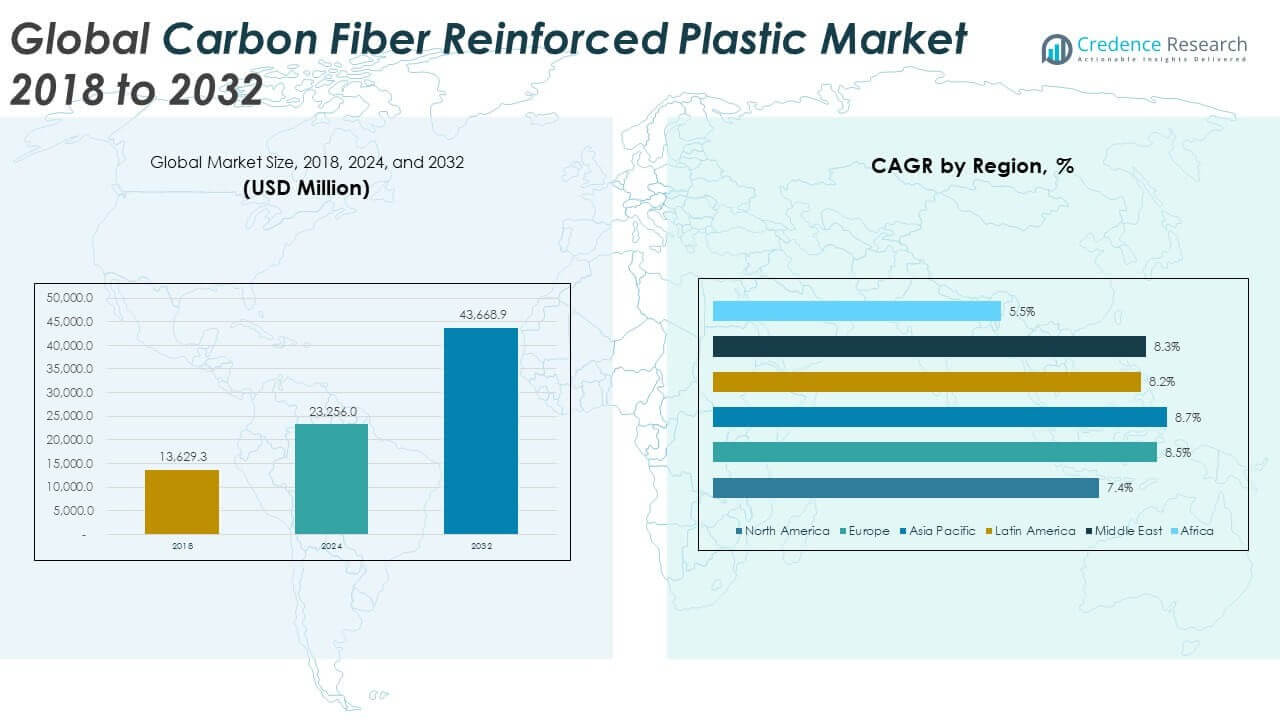
The Global Carbon Fiber Reinforced Plastic Market size was valued at USD 13,629.3 million in 2018 to USD 23,256.0 million in 2024 and is anticipated to reach USD 43,668.9 million by 2032, at a CAGR of 8.17% during the forecast period.
| REPORT ATTRIBUTE | DETAILS |
|---|---|
| Historical Period | 2020-2023 |
| Base Year | 2024 |
| Forecast Period | 2025-2032 |
| Carbon Fiber Reinforced Plastic Market Size 2024 | USD 23,256.0 million |
| Carbon Fiber Reinforced Plastic Market, CAGR | 8.17% |
| Carbon Fiber Reinforced Plastic Market Size 2032 | USD 43,668.9 million |
The growth of the Carbon Fiber Reinforced Plastic market is primarily driven by increasing demand for lightweight and fuel-efficient materials across transportation and energy sectors. Automotive and aerospace manufacturers actively adopt CFRP to reduce vehicle and aircraft weight, thereby enhancing fuel efficiency and meeting strict environmental regulations. This shift is also supported by growing government pressure to lower carbon emissions and improve energy efficiency. CFRP’s high strength-to-weight ratio, corrosion resistance, and structural rigidity make it a preferred material in structural and performance components. Simultaneously, rapid innovation in precursor materials and production techniques, including advancements in thermoplastic resin matrices and automation of lay-up processes, has improved production efficiency and cost-effectiveness. Wind energy is another key sector contributing to market expansion, as CFRP is increasingly used in the construction of long, lightweight wind turbine blades. Beyond industrial use, consumer goods manufacturers are exploring CFRP applications in sports equipment, electronics, and luxury goods due to its aesthetic appeal and premium performance attributes. This broadening scope, combined with continuous R&D investments and emerging circular economy initiatives, reinforces the market’s upward trajectory.
From a geographic perspective, Europe currently leads the Carbon Fiber Reinforced Plastic market, owing to its advanced automotive and aerospace manufacturing capabilities, strict environmental regulations, and strong emphasis on renewable energy. Countries such as Germany, France, and the United Kingdom host major CFRP manufacturers and research hubs focused on composites innovation. North America follows closely, particularly driven by the United States, where the market benefits from extensive applications in aerospace, defense, and automotive sectors. The presence of leading aerospace firms, government defense contracts, and emission-reduction mandates are all contributing to sustained CFRP demand. Meanwhile, the Asia Pacific region is rapidly emerging as a key growth area, led by China, Japan, South Korea, and India. In these countries, expanding industrialization, rising automotive production, and increasing investments in wind and solar infrastructure are accelerating CFRP adoption. Local governments are also supporting domestic CFRP manufacturing capabilities to reduce dependency on imports and strengthen technological self-sufficiency.
Market Insights:
- The Global Carbon Fiber Reinforced Plastic Market was valued at USD 13,629.3 million in 2018 and is projected to reach USD 43,668.9 million by 2032, growing at a CAGR of 8.17% during the forecast period.
- Strong demand from automotive and aerospace sectors supports rapid market growth, as CFRP helps reduce vehicle and aircraft weight while improving fuel efficiency and meeting global emissions standards.
- Renewable energy initiatives boost CFRP adoption in wind turbine blade manufacturing due to its strength, fatigue resistance, and light weight, enhancing overall energy output.
- Europe leads the market due to advanced automotive and aerospace infrastructure, strict emission policies, and established composite research hubs in countries like Germany and the UK.
- North America, driven by the United States, shows consistent demand for CFRP in defense, aviation, and electric vehicle manufacturing due to regulatory mandates and technological capabilities.
- Asia Pacific emerges as a fast-growing region, led by China, Japan, India, and South Korea, fueled by industrial expansion, infrastructure development, and domestic CFRP manufacturing investments.
- High production costs and limited recycling infrastructure remain major challenges, but innovation in thermoplastic formulations, automated production, and public-private collaborations continue to unlock new opportunities.
Market Drivers:
Rising Demand for Lightweight Materials Across Mobility Sectors:
Automotive, aerospace, and transportation sectors increasingly prioritize lightweight construction to reduce fuel consumption and improve operational efficiency. The Global Carbon Fiber Reinforced Plastic Market benefits from this shift, as CFRP offers an ideal combination of strength, rigidity, and low weight. Stringent emissions regulations in Europe, North America, and Asia drive OEMs to replace traditional metals with CFRP components. Aircraft manufacturers rely on CFRP for fuselage, wings, and interior structures to enhance fuel economy and payload capacity. Automotive brands incorporate it into body panels, frames, and interior trims to support electric vehicle range extension. The demand for lightweight composites continues to grow, reinforcing CFRP’s importance in next-generation mobility platforms.
- For instance, BMW’s i3 electric vehicle features a full carbon fiber passenger cell, making it one of the first mass-produced cars to extensively use CFRP in its body structure, reducing overall vehicle weight by approximately 250 kg compared to a conventional steel structure.
Expanding Applications in Renewable Energy and Infrastructure:
Wind energy developers deploy CFRP in turbine blade production to improve blade length, reduce weight, and increase power generation efficiency. The Global Carbon Fiber Reinforced Plastic Market gains momentum as governments fund renewable energy infrastructure and establish clean energy targets. CFRP’s durability and fatigue resistance make it well-suited for long-term outdoor structural applications. Infrastructure projects increasingly integrate CFRP to strengthen bridges, buildings, and pipelines without adding excessive load. Engineers value its corrosion resistance, especially in marine and coastal environments. Public and private sectors continue to adopt CFRP in large-scale projects that require longevity and performance.
- For instance, engineers at Sandia National Laboratories retrofitted SERI-8 wind turbine blades with carbon fibers and found the hybrid blade design increased structural properties while cutting blade weight by 25% compared to conventional fiberglass blades.
Advancement in Material Processing and Manufacturing Technologies:
Manufacturers invest in automated production systems, resin infusion techniques, and advanced thermoplastic formulations to reduce cycle times and material waste. These innovations strengthen the Global Carbon Fiber Reinforced Plastic Market by making CFRP components more accessible and cost-competitive. Improvements in tow placement, preform development, and curing processes accelerate output without compromising quality. Thermoplastic-based CFRP also supports recyclability, which aligns with global sustainability goals. Industry players integrate AI and robotics to streamline inspection and fabrication stages. Process optimization enhances production scalability, encouraging broader adoption across mid-sized enterprises.
Supportive Regulatory Frameworks and Industry Collaborations:
Governments and regulatory bodies promote the use of CFRP through funding programs, sustainability incentives, and emissions mandates. The Global Carbon Fiber Reinforced Plastic Market benefits from collaborative initiatives between OEMs, material suppliers, and academic institutions. Public-private partnerships accelerate development of cost-effective composite technologies and support pilot-scale production efforts. Industry standards and testing protocols evolve to ensure CFRP performance in critical applications. Defense agencies and aerospace regulators approve CFRP integration in mission-critical platforms, further validating its reliability. Policy alignment and cross-sector cooperation strengthen the foundation for long-term market growth.
Market Trends:
Integration of CFRP in Consumer Electronics and Luxury Goods:
Electronics manufacturers adopt CFRP for lightweight, stylish, and durable casings in laptops, smartphones, and wearable devices. The Global Carbon Fiber Reinforced Plastic Market expands beyond industrial domains as brands seek materials that combine strength and visual appeal. Luxury goods producers incorporate CFRP in watches, luggage, and accessories to elevate brand identity and product differentiation. Its tactile finish and futuristic aesthetic contribute to premium positioning. CFRP’s high strength-to-thickness ratio supports the design of ultra-thin yet resilient products. Consumer interest in performance-enhanced materials continues to reshape product development strategies.
- For instance, The world's first high-performance carbon fiber luggage series uses patented processes with carbon fiber strands. This results in luggage that is extremely lightweight (around 8.8 lbs for a carry-on) yet highly impact resistant, featuring structural reinforcement and smooth-rolling stainless steel ball bearing wheels.
Customization and Design Flexibility in High-End Applications:
Product designers increasingly use CFRP for its formability, moldability, and ability to create intricate geometries without compromising strength. The Global Carbon Fiber Reinforced Plastic Market responds to this trend by supplying variants optimized for specific visual or mechanical requirements. Automotive and aerospace interiors showcase custom textures, colors, and surface treatments enabled by CFRP. Architectural firms deploy CFRP panels and structures in signature building designs. Design studios leverage its flexibility for conceptual prototypes and bespoke components. High-value applications continue to push CFRP’s aesthetic and structural boundaries.
- For instance, BMW offers a range of carbon fiber parts, including splitters, side sill extensions, rear diffusers, tailpipe trims, and mirror caps, designed for aesthetics and weight reduction. These components are applied to models such as the BMW M5, emphasizing both functional performance and visual appeal.
Growing Emphasis on Circular Economy and Recycling Initiatives:
Sustainability frameworks push industries to develop recyclable CFRP solutions and minimize end-of-life environmental impacts. The Global Carbon Fiber Reinforced Plastic Market tracks this shift through innovations in thermoplastic matrices and pyrolysis-based recycling. Manufacturers partner with waste management firms to establish CFRP reclamation and repurposing programs. R&D teams explore low-energy fiber recovery and secondary material usage. Aerospace and automotive companies introduce take-back schemes to close the materials loop. Recycling capability becomes a strategic differentiator for CFRP suppliers.
Rising Penetration in Medical and Sports Equipment:
CFRP’s biocompatibility, lightweight structure, and fatigue resistance attract attention in medical prosthetics, orthotic supports, and surgical tools. The Global Carbon Fiber Reinforced Plastic Market gains traction in healthcare due to the need for high-performance materials in patient care. Sports equipment manufacturers use CFRP in bicycles, racquets, helmets, and protective gear to boost agility and safety. Athletes and professionals demand gear that balances strength and responsiveness. Product innovation across recreational and healthcare segments supports CFRP’s visibility in human-centered applications.
Market Challenges Analysis:
High Production Costs and Energy-Intensive Manufacturing Processes:
The Global Carbon Fiber Reinforced Plastic Market faces significant cost-related challenges due to the expensive nature of raw materials and complex manufacturing techniques. Producing carbon fiber from polyacrylonitrile (PAN) or pitch precursors involves high-temperature processes that consume substantial energy and require specialized equipment. These cost-intensive inputs raise the overall price of CFRP components, limiting their use to premium applications. Small and mid-sized manufacturers struggle to absorb these expenses or scale operations without financial risk. It also remains difficult to reduce costs without compromising material performance. Cost barriers slow down adoption across mass-market automotive, infrastructure, and consumer goods sectors.
Limited Recycling Infrastructure and Material Recovery Challenges:
CFRP recycling remains underdeveloped compared to traditional materials like steel or aluminum, creating sustainability concerns for industries that prioritize environmental impact. The Global Carbon Fiber Reinforced Plastic Market encounters obstacles in end-of-life processing, with fiber degradation and matrix separation posing technical difficulties. Thermoset-based CFRPs, which dominate in aerospace and automotive use, present greater recycling complexity due to their irreversible curing process. Although emerging recycling methods such as pyrolysis and solvolysis show promise, they remain costly and not widely available. Manufacturers face pressure to invest in closed-loop systems and scalable recovery methods. These limitations constrain the material’s long-term sustainability potential and regulatory alignment.
Market Opportunities:
Expansion into Mass-Market Automotive and Electric Vehicles:
The Global Carbon Fiber Reinforced Plastic Market holds strong opportunity in the growing electric vehicle (EV) segment and mid-range automotive platforms. OEMs seek lightweight materials to extend battery range and improve energy efficiency. CFRP's strength-to-weight advantage aligns with these performance goals. Mass-market adoption depends on scalable production, modular design integration, and cost optimization. Partnerships between automakers and material suppliers can accelerate commercial viability. Market players that deliver high-volume, automotive-grade CFRP at reduced costs will gain early advantage.
Emergence of Smart Infrastructure and Urban Mobility Solutions:
Rising demand for smart cities and sustainable urban development opens new applications for CFRP in transportation systems, modular buildings, and public infrastructure. The Global Carbon Fiber Reinforced Plastic Market can support lightweight, corrosion-resistant components in pedestrian bridges, railway systems, and prefabricated structures. Urban planners’ value CFRP’s durability, design flexibility, and low maintenance requirements. Integration into drone delivery platforms and micro-mobility devices also expands its scope. Long-term infrastructure investments and urban transit upgrades create space for CFRP innovation. Players that align product development with city-level sustainability goals will access new revenue streams.
Market Segmentation Analysis:
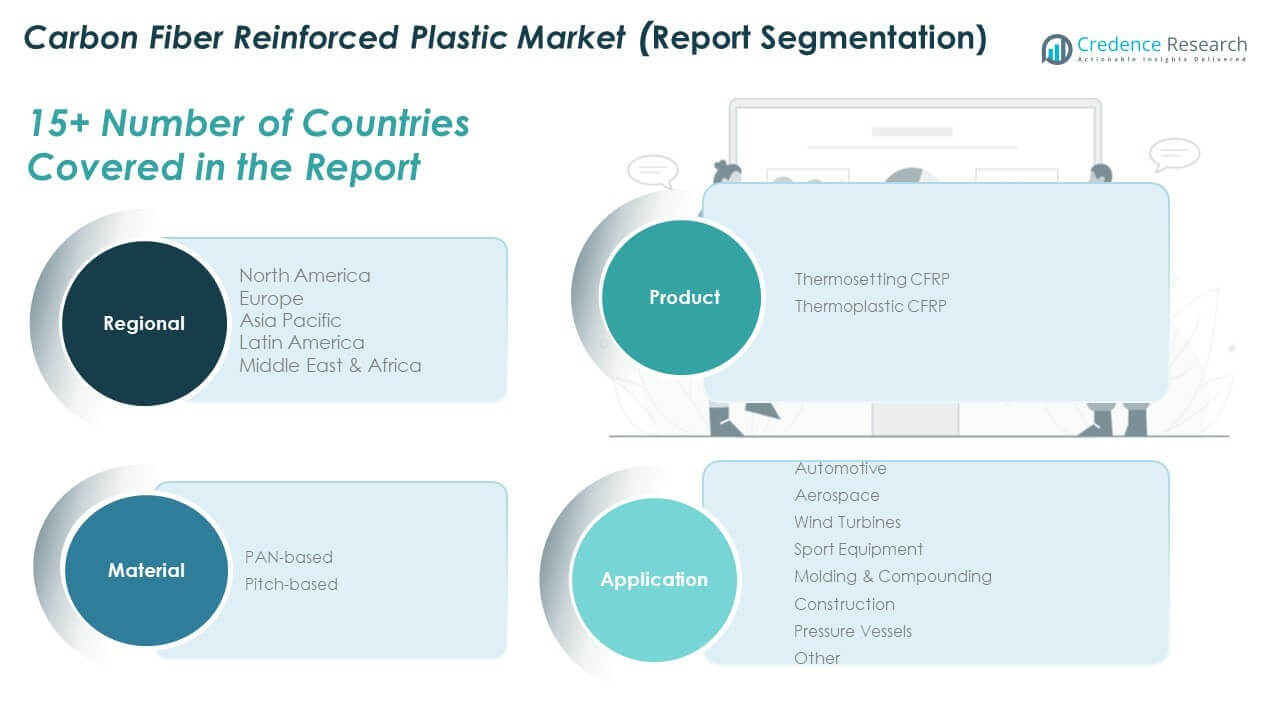
By Product
The market includes thermosetting and thermoplastic CFRP. Thermosetting CFRP holds the largest share due to its high strength, thermal stability, and suitability for structural applications in aerospace, automotive, and energy. It offers excellent rigidity once cured. Thermoplastic CFRP is expanding rapidly, supported by its recyclability, faster processing cycles, and growing use in high-volume production environments such as automotive components.
- For instance, SGL Carbon manufactures EV battery housings using thermosetting CFRP, achieving up to 50% weight reduction compared to steel components, with high fire resistance and thermal shielding.
By Material
PAN-based carbon fibers dominate the Global Carbon Fiber Reinforced Plastic Market, favored for their superior tensile strength, reliability, and established commercial supply. It supports critical applications across transportation, defense, and wind energy. Pitch-based carbon fibers serve specialized markets where high modulus and thermal conductivity are necessary, including aerospace thermal shielding and advanced pressure vessels.
- For instance, select commercial PAN-based carbon fibers reach tensile strengths exceeding 5,000 MPa, supporting demanding loads in automotive, defense, and renewable energy applications.
By Application
Automotive is a leading segment, driven by rising demand for lightweight vehicles and electric mobility. CFRP components improve energy efficiency and performance in structural and interior applications. The aerospace segment consistently contributes strong demand due to CFRP’s role in reducing aircraft weight and enhancing fuel economy. Wind turbines represent a fast-growing segment where CFRP enables longer blades and improved energy output. Sports equipment leverages CFRP for its performance edge in products like bicycles, racquets, and helmets. Construction uses CFRP in retrofitting and load-bearing applications. Molding and compounding support industrial use, while pressure vessels and other applications benefit from CFRP’s corrosion resistance and strength.
Segmentation:
By Product
- Thermosetting CFRP
- Thermoplastic CFRP
By Material
- PAN-based
- Pitch-based
By Application
- Automotive
- Aerospace
- Wind Turbines
- Sport Equipment
- Molding & Compounding
- Construction
- Pressure Vessels
- Other
By Region
- North America
- U.S.
- Canada
- Mexico
- Europe
- Germany
- France
- U.K.
- Italy
- Spain
- Rest of Europe
- Asia Pacific
- China
- Japan
- India
- South Korea
- South-east Asia
- Rest of Asia Pacific
- Latin America
- Brazil
- Argentina
- Rest of Latin America
- Middle East & Africa
- GCC Countries
- South Africa
- Rest of the Middle East and Africa
Regional Analysis:
North America
The North America Carbon Fiber Reinforced Plastic Market size was valued at USD 2,695.88 million in 2018 to USD 4,422.63 million in 2024 and is anticipated to reach USD 7,860.41 million by 2032, at a CAGR of 7.4% during the forecast period. North America accounts for approximately 19% of the Global Carbon Fiber Reinforced Plastic Market. It benefits from the region’s mature aerospace and defense sectors, with leading manufacturers integrating CFRP into next-generation aircraft and military platforms. The United States drives demand through stringent fuel economy regulations and extensive R&D investments in composite technologies. Electric vehicle manufacturers increasingly adopt CFRP to reduce weight and extend range. Government-backed sustainability goals and industrial funding support expansion across energy and infrastructure sectors. CFRP remains a strategic material in U.S. innovation and defense efforts.
Europe
The Europe Carbon Fiber Reinforced Plastic Market size was valued at USD 2,968.46 million in 2018 to USD 5,172.80 million in 2024 and is anticipated to reach USD 9,982.72 million by 2032, at a CAGR of 8.5% during the forecast period. Europe holds around 22.9% share of the Global Carbon Fiber Reinforced Plastic Market, led by Germany, France, and the United Kingdom. The region shows strong adoption in automotive light weighting, driven by environmental regulations and emission reduction targets. Aerospace OEMs such as Airbus continue integrating CFRP in airframes and interior components. Renewable energy infrastructure, particularly in offshore wind, expands CFRP use in large turbine blades. Europe’s established composite research hubs and manufacturing base ensure high standards in production and design capabilities. It continues to lead in innovation and deployment of sustainable CFRP solutions.
Asia Pacific
The Asia Pacific Carbon Fiber Reinforced Plastic Market size was valued at USD 4,662.59 million in 2018 to USD 8,212.03 million in 2024 and is anticipated to reach USD 16,061.44 million by 2032, at a CAGR of 8.7% during the forecast period. Asia Pacific commands the largest share of the Global Carbon Fiber Reinforced Plastic Market at 37%. China, Japan, South Korea, and India drive market growth through rising demand in automotive, industrial, and renewable energy sectors. Governments invest in CFRP production facilities to boost domestic capability and reduce import reliance. CFRP adoption accelerates in electric vehicles, wind turbine blades, and infrastructure reinforcement. Competitive pricing and local innovation attract global partnerships and technology transfers. Asia Pacific’s industrial expansion and regulatory reforms position it for sustained leadership.
Latin America
The Latin America Carbon Fiber Reinforced Plastic Market size was valued at USD 1,533.30 million in 2018 to USD 2,625.27 million in 2024 and is anticipated to reach USD 4,952.06 million by 2032, at a CAGR of 8.2% during the forecast period. Latin America holds about 11.3% share of the Global Carbon Fiber Reinforced Plastic Market. Brazil and Mexico anchor demand due to growing automotive production and defense procurement. Aerospace assembly lines and infrastructure projects increasingly adopt CFRP to meet durability and performance requirements. Renewable energy initiatives expand CFRP use in wind energy components. Government infrastructure programs offer new opportunities for CFRP in structural reinforcement. It remains an emerging market with high potential tied to regional modernization plans.
Middle East
The Middle East Carbon Fiber Reinforced Plastic Market size was valued at USD 735.98 million in 2018 to USD 1,266.79 million in 2024 and is anticipated to reach USD 2,406.16 million by 2032, at a CAGR of 8.3% during the forecast period. The region contributes approximately 5.5% to the Global Carbon Fiber Reinforced Plastic Market. Countries such as the UAE and Saudi Arabia invest in high-performance materials for aerospace, defense, and infrastructure. Smart city projects and high-end construction boost demand for CFRP in architectural elements and transportation networks. The region focuses on diversifying from oil dependency by adopting advanced composites in new industries. Investment in renewable energy projects also supports CFRP use in turbine components. It gradually becomes a niche hub for high-value CFRP applications.
Africa
The Africa Carbon Fiber Reinforced Plastic Market size was valued at USD 1,033.10 million in 2018 to USD 1,556.49 million in 2024 and is anticipated to reach USD 2,406.16 million by 2032, at a CAGR of 5.5% during the forecast period. Africa accounts for about 4.3% of the Global Carbon Fiber Reinforced Plastic Market. Market growth is driven by early-stage infrastructure upgrades, transportation modernization, and renewable energy development. South Africa plays a central role in aerospace and composite research initiatives. Public sector-led infrastructure projects offer scope for CFRP in bridge and pipeline reinforcement. Challenges remain around supply chain, skilled labor, and production capacity. It holds long-term potential as industrial capabilities expand and sustainability goals intensify.
Key Player Analysis:
- Toray Industries Inc.
- Teijin Limited
- Mitsubishi Chemical Holdings Corporation
- SGL Group
- Formosa Plastics Corporation
- Hexcel Corporation
- Gurit Holding AG
- Plasan Carbon Composites
- Kringlan Composites AG
- Other Key Players
Competitive Analysis:
The Global Carbon Fiber Reinforced Plastic Market features a competitive landscape shaped by innovation, capacity expansion, and vertical integration. Leading players include Toray Industries, Teijin Limited, SGL Group, and Hexcel Corporation. These companies invest heavily in R&D to enhance material performance, reduce production costs, and scale thermoplastic CFRP offerings. Strategic partnerships with automotive, aerospace, and renewable energy firms strengthen supply chains and secure long-term contracts. Emerging players focus on regional markets and application-specific solutions, particularly in Asia Pacific. The market sees active mergers and acquisitions aimed at consolidating expertise and expanding global reach. It remains moderately consolidated, with top-tier players holding significant market share. Competitive advantage depends on proprietary fiber technologies, processing capabilities, and responsiveness to sustainability mandates. Companies that align innovation with cost efficiency and regulatory compliance continue to lead. The market rewards agility, application diversity, and consistent investment in advanced composite technologies.
Recent Developments:
- In June 2025, Toray Industries Inc. announced the expansion of its advanced thermoplastic composite portfolio with the introduction of Toray Cetex® TC1130 PESU, specifically engineered for aircraft interior applications, and Toray Cetex TC915 PA+™ for lightweight design in urban air mobility and unmanned systems. The company also showcased the TORAYCA™ T1200, which offers the world’s highest tensile strength of 8.0 GPa, at the Paris Air Show, underlining its leadership in aerospace innovation and commitment to next-generation aviation materials.
- In April 2025, Gurit Holding AG secured CHF 120 million in financing, ensuring continued support for high-performance composite materials delivery, particularly for wind turbine blade manufacturing. The company also announced in March 2025 the re-signing of a long-term supply contract for the defense sector, supporting its multi-market strategy and strong presence in marine and defense composites.
- In March 2025, Mitsubishi Chemical Holdings Corporation announced a landmark partnership with French chemical leader SNF, initiating a pioneering project to produce N-vinylformamide (NVF), an essential monomer for advanced polymers. The new NVF facility, operational since December 2024 and fully ramped up by the second quarter of 2025, leverages Mitsubishi Chemical’s monomer technology to drive innovation and circular economy objectives in industrial manufacturing.
Market Concentration & Characteristics:
The Global Carbon Fiber Reinforced Plastic Market shows moderate-to-high market concentration, with a few multinational players controlling a significant share of global production capacity. It is characterized by high entry barriers due to capital-intensive manufacturing, proprietary technology requirements, and long qualification cycles, particularly in aerospace and automotive sectors. The market favors vertically integrated companies that manage the full value chain from fiber production to composite fabrication. It exhibits strong technological orientation, with emphasis on performance, cost reduction, and sustainability. Innovation, quality consistency, and strategic partnerships play critical roles in competitive positioning. Demand remains application-driven, with product customization and regulatory compliance shaping purchasing decisions.
Report Coverage:
The research report offers an in-depth analysis based on product, material, and application. It details leading market players, providing an overview of their business, product offerings, investments, revenue streams, and key applications. Additionally, the report includes insights into the competitive environment, SWOT analysis, current market trends, as well as the primary drivers and constraints. Furthermore, it discusses various factors that have driven market expansion in recent years. The report also explores market dynamics, regulatory scenarios, and technological advancements that are shaping the industry. It assesses the impact of external factors and global economic changes on market growth. Lastly, it provides strategic recommendations for new entrants and established companies to navigate the complexities of the market.
Future Outlook:
- Increased EV production will drive demand for lightweight CFRP components to extend battery range and meet emission targets.
- Advancements in thermoplastic CFRP will support higher recyclability and enable cost-effective mass production.
- Aerospace sector will continue to adopt CFRP for structural parts to enhance fuel efficiency and reduce maintenance.
- Wind energy expansion, especially offshore, will create opportunities for CFRP in longer and lighter turbine blades.
- Infrastructure projects will integrate CFRP for corrosion-resistant reinforcement in bridges, tunnels, and marine structures.
- Consumer electronics and luxury goods sectors will grow as CFRP gains popularity for its durability and premium appeal.
- Asia Pacific will lead volume growth due to rising domestic production and expanding industrial applications.
- Strategic collaborations between OEMs and composite manufacturers will accelerate technology adoption and supply chain efficiency.
- Investment in recycling technologies and closed-loop systems will improve material sustainability and regulatory alignment.
- Innovation in manufacturing automation and AI-based quality control will enhance scalability and production precision.
Request a Free Sample
Fill in your details and we'll send you a free sample report.
- Sample data tables & charts
- Research methodology
Market Dynamics
Lightweighting in Transportation and Mobility
Automotive and aerospace manufacturers are increasingly adopting CFRP to reduce vehicle and aircraft weight, which directly improves fuel efficiency and helps meet stringent global emissions regulations. This trend is reinforced by the shift toward electric vehicles, where lightweight materials are critical for extending battery range.
Expansion of Renewable Energy Infrastructure
The use of CFRP in wind turbine blades is accelerating as governments and private sector players invest in renewable energy projects. CFRP's high strength-to-weight ratio and fatigue resistance enable the production of longer, lighter blades, boosting energy output and supporting clean energy targets.
Advancements in Manufacturing and Material Technology
Innovations in thermoplastic resin matrices, automated lay-up processes, and resin infusion techniques are making CFRP production more efficient and cost-effective. These advancements are lowering barriers for broader adoption across industries and enabling scalable, high-volume manufacturing.
Supportive Regulatory and Sustainability Initiatives
Government mandates for lower carbon emissions and incentives for sustainable materials are driving OEMs and suppliers to integrate CFRP into their products. Public-private partnerships and evolving industry standards are accelerating the development and qualification of CFRP for critical applications.
Diversification into Consumer and Industrial Applications
Beyond traditional sectors, CFRP is gaining traction in consumer electronics, luxury goods, sports equipment, and infrastructure due to its premium performance, design flexibility, and aesthetic appeal. This diversification is expanding the addressable market and creating new growth avenues.
Need a Custom Version of This Report?
Tailor the scope, geography, or segments to your exact requirements.
- Custom geography or segment scope
- Direct access to our analyst team
Frequently Asked Questions
What is the current size of the Global Carbon Fiber Reinforced Plastic Market?
What factors are driving the growth of the Global Carbon Fiber Reinforced Plastic Market?
What are the key segments within the Global Carbon Fiber Reinforced Plastic Market?
What are some challenges faced by the Global Carbon Fiber Reinforced Plastic Market?
Who are the major players in the Global Carbon Fiber Reinforced Plastic Market?
Table of Content
Chapter 1 Market Segmentation
- 1.1 Segmentation Framework
- 1.1.1 Product and Service Classification
- 1.1.2 Application and End-Use Classification
- 1.1.3 Technology and Solution Classification
- 1.1.4 Customer and Distribution Channel Classification
- 1.1.5 Geographic Segmentation
- 1.1.6 Market Segment Definitions and Boundaries
- 1.2 By Product
- 1.2.1 Thermosetting CFRP
- 1.2.2 Thermoplastic CFRP
- 1.3 By Material
- 1.3.1 PAN-based
- 1.3.2 Pitch-based
- 1.4 By Application
- 1.4.1 Automotive
- 1.4.2 Aerospace
- 1.4.3 Wind Turbines
- 1.4.4 Sport Equipment
- 1.4.5 Molding & Compounding
- 1.4.6 Construction
- 1.4.7 Pressure Vessels
- 1.4.8 Other
Chapter 2 Introduction
- 2.1 Report Objectives and Scope
- 2.2 Product Definition and Industry Terminology
- 2.3 Market Inclusions and Exclusions
- 2.4 Research Process
- 2.4.1 Primary Research and Expert Interviews
- 2.4.2 Secondary Research and Source Review
- 2.4.3 Top-Down and Bottom-Up Estimation
- 2.4.4 Data Triangulation and Verification
- 2.5 Market Size Measurement Basis
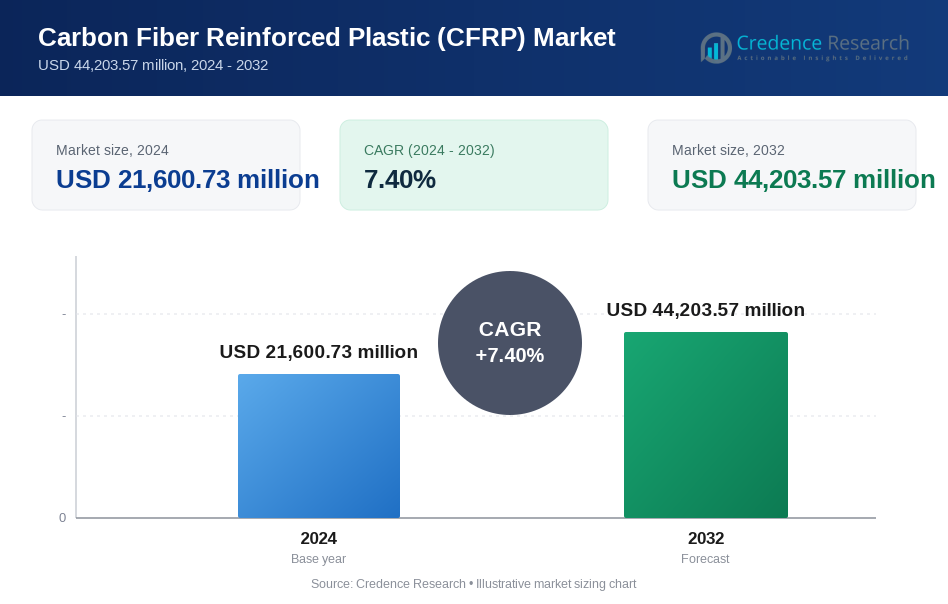
- 2.5.1 2024: USD 21,600.73 million → 2032: USD 44,203.57 million
- 2.6 Historical and Forecast Reference Periods
- 2.6.1 Base Year: 2024
- 2.6.2 Forecast Period: 2024-2032
- 2.7 Research Assumptions and Limitations
Chapter 3 Executive Summary
- 3.1 Market Snapshot and Key Findings
- 3.2 Base-Year Market Size, 2024
- 3.3 Forecast Market Size, 2032
- 3.4 Revenue and Volume Growth Outlook
- 3.5 Key Demand and Supply Indicators
- 3.6 Leading Market Segments
- 3.7 Fastest-Growing Market Opportunities
- 3.8 Regional Performance Highlights
- 3.9 Technology and Industry Transformation
- 3.10 Competitive Landscape Summary
- 3.11 Analyst View and Strategic Implications
Chapter 4 Global Carbon Fiber Reinforced Plastic (CFRP) Market Trends and Developments
- 4.1 Historical Industry Development
- 4.2 Recent Market Trends and Developments
- 4.3 Demand and Customer Behavior Trends
- 4.4 Technology and Product Innovation
- 4.5 Artificial Intelligence, Automation and Digitalization
- 4.6 Local Manufacturing and Supply Chain Realignment
- 4.7 Industry Partnerships, Mergers and Acquisitions
- 4.8 Sustainability and Circular Economy Developments
- 4.9 Government and Private Sector Investment Trends
- 4.10 Emerging Business Models and Commercialization
- 4.11 Industry Developments and Announcements
Chapter 5 Global Carbon Fiber Reinforced Plastic (CFRP) Market Production, Supply and Demand Analysis
- 5.1 Demand Trend and Consumption Analysis
- 5.2 Demand Forecast, 2024-2032
- 5.3 Production and Output Trend
- 5.4 Production and Output Forecast, 2024-2032
- 5.5 Installed Capacity and Capacity Utilization
- 5.6 Company-Wise Production Plants and Statistics
- 5.6.1 Installed Production Capacity
- 5.6.2 Actual Production
- 5.6.3 Planned Capacity and Expansion Targets
- 5.7 Supply Chain Structure and Procurement Trends
- 5.8 Supply-Demand Gap and Bottlenecks
- 5.9 Import Dependence and Sourcing Structure
- 5.10 Contract Manufacturing and Outsourcing
- 5.11 Regional Supply and Demand Concentration
Chapter 6 Global Carbon Fiber Reinforced Plastic (CFRP) Market Pricing Analysis
- 6.1 Pricing Structure and Measurement
- 6.2 Historical Pricing Trends
- 6.3 Pricing Outlook, 2024-2032
- 6.4 Average Selling Price and Unit Economics
- 6.5 Pricing by Product and Market Segment
- 6.6 Geographic Pricing Differences
- 6.7 Key Input, Energy, Labor and Logistics Costs
- 6.8 Contract Pricing and Purchasing Models
- 6.9 Pricing Sensitivity and Competitive Positioning
- 6.10 Price, Margin and Profitability Implications
Chapter 7 Global Carbon Fiber Reinforced Plastic (CFRP) Market Dynamics
- 7.1 Market Growth Drivers
- 7.1.1 Demand-Side Drivers
- 7.1.2 Technology and Innovation Drivers
- 7.1.3 Infrastructure and Investment Drivers
- 7.1.4 Regulatory and Policy Drivers
- 7.2 Market Restraints
- 7.2.1 Cost and Affordability Constraints
- 7.2.2 Technology and Adoption Barriers
- 7.2.3 Supply Chain and Operational Constraints
- 7.3 Market Challenges
- 7.3.1 Competitive Pressure and Margin Erosion
- 7.3.2 Skills, Infrastructure and Implementation Gaps
- 7.4 Emerging Market Opportunities
- 7.5 Market Dynamics Impact and Time-Horizon Assessment
Chapter 8 Global Carbon Fiber Reinforced Plastic (CFRP) Value Chain Analysis
- 8.1 Industry Value Chain Overview
- 8.2 Upstream Suppliers and Critical Inputs
- 8.3 Technology and Component Providers
- 8.4 Manufacturing or Service Delivery
- 8.5 Distribution, Channel Partners and Integrators
- 8.6 Downstream Applications and End Users
- 8.7 Value Addition and Profit Pools
- 8.8 Vertical Integration and Outsourcing
- 8.9 Supplier Concentration and Risk
- 8.10 Supply Chain Localization and Resilience
Chapter 9 Global Carbon Fiber Reinforced Plastic (CFRP) Market Regulations and Policies
- 9.1 Relevant Laws, Standards and Compliance Frameworks
- 9.2 Product, Service, Safety and Quality Requirements
- 9.3 Government Policies, Incentives and Subsidies
- 9.4 Imports, Exports and Trade Barriers
- 9.5 Public Procurement and Local Content Requirements
- 9.6 Environmental and Sustainability Compliance
- 9.7 Upcoming Policy Changes and Market Implications
Chapter 10 Global Carbon Fiber Reinforced Plastic (CFRP) Market Hotspots and Opportunities
- 10.1 Market Opportunity Mapping and Growth Hotspots
- 10.2 High-Growth Applications and Customer Groups
- 10.3 Underserved Markets and White-Space Opportunities
- 10.4 Emerging Technology and Product Opportunities
- 10.5 New Capacity and Investment Hotspots
- 10.6 Market Entry and Expansion Opportunities
- 10.7 Distribution and Partnership Opportunities
- 10.8 Near-Term and Long-Term Commercial Potential
- 10.9 Opportunity Attractiveness and Execution Risks
Chapter 11 Global Carbon Fiber Reinforced Plastic (CFRP) Market Outlook, 2024-2032
- 11.1 Market Size and Analysis
- 11.1.1 Revenue (Market Measurement: 2024: USD 21,600.73 million → 2032: USD 44,203.57 million)
- 11.1.2 Market Volume and Quantity Sold
- 11.1.3 Historical Market Size
- 11.1.4 Base-Year Market Size, 2024
- 11.2 Market Forecast, 2024-2032
- 11.2.1 Revenue Forecast to 2032
- 11.2.2 Volume Forecast to 2032
- 11.2.3 CAGR and Year-on-Year Growth
- 11.2.4 Incremental Revenue Opportunity
- 11.3 Forecast Assumptions and Scenario Analysis
- 11.3.1 Base-Case Forecast
- 11.3.2 Optimistic and Conservative Scenarios
- 11.3.3 Technology, Pricing and Policy Sensitivities
- 11.4 Market Attractiveness and Growth Outlook
Chapter 12 Global Carbon Fiber Reinforced Plastic (CFRP) Market Segmentation and Outlook
- 12.1 Segmentation Summary and Market Shares, 2024
- 12.2 Largest and Fastest-Growing Segments
- 12.3 By Product - Market Size and Forecast, 2024-2032
- 12.3.1 Segment Definition and Scope
- 12.3.2 Historical Market Size
- 12.3.3 Revenue Forecast, 2024-2032
- 12.3.4 Volume Forecast, 2024-2032
- 12.3.5 Base-Year Market Share, 2024
- 12.3.6 Segment CAGR and Growth Drivers
- 12.3.7 Subsegment Market Size and Forecast
- 12.3.7.1 Thermosetting CFRP
- 12.3.7.2 Thermoplastic CFRP
- 12.3.8 Subsegment Pricing and Adoption Trends
- 12.3.9 Leading Suppliers and Competition
- 12.3.10 Regional Demand and Opportunities
- 12.4 By Material - Market Size and Forecast, 2024-2032
- 12.4.1 Segment Definition and Scope
- 12.4.2 Historical Market Size
- 12.4.3 Revenue Forecast, 2024-2032
- 12.4.4 Volume Forecast, 2024-2032
- 12.4.5 Base-Year Market Share, 2024
- 12.4.6 Segment CAGR and Growth Drivers
- 12.4.7 Subsegment Market Size and Forecast
- 12.4.7.1 PAN-based
- 12.4.7.2 Pitch-based
- 12.4.8 Subsegment Pricing and Adoption Trends
- 12.4.9 Leading Suppliers and Competition
- 12.4.10 Regional Demand and Opportunities
- 12.5 By Application - Market Size and Forecast, 2024-2032
- 12.5.1 Segment Definition and Scope
- 12.5.2 Historical Market Size
- 12.5.3 Revenue Forecast, 2024-2032
- 12.5.4 Volume Forecast, 2024-2032
- 12.5.5 Base-Year Market Share, 2024
- 12.5.6 Segment CAGR and Growth Drivers
- 12.5.7 Subsegment Market Size and Forecast
- 12.5.7.1 Automotive
- 12.5.7.2 Aerospace
- 12.5.7.3 Wind Turbines
- 12.5.7.4 Sport Equipment
- 12.5.7.5 Molding & Compounding
- 12.5.7.6 Construction
- 12.5.7.7 Pressure Vessels
- 12.5.7.8 Other
- 12.5.8 Subsegment Pricing and Adoption Trends
- 12.5.9 Leading Suppliers and Competition
- 12.5.10 Regional Demand and Opportunities
- 12.6 Segment Growth Comparison
- 12.7 Segment Attractiveness and Priority Matrix
Chapter 13 Global Carbon Fiber Reinforced Plastic (CFRP) End-Use and Application Market Outlook
- 13.1 End-Use Industry and Customer Demand Structure
- 13.2 Leading Applications and Customer Groups
- 13.3 End-Use Market Size, Share and Forecast
- 13.4 Major End-Use Industry Deep Dives
- 13.4.1 Customer Requirements and Use Cases
- 13.4.2 Demand and Replacement Cycles
- 13.4.3 Technical and Regulatory Considerations
- 13.4.4 Purchasing and Procurement Models
- 13.4.5 Leading Vendors and Distribution Channels
- 13.4.6 Forecast and Commercial Opportunities
- 13.5 Emerging Applications and Cross-Segment Demand
- 13.6 End-Use Industry Investment Priorities
Chapter 14 Global Carbon Fiber Reinforced Plastic (CFRP) Geographic Market Outlook, 2024-2032
- 14.1 Regional Market Size and Share, 2024
- 14.2 Regional Market Forecast, 2024-2032
- 14.3 Regional Pricing, Production and Demand Differences
- 14.4 North America
- 14.4.1 United States
- 14.4.2 Canada
- 14.4.3 Mexico
- 14.5 Europe
- 14.5.1 Germany
- 14.5.2 France
- 14.5.3 Italy
- 14.5.4 United Kingdom
- 14.5.5 Spain
- 14.5.6 Poland
- 14.5.7 Russia
- 14.5.8 Netherlands
- 14.5.9 Belgium
- 14.5.10 Sweden
- 14.5.11 Denmark
- 14.5.12 Norway
- 14.5.13 Rest of Europe
- 14.6 Asia Pacific
- 14.6.1 China
- 14.6.2 India
- 14.6.3 Japan
- 14.6.4 South Korea
- 14.6.5 Thailand
- 14.6.6 Indonesia
- 14.6.7 Vietnam
- 14.6.8 Malaysia
- 14.6.9 Australia
- 14.6.10 Rest of Asia Pacific
- 14.7 Latin America
- 14.7.1 Brazil
- 14.7.2 Argentina
- 14.7.3 Colombia
- 14.7.4 Chile
- 14.7.5 Rest of Latin America
- 14.8 Middle East
- 14.8.1 Saudi Arabia
- 14.8.2 United Arab Emirates
- 14.8.3 Turkey
- 14.8.4 Israel
- 14.8.5 Iran
- 14.8.6 Rest of the Middle East
- 14.9 Africa
- 14.9.1 South Africa
- 14.9.2 Egypt
- 14.9.3 Nigeria
- 14.9.4 Morocco
- 14.9.5 Rest of Africa
- 14.10 Regional Investment, Policy and Supply Chain Differences
- 14.11 Regional Competitive Landscape
- 14.12 Geographic Growth Hotspots
Chapter 15 Global Carbon Fiber Reinforced Plastic (CFRP) Technology, Innovation and Sustainability Outlook
- 15.1 Technology Landscape and Maturity
- 15.2 Product, Process and Service Innovation
- 15.3 AI, Automation and Digital Tools in the Industry
- 15.4 Technology Adoption and Performance Benchmarking
- 15.5 Innovation Pipeline and R&D Investment
- 15.6 Patent and Intellectual Property Trends
- 15.7 Energy Efficiency and Resource Management
- 15.8 Sustainability, Recycling and Circularity
- 15.9 Technology Roadmap, 2024-2032
- 15.10 Risks of Obsolescence and Technology Substitution
Chapter 16 Global Carbon Fiber Reinforced Plastic (CFRP) Market Key Strategic Imperatives
- 16.1 Growth and Market Entry Priorities
- 16.2 High-Return Products and Segments
- 16.3 Pricing, Profitability and Cost Optimization
- 16.4 Technology Investment and Product Differentiation
- 16.5 Supply Chain Localization and Resilience
- 16.6 Distribution and Customer Acquisition
- 16.7 Partnership, Acquisition and Capacity Strategy
- 16.8 Regional Expansion Priorities
- 16.9 Short-, Medium- and Long-Term Actions
Chapter 17 Competition Outlook
- 17.1 Industry Competition Characteristics
- 17.2 Market Structure and Concentration
- 17.3 Market Share and Competitive Positioning, 2024
- 17.4 Company-Wise Revenue and Product Benchmarking
- 17.5 Production and Service Capacity Benchmarking
- 17.6 Technology, Pricing and Differentiation
- 17.7 Regional Footprint and Distribution Strength
- 17.8 Mergers, Acquisitions and Strategic Alliances
- 17.9 New Entrants and Competitive Threats
- 17.10 Porter's Five Forces and Industry Attractiveness
- 17.11 Competitive Outlook, 2024-2032
Chapter 18 Company Profiles
- 18.1 Company Coverage and Selection Criteria
- 18.2 Toray Industries Inc.
- 18.2.1 Business Description
- 18.2.2 Company Ownership and Geographic Presence
- 18.2.3 Product and Service Portfolio
- 18.2.4 Manufacturing and Operating Footprint
- 18.2.5 Production Capacity and Expansion Plans
- 18.2.6 Financial Performance and Investment
- 18.2.7 Market Share and Competitive Position
- 18.2.8 Technology and Innovation Capabilities
- 18.2.9 Strategic Alliances or Partnerships
- 18.2.10 Recent Developments
- 18.2.11 Growth Strategy and Outlook
- 18.3 Teijin Limited
- 18.4 Mitsubishi Chemical Holdings Corporation
- 18.5 SGL Group
- 18.6 Formosa Plastics Corporation
- 18.7 Hexcel Corporation
- 18.8 Gurit Holding AG
- 18.9 Plasan Carbon Composites
- 18.10 Kringlan Composites AG
- 18.11 Other Relevant Market Participants
Note: Every listed company is profiled on the structure shown under the first company. The company list is preliminary and may change based on research findings, market developments, data availability and client requirements.
Chapter 19 Disclaimer
- 19.1 Research and Forecast Disclaimer
- 19.2 Data Source and Estimation Limitations
Note: The depth of individual sections depends on data availability for this market. Volume, capacity, trade and other unit-based metrics are included where applicable.

