
Cardiac Rhythm Management Devices Market Overview:
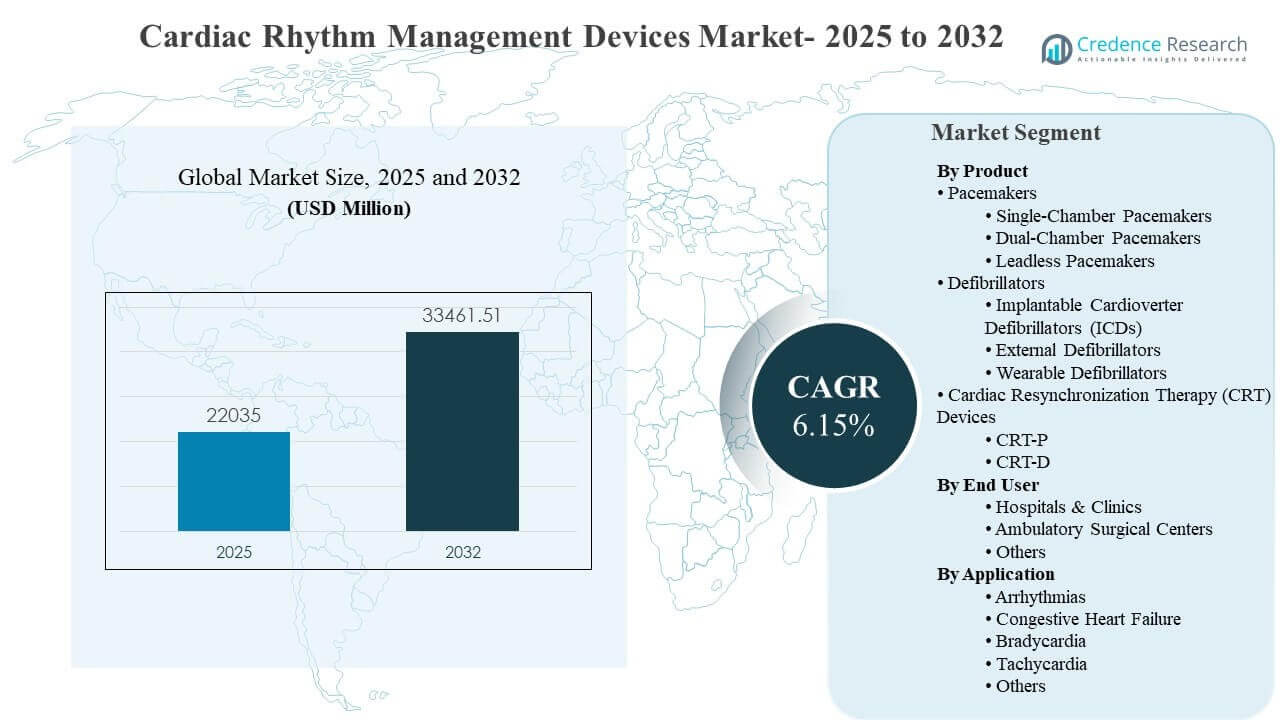
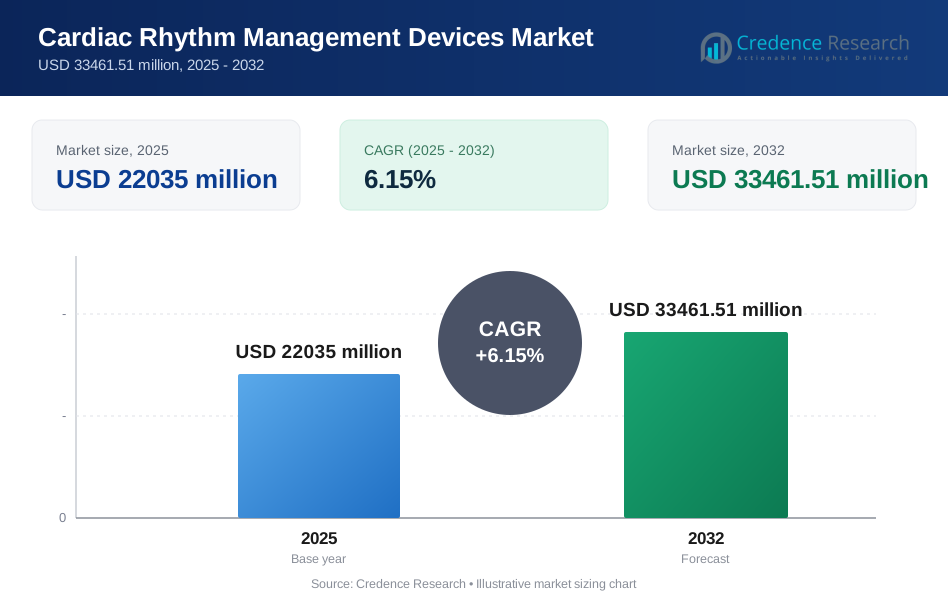
The global Cardiac rhythm management devices market size was estimated at USD 22035 million in 2025 and is expected to reach USD 33461.51 million by 2032, growing at a CAGR of 6.15% from 2025 to 2032. Growth is primarily driven by rising diagnosis and long-term management needs for atrial fibrillation, bradycardia, and ventricular arrhythmias across aging populations, combined with higher implant volumes and replacement demand. North America continues to set the pace for advanced therapy adoption, with Europe maintaining strong procedural depth and Asia Pacific expanding access through improving electrophysiology capacity.
| REPORT ATTRIBUTE | DETAILS |
|---|---|
| Historical Period | 2020-2024 |
| Base Year | 2025 |
| Forecast Period | 2026-2032 |
| Cardiac Rhythm Management Devices Market Size 2025 | USD 22035 million |
| Cardiac Rhythm Management Devices Market, CAGR | 6.15% |
| Cardiac Rhythm Management Devices Market Size 2032 | USD 33461.51 million |
Key Market Trends & Insights
- North America accounted for 43.90% share in 2025, supported by high implant penetration, established electrophysiology pathways, and strong reimbursement depth.
- Europe captured 26.60% share in 2025, reflecting mature cardiac centers and steady replacement cycles across major healthcare systems.
- Asia Pacific reached 22.70% share in 2025, driven by expanding procedural access, improving affordability, and rapid scaling of hospital cardiac programs.
- Defibrillators represented the largest product segment at 37.6% in 2025, underpinned by clinical focus on sudden cardiac death prevention and higher-acuity patient management.
- Hospitals & Clinics led end-user demand with 51.8% share in 2025, reflecting concentration of complex implants, inpatient monitoring capability, and specialist-led follow-up programs.
Segment Analysis
Demand dynamics in the Cardiac rhythm management devices market are shaped by a mix of life-saving acute interventions and long-duration therapy management. Clinical pathways increasingly emphasize earlier identification of rhythm disorders and structured follow-up, supporting steady implantation volumes alongside replacement procedures. Provider purchasing decisions increasingly prioritize device longevity, miniaturization, and workflow integration, particularly for high-voltage therapy and CRT. Remote monitoring and connected platforms reinforce continuity of care and strengthen long-term device management programs.
Technology shifts continue to reshape segment performance across product categories. Leadless pacing expands interest in less invasive pacing options and reduces the burden associated with leads and pockets in selected patients. Defibrillation therapy remains central for higher-risk cohorts, and CRT demand stays tied to heart failure optimization and eligibility expansion. Hospital-centric care remains dominant, yet outpatient pathways continue to expand for selected lower-risk procedures and follow-up services.
By Product Insights
Defibrillators accounted for the largest share of 37.6% in 2025. The segment leads due to sustained clinical priority for preventing sudden cardiac death and managing malignant ventricular arrhythmias in both primary and secondary prevention settings. Product upgrades in sensing algorithms, battery longevity, and connectivity reinforce replacement cycles and support premium device adoption. ICD usage continues to benefit from expanding electrophysiology capacity and guideline-led therapy selection, supporting stable high-voltage therapy volumes.
By End User Insights
Hospitals & Clinics accounted for the largest share of 51.8% in 2025. Hospitals and clinics lead because complex implants such as ICDs and CRT-D require advanced procedural infrastructure, multidisciplinary teams, and post-implant monitoring capability. Large hospital systems also standardize clinical pathways for implantation, optimization, and remote follow-up, supporting consistent device utilization. Reimbursement maturity and specialist availability further sustain hospital-based volumes for higher-acuity CRM procedures.
By Application Insights
Congestive Heart Failure accounted for the largest share of 27.4% in 2025. Heart failure leads because CRT and CRT-D therapies remain core tools for improving ventricular synchrony, reducing hospitalization risk, and supporting long-term disease management in eligible cohorts. Clinical emphasis on therapy optimization and care pathway standardization strengthens CRT utilization in major cardiac centers. Broader screening and improved referral patterns for symptomatic patients support continued demand across CRT-related applications.
Cardiac Rhythm Management Devices Market Drivers
Rising Rhythm Disorder Burden And Aging Demographics
Rising prevalence of atrial fibrillation, bradyarrhythmias, and ventricular arrhythmias expands the treated population for long-term rhythm therapy. Aging demographics increase the incidence of conduction disorders and the need for pacing support across chronic care pathways. Higher diagnosis rates, broader screening, and improved access to electrophysiology consultations expand referral volumes for implants. Replacement demand also grows as implanted populations increase and programmed longevity cycles drive repeat procedures.
- For instance, Medtronic states that its Micra leadless pacemakers have been implanted in more than 300,000 patients worldwide, highlighting how a growing implanted base can translate into a larger long-term follow-up and replacement pool.
Technology Upgrades And Expanding Leadless Adoption
Device innovation supports adoption through improvements in size reduction, battery longevity, sensing accuracy, and algorithm performance. Leadless pacing platforms reduce lead- and pocket-related complication exposure in selected patients and strengthen procedural efficiency in experienced centers. Remote monitoring features and connected ecosystems improve follow-up adherence and enable early identification of device and arrhythmia events. Continuous platform refreshes encourage hospital procurement cycles and strengthen vendor positioning across high-value accounts.
Expanding Electrophysiology Capacity And Procedure Volumes
Broader investment in electrophysiology labs, specialist training, and structured implant programs increases procedural throughput. Hospitals expand capacity for complex implants such as ICDs and CRT-D through integrated imaging, anesthesia, and post-procedural monitoring systems. Standardized clinical protocols improve patient selection, reduce pathway variability, and reinforce consistent device utilization. Growing interventional capability also supports regional expansion in markets where implant penetration remains below mature benchmarks.
- For instance, Boston Scientific reported in a multicenter registry of more than 650 AF ablation procedures that over 90% of FARAPULSE cases were completed in under 90 minutes, versus 60% with historical radiofrequency or cryoballoon ablation, showing how workflow-efficient platforms can improve EP lab throughput.
Reimbursement Depth And Structured Care Pathways
Reimbursement frameworks support broader access to implanted therapies in high-income markets and selectively across expanding middle-income markets. Clinical guidelines and care pathway integration increase therapy confidence, especially for high-risk patients requiring defibrillation or CRT. Remote monitoring reimbursement and value-based care initiatives strengthen demand for integrated device-follow-up ecosystems. Payer focus on preventing hospitalization and acute events also supports sustained investment in higher-efficacy rhythm management solutions.
Market Challenges
Pricing pressure and procurement scrutiny constrain margin expansion in the Cardiac rhythm management devices market, especially in tender-driven systems. Hospital value committees increasingly evaluate total cost of ownership across device pricing, follow-up workload, and replacement cycles. Complex therapy pathways require specialist availability and procedural capacity, creating uneven access across secondary and rural healthcare systems. Regulatory compliance and post-market surveillance demands also increase operating complexity for manufacturers and providers.
Clinical and operational barriers can slow adoption of newer technologies across selected care settings. Patient eligibility constraints, comorbidities, and physician preference variability influence therapy selection, particularly for CRT candidacy and defibrillator indications. Follow-up intensity and long-term monitoring requirements increase workload for clinics with limited staffing. Device recalls, safety updates, and publicized adverse events can also affect purchasing confidence and require additional patient management resources.
- For instance, Abbott states that clinical data for its ICD and CRT-D platform showed a 14% improvement in first-shock success with optimized Precision Shock Technology, highlighting how device-specific performance metrics can shape clinician confidence and therapy-selection decisions even when adoption barriers remain.
Cardiac Rhythm Management Devices Market Trends and Opportunities
Remote monitoring expansion and connected device ecosystems remain a key trend across implanted and external rhythm management. Provider networks increasingly favor platforms that integrate programming, home monitoring, and analytics to improve continuity of care. Data-driven follow-up supports earlier detection of arrhythmia episodes and device performance issues, strengthening clinical confidence and therapy adherence. Growth opportunities emerge from scaling remote workflows across broader geographies and embedding monitoring into hospital-to-home care models.
- For instance, Medtronic’s CONNECT trial reported that its CareLink remote monitoring workflow reduced median time from a clinical event to physician decision from 22 days to 4.6 days, while mean cardiovascular hospital stay fell from 4.0 days to 3.3 days across a 1,997-patient study conducted at 136 U.S. sites with 15 months of follow-up, underscoring how connected monitoring can accelerate intervention in hospital-to-home care pathways.
Leadless pacing and minimally invasive therapy pathways continue to generate opportunity through improved patient experience and streamlined procedures. Innovation in device miniaturization and algorithm enhancements supports adoption in centers that prioritize complication reduction and operational efficiency. Expanding electrophysiology capability in Asia Pacific and selected emerging markets creates headroom for penetration growth across pacing and defibrillation therapies. Product differentiation through interoperability, workflow integration, and service support can further strengthen account retention.
Regional Insights
North America
North America accounted for 43.90% share in 2025, reflecting high implant penetration and broad electrophysiology capacity across major hospital networks. The region benefits from mature reimbursement structures supporting both implantation and follow-up services, including remote monitoring programs. High adoption of advanced pacing and defibrillation technologies supports steady replacement cycles and premium device utilization. Strong clinical pathway standardization across integrated systems sustains stable procedural volumes.
Europe
Europe represented 26.60% share in 2025, supported by established cardiac centers and consistent adherence to guideline-based rhythm therapy. Demand remains steady due to large installed bases, replacement procedures, and structured follow-up practices across major economies. Public health systems prioritize clinically proven therapies, reinforcing CRT and defibrillation utilization in eligible cohorts. Device procurement remains value-focused, increasing emphasis on platform reliability and long-term service support.
Asia Pacific
Asia Pacific held 22.70% share in 2025, driven by expanding access to cardiac care and rising diagnosis rates across urban hospital systems. Growth is supported by increasing electrophysiology capacity, improving affordability, and broader deployment of specialized cardiac programs. Penetration remains uneven across markets, yet metropolitan centers continue to scale implant volumes and follow-up programs. Manufacturer strategies focused on training, service networks, and localized offerings support regional expansion.
Latin America
Latin America reached 4.30% share in 2025, reflecting variability in reimbursement depth and uneven access to specialist-led implant programs. Demand concentrates in private hospitals and major urban referral centers with higher procedural capability. Procurement is sensitive to device pricing and service availability, shaping vendor selection and portfolio mix. Expansion opportunities depend on improving payer coverage and scaling electrophysiology capacity across broader hospital networks.
Middle East & Africa
Middle East & Africa accounted for 2.50% share in 2025, with demand concentrated in higher-income subregions and tertiary cardiac centers. Access remains constrained by specialist availability, infrastructure gaps, and heterogeneous reimbursement coverage. Public-private expansion of cardiac programs and investment in advanced hospital systems support gradual adoption. Vendor success depends on service support, training partnerships, and reliable supply in complex procurement environments.
Competitive Landscape
Competition in the Cardiac rhythm management devices market is shaped by portfolio breadth across pacemakers, ICDs, and CRT systems, along with continuous platform refresh cycles that improve longevity, connectivity, and clinical performance. Leading manufacturers compete through physician education, hospital account depth, and integrated device ecosystems that strengthen follow-up and retention. Differentiation increasingly centers on leadless pacing options, remote monitoring workflow integration, and evidence-backed performance in complex patient cohorts. Regional expansion strategies also prioritize regulatory clearances, service network scale, and procedural training support.
Medtronic plc remains a leading participant through broad CRM portfolio coverage and a strong focus on therapy innovation and workflow integration across hospital accounts. The company’s positioning benefits from large installed bases that support replacement cycles and long-term service engagement. Device connectivity and monitoring ecosystem development strengthens continuity-of-care capabilities for providers managing chronic patients. Strategic emphasis on advanced pacing platforms and scaling access across emerging markets supports competitive durability.
The industry research and growth report includes detailed analyses of the competitive landscape of the market and information about key companies, including:
- Medtronic plc
- Abbott
- Boston Scientific Corporation
- BIOTRONIK
- Koninklijke Philips N.V.
- MicroPort Scientific Corporation
- LivaNova PLC
- ZOLL Medical Corporation
- Schiller AG
- Lepu Medical Technology
- Nihon Kohden Corporation
- Stryker
- OSCOR
- Kestra Medical Technologies
- Shree Pacetronix
Qualitative and quantitative analysis of companies has been conducted to help clients understand the wider business environment as well as the strengths and weaknesses of key industry players. Data is qualitatively analyzed to categorize companies as pure play, category-focused, industry-focused, and diversified; it is quantitatively analyzed to categorize companies as dominant, leading, strong, tentative, and weak.
Recent Developments
- In March 2025, Medtronic Japan Co., Ltd. announced the launch in Japan of the Aurora EV-ICD MRI device and the Epsila EV MRI Lead for the treatment of ventricular arrhythmias. Medtronic said the Aurora EV-ICD system places the lead under the sternum rather than inside blood vessels, making it a less invasive alternative to conventional transvenous ICD systems.
- In April 2025, Medtronic plc received U.S. FDA approval for the OmniaSecure defibrillation lead, described by the company as the smallest-diameter, lumenless defibrillation lead for placement in the right ventricle. Medtronic also announced investigational clinical study results around the same time, positioning OmniaSecure as a new addition to its catheter-based cardiac rhythm management portfolio.
- In May 2025, Element Science gained FDA approval for the Jewel Patch Wearable Cardioverter Defibrillator, a lightweight patch-based device designed with AI algorithms to reduce false alarms and inappropriate shocks. The approval added a new rhythm-management option for high-risk patients who are not yet candidates for permanent implanted devices.
- In May 2024, Cardiomatics partnered with BIOTRONIK in Germany to expand access to Cardiomatics’ AI-powered ECG analysis solution through BIOTRONIK’s sales organization. Under the partnership, BIOTRONIK would distribute the Cardiomatics solution together with its net_ECG advanced ECG-Patch Holter Monitor, supporting more precise cardiac monitoring and analysis.
Report Scope
| Report Attribute | Details |
| Market size value in 2025 | USD 22035 million |
| Revenue forecast in 2032 | USD 33461.51 million |
| Growth rate (CAGR) | 6.15% (2025–2032) |
| Base year | 2025 |
| Forecast period | 2026-2032 |
| Quantitative units | USD million |
| Segments covered | By Product Outlook: Pacemakers (Single-Chamber, Dual-Chamber, Leadless), Defibrillators (ICDs, External, Wearable), Cardiac Resynchronization Therapy (CRT) Devices (CRT-P, CRT-D); By End User Outlook: Hospitals & Clinics, Ambulatory Surgical Centers, Others; By Application Outlook: Arrhythmias, Congestive Heart Failure, Bradycardia, Tachycardia, Others |
| Regional scope | North America, Europe, Asia Pacific, Latin America, Middle East & Africa |
| Key companies profiled | Medtronic plc; Abbott; Boston Scientific Corporation; BIOTRONIK; Koninklijke Philips N.V.; MicroPort Scientific Corporation; LivaNova PLC; ZOLL Medical Corporation; Schiller AG; Lepu Medical Technology; Nihon Kohden Corporation; Stryker; OSCOR; Kestra Medical Technologies; Shree Pacetronix |
| No. of Pages | 326 |
Segmentation
By Product
- Pacemakers
- Single-Chamber Pacemakers
- Dual-Chamber Pacemakers
- Leadless Pacemakers
- Defibrillators
- Implantable Cardioverter Defibrillators (ICDs)
- External Defibrillators
- Wearable Defibrillators
- Cardiac Resynchronization Therapy (CRT) Devices
- CRT-P
- CRT-D
By End User
- Hospitals & Clinics
- Ambulatory Surgical Centers
- Others
By Application
- Arrhythmias
- Congestive Heart Failure
- Bradycardia
- Tachycardia
- Others
By Region
- North America
- U.S.
- Canada
- Mexico
- Europe
- Germany
- France
- U.K.
- Italy
- Spain
- Rest of Europe
- Asia Pacific
- China
- Japan
- India
- South Korea
- South-east Asia
- Rest of Asia Pacific
- Latin America
- Brazil
- Argentina
- Rest of Latin America
- Middle East & Africa
- GCC Countries
- South Africa
- Rest of the Middle East and Africa
Request a Free Sample
Fill in your details and we'll send you a free sample report.
- Sample data tables & charts
- Research methodology
Market Dynamics
Rising Rhythm Disorder Burden and Aging Demographics
The increasing prevalence of atrial fibrillation, bradyarrhythmias, and ventricular arrhythmias, especially among aging populations, is expanding the pool of patients requiring long-term cardiac rhythm management devices. Higher diagnosis rates and broader screening are leading to more referrals for device implantation and replacement.
Technology Upgrades and Expanding Leadless Adoption
Continuous innovation in device miniaturization, battery longevity, and sensing algorithms is driving adoption, particularly of leadless pacemakers and advanced defibrillators. These improvements reduce complications and enhance procedural efficiency, encouraging hospitals to upgrade and expand their device inventories.
Expanding Electrophysiology Capacity and Procedure Volumes
Investment in electrophysiology labs, specialist training, and structured implant programs is increasing the number of procedures performed, especially for complex devices like ICDs and CRT-Ds. This expansion supports higher implant volumes and replacement cycles, particularly in emerging markets.
Reimbursement Depth and Structured Care Pathways
Mature reimbursement frameworks in developed markets and expanding coverage in emerging regions are making advanced cardiac rhythm management therapies more accessible. Integration of remote monitoring and value-based care initiatives further supports sustained demand for these devices.
Remote Monitoring and Connected Device Ecosystems
The adoption of remote monitoring technologies and connected device platforms is improving continuity of care, enabling earlier detection of arrhythmias and device issues. This trend is strengthening clinical confidence, supporting therapy adherence, and driving market growth through enhanced follow-up and patient management.
Need a Custom Version of This Report?
Tailor the scope, geography, or segments to your exact requirements.
- Custom geography or segment scope
- Direct access to our analyst team
Frequently Asked Questions
What is the market size of the Cardiac rhythm management devices market in 2025 and 2032?
What is the CAGR for the Cardiac rhythm management devices market during 2025–2032?
Which is the largest segment in the Cardiac rhythm management devices market?
What factors are driving growth in the Cardiac rhythm management devices market?
Who are the leading companies in the Cardiac rhythm management devices market?
Which region leads the Cardiac rhythm management devices market?
Table of Content
Chapter 1 Market Segmentation
- 1.1 Segmentation Framework
- 1.1.1 Product and Service Classification
- 1.1.2 Application and End-Use Classification
- 1.1.3 Technology and Solution Classification
- 1.1.4 Customer and Distribution Channel Classification
- 1.1.5 Geographic Segmentation
- 1.1.6 Market Segment Definitions and Boundaries
- 1.2 By Product
- 1.2.1 Pacemakers (Single-Chamber, Dual-Chamber, Leadless)
- 1.2.2 Defibrillators (ICDs, External, Wearable)
- 1.2.3 Cardiac Resynchronization Therapy (CRT) Devices (CRT-P, CRT-D)
- 1.3 By End User
- 1.3.1 Hospitals & Clinics
- 1.3.2 Ambulatory Surgical Centers
- 1.3.3 Others
- 1.4 By Application
- 1.4.1 Arrhythmias
- 1.4.2 Congestive Heart Failure
- 1.4.3 Bradycardia
- 1.4.4 Tachycardia
- 1.4.5 Others
Chapter 2 Introduction
- 2.1 Report Objectives and Scope
- 2.2 Product Definition and Industry Terminology
- 2.3 Market Inclusions and Exclusions
- 2.4 Research Process
- 2.4.1 Primary Research and Expert Interviews
- 2.4.2 Secondary Research and Source Review
- 2.4.3 Top-Down and Bottom-Up Estimation
- 2.4.4 Data Triangulation and Verification
- 2.5 Market Size Measurement Basis
- 2.5.1 2025: USD 22035 million → 2032: USD 33461.51 million
- 2.6 Historical and Forecast Reference Periods
- 2.6.1 Base Year: 2025
- 2.6.2 Forecast Period: 2025-2032
- 2.7 Research Assumptions and Limitations
Chapter 3 Executive Summary
- 3.1 Market Snapshot and Key Findings
- 3.2 Base-Year Market Size, 2025
- 3.3 Forecast Market Size, 2032
- 3.4 Revenue and Volume Growth Outlook
- 3.5 Key Demand and Supply Indicators
- 3.6 Leading Market Segments
- 3.7 Fastest-Growing Market Opportunities
- 3.8 Regional Performance Highlights
- 3.9 Technology and Industry Transformation
- 3.10 Competitive Landscape Summary
- 3.11 Analyst View and Strategic Implications
Chapter 4 Global Cardiac Rhythm Management Devices Market Trends and Developments
- 4.1 Historical Industry Development
- 4.2 Recent Market Trends and Developments
- 4.3 Demand and Customer Behavior Trends
- 4.4 Technology and Product Innovation
- 4.5 Artificial Intelligence, Automation and Digitalization
- 4.6 Local Manufacturing and Supply Chain Realignment
- 4.7 Industry Partnerships, Mergers and Acquisitions
- 4.8 Sustainability and Circular Economy Developments
- 4.9 Government and Private Sector Investment Trends
- 4.10 Emerging Business Models and Commercialization
- 4.11 Industry Developments and Announcements
Chapter 5 Global Cardiac Rhythm Management Devices Market Production, Supply and Demand Analysis
- 5.1 Demand Trend and Consumption Analysis
- 5.2 Demand Forecast, 2025-2032
- 5.3 Production and Output Trend
- 5.4 Production and Output Forecast, 2025-2032
- 5.5 Installed Capacity and Capacity Utilization
- 5.6 Company-Wise Production Plants and Statistics
- 5.6.1 Installed Production Capacity
- 5.6.2 Actual Production
- 5.6.3 Planned Capacity and Expansion Targets
- 5.7 Supply Chain Structure and Procurement Trends
- 5.8 Supply-Demand Gap and Bottlenecks
- 5.9 Import Dependence and Sourcing Structure
- 5.10 Contract Manufacturing and Outsourcing
- 5.11 Regional Supply and Demand Concentration
Chapter 6 Global Cardiac Rhythm Management Devices Market Pricing Analysis
- 6.1 Pricing Structure and Measurement
- 6.2 Historical Pricing Trends
- 6.3 Pricing Outlook, 2025-2032
- 6.4 Average Selling Price and Unit Economics
- 6.5 Pricing by Product and Market Segment
- 6.6 Geographic Pricing Differences
- 6.7 Key Input, Energy, Labor and Logistics Costs
- 6.8 Contract Pricing and Purchasing Models
- 6.9 Pricing Sensitivity and Competitive Positioning
- 6.10 Price, Margin and Profitability Implications
Chapter 7 Global Cardiac Rhythm Management Devices Market Dynamics
- 7.1 Market Growth Drivers
- 7.1.1 Demand-Side Drivers
- 7.1.2 Technology and Innovation Drivers
- 7.1.3 Infrastructure and Investment Drivers
- 7.1.4 Regulatory and Policy Drivers
- 7.2 Market Restraints
- 7.2.1 Cost and Affordability Constraints
- 7.2.2 Technology and Adoption Barriers
- 7.2.3 Supply Chain and Operational Constraints
- 7.3 Market Challenges
- 7.3.1 Competitive Pressure and Margin Erosion
- 7.3.2 Skills, Infrastructure and Implementation Gaps
- 7.4 Emerging Market Opportunities
- 7.5 Market Dynamics Impact and Time-Horizon Assessment
Chapter 8 Global Cardiac Rhythm Management Devices Value Chain Analysis
- 8.1 Industry Value Chain Overview
- 8.2 Upstream Suppliers and Critical Inputs
- 8.3 Technology and Component Providers
- 8.4 Manufacturing or Service Delivery
- 8.5 Distribution, Channel Partners and Integrators
- 8.6 Downstream Applications and End Users
- 8.7 Value Addition and Profit Pools
- 8.8 Vertical Integration and Outsourcing
- 8.9 Supplier Concentration and Risk
- 8.10 Supply Chain Localization and Resilience
Chapter 9 Global Cardiac Rhythm Management Devices Market Regulations and Policies
- 9.1 Relevant Laws, Standards and Compliance Frameworks
- 9.2 Product, Service, Safety and Quality Requirements
- 9.3 Government Policies, Incentives and Subsidies
- 9.4 Imports, Exports and Trade Barriers
- 9.5 Public Procurement and Local Content Requirements
- 9.6 Environmental and Sustainability Compliance
- 9.7 Upcoming Policy Changes and Market Implications
Chapter 10 Global Cardiac Rhythm Management Devices Market Hotspots and Opportunities
- 10.1 Market Opportunity Mapping and Growth Hotspots
- 10.2 High-Growth Applications and Customer Groups
- 10.3 Underserved Markets and White-Space Opportunities
- 10.4 Emerging Technology and Product Opportunities
- 10.5 New Capacity and Investment Hotspots
- 10.6 Market Entry and Expansion Opportunities
- 10.7 Distribution and Partnership Opportunities
- 10.8 Near-Term and Long-Term Commercial Potential
- 10.9 Opportunity Attractiveness and Execution Risks
Chapter 11 Global Cardiac Rhythm Management Devices Market Outlook, 2025-2032
- 11.1 Market Size and Analysis
- 11.1.1 Revenue (Market Measurement: 2025: USD 22035 million → 2032: USD 33461.51 million)
- 11.1.2 Market Volume and Quantity Sold
- 11.1.3 Historical Market Size
- 11.1.4 Base-Year Market Size, 2025
- 11.2 Market Forecast, 2025-2032
- 11.2.1 Revenue Forecast to 2032
- 11.2.2 Volume Forecast to 2032
- 11.2.3 CAGR and Year-on-Year Growth
- 11.2.4 Incremental Revenue Opportunity
- 11.3 Forecast Assumptions and Scenario Analysis
- 11.3.1 Base-Case Forecast
- 11.3.2 Optimistic and Conservative Scenarios
- 11.3.3 Technology, Pricing and Policy Sensitivities
- 11.4 Market Attractiveness and Growth Outlook
Chapter 12 Global Cardiac Rhythm Management Devices Market Segmentation and Outlook
- 12.1 Segmentation Summary and Market Shares, 2025
- 12.2 Largest and Fastest-Growing Segments
- 12.3 By Product - Market Size and Forecast, 2025-2032
- 12.3.1 Segment Definition and Scope
- 12.3.2 Historical Market Size
- 12.3.3 Revenue Forecast, 2025-2032
- 12.3.4 Volume Forecast, 2025-2032
- 12.3.5 Base-Year Market Share, 2025
- 12.3.6 Segment CAGR and Growth Drivers
- 12.3.7 Subsegment Market Size and Forecast
- 12.3.7.1 Pacemakers (Single-Chamber, Dual-Chamber, Leadless)
- 12.3.7.2 Defibrillators (ICDs, External, Wearable)
- 12.3.7.3 Cardiac Resynchronization Therapy (CRT) Devices (CRT-P, CRT-D)
- 12.3.8 Subsegment Pricing and Adoption Trends
- 12.3.9 Leading Suppliers and Competition
- 12.3.10 Regional Demand and Opportunities
- 12.4 By End User - Market Size and Forecast, 2025-2032
- 12.4.1 Segment Definition and Scope
- 12.4.2 Historical Market Size
- 12.4.3 Revenue Forecast, 2025-2032
- 12.4.4 Volume Forecast, 2025-2032
- 12.4.5 Base-Year Market Share, 2025
- 12.4.6 Segment CAGR and Growth Drivers
- 12.4.7 Subsegment Market Size and Forecast
- 12.4.7.1 Hospitals & Clinics
- 12.4.7.2 Ambulatory Surgical Centers
- 12.4.7.3 Others
- 12.4.8 Subsegment Pricing and Adoption Trends
- 12.4.9 Leading Suppliers and Competition
- 12.4.10 Regional Demand and Opportunities
- 12.5 By Application - Market Size and Forecast, 2025-2032
- 12.5.1 Segment Definition and Scope
- 12.5.2 Historical Market Size
- 12.5.3 Revenue Forecast, 2025-2032
- 12.5.4 Volume Forecast, 2025-2032
- 12.5.5 Base-Year Market Share, 2025
- 12.5.6 Segment CAGR and Growth Drivers
- 12.5.7 Subsegment Market Size and Forecast
- 12.5.7.1 Arrhythmias
- 12.5.7.2 Congestive Heart Failure
- 12.5.7.3 Bradycardia
- 12.5.7.4 Tachycardia
- 12.5.7.5 Others
- 12.5.8 Subsegment Pricing and Adoption Trends
- 12.5.9 Leading Suppliers and Competition
- 12.5.10 Regional Demand and Opportunities
- 12.6 Segment Growth Comparison
- 12.7 Segment Attractiveness and Priority Matrix
Chapter 13 Global Cardiac Rhythm Management Devices End-Use and Application Market Outlook
- 13.1 End-Use Industry and Customer Demand Structure
- 13.2 Leading Applications and Customer Groups
- 13.3 End-Use Market Size, Share and Forecast
- 13.4 Major End-Use Industry Deep Dives
- 13.4.1 Customer Requirements and Use Cases
- 13.4.2 Demand and Replacement Cycles
- 13.4.3 Technical and Regulatory Considerations
- 13.4.4 Purchasing and Procurement Models
- 13.4.5 Leading Vendors and Distribution Channels
- 13.4.6 Forecast and Commercial Opportunities
- 13.5 Emerging Applications and Cross-Segment Demand
- 13.6 End-Use Industry Investment Priorities
Chapter 14 Global Cardiac Rhythm Management Devices Geographic Market Outlook, 2025-2032
- 14.1 Regional Market Size and Share, 2025
- 14.2 Regional Market Forecast, 2025-2032
- 14.3 Regional Pricing, Production and Demand Differences
- 14.4 North America
- 14.4.1 United States
- 14.4.2 Canada
- 14.4.3 Mexico
- 14.5 Europe
- 14.5.1 Germany
- 14.5.2 France
- 14.5.3 Italy
- 14.5.4 United Kingdom
- 14.5.5 Spain
- 14.5.6 Poland
- 14.5.7 Russia
- 14.5.8 Netherlands
- 14.5.9 Belgium
- 14.5.10 Sweden
- 14.5.11 Denmark
- 14.5.12 Norway
- 14.5.13 Rest of Europe
- 14.6 Asia Pacific
- 14.6.1 China
- 14.6.2 India
- 14.6.3 Japan
- 14.6.4 South Korea
- 14.6.5 Thailand
- 14.6.6 Indonesia
- 14.6.7 Vietnam
- 14.6.8 Malaysia
- 14.6.9 Australia
- 14.6.10 Rest of Asia Pacific
- 14.7 Latin America
- 14.7.1 Brazil
- 14.7.2 Argentina
- 14.7.3 Colombia
- 14.7.4 Chile
- 14.7.5 Rest of Latin America
- 14.8 Middle East
- 14.8.1 Saudi Arabia
- 14.8.2 United Arab Emirates
- 14.8.3 Turkey
- 14.8.4 Israel
- 14.8.5 Iran
- 14.8.6 Rest of the Middle East
- 14.9 Africa
- 14.9.1 South Africa
- 14.9.2 Egypt
- 14.9.3 Nigeria
- 14.9.4 Morocco
- 14.9.5 Rest of Africa
- 14.10 Regional Investment, Policy and Supply Chain Differences
- 14.11 Regional Competitive Landscape
- 14.12 Geographic Growth Hotspots
Chapter 15 Global Cardiac Rhythm Management Devices Technology, Innovation and Sustainability Outlook
- 15.1 Technology Landscape and Maturity
- 15.2 Product, Process and Service Innovation
- 15.3 AI, Automation and Digital Tools in the Industry
- 15.4 Technology Adoption and Performance Benchmarking
- 15.5 Innovation Pipeline and R&D Investment
- 15.6 Patent and Intellectual Property Trends
- 15.7 Energy Efficiency and Resource Management
- 15.8 Sustainability, Recycling and Circularity
- 15.9 Technology Roadmap, 2025-2032
- 15.10 Risks of Obsolescence and Technology Substitution
Chapter 16 Global Cardiac Rhythm Management Devices Market Key Strategic Imperatives
- 16.1 Growth and Market Entry Priorities
- 16.2 High-Return Products and Segments
- 16.3 Pricing, Profitability and Cost Optimization
- 16.4 Technology Investment and Product Differentiation
- 16.5 Supply Chain Localization and Resilience
- 16.6 Distribution and Customer Acquisition
- 16.7 Partnership, Acquisition and Capacity Strategy
- 16.8 Regional Expansion Priorities
- 16.9 Short-, Medium- and Long-Term Actions
Chapter 17 Competition Outlook
- 17.1 Industry Competition Characteristics
- 17.2 Market Structure and Concentration
- 17.3 Market Share and Competitive Positioning, 2025
- 17.4 Company-Wise Revenue and Product Benchmarking
- 17.5 Production and Service Capacity Benchmarking
- 17.6 Technology, Pricing and Differentiation
- 17.7 Regional Footprint and Distribution Strength
- 17.8 Mergers, Acquisitions and Strategic Alliances
- 17.9 New Entrants and Competitive Threats
- 17.10 Porter's Five Forces and Industry Attractiveness
- 17.11 Competitive Outlook, 2025-2032
Chapter 18 Company Profiles
- 18.1 Company Coverage and Selection Criteria
- 18.2 Medtronic plc
- 18.2.1 Business Description
- 18.2.2 Company Ownership and Geographic Presence
- 18.2.3 Product and Service Portfolio
- 18.2.4 Manufacturing and Operating Footprint
- 18.2.5 Production Capacity and Expansion Plans
- 18.2.6 Financial Performance and Investment
- 18.2.7 Market Share and Competitive Position
- 18.2.8 Technology and Innovation Capabilities
- 18.2.9 Strategic Alliances or Partnerships
- 18.2.10 Recent Developments
- 18.2.11 Growth Strategy and Outlook
- 18.3 Abbott
- 18.4 Boston Scientific Corporation
- 18.5 BIOTRONIK
- 18.6 Koninklijke Philips N.V.
- 18.7 MicroPort Scientific Corporation
- 18.8 LivaNova PLC
- 18.9 ZOLL Medical Corporation
- 18.10 Schiller AG
- 18.11 Nihon Kohden Corporation
- 18.12 Other Relevant Market Participants
Note: Every listed company is profiled on the structure shown under the first company. The company list is preliminary and may change based on research findings, market developments, data availability and client requirements.
Chapter 19 Disclaimer
- 19.1 Research and Forecast Disclaimer
- 19.2 Data Source and Estimation Limitations
Note: The depth of individual sections depends on data availability for this market. Volume, capacity, trade and other unit-based metrics are included where applicable.

