
| REPORT ATTRIBUTE | DETAILS |
|---|---|
| Historical Period | 2019-2022 |
| Base Year | 2023 |
| Forecast Period | 2024-2032 |
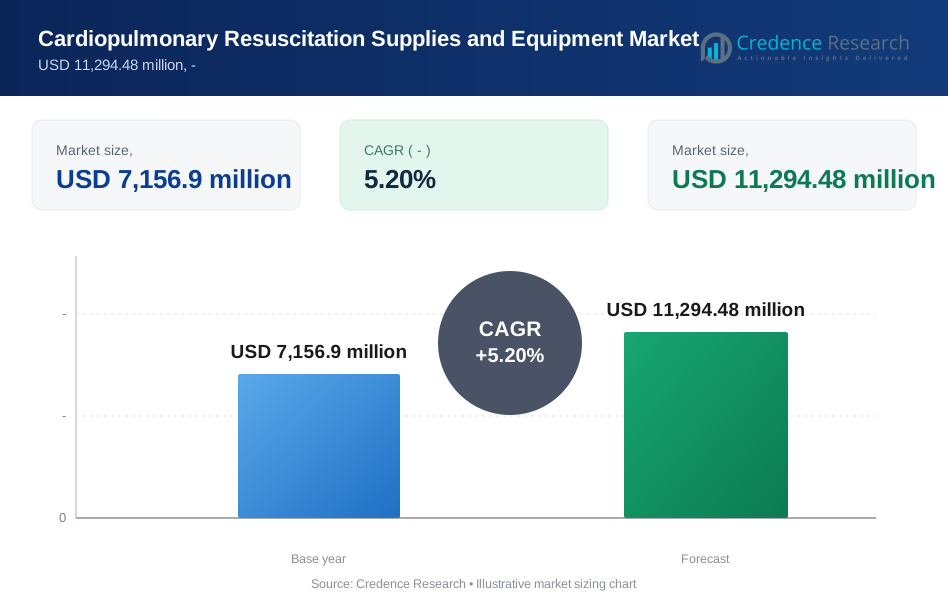
| Cardiopulmonary Resuscitation Supplies and Equipment Market Size 2023 | USD 7156.9 million |
| Cardiopulmonary Resuscitation Supplies and Equipment Market, CAGR | 5.20% |
| Cardiopulmonary Resuscitation Supplies and Equipment Market Size 2032 | USD 11294.48 million |
Market Insights
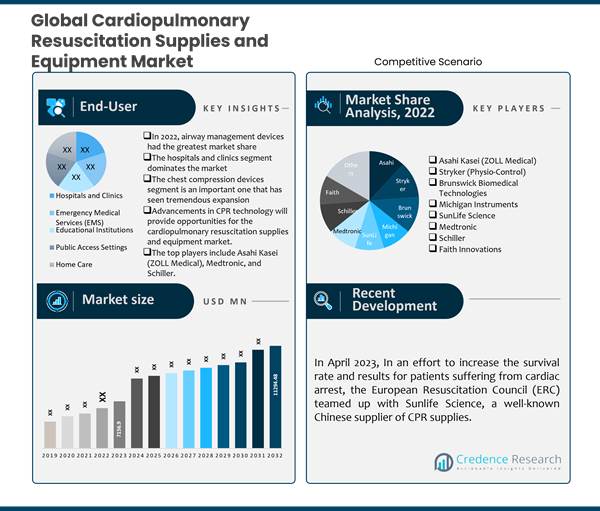
- Between 2024 and 2032, the global market for cardiopulmonary resuscitation supplies and equipment is projected to expand at a compound annual growth rate (CAGR) of 5.20%, from an estimated USD 7156.9 million in 2023 to USD 11294.48 million in 2032.
- The largest category is airway management devices. Chest compression devices, on the other hand, are expected to grow at a strong CAGR.
- The hospitals and clinics category will expand rapidly.
- Asia Pacific controlled the cardiopulmonary resuscitation supplies and equipment market.
- Regarding the market share of cardiopulmonary resuscitation supplies and equipment, Europe is expected to come second.
- North America is expected to experience the fastest growth in the cardiopulmonary resuscitation supplies and equipment industry.
- Global population aging and the increasing number of cases of cardiovascular disorders have contributed to the growth of the cardiopulmonary resuscitation supplies and equipment market.
- Growing public knowledge of CPR procedures and the growth of CPR training initiatives could profit the market for cardiopulmonary resuscitation supplies and equipment.
Executive Summary
Market Definition
Heart arrest and other life-threatening disorders requiring resuscitation are diagnosed, treated, and managed with the help of a variety of medical devices and supplies that are part of the Cardiopulmonary Resuscitation (CPR) Supplies and Equipment industry. Medicinal professionals use these devices in hospitals, clinics, and emergency medical services to restore and maintain heart and lung function in emergencies. Other products in this market include bag-valve masks, defibrillators, airway management devices, and chest compression systems.
Market Overview
It is predicted that the cardiopulmonary resuscitation supplies and equipment industry will continue its upward trajectory between 2024 and 2032, growing at a compound annual growth rate (CAGR) of 5.20%. From its projected USD 7156.9 million in 2023 to USD 11294.48 million in 2032, the market will continue to grow.
Globally, heart disease is the most prevalent cause of death for both men and women. Every forty seconds, an American will suffer a myocardial infarction, according to the American College of Cardiology. The report continued by stating that emergency medical services determined that 356,461 Americans had suffered an out-of-hospital cardiac arrest in 2017; in 52% of those cases, therapy was initiated by emergency medical services. Ventricular fibrillation, ventricular tachycardia, or an early cardiac rhythm that could be shocked with an automated external defibrillator were present in just 18.7% of the patients.
Adult survivorship rates were 10.4% and 8.4%, respectively, for hospital release and satisfactory functional status. Furthermore, respiratory illness affects one in five individuals and is the third greatest cause of death in England, behind cardiovascular disease and cancer, according to NHS England. When CPR is done correctly, patients with cardiac and respiratory issues have a better chance of surviving. Providing CPR as soon as feasible can significantly improve the odds of life for victims. 70% of Americans feel powerless in a cardiac emergency because they are unable to administer CPR, citing a report by the American Heart Association. These factors are anticipated to support the growth of the cardiopulmonary resuscitation supplies and equipment market.
Segmentation by Product Type
- Airway management devices are the market leader in terms of product type. Increased CPR training, improved emergency services, increasing prevalence of cardiovascular illness, and technological improvements are driving demand for airway management devices in the CPR supplies and equipment industry. In order to improve the effectiveness of CPR and give real-time feedback, monitoring systems are increasingly integrating airway management equipment.
- The chest compression devices category will exhibit a sizable CAGR during the projected period. The market for CPR supplies and equipment is seeing an increase in demand for chest compression devices because of the increased frequency of cardiac arrests, enhancements in ambulance services, increased emphasis on doing CPR effectively, and technical breakthroughs.
- Other product types, including automated external defibrillators (AEDs), CPR training manikins, and monitoring and feedback devices, also support the need for cardiopulmonary resuscitation supplies and equipment.
Segmentation by End-User
- Hospitals and clinics are considered the top end-users. They drive the need for CPR supplies and equipment because they require dependable, cutting-edge tools for emergency care. This includes defibrillators, chest compression systems, and airway management equipment due to the rising number of cardiac incidents and the significance of effective, life-saving therapies.
- The emergency medical services (EMS) category will likely register a significant CAGR during forecasting. The increasing requirement for portable, dependable, and efficient instruments in pre-hospital settings is driving growing demand for CPR supplies and equipment from emergency medical services (EMS).
- Other end-users, such as educational institutions, public access settings, and home care, further enhance the need for cardiopulmonary resuscitation supplies and equipment.
Segmentation by Region
- Asia Pacific leads the cardiopulmonary resuscitation supplies and equipment industry. This is due to the rising demand for cardiopulmonary resuscitation supplies and equipment from the Asia Pacific countries such as China, India, Japan, and other countries.
- Europe is estimated to rank second in cardiopulmonary resuscitation supplies and equipment market size.
- It is anticipated that the cardiopulmonary resuscitation supplies and equipment market in North America will grow quickly.
- The remaining need for cardiopulmonary resuscitation supplies and equipment is met by regions including Latin America, the Middle East, and Africa.
Manual chest compression during CPR is less successful than in a natural clinical setting, as evidenced by recent studies and multiple examples. According to clinical research, automated and mechanical compression devices can enhance coronary perfusion, hemodynamic effect, and the likelihood that spontaneous circulation will return. When medical professionals evaluated CPR procedures, they found that chest compressions were ineffective and rarely performed. Their contractions are marked by long pauses, which reduces their chances of survival. Mechanically automated chest compression equipment, which is utilized in mechanical CPR, has solved these drawbacks. By doing this, it's possible to overcome the shortcomings of conventional manual CPR and raise perfusion pressures. Immediate CPR application can significantly improve victims' chances of life. These factors will boost the growth of the global market.
It is anticipated that cardiopulmonary resuscitation supplies and equipment sales in Asia Pacific will surpass those in the entire world. This is brought on by higher cardiac arrests, government initiatives, and unrealized potential. This region is growing because of an aging population, an increase in chronic illnesses, and an increase in the usage of medical devices in healthcare.
It is projected that the cardiopulmonary resuscitation supplies and equipment market will develop at the fastest rate in the North American region. Because of the rise in heart disease and other lifestyle-related ailments, North America has become an important region. North America generated the largest amount of income globally in 2022. Out-of-hospital cardiac arrests have increased in the United States throughout the past ten years. Increased obesity prevalence was brought about by the shift to a sedentary lifestyle, and it is predicted that this area will see more heart disease fatalities due to other chronic heart illnesses.
Key Highlights of the Report
The global cardiopulmonary resuscitation supplies and equipment market is segmented by product type, end-user, and region. As far as the product type is concerned, airway management devices are the market spearhead. Hospitals and clinics are the top end-user category. Asia Pacific is seeing the most growth in the cardiopulmonary resuscitation supplies and equipment market.
Strong paramedical and emergency medical services, a rise in cardiac problems among the elderly, growing economies, high disposable income per person, and rising healthcare costs are all contributing to Europe's expansion. In Europe, the United Kingdom and Germany represent the largest markets for cardiopulmonary resuscitation supplies and equipment. An increase in sudden cardiac events is a significant factor contributing to this region's profitable development.
It is anticipated that Asia Pacific will hold the biggest global market share for cardiopulmonary resuscitation supplies and equipment. A greater understanding of medical equipment, expanding acceptance of monitoring devices, and improved emergency paramedical services are among the significant factors propelling the market expansion in the Asia Pacific region. In addition, it is projected that the market in North America will grow at the quickest rate. The most significant factors accelerating the market's growth in North America are older Americans, an upsurge in heart and respiratory illnesses, and ongoing technical and product improvements.
Which Key Factors Are Driving The Global Cardiopulmonary Resuscitation Supplies and Equipment Market?
The increased need for emergency medical services and the technological developments in CPR equipment are driving the need for cardiopulmonary resuscitation supplies and equipment.
What Are The Main Challenges Confronting The Global Cardiopulmonary Resuscitation Supplies and Equipment Market?
Cardiopulmonary resuscitation supplies and equipment sector are impacted by several issues, including cultural and societal impediments to CPR implementation, opposition to departing from traditional practices, and perceptions of CPR equipment as too complicated or technical.
What Market Opportunities Exist For Cardiopulmonary Resuscitation Supplies and Equipment Globally?
Growing rates of cardiac arrests that occur outside of hospitals, together with the availability of public access defibrillation programs, are contributing factors to the market expansion for cardiopulmonary resuscitation supplies and equipment.
Market Drivers
Rising Rates of Cardiovascular Conditions
The increasing prevalence of cardiovascular diseases is a major factor supporting the growth of the market for cardiopulmonary resuscitation (CPR) supplies and equipment. Since cardiovascular disorders are the primary cause of death worldwide, prompt and efficient emergency interventions, including CPR, are required. Reliable CPR equipment is in high demand as the number of heart attacks, strokes, and other heart-related diseases rises. An aging population, which is more vulnerable to cardiovascular problems, intensifies this trend even more. As a result, the market is expanding because healthcare professionals, public places, and individuals are investing more money in CPR supplies and equipment to be ready for cardiac emergencies.
Market Restraints
Expensive Costs of Modern CPR Equipment
The market's growth is severely constrained by the high costs of contemporary CPR equipment. Automated external defibrillators (AEDs) and high-fidelity training manikins are examples of advanced devices that are too expensive for many hospitals, schools, and even private citizens to purchase. Prospective customers are additionally burdened by the initial purchase price as well as continuing maintenance costs like software upgrades and battery replacements. Smaller clinics, community centers, and areas with constrained healthcare funding are disproportionately impacted by this cost barrier. In order to increase market share and guarantee that life-saving equipment is widely accessible, manufacturers and other industry participants in the CPR equipment sector must strike a balance between innovation and affordability.
Opportunities
Advancements in CPR Technology
Technological developments in cardiopulmonary resuscitation (CPR) are opening up new markets for supplies and equipment used in CPR. The efficiency and accessibility of CPR are increased by innovations, including real-time feedback devices, sophisticated training manikins with lifelike simulations, and automated external defibrillators (AEDs) with improved user interfaces. These advancements are further enhanced by mobile applications that provide prompt guidance in emergencies. These developments in technology raise the need for contemporary CPR equipment, improve survival rates, and make CPR more approachable for non-medical staff. As a result, producers are spending money on R&D to launch innovative goods, which contributes to market expansion and broadening the range of industries where CPR applications are possible.
Competitive Landscape
Key Players
The highly competitive global market for cardiopulmonary resuscitation supplies and equipment is dominated by a number of significant players. A handful of the top market players are shown below, together with their respective market shares:
- Asahi Kasei (ZOLL Medical)
- Stryker (Physio-Control)
- Brunswick Biomedical Technologies
- Michigan Instruments
- SunLife Science
- Medtronic
- Schiller
- Faith Innovations
- Others
In order to stay competitive, these organizations give priority to product innovation, expansion of their distribution channels, and mergers and acquisitions.
By creating cutting-edge ideas and goods, the foremost manufacturers in the global market for cardiopulmonary resuscitation supplies and equipment consistently strive to stay one step ahead of the competition.
In April 2023, To support the company's expansion, Nordic Capital purchased a significant share in Germany-based Corpuls, an inventive medical technology business that specializes in emergency cardiac resuscitation and other medical solutions.
In April 2022, Dynarex Corporation, a prominent manufacturer of surgical instruments and disposable medical supplies, announced Dynarex Resp-O2, a new line of premium respiratory treatment solutions. Bronchial/asthma care, suction solutions, trach care, manual resuscitation, oxygen therapy, aerosol therapy, and other excellent respiratory treatments are all included in this wide range of respiratory remedies.
In August 2019, Koninklijke Philips N.V. (Netherlands) introduced IntelliSpace Connect compatibility for its HeartStart Intrepid Monitor/Defibrillator.
How are Companies Performing in the Cardiopulmonary Resuscitation Supplies and Equipment Market?
Due to a number of significant factors, companies in the cardiopulmonary resuscitation (CPR) supplies and equipment sector are performing well. The market for cardiopulmonary resuscitation (CPR) supplies and equipment is characterized by a dynamic and diverse competitive environment. Top companies of automated CPR equipment are concentrating on new product introductions and regulatory clearances in order to maintain their competitive edge.
Numerous companies are prioritizing enhancing their visibility in areas with elevated rates of chronic illnesses and elderly demographics. This is because cardiac arrest is frequently made more likely by these variables. In addition, significant companies are funding awareness efforts to boost the use of mechanical CPR equipment. A growing number of companies are focusing their marketing efforts on showcasing the newest advancements in CPR devices at trade events and other exhibitions.
Companies tend to boost sales through partnerships and assistance from government organizations. Numerous government organizations offer grants for the acquisition of mechanical CPR equipment. Additionally, the fire safety department has been requesting more CPR solutions, which has improved the adoption of mechanical cardiopulmonary resuscitation equipment. To expand their market reach, companies are also using tactics, including acquisitions, partnerships, distribution agreements, and mergers.
A medical device company called CPR Therapeutics Inc. declared in September 2022 that it had been awarded a US$1.6 million National Institutes of Health (NIH) Direct-To-Phase II Small Business Innovation Research Award for its project "A Multimodal Integrated System for Improved Cardiopulmonary Resuscitation." The company is working to create a next-generation system for cardiopulmonary resuscitation. The study will be carried out by working with the Johns Hopkins Hospital in Baltimore, MD. In order to improve automated mechanical CPR, CPR Therapeutics is creating multimodal cardiopulmonary resuscitation (CPR). As the most common cause of mortality in Western nations, sudden cardiac arrest can be prevented using manual chest compressions, which is currently the most effective device available. The majority of communities have a survival rate of less than 10% following abrupt cardiac arrest.
Summary of Key Findings
- The market for cardiopulmonary resuscitation supplies and equipment is influenced by regulatory support for CPR equipment.
- The market is segmented by product type, end-user, and region.
- In the market, the most prevalent type of product is airway management devices.
- Hospitals and clinics are the foremost end-user category.
- In terms of market development, Asia Pacific is a leader; the market is highly competitive with key players including Asahi Kasei (ZOLL Medical), Stryker (Physio-Control), Brunswick Biomedical Technologies, Michigan Instruments, SunLife Science, Medtronic, Schiller, Faith Innovations, and Others.
Future Outlook
- The cardiopulmonary resuscitation supplies and equipment industry is expected to increase significantly in Asia Pacific, and its outlook is positive worldwide.
- Various factors, such as the acceptance of CPR in school curricula and the rise in health clubs and gyms, will contribute to the market's continued expansion.
- The two most significant barriers to the growth of the cardiopulmonary resuscitation supplies and equipment industry are the need for more knowledge regarding the significance of CPR and the influence of economic uncertainty on healthcare spending.
- Developing new products, reaching a wider market, and maintaining competitive prices are all necessary for major businesses to stay ahead of the competition.
How the Credence Research Cardiopulmonary Resuscitation Supplies and Equipment Market Report Can Help CXOs
The Credence Research Cardiopulmonary Resuscitation Supplies and Equipment Market Report provides CXOs with an extensive market overview and comprises the following:
- Market size and growth forecast: The study offers comprehensive market estimations for cardiopulmonary resuscitation supplies and equipment globally, broken down by product type, end-user, and region. Furthermore, the report includes market forecasts through 2032, derived from key drivers and trends.
- Market segmentation: The cardiopulmonary resuscitation supplies and equipment market is divided into segments by product type, end-user, and region in the research report. This segmentation helps CXOs understand the market and the opportunities inside each area in great depth.
- Competitive landscape: The study report provides a thorough analysis of the leading businesses in the cardiopulmonary resuscitation supplies and equipment sector, together with details on their revenue streams, product lines, and business strategies. With this information, CXOs can assess and identify their competitors.
- Key trends and drivers: The study report analyzes and highlights the key developments and elements driving the market for cardiopulmonary resuscitation supplies and equipment. CXOs can utilize this information to make well-informed choices regarding their plans and investments.
The Credence Research Cardiopulmonary Resuscitation Supplies and Equipment Market Report provides CXOs with insights that they may utilize to:
- Identify growth opportunities: This analysis is likely to help CXOs find fresh growth prospects in the cardiopulmonary resuscitation supplies and equipment sector. For example, the research recognizes the increasing requirement for cardiopulmonary resuscitation supplies and equipment from hospitals and clinics as a crucial opportunity.
- Make informed investment decisions: The study aids CXOs in making informed decisions about cardiopulmonary resuscitation supplies and equipment. For example, it delivers information on the key variables to consider while picking solutions and evaluating suppliers.
- Develop competitive strategies: CXOs can utilize the research report to establish competitive strategies for their cardiopulmonary resuscitation supplies and equipment firms. The study paper explores the primary tactics employed by cardiopulmonary resuscitation supplies and equipment providers to set themselves apart from their rivals.
- Track market developments: By tracking market advancements, this research report could assist CXOs in remaining ahead of the curve. For example, it provides information about the latest advancements and patterns in the cardiopulmonary resuscitation supplies and equipment industry.
The Credence Research Cardiopulmonary Resuscitation Supplies and Equipment Market Report is helpful for CXOs who want to learn more about the market and identify potential opportunities.
Segmentation
-
By Product Type
- Airway Management Devices
- Oropharyngeal Airways
- Nasopharyngeal Airways
- Resuscitation Masks and Shields
- Chest Compression Devices
- Automated External Defibrillators (AEDs)
- CPR Training Manikins
- Monitoring and Feedback Devices
- Airway Management Devices
-
By End-User
- Hospitals and Clinics
- Emergency Medical Services (EMS)
- Educational Institutions
- Public Access Settings
- Home Care
-
By Region
- North America
- U.S
- Canada
- Mexico
- Europe
- Germany
- France
- UK
- Italy
- Spain
- Rest of Europe
- Asia Pacific
- China
- Japan
- India
- South Korea
- South-east Asia
- Rest of Asia Pacific
- Latin America
- Brazil
- Argentina
- Rest of Latin America
- Middle East & Africa
- GCC Countries
- South Africa
- The Rest of the Middle East and Africa
- North America
Adjacent Markets
Several adjacent markets in the cardiopulmonary resuscitation supplies and equipment market have high revenue growth opportunities. The key adjacent markets for the cardiopulmonary resuscitation supplies and equipment market -
Adjacent Markets |
||
| Automated External Defibrillators (AEDs) | Emergency Medical Services (EMS) | Hospital Emergency Departments |
| Medical Training and Simulation | First Aid Supplies | Cardiac Monitoring Devices |
| Home Healthcare Equipment | Personal Protective Equipment (PPE) | Resuscitation Ventilators |
Request a Free Sample
Fill in your details and we'll send you a free sample report.
- Sample data tables & charts
- Research methodology
Need a Custom Version of This Report?
Tailor the scope, geography, or segments to your exact requirements.
- Custom geography or segment scope
- Direct access to our analyst team
Frequently Asked Questions
How much does the global market currently hold for cardiopulmonary resuscitation supplies and equipment?
What is the projected growth rate of the cardiopulmonary resuscitation supplies and equipment market between 2024 and 2032?
In terms of the product type, which market category is leading?
Regarding the end-user, which market category is in the lead?
Which product type category is anticipated to grow at the fastest rate throughout the projected period?
In which region is the market for cardiopulmonary resuscitation supplies and equipment expanding?
Who are the main players in the global cardiopulmonary resuscitation supplies and equipment industry?
Which market factors are the primary drivers of the cardiopulmonary resuscitation supplies and equipment industry?
What main market challenges prevent the growth of the cardiopulmonary resuscitation supplies and equipment sector?
What are the main market opportunities for the cardiopulmonary resuscitation supplies and equipment sector?
Table of Content
Chapter 1. Report Introduction
- 1.1 Report Description & Purpose
- 1.1.1 Report Title & Market Definition
- 1.1.2 Unique Selling Propositions (USP) & Key Differentiators
- 1.1.3 Value Proposition for Stakeholders
- 1.2 Research Objectives
- 1.2.1 Market Sizing Objectives (Volume & Revenue)
- 1.2.2 Segmentation Objectives
- 1.2.3 Competitive Intelligence Objectives
- 1.2.4 Forecast & Scenario Objectives
- 1.3 Report Scope
- 1.3.1 Cardiopulmonary Resuscitation Supplies and Equipment Scope – Types & Subtypes Covered
- 1.3.2 Geographic Scope – Regions & Countries Covered
- 1.3.3 Historical Period, Base Year & Forecast Period (the historical period; forecast to the forecast period)
- 1.3.4 Inclusions & Exclusions
- 1.4 HS Code & Classification Framework
- 1.5 Currency, Units & Pricing Basis
- 1.6 Target Stakeholders
- 1.7 Limitations & Assumptions
Chapter 2. Executive Summary
- 2.1 Global Cardiopulmonary Resuscitation Supplies and Equipment Market Snapshot
- 2.1.1 Market Size – Historical (the historical period) & Forecast (the forecast period) (base year: USD 7,156.9 million → forecast year: USD 11,294.48 million)
- 2.1.2 Volume & Revenue – Global Totals
- 2.1.3 Key Market Highlights – Top Five Facts
- 2.2 Cardiopulmonary Resuscitation Supplies and Equipment Market Segmentation Snapshot
- 2.2.1 Market Split by Region – vs.
- 2.3 Competitive Snapshot
- 2.3.1 Top 10 Players by Revenue Share –
- 2.3.2 Top 10 Players by Volume Share –
- 2.3.3 Recent Strategic Developments (18-Month Summary)
- 2.4 Key Investment Highlights & Strategic Conclusions
Chapter 3. Cardiopulmonary Resuscitation Supplies and Equipment Market Dynamics & Industry Analysis
- 3.1 Market Overview & Context
- 3.1.1 Cardiopulmonary Resuscitation Supplies and Equipment Market Position in the Broader Automotive Value Chain
- 3.1.2 OEM vs. Replacement Market Dynamics
- 3.1.3 Market Maturity & Development Stage by Region
- 3.2 Cardiopulmonary Resuscitation Supplies and Equipment Market Drivers
- 3.3 Cardiopulmonary Resuscitation Supplies and Equipment Market Restraints & Challenges
- 3.4 Cardiopulmonary Resuscitation Supplies and Equipment Market Opportunities
- 3.5 Porter's Five Forces Analysis
- 3.5.1 Threat of New Entrants
- 3.5.2 Bargaining Power of Suppliers
- 3.5.3 Bargaining Power of Buyers
- 3.5.4 Threat of Substitutes
- 3.5.5 Competitive Rivalry – Intensity Assessment
- 3.6 Cardiopulmonary Resuscitation Supplies and Equipment Value Chain Analysis
- 3.6.1 Upstream – Raw Material/Input Suppliers
- 3.6.1.1 Raw Material/Input 1
- 3.6.1.2 Raw Material/Input 2
- 3.6.1.3 Raw Material/Input 3
- 3.6.2 Midstream – Production/Manufacturing/Service Delivery
- 3.6.2.1 Production/Process Overview
- 3.6.2.2 Key Facility Locations & Capacity by Manufacturer
- 3.6.3 Downstream – Distribution & End Consumer
- 3.6.3.1 Primary Channel – B2B/OEM
- 3.6.3.2 Secondary Channels – Dealer, Retail, Online, Direct
- 3.6.4 Value Chain Profitability Analysis
- 3.6.1 Upstream – Raw Material/Input Suppliers
- 3.7 PESTEL Analysis
- 3.7.1 Political Factors
- 3.7.2 Economic Factors
- 3.7.3 Social Factors
- 3.7.4 Technological Factors
- 3.7.5 Environmental Factors
- 3.7.6 Legal Factors
- 3.8 Cardiopulmonary Resuscitation Supplies and Equipment Supply Chain Analysis
- 3.8.1 Raw Material/Input Supply Risk Assessment
- 3.8.2 Manufacturing Concentration Risk (Geographic Exposure)
- 3.8.3 Trade Disruption Impact Analysis
- 3.9 Regulatory & Policy Landscape
Note: The regulatory and policy landscape section covers regulations based on their applicability to the market, Cardiopulmonary Resuscitation Supplies and Equipment category, geography, and scope of the study. Only regulatory frameworks with a material impact on operations, compliance, trade, sustainability, or market access are analyzed in detail.
Chapter 4. Key Investment Pockets & Opportunity Analysis
- 4.1 Cardiopulmonary Resuscitation Supplies and Equipment Market Attractiveness Analysis
- 4.1.1 By Region – Investment Attractiveness Matrix (Volume × CAGR)
- 4.2 Absolute Revenue Growth Opportunity
- 4.2.1 By Region – Absolute USD Growth Through the forecast period
- 4.3 Incremental Volume Opportunity
- 4.3.1 By Region – Incremental Volume Through the forecast period
- 4.3.2 Segment – Incremental Volume
- 4.4 Emerging Submarket Opportunity Deep Dive (Subject to Applicability)
- 4.5 Emerging Market Opportunity Scorecards
- 4.5.1 United States
- 4.5.2 Europe
- 4.5.3 Asia
- 4.5.4 Middle East & Africa
Note: Emerging Market Opportunity Scorecards will be included based on relevance and strategic importance. Regions listed are indicative and may vary depending on data availability and market dynamics.
Chapter 5. Cardiopulmonary Resuscitation Supplies and Equipment Import-Export Analysis & Trade Flows
- 5.1 Global Trade Overview
- 5.1.1 Global Export Value by Country (the historical period)
- 5.1.2 Global Export Volume by Country (the historical period)
- 5.1.3 Global Import Value by Country (the historical period)
- 5.1.4 Global Import Volume by Country (the historical period)
- 5.1.5 Net Trade Balance by Country (the historical period)
- 5.2 Export Analysis – Segment
- 5.2.1 Type 1 (HS Code)
- 5.2.2 Type 2 (HS Code)
- 5.2.3 Type 3 (HS Code)
- 5.2.4 Type 4 (HS Code)
- 5.2.5 Type 5 (HS Code)
- 5.3 Import Analysis – Segment
- 5.3.1 Type 1 (HS Code)
- 5.3.2 Type 2 (HS Code)
- 5.3.3 Type 3 (HS Code)
- 5.3.4 Type 4 (HS Code)
- 5.3.5 Type 5 (HS Code)
- 5.4 Average Unit Trade Prices
- 5.4.1 Average Export Price – Segment & Country
- 5.4.2 Average Import Price – Segment & Source Country
- 5.4.3 Price Trends (the historical period)
- 5.5 Key Trade Route Analysis
- 5.5.1 Trade Route 1
- 5.5.2 Trade Route 2
- 5.5.3 Trade Route 3
- 5.5.4 Trade Route 4
- 5.5.5 Trade Route 5
- 5.6 Trade Policy Impact Assessment
- 5.6.1 US Anti-Dumping & Section 301 Tariffs
- 5.6.2 EU Customs Union Impact
- 5.6.3 Major Free Trade Agreements
- 5.6.4 USMCA Rules of Origin
Note: Trade policy analysis will be included only where relevant to the Cardiopulmonary Resuscitation Supplies and Equipment market.
Chapter 6. Competitive Landscape & Company Benchmarking
- 6.1 Cardiopulmonary Resuscitation Supplies and Equipment Market Concentration & Structure
- 6.1.1 Herfindahl-Hirschman Index (HHI) – vs.
- 6.1.2 Tier 1, Tier 2 & Tier 3 Market Structure
- 6.1.3 Global, Regional & Local Player Dynamics
- 6.2 Cardiopulmonary Resuscitation Supplies and Equipment Market Share Analysis –
- 6.2.1 Global Revenue Share by Company
- 6.2.2 Global Volume Share by Company
- 6.2.3 Regional Revenue Share
- 6.2.4 Market Share Evolution ( vs. )
- 6.2.5 OEM Segment Share by Company
- 6.2.6 Replacement Segment Share by Company
- 6.3 Production/Delivery Capacity & Facility Analysis
- 6.3.1 Global Installed Capacity
- 6.3.2 Capacity Utilization Rates
- 6.3.3 Production/Output Volume
- 6.3.4 Facility Locations & Capacity Map
- 6.3.5 Planned Capacity Additions
- 6.4 Cardiopulmonary Resuscitation Supplies and Equipment Competitive Benchmarking Matrix
- 6.4.1 Revenue, Volume, CAGR & Profitability Comparison
- 6.4.2 Channel Revenue Mix
- 6.4.3 Geographic Revenue Exposure
- 6.4.4 R&D Intensity
- 6.4.5 Sustainability Maturity
- 6.5 Strategic Developments in Cardiopulmonary Resuscitation Supplies and Equipment (Last 24 Months)
- 6.5.1 Mergers, Acquisitions & Divestments
- 6.5.2 New Cardiopulmonary Resuscitation Supplies and Equipment Launches
- 6.5.3 Facility Expansions
- 6.5.4 Strategic Alliances, Joint Ventures & Partnerships
- 6.5.5 Distribution Expansion & Market Entry
- 6.5.6 Sustainability & ESG Initiatives
- 6.6 Competitive Strategy Mapping
- 6.6.1 Leader, Challenger, Follower & Niche Classification
- 6.6.2 Pricing Strategy Comparison
- 6.6.3 Channel Strategy Matrix
Note: Strategic developments are included based on their materiality and the availability of reliable information.
Chapter 7. Global Cardiopulmonary Resuscitation Supplies and Equipment Market – By Distribution Channel
- 7.1 Segment Overview
- 7.1.1 Volume & Revenue Split by Channel ( & )
- 7.1.2 Channel Mix Evolution (the forecast period)
Chapter 8. Regional Market Analysis – Global Overview
- 8.1 Global Regional Overview
- 8.1.1 Regional Volume Share
- 8.1.2 Regional Revenue Share
- 8.1.3 Regional Volume by Region
- 8.1.4 Regional Revenue by Region
- 8.1.5 Regional Forecast Through the forecast period
- 8.2 Cross-Regional Segment Analysis
- 8.2.1 By Distribution Channel
- 8.2.2 By Brand/Price Tier
Chapter 9. North America Cardiopulmonary Resuscitation Supplies and Equipment Market
- 9.1 United States
- 9.2 Canada
- 9.3 Mexico
Chapter 10. Europe Cardiopulmonary Resuscitation Supplies and Equipment Market
- 10.1 Germany
- 10.2 France
- 10.3 Italy
- 10.4 United Kingdom
- 10.5 Spain
- 10.6 Poland
- 10.7 Russia
- 10.8 Netherlands
- 10.9 Belgium
- 10.10 Sweden
- 10.11 Denmark
- 10.12 Norway
- 10.13 Rest of Europe
Chapter 11. Asia Pacific Cardiopulmonary Resuscitation Supplies and Equipment Market
- 11.1 China
- 11.2 India
- 11.3 Japan
- 11.4 South Korea
- 11.5 Thailand
- 11.6 Indonesia
- 11.7 Vietnam
- 11.8 Malaysia
- 11.9 Australia
- 11.10 Rest of Asia Pacific
Chapter 12. Latin America Cardiopulmonary Resuscitation Supplies and Equipment Market
- 12.1 Brazil
- 12.2 Argentina
- 12.3 Colombia
- 12.4 Chile
- 12.5 Rest of Latin America
Chapter 13. Middle East Cardiopulmonary Resuscitation Supplies and Equipment Market
- 13.1 Saudi Arabia
- 13.2 United Arab Emirates
- 13.3 Turkey
- 13.4 Israel
- 13.5 Iran
- 13.6 Rest of the Middle East
Chapter 14. Africa Cardiopulmonary Resuscitation Supplies and Equipment Market
- 14.1 South Africa
- 14.2 Egypt
- 14.3 Nigeria
- 14.4 Morocco
- 14.5 Rest of Africa
Chapter 15. Cardiopulmonary Resuscitation Supplies and Equipment Company Profiles
- 15.1 [Company 01]
- 15.1.1 Company Overview
- 15.1.2 Key Management Personnel
- 15.1.3 Products & Services Portfolio
- 15.1.4 Financial Performance
- 15.1.5 Key Market Focus & Geographic Presence
- 15.1.6 Recent Developments & Strategic Initiatives
Note: The company profile list is preliminary and may change based on research findings, market developments, data availability, and client requirements.
Chapter 16. Appendices
- Appendix A – List of Abbreviations & Acronyms
- Appendix B – Industry Classification Code Reference – Full Series
- Appendix C – Production & Capacity Data Tables
- Appendix D – End-Use & Demand Base Tables
- Appendix E – Consumption & Replacement Rate Assumptions
- Appendix F – ASP Reference Tables
- Appendix G – Manufacturing & Facility Database
- Appendix H – Import-Export Data Tables
- Appendix I – Regulatory Summary Tables
- Appendix J – Primary Research Participant List (Anonymized)
- Appendix K – Primary Research Questionnaire Framework
- Appendix L – Data Sources & Bibliography
- Appendix M – Market Size Divergence & Source Comparison
Chapter 17. Research Methodology
- 17.1 Research Framework & Philosophy
- 17.2 Secondary Research – Sources, Hierarchy & Data Extraction
- 17.3 Data Modeling – Bottom-Up & Top-Down Market Sizing
- 17.4 Primary Research – Stakeholder Framework, LOI & Sample Sizes
- 17.5 Forecast Methodology – Regression, Scenario & Sensitivity Analysis
- 17.6 Quality Control – Four-Layer Validation Framework
- 17.7 Limitations & Standard Assumptions
- 17.8 Disclaimer
