
| REPORT ATTRIBUTE | DETAILS |
|---|---|
| Historical Period | 2019-2022 |
| Base Year | 2023 |
| Forecast Period | 2024-2032 |
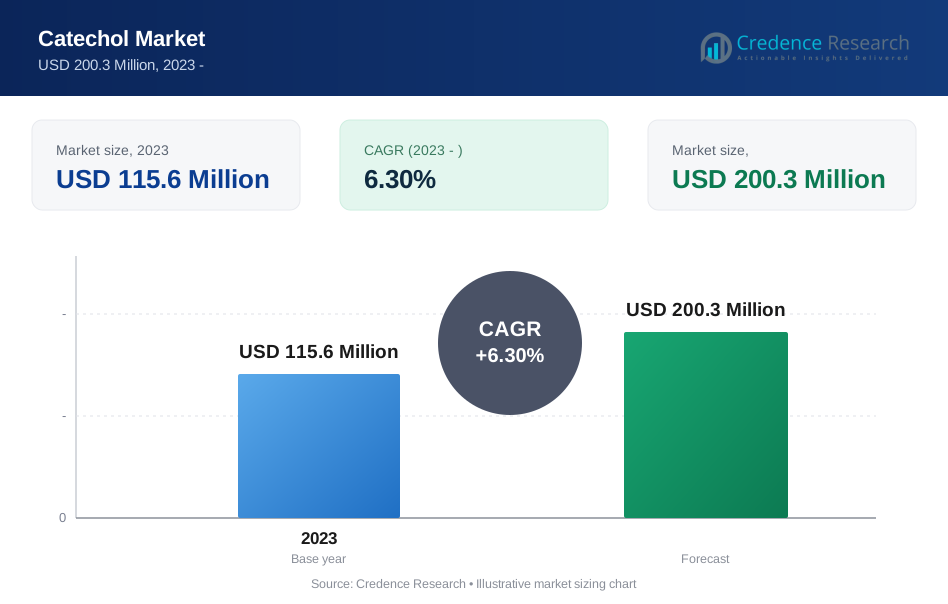
| Catechol Market Size 2023 | USD 115.6 Million |
| Catechol Market, CAGR | 6.30% |
| Catechol Market Size 2032 | USD 200.3 Million |
Market Insights
- The Catechol Market attained a valuation of USD 115.6 Million in 2023 and is anticipated to escalate to USD 200.3 Million by 2032, exhibiting a robust CAGR of 6.30% during the forecast period from 2024 to 2032.
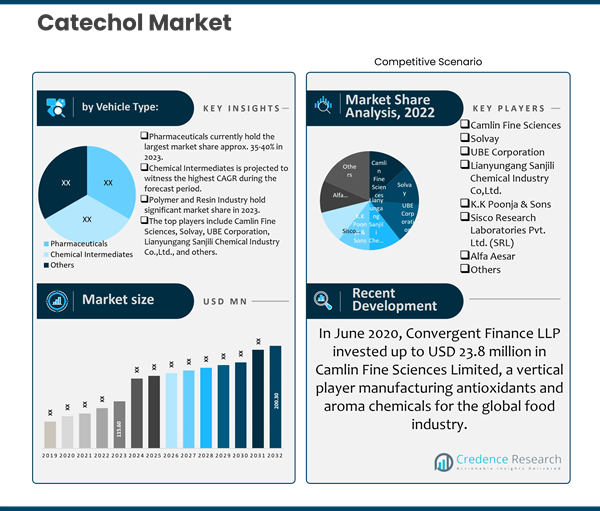
- Among the key segments, Pharmaceuticals emerged as the market leader by end-use industry, constituting approximately 35-40% of the total market share in 2023. However, Chemical Intermediates are projected to witness the highest CAGR during the forecast period.
- Antioxidant applications currently hold the largest market share approx. 25-30% in 2023 due to their ability to scavenge free radicals, making them useful in food preservation, cosmetics, and industrial applications where oxidative damage must be prevented. Photographic Chemicals are projected to witness the highest CAGR during the forecast period owing to emerging technologies in imaging and printing industries.
- High-purity Catechol currently holds the largest market share approx. 60-65% in 2023 owing to Strict quality standards required in some industries, such as pharmaceuticals and electronics, increasing the demand for high-purity products. Technical-grade Catechol is projected to witness the highest CAGR during the forecast period due to rising consumption in developing economies with widespread adoption in various sectors such as agrochemicals, polymers, resins, etc.
- Asia Pacific held the largest share around 38-42% of the market in 2023. North America and Europe collectively account for just under 55% share in 2023.
- The shift towards sustainable practices and product innovation, and its role in the production of biodegradable products are also contributing to the market growth.
- Key opportunities in the market include innovations in manufacturing technologies with evolving channels, continuous bio-based and sustainable methods, and the rising demand for catechol derivatives in niche industries like antioxidants and polymer production, fostering market expansion.
Executive Summary
Market Definition
The catechol market refers to the industry involved in the production and sale of catechols, which can be organic compounds that comprise a benzene ring with two hydroxyl organizations. They are widely used as intermediates within the synthesis of various chemicals along with prescription drugs, agrochemicals, dyes, and resins. Catechols may be located certainly in certain plants, results, and vegetables, but maximum industrial catechols are produced through chemical reactions regarding phenol or other fragrant compounds. The production procedure generally entails oxidation, hydroxylation, or halogenation reactions. The worldwide catechol marketplace has been growing gradually due to increasing uses in personal care and cosmetics industries. Pharmaceutical organizations use catechols to provide drugs for treating situations like Parkinson's disease, depression, and high blood pressure.
Market Overview
The Catechol Market has exhibited steady growth and is anticipated to maintain a robust Compound Annual Growth Rate (CAGR) of 6.30% from 2024 to 2032. Valued at USD 115.6 million in 2023, this market is forecasted to reach USD 200.3 million by 2032.
Among the primary segments, Pharmaceuticals dominated the market landscape by end-use industry, comprising approximately 35-40% of the total market share in 2023. However, Chemical Intermediates are expected to observe the highest CAGR over the forecast period.
Antioxidant applications currently hold the largest market share approx 25-30% in 2023, driven by their efficacy in food preservation, cosmetics, and industrial applications. Photographic Chemicals are projected to witness the highest CAGR during the forecast period due to advancements in imaging and printing technologies.
High-purity Catechol currently holds the largest market share approx 60-65% in 2023, driven by the stringent quality standards required in industries such as pharmaceuticals and electronics. Technical-grade Catechol is projected to witness the highest CAGR during the forecast period due to rising consumption in developing economies.
Asia Pacific constituted a significant portion of the market in 2023, followed by North America and Europe, collectively representing just under 55% of the market share.
The surge in demand for Catechol, driven by factors such as increasing applications in pharmaceuticals, agrochemicals, and personal care products, fosters market growth, especially in regions like Asia Pacific.
Rapid advancement in Catechol production technology and the adoption of sustainable practices are driving market demand, especially in regions like Europe where environmental consciousness is high.
Segmentation by End-Use Industry
- Pharmaceuticals currently hold the largest market share approx. 35-40% in 2023. Catechol is used as a raw material in pharmaceutical formulations, and increasing R&D activities in the pharmaceutical industry are expected to drive the growth of this segment.
- Chemical Intermediates is projected to witness the highest CAGR during the forecast period. There is an increasing demand for high-performance materials and biologically friendly synthetic chemicals can contribute to the rapid partial growth of chemical intermediates.
Segmentation by Application
- Antioxidant applications currently hold the largest market share approx. 25-30% in 2023 due to their ability to scavenge free radicals, making them useful in food preservation, cosmetics, and industrial applications where oxidative damage must be prevented.
- Photographic Chemicals is projected to witness the highest CAGR during the forecast period owing to emerging technologies in imaging and printing industries.
Segmentation by Purity Level
- High-purity Catechol currently holds the largest market share approx. 60-65% in 2023 owing to Strict quality standards required in some industries, such as pharmaceuticals and electronics, increasing the demand for high-purity products.
- Technical-grade Catechol is projected to witness the highest CAGR during the forecast period. Rising consumption in developing economies with widespread adoption in various sectors such as agrochemicals, polymers, resins, etc. drive the demand of Technical-grade Catechol.
Segmentation by Region
- Asia Pacific held largest share around 38-42% of the market in 2023. This is due to the rapid economic growth in China, India, Japan, South Korea, investment in major sectors such as pharmaceuticals, personal care and cosmetics, agricultural chemicals.
- North America and Europe collectively account for just under 55% share in 2023, with North America holding over 20% share in the same year.
- The rest of the world, including Latin America, the Middle East, and Africa, supplies the remaining demand for Catechol.
The shift towards sustainable practices and product innovation, and its role in the production of biodegradable products are also contributing to the market growth.
The Asia Pacific region holds the largest market share in the Catechol market. Industries relying heavily on catechol, such as pharmaceuticals, agricultural chemicals, and personal care products, in this region further drive the market growth. Moreover, governments in the region are aggressively promoting environmental consciousness, pushing businesses towards sustainable green practices. This trend is fueling interest in naturally occurring compounds including catechol, opening new doors for manufacturers and consumers. Companies operating in the Catechol market can focus and invest in Asia Pacific to take advantage of its growth and profitability Understanding these market dynamics can be helpful industry to make informed decisions on manufacturing, distribution, and marketing strategies tailored to meet the needs of customers in this region. The prominence in catechol market underscores its importance as an integral part of the global economy.
Europe holds a significant market share of the global Catechol market. Europe has stringent environmental regulations and increasing demand from industry to use catechol as a primary ingredient. Governments in Europe have been pushing to reduce carbon emissions and promote green chemistry, leading to increased use of catechol in eco-friendly products and services, and countries like Germany, France, Italy, and the UK leading the way in adopting new technologies and conditions to come up with benchmarks for others in the industry. Key factors strengthening Europe’s foothold in the catechol market include a growing pharmaceutical industry seeking efficient manufacturing processes, coupled with a rapidly expanding specialty pharmaceutical market seeking solutions tailored to the unique challenges and nature of internal products, and clean labels. Furthermore, the presence of established research institutes and universities stimulates the European catechol market development and facilitates region growth.
Key Highlights of the Report
The Catechol Market is segmented by End-Use Industry, Application, Purity Level, and Region. The growing demand for catechol is propelled by factors such as its diverse applications in pharmaceuticals, agrochemicals, and personal care products, particularly in industries requiring intermediate chemicals for manufacturing processes.
Pharmaceuticals dominate the segment, utilizing catechol as a crucial raw material in drug formulations. High-purity catechol holds a significant market share, meeting the stringent quality standards required in industries such as pharmaceuticals and electronics.
Technical-grade catechol is projected to witness the highest CAGR during the forecast period, driven by its rising consumption in developing economies and widespread adoption across various sectors.
Antioxidant applications currently hold the largest market share approx 25-30% in 2023, contributing to food preservation, cosmetics, and industrial applications. Photographic Chemicals are projected to witness the highest CAGR during the forecast period due to advancements in imaging and printing technologies.
Asia Pacific held the largest share of the catechol market, supported by rapid economic growth and increasing investments in key sectors such as pharmaceuticals and personal care products. Government initiatives promoting environmental consciousness further drive market growth in the region.
Key players like Camlin Fine Sciences, Solvay, and UBE Corporation compete in the market, focusing on product innovation, distribution network expansion, and strategic alliances to maintain competitiveness. Collaborations and technological advancements contribute to Asia Pacific's leadership in the Catechol Market, with major players expanding their offerings to meet diverse customer needs in the region.
What Are The Main Drivers Of The Global Catechol Market?
The global Catechol market is driven by various factors such as increasing demand from pharmaceutical, agrochemical, cosmetic, and other industries due to its versatility coupled with technological advancements in manufacturing, coupled with R&D increasing activities, increasing the profitability and availability of catechol, especially in developing countries. Furthermore, the advantages of catechol in various applications and increasing environmental consciousness are also driving market demand, prompting manufacturers to invest have incorporated to expand their product range to meet the growing needs of the market.
What Are The Major Challenges Faced By The Global Catechol Market?
The global Catechol market is mainly challenged by including stringent regulations and environmental concerns related to its production and consumption. Also, fluctuations in raw material prices, competition from new drugs and substitutes also poses a challenge to market growth. Moreover, geopolitical conflicts and trade barriers can disrupt supply chains and hinder market expansion.
What Are The Growth Opportunities In The Global Catechol Market?
The global Catechol market presents numerous growth opportunities due to innovations in manufacturing technologies with evolving channels continuous bio-based and sustainable methods, offer avenues for market expansion while addressing environmental concerns. Moreover, the rising demand for catechol derivatives in niche industries like antioxidants and polymer production opens new opportunity for market players. In addition, adoption of various strategies among market players makes significant opportunity for the market.
Market Drivers
Increasing Demand From Cosmetic Industry
The global Catechol market has significant growth, driven by the increasing demand from cosmetic industry. Catechol is an important ingredient in cosmetics due to its antioxidant properties and usefulness in skin care and hair care products. Consumers are looking for products that are natural and fly more effective in their beauty regimen, so catechol is emerging as a desirable ingredient for cosmetics. As the beauty industry expands globally, the demand for catechol in cosmetics is poised for further growth, leading to market expansion.
Market Restraints
Stringent Regulations And Environmental Concerns
Stringent regulations and environmental concerns create challenges for the Catechol market. The regulatory framework governing the manufacture, use, and disposal of catechol compounds requires adherence to strict standards, increasing compliance costs for manufacturers. As an environmental concern that addresses the impact of catechol production on air, water, and soil quality besides the need for sustainable practices and mitigation measures Environmental. Furthermore, public scrutiny and reputation of potential environmental damage puts additional pressure on market players. Navigating these challenges requires continuous innovation, collaboration, and commitment to sustainability in the catechol industry.
Opportunities
Adoption Of Various Strategies Among Market Players
The major companies serving the global Catechol Market are Camlin Fine Sciences, Solvay, UBE Corporation, and Lianyungang Sanjili Chemical Industry Co., Ltd, among others. The market players are considerably contributing to the market growth by the adoption of various strategies including mergers & acquisitions, collaborations, funding, and new product launches, to stay competitive in the market. For instance, in December 2019, Solvay and Indian firm Anthea formed a joint venture called Catasynth Speciality Chemicals, aiming to manufacture catechol derivatives such as piperonal, helional, and methylenedioxybenzene. Focusing on supplying flavor, fragrance, agrochemical, and pharma industries, the partnership aims to address customer needs for stable, dependable catechol derivative sources.
Competitive Landscape
Key Players
The global Catechol market is highly competitive, with several key players. Some of the major players in the market and their market share are as follows:
- Camlin Fine Sciences
- Solvay
- UBE Corporation
- Lianyungang Sanjili Chemical Industry Co,Ltd.
- K.K Poonja & Sons
- Sisco Research Laboratories Pvt. Ltd. (SRL)
- Alfa Aesar
- others
These organizations prioritize product innovation, distribution channel expansion, and mergers and acquisitions to stay competitive.
The global Catechol market's key players continually seek to stay ahead by offering new products and developments.
In June 2020, Convergent Finance LLP invested up to USD 23.8 million in Camlin Fine Sciences Limited, a vertical player manufacturing antioxidants and aroma chemicals for the global food industry.
In December 2019, Solvay and Indian firm Anthea formed a joint venture called Catasynth Speciality Chemicals, aiming to manufacture catechol derivatives such as piperonal, helional, and methylenedioxybenzene. Focusing on supplying flavor, fragrance, agrochemical, and pharma industries, the partnership aims to address customer needs for stable, dependable catechol derivative sources.
Summary of Key Findings
- The Catechol Market is experiencing steady growth driven by increasing demand across various sectors such as pharmaceuticals, agrochemicals, and personal care products. This growth is fueled by factors like technological advancements, expanding applications, and rising environmental consciousness.
- Market segmentation covers a wide range of factors including end-use industry, application, purity level, and region, reflecting the diverse requirements and applications within the catechol industry.
- Pharmaceuticals emerge as the leading segment, utilizing catechol as a crucial raw material in drug formulations. Technical-grade catechol is expected to experience the highest growth, driven by its rising consumption in developing economies and across various sectors.
- Asia Pacific holds the largest share of the market, supported by rapid economic growth and increasing investments in key sectors such as pharmaceuticals and personal care products. Major players like Camlin Fine Sciences, Solvay, and UBE Corporation are competing in the market, focusing on innovation and strategic alliances to maintain competitiveness.
Future Outlook
- The Catechol Market presents promising growth opportunities, particularly in regions like Asia Pacific where economic growth and government initiatives drive demand for catechol in various industries. Anticipated challenges include regulatory hurdles and competition from alternative chemical compounds. To address these challenges, industry players should prioritize innovation, sustainability, and market diversification.
- Strategies for maintaining competitiveness include continuous product innovation, expanding market presence, and forging strategic partnerships to capitalize on emerging market trends and sustain growth in the dynamic Catechol Market.
How CXOs Can Benefit from the Credence Research Catechol Networks Market Report
The Credence Research Catechol Networks Market Report provides CXOs with a comprehensive overview of the market, including:
- Market size and growth forecast: The report provides detailed estimates of the global Catechol networks market size, segmented by end-use industry, application, purity level, and region. It also includes forecasts for the market through 2032, based on key trends and drivers.
- Market segmentation: The report segments the Catechol networks market by end-use industry, application, purity level, and region. The increasing demand for advanced solutions is driven. This segmentation provides CXOs with a granular understanding of the market and the opportunities in each segment.
- Competitive landscape: The report profiles the key players in the Catechol networks market and provides insights into their strategies, product offerings, and financial performance. This information can help CXOs to identify and assess their competition.
- Key trends and drivers: The report identifies and analyzes the key trends and drivers that are shaping the Catechol networks market. This information can help CXOs to make informed decisions about their investments and strategies.
CXOs can use the insights from the Credence Research Catechol Networks Market Report to:
- Identify growth opportunities: The report can help CXOs to identify new growth opportunities in the Catechol networks market. For example, the report identifies the growing demand for Catechol networks from cloud computing providers and telecom companies as a key opportunity.
- Make informed investment decisions: The report can help CXOs to make informed investment decisions about Catechol networks. For example, the report provides insights into the key factors to consider when evaluating Catechol providers and selecting Catechol solutions.
- Develop competitive strategies: The report can help CXOs to develop competitive strategies for their Catechol networks businesses. For example, the report identifies the key strategies that Catechol providers are using to differentiate themselves from their competitors.
- Track market developments: The report can help CXOs to track market developments and stay ahead of the curve. For example, the report provides insights into the latest trends and innovations in the Catechol networks market.
Overall, the Credence Research Catechol Networks Market Report is a valuable resource for CXOs who are looking to gain a deeper understanding of the market and identify opportunities for growth.
Segmentation
-
End-Use Industry:
- Pharmaceuticals
- Agrochemicals
- Personal Care and Cosmetics
- Polymer and Resin Industry
- Chemical Intermediates
- Fragrances and Flavors
- Others
-
Application:
- Antioxidants
- Pharmaceuticals (e.g., epinephrine, dopamine)
- Agrochemicals (e.g., pesticides, herbicides)
- Polymerization Inhibitors
- Resins and Adhesives
- Hair Dyes
- Fragrances and Perfumes
- Corrosion Inhibitors
- Photographic Chemicals
- Others
-
Purity Level:
- High-purity Catechol
- Technical-grade Catechol
-
By Region
- North America
- US
- Canada
- Mexico
- Europe
- Germany
- France
- UK.
- Italy
- Spain
- Rest of Europe
- Asia Pacific
- China
- Japan
- India
- South Korea
- South-east Asia
- Rest of Asia Pacific
- Latin America
- Brazil
- Argentina
- Rest of Latin America
- Middle East & Africa
- GCC Countries
- South Africa
- Rest of Middle East and Africa
- North America
Adjacent Markets
In the Catechol market, there are several adjacent markets which has high revenue growth opportunities. The key adjacent markets for Catechol market -
Adjacent Markets |
||
| Phenol Market | Benzenediol Market | Chemical Intermediates Market |
| Resorcinol Market | Pyrocatechol Market | Specialty Chemicals Market |
| Hydroquinone Market | Catechol Derivatives Market | Aromatic Compounds Market |
Request a Free Sample
Fill in your details and we'll send you a free sample report.
- Sample data tables & charts
- Research methodology
Need a Custom Version of This Report?
Tailor the scope, geography, or segments to your exact requirements.
- Custom geography or segment scope
- Direct access to our analyst team
Frequently Asked Questions
What is the current size of the global Catechol market?
What is the expected growth rate of the Catechol market between 2024 and 2032?
Which segment is leading the market share in terms of End-Use Industry?
Which Application governs the demand for Catechols in the world?
Which Purity Level segment is expected to post the highest CAGR during the forecast period?
Which region is fueling the growth of the Catechol industry?
Who are the major players in the global Catechol market?
What are the major market drivers of the Catechol industry?
What are the major market restraints of the Catechol industry?
What are the major market opportunities of the Catechol industry?
Table of Content
Chapter 1. Report Introduction
- 1.1 Report Description & Purpose
- 1.1.1 Report Title & Market Definition
- 1.1.2 Unique Selling Propositions (USP) & Key Differentiators
- 1.1.3 Value Proposition for Stakeholders
- 1.2 Research Objectives
- 1.2.1 Market Sizing Objectives (Volume & Revenue)
- 1.2.2 Segmentation Objectives
- 1.2.3 Competitive Intelligence Objectives
- 1.2.4 Forecast & Scenario Objectives
- 1.3 Report Scope
- 1.3.1 Catechol Scope – Types & Subtypes Covered
- 1.3.2 Geographic Scope – Regions & Countries Covered
- 1.3.3 Historical Period, Base Year & Forecast Period (2023; forecast to the forecast period)
- 1.3.4 Inclusions & Exclusions
- 1.4 HS Code & Classification Framework
- 1.5 Currency, Units & Pricing Basis
- 1.6 Target Stakeholders
- 1.7 Limitations & Assumptions
Chapter 2. Executive Summary
- 2.1 Global Catechol Market Snapshot
- 2.1.1 Market Size – Historical (2023) & Forecast (the forecast period) (2023: USD 115.6 Million → forecast year: USD 200.3 Million)
- 2.1.2 Volume & Revenue – Global Totals
- 2.1.3 Key Market Highlights – Top Five Facts
- 2.2 Catechol Market Segmentation Snapshot
- 2.2.1 Market Split by Region – 2023 vs.
- 2.3 Competitive Snapshot
- 2.3.1 Top 10 Players by Revenue Share – 2023
- 2.3.2 Top 10 Players by Volume Share – 2023
- 2.3.3 Recent Strategic Developments (18-Month Summary)
- 2.4 Key Investment Highlights & Strategic Conclusions
Chapter 3. Catechol Market Dynamics & Industry Analysis
- 3.1 Market Overview & Context
- 3.1.1 Catechol Market Position in the Broader Automotive Value Chain
- 3.1.2 OEM vs. Replacement Market Dynamics
- 3.1.3 Market Maturity & Development Stage by Region
- 3.2 Catechol Market Drivers
- 3.3 Catechol Market Restraints & Challenges
- 3.4 Catechol Market Opportunities
- 3.5 Porter's Five Forces Analysis
- 3.5.1 Threat of New Entrants
- 3.5.2 Bargaining Power of Suppliers
- 3.5.3 Bargaining Power of Buyers
- 3.5.4 Threat of Substitutes
- 3.5.5 Competitive Rivalry – Intensity Assessment
- 3.6 Catechol Value Chain Analysis
- 3.6.1 Upstream – Raw Material/Input Suppliers
- 3.6.1.1 Raw Material/Input 1
- 3.6.1.2 Raw Material/Input 2
- 3.6.1.3 Raw Material/Input 3
- 3.6.2 Midstream – Production/Manufacturing/Service Delivery
- 3.6.2.1 Production/Process Overview
- 3.6.2.2 Key Facility Locations & Capacity by Manufacturer
- 3.6.3 Downstream – Distribution & End Consumer
- 3.6.3.1 Primary Channel – B2B/OEM
- 3.6.3.2 Secondary Channels – Dealer, Retail, Online, Direct
- 3.6.4 Value Chain Profitability Analysis
- 3.6.1 Upstream – Raw Material/Input Suppliers
- 3.7 PESTEL Analysis
- 3.7.1 Political Factors
- 3.7.2 Economic Factors
- 3.7.3 Social Factors
- 3.7.4 Technological Factors
- 3.7.5 Environmental Factors
- 3.7.6 Legal Factors
- 3.8 Catechol Supply Chain Analysis
- 3.8.1 Raw Material/Input Supply Risk Assessment
- 3.8.2 Manufacturing Concentration Risk (Geographic Exposure)
- 3.8.3 Trade Disruption Impact Analysis
- 3.9 Regulatory & Policy Landscape
Note: The regulatory and policy landscape section covers regulations based on their applicability to the market, Catechol category, geography, and scope of the study. Only regulatory frameworks with a material impact on operations, compliance, trade, sustainability, or market access are analyzed in detail.
Chapter 4. Key Investment Pockets & Opportunity Analysis
- 4.1 Catechol Market Attractiveness Analysis
- 4.1.1 By Region – Investment Attractiveness Matrix (Volume × CAGR)
- 4.2 Absolute Revenue Growth Opportunity
- 4.2.1 By Region – Absolute USD Growth Through the forecast period
- 4.3 Incremental Volume Opportunity
- 4.3.1 By Region – Incremental Volume Through the forecast period
- 4.3.2 Segment – Incremental Volume
- 4.4 Emerging Submarket Opportunity Deep Dive (Subject to Applicability)
- 4.5 Emerging Market Opportunity Scorecards
- 4.5.1 United States
- 4.5.2 Europe
- 4.5.3 Asia
- 4.5.4 Middle East & Africa
Note: Emerging Market Opportunity Scorecards will be included based on relevance and strategic importance. Regions listed are indicative and may vary depending on data availability and market dynamics.
Chapter 5. Catechol Import-Export Analysis & Trade Flows
- 5.1 Global Trade Overview
- 5.1.1 Global Export Value by Country (2023)
- 5.1.2 Global Export Volume by Country (2023)
- 5.1.3 Global Import Value by Country (2023)
- 5.1.4 Global Import Volume by Country (2023)
- 5.1.5 Net Trade Balance by Country (2023)
- 5.2 Export Analysis – Segment
- 5.2.1 Type 1 (HS Code)
- 5.2.2 Type 2 (HS Code)
- 5.2.3 Type 3 (HS Code)
- 5.2.4 Type 4 (HS Code)
- 5.2.5 Type 5 (HS Code)
- 5.3 Import Analysis – Segment
- 5.3.1 Type 1 (HS Code)
- 5.3.2 Type 2 (HS Code)
- 5.3.3 Type 3 (HS Code)
- 5.3.4 Type 4 (HS Code)
- 5.3.5 Type 5 (HS Code)
- 5.4 Average Unit Trade Prices
- 5.4.1 Average Export Price – Segment & Country
- 5.4.2 Average Import Price – Segment & Source Country
- 5.4.3 Price Trends (2023)
- 5.5 Key Trade Route Analysis
- 5.5.1 Trade Route 1
- 5.5.2 Trade Route 2
- 5.5.3 Trade Route 3
- 5.5.4 Trade Route 4
- 5.5.5 Trade Route 5
- 5.6 Trade Policy Impact Assessment
- 5.6.1 US Anti-Dumping & Section 301 Tariffs
- 5.6.2 EU Customs Union Impact
- 5.6.3 Major Free Trade Agreements
- 5.6.4 USMCA Rules of Origin
Note: Trade policy analysis will be included only where relevant to the Catechol market.
Chapter 6. Competitive Landscape & Company Benchmarking
- 6.1 Catechol Market Concentration & Structure
- 6.1.1 Herfindahl-Hirschman Index (HHI) – vs. 2023
- 6.1.2 Tier 1, Tier 2 & Tier 3 Market Structure
- 6.1.3 Global, Regional & Local Player Dynamics
- 6.2 Catechol Market Share Analysis – 2023
- 6.2.1 Global Revenue Share by Company
- 6.2.2 Global Volume Share by Company
- 6.2.3 Regional Revenue Share
- 6.2.4 Market Share Evolution ( vs. 2023)
- 6.2.5 OEM Segment Share by Company
- 6.2.6 Replacement Segment Share by Company
- 6.3 Production/Delivery Capacity & Facility Analysis
- 6.3.1 Global Installed Capacity
- 6.3.2 Capacity Utilization Rates
- 6.3.3 Production/Output Volume
- 6.3.4 Facility Locations & Capacity Map
- 6.3.5 Planned Capacity Additions
- 6.4 Catechol Competitive Benchmarking Matrix
- 6.4.1 Revenue, Volume, CAGR & Profitability Comparison
- 6.4.2 Channel Revenue Mix
- 6.4.3 Geographic Revenue Exposure
- 6.4.4 R&D Intensity
- 6.4.5 Sustainability Maturity
- 6.5 Strategic Developments in Catechol (Last 24 Months)
- 6.5.1 Mergers, Acquisitions & Divestments
- 6.5.2 New Catechol Launches
- 6.5.3 Facility Expansions
- 6.5.4 Strategic Alliances, Joint Ventures & Partnerships
- 6.5.5 Distribution Expansion & Market Entry
- 6.5.6 Sustainability & ESG Initiatives
- 6.6 Competitive Strategy Mapping
- 6.6.1 Leader, Challenger, Follower & Niche Classification
- 6.6.2 Pricing Strategy Comparison
- 6.6.3 Channel Strategy Matrix
Note: Strategic developments are included based on their materiality and the availability of reliable information.
Chapter 7. Global Catechol Market – By Distribution Channel
- 7.1 Segment Overview
- 7.1.1 Volume & Revenue Split by Channel (2023 & )
- 7.1.2 Channel Mix Evolution (the forecast period)
Chapter 8. Regional Market Analysis – Global Overview
- 8.1 Global Regional Overview
- 8.1.1 Regional Volume Share
- 8.1.2 Regional Revenue Share
- 8.1.3 Regional Volume by Region
- 8.1.4 Regional Revenue by Region
- 8.1.5 Regional Forecast Through the forecast period
- 8.2 Cross-Regional Segment Analysis
- 8.2.1 By Distribution Channel
- 8.2.2 By Brand/Price Tier
Chapter 9. North America Catechol Market
- 9.1 United States
- 9.2 Canada
- 9.3 Mexico
Chapter 10. Europe Catechol Market
- 10.1 Germany
- 10.2 France
- 10.3 Italy
- 10.4 United Kingdom
- 10.5 Spain
- 10.6 Poland
- 10.7 Russia
- 10.8 Netherlands
- 10.9 Belgium
- 10.10 Sweden
- 10.11 Denmark
- 10.12 Norway
- 10.13 Rest of Europe
Chapter 11. Asia Pacific Catechol Market
- 11.1 China
- 11.2 India
- 11.3 Japan
- 11.4 South Korea
- 11.5 Thailand
- 11.6 Indonesia
- 11.7 Vietnam
- 11.8 Malaysia
- 11.9 Australia
- 11.10 Rest of Asia Pacific
Chapter 12. Latin America Catechol Market
- 12.1 Brazil
- 12.2 Argentina
- 12.3 Colombia
- 12.4 Chile
- 12.5 Rest of Latin America
Chapter 13. Middle East Catechol Market
- 13.1 Saudi Arabia
- 13.2 United Arab Emirates
- 13.3 Turkey
- 13.4 Israel
- 13.5 Iran
- 13.6 Rest of the Middle East
Chapter 14. Africa Catechol Market
- 14.1 South Africa
- 14.2 Egypt
- 14.3 Nigeria
- 14.4 Morocco
- 14.5 Rest of Africa
Chapter 15. Catechol Company Profiles
- 15.1 [Company 01]
- 15.1.1 Company Overview
- 15.1.2 Key Management Personnel
- 15.1.3 Products & Services Portfolio
- 15.1.4 Financial Performance
- 15.1.5 Key Market Focus & Geographic Presence
- 15.1.6 Recent Developments & Strategic Initiatives
Note: The company profile list is preliminary and may change based on research findings, market developments, data availability, and client requirements.
Chapter 16. Appendices
- Appendix A – List of Abbreviations & Acronyms
- Appendix B – Industry Classification Code Reference – Full Series
- Appendix C – Production & Capacity Data Tables
- Appendix D – End-Use & Demand Base Tables
- Appendix E – Consumption & Replacement Rate Assumptions
- Appendix F – ASP Reference Tables
- Appendix G – Manufacturing & Facility Database
- Appendix H – Import-Export Data Tables
- Appendix I – Regulatory Summary Tables
- Appendix J – Primary Research Participant List (Anonymized)
- Appendix K – Primary Research Questionnaire Framework
- Appendix L – Data Sources & Bibliography
- Appendix M – Market Size Divergence & Source Comparison
Chapter 17. Research Methodology
- 17.1 Research Framework & Philosophy
- 17.2 Secondary Research – Sources, Hierarchy & Data Extraction
- 17.3 Data Modeling – Bottom-Up & Top-Down Market Sizing
- 17.4 Primary Research – Stakeholder Framework, LOI & Sample Sizes
- 17.5 Forecast Methodology – Regression, Scenario & Sensitivity Analysis
- 17.6 Quality Control – Four-Layer Validation Framework
- 17.7 Limitations & Standard Assumptions
- 17.8 Disclaimer
