
| REPORT ATTRIBUTE | DETAILS |
|---|---|
| Historical Period | 2020-2023 |
| Base Year | 2024 |
| Forecast Period | 2025-2032 |
| Command and Control Systems Market Size 2024 | USD 39,700 million |
| Command and Control Systems Market, CAGR | 6.7% |
| Command and Control Systems Market Size 2032 | USD 66,696.93 million |
Market Overview
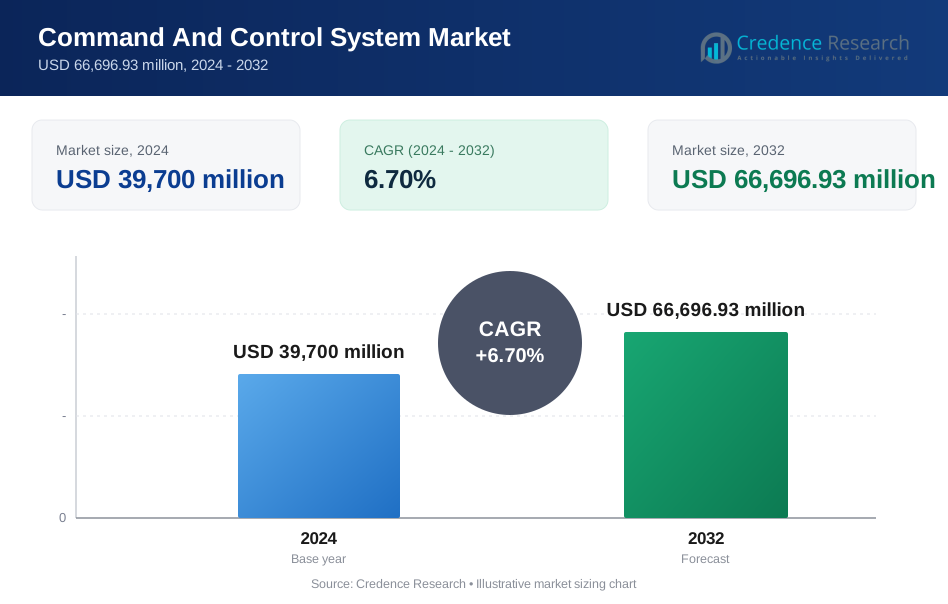
The Command and Control Systems Market is projected to grow from USD 39,700 million in 2024 to USD 66,696.93 million by 2032, registering a compound annual growth rate (CAGR) of 6.7% during the forecast period.
The Command and Control Systems Market is driven by increasing defense modernization programs, growing demand for real-time situational awareness, and rising geopolitical tensions globally. Governments are investing heavily in advanced command infrastructure to enhance decision-making capabilities, particularly in military and homeland security operations. The integration of artificial intelligence, machine learning, and big data analytics into command systems is reshaping operational efficiency and strategic planning. Additionally, the proliferation of network-centric warfare and the need for seamless communication across air, land, sea, space, and cyber domains are accelerating the adoption of integrated command and control solutions. The market is witnessing a trend toward modular, scalable systems that support multi-domain operations and rapid deployment. Enhanced interoperability between allied forces and advancements in cloud computing, cyber defense, and satellite communication technologies are further influencing market dynamics. The shift toward unmanned systems and autonomous platforms also underscores the need for robust, adaptable command and control frameworks to manage complex missions in real-time.
The Command and Control Systems Market demonstrates strong geographical diversity, with North America leading at 34% market share due to robust defense spending and key players like Lockheed Martin, Raytheon Technologies, and Northrop Grumman. Europe, holding 26%, is driven by defense modernization and regional collaborations, supported by companies such as Thales Group, BAE Systems, and Leonardo S.p.A. Asia Pacific accounts for 24%, fueled by rising military investments in China, India, and Japan, with active contributors like Saab AB and Elbit Systems. Other key players including General Dynamics, L3Harris Technologies, The Boeing Company, CACI International, and RGB Spectrum are expanding their global footprint across regions. These firms compete on technological innovation, multi-domain integration, and scalable platforms. The market’s regional dynamics reflect strategic defense priorities and growing focus on interoperable, AI-enabled, and cyber-secure command solutions.
Market Insights
- The Command and Control Systems Market is projected to grow from USD 39,700 million in 2024 to USD 66,696.93 million by 2032, at a CAGR of 6.7%, driven by defense modernization, real-time data needs, and rising geopolitical tensions.
- Integration of artificial intelligence, machine learning, and big data analytics enhances decision-making, threat detection, and strategic operations across military applications.
- Network-centric warfare doctrines are expanding demand for interoperable command platforms that link air, land, sea, space, and cyber forces through advanced digital networks.
- Modular, scalable systems designed for rapid deployment and multi-domain operations are gaining traction across both government and commercial sectors.
- High implementation costs and limited budgets, particularly in developing economies, pose significant challenges to large-scale adoption and system upgrades.
- Compatibility issues with legacy infrastructure continue to hinder seamless integration, real-time coordination, and interoperability among allied forces.
- North America leads with 34% market share, followed by Europe at 26% and Asia Pacific at 24%, with major contributions from the U.S., Germany, UK, China, and India.
Market Drivers
Rising Defense Modernization Initiatives Across the Globe
The Command and Control Systems Market is experiencing significant growth due to increased defense modernization efforts by major economies. Countries are upgrading legacy systems with next-generation technologies to enhance operational readiness and responsiveness. This includes the integration of digital communication systems, secure data links, and real-time information sharing. It enables armed forces to conduct synchronized operations across multiple domains. Governments are allocating substantial budgets to develop resilient and agile command structures. This strategic shift strengthens national security frameworks and bolsters deterrence capabilities.
- For instance, BAE Systems has focused on secure battlefield management and protected data transmission, providing advanced cybersecurity strategies and communication systems designed to perform reliably in contested and complex operational environments.
Growing Need for Situational Awareness and Real-Time Decision-Making
Modern military operations demand instant access to accurate data to make informed decisions in critical scenarios. The Command and Control Systems Market benefits from this demand by delivering tools that enhance real-time situational awareness. These systems fuse data from various sensors, satellites, and communication platforms to present a unified operational picture. It improves mission efficiency and supports rapid threat response. The market is gaining traction due to the importance of coordinated battlefield awareness. This capability is vital in high-intensity conflict zones and asymmetric warfare.
- For instance, the U.S. military has partnered with Viasat to deploy satellite communications (SATCOM) that provide global, real-time connectivity for intelligence sharing and mission data, ensuring operational resilience even in remote locations.
Proliferation of Network-Centric Warfare Capabilities
With the rise of network-centric warfare doctrines, defense agencies prioritize interoperability and information superiority. The Command and Control Systems Market plays a pivotal role in enabling data-driven operations by connecting disparate units through advanced digital infrastructure. It facilitates coordination between land, air, sea, space, and cyber forces. This integration enhances force effectiveness and reduces decision latency. Nations are focusing on acquiring systems that support joint operations and secure communication. The shift toward connected battlespaces drives strong demand for sophisticated command technologies.
Integration of Emerging Technologies for Strategic Advantage
Technological advancements in artificial intelligence, big data analytics, and cloud computing are transforming the Command and Control Systems Market. These technologies enhance system automation, threat detection, and predictive decision-making capabilities. It allows defense forces to optimize resource deployment and improve strategic planning. The inclusion of cybersecurity features also ensures data integrity in high-risk environments. Defense contractors are developing modular, scalable solutions that align with evolving mission requirements. The market’s innovation trajectory is shaped by rapid digital transformation initiatives worldwide.
Market Trends
Increased Integration of Artificial Intelligence and Automation
The Command and Control Systems Market is witnessing a growing trend toward the integration of artificial intelligence (AI) and automation to enhance operational efficiency and speed. AI algorithms support data analysis, threat detection, and decision-making processes by minimizing human error and reducing response time. It enables autonomous control of unmanned systems and predictive maintenance of assets. Automation streamlines command workflows and improves mission success rates in complex environments. Military organizations are deploying AI-enabled platforms to manage battlefield data more effectively. This trend is transforming command capabilities across defense forces.
- For instance, Airbus has deployed AI algorithms for predictive maintenance, analyzing real-time aircraft sensor data to identify potential issues before failures occur, which has led to reduced maintenance costs and improved safety by minimizing unplanned downtime.
Expansion of Multi-Domain Operations and Interoperability
The increasing focus on multi-domain operations across air, land, sea, space, and cyber is driving the demand for interoperable systems. The Command and Control Systems Market supports this requirement by offering flexible, modular solutions that allow real-time collaboration between different military branches. It enhances situational awareness and enables synchronized mission planning. Defense forces seek platforms that integrate seamlessly with allied systems during joint operations. Interoperability ensures faster response and coordinated efforts during global deployments. This trend aligns with evolving military doctrines that emphasize cross-domain synergy.
- For instance, Lockheed Martin’s Command and Control, Battle Management, and Communications (C2BMC) system enables integrated missile defense by connecting sensors and interceptors across multiple domains, providing real-time data fusion for U.S. and allied forces.
Shift Toward Cloud-Based and Edge Computing Architectures
Cloud-based infrastructure and edge computing are reshaping how military forces process and share operational data. The Command and Control Systems Market benefits from this shift by providing scalable, secure, and decentralized platforms. It allows real-time data access even in remote or contested environments. Edge computing reduces latency and supports faster tactical decision-making at the frontline. These technologies enhance mobility and adaptability of command units in dynamic threat scenarios. Armed forces are rapidly adopting these systems to maintain operational superiority and information dominance.
Emphasis on Cybersecurity and Data Resilience
With the growing reliance on digital infrastructure, cybersecurity has become a critical trend shaping the Command and Control Systems Market. It emphasizes protecting sensitive command data from cyberattacks and ensuring system resilience against disruptions. Military organizations are integrating advanced encryption, intrusion detection, and secure communication protocols into command frameworks. The focus on cyber-hardened platforms is increasing across procurement strategies. This trend ensures mission continuity and protects against data manipulation or espionage. Cybersecurity readiness is now fundamental to modern command system development.
Market Challenges Analysis
High Implementation Costs and Budget Constraints
The Command and Control Systems Market faces significant challenges due to the high costs associated with the development, deployment, and maintenance of advanced systems. These solutions often require substantial investment in hardware, software integration, and specialized training for personnel. Budget constraints, especially in developing regions, limit adoption across military and security sectors. It impacts procurement timelines and delays modernization efforts. Governments must balance defense spending with other national priorities, creating funding uncertainty. Cost concerns also hinder smaller contractors from entering the market and contributing to innovation.
- For instance, Raytheon Intelligence & Space, a business unit of RTX (US), was awarded a contract in January 2023 to develop a prototype missile track custody (MTC) system for the US Space Force, illustrating the substantial investment required for advanced system development and deployment.
Complex Integration and Interoperability Issues
Integrating new command and control systems with legacy infrastructure remains a persistent challenge. The Command and Control Systems Market must address compatibility issues among various platforms, communication standards, and equipment used by different military branches or allied forces. It complicates data sharing, disrupts real-time operations, and requires customized solutions that increase development time and cost. Disparate systems often lack standardized protocols, creating fragmentation in command workflows. Successful integration demands rigorous testing, coordination among vendors, and long-term technical support. These factors slow market scalability and impact operational reliability.
Market Opportunities
Growing Demand for Modernization in Emerging Economies
The Command and Control Systems Market is witnessing new opportunities driven by defense modernization initiatives in emerging economies. Countries in Asia Pacific, the Middle East, and Latin America are increasing investments in advanced command infrastructures to strengthen national security. It enables market players to expand their footprint by offering scalable and cost-effective solutions tailored to regional needs. Governments seek interoperable and mobile systems that support both conventional and asymmetric warfare. These regions present untapped potential for suppliers capable of navigating complex procurement environments. Collaborations with local defense firms further enhance market access and customization.
Expansion of Applications in Civil and Commercial Sectors
The Command and Control Systems Market is expanding beyond military use, with growing applications in disaster response, border security, air traffic control, and critical infrastructure protection. Public safety agencies and transportation authorities are adopting command solutions for coordinated response and resource management. It opens new revenue streams for vendors that offer dual-use technologies. Civil-military integration strategies create long-term demand for adaptable platforms. The increasing frequency of natural disasters and security threats amplifies the need for centralized control systems. This diversification strengthens the market’s resilience and supports broader technology adoption.
Market Segmentation Analysis:
By Application
The Command and Control Systems Market is segmented into government & defense and commercial applications. The government & defense segment dominates due to the increasing demand for integrated systems in military operations, homeland security, and border surveillance. It supports mission-critical communication and real-time decision-making in complex environments. The commercial segment is expanding steadily, driven by the adoption of command systems in public safety, transportation, and emergency response. Growing threats to critical infrastructure have accelerated investments in commercial command and control technologies.
By Platform
The market includes land, airborne, maritime, and space-based platforms. Land-based systems hold a significant share, supported by their extensive use in tactical operations and ground-based command centers. The airborne segment is gaining momentum with the integration of network-centric systems in aircraft and UAVs. Maritime command systems support naval operations and coastal surveillance, offering robust situational awareness. Space-based platforms are emerging rapidly, driven by satellite-based surveillance, navigation, and communications that enhance strategic command capabilities.
By Installation Type
The market is bifurcated into new installation and upgradation segments. New installations are propelled by large-scale modernization programs and infrastructure expansions in both defense and civil sectors. Upgradation remains critical, especially for integrating legacy systems with advanced digital architectures. It enables defense forces to extend the lifecycle of existing platforms while aligning with evolving operational needs. The need for rapid deployment, scalability, and technological compatibility continues to support demand in both installation types.
Segments:
Based on Application
- Government & Defense
- Commercial
Based on Platform
- Land
- Airborne
- Maritime
- Space
Based on Installation Type
- New Installation
- Upgradation
Based on Installation Base
- Fixed Command Center
- Deployable Command Center
Based on Solution
- Software
- Hardware
- Services
Based on the Geography:
- North America
- U.S.
- Canada
- Mexico
- Europe
- Germany
- France
- U.K.
- Italy
- Spain
- Rest of Europe
- Asia Pacific
- China
- Japan
- India
- South Korea
- South-east Asia
- Rest of Asia Pacific
- Latin America
- Brazil
- Argentina
- Rest of Latin America
- Middle East & Africa
- GCC Countries
- South Africa
- Rest of the Middle East and Africa
Regional Analysis
North America
North America holds the largest share of the Command and Control Systems Market, accounting for 34% of the global revenue. The region benefits from significant defense spending, strong technological infrastructure, and the presence of leading market players such as Lockheed Martin, Raytheon Technologies, and Northrop Grumman. The U.S. Department of Defense continues to invest in advanced command frameworks to support multi-domain operations and modern warfare capabilities. It drives consistent demand for interoperable, secure, and scalable systems across all branches of the military. Homeland security and public safety initiatives further support market growth in the region. Canada also contributes with modernization projects focused on aerospace and cybersecurity.
Europe
Europe captures 26% of the Command and Control Systems Market, supported by rising defense cooperation and investments under the European Defence Fund. Countries such as Germany, France, and the United Kingdom are upgrading their command infrastructure to align with NATO standards. The region emphasizes integrated battlefield management and cross-border security coordination. It sees strong adoption of space-based command systems and ground surveillance platforms. Defense manufacturers are collaborating with technology providers to enhance data-driven decision-making. Demand from civil protection and critical infrastructure security also supports market expansion across Europe.
Asia Pacific
Asia Pacific accounts for 24% of the Command and Control Systems Market, driven by geopolitical tensions, regional conflicts, and growing military budgets. Countries including China, India, Japan, and South Korea are investing in command systems to improve border security and strategic deterrence. It supports the deployment of advanced communication networks and surveillance assets. The region focuses on indigenizing defense production and reducing dependency on foreign technologies. Rising cybersecurity threats and the modernization of armed forces accelerate demand. Regional partnerships and government-led digital transformation programs also fuel system upgrades.
Key Player Analysis
- RGB Spectrum
- Northrop Grumman Corporation
- Leonardo S.p.A.
- CACI International Inc.
- The Boeing Company
- General Dynamics Mission Systems Inc (General Dynamics Corporation)
- Thales Group
- Elbit Systems Ltd.
- L3Harris Technologies Inc.
- Lockheed Martin Corporation
- Raytheon Technologies Corporation
- Saab AB
- BAE Systems plc
Competitive Analysis
The Command and Control Systems Market features a competitive landscape dominated by global defense contractors and technology firms that focus on integrated, interoperable, and secure solutions. Key players such as Lockheed Martin Corporation, Northrop Grumman Corporation, Raytheon Technologies Corporation, and BAE Systems plc lead the market through continuous innovation and large defense contracts. It sees intense competition driven by rising defense budgets, multi-domain operational needs, and increasing demand for AI-enhanced systems. Companies like Thales Group, Saab AB, and Leonardo S.p.A. strengthen their market presence through regional partnerships and advanced product offerings. L3Harris Technologies Inc. and General Dynamics Mission Systems Inc. invest in scalable platforms and digital battlefield solutions. Firms such as Elbit Systems Ltd., CACI International Inc., and RGB Spectrum support niche capabilities in command infrastructure and visual intelligence systems. The Command and Control Systems Market rewards players that deliver real-time data integration, cyber resilience, and mission-critical performance across diverse operational environments.
Recent Developments
- In April 2024, L3Harris Technologies, Inc. secured option year five of the Maintenance of Space Situational Awareness Integrated Capabilities (MOSSAIC) program from the U.S. Space Force under a USD 187 million contract. The initiative aims to sustain and modernize critical space infrastructure to enhance space domain awareness, supporting command centers and surveillance operations across multiple U.S. locations.
- In May 2024, VuWall Technology Inc. was awarded an indefinite-delivery/indefinite-quantity contract by the Missile Defense Agency, with a ceiling value of USD 4.09 billion. This effort focuses on advancing systems for command and control, battle management, and communications.
- In February 2024, Collins Aerospace, a business unit of RTX, delivered vehicle-mounted air traffic navigation, integration, and coordination systems to the U.S. Air Force. These systems, equipped with electronics and antennas for three radars, enhance air traffic control in contested environments and include advanced primary surveillance radars with extended range.
- In March 2024, Northrop Grumman entered into a Memorandum of Understanding (MoU) with Diehl Defense GmbH & Co. KG to enhance Germany’s layered air and missile defense. Northrop’s capabilities in integrated air and missile defense and command systems, such as the Integrated Battle Command System, complement Diehl’s ground-based defense technologies.
- In February 2024, BAE Systems Plc. announced its delivery plans for cutting-edge electromagnetic warfare mission systems tailored for the U.S. Air Force’s EA-37B fleet. These systems will bolster the Compass Call mission, which disrupts adversary C5ISRT (command and control, computing, communications, combat systems, and ISR targeting) operations.
- In April 2024, Lockheed Martin Corporation unveiled the Controlvu Touch Panel, a new Power over Ethernet (PoE) touchscreen interface designed for command and control environments. This advanced panel allows real-time monitoring and control of multiple video sources directly from a single screen.
Market Concentration & Characteristics
The Command and Control Systems Market exhibits a moderately high level of market concentration, with a few major defense contractors dominating global revenues through long-term government contracts and advanced technological capabilities. It is characterized by intensive research and development, stringent regulatory compliance, and a high entry barrier due to capital and technical requirements. The market demands continuous innovation in cybersecurity, artificial intelligence, and interoperability to meet evolving multi-domain operational needs. It shows a strong preference for modular, scalable platforms that allow rapid deployment and seamless integration across diverse defense and security infrastructures. Governments prioritize vendors with proven performance in mission-critical environments, reinforcing the position of established players. The Railway mService System Market also shares traits such as specialized technology, regulatory sensitivity, and reliance on long-term infrastructure programs, although it operates in a different transportation-focused context. The command systems space remains dynamic, shaped by shifting geopolitical priorities and the increasing complexity of modern defense ecosystems.
Report Coverage
The research report offers an in-depth analysis based on Application, Platform, Installation, Base, Installation Type, Solution and Geography. It details leading market players, providing an overview of their business, product offerings, investments, revenue streams, and key applications. Additionally, the report includes insights into the competitive environment, SWOT analysis, current market trends, as well as the primary drivers and constraints. Furthermore, it discusses various factors that have driven market expansion in recent years. The report also explores market dynamics, regulatory scenarios, and technological advancements that are shaping the industry. It assesses the impact of external factors and global economic changes on market growth. Lastly, it provides strategic recommendations for new entrants and established companies to navigate the complexities of the market.
Future Outlook
- Defense agencies will continue prioritizing multi-domain integration to enhance coordination across air, land, sea, space, and cyber operations.
- Governments will increase investments in AI-enabled systems to support faster decision-making and autonomous mission execution.
- Demand for interoperable platforms will grow to facilitate joint operations among allied forces and defense coalitions.
- Cybersecurity enhancements will remain critical to protect command infrastructure from evolving digital threats.
- Adoption of edge computing and cloud-based architectures will improve mobility and real-time data access in remote areas.
- Space-based command systems will gain traction to support satellite communications and strategic surveillance capabilities.
- Public safety, disaster response, and civil applications will open new avenues for dual-use command technologies.
- Upgrades to legacy systems will increase as nations seek cost-effective modernization strategies.
- Emerging economies will drive demand through regional security initiatives and digital defense transformation.
- Industry collaborations and defense-tech partnerships will shape innovation pipelines and global market expansion.
Request a Free Sample
Fill in your details and we'll send you a free sample report.
- Sample data tables & charts
- Research methodology
Need a Custom Version of This Report?
Tailor the scope, geography, or segments to your exact requirements.
- Custom geography or segment scope
- Direct access to our analyst team
Frequently Asked Questions
What is the projected growth of the Command and Control System Market?
What factors are driving the growth of the Command and Control System Market?
Which regions are leading the Command and Control System Market?
why is defense spending important for the growth of the market?
Who are the major players in this market?
Table of Content
Chapter 1. Report Introduction
- 1.1 Report Description & Purpose
- 1.1.1 Report Title & Market Definition
- 1.1.2 Unique Selling Propositions (USP) & Key Differentiators
- 1.1.3 Value Proposition for Stakeholders
- 1.2 Research Objectives
- 1.2.1 Market Sizing Objectives (Volume & Revenue)
- 1.2.2 Segmentation Objectives
- 1.2.3 Competitive Intelligence Objectives
- 1.2.4 Forecast & Scenario Objectives
- 1.3 Report Scope
- 1.3.1 Command And Control System Scope – Types & Subtypes Covered
- 1.3.2 Geographic Scope – Regions & Countries Covered
- 1.3.3 Historical Period, Base Year & Forecast Period (2024; forecast to 2032)
- 1.3.4 Inclusions & Exclusions
- 1.4 HS Code & Classification Framework
- 1.5 Currency, Units & Pricing Basis
- 1.6 Target Stakeholders
- 1.7 Limitations & Assumptions
Chapter 2. Executive Summary
- 2.1 Global Command And Control System Market Snapshot
- 2.1.1 Market Size – Historical (2024) & Forecast (2024-2032) (2024: USD 39,700 million → 2032: USD 66,696.93 million)
- 2.1.2 Volume & Revenue – Global Totals
- 2.1.3 Key Market Highlights – Top Five Facts
- 2.2 Command And Control System Market Segmentation Snapshot
- 2.2.1 Market Split by Region – 2024 vs. 2032
- 2.3 Competitive Snapshot
- 2.3.1 Top 10 Players by Revenue Share – 2024
- 2.3.2 Top 10 Players by Volume Share – 2024
- 2.3.3 Recent Strategic Developments (18-Month Summary)
- 2.4 Key Investment Highlights & Strategic Conclusions
Chapter 3. Command And Control System Market Dynamics & Industry Analysis
- 3.1 Market Overview & Context
- 3.1.1 Command And Control System Market Position in the Broader Automotive Value Chain
- 3.1.2 OEM vs. Replacement Market Dynamics
- 3.1.3 Market Maturity & Development Stage by Region
- 3.2 Command And Control System Market Drivers
- 3.3 Command And Control System Market Restraints & Challenges
- 3.4 Command And Control System Market Opportunities
- 3.5 Porter's Five Forces Analysis
- 3.5.1 Threat of New Entrants
- 3.5.2 Bargaining Power of Suppliers
- 3.5.3 Bargaining Power of Buyers
- 3.5.4 Threat of Substitutes
- 3.5.5 Competitive Rivalry – Intensity Assessment
- 3.6 Command And Control System Value Chain Analysis
- 3.6.1 Upstream – Raw Material/Input Suppliers
- 3.6.1.1 Raw Material/Input 1
- 3.6.1.2 Raw Material/Input 2
- 3.6.1.3 Raw Material/Input 3
- 3.6.2 Midstream – Production/Manufacturing/Service Delivery
- 3.6.2.1 Production/Process Overview
- 3.6.2.2 Key Facility Locations & Capacity by Manufacturer
- 3.6.3 Downstream – Distribution & End Consumer
- 3.6.3.1 Primary Channel – B2B/OEM
- 3.6.3.2 Secondary Channels – Dealer, Retail, Online, Direct
- 3.6.4 Value Chain Profitability Analysis
- 3.6.1 Upstream – Raw Material/Input Suppliers
- 3.7 PESTEL Analysis
- 3.7.1 Political Factors
- 3.7.2 Economic Factors
- 3.7.3 Social Factors
- 3.7.4 Technological Factors
- 3.7.5 Environmental Factors
- 3.7.6 Legal Factors
- 3.8 Command And Control System Supply Chain Analysis
- 3.8.1 Raw Material/Input Supply Risk Assessment
- 3.8.2 Manufacturing Concentration Risk (Geographic Exposure)
- 3.8.3 Trade Disruption Impact Analysis
- 3.9 Regulatory & Policy Landscape
Note: The regulatory and policy landscape section covers regulations based on their applicability to the market, Command And Control System category, geography, and scope of the study. Only regulatory frameworks with a material impact on operations, compliance, trade, sustainability, or market access are analyzed in detail.
Chapter 4. Key Investment Pockets & Opportunity Analysis
- 4.1 Command And Control System Market Attractiveness Analysis
- 4.1.1 By Region – Investment Attractiveness Matrix (Volume × CAGR)
- 4.2 Absolute Revenue Growth Opportunity
- 4.2.1 By Region – Absolute USD Growth Through 2032
- 4.3 Incremental Volume Opportunity
- 4.3.1 By Region – Incremental Volume Through 2032
- 4.3.2 Segment – Incremental Volume
- 4.4 Emerging Submarket Opportunity Deep Dive (Subject to Applicability)
- 4.5 Emerging Market Opportunity Scorecards
- 4.5.1 United States
- 4.5.2 Europe
- 4.5.3 Asia
- 4.5.4 Middle East & Africa
Note: Emerging Market Opportunity Scorecards will be included based on relevance and strategic importance. Regions listed are indicative and may vary depending on data availability and market dynamics.
Chapter 5. Command And Control System Import-Export Analysis & Trade Flows
- 5.1 Global Trade Overview
- 5.1.1 Global Export Value by Country (2024)
- 5.1.2 Global Export Volume by Country (2024)
- 5.1.3 Global Import Value by Country (2024)
- 5.1.4 Global Import Volume by Country (2024)
- 5.1.5 Net Trade Balance by Country (2024)
- 5.2 Export Analysis – Segment
- 5.2.1 Type 1 (HS Code)
- 5.2.2 Type 2 (HS Code)
- 5.2.3 Type 3 (HS Code)
- 5.2.4 Type 4 (HS Code)
- 5.2.5 Type 5 (HS Code)
- 5.3 Import Analysis – Segment
- 5.3.1 Type 1 (HS Code)
- 5.3.2 Type 2 (HS Code)
- 5.3.3 Type 3 (HS Code)
- 5.3.4 Type 4 (HS Code)
- 5.3.5 Type 5 (HS Code)
- 5.4 Average Unit Trade Prices
- 5.4.1 Average Export Price – Segment & Country
- 5.4.2 Average Import Price – Segment & Source Country
- 5.4.3 Price Trends (2024)
- 5.5 Key Trade Route Analysis
- 5.5.1 Trade Route 1
- 5.5.2 Trade Route 2
- 5.5.3 Trade Route 3
- 5.5.4 Trade Route 4
- 5.5.5 Trade Route 5
- 5.6 Trade Policy Impact Assessment
- 5.6.1 US Anti-Dumping & Section 301 Tariffs
- 5.6.2 EU Customs Union Impact
- 5.6.3 Major Free Trade Agreements
- 5.6.4 USMCA Rules of Origin
Note: Trade policy analysis will be included only where relevant to the Command And Control System market.
Chapter 6. Competitive Landscape & Company Benchmarking
- 6.1 Command And Control System Market Concentration & Structure
- 6.1.1 Herfindahl-Hirschman Index (HHI) – vs. 2024
- 6.1.2 Tier 1, Tier 2 & Tier 3 Market Structure
- 6.1.3 Global, Regional & Local Player Dynamics
- 6.2 Command And Control System Market Share Analysis – 2024
- 6.2.1 Global Revenue Share by Company
- 6.2.2 Global Volume Share by Company
- 6.2.3 Regional Revenue Share
- 6.2.4 Market Share Evolution ( vs. 2024)
- 6.2.5 OEM Segment Share by Company
- 6.2.6 Replacement Segment Share by Company
- 6.3 Production/Delivery Capacity & Facility Analysis
- 6.3.1 Global Installed Capacity
- 6.3.2 Capacity Utilization Rates
- 6.3.3 Production/Output Volume
- 6.3.4 Facility Locations & Capacity Map
- 6.3.5 Planned Capacity Additions
- 6.4 Command And Control System Competitive Benchmarking Matrix
- 6.4.1 Revenue, Volume, CAGR & Profitability Comparison
- 6.4.2 Channel Revenue Mix
- 6.4.3 Geographic Revenue Exposure
- 6.4.4 R&D Intensity
- 6.4.5 Sustainability Maturity
- 6.5 Strategic Developments in Command And Control System (Last 24 Months)
- 6.5.1 Mergers, Acquisitions & Divestments
- 6.5.2 New Command And Control System Launches
- 6.5.3 Facility Expansions
- 6.5.4 Strategic Alliances, Joint Ventures & Partnerships
- 6.5.5 Distribution Expansion & Market Entry
- 6.5.6 Sustainability & ESG Initiatives
- 6.6 Competitive Strategy Mapping
- 6.6.1 Leader, Challenger, Follower & Niche Classification
- 6.6.2 Pricing Strategy Comparison
- 6.6.3 Channel Strategy Matrix
Note: Strategic developments are included based on their materiality and the availability of reliable information.
Chapter 7. Global Command And Control System Market – By Distribution Channel
- 7.1 Segment Overview
- 7.1.1 Volume & Revenue Split by Channel (2024 & 2032)
- 7.1.2 Channel Mix Evolution (2024-2032)
Chapter 8. Regional Market Analysis – Global Overview
- 8.1 Global Regional Overview
- 8.1.1 Regional Volume Share
- 8.1.2 Regional Revenue Share
- 8.1.3 Regional Volume by Region
- 8.1.4 Regional Revenue by Region
- 8.1.5 Regional Forecast Through 2032
- 8.2 Cross-Regional Segment Analysis
- 8.2.1 By Distribution Channel
- 8.2.2 By Brand/Price Tier
Chapter 9. North America Command And Control System Market
- 9.1 United States
- 9.2 Canada
- 9.3 Mexico
Chapter 10. Europe Command And Control System Market
- 10.1 Germany
- 10.2 France
- 10.3 Italy
- 10.4 United Kingdom
- 10.5 Spain
- 10.6 Poland
- 10.7 Russia
- 10.8 Netherlands
- 10.9 Belgium
- 10.10 Sweden
- 10.11 Denmark
- 10.12 Norway
- 10.13 Rest of Europe
Chapter 11. Asia Pacific Command And Control System Market
- 11.1 China
- 11.2 India
- 11.3 Japan
- 11.4 South Korea
- 11.5 Thailand
- 11.6 Indonesia
- 11.7 Vietnam
- 11.8 Malaysia
- 11.9 Australia
- 11.10 Rest of Asia Pacific
Chapter 12. Latin America Command And Control System Market
- 12.1 Brazil
- 12.2 Argentina
- 12.3 Colombia
- 12.4 Chile
- 12.5 Rest of Latin America
Chapter 13. Middle East Command And Control System Market
- 13.1 Saudi Arabia
- 13.2 United Arab Emirates
- 13.3 Turkey
- 13.4 Israel
- 13.5 Iran
- 13.6 Rest of the Middle East
Chapter 14. Africa Command And Control System Market
- 14.1 South Africa
- 14.2 Egypt
- 14.3 Nigeria
- 14.4 Morocco
- 14.5 Rest of Africa
Chapter 15. Command And Control System Company Profiles
- 15.1 [Company 01]
- 15.1.1 Company Overview
- 15.1.2 Key Management Personnel
- 15.1.3 Products & Services Portfolio
- 15.1.4 Financial Performance
- 15.1.5 Key Market Focus & Geographic Presence
- 15.1.6 Recent Developments & Strategic Initiatives
Note: The company profile list is preliminary and may change based on research findings, market developments, data availability, and client requirements.
Chapter 16. Appendices
- Appendix A – List of Abbreviations & Acronyms
- Appendix B – Industry Classification Code Reference – Full Series
- Appendix C – Production & Capacity Data Tables
- Appendix D – End-Use & Demand Base Tables
- Appendix E – Consumption & Replacement Rate Assumptions
- Appendix F – ASP Reference Tables
- Appendix G – Manufacturing & Facility Database
- Appendix H – Import-Export Data Tables
- Appendix I – Regulatory Summary Tables
- Appendix J – Primary Research Participant List (Anonymized)
- Appendix K – Primary Research Questionnaire Framework
- Appendix L – Data Sources & Bibliography
- Appendix M – Market Size Divergence & Source Comparison
Chapter 17. Research Methodology
- 17.1 Research Framework & Philosophy
- 17.2 Secondary Research – Sources, Hierarchy & Data Extraction
- 17.3 Data Modeling – Bottom-Up & Top-Down Market Sizing
- 17.4 Primary Research – Stakeholder Framework, LOI & Sample Sizes
- 17.5 Forecast Methodology – Regression, Scenario & Sensitivity Analysis
- 17.6 Quality Control – Four-Layer Validation Framework
- 17.7 Limitations & Standard Assumptions
- 17.8 Disclaimer
