
| REPORT ATTRIBUTE | DETAILS |
|---|---|
| Historical Period | 2019-2022 |
| Base Year | 2023 |
| Forecast Period | 2024-2032 |
| Commercial Avionics Market Size 2023 | USD 34,721.49 Million |
| Commercial Avionics Market , CAGR | 4.50% |
| Commercial Avionics Market Size 2032 | USD 51,599.44 Million |
Market Overview
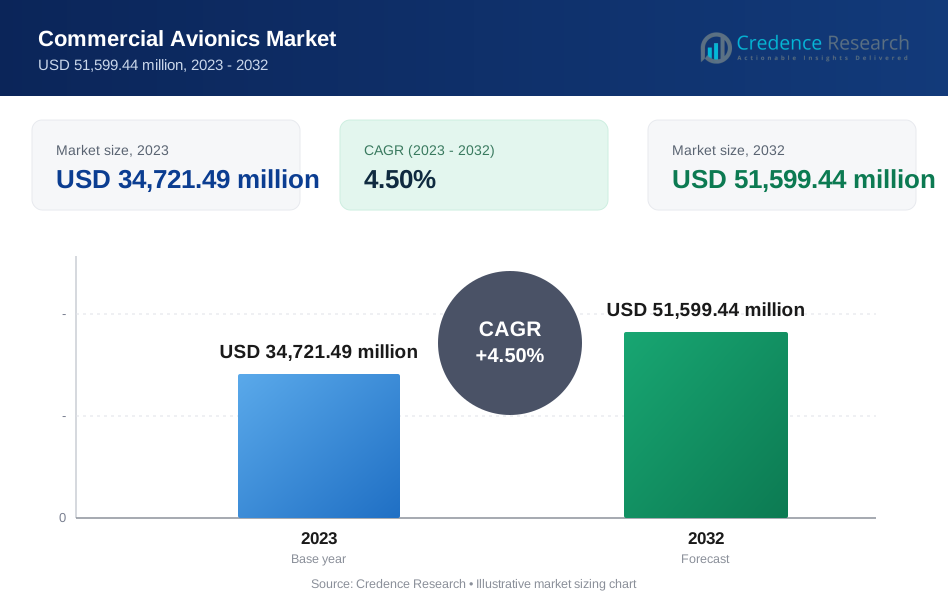
The Commercial Avionics Market is projected to grow from USD 34,721.49 million in 2023 to an estimated USD 51,599.44 million by 2032, with a compound annual growth rate (CAGR) of 4.50% from 2024 to 2032. This growth is driven by the increasing demand for advanced avionics systems in both new and retrofitted commercial aircraft, as airlines seek to enhance operational efficiency, safety, and passenger experience.
Key drivers for the Commercial Avionics Market include the growing adoption of automation in aviation, the need for modernizing aging fleets, and stringent regulatory requirements for safety and efficiency. Additionally, the integration of artificial intelligence and data analytics in avionics systems is a notable trend, providing real-time insights and predictive maintenance capabilities, which are expected to fuel market growth in the coming years.
Geographically, North America is expected to hold the largest market share due to the presence of major avionics manufacturers and high investment in aviation technology. Europe and Asia Pacific follow closely, with Asia Pacific anticipated to witness the fastest growth due to the region's expanding commercial aviation sector and increasing aircraft deliveries. Key players in the market include Honeywell International Inc., Collins Aerospace, Thales Group, Garmin Ltd., and L3Harris Technologies, who are continuously innovating to maintain their competitive edge.
Market Drivers
Rising Demand for Advanced Avionics Systems
The commercial avionics market is experiencing robust growth driven by increasing demand for advanced systems across the aviation industry. According to FAA data, the number of commercial aircraft equipped with next-generation avionics has risen steadily over the past decade. Airlines are adopting sophisticated solutions like enhanced flight management systems, advanced communication and navigation equipment, and integrated modular avionics to improve operational efficiency and safety. For instance, a recent IATA survey found that a majority of airlines plan to invest in upgrading their avionics within the next 5 years. The integration of these systems enables fuel savings, enhanced situational awareness, and reduced pilot workload. As reported by Eurocontrol, advanced avionics have contributed to a decrease in air traffic delays and improved on-time performance for European carriers. With global air passenger traffic projected to double in the coming decades according to ICAO forecasts, the demand for state-of-the-art avionics is expected to grow further. Industry analysts predict continued innovation in areas like synthetic vision systems, touchscreen displays, and connectivity solutions to meet evolving operational needs.
Growth in Aircraft Fleet and Fleet Modernization Programs
The expansion of the global commercial aircraft fleet is a key factor propelling the avionics market. FAA data shows the U.S. commercial fleet has grown consistently year-over-year, with similar trends seen globally. Airlines are adding new technologically-advanced aircraft to accommodate rising passenger volumes, particularly in emerging markets. For instance, recent IATA surveys indicate robust fleet expansion plans among carriers in Asia Pacific and the Middle East. Additionally, many airlines are undertaking fleet modernization initiatives to replace older aircraft with new models featuring the latest avionics. A study by Oliver Wyman found that the average age of commercial aircraft is decreasing as airlines prioritize newer, more efficient planes. These modernization efforts aim to improve operational efficiency, reduce maintenance costs, and enhance safety. Aircraft manufacturers report strong order backlogs for next-generation narrow-body and wide-body jets equipped with advanced avionics suites. The ongoing fleet renewal cycle is creating substantial opportunities for avionics suppliers. Industry forecasts from ICAO and aircraft OEMs project continued fleet growth and modernization efforts in the coming years, supporting sustained demand for cutting-edge avionics systems.
Stringent Regulatory Requirements and Safety Standards
Regulatory mandates from aviation authorities are driving avionics adoption in the commercial sector. The FAA, EASA, and ICAO have established rigorous safety standards governing avionics systems. These regulations require the use of specific technologies like Traffic Collision Avoidance Systems (TCAS), Enhanced Ground Proximity Warning Systems (EGPWS), and Automatic Dependent Surveillance-Broadcast (ADS-B). FAA data shows near-universal equipage of commercial aircraft with these mandated systems. Compliance is not optional, compelling airlines and manufacturers to invest in advanced solutions. Regulatory bodies regularly update requirements to enhance safety and efficiency. For example, recent FAA mandates for ADS-B Out capability have driven widespread avionics upgrades across the U.S. fleet. EASA has introduced similar requirements in Europe. Industry surveys indicate that regulatory compliance is a top priority for airlines when making avionics investment decisions. Ongoing regulatory initiatives focused on improving navigation precision, enhancing communication capabilities, and reducing environmental impact are expected to spur further avionics upgrades. The continuous evolution of safety standards and operational requirements will likely sustain demand for state-of-the-art avionics in commercial aviation.
Technological Advancements and Integration of Emerging Technologies
The commercial avionics market is benefiting significantly from rapid technological advancements and the integration of emerging technologies, such as artificial intelligence (AI), data analytics, and the Internet of Things (IoT). These technologies are transforming traditional avionics systems by enabling real-time data processing, predictive maintenance, and enhanced decision-making capabilities. For instance, AI-powered avionics systems can analyze vast amounts of flight data to predict potential issues before they occur, thereby reducing the likelihood of in-flight failures and minimizing maintenance-related delays. Similarly, IoT-enabled avionics solutions facilitate seamless communication between aircraft components, ground stations, and air traffic control, enhancing operational efficiency and safety. The adoption of these advanced technologies is expected to accelerate as airlines and aircraft manufacturers seek to improve the overall performance of their fleets, further driving market growth.
Market Trends
Increasing Adoption of Connected Aircraft and Digital Avionics Solutions
One of the most significant trends in the commercial avionics market is the increasing adoption of connected aircraft and digital avionics solutions. Airlines and aircraft operators are progressively embracing digital transformation by integrating advanced avionics systems that enable real-time data exchange between the aircraft, ground stations, and air traffic control. This connectivity facilitates continuous monitoring of aircraft performance, predictive maintenance, and optimized flight operations. For instance, a major European airline reported substantial fuel savings and reduced maintenance costs after implementing connected avionics systems across its fleet. Government aviation authorities have also noted a marked improvement in safety metrics for airlines utilizing these advanced digital solutions. Additionally, surveys conducted by leading avionics manufacturers indicate growing interest from commercial carriers in upgrading to fully integrated digital cockpits. The trend toward connected and smart avionics systems is expected to gain further momentum as airlines seek to improve safety, reduce operational costs, and enhance the overall passenger experience. Industry experts predict that within the next decade, the majority of commercial aircraft will be equipped with some form of connected avionics technology.
Integration of Artificial Intelligence (AI) and Automation in Avionics
Another key trend shaping the commercial avionics market is the integration of artificial intelligence (AI) and automation technologies into avionics systems. AI is playing an increasingly pivotal role in enhancing the capabilities of modern avionics, enabling systems to process large volumes of data in real-time and make informed decisions that improve flight safety and efficiency. For example, a leading North American airline reported significant improvements in on-time performance and reduced fuel consumption after implementing AI-powered flight management systems. Government aviation safety boards have documented fewer incidents related to human error in aircraft equipped with advanced AI-assisted avionics. Automation is also becoming more prevalent, with the development of next-generation avionics systems such as autopilot systems, electronic flight bags (EFBs), and fly-by-wire (FBW) systems, which reduce pilot workload and enhance the precision of flight operations. A survey of commercial pilots conducted by a prominent pilots' association found overwhelming support for increased automation in cockpit systems. As AI and automation technologies continue to evolve, their integration into avionics systems is expected to drive significant advancements in the commercial aviation sector.
Market Restraints and Challenges
High Costs and Long Development Cycles
One of the primary restraints in the commercial avionics market is the high cost associated with the development, certification, and deployment of advanced avionics systems. For instance, a recent industry survey conducted by a leading aerospace association found that avionics manufacturers consistently rank R&D expenses as their top financial concern. The research and development processes for new avionics technologies are both time-consuming and expensive, often requiring substantial investment from manufacturers. Additionally, the stringent regulatory environment in the aviation industry necessitates extensive testing and certification, further extending the development timeline and increasing costs. A government report on aviation technology adoption indicates that many airlines cite the high capital expenditures required for avionics upgrades as a major barrier to implementation. These financial and temporal demands can be challenging for both established players and new entrants in the market. The survey also revealed that smaller avionics firms often struggle to compete due to limited R&D budgets. Consequently, the high cost and long development cycles can slow down innovation and limit the adoption of new technologies, posing a significant challenge to market growth.
Cybersecurity Threats and Data Privacy Concerns
As the commercial avionics market increasingly embraces digitalization and connected systems, cybersecurity threats have emerged as a critical challenge. A comprehensive study by a cybersecurity firm specializing in aviation found that incidents of attempted cyberattacks on avionics systems have risen significantly in recent years. Modern avionics systems, which rely heavily on real-time data exchange and internet connectivity, are vulnerable to cyberattacks that could compromise flight safety and operational efficiency. The risk of unauthorized access, data breaches, and potential sabotage presents a significant concern for airlines, manufacturers, and regulatory bodies. A survey of airline IT professionals indicated that cybersecurity is now considered one of the top priorities in avionics system selection and maintenance. Ensuring the cybersecurity of avionics systems requires continuous investment in robust security measures. Additionally, the integration of artificial intelligence and big data analytics in avionics raises concerns about data privacy. A consumer trust survey revealed that passengers are increasingly worried about the security of their personal information in connected aircraft systems. Addressing these challenges requires a concerted effort from industry stakeholders to develop and implement comprehensive cybersecurity frameworks.
Market Segmentation Analysis
By Type
The commercial avionics market is segmented by aircraft type into narrowbody, widebody, and regional aircraft, each with distinct avionics needs. Narrowbody aircraft dominate the market due to rising short and medium-haul travel demand. For instance, Airbus forecasts that narrowbody aircraft will account for over 75% of new deliveries through 2040, driving demand for advanced avionics systems optimized for fuel efficiency and lower operating costs. Widebody aircraft, while fewer in number, require more sophisticated avionics for long-haul international flights. Boeing projects that widebody aircraft will represent about 20% of new deliveries, with a focus on next-generation avionics to enhance safety and passenger experience on extended routes. Regional aircraft play a crucial role in connecting smaller markets, with avionics upgrades focused on improving operational efficiency. For example, Embraer estimates that regional jets will make up approximately 10% of commercial aircraft deliveries in the coming decades, with airlines investing in modern avionics to ensure regulatory compliance and enhance connectivity in underserved areas. The evolving needs across these aircraft types are shaping avionics development and adoption in the commercial aviation sector.
By Subsystem
The commercial avionics market encompasses various critical subsystems, each contributing to aircraft safety and efficiency. Health monitoring systems are gaining prominence, with airlines increasingly adopting predictive maintenance solutions. For instance, Lufthansa Technik reports that its health monitoring systems have helped reduce unscheduled maintenance events by up to 35% for some operators. Flight management and control systems continue to evolve, with Honeywell's latest flight management system showing a 2% improvement in fuel efficiency across various aircraft types. Communication and navigation systems are advancing rapidly, driven by the transition to satellite-based technologies. For example, the FAA reports that over 100,000 aircraft in the U.S. have been equipped with ADS-B Out technology, enhancing air traffic management capabilities. Cockpit systems are becoming more intuitive, with Airbus's new cockpit display system reducing pilot workload by up to 50% compared to previous generations. Other subsystems, such as weather radar and collision avoidance systems, are also seeing technological advancements. The International Civil Aviation Organization (ICAO) notes that modern avionics have contributed to a significant reduction in weather-related incidents over the past decade.
Segments
Based on Type
- Narrowbody Aircraft
- Widebody Aircraft
- Regional Aircraft
Based on Subsystem
- Health Monitoring System
- Flight Management and Control System
- Communication and Navigation
- Cockpit Systems
- Others
Based on Fit
- Line Fit
- Retrofit
Based on Region
- North America
- Europe
- Asia Pacific
- Rest of the World
Regional Analysis
North America (35%):
North America holds the largest share of the commercial avionics market, accounting for approximately 35% of the global market in 2023. This dominance is attributed to the presence of major avionics manufacturers, including Honeywell International Inc., Collins Aerospace, and L3Harris Technologies. For instance, a recent survey by the Aerospace Industries Association showed that North American companies lead in avionics R&D spending. The region's mature aviation industry drives continuous innovation in avionics technologies. Additionally, North America's strict regulatory standards contribute to its leading market position. The Federal Aviation Administration reported a significant increase in next-generation avionics adoption rates among commercial airlines. The growing demand for advanced avionics in both new aircraft and retrofit solutions is expected to sustain North America's market leadership.
Europe (28%):
Europe is the second-largest market, holding around 28% of the global market share in 2023. The region is home to prominent aircraft manufacturers such as Airbus, which drives the demand for sophisticated avionics systems. For instance, Airbus reported that its latest A350 aircraft incorporates over 30 advanced avionics systems from European suppliers. The European market is heavily influenced by stringent safety and environmental regulations enforced by agencies like the European Union Aviation Safety Agency (EASA). A recent EASA survey indicated that European airlines are rapidly adopting new avionics technologies to meet these regulations. Europe's focus on reducing carbon emissions and enhancing air traffic management efficiency is driving the adoption of cutting-edge avionics technologies. The European Commission's Clean Sky initiative has reported significant progress in developing eco-friendly avionics solutions.
Key players
- Honeywell International Inc.
- General Electric Company
- Thales Group
- BAE Systems plc
- Cobham Limited
- Esterline Technologies Corp.
- Diehl Stiftung & Co KG
- L3Harris Technologies Inc.
- Raytheon Technologies Corp.
- Meggitt PLC
- Teledyne Technologies Incorporated
- Safran
Competitive Analysis
The commercial avionics market is characterized by intense competition among several major players, each leveraging their technological expertise, extensive product portfolios, and strong customer relationships to maintain and expand their market presence. Companies like Honeywell International Inc., Thales Group, and Raytheon Technologies Corp. lead the market with their advanced avionics solutions, robust R&D capabilities, and global reach. These key players focus on innovation, particularly in areas such as flight management systems, communication and navigation, and cockpit systems, to meet the evolving demands of the aviation industry. Meanwhile, companies like BAE Systems, L3Harris Technologies, and Safran are also significant competitors, offering specialized avionics systems and services tailored to both commercial and defense applications. The market is further characterized by strategic partnerships, mergers, and acquisitions as companies seek to enhance their technological capabilities and expand their global footprint.
Recent Developments
- In June 2024, Honeywell announced the acquisition of Air Products' liquefied natural gas (LNG) process technology and equipment business for $1.81 billion. While not directly related to commercial avionics, this acquisition strengthens Honeywell's energy transition capabilities and may have implications for aviation fuel technologies.
- In September 2024, L3Harris received a five-year contract worth up to $587.4 million from the U.S. Navy to deliver custom tactical jamming pods for the Next Generation Jammer – Low Band (NGJ-LB) system. Although this is primarily a military application, the technology could have potential crossover benefits for commercial avionics.
- In September 2024, BAE Systems announced the acquisition of Kirintec to enhance its electronic warfare capabilities. This acquisition could potentially impact commercial avionics through advancements in electronic systems and technologies.
- In September 2024, Thales reported that its ChemCam laser, designed for Mars exploration, has been operating for twelve years and fired its one millionth shot. While not directly related to commercial avionics, this demonstrates Thales' capabilities in developing long-lasting, high-performance electronic systems.
- In September 2024, Cobham Satcom introduced a new range of advanced satellite Safety Terminals at SMM 2024, designed for the Global Maritime Distress and Safety System (GMDSS). These terminals, while primarily for maritime use, showcase Cobham's advancements in satellite communication technology that could have applications in aviation.
- In September 2024, Safran announced the acquisition of Preligens, an AI company specializing in aerospace and defense, for an enterprise value of €220 million. This acquisition is expected to enhance Safran's AI capabilities in various sectors, including commercial avionics.
- In September 2024, RTX's Raytheon and Northrop Grumman successfully tested a solid rocket motor for hypersonic applications. While this is primarily a defense-related development, the technology could potentially influence future commercial aviation propulsion systems.
Market Concentration and Characteristics
The Commercial Avionics Market is moderately concentrated, with a few key players dominating a significant portion of the market share. These companies, including Honeywell International Inc., Thales Group, and Raytheon Technologies Corp., lead the market due to their extensive product offerings, strong R&D investments, and established relationships with major aircraft manufacturers and airlines. The market is characterized by high entry barriers, primarily due to the substantial capital requirements, stringent regulatory standards, and the need for advanced technological expertise. Additionally, the market is marked by continuous innovation, with companies focusing on developing next-generation avionics systems that enhance flight safety, operational efficiency, and connectivity. Strategic partnerships, mergers, and acquisitions are common as players aim to strengthen their market position and expand their global presence. Despite the dominance of leading firms, the market remains dynamic, with opportunities for growth driven by emerging technologies and increasing demand for advanced avionics solutions.
Report Coverage
The research report offers an in-depth analysis based on Type, Subsystem, Fit and Region. It details leading market players, providing an overview of their business, product offerings, investments, revenue streams, and key applications. Additionally, the report includes insights into the competitive environment, SWOT analysis, current market trends, as well as the primary drivers and constraints. Furthermore, it discusses various factors that have driven market expansion in recent years. The report also explores market dynamics, regulatory scenarios, and technological advancements that are shaping the industry. It assesses the impact of external factors and global economic changes on market growth. Lastly, it provides strategic recommendations for new entrants and established companies to navigate the complexities of the market.
Future Outlook
- The commercial avionics market is expected to see continued growth as airlines prioritize the adoption of advanced systems to enhance safety, efficiency, and passenger experience.
- Rapid growth in air travel across emerging markets, particularly in Asia Pacific and the Middle East, will drive demand for new aircraft equipped with cutting-edge avionics technologies.
- Airlines globally will continue investing in fleet modernization, upgrading older aircraft with next-generation avionics systems to meet regulatory standards and improve operational efficiency.
- AI will play a crucial role in the evolution of avionics systems, offering predictive maintenance, real-time data analysis, and enhanced decision-making capabilities for pilots and operators.
- The trend towards connected aircraft will accelerate, with avionics systems increasingly integrated into broader digital ecosystems, enabling seamless communication and data exchange.
- Stricter regulatory requirements related to safety, emissions, and air traffic management will drive continuous innovation in avionics technologies, ensuring compliance and operational excellence.
- The adoption of satellite-based navigation and communication systems will expand, improving the accuracy and reliability of flight operations and supporting global air traffic management initiatives.
- As avionics systems become more connected, the industry will place greater emphasis on cybersecurity, investing in robust solutions to protect against potential threats and ensure the safety of flight operations.
- Strategic partnerships and collaborations among avionics manufacturers, airlines, and technology firms will increase, aimed at developing innovative solutions and expanding market reach.
- The push for greener aviation will drive demand for avionics systems that support fuel efficiency, emissions reduction, and sustainable flight operations, aligning with global environmental goals.
Request a Free Sample
Fill in your details and we'll send you a free sample report.
- Sample data tables & charts
- Research methodology
Need a Custom Version of This Report?
Tailor the scope, geography, or segments to your exact requirements.
- Custom geography or segment scope
- Direct access to our analyst team
Frequently Asked Questions
What is the market size of the Commercial Avionics Market in 2023 and 2032, and what is its CAGR?
What are the key factors driving the growth of the Commercial Avionics Market?
How is technological advancement influencing the Commercial Avionics Market?
Which region holds the largest share in the Commercial Avionics Market?
Who are the major players in the Commercial Avionics Market?
Table of Content
Chapter 1. Report Introduction
- 1.1 Report Description & Purpose
- 1.1.1 Report Title & Market Definition
- 1.1.2 Unique Selling Propositions (USP) & Key Differentiators
- 1.1.3 Value Proposition for Stakeholders
- 1.2 Research Objectives
- 1.2.1 Market Sizing Objectives (Volume & Revenue) (Volume Where Applicable)
- 1.2.2 Segmentation Objectives
- 1.2.3 Competitive Intelligence Objectives
- 1.2.4 Forecast & Scenario Objectives
- 1.3 Report Scope
- 1.3.1 Commercial Avionics Scope – Segments & Subsegments Covered
- 1.3.2 Geographic Scope – Regions & Countries Covered
- 1.3.3 Historical Period, Base Year & Forecast Period (2023; forecast to 2032)
- 1.3.4 Inclusions & Exclusions
- 1.4 Industry Classification & Applicable Codes
- 1.5 Currency, Measurement Units & Valuation Basis
- 1.6 Target Stakeholders
- 1.7 Limitations & Assumptions
Chapter 2. Executive Summary
- 2.1 Global Commercial Avionics Market Snapshot
- 2.1.1 Market Size – Historical (2023) & Forecast (2023-2032) (2023: USD 34,721.49 million → 2032: USD 51,599.44 million)
- 2.1.2 Volume & Revenue – Global Totals (Volume Where Applicable)
- 2.1.3 Key Market Highlights – Top Five Facts
- 2.2 Commercial Avionics Market Segmentation Snapshot
- 2.2.1 Market Split by Region – 2023 vs. 2032
- 2.3 Competitive Snapshot
- 2.3.1 Top 10 Players by Revenue Share – 2023
- 2.3.2 Top 10 Players by Volume Share – 2023 (Volume Where Applicable)
- 2.3.3 Recent Strategic Developments (18-Month Summary)
- 2.4 Key Investment Highlights & Strategic Conclusions
Chapter 3. Commercial Avionics Market Dynamics & Industry Analysis
- 3.1 Market Overview & Context
- 3.1.1 Commercial Avionics Market Position in the Broader Industry Value Chain
- 3.1.2 Demand Structure & Purchasing Dynamics
- 3.1.3 Market Maturity & Development Stage by Region
- 3.2 Commercial Avionics Market Drivers
- 3.3 Commercial Avionics Market Restraints & Challenges
- 3.4 Commercial Avionics Market Opportunities
- 3.5 Porter's Five Forces Analysis
- 3.5.1 Threat of New Entrants
- 3.5.2 Bargaining Power of Suppliers
- 3.5.3 Bargaining Power of Buyers
- 3.5.4 Threat of Substitutes
- 3.5.5 Competitive Rivalry – Intensity Assessment
- 3.6 Commercial Avionics Value Chain Analysis
- 3.6.1 Upstream – Key Inputs, Resources & Suppliers
- 3.6.1.1 Key Input/Resource 1
- 3.6.1.2 Key Input/Resource 2
- 3.6.1.3 Key Input/Resource 3
- 3.6.2 Midstream – Core Operations & Value Creation
- 3.6.2.1 Operating Model & Process Overview
- 3.6.2.2 Key Operating Locations & Capabilities by Company
- 3.6.3 Downstream – Market Channels & End Users
- 3.6.3.1 Direct Sales & Customer Engagement Channels
- 3.6.3.2 Indirect Sales, Intermediaries & Partner Channels
- 3.6.4 Value Chain Profitability Analysis
- 3.6.1 Upstream – Key Inputs, Resources & Suppliers
- 3.7 PESTEL Analysis
- 3.7.1 Political Factors
- 3.7.2 Economic Factors
- 3.7.3 Social Factors
- 3.7.4 Technological Factors
- 3.7.5 Environmental Factors
- 3.7.6 Legal Factors
- 3.8 Commercial Avionics Supply Chain Analysis
- 3.8.1 Critical Input & Resource Availability Risk Assessment
- 3.8.2 Supplier & Operational Concentration Risk (Geographic Exposure)
- 3.8.3 Supply & Service Disruption Impact Analysis
- 3.9 Regulatory & Policy Landscape
Note: The regulatory and policy landscape section covers regulations based on their applicability to the market, Commercial Avionics category, geography, and scope of the study. Only regulatory frameworks with a material impact on operations, compliance, trade, sustainability, or market access are analyzed in detail.
Chapter 4. Key Investment Pockets & Opportunity Analysis
- 4.1 Commercial Avionics Market Attractiveness Analysis
- 4.1.1 By Region – Investment Attractiveness Matrix (Market Size × CAGR)
- 4.2 Absolute Revenue Growth Opportunity
- 4.2.1 By Region – Absolute Revenue Growth Through 2032
- 4.3 Incremental Demand Opportunity
- 4.3.1 By Region – Incremental Demand Through 2032
- 4.3.2 Segment – Incremental Demand
- 4.4 Emerging Submarket Opportunity Deep Dive (Subject to Applicability)
- 4.5 Priority Market Opportunity Scorecards
- 4.5.1 United States
- 4.5.2 Europe
- 4.5.3 Asia
- 4.5.4 Middle East & Africa
Note: Priority market opportunity scorecards reflect the geographic scope and strategic relevance of the study. Listed markets are indicative and may be adapted to the industry.
Chapter 5. Commercial Avionics Cross-Border Trade & Market Access Analysis
- 5.1 International Trade & Cross-Border Activity Overview
- 5.1.1 Global Export Value by Country (2023)
- 5.1.2 Global Export Volume by Country (2023) (Volume Where Applicable)
- 5.1.3 Global Import Value by Country (2023)
- 5.1.4 Global Import Volume by Country (2023) (Volume Where Applicable)
- 5.1.5 Net Trade Balance by Country (2023)
- 5.2 Export Analysis – Segment
- 5.2.1 Category 1 (Applicable Classification Code)
- 5.2.2 Category 2 (Applicable Classification Code)
- 5.2.3 Category 3 (Applicable Classification Code)
- 5.2.4 Category 4 (Applicable Classification Code)
- 5.2.5 Category 5 (Applicable Classification Code)
- 5.3 Import Analysis – Segment
- 5.3.1 Category 1 (Applicable Classification Code)
- 5.3.2 Category 2 (Applicable Classification Code)
- 5.3.3 Category 3 (Applicable Classification Code)
- 5.3.4 Category 4 (Applicable Classification Code)
- 5.3.5 Category 5 (Applicable Classification Code)
- 5.4 Cross-Border Pricing & Transaction Benchmarks
- 5.4.1 Export Pricing – Segment & Country
- 5.4.2 Import Pricing – Segment & Source Country
- 5.4.3 Price Trends (2023)
- 5.5 Key Cross-Border Trade & Delivery Routes
- 5.5.1 Cross-Border Trade/Delivery Route 1
- 5.5.2 Cross-Border Trade/Delivery Route 2
- 5.5.3 Cross-Border Trade/Delivery Route 3
- 5.5.4 Cross-Border Trade/Delivery Route 4
- 5.5.5 Cross-Border Trade/Delivery Route 5
- 5.6 Trade Policy & Market Access Impact Assessment
- 5.6.1 Tariff & Non-Tariff Barriers
- 5.6.2 Regional Trade & Economic Integration Frameworks
- 5.6.3 Bilateral & Multilateral Trade Agreements
- 5.6.4 Cross-Border Operating, Licensing & Localization Requirements
Note: This chapter applies where cross-border trade or delivery is relevant to Commercial Avionics. Goods, services, and digital offerings are assessed using applicable classifications and transaction measures. Import-export volumes, trade balances, and route analyses are included only where meaningful to the market.
Chapter 6. Competitive Landscape & Company Benchmarking
- 6.1 Commercial Avionics Market Concentration & Structure
- 6.1.1 Herfindahl-Hirschman Index (HHI) – vs. 2023
- 6.1.2 Leading, Mid-Sized & Emerging Player Structure
- 6.1.3 Global, Regional & Local Player Dynamics
- 6.2 Commercial Avionics Market Share Analysis – 2023
- 6.2.1 Global Revenue Share by Company
- 6.2.2 Global Volume Share by Company (Volume Where Applicable)
- 6.2.3 Regional Revenue Share
- 6.2.4 Market Share Evolution ( vs. 2023)
- 6.2.5 Company Market Share by Key Segment
- 6.2.6 Company Market Share by Customer Group
- 6.3 Operating Scale, Capacity & Infrastructure Analysis
- 6.3.1 Global Operating Scale & Supply Capacity
- 6.3.2 Resource Utilization & Operating Efficiency
- 6.3.3 Output, Service Delivery & Activity Metrics
- 6.3.4 Operating Footprint & Infrastructure Map
- 6.3.5 Planned Operational & Capacity Expansion
- 6.4 Commercial Avionics Competitive Benchmarking Matrix
- 6.4.1 Revenue, Growth, Profitability & Operating Metric Comparison
- 6.4.2 Channel Revenue Mix
- 6.4.3 Geographic Revenue Exposure
- 6.4.4 R&D Intensity
- 6.4.5 Sustainability Maturity
- 6.5 Strategic Developments in Commercial Avionics (Last 24 Months)
- 6.5.1 Mergers, Acquisitions & Divestments
- 6.5.2 New Products, Services & Solutions in Commercial Avionics
- 6.5.3 Operational & Infrastructure Expansions
- 6.5.4 Strategic Alliances, Joint Ventures & Partnerships
- 6.5.5 Distribution Expansion & Market Entry
- 6.5.6 Sustainability & ESG Initiatives
- 6.6 Competitive Strategy Mapping
- 6.6.1 Leader, Challenger, Follower & Niche Classification
- 6.6.2 Pricing Strategy Comparison
- 6.6.3 Channel Strategy Matrix
Note: Strategic developments are included based on their materiality and the availability of reliable information.
Chapter 7. Global Commercial Avionics Market – By Sales & Delivery Channel
- 7.1 Segment Overview
- 7.1.1 Volume & Revenue Split by Channel (2023 & 2032) (Volume Where Applicable)
- 7.1.2 Channel Mix Evolution (2023-2032)
Chapter 8. Regional Market Analysis – Global Overview
- 8.1 Global Regional Overview
- 8.1.1 Regional Volume Share (Volume Where Applicable)
- 8.1.2 Regional Revenue Share
- 8.1.3 Regional Volume by Region (Volume Where Applicable)
- 8.1.4 Regional Revenue by Region
- 8.1.5 Regional Forecast Through 2032
- 8.2 Cross-Regional Segment Analysis
- 8.2.1 By Sales & Delivery Channel
- 8.2.2 By Competitive Positioning & Price Tier
Chapter 9. North America Commercial Avionics Market
- 9.1 United States
- 9.2 Canada
- 9.3 Mexico
Chapter 10. Europe Commercial Avionics Market
- 10.1 Germany
- 10.2 France
- 10.3 Italy
- 10.4 United Kingdom
- 10.5 Spain
- 10.6 Poland
- 10.7 Russia
- 10.8 Netherlands
- 10.9 Belgium
- 10.10 Sweden
- 10.11 Denmark
- 10.12 Norway
- 10.13 Rest of Europe
Chapter 11. Asia Pacific Commercial Avionics Market
- 11.1 China
- 11.2 India
- 11.3 Japan
- 11.4 South Korea
- 11.5 Thailand
- 11.6 Indonesia
- 11.7 Vietnam
- 11.8 Malaysia
- 11.9 Australia
- 11.10 Rest of Asia Pacific
Chapter 12. Latin America Commercial Avionics Market
- 12.1 Brazil
- 12.2 Argentina
- 12.3 Colombia
- 12.4 Chile
- 12.5 Rest of Latin America
Chapter 13. Middle East Commercial Avionics Market
- 13.1 Saudi Arabia
- 13.2 United Arab Emirates
- 13.3 Turkey
- 13.4 Israel
- 13.5 Iran
- 13.6 Rest of the Middle East
Chapter 14. Africa Commercial Avionics Market
- 14.1 South Africa
- 14.2 Egypt
- 14.3 Nigeria
- 14.4 Morocco
- 14.5 Rest of Africa
Chapter 15. Commercial Avionics Company Profiles
- 15.1 [Company 01]
- 15.1.1 Company Overview
- 15.1.2 Key Management Personnel
- 15.1.3 Products & Services Portfolio
- 15.1.4 Financial Performance
- 15.1.5 Key Market Focus & Geographic Presence
- 15.1.6 Recent Developments & Strategic Initiatives
Note: The company profile list is preliminary and may change based on research findings, market developments, data availability, and client requirements.
Chapter 16. Appendices
- Appendix A – List of Abbreviations & Acronyms
- Appendix B – Industry Classification Code Reference – Full Series
- Appendix C – Supply, Output & Operating Capacity Data Tables
- Appendix D – End-Use & Demand Base Tables
- Appendix E – Demand, Adoption & Usage Assumptions
- Appendix F – Pricing & Revenue Metric Reference Tables
- Appendix G – Company Operations & Infrastructure Database
- Appendix H – Cross-Border Trade & Activity Data Tables (Where Applicable)
- Appendix I – Regulatory Summary Tables
- Appendix J – Primary Research Participant List (Anonymized)
- Appendix K – Primary Research Questionnaire Framework
- Appendix L – Data Sources & Bibliography
- Appendix M – Market Size Divergence & Source Comparison
Chapter 17. Research Methodology
- 17.1 Research Framework & Philosophy
- 17.2 Secondary Research – Sources, Hierarchy & Data Extraction
- 17.3 Data Modeling – Bottom-Up & Top-Down Market Sizing
- 17.4 Primary Research – Stakeholder Framework, LOI & Sample Sizes
- 17.5 Forecast Methodology – Regression, Scenario & Sensitivity Analysis
- 17.6 Quality Control – Four-Layer Validation Framework
- 17.7 Limitations & Standard Assumptions
- 17.8 Disclaimer
