
| REPORT ATTRIBUTE | DETAILS |
|---|---|
| Historical Period | 2019-2022 |
| Base Year | 2023 |
| Forecast Period | 2024-2032 |
| Contraceptives Market Size 2023 | USD 29154.2 Million |
| Contraceptives Market, CAGR | 6.80% |
| Contraceptives Market Size 2032 | USD 52703.8 Million |
Market Insights
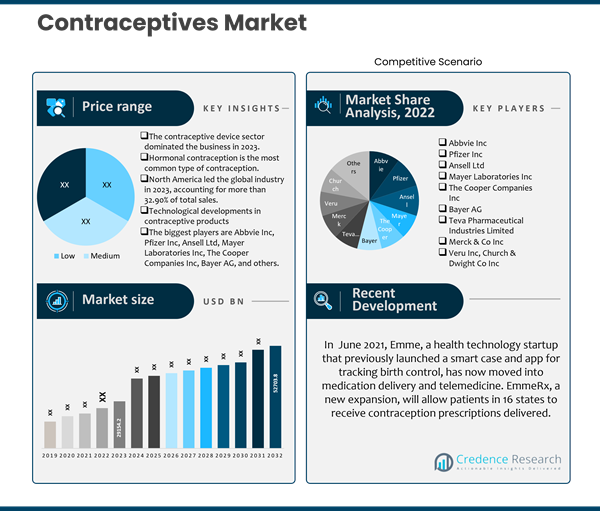
- The global demand for Contraceptives was valued at USD 29154.2 Million in 2023 and is expected to reach USD 52703.8 Million in 2032, growing at a CAGR of 6.80% between 2024 and 2032.
- In 2023, the contraceptive device segment dominated the industry, accounting for more than 65.66% of total revenue, while contraceptive medications held the second highest market share.
- Retail pharmacies are likely to have the biggest market share during the forecast period, while the online channel category is expected to grow rapidly.
- The home care sector is the major contributor to the market, while the Hospitals and Clinics segment is predicted to witness a substantial CAGR of approximately 4.2%.
- Adults constitute the major segment of the contraceptive market.
- Prescription-based contraceptives make up a significant share of the contraceptive market.
- Hormonal contraception is the most common type of contraception.
- North America dominated the global industry in 2023, accounting for about 32.90% of total revenue. Asia Pacific is expected to have the fastest CAGR over the projected period.
- Rising awareness and government initiatives to avoid unplanned pregnancies will fuel growth.
- The lack of societal acceptance will hamper market growth.
Executive Summary
Market Definition
The Contraceptives Market is the industry that produces, distributes, and sells various methods and devices for preventing pregnancy. This comprises contraceptive tablets, intrauterine devices (IUDs), condoms, contraceptive implants, patches, vaginal rings, and other products. The demand is pushing the market for effective and safe contraceptive choices, as well as increased awareness and accessibility to these products. The contraceptive market is critical to promote reproductive health and family planning by giving people options for preventing unplanned pregnancies.
Market Overview
The global Contraceptives Market has witnessed steady growth in recent years and is expected to grow at a CAGR of 6.80% between 2024 and 2032. The market was valued at USD 29154.2 million in 2023 and is expected to reach USD 52703.8 million in 2032.
The contraceptive market is a large and expanding sector worldwide. It covers a wide range of contraceptive procedures and products used to avoid pregnancy. Increasing awareness about family planning, the rising population, and the demand for effective and safe contraception choices all contribute to the market's growth. The market provides a wide variety of contraceptive options, including oral contraceptive tablets, condoms, intrauterine devices (IUDs), contraceptive implants, patches, vaginal rings, and others. Pharmaceutical businesses develop these medications, which are then distributed through a variety of channels, including pharmacies, clinics, internet platforms, and healthcare providers. The contraceptive market is critical in improving reproductive health, empowering individuals to make educated decisions about their reproductive lives, and contributing to population control initiatives.
Segmentation by Product Type
- The contraceptive devices segment dominated the industry in 2023, accounting for more than 65.66% of total revenue, and is predicted to increase at the fastest rate with a CAGR of 7.12% over the forecast period. This is due to increased awareness about STDs and the effectiveness of condoms in preventing infections, including HIV. A recent study found that subdermal implants have enormous potential to address women's family planning needs.
- Contraceptive drugs have the second largest market share.
Segmentation by Distribution Channel
- Retail pharmacies are predicted to have the largest market share during the projection period. This is owing to the manufacturer's better supply chain network. The hospital pharmacy segment is also expected to develop at a significant CAGR as hospitals collaborate with distributors and manufacturers, particularly for birth control devices.
- The online channel category is expected to rise significantly during the forecast period, owing to the increased accessibility of over-the-counter pharmaceuticals on the online platform.
Segmentation by End-User
- The home care sector is the largest contributor to the market, expanding at a CAGR of 6.9% over the projection period. Oral contraceptives, topical contraceptives, and contraceptive patches are all recommended for usage in the privacy of one's own home. These contraceptives help to lower the risk of undesired pregnancy and sexually transmitted illnesses (STls).
- The Hospitals and Clinics segment is expected to see a significant CAGR of roughly 4.2% over the next several years.
Segmentation by Age Group
- Adults are the dominant section of the contraceptive market. Adults of reproductive age account for a large share of the contraceptive market. Adults are more likely to be sexually active, necessitating the use of contraception to avoid unintended pregnancy. They are better aware of different types of contraception and are more inclined to seek out and use them.
Segmentation by Mode of Prescription
- Prescription-based contraceptives account for a considerable share of the contraceptive market. Prescription-based contraceptives must be obtained with a prescription from a healthcare provider. This category covers contraceptives like birth control tablets, patches, injections, and intrauterine devices (IUDs). Because these contraceptives require physician assistance and supervision, they are frequently seen to be more effective and trustworthy.
Segmentation by Hormonal vs. Non-Hormonal
- Hormonal contraceptives are the most popular type of contraception. Hormonal contraception consists of both combination hormonal treatments and progestin-only hormonal techniques. Birth control pills, patches, and vaginal rings are examples of combined hormonal treatments, which include both estrogen and progestin. Progestin-only hormonal techniques include mini-pills, hormonal IUDs, and implants.
Segmentation by Region
- North America dominated the global industry in 2023, accounting for more than 32.90% of total revenue
- Asia Pacific is predicted to have the quickest CAGR throughout the forecast period.
- The rest of the world, including Latin America, the Middle East, and Africa, supplies the remaining demand for Contraceptives.
North America dominated the global industry in 2023 and is expected to maintain its position throughout the forecast period due to the region's high incidence of abortion, growing population of women aged 15 to 44, and high patient awareness levels. The availability of generic and low-cost medications and devices has increased teenagers' need for contraception. Reckitt Benckiser will debut Durex Intense, a new condom category, in April 2022. Asia Pacific is expected to have the quickest CAGR during the projection period.
The increase can be ascribed to an increase in government activities, rising demand for population control, and a drop in unplanned pregnancy rates. According to the Center for Reproductive Rights, 53.8 million unplanned pregnancies occur throughout Asia each year, with abortion accounting for approximately 65% of those cases. The contraception prevalence rate among married teens in Asia is approximately 41%.
Key Highlights of the Report
Product Type, Distribution Channel, End-User, Age Group, Type, Hormonal vs. Non-Hormonal, and region segment of the global Contraceptives Market. The home care sector and retail pharmacies are the greatest contributors to the market, with contraceptive devices dominating the industry in 2023. Furthermore, hormonal contraceptives are the most common type of contraception, with prescription-based contraceptives accounting for a significant percentage, with North America leading the market growth.
The market is being driven by an increasing population and the demand for effective contraception choices, as well as growing government initiatives and programs supporting contraceptive access. Furthermore, cultural and social hurdles that limit contraceptive use, lack of availability and accessibility of contraceptives, and stigma and misconceptions around contraceptive methods are the main market restraints.
Nonetheless, North America dominated the global business in 2023 and is predicted to keep its lead throughout the forecast period, owing to the region's high abortion rate, expanding population of women aged 15 to 44, and high patient awareness levels. Furthermore, Asia Pacific is predicted to have the fastest CAGR over the projection period.
What Are The Main Drivers Of The Global Contraceptives Market?
One of the key drivers in the Contraceptives Market is the increasing awareness and education about family planning and reproductive health. As more individuals understand the importance of contraception in managing their reproductive lives, the demand for contraceptive methods continues to rise. Additionally, the growing global population and the need for effective contraception options further contribute to the growth of the market. Governments and healthcare organizations are also implementing initiatives and programs to promote access to contraceptives, creating a favorable environment for the market to expand.
What Are The Major Challenges Faced By The Global Contraceptives Market?
Despite the progress made in promoting contraception, there are still certain cultural and social barriers that limit its use in some regions. Cultural norms and beliefs surrounding reproductive health and contraception can influence the acceptance and adoption of contraceptive methods. Moreover, the lack of availability and accessibility of contraceptives, particularly in remote areas, poses a significant restraint.
What Are The Growth Opportunities In The Global Contraceptives Market?
The Contraceptives Market presents several opportunities for growth and innovation. Technological advancements are leading to the development of innovative contraceptive products, such as new delivery systems or enhanced effectiveness. This opens up avenues for manufacturers to introduce novel solutions to meet the evolving needs of consumers. Furthermore, there is an opportunity to expand the range of contraceptive product offerings to cater to diverse consumer preferences and requirements. Collaborations and partnerships between pharmaceutical companies and healthcare organizations can also play a crucial role in improving access and affordability of contraceptives, especially in underserved communities.
Market Drivers
Rising Awareness And Government Initiatives To Prevent Unwanted Pregnancies
The ever-increasing global population, particularly in developing economies, is a growing source of concern, highlighting the need for government initiatives to drive awareness campaigns to eliminate or reduce the risk of unwanted pregnancies, abortion risks, and sexual disorder threats. For example, at the 2012 London Summit on Family Planning, the Indian government committed to providing family planning services to an additional 48 million new consumers by 2020.
Furthermore, the United States government has launched a mother and infant health campaign to promote the effective use of contraception with the goal of lowering undesired pregnancy rates and related hazards.
Market Restraints
Lack Of Social Acceptance
For instance, in India, various religions, including Christianity, think that the concept of contraception stems from church teachings rather than scripture. However, there is no ban against taking birth control in Hinduism. As a result, many superstitious ideas about the use of contraceptives have a negative impact on the growth of the contraceptive medicine business. Ethnic and cultural variety varies widely, as do opinions regarding contraception and fertility issues. The market's expansion has been slowed further by factors such as the social shame associated with purchasing oral contraception tablets and incorrect information. On the other hand, it is expected that the impact of this factor will decrease in the near future as a result of increased awareness of the benefits of contraceptive medications raised by various groups.
Opportunities
Developing Countries' Rising Disposable Income And Unmet Contraceptive Needs
The rise in median household income, as well as a greater emphasis on living a healthy lifestyle, have all contributed to longer life expectancies. People are primarily concerned with living a disease-free lifestyle and developing health consciousness, both of which have resulted in a rise in the use of contraceptive medications due to increasing awareness of numerous diseases such as AIDS and several STDs. Furthermore, studies have indicated that an increase in disposable income has a considerable impact on contraceptive drug usage. Spending on contraceptive medications and prophylactic measures has increased in recent years as people become more aware of modern contraception options.
Furthermore, a sizable proportion of the population in underdeveloped countries like South Africa lacks access to medical facilities and resources, such as contraceptive drugs. As a result, this opens up attractive potential for market actors in underdeveloped nations to invest in contraceptive development initiatives and provide access to these treatments to the entire population.
Competitive Landscape
Key Players
The global Contraceptives Market is highly competitive, with several key players. Some of the major players in the market and their market share are as follows:
- Abbvie Inc
- Pfizer Inc
- Ansell Ltd
- Mayer Laboratories Inc
- The Cooper Companies Inc
- Bayer AG
- Teva Pharmaceutical Industries Limited
- Merck & Co Inc
- Veru Inc
- Church & Dwight Co Inc
These organizations prioritize product innovation, End-User expansion, and mergers and acquisitions to stay competitive.
The global Contraceptives Market's key players continually seek to stay ahead by offering new products and developments.
In November 2020, AbbVie has partnered with the American College of Obstetricians and Gynaecologists, the Endometriosis Association, Healthy Women, the International Pelvic Pain Society, GE Healthcare, and the Black Women's Health Imperative to improve the lives of one in every ten women of reproductive age in the United States who suffer from this disease.
In March 2021, Clue launched a digital contraception that provides customers with statistical predictions of ovulation as a birth control tool.
In May 2020, Evofem Biosciences Inc. gained FDA approval for Phexxi, the first non-hormonal birth control gel.
Summary of Key Findings
- Developing countries' increased disposable income and unmet contraception needs will increase market prospects.
- Market segmented by Product Type, Distribution Channel, End-User, Age Group, Type, Hormonal vs. Non-Hormonal, and region.
- Prescription-based contraceptives make up a significant share of the contraceptive market.
- The home care sector is the major contributor to the market
- North America is leading market growth; the market is highly competitive with key players including Abbvie Inc, Pfizer Inc, Ansell Ltd, Mayer Laboratories Inc, The Cooper Companies Inc, Bayer AG and Others.
Future Outlook
- Growing demand for long-acting reversible contraceptives (LARCs)
- Increasing adoption of contraceptive methods in developing countries
- Technological advancements in contraceptive products
- Rising focus on male contraception options
- Growing availability of over-the-counter contraceptive products
- Increasing investments in research and development for innovative contraceptive solutions
How CXOs Can Benefit from the Credence Research Contraceptives Market Report
The Credence Research Contraceptives Market Report provides CXOs with a comprehensive overview of the market, including:
- Market size and growth forecast: The report provides detailed estimates of the global Contraceptives Market size, segmented by Product Type, Distribution Channel, End-User, Age Group, Type, Hormonal vs. Non-Hormonal, and region. It also includes forecasts for the market through 2032, based on key trends and drivers.
- Market segmentation: The report segments the Contraceptives Market by Product Type, Distribution Channel, End-User, Age Group, Type, Hormonal vs. Non-Hormonal, and region. This segmentation provides CXOs with a granular understanding of the market and the opportunities in each segment.
- Competitive landscape: The report profiles the key players in the Contraceptives Market and provides insights into their strategies, product offerings, and financial performance. This information can help CXOs to identify and assess their competition.
- Key trends and drivers: The report identifies and analyzes the key trends and drivers that are shaping the Contraceptives Market. This information can help CXOs to make informed decisions about their investments and strategies.
CXOs can use the insights from the Credence Research Contraceptives Market Report to:
- Identify growth opportunities: The report can help CXOs to identify new growth opportunities in the Contraceptives Market. For example, it can provide insights into emerging technologies, market trends, and key market players.
- Make informed investment decisions: The report can help CXOs to make informed investment decisions about Contraceptives. For example, t can provide insights into market trends, growth potential, competitive landscape, and key players in the industry.
- Develop competitive strategies: The report can help CXOs to develop competitive strategies for their Contraceptives businesses. For example, the report identifies the key strategies that dark fiber providers are using to differentiate themselves from their competitors.
- Track market developments: The report can help CXOs to track market developments and stay ahead of the curve. For example, the report provides insights into the latest trends and innovations in the Contraceptives Market.
Overall, the Credence Research Breast Cancer .Treatment Market Report is a valuable resource for CXOs who are looking to gain a deeper understanding of the market and identify opportunities for growth.
Segmentation
- By Product Type:
- Contraceptive Drugs
- Oral Contraceptives (Combined Oral Contraceptives, Progestin-Only Pills)
- Contraceptive Injectable
- Contraceptive Patches
- Contraceptive Implants
- Contraceptive Devices
- Male Condoms
- Female Condoms
- Diaphragms
- Cervical Caps
- Intrauterine Devices (IUDs)
- Contraceptive Sponges
- By End-User:
- Hospital Pharmacies
- Retail Pharmacies
- Online Channels
- By End-User:
- Hospitals and Clinics
- Home Care Settings
- By Age Group:
- Adolescents
- Adults
- By Mode of Prescription:
- Prescription-based Contraceptives
- Over-the-Counter (OTC) Contraceptives
- By Hormonal vs. Non-Hormonal:
- Hormonal Contraceptives
- Combination Hormonal Methods
- Progestin-Only Hormonal Methods
- Non-Hormonal Contraceptives
- Barrier Methods
- Intrauterine Devices (Copper IUDs)
- By Region
- North America
- US
- Canada
- Mexico
- Europe
- Germany
- France
- UK
- Italy
- Spain
- Rest of Europe
- Asia Pacific
- China
- Japan
- India
- South Korea
- South-east Asia
- Rest of Asia Pacific
- Latin America
- Brazil
- Argentina
- Rest of Latin America
- Middle East & Africa
- GCC Countries
- South Africa
- Rest of Middle East and Africa
- North America
Adjacent Markets
In the Contraceptives Market, several adjacent markets have high revenue growth opportunities. The key adjacent markets for Contraceptives Market –
Adjacent Markets |
||
| Sexual Wellness Products Market | Reproductive Health Market | Fertility Products Market |
| Women's Health Market | Birth Control Market | STD/STI Prevention Market |
| Family Planning Market | Maternal Health Market | Men's Health Market |
Request a Free Sample
Fill in your details and we'll send you a free sample report.
- Sample data tables & charts
- Research methodology
Need a Custom Version of This Report?
Tailor the scope, geography, or segments to your exact requirements.
- Custom geography or segment scope
- Direct access to our analyst team
Frequently Asked Questions
What is the size of Contraceptives Market?
What is the Contraceptives Market CAGR?
What is the Forecast period considered for Contraceptives Market?
What is the base year considered for Contraceptives Market?
Table of Content
Chapter 1. Report Introduction
- 1.1 Report Description & Purpose
- 1.1.1 Report Title & Market Definition
- 1.1.2 Unique Selling Propositions (USP) & Key Differentiators
- 1.1.3 Value Proposition for Stakeholders
- 1.2 Research Objectives
- 1.2.1 Market Sizing Objectives (Volume & Revenue)
- 1.2.2 Segmentation Objectives
- 1.2.3 Competitive Intelligence Objectives
- 1.2.4 Forecast & Scenario Objectives
- 1.3 Report Scope
- 1.3.1 Contraceptives Scope – Types & Subtypes Covered
- 1.3.2 Geographic Scope – Regions & Countries Covered
- 1.3.3 Historical Period, Base Year & Forecast Period (the historical period; forecast to 2022)
- 1.3.4 Inclusions & Exclusions
- 1.4 HS Code & Classification Framework
- 1.5 Currency, Units & Pricing Basis
- 1.6 Target Stakeholders
- 1.7 Limitations & Assumptions
Chapter 2. Executive Summary
- 2.1 Global Contraceptives Market Snapshot
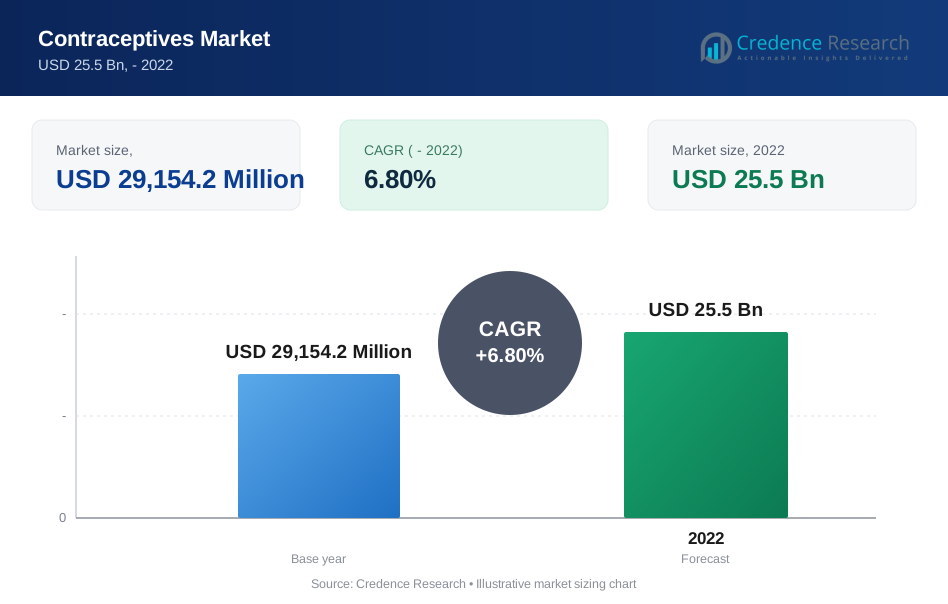
- 2.1.1 Market Size – Historical (the historical period) & Forecast (2022) (base year: USD 29,154.2 Million → 2022: USD 25.5 Bn)
- 2.1.2 Volume & Revenue – Global Totals
- 2.1.3 Key Market Highlights – Top Five Facts
- 2.2 Contraceptives Market Segmentation Snapshot
- 2.2.1 Market Split by Region – vs. 2022
- 2.3 Competitive Snapshot
- 2.3.1 Top 10 Players by Revenue Share –
- 2.3.2 Top 10 Players by Volume Share –
- 2.3.3 Recent Strategic Developments (18-Month Summary)
- 2.4 Key Investment Highlights & Strategic Conclusions
Chapter 3. Contraceptives Market Dynamics & Industry Analysis
- 3.1 Market Overview & Context
- 3.1.1 Contraceptives Market Position in the Broader Automotive Value Chain
- 3.1.2 OEM vs. Replacement Market Dynamics
- 3.1.3 Market Maturity & Development Stage by Region
- 3.2 Contraceptives Market Drivers
- 3.3 Contraceptives Market Restraints & Challenges
- 3.4 Contraceptives Market Opportunities
- 3.5 Porter's Five Forces Analysis
- 3.5.1 Threat of New Entrants
- 3.5.2 Bargaining Power of Suppliers
- 3.5.3 Bargaining Power of Buyers
- 3.5.4 Threat of Substitutes
- 3.5.5 Competitive Rivalry – Intensity Assessment
- 3.6 Contraceptives Value Chain Analysis
- 3.6.1 Upstream – Raw Material/Input Suppliers
- 3.6.1.1 Raw Material/Input 1
- 3.6.1.2 Raw Material/Input 2
- 3.6.1.3 Raw Material/Input 3
- 3.6.2 Midstream – Production/Manufacturing/Service Delivery
- 3.6.2.1 Production/Process Overview
- 3.6.2.2 Key Facility Locations & Capacity by Manufacturer
- 3.6.3 Downstream – Distribution & End Consumer
- 3.6.3.1 Primary Channel – B2B/OEM
- 3.6.3.2 Secondary Channels – Dealer, Retail, Online, Direct
- 3.6.4 Value Chain Profitability Analysis
- 3.6.1 Upstream – Raw Material/Input Suppliers
- 3.7 PESTEL Analysis
- 3.7.1 Political Factors
- 3.7.2 Economic Factors
- 3.7.3 Social Factors
- 3.7.4 Technological Factors
- 3.7.5 Environmental Factors
- 3.7.6 Legal Factors
- 3.8 Contraceptives Supply Chain Analysis
- 3.8.1 Raw Material/Input Supply Risk Assessment
- 3.8.2 Manufacturing Concentration Risk (Geographic Exposure)
- 3.8.3 Trade Disruption Impact Analysis
- 3.9 Regulatory & Policy Landscape
Note: The regulatory and policy landscape section covers regulations based on their applicability to the market, Contraceptives category, geography, and scope of the study. Only regulatory frameworks with a material impact on operations, compliance, trade, sustainability, or market access are analyzed in detail.
Chapter 4. Key Investment Pockets & Opportunity Analysis
- 4.1 Contraceptives Market Attractiveness Analysis
- 4.1.1 By Region – Investment Attractiveness Matrix (Volume × CAGR)
- 4.2 Absolute Revenue Growth Opportunity
- 4.2.1 By Region – Absolute USD Growth Through 2022
- 4.3 Incremental Volume Opportunity
- 4.3.1 By Region – Incremental Volume Through 2022
- 4.3.2 Segment – Incremental Volume
- 4.4 Emerging Submarket Opportunity Deep Dive (Subject to Applicability)
- 4.5 Emerging Market Opportunity Scorecards
- 4.5.1 United States
- 4.5.2 Europe
- 4.5.3 Asia
- 4.5.4 Middle East & Africa
Note: Emerging Market Opportunity Scorecards will be included based on relevance and strategic importance. Regions listed are indicative and may vary depending on data availability and market dynamics.
Chapter 5. Contraceptives Import-Export Analysis & Trade Flows
- 5.1 Global Trade Overview
- 5.1.1 Global Export Value by Country (the historical period)
- 5.1.2 Global Export Volume by Country (the historical period)
- 5.1.3 Global Import Value by Country (the historical period)
- 5.1.4 Global Import Volume by Country (the historical period)
- 5.1.5 Net Trade Balance by Country (the historical period)
- 5.2 Export Analysis – Segment
- 5.2.1 Type 1 (HS Code)
- 5.2.2 Type 2 (HS Code)
- 5.2.3 Type 3 (HS Code)
- 5.2.4 Type 4 (HS Code)
- 5.2.5 Type 5 (HS Code)
- 5.3 Import Analysis – Segment
- 5.3.1 Type 1 (HS Code)
- 5.3.2 Type 2 (HS Code)
- 5.3.3 Type 3 (HS Code)
- 5.3.4 Type 4 (HS Code)
- 5.3.5 Type 5 (HS Code)
- 5.4 Average Unit Trade Prices
- 5.4.1 Average Export Price – Segment & Country
- 5.4.2 Average Import Price – Segment & Source Country
- 5.4.3 Price Trends (the historical period)
- 5.5 Key Trade Route Analysis
- 5.5.1 Trade Route 1
- 5.5.2 Trade Route 2
- 5.5.3 Trade Route 3
- 5.5.4 Trade Route 4
- 5.5.5 Trade Route 5
- 5.6 Trade Policy Impact Assessment
- 5.6.1 US Anti-Dumping & Section 301 Tariffs
- 5.6.2 EU Customs Union Impact
- 5.6.3 Major Free Trade Agreements
- 5.6.4 USMCA Rules of Origin
Note: Trade policy analysis will be included only where relevant to the Contraceptives market.
Chapter 6. Competitive Landscape & Company Benchmarking
- 6.1 Contraceptives Market Concentration & Structure
- 6.1.1 Herfindahl-Hirschman Index (HHI) – vs.
- 6.1.2 Tier 1, Tier 2 & Tier 3 Market Structure
- 6.1.3 Global, Regional & Local Player Dynamics
- 6.2 Contraceptives Market Share Analysis –
- 6.2.1 Global Revenue Share by Company
- 6.2.2 Global Volume Share by Company
- 6.2.3 Regional Revenue Share
- 6.2.4 Market Share Evolution ( vs. )
- 6.2.5 OEM Segment Share by Company
- 6.2.6 Replacement Segment Share by Company
- 6.3 Production/Delivery Capacity & Facility Analysis
- 6.3.1 Global Installed Capacity
- 6.3.2 Capacity Utilization Rates
- 6.3.3 Production/Output Volume
- 6.3.4 Facility Locations & Capacity Map
- 6.3.5 Planned Capacity Additions
- 6.4 Contraceptives Competitive Benchmarking Matrix
- 6.4.1 Revenue, Volume, CAGR & Profitability Comparison
- 6.4.2 Channel Revenue Mix
- 6.4.3 Geographic Revenue Exposure
- 6.4.4 R&D Intensity
- 6.4.5 Sustainability Maturity
- 6.5 Strategic Developments in Contraceptives (Last 24 Months)
- 6.5.1 Mergers, Acquisitions & Divestments
- 6.5.2 New Contraceptives Launches
- 6.5.3 Facility Expansions
- 6.5.4 Strategic Alliances, Joint Ventures & Partnerships
- 6.5.5 Distribution Expansion & Market Entry
- 6.5.6 Sustainability & ESG Initiatives
- 6.6 Competitive Strategy Mapping
- 6.6.1 Leader, Challenger, Follower & Niche Classification
- 6.6.2 Pricing Strategy Comparison
- 6.6.3 Channel Strategy Matrix
Note: Strategic developments are included based on their materiality and the availability of reliable information.
Chapter 7. Global Contraceptives Market – By Distribution Channel
- 7.1 Segment Overview
- 7.1.1 Volume & Revenue Split by Channel ( & 2022)
- 7.1.2 Channel Mix Evolution (2022)
Chapter 8. Regional Market Analysis – Global Overview
- 8.1 Global Regional Overview
- 8.1.1 Regional Volume Share
- 8.1.2 Regional Revenue Share
- 8.1.3 Regional Volume by Region
- 8.1.4 Regional Revenue by Region
- 8.1.5 Regional Forecast Through 2022
- 8.2 Cross-Regional Segment Analysis
- 8.2.1 By Distribution Channel
- 8.2.2 By Brand/Price Tier
Chapter 9. North America Contraceptives Market
- 9.1 United States
- 9.2 Canada
- 9.3 Mexico
Chapter 10. Europe Contraceptives Market
- 10.1 Germany
- 10.2 France
- 10.3 Italy
- 10.4 United Kingdom
- 10.5 Spain
- 10.6 Poland
- 10.7 Russia
- 10.8 Netherlands
- 10.9 Belgium
- 10.10 Sweden
- 10.11 Denmark
- 10.12 Norway
- 10.13 Rest of Europe
Chapter 11. Asia Pacific Contraceptives Market
- 11.1 China
- 11.2 India
- 11.3 Japan
- 11.4 South Korea
- 11.5 Thailand
- 11.6 Indonesia
- 11.7 Vietnam
- 11.8 Malaysia
- 11.9 Australia
- 11.10 Rest of Asia Pacific
Chapter 12. Latin America Contraceptives Market
- 12.1 Brazil
- 12.2 Argentina
- 12.3 Colombia
- 12.4 Chile
- 12.5 Rest of Latin America
Chapter 13. Middle East Contraceptives Market
- 13.1 Saudi Arabia
- 13.2 United Arab Emirates
- 13.3 Turkey
- 13.4 Israel
- 13.5 Iran
- 13.6 Rest of the Middle East
Chapter 14. Africa Contraceptives Market
- 14.1 South Africa
- 14.2 Egypt
- 14.3 Nigeria
- 14.4 Morocco
- 14.5 Rest of Africa
Chapter 15. Contraceptives Company Profiles
- 15.1 [Company 01]
- 15.1.1 Company Overview
- 15.1.2 Key Management Personnel
- 15.1.3 Products & Services Portfolio
- 15.1.4 Financial Performance
- 15.1.5 Key Market Focus & Geographic Presence
- 15.1.6 Recent Developments & Strategic Initiatives
Note: The company profile list is preliminary and may change based on research findings, market developments, data availability, and client requirements.
Chapter 16. Appendices
- Appendix A – List of Abbreviations & Acronyms
- Appendix B – Industry Classification Code Reference – Full Series
- Appendix C – Production & Capacity Data Tables
- Appendix D – End-Use & Demand Base Tables
- Appendix E – Consumption & Replacement Rate Assumptions
- Appendix F – ASP Reference Tables
- Appendix G – Manufacturing & Facility Database
- Appendix H – Import-Export Data Tables
- Appendix I – Regulatory Summary Tables
- Appendix J – Primary Research Participant List (Anonymized)
- Appendix K – Primary Research Questionnaire Framework
- Appendix L – Data Sources & Bibliography
- Appendix M – Market Size Divergence & Source Comparison
Chapter 17. Research Methodology
- 17.1 Research Framework & Philosophy
- 17.2 Secondary Research – Sources, Hierarchy & Data Extraction
- 17.3 Data Modeling – Bottom-Up & Top-Down Market Sizing
- 17.4 Primary Research – Stakeholder Framework, LOI & Sample Sizes
- 17.5 Forecast Methodology – Regression, Scenario & Sensitivity Analysis
- 17.6 Quality Control – Four-Layer Validation Framework
- 17.7 Limitations & Standard Assumptions
- 17.8 Disclaimer
