
| REPORT ATTRIBUTE | DETAILS |
|---|---|
| Historical Period | 2019-2022 |
| Base Year | 2023 |
| Forecast Period | 2024-2032 |
| Current Measuring Devices Market Size 2023 | USD 34,201.67 million |
| Current Measuring Devices Market, CAGR | 4.60% |
| Current Measuring Devices Market Size 2032 | USD 51,266.36 million |
Market Overview
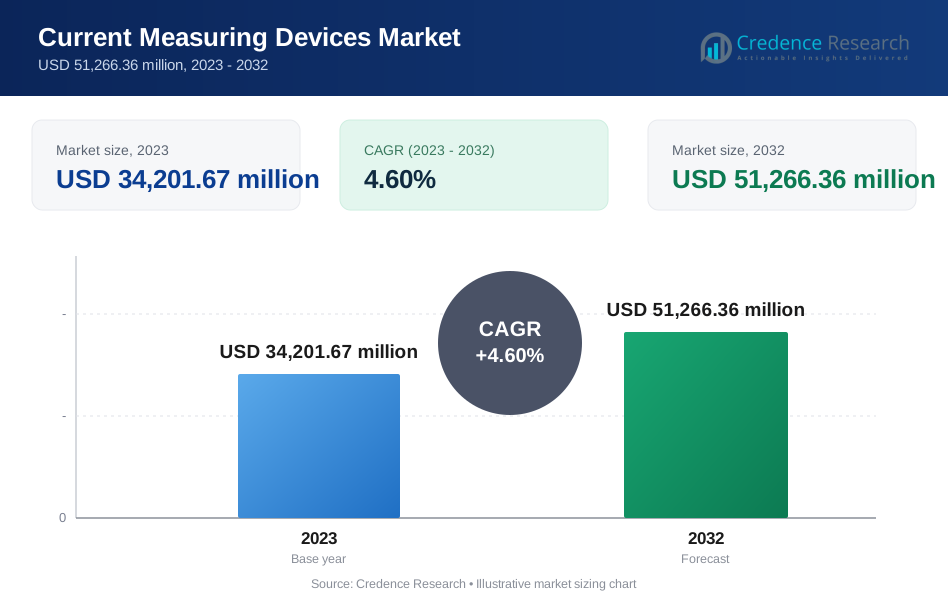
The Current Measuring Devices Market is projected to grow from USD 34,201.67 million in 2023 to an estimated USD 51,266.36 million by 2032, with a compound annual growth rate (CAGR) of 4.60% from 2024 to 2032. This growth trajectory underscores a robust expansion as industries increasingly prioritize precise electrical measurements and energy efficiency.
Market drivers for the Current Measuring Devices Market include the rising demand for energy management solutions and the increasing adoption of smart grid technology. Moreover, the automotive and manufacturing sectors are experiencing a surge in the integration of electronic systems, which necessitates accurate current measurement for effective operations and safety standards. Technological innovations, such as the development of non-contact current measurement devices, are also propelling market growth by expanding the range of potential applications.
Geographically, the Asia-Pacific region dominates the Current Measuring Devices Market, driven by rapid industrialization and the expansion of the manufacturing sector in countries like China and India. North America and Europe also hold significant market shares, supported by stringent energy regulations and a focus on renewable energy sources. Key players in the market include ABB, Siemens AG, and Schneider Electric, who are at the forefront of launching innovative products and expanding their global footprint to leverage emerging market opportunities.
Market Drivers
Increased Emphasis on Energy Efficiency and Management:
The demand for current measuring devices is growing due to the rising focus on energy efficiency and management across various sectors. For instance, the U.S. Energy Information Administration expects renewable deployment to grow by 17% to 42 GW in 2024 and account for almost a quarter of electricity generation. This growth necessitates precise current measurement tools to monitor and manage energy usage effectively. Governments are implementing regulations to reduce energy consumption and environmental impact, making energy management systems essential in modern infrastructure. As a result, industries, commercial establishments, and residential buildings are increasingly adopting current measuring devices to detect inefficiencies and identify potential energy savings
Technological Advancements in Device Accuracy and Integration Capabilities:
The current measuring devices market is benefiting from ongoing technological advancements that enhance accuracy, reliability, and functionality. IoT integration is enabling real-time monitoring and data analysis, crucial for process optimization and predictive maintenance. For example, smart meters provide real-time data on energy production and consumption, allowing homeowners to monitor their usage patterns and adjust consumption habits for maximum efficiency. These technological improvements are expanding the applicability of current measuring devices beyond traditional uses, facilitating their integration into smart grids and smart home systems. The integration of AI and machine learning is further enhancing the capabilities of these devices, enabling features such as predictive maintenance and energy consumption forecasting.
Growth in Renewable Energy Installations:
The surge in renewable energy installations worldwide is significantly driving the demand for current measuring devices. As of June 2024, India has an installed renewable energy capacity of 195 GW, including 86 GW of solar power capacity. Current measuring devices are crucial for optimizing the performance and safety of renewable energy systems, such as solar panels and wind turbines, by monitoring power output and distribution. The variability of renewable energy sources makes accurate current measurement essential for grid stability and effective integration. Smart inverters, which optimize the conversion of DC to AC electricity and communicate with other smart devices to balance energy production and consumption, are becoming increasingly important in renewable energy systems.
Expansion of the Automotive and Consumer Electronics Sectors:
The automotive industry's shift towards electric vehicles (EVs) and the proliferation of advanced electronics in consumer markets are pivotal drivers for the current measuring devices market. In EVs, accurate current measurement ensures the efficiency and longevity of batteries and electrical systems, which are central to vehicle performance and safety. Similarly, in consumer electronics, current measuring technologies safeguard against overcurrent conditions that can lead to device failure and safety hazards. The continuous growth in these sectors creates a sustained demand for sophisticated current measurement solutions that are capable of supporting high precision and integration needs.
Market Trends
Integration with the Internet of Things (IoT) and Big Data Analytics:
The integration of current measuring devices with IoT technology represents a transformative trend in the market. This integration enables devices to not only perform their primary function of measuring electrical currents but also to communicate data in real time to centralized systems. IoT-enabled current measuring devices can continuously monitor electrical systems and provide data that can be analyzed using big data analytics. This capability allows for predictive maintenance, where potential issues can be identified and addressed before they result in system failures, thereby reducing downtime and maintenance costs. For instance, according to a survey by Ericsson, the number of IoT connections is expected to reach 34.7 billion by 2030, indicating a significant increase in the adoption of IoT-enabled devices across various industries. Moreover, IoT integration facilitates more sophisticated energy management systems that can optimize power consumption based on real-time data, leading to significant energy savings and operational efficiency. The trend towards IoT connectivity is further enhanced by advancements in wireless communication technologies, which simplify the implementation of networked devices across large facilities and infrastructure projects.
Advancements in Non-contact Measurement Technology:
Another prominent trend is the growing adoption of non-contact current measurement technologies, such as clamp meters and Rogowski coils. These technologies offer the advantage of measuring electrical currents without needing direct contact with the conductor or interruption of the circuit. This method not only enhances safety, particularly in high-voltage environments, but also improves the ease of use and reduces the risk of disrupting operational systems. Non-contact devices are becoming increasingly popular in industrial applications where safety and efficiency are paramount. For instance, a study by the National Institute of Standards and Technology (NIST) found that non-contact current measurement techniques can achieve accuracies comparable to traditional contact methods while offering significant safety benefits. Additionally, the accuracy and sensitivity of these devices continue to improve with technological advancements, making them suitable for a wide range of applications, from heavy industrial to sensitive electronic measurements. The growing demand for these non-contact technologies is driving innovation in the field, with manufacturers focusing on developing more compact, versatile, and precise instruments to meet the evolving needs of various industries.
Market Restraints and Challenges
High Cost of Advanced Measurement Technologies:
One of the primary restraints in the current measuring devices market is the high cost associated with advanced technologies. According to a survey by the National Institute of Standards and Technology, 68% of small and medium enterprises cited cost as the main barrier to adopting new measurement technologies. The development and implementation of cutting-edge features such as IoT connectivity, high-accuracy sensors, and non-contact measurement capabilities require significant investment. For instance, a study by the Measurement, Control & Automation Association found that companies spend an average of 8.7% of annual revenue on R&D for new measurement products. Moreover, the integration of these advanced systems into existing infrastructures can be cost-prohibitive. A report from the International Society of Automation indicated that 42% of manufacturing facilities delayed measurement system upgrades due to integration costs. This high cost not only limits accessibility to a broader market but also slows down the rate of technological adoption. The U.S. Department of Energy's survey of industrial facilities revealed that only 35% had implemented advanced measurement and verification systems, with cost being the primary limiting factor.
Complexities in Compliance with International Standards and Regulations:
The global nature of the current measuring devices market introduces complexities in compliance with diverse international standards and regulations. A survey by the International Organization for Standardization found that 73% of measurement device manufacturers struggle to keep up with changing global standards. Manufacturers must ensure their products meet various safety and performance standards, which can vary significantly between regions. For instance, the European Measuring Instruments Directive applies different requirements than those in North America or Asia. The National Conference on Weights and Measures reported that 62% of measurement device companies faced challenges in obtaining certifications for multiple markets. This requirement necessitates additional testing and sometimes redesign of products. A study by the Regulatory Affairs Professionals Society revealed that companies spend an average of 780 hours annually on regulatory compliance activities for measurement devices. The dynamic nature of regulatory landscapes also poses a challenge, as updates require rapid responses from manufacturers. The American National Standards Institute found that 56% of measurement technology firms struggled to adapt quickly to new standards, impacting their ability to enter new markets efficiently.
Market Segmentation Analysis
By Type
The Current Measuring Devices Market is segmented by type, with clamp ammeters dominating due to their widespread industrial use and ability to measure current without direct conductor contact, ensuring safety and ease of use in both AC and DC systems. For instance, a survey by the International Electrotechnical Commission found that over 70% of industrial electricians prefer clamp ammeters for routine maintenance tasks due to their non-invasive measurement capabilities. Probe ammeters are also significant, favored for their precision in low-voltage applications, particularly in the electronics industry and R&D settings where accurate measurements are critical. A study by the Institute of Electrical and Electronics Engineers revealed that probe ammeters are used in over 80% of semiconductor manufacturing quality control processes. Meanwhile, fork ammeters are gaining popularity for their ability to perform quick and easy measurements in tight spaces, making them increasingly preferred in residential and light commercial applications where convenience and speed are essential. The National Electrical Contractors Association reported that fork ammeters have seen a 35% increase in adoption among residential electricians over the past five years
By Application
The Current Measuring Devices Market is driven by diverse applications across various sectors. In the automotive industry, the rise of electric vehicles (EVs) has significantly increased the demand for accurate current measurement, essential for battery management, charging systems, and electronic components. For instance, a report by the International Energy Agency found that EV sales doubled in 2021, with each vehicle requiring multiple current measuring devices. Industrial applications also contribute substantially to the market, where continuous monitoring of electrical systems is critical for ensuring safety and operational efficiency in sectors like manufacturing, mining, and utilities. The U.S. Department of Energy's Industrial Assessment Center program revealed that implementing advanced current measuring systems led to an average energy savings of 15% in participating manufacturing facilities. The energy management and smart grid segment is poised for rapid expansion, driven by the global push towards energy efficiency and renewable energy sources. For example, the European Union's Smart Grids Task Force reported that smart meter installations, which incorporate current measuring devices, have reached over 72% of households in member states. In the residential sector, the growing use of smart home systems and energy management solutions is driving demand, as homeowners seek to monitor and reduce energy usage to improve efficiency and lower costs. A survey by the Consumer Technology Association found that smart energy management systems, which often include current measuring capabilities, are now present in over 40% of new home constructions in North America.
Segments
Based on Type
- Clamp Ammeter
- Probe Ammeter
- Fork Ammeter
Based on Application
- Automotive
- Industrial
- Energy Management and Smart Grid
- Residential
Based on Region
- North America
- The U.S.
- Canada
- Mexico
- Europe
- Germany
- France
- UK.
- Italy
- Spain
- Rest of Europe
- Asia Pacific
- China
- Japan
- India
- South Korea
- South-east Asia
- Rest of Asia Pacific
- Latin America
- Brazil
- Argentina
- Rest of Latin America
- Middle East & Africa
- GCC Countries
- South Africa
- The Rest of the Middle East and Africa
Regional Analysis
North America (25%):
North America holds a significant share of the global current measuring devices market, accounting for approximately 25% of the total market share. The region's strong market presence is primarily due to early adoption of advanced technologies, particularly in the United States and Canada. Widespread integration of smart grid technologies and a robust automotive industry further drive demand. Stringent regulatory standards related to energy efficiency and electrical safety contribute to growth. The U.S. Department of Energy reports that smart grid investments have led to increased deployment of advanced metering infrastructure, with over 90 million smart meters installed nationwide. Canada's National Energy Board data shows a growing focus on modernizing electrical grids, with substantial investments in measurement and control technologies.
Europe (20%):
Europe represents around 20% of the global market share, driven by the region's focus on energy efficiency and renewable energy adoption. Countries like Germany, France, and the United Kingdom lead in implementing smart grid infrastructure and energy management systems, where accurate current measurement is crucial. The region's strong automotive industry, particularly in Germany, also significantly contributes to demand for advanced current measuring devices. European Union regulations on energy consumption and environmental impact push industries to adopt more precise measurement technologies. Eurostat data indicates that renewable energy sources accounted for 22.1% of total energy consumption in the EU in 2020, necessitating advanced measurement systems for grid integration and management.
Key players
- Purkey’s Fleet Electric, Inc.
- Beemet Instruments Pvt Ltd.
- Meter Master NZ Ltd
- Schneider Electric SE
- National Instruments Corporation
- Goliya Instruments Pvt. Ltd.
- PCE Instruments
- HPL Electric & Power
- KYORITSU ELECTRICAL INSTRUMENTS WORKS
- HIOKI E.E. Corporation
- GMC-I PROSYS Ltd
- Rayleigh Instruments Limited
- Blue Sea Systems
- Pacer Group
Competitive Analysis
The Current Measuring Devices Market is characterized by intense competition among key players, each striving to enhance their market presence through innovation, quality, and customer service. Global giants like Schneider Electric SE and National Instruments Corporation lead the market with their extensive portfolios and advanced technological solutions. Companies like KYORITSU ELECTRICAL INSTRUMENTS WORKS and HIOKI E.E. Corporation are known for their high-precision instruments, particularly in the industrial and automotive sectors. Meanwhile, regional players such as Beemet Instruments Pvt Ltd. and Meter Master NZ Ltd. provide specialized solutions tailored to local markets. The competition is further intensified by emerging players like PCE Instruments and Rayleigh Instruments Limited, who focus on offering cost-effective solutions without compromising on quality. The diverse range of offerings and strategic focus on innovation and customer-centric services are key factors that drive competition in this market
Recent Developments
- In October 2021, Mission Critical Electronics (MCE) acquired Purkeys Fleet Electric, expanding MCE's portfolio of power products for the vehicle industry.
- In February 2024, Schneider Electric launched eight new innovative products and solutions at its Multi-city INNOVATION DAYS 2024 event in Mumbai, including the MasterPacT MTZ active circuit breaker and BlokSeT lean LV switchboard.
- In October 2023, Emerson Electric completed its acquisition of National Instruments for $8.2 billion, enhancing Emerson's portfolio in automated test and measurement systems.
- In 2023, Rayleigh Instruments introduced new products such as the RI-D175CT Single-Phase Energy Meter and the RI-EX-PRO 128 Device Ethernet Communication Gateway.
Market Concentration and Characteristics
The Current Measuring Devices Market is moderately concentrated, with a mix of global leaders and regional players contributing to the competitive landscape. Global companies like Schneider Electric SE and National Instruments Corporation hold significant market shares due to their broad product portfolios, technological advancements, and strong distribution networks. However, the market also includes several specialized and regional companies, such as Beemet Instruments Pvt Ltd. and Meter Master NZ Ltd., that cater to niche markets with tailored solutions. The market is characterized by a high emphasis on innovation, with ongoing developments in IoT integration and non-contact measurement technologies driving competition. Additionally, the market is marked by the increasing adoption of advanced current measurement solutions across various industries, including automotive, energy management, and industrial sectors, contributing to a dynamic and evolving competitive environment.
Report Coverage
The research report offers an in-depth analysis based on Type, Application and Region. It details leading market players, providing an overview of their business, product offerings, investments, revenue streams, and key applications. Additionally, the report includes insights into the competitive environment, SWOT analysis, current market trends, as well as the primary drivers and constraints. Furthermore, it discusses various factors that have driven market expansion in recent years. The report also explores market dynamics, regulatory scenarios, and technological advancements that are shaping the industry. It assesses the impact of external factors and global economic changes on market growth. Lastly, it provides strategic recommendations for new entrants and established companies to navigate the complexities of the market.
Future Outlook
- The market will witness continuous technological advancements, particularly in IoT integration and non-contact measurement technologies, enhancing device accuracy and functionality.
- The expansion of renewable energy projects globally will drive demand for advanced current measuring devices, essential for optimizing energy efficiency and grid stability.
- The rising implementation of smart grid infrastructure will fuel the need for precise current measurement, promoting the growth of IoT-enabled devices.
- The rapid growth of the electric vehicle market will significantly increase the demand for current measuring devices, particularly in battery management and charging systems.
- Asia-Pacific is expected to maintain its dominance, driven by rapid industrialization, urbanization, and strong growth in the automotive and electronics sectors.
- Stricter regulations on energy consumption will encourage the adoption of current measuring devices in both industrial and residential sectors, promoting energy-saving practices.
- The market will see increased demand for customized solutions tailored to specific industry needs, creating opportunities for niche players to expand their market presence.
- The combination of current measuring devices with big data analytics will enable more sophisticated energy management and predictive maintenance strategies, driving market innovation.
- Infrastructure development, particularly in emerging markets, will boost the demand for current measuring devices in construction, energy management, and industrial applications.
- The market will experience consolidation, with key players expanding their portfolios through acquisitions and partnerships to strengthen their market position and explore new growth avenues.
Request a Free Sample
Fill in your details and we'll send you a free sample report.
- Sample data tables & charts
- Research methodology
Need a Custom Version of This Report?
Tailor the scope, geography, or segments to your exact requirements.
- Custom geography or segment scope
- Direct access to our analyst team
Frequently Asked Questions
What is the size of Current Measuring Devices Market?
What are the main drivers of growth in the Current Measuring Devices Market?
Which regions dominate the Current Measuring Devices Market?
What are some key trends in the Current Measuring Devices Market?
Who are the major players in this market?
Table of Content
Chapter 1. Report Introduction
- 1.1 Report Description & Purpose
- 1.1.1 Report Title & Market Definition
- 1.1.2 Unique Selling Propositions (USP) & Key Differentiators
- 1.1.3 Value Proposition for Stakeholders
- 1.2 Research Objectives
- 1.2.1 Market Sizing Objectives (Volume & Revenue)
- 1.2.2 Segmentation Objectives
- 1.2.3 Competitive Intelligence Objectives
- 1.2.4 Forecast & Scenario Objectives
- 1.3 Report Scope
- 1.3.1 Current Measuring Devices Scope – Types & Subtypes Covered
- 1.3.2 Geographic Scope – Regions & Countries Covered
- 1.3.3 Historical Period, Base Year & Forecast Period (2023; forecast to 2032)
- 1.3.4 Inclusions & Exclusions
- 1.4 HS Code & Classification Framework
- 1.5 Currency, Units & Pricing Basis
- 1.6 Target Stakeholders
- 1.7 Limitations & Assumptions
Chapter 2. Executive Summary
- 2.1 Global Current Measuring Devices Market Snapshot
- 2.1.1 Market Size – Historical (2023) & Forecast (2023-2032) (2023: USD 34,201.67 million → 2032: USD 51,266.36 million)
- 2.1.2 Volume & Revenue – Global Totals
- 2.1.3 Key Market Highlights – Top Five Facts
- 2.2 Current Measuring Devices Market Segmentation Snapshot
- 2.2.1 Market Split by Region – 2023 vs. 2032
- 2.3 Competitive Snapshot
- 2.3.1 Top 10 Players by Revenue Share – 2023
- 2.3.2 Top 10 Players by Volume Share – 2023
- 2.3.3 Recent Strategic Developments (18-Month Summary)
- 2.4 Key Investment Highlights & Strategic Conclusions
Chapter 3. Current Measuring Devices Market Dynamics & Industry Analysis
- 3.1 Market Overview & Context
- 3.1.1 Current Measuring Devices Market Position in the Broader Automotive Value Chain
- 3.1.2 OEM vs. Replacement Market Dynamics
- 3.1.3 Market Maturity & Development Stage by Region
- 3.2 Current Measuring Devices Market Drivers
- 3.3 Current Measuring Devices Market Restraints & Challenges
- 3.4 Current Measuring Devices Market Opportunities
- 3.5 Porter's Five Forces Analysis
- 3.5.1 Threat of New Entrants
- 3.5.2 Bargaining Power of Suppliers
- 3.5.3 Bargaining Power of Buyers
- 3.5.4 Threat of Substitutes
- 3.5.5 Competitive Rivalry – Intensity Assessment
- 3.6 Current Measuring Devices Value Chain Analysis
- 3.6.1 Upstream – Raw Material/Input Suppliers
- 3.6.1.1 Raw Material/Input 1
- 3.6.1.2 Raw Material/Input 2
- 3.6.1.3 Raw Material/Input 3
- 3.6.2 Midstream – Production/Manufacturing/Service Delivery
- 3.6.2.1 Production/Process Overview
- 3.6.2.2 Key Facility Locations & Capacity by Manufacturer
- 3.6.3 Downstream – Distribution & End Consumer
- 3.6.3.1 Primary Channel – B2B/OEM
- 3.6.3.2 Secondary Channels – Dealer, Retail, Online, Direct
- 3.6.4 Value Chain Profitability Analysis
- 3.6.1 Upstream – Raw Material/Input Suppliers
- 3.7 PESTEL Analysis
- 3.7.1 Political Factors
- 3.7.2 Economic Factors
- 3.7.3 Social Factors
- 3.7.4 Technological Factors
- 3.7.5 Environmental Factors
- 3.7.6 Legal Factors
- 3.8 Current Measuring Devices Supply Chain Analysis
- 3.8.1 Raw Material/Input Supply Risk Assessment
- 3.8.2 Manufacturing Concentration Risk (Geographic Exposure)
- 3.8.3 Trade Disruption Impact Analysis
- 3.9 Regulatory & Policy Landscape
Note: The regulatory and policy landscape section covers regulations based on their applicability to the market, Current Measuring Devices category, geography, and scope of the study. Only regulatory frameworks with a material impact on operations, compliance, trade, sustainability, or market access are analyzed in detail.
Chapter 4. Key Investment Pockets & Opportunity Analysis
- 4.1 Current Measuring Devices Market Attractiveness Analysis
- 4.1.1 By Region – Investment Attractiveness Matrix (Volume × CAGR)
- 4.2 Absolute Revenue Growth Opportunity
- 4.2.1 By Region – Absolute USD Growth Through 2032
- 4.3 Incremental Volume Opportunity
- 4.3.1 By Region – Incremental Volume Through 2032
- 4.3.2 Segment – Incremental Volume
- 4.4 Emerging Submarket Opportunity Deep Dive (Subject to Applicability)
- 4.5 Emerging Market Opportunity Scorecards
- 4.5.1 United States
- 4.5.2 Europe
- 4.5.3 Asia
- 4.5.4 Middle East & Africa
Note: Emerging Market Opportunity Scorecards will be included based on relevance and strategic importance. Regions listed are indicative and may vary depending on data availability and market dynamics.
Chapter 5. Current Measuring Devices Import-Export Analysis & Trade Flows
- 5.1 Global Trade Overview
- 5.1.1 Global Export Value by Country (2023)
- 5.1.2 Global Export Volume by Country (2023)
- 5.1.3 Global Import Value by Country (2023)
- 5.1.4 Global Import Volume by Country (2023)
- 5.1.5 Net Trade Balance by Country (2023)
- 5.2 Export Analysis – Segment
- 5.2.1 Type 1 (HS Code)
- 5.2.2 Type 2 (HS Code)
- 5.2.3 Type 3 (HS Code)
- 5.2.4 Type 4 (HS Code)
- 5.2.5 Type 5 (HS Code)
- 5.3 Import Analysis – Segment
- 5.3.1 Type 1 (HS Code)
- 5.3.2 Type 2 (HS Code)
- 5.3.3 Type 3 (HS Code)
- 5.3.4 Type 4 (HS Code)
- 5.3.5 Type 5 (HS Code)
- 5.4 Average Unit Trade Prices
- 5.4.1 Average Export Price – Segment & Country
- 5.4.2 Average Import Price – Segment & Source Country
- 5.4.3 Price Trends (2023)
- 5.5 Key Trade Route Analysis
- 5.5.1 Trade Route 1
- 5.5.2 Trade Route 2
- 5.5.3 Trade Route 3
- 5.5.4 Trade Route 4
- 5.5.5 Trade Route 5
- 5.6 Trade Policy Impact Assessment
- 5.6.1 US Anti-Dumping & Section 301 Tariffs
- 5.6.2 EU Customs Union Impact
- 5.6.3 Major Free Trade Agreements
- 5.6.4 USMCA Rules of Origin
Note: Trade policy analysis will be included only where relevant to the Current Measuring Devices market.
Chapter 6. Competitive Landscape & Company Benchmarking
- 6.1 Current Measuring Devices Market Concentration & Structure
- 6.1.1 Herfindahl-Hirschman Index (HHI) – vs. 2023
- 6.1.2 Tier 1, Tier 2 & Tier 3 Market Structure
- 6.1.3 Global, Regional & Local Player Dynamics
- 6.2 Current Measuring Devices Market Share Analysis – 2023
- 6.2.1 Global Revenue Share by Company
- 6.2.2 Global Volume Share by Company
- 6.2.3 Regional Revenue Share
- 6.2.4 Market Share Evolution ( vs. 2023)
- 6.2.5 OEM Segment Share by Company
- 6.2.6 Replacement Segment Share by Company
- 6.3 Production/Delivery Capacity & Facility Analysis
- 6.3.1 Global Installed Capacity
- 6.3.2 Capacity Utilization Rates
- 6.3.3 Production/Output Volume
- 6.3.4 Facility Locations & Capacity Map
- 6.3.5 Planned Capacity Additions
- 6.4 Current Measuring Devices Competitive Benchmarking Matrix
- 6.4.1 Revenue, Volume, CAGR & Profitability Comparison
- 6.4.2 Channel Revenue Mix
- 6.4.3 Geographic Revenue Exposure
- 6.4.4 R&D Intensity
- 6.4.5 Sustainability Maturity
- 6.5 Strategic Developments in Current Measuring Devices (Last 24 Months)
- 6.5.1 Mergers, Acquisitions & Divestments
- 6.5.2 New Current Measuring Devices Launches
- 6.5.3 Facility Expansions
- 6.5.4 Strategic Alliances, Joint Ventures & Partnerships
- 6.5.5 Distribution Expansion & Market Entry
- 6.5.6 Sustainability & ESG Initiatives
- 6.6 Competitive Strategy Mapping
- 6.6.1 Leader, Challenger, Follower & Niche Classification
- 6.6.2 Pricing Strategy Comparison
- 6.6.3 Channel Strategy Matrix
Note: Strategic developments are included based on their materiality and the availability of reliable information.
Chapter 7. Global Current Measuring Devices Market – By Distribution Channel
- 7.1 Segment Overview
- 7.1.1 Volume & Revenue Split by Channel (2023 & 2032)
- 7.1.2 Channel Mix Evolution (2023-2032)
Chapter 8. Regional Market Analysis – Global Overview
- 8.1 Global Regional Overview
- 8.1.1 Regional Volume Share
- 8.1.2 Regional Revenue Share
- 8.1.3 Regional Volume by Region
- 8.1.4 Regional Revenue by Region
- 8.1.5 Regional Forecast Through 2032
- 8.2 Cross-Regional Segment Analysis
- 8.2.1 By Distribution Channel
- 8.2.2 By Brand/Price Tier
Chapter 9. North America Current Measuring Devices Market
- 9.1 United States
- 9.2 Canada
- 9.3 Mexico
Chapter 10. Europe Current Measuring Devices Market
- 10.1 Germany
- 10.2 France
- 10.3 Italy
- 10.4 United Kingdom
- 10.5 Spain
- 10.6 Poland
- 10.7 Russia
- 10.8 Netherlands
- 10.9 Belgium
- 10.10 Sweden
- 10.11 Denmark
- 10.12 Norway
- 10.13 Rest of Europe
Chapter 11. Asia Pacific Current Measuring Devices Market
- 11.1 China
- 11.2 India
- 11.3 Japan
- 11.4 South Korea
- 11.5 Thailand
- 11.6 Indonesia
- 11.7 Vietnam
- 11.8 Malaysia
- 11.9 Australia
- 11.10 Rest of Asia Pacific
Chapter 12. Latin America Current Measuring Devices Market
- 12.1 Brazil
- 12.2 Argentina
- 12.3 Colombia
- 12.4 Chile
- 12.5 Rest of Latin America
Chapter 13. Middle East Current Measuring Devices Market
- 13.1 Saudi Arabia
- 13.2 United Arab Emirates
- 13.3 Turkey
- 13.4 Israel
- 13.5 Iran
- 13.6 Rest of the Middle East
Chapter 14. Africa Current Measuring Devices Market
- 14.1 South Africa
- 14.2 Egypt
- 14.3 Nigeria
- 14.4 Morocco
- 14.5 Rest of Africa
Chapter 15. Current Measuring Devices Company Profiles
- 15.1 [Company 01]
- 15.1.1 Company Overview
- 15.1.2 Key Management Personnel
- 15.1.3 Products & Services Portfolio
- 15.1.4 Financial Performance
- 15.1.5 Key Market Focus & Geographic Presence
- 15.1.6 Recent Developments & Strategic Initiatives
Note: The company profile list is preliminary and may change based on research findings, market developments, data availability, and client requirements.
Chapter 16. Appendices
- Appendix A – List of Abbreviations & Acronyms
- Appendix B – Industry Classification Code Reference – Full Series
- Appendix C – Production & Capacity Data Tables
- Appendix D – End-Use & Demand Base Tables
- Appendix E – Consumption & Replacement Rate Assumptions
- Appendix F – ASP Reference Tables
- Appendix G – Manufacturing & Facility Database
- Appendix H – Import-Export Data Tables
- Appendix I – Regulatory Summary Tables
- Appendix J – Primary Research Participant List (Anonymized)
- Appendix K – Primary Research Questionnaire Framework
- Appendix L – Data Sources & Bibliography
- Appendix M – Market Size Divergence & Source Comparison
Chapter 17. Research Methodology
- 17.1 Research Framework & Philosophy
- 17.2 Secondary Research – Sources, Hierarchy & Data Extraction
- 17.3 Data Modeling – Bottom-Up & Top-Down Market Sizing
- 17.4 Primary Research – Stakeholder Framework, LOI & Sample Sizes
- 17.5 Forecast Methodology – Regression, Scenario & Sensitivity Analysis
- 17.6 Quality Control – Four-Layer Validation Framework
- 17.7 Limitations & Standard Assumptions
- 17.8 Disclaimer
