
Market Overview
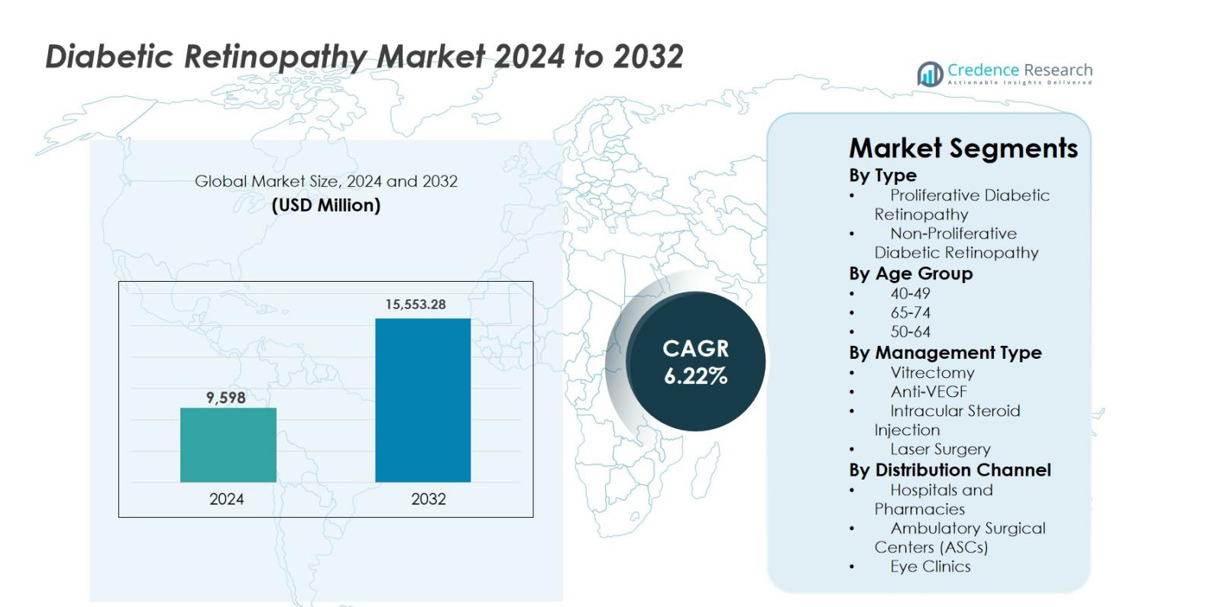
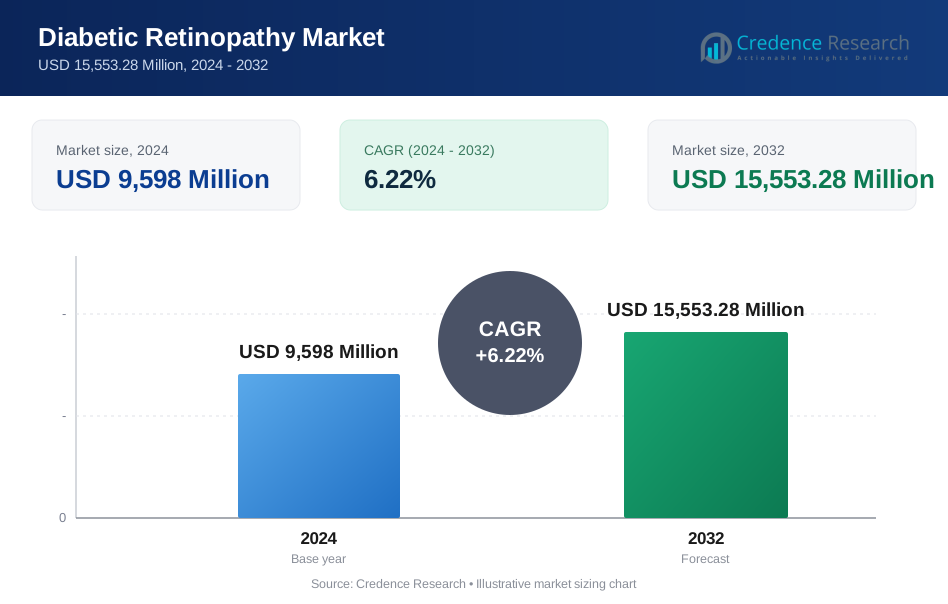
Diabetic Retinopathy market size was valued at USD 9,598 Million in 2024 and is anticipated to reach USD 15,553.28 Million by 2032, growing at a CAGR of 6.22% during the forecast period.
| REPORT ATTRIBUTE | DETAILS |
|---|---|
| Historical Period | 2020-2023 |
| Base Year | 2024 |
| Forecast Period | 2025-2032 |
| Diabetic Retinopathy Market Size 2024 | USD 9,598 Million |
| Diabetic Retinopathy Market, CAGR | 6.22% |
| Diabetic Retinopathy Market Size 2032 | USD 15,553.28 Million |
Diabetic Retinopathy market is driven by the strong presence of established pharmaceutical and biotechnology companies focused on retinal disease management, including Bayer AG, AbbVie Inc., Novartis AG, Genentech, Inc., Alimera Sciences, Oxurion NV, Sirnaomics, Ampio Pharmaceuticals Inc., BCNPeptides, and Kowa Company Ltd. These players emphasize innovation in anti-VEGF therapies, sustained-release drug delivery systems, and novel biologics to improve treatment durability and patient outcomes. North America leads the Diabetic Retinopathy market with an exact 38.2% market share, supported by advanced healthcare infrastructure, high screening rates, and favorable reimbursement policies. Europe follows with 27.6% share, driven by strong public healthcare programs, while Asia Pacific holds 23.4% share, supported by a large diabetic population and expanding access to ophthalmic care.
Market Insights
- Diabetic Retinopathy market size was valued at USD 9,598 million in 2024 and is projected to reach USD 15,553.28 million by 2032, growing at a CAGR of 6.22%, supported by rising diabetes prevalence and increasing demand for vision-preserving therapies.
- Market growth is primarily driven by the expanding global diabetic population, longer disease duration, and higher screening rates, which increase diagnosis and treatment volumes, particularly for early-stage non-proliferative diabetic retinopathy.
- A key market trend is the strong adoption of anti-VEGF therapy, which dominates management types with approximately 52.4% share, driven by proven clinical efficacy, favorable reimbursement, and widespread physician preference.
- Competitive activity focuses on innovation in long-acting injectables, sustained-release implants, and pipeline expansion, as leading players strengthen ophthalmology portfolios and pursue differentiation through improved treatment durability.
- Regionally, North America leads with 38.2% share, followed by Europe at 27.6% and Asia Pacific at 23.4%, while non-proliferative diabetic retinopathy remains the dominant disease segment with about 64.8% share due to higher prevalence and early diagnosis.
Market Segmentation Analysis
By Type
The Diabetic Retinopathy market by disease type is led by Non-Proliferative Diabetic Retinopathy (NPDR), which accounted for 64.8% market share in 2024. NPDR dominance is driven by its higher prevalence among early- and mid-stage diabetic patients and increasing screening rates that enable earlier diagnosis. Growing awareness programs, routine fundus examinations, and the rising global diabetic population support demand for NPDR management. Proliferative Diabetic Retinopathy (PDR) represents a smaller but critical segment, driven by advanced disease severity and higher intervention needs, particularly in patients with long-standing, poorly controlled diabetes.
- For instance, Regeneron’s Eylea (aflibercept) demonstrated sustained ≥2-step DR severity score improvement in NPDR patients in DRCR Retina Network Protocol W, reinforcing early pharmacologic intervention before progression to PDR.
By Age Group
The 50–64 age group dominated the Diabetic Retinopathy market with 38.6% share in 2024, supported by a high incidence of type 2 diabetes and longer disease duration. This group shows increased susceptibility to microvascular complications due to cumulative glycemic exposure and lifestyle-related risk factors. Regular ophthalmic monitoring and early therapeutic intervention drive higher diagnosis and treatment rates. The 65–74 segment follows closely, driven by aging populations, while the 40–49 group benefits from growing preventive screening and early disease identification initiatives.
- For instance, data from the CDC National Diabetes Statistics Report (2023) show that adults aged 45–64 account for one of the highest diagnosed diabetes prevalence rates in the U.S., directly increasing routine retinal screening volumes in this age bracket.
By Management Type
The Diabetic Retinopathy market by management type is dominated by Anti-VEGF therapy, holding 52.4% market share in 2024. This leadership is driven by strong clinical efficacy in reducing macular edema, improving visual outcomes, and delaying disease progression. Favorable reimbursement coverage, repeated treatment adoption, and physician preference further reinforce dominance. Laser surgery remains widely used in advanced cases due to durability and cost-effectiveness, while vitrectomy and intravitreal steroid injections support complex or refractory cases, contributing to diversified treatment demand.
Key Growth Drivers
Rising Global Prevalence of Diabetes
The increasing global burden of diabetes remains the primary growth driver for the Diabetic Retinopathy market. Sedentary lifestyles, unhealthy dietary patterns, and rising obesity rates continue to accelerate the incidence of both type 1 and type 2 diabetes across developed and emerging economies. Longer life expectancy among diabetic patients increases cumulative exposure to hyperglycemia, significantly raising the risk of retinal complications. As a result, healthcare systems are witnessing a growing patient pool requiring regular retinal screening, monitoring, and treatment. This expanding diabetic population directly drives sustained demand for diagnostic services, pharmacological therapies, and interventional procedures.
- For instance, the World Health Organization (WHO) highlights that prolonged diabetes duration is a major risk factor for retinopathy, noting that more than one-third of people with diabetes develop some form of diabetic retinopathy during their lifetime.
Advancements in Therapeutic Technologies
Continuous innovation in therapeutic approaches strongly supports Diabetic Retinopathy market growth. The development of advanced anti-VEGF agents, sustained-release intravitreal implants, and combination treatment strategies has significantly improved clinical outcomes and patient compliance. These therapies enable better disease control, reduced injection frequency, and improved visual acuity preservation. Growing physician confidence in evidence-based treatment protocols and expanding reimbursement coverage further accelerate adoption. Technological progress in drug formulation and delivery systems enhances treatment precision, making advanced therapies more accessible across diverse patient populations.
- For instance, AbbVie’s Ozurdex (dexamethasone intravitreal implant) provides sustained corticosteroid release for up to six months, reducing treatment burden in select diabetic retinopathy and diabetic macular edema patients and supporting wider adoption of long-acting delivery systems.
Expansion of Screening and Early Diagnosis Programs
The growing emphasis on early diagnosis and preventive eye care acts as a major growth catalyst for the Diabetic Retinopathy market. Government-led public health initiatives, insurance-driven annual eye examinations, and employer-sponsored wellness programs encourage routine retinal screening among diabetic patients. Improved access to ophthalmic care in urban and semi-urban regions enables early-stage detection, particularly of non-proliferative diabetic retinopathy. Early diagnosis increases treatment initiation rates and long-term disease management, reducing vision-threatening complications while steadily expanding the treated patient base worldwide.
Key Trends & Opportunities
Adoption of AI-Enabled Retinal Imaging and Diagnostics
Artificial intelligence–driven retinal imaging solutions are transforming the Diabetic Retinopathy market by enabling faster, more accurate, and scalable disease detection. AI algorithms integrated with fundus photography and optical coherence tomography support automated screening, particularly in primary care and remote settings. These technologies reduce diagnostic burden on specialists and improve screening coverage in underserved regions. Healthcare providers increasingly adopt AI-assisted platforms to enhance early detection and optimize referral workflows. This trend creates significant opportunities for technology developers, diagnostic service providers, and healthcare systems seeking cost-efficient solutions to manage growing diabetic populations.
- For instance, Eyenuk’s EyeArt AI system received regulatory clearance in multiple regions after clinical studies showed high accuracy in detecting more-than-mild diabetic retinopathy, enabling automated referrals and reducing dependence on specialist graders in high-volume screening workflows.
Shift Toward Long-Acting and Combination Therapies
The market is witnessing a strong shift toward long-acting treatment modalities and combination therapies that reduce treatment frequency and improve patient adherence. Sustained-release intravitreal implants, extended-duration anti-VEGF agents, and therapies targeting multiple disease pathways are gaining traction. These innovations address challenges associated with frequent injections, clinic visits, and treatment fatigue. Growing clinical evidence supporting durable efficacy and safety strengthens physician adoption. This trend opens new opportunities for pharmaceutical companies to differentiate products, extend treatment lifecycles, and improve patient outcomes while optimizing healthcare resource utilization.
- For instance, Genentech’s Vabysmo (faricimab) demonstrated durable efficacy with dosing intervals up to 16 weeks in Phase III YOSEMITE and RHINE trials, reflecting growing acceptance of longer-acting anti-VEGF therapy in diabetic retinal disease management.
Key Challenges
High Treatment Costs and Reimbursement Limitations
High treatment costs remain a significant challenge in the Diabetic Retinopathy market, particularly for advanced pharmacological therapies. Anti-VEGF injections, repeated procedures, and long-term disease management impose substantial financial burdens on healthcare systems and patients. Inadequate reimbursement policies in several emerging economies limit treatment accessibility, leading to delayed intervention and disease progression. Cost constraints also restrict adoption of innovative therapies in resource-limited settings, slowing overall market penetration and creating disparities in patient care outcomes.
Limited Access to Specialized Ophthalmic Care
Limited availability of trained ophthalmologists and advanced retinal care facilities poses a critical challenge, especially in rural and low-income regions. Long waiting times, uneven distribution of specialists, and inadequate infrastructure hinder timely diagnosis and treatment. These access gaps contribute to underdiagnosis and late-stage presentation of diabetic retinopathy. Despite growing screening efforts, the lack of follow-up care and treatment capacity restricts effective disease management, impacting patient outcomes and moderating market growth potential in underserved geographies.
Regional Analysis
North America
North America dominated the Diabetic Retinopathy market with approximately 38.2% market share in 2024, supported by a high prevalence of diabetes, strong awareness levels, and advanced healthcare infrastructure. Widespread adoption of routine retinal screening, early diagnosis, and high treatment penetration for anti-VEGF therapies drive regional leadership. Favorable reimbursement frameworks, strong presence of leading pharmaceutical companies, and rapid uptake of innovative therapies further support growth. The United States remains the primary contributor due to large diabetic populations and early adoption of AI-enabled diagnostics, while Canada benefits from expanding public healthcare screening initiatives.
Europe
Europe accounted for around 27.6% market share in 2024, driven by well-established healthcare systems and rising diabetes incidence across aging populations. Strong government-led screening programs and standardized treatment guidelines support early detection and consistent disease management. Countries such as Germany, the UK, France, and Italy lead regional demand due to high diagnosis rates and access to advanced ophthalmic care. Increasing adoption of long-acting therapies and growing investments in digital health solutions further enhance market growth, while expanding awareness programs continue to improve treatment initiation across Western and Northern Europe.
Asia Pacific
Asia Pacific held approximately 23.4% market share in 2024 and represents the fastest-growing region in the Diabetic Retinopathy market. Rapid growth is driven by a large and expanding diabetic population, improving healthcare access, and increasing awareness of diabetic eye complications. China and India dominate regional demand due to rising urbanization, lifestyle changes, and government-supported screening initiatives. Expanding private healthcare infrastructure and growing adoption of cost-effective anti-VEGF therapies further support growth. Increased investments in teleophthalmology and AI-based screening platforms enhance early diagnosis across underserved areas.
Latin America
Latin America captured about 6.4% market share in 2024, supported by rising diabetes prevalence and improving access to ophthalmic care. Countries such as Brazil, Mexico, and Argentina drive regional demand due to expanding healthcare coverage and increasing awareness of diabetic eye diseases. Gradual adoption of advanced therapies, supported by public-private partnerships, improves treatment availability. However, uneven access to specialized care and reimbursement limitations continue to affect market penetration. Ongoing investments in screening programs and healthcare infrastructure are expected to strengthen long-term market growth across the region.
Middle East & Africa
The Middle East & Africa region accounted for around 4.4% market share in 2024, driven by rising diabetes incidence and improving healthcare investments. Gulf countries lead regional demand due to better access to advanced ophthalmic services and higher healthcare spending. In contrast, parts of Africa face challenges related to limited screening access and specialist availability. Increasing government initiatives, international health programs, and mobile screening solutions support early detection. Gradual expansion of healthcare infrastructure and awareness campaigns is expected to improve diagnosis and treatment rates across the region.
Market Segmentations
By Type
- Proliferative Diabetic Retinopathy
- Non-Proliferative Diabetic Retinopathy
By Age Group
- 40-49
- 65-74
- 50-64
By Management Type
- Vitrectomy
- Anti-VEGF
- Intracular Steroid Injection
- Laser Surgery
By Distribution Channel
- Hospitals and Pharmacies
- Ambulatory Surgical Centers (ASCs)
- Eye Clinics
By Geography
- North America
- U.S.
- Canada
- Mexico
- Europe
- Germany
- France
- U.K.
- Italy
- Spain
- Rest of Europe
- Asia Pacific
- China
- Japan
- India
- South Korea
- South-east Asia
- Rest of Asia Pacific
- Latin America
- Brazil
- Argentina
- Rest of Latin America
- Middle East & Africa
- GCC Countries
- South Africa
- Rest of the Middle East and Africa
Competitive Landscape
The Diabetic Retinopathy market features a moderately consolidated competitive landscape, characterized by the presence of established pharmaceutical companies and emerging biotechnology firms focused on retinal disease management. Key players such as Bayer AG, AbbVie Inc., Novartis AG, Genentech, Inc., and Alimera Sciences maintain strong positions through broad ophthalmology portfolios, robust clinical pipelines, and established global distribution networks. These companies emphasize innovation in anti-VEGF therapies, sustained-release drug delivery systems, and next-generation biologics to improve treatment durability and patient adherence. Smaller players including Oxurion NV, Sirnaomics, Ampio Pharmaceuticals Inc., BCNPeptides, and Kowa Company Ltd. focus on novel mechanisms of action, gene-based therapies, and differentiated formulations targeting unmet clinical needs. Strategic initiatives such as product launches, clinical trial expansion, partnerships, and geographic market expansion remain central to competitive positioning, as companies seek to strengthen therapeutic efficacy, extend product lifecycles, and capture growing demand driven by rising diabetic populations worldwide.
Key Player Analysis
- Genentech, Inc.
- Oxurion NV
- Kowa Company Ltd.
- AbbVie Inc.
- Sirnaomics
- Bayer AG
- BCNPeptides
- Alimera Sciences
- Novartis AG
- Ampio Pharmaceuticals Inc.
Recent Developments
- In August 2025, Topcon Healthcare completed the acquisition of Intelligent Retinal Imaging Systems to enhance connected care across primary and eye care services, supporting diabetic retinopathy screening efforts.
- In June 2025, Avant Technologies, Inc. and its joint venture partner Ainnova Tech, Inc. began diabetic retinopathy screenings using its AI-based Vision AI platform in collaboration with Grupo Dökka’s pharmacy network in Central America.
- In May 2025, Roche’s Genentech announced that the U.S. FDA approved Susvimo® (ranibizumab injection) 100 mg/mL for the treatment of diabetic retinopathy, marking the first continuous delivery treatment requiring just one refill every nine months.
Report Coverage
The research report offers an in-depth analysis based on Type, Age Group, Management Type Distribution Channel and Geography. It details leading market players, providing an overview of their business, product offerings, investments, revenue streams, and key applications. Additionally, the report includes insights into the competitive environment, SWOT analysis, current market trends, as well as the primary drivers and constraints. Furthermore, it discusses various factors that have driven market expansion in recent years. The report also explores market dynamics, regulatory scenarios, and technological advancements that are shaping the industry. It assesses the impact of external factors and global economic changes on market growth. Lastly, it provides strategic recommendations for new entrants and established companies to navigate the complexities of the market.
Future Outlook
- The Diabetic Retinopathy market will continue to expand steadily, supported by the rising global diabetic population and longer disease duration.
- Early diagnosis and preventive screening will gain stronger emphasis, increasing treatment initiation at non-proliferative stages.
- Adoption of AI-enabled retinal imaging will accelerate large-scale screening and improve diagnostic efficiency in primary care settings.
- Anti-VEGF therapies will remain the cornerstone of treatment, while next-generation agents improve durability and patient compliance.
- Long-acting drug delivery systems will reduce treatment frequency and enhance patient adherence.
- Combination therapies targeting multiple disease pathways will gain wider clinical acceptance.
- Teleophthalmology will expand access to retinal care in underserved and remote regions.
- Growing healthcare investments in emerging economies will improve treatment accessibility and infrastructure.
- Regulatory support and guideline updates will encourage standardized management and early intervention.
- Strategic collaborations and pipeline expansion will intensify as companies seek innovation-led differentiation.
Request a Free Sample
Fill in your details and we'll send you a free sample report.
- Sample data tables & charts
- Research methodology
Need a Custom Version of This Report?
Tailor the scope, geography, or segments to your exact requirements.
- Custom geography or segment scope
- Direct access to our analyst team
Frequently Asked Questions
What is the current market size for the Diabetic Retinopathy market, and what is its projected size in 2032?
At what Compound Annual Growth Rate is the Diabetic Retinopathy market projected to grow between 2024 and 2032?
Which market segment is leading in terms of type?
Which end-user segment is estimated to have the highest CAGR throughout the forecast period?
Who are the key participants in the global market for diabetic retinopathy?
Table of Content
Chapter 1. Report Introduction
- 1.1 Report Description & Purpose
- 1.1.1 Report Title & Market Definition
- 1.1.2 Unique Selling Propositions (USP) & Key Differentiators
- 1.1.3 Value Proposition for Stakeholders
- 1.2 Research Objectives
- 1.2.1 Market Sizing Objectives (Volume & Revenue)
- 1.2.2 Segmentation Objectives
- 1.2.3 Competitive Intelligence Objectives
- 1.2.4 Forecast & Scenario Objectives
- 1.3 Report Scope
- 1.3.1 Diabetic Retinopathy Scope – Types & Subtypes Covered
- 1.3.2 Geographic Scope – Regions & Countries Covered
- 1.3.3 Historical Period, Base Year & Forecast Period (2024; forecast to 2032)
- 1.3.4 Inclusions & Exclusions
- 1.4 HS Code & Classification Framework
- 1.5 Currency, Units & Pricing Basis
- 1.6 Target Stakeholders
- 1.7 Limitations & Assumptions
Chapter 2. Executive Summary
- 2.1 Global Diabetic Retinopathy Market Snapshot
- 2.1.1 Market Size – Historical (2024) & Forecast (2024-2032) (2024: USD 9,598 Million → 2032: USD 15,553.28 Million)
- 2.1.2 Volume & Revenue – Global Totals
- 2.1.3 Key Market Highlights – Top Five Facts
- 2.2 Diabetic Retinopathy Market Segmentation Snapshot
- 2.2.1 Market Split by Region – 2024 vs. 2032
- 2.3 Competitive Snapshot
- 2.3.1 Top 10 Players by Revenue Share – 2024
- 2.3.2 Top 10 Players by Volume Share – 2024
- 2.3.3 Recent Strategic Developments (18-Month Summary)
- 2.4 Key Investment Highlights & Strategic Conclusions
Chapter 3. Diabetic Retinopathy Market Dynamics & Industry Analysis
- 3.1 Market Overview & Context
- 3.1.1 Diabetic Retinopathy Market Position in the Broader Automotive Value Chain
- 3.1.2 OEM vs. Replacement Market Dynamics
- 3.1.3 Market Maturity & Development Stage by Region
- 3.2 Diabetic Retinopathy Market Drivers
- 3.3 Diabetic Retinopathy Market Restraints & Challenges
- 3.4 Diabetic Retinopathy Market Opportunities
- 3.5 Porter's Five Forces Analysis
- 3.5.1 Threat of New Entrants
- 3.5.2 Bargaining Power of Suppliers
- 3.5.3 Bargaining Power of Buyers
- 3.5.4 Threat of Substitutes
- 3.5.5 Competitive Rivalry – Intensity Assessment
- 3.6 Diabetic Retinopathy Value Chain Analysis
- 3.6.1 Upstream – Raw Material/Input Suppliers
- 3.6.1.1 Raw Material/Input 1
- 3.6.1.2 Raw Material/Input 2
- 3.6.1.3 Raw Material/Input 3
- 3.6.2 Midstream – Production/Manufacturing/Service Delivery
- 3.6.2.1 Production/Process Overview
- 3.6.2.2 Key Facility Locations & Capacity by Manufacturer
- 3.6.3 Downstream – Distribution & End Consumer
- 3.6.3.1 Primary Channel – B2B/OEM
- 3.6.3.2 Secondary Channels – Dealer, Retail, Online, Direct
- 3.6.4 Value Chain Profitability Analysis
- 3.6.1 Upstream – Raw Material/Input Suppliers
- 3.7 PESTEL Analysis
- 3.7.1 Political Factors
- 3.7.2 Economic Factors
- 3.7.3 Social Factors
- 3.7.4 Technological Factors
- 3.7.5 Environmental Factors
- 3.7.6 Legal Factors
- 3.8 Diabetic Retinopathy Supply Chain Analysis
- 3.8.1 Raw Material/Input Supply Risk Assessment
- 3.8.2 Manufacturing Concentration Risk (Geographic Exposure)
- 3.8.3 Trade Disruption Impact Analysis
- 3.9 Regulatory & Policy Landscape
Note: The regulatory and policy landscape section covers regulations based on their applicability to the market, Diabetic Retinopathy category, geography, and scope of the study. Only regulatory frameworks with a material impact on operations, compliance, trade, sustainability, or market access are analyzed in detail.
Chapter 4. Key Investment Pockets & Opportunity Analysis
- 4.1 Diabetic Retinopathy Market Attractiveness Analysis
- 4.1.1 By Region – Investment Attractiveness Matrix (Volume × CAGR)
- 4.2 Absolute Revenue Growth Opportunity
- 4.2.1 By Region – Absolute USD Growth Through 2032
- 4.3 Incremental Volume Opportunity
- 4.3.1 By Region – Incremental Volume Through 2032
- 4.3.2 Segment – Incremental Volume
- 4.4 Emerging Submarket Opportunity Deep Dive (Subject to Applicability)
- 4.5 Emerging Market Opportunity Scorecards
- 4.5.1 United States
- 4.5.2 Europe
- 4.5.3 Asia
- 4.5.4 Middle East & Africa
Note: Emerging Market Opportunity Scorecards will be included based on relevance and strategic importance. Regions listed are indicative and may vary depending on data availability and market dynamics.
Chapter 5. Diabetic Retinopathy Import-Export Analysis & Trade Flows
- 5.1 Global Trade Overview
- 5.1.1 Global Export Value by Country (2024)
- 5.1.2 Global Export Volume by Country (2024)
- 5.1.3 Global Import Value by Country (2024)
- 5.1.4 Global Import Volume by Country (2024)
- 5.1.5 Net Trade Balance by Country (2024)
- 5.2 Export Analysis – Segment
- 5.2.1 Type 1 (HS Code)
- 5.2.2 Type 2 (HS Code)
- 5.2.3 Type 3 (HS Code)
- 5.2.4 Type 4 (HS Code)
- 5.2.5 Type 5 (HS Code)
- 5.3 Import Analysis – Segment
- 5.3.1 Type 1 (HS Code)
- 5.3.2 Type 2 (HS Code)
- 5.3.3 Type 3 (HS Code)
- 5.3.4 Type 4 (HS Code)
- 5.3.5 Type 5 (HS Code)
- 5.4 Average Unit Trade Prices
- 5.4.1 Average Export Price – Segment & Country
- 5.4.2 Average Import Price – Segment & Source Country
- 5.4.3 Price Trends (2024)
- 5.5 Key Trade Route Analysis
- 5.5.1 Trade Route 1
- 5.5.2 Trade Route 2
- 5.5.3 Trade Route 3
- 5.5.4 Trade Route 4
- 5.5.5 Trade Route 5
- 5.6 Trade Policy Impact Assessment
- 5.6.1 US Anti-Dumping & Section 301 Tariffs
- 5.6.2 EU Customs Union Impact
- 5.6.3 Major Free Trade Agreements
- 5.6.4 USMCA Rules of Origin
Note: Trade policy analysis will be included only where relevant to the Diabetic Retinopathy market.
Chapter 6. Competitive Landscape & Company Benchmarking
- 6.1 Diabetic Retinopathy Market Concentration & Structure
- 6.1.1 Herfindahl-Hirschman Index (HHI) – vs. 2024
- 6.1.2 Tier 1, Tier 2 & Tier 3 Market Structure
- 6.1.3 Global, Regional & Local Player Dynamics
- 6.2 Diabetic Retinopathy Market Share Analysis – 2024
- 6.2.1 Global Revenue Share by Company
- 6.2.2 Global Volume Share by Company
- 6.2.3 Regional Revenue Share
- 6.2.4 Market Share Evolution ( vs. 2024)
- 6.2.5 OEM Segment Share by Company
- 6.2.6 Replacement Segment Share by Company
- 6.3 Production/Delivery Capacity & Facility Analysis
- 6.3.1 Global Installed Capacity
- 6.3.2 Capacity Utilization Rates
- 6.3.3 Production/Output Volume
- 6.3.4 Facility Locations & Capacity Map
- 6.3.5 Planned Capacity Additions
- 6.4 Diabetic Retinopathy Competitive Benchmarking Matrix
- 6.4.1 Revenue, Volume, CAGR & Profitability Comparison
- 6.4.2 Channel Revenue Mix
- 6.4.3 Geographic Revenue Exposure
- 6.4.4 R&D Intensity
- 6.4.5 Sustainability Maturity
- 6.5 Strategic Developments in Diabetic Retinopathy (Last 24 Months)
- 6.5.1 Mergers, Acquisitions & Divestments
- 6.5.2 New Diabetic Retinopathy Launches
- 6.5.3 Facility Expansions
- 6.5.4 Strategic Alliances, Joint Ventures & Partnerships
- 6.5.5 Distribution Expansion & Market Entry
- 6.5.6 Sustainability & ESG Initiatives
- 6.6 Competitive Strategy Mapping
- 6.6.1 Leader, Challenger, Follower & Niche Classification
- 6.6.2 Pricing Strategy Comparison
- 6.6.3 Channel Strategy Matrix
Note: Strategic developments are included based on their materiality and the availability of reliable information.
Chapter 7. Global Diabetic Retinopathy Market – By Distribution Channel
- 7.1 Segment Overview
- 7.1.1 Volume & Revenue Split by Channel (2024 & 2032)
- 7.1.2 Channel Mix Evolution (2024-2032)
Chapter 8. Regional Market Analysis – Global Overview
- 8.1 Global Regional Overview
- 8.1.1 Regional Volume Share
- 8.1.2 Regional Revenue Share
- 8.1.3 Regional Volume by Region
- 8.1.4 Regional Revenue by Region
- 8.1.5 Regional Forecast Through 2032
- 8.2 Cross-Regional Segment Analysis
- 8.2.1 By Distribution Channel
- 8.2.2 By Brand/Price Tier
Chapter 9. North America Diabetic Retinopathy Market
- 9.1 United States
- 9.2 Canada
- 9.3 Mexico
Chapter 10. Europe Diabetic Retinopathy Market
- 10.1 Germany
- 10.2 France
- 10.3 Italy
- 10.4 United Kingdom
- 10.5 Spain
- 10.6 Poland
- 10.7 Russia
- 10.8 Netherlands
- 10.9 Belgium
- 10.10 Sweden
- 10.11 Denmark
- 10.12 Norway
- 10.13 Rest of Europe
Chapter 11. Asia Pacific Diabetic Retinopathy Market
- 11.1 China
- 11.2 India
- 11.3 Japan
- 11.4 South Korea
- 11.5 Thailand
- 11.6 Indonesia
- 11.7 Vietnam
- 11.8 Malaysia
- 11.9 Australia
- 11.10 Rest of Asia Pacific
Chapter 12. Latin America Diabetic Retinopathy Market
- 12.1 Brazil
- 12.2 Argentina
- 12.3 Colombia
- 12.4 Chile
- 12.5 Rest of Latin America
Chapter 13. Middle East Diabetic Retinopathy Market
- 13.1 Saudi Arabia
- 13.2 United Arab Emirates
- 13.3 Turkey
- 13.4 Israel
- 13.5 Iran
- 13.6 Rest of the Middle East
Chapter 14. Africa Diabetic Retinopathy Market
- 14.1 South Africa
- 14.2 Egypt
- 14.3 Nigeria
- 14.4 Morocco
- 14.5 Rest of Africa
Chapter 15. Diabetic Retinopathy Company Profiles
- 15.1 [Company 01]
- 15.1.1 Company Overview
- 15.1.2 Key Management Personnel
- 15.1.3 Products & Services Portfolio
- 15.1.4 Financial Performance
- 15.1.5 Key Market Focus & Geographic Presence
- 15.1.6 Recent Developments & Strategic Initiatives
Note: The company profile list is preliminary and may change based on research findings, market developments, data availability, and client requirements.
Chapter 16. Appendices
- Appendix A – List of Abbreviations & Acronyms
- Appendix B – Industry Classification Code Reference – Full Series
- Appendix C – Production & Capacity Data Tables
- Appendix D – End-Use & Demand Base Tables
- Appendix E – Consumption & Replacement Rate Assumptions
- Appendix F – ASP Reference Tables
- Appendix G – Manufacturing & Facility Database
- Appendix H – Import-Export Data Tables
- Appendix I – Regulatory Summary Tables
- Appendix J – Primary Research Participant List (Anonymized)
- Appendix K – Primary Research Questionnaire Framework
- Appendix L – Data Sources & Bibliography
- Appendix M – Market Size Divergence & Source Comparison
Chapter 17. Research Methodology
- 17.1 Research Framework & Philosophy
- 17.2 Secondary Research – Sources, Hierarchy & Data Extraction
- 17.3 Data Modeling – Bottom-Up & Top-Down Market Sizing
- 17.4 Primary Research – Stakeholder Framework, LOI & Sample Sizes
- 17.5 Forecast Methodology – Regression, Scenario & Sensitivity Analysis
- 17.6 Quality Control – Four-Layer Validation Framework
- 17.7 Limitations & Standard Assumptions
- 17.8 Disclaimer
