
| REPORT ATTRIBUTE | DETAILS |
|---|---|
| Historical Period | 2019-2022 |
| Base Year | 2023 |
| Forecast Period | 2024-2032 |
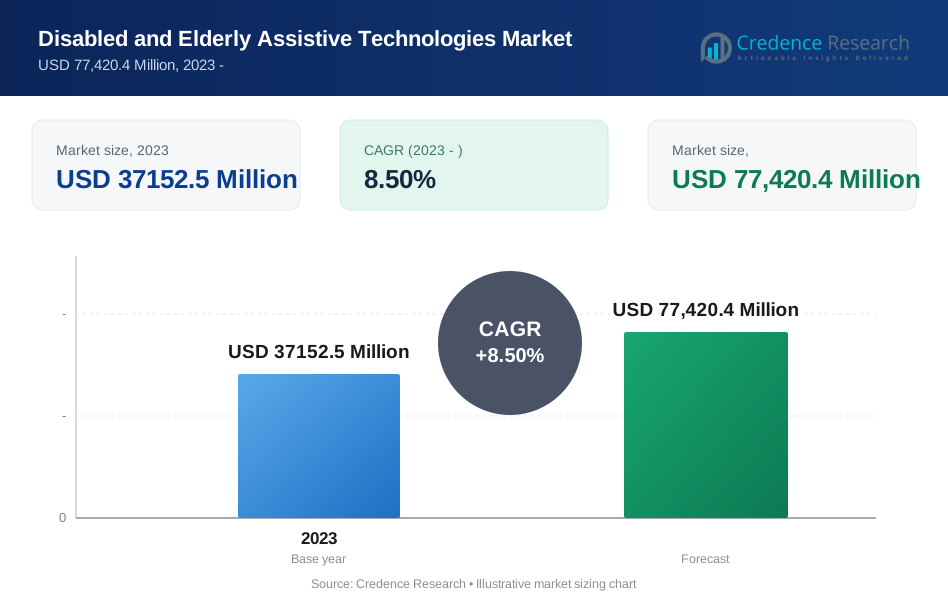
| Disabled and Elderly Assistive Technologies Market Size 2023 | USD 37152.5 Million |
| Disabled and Elderly Assistive Technologies Market, CAGR | 8.50% |
| Disabled and Elderly Assistive Technologies Market Size 2032 | USD 77420.4 Million |
Market Insights
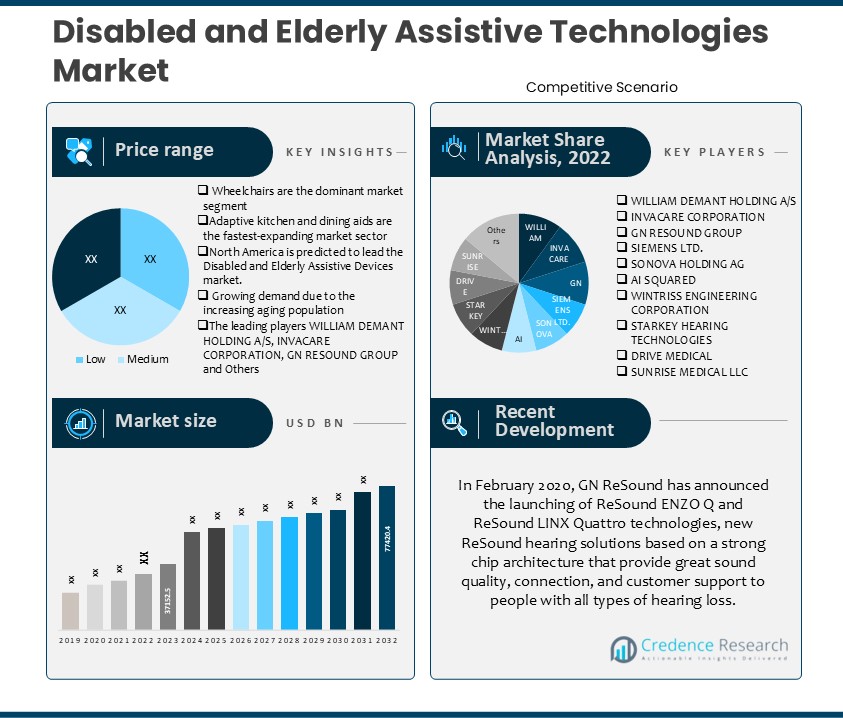
- The global demand for Disabled and Elderly Assistive Technologies was valued at USD 37152.5 Million in 2023 and is expected to reach USD 77420.4 Million in 2032, growing at a CAGR of 8.50% between 2024 and 2032.
- Wheelchairs are the leading market category, whereas mobility scooters are an important market sector.
- Hearing aids devices are a big market share holder. Another significant market segment is augmentative and alternative communication (AAC) devices.
- Hearing aids are the most significant stakeholder segment.
- Adaptive kitchen and dining aids are the fastest growing market area, while personal care and hygiene aids are also substantial.
- Bathroom safety is projected to be the most advantageous category over the forecast period.
- Memory aids are in the highest market demand.
- The most popular market segment is robot assistance with daily duties.
- Wearable health monitors are the market's predominant category.
- In 2023, hospitals were the dominating category in the global market, with homecare expected to be the fastest-growing area throughout the forecast period.
- North America is expected to lead the Disabled and Elderly Assistive Devices market, while Asia-Pacific will experience considerable market expansion.
- Growing Government Support for the Aging Population Drives the Market.
- High costs and a lack of knowledge stifle market expansion.
Executive Summary
Market Definition
The Disabled and Elderly Assistive Technologies Market is defined as the market for products and services that are specifically designed to assist people with disabilities and the elderly in their daily activities. These technologies attempt to promote independence, mobility, and support in a variety of sectors, including communication, mobility aids, home modifications, and healthcare devices.
Market Overview
The global Disabled and Elderly Assistive Technologies Market has witnessed steady growth in recent years and is expected to grow at a CAGR of 8.50% between 2024 and 2032. The market was valued at USD 37152.5 million in 2023 and is expected to reach USD 77420.4 million in 2032.
The Disabled and Elderly Assistive Technologies Market is expanding rapidly worldwide. Several reasons drive this industry, including an aging population, an increase in disability prevalence, and technological improvements.
The industry provides a diverse range of assistive technology aimed at improving the quality of life for those with impairments and the elderly. Mobility aids such as wheelchairs and scooters, communication gadgets, house modifications, personal care equipment, and healthcare devices such as hearing aids and prostheses are all examples of such technologies.
One of the important market trends is the development of innovative and user-friendly technologies that improve freedom and mobility.
Segmentation by Mobility Aids
- Wheelchairs are the dominant market segment. People with mobility disabilities frequently utilize wheelchairs to improve their mobility and freedom. They come in a variety of styles, including manual and motorized wheelchairs, and provide varying amounts of support and capability.
- Mobility scooters are an important market segment.
Segmentation by Communication Aids
- Hearing aid devices are a big market share holder. Hearing aids are commonly used by people with hearing problems to enhance sound and improve their ability to hear and communicate.
- Another significant market category is augmentative and alternative communication (AAC) devices.
Segmentation by Vision and Hearing Aids
- Hearing aids are the most major shareholder segment. People with hearing problems commonly use hearing aids to improve their ability to hear and communicate. They are available in a variety of forms and styles, including behind-the-ear (BTE) and in-the-ear (ITE) devices, with varying functions to match individual demands.
Segmentation by Daily Living Aids
- Adaptive kitchen and dining aids are the fastest-expanding market sector. These tools are intended to help people with impairments or limited mobility accomplish cooking, eating, and dining duties more easily. Adaptive utensils, specialized cutting boards, ergonomic cooking tools, and customized dining equipment are all examples.
- Personal care and hygiene aids are another significant market sector.
Segmentation by Assistive Furniture and Home Modifications
- Bathroom safety is expected to be the most opportune category over the projection period. This is due to the growing emphasis on improving the quality of life of the disabled and elderly people.
Segmentation by Cognitive Assistance Technologies
- Memory aids have the highest market demand. They are intended to help people with memory problems or cognitive disabilities manage their daily duties, appointments, and reminders. Electronic organizers, reminder apps, and voice-activated assistants are examples of technology that can assist people in staying organized and on top of vital information.
Segmentation by Service Robots and Robotic Assistance
- The most prominent market category is robot assistance for daily tasks. Robotic assistance devices are intended to assist people with impairments or restricted movement in completing daily tasks, including cleaning, cooking, and transporting goods.
Segmentation by Wearable Assistive Technologies
- Wearable health monitors are the market’s dominant category. These devices are worn on the body to track various health parameters, including heart rate, sleep patterns, activity levels, and more.
Segmentation by Communication and Software Solutions
- Accessible software and apps account for the majority of the market share. Accessible software and apps are developed to ensure that people with disabilities or limited mobility have equal access to digital content and services. They use screen readers, voice commands, and configurable interfaces to make technology more accessible and user-friendly.
Segmentation by End-User
- In 2023, hospitals were the dominant segment in the global market. This is owing to an increase in hospital admissions caused by increased traffic accidents and the rising prevalence of a variety of chronic illnesses and disorders, such as paralysis, cerebral palsy, stroke, amputation, and multiple sclerosis. These disorders are the key driving forces behind the assistive device market.
- On the other hand, homecare is predicted to be the fastest-growing area during the forecast period.
Segmentation by Region
- North America is predicted to lead the Disabled and Elderly Assistive Devices market.
- Asia-Pacific will see significant market growth
- The rest of the world, including Latin America, the Middle East, and Africa, supplies the remaining demand for Disabled and Elderly Assistive Technologies.
North America is expected to dominate the Disabled and Elderly Assistive Devices industry. North America has a well-developed healthcare system and substantial health spending by individuals, particularly in the United States and Canada. Hospitals, rehabilitation institutes, and long-term care facilities provide distribution outlets for assistive devices. The National Health Expenditure Account (NHEA) estimates that the United States will spend USD 4.3 trillion on healthcare in 2021, or USD 12,914 per person. This accounts for 18.3% of the country's GDP.
On the other hand, Asia-Pacific will see significant market growth. Asia-Pacific assistive device sector is booming, because to a variety of factors, including a rapidly aging population that is more prone to suffer from chronic health disorders and mobility issues. A population like this necessitates the use of assistive technology. According to the World Health Organization (WHO), China's elderly population is quickly increasing. The overall number of persons over the age of 60 is expected to contribute 28% by 2040, owing to longer lifespans and lower birth rates.
Key Highlights of the Report
Mobility Aids, Communication Aids, Vision and Hearing Aids, Daily Living Aids, Mobility Aids, Cognitive Assistance Technologies, Service Robots and Robotic Assistance, Wearable Assistive Technologies, and Region segment of the global Disabled and Elderly Assistive Technologies Market. In 2023, hospitals were the leading category in the global market, while hearing aids were the largest shareholder segment. Adaptive kitchen and dining aids are the fastest-growing market area, whereas memory aids have the highest demand. Also, another prominent market segment is augmentative and alternative communication (AAC) devices, with North America leading the market growth.
The market is being driven by an aging population and an increase in the prevalence of disabilities, as well as technological advancements and supportive government regulations. Furthermore, high costs, limited awareness and comprehension of existing technologies, and regulatory constraints are the main barriers of the industry.
Nonetheless, North America is predicted to lead the Disabled and Elderly Assistive Devices sector. Individuals in North America spend a significant amount of money on healthcare, particularly in the United States and Canada. In addition, Asia-Pacific will experience significant market expansion. The Asia-Pacific assistive device business is thriving due to a number of causes, including a rising aging population that is more prone to suffer from chronic health diseases and mobility issue
What Are The Main Drivers Of The Global Disabled and Elderly Assistive Technologies Market?
The growing aging population and incidence of disabilities are two major drivers of the Disabled and Elderly Assistive Technologies Market. As the population ages, the demand for assistive devices increases. These technologies assist people with impairments and the elderly in improving their quality of life, preserving their independence, and general well-being. Furthermore, advances in technology, such as artificial intelligence (AI) and the Internet of Things (IoT), have created new opportunities for building novel and effective assistive solutions. These technical breakthroughs enable the development of smart devices and customizable solutions tailored to individuals' specific demands and preferences.
What Are The Major Challenges Faced By The Global Disabled and Elderly Assistive Technologies Market?
While the Disabled and Elderly Assistive Technologies Market has significant potential, there are some limitations that must be considered. One of the primary issues is the high expense of these technology. Assistive gadgets' advanced features and functionality are frequently more expensive, making them less accessible to people with little financial resources. Another barrier is a lack of awareness and understanding of existing technology among potential users and caregivers. Many people may be unaware of the numerous assistive technology that might significantly improve their lives.
What Are The Growth Opportunities In The Global Disabled and Elderly Assistive Technologies Market?
The Disabled and Elderly Assistive Technologies Market offers numerous chances for growth and development. One of the most significant opportunities is the growing need for tailored and user-friendly solutions. Individuals have unique wants and preferences, thus there is an increasing demand for assistive technologies that may be personalized to their specific needs. This enables businesses to create personalized and adaptive solutions that appeal to certain users. Furthermore, there is enormous room for market expansion into emerging economies, particularly in developing nations. These regions frequently have a large elderly population and a growing demand for assistive technologies.
Market Drivers
Several factors drive the global Disabled and Elderly Assistive Technologies Market. The following are the key drivers of the global Disabled and Elderly Assistive Technologies Market:
Growing Government Support for the Aging Population
Governments throughout the world are progressively assisting older persons, which is driving the expansion of the crippled and aged assistive device market. Governments understand the value of providing full care and assistance to their older citizens, including healthcare, accessibility, and quality of life.
For instance, the United States Department of Health and Human Services' National Health Initiatives encourage health and disease prevention throughout the country's lifespan. As a result, there is a growing emphasis on creating and implementing assistive technology that addresses the unique needs of older persons. This covers technologies and systems that enhance mobility, communication, and daily living.
Financial incentives, subsidies, and legislative frameworks promote the development and dissemination of these technologies. The government's strong support promotes innovation and provides older individuals with cutting-edge solutions to improve their independence and well-being. This serves as a drive for the assistive device business to adapt to the changing needs of the aging global population.
Market Restraints
The global Disabled and Elderly Assistive Technologies Market faces some challenges that may hinder its growth. These include the following:
High Cost And Lack Of Awareness
Assistive technologies are sometimes out of reach for low-income individuals in developing and undeveloped countries due to their high costs. This restricts access for a large segment of the population. Many individuals, caregivers, and healthcare professionals may be unaware of assistive technology and its benefits, which can result in underuse.
Opportunities
The global Disabled and Elderly Assistive Technologies Market offers significant growth opportunities. These include the following:
Growing Government Support for the Aging Population
Governments throughout the world are progressively assisting older persons, which is driving the expansion of the crippled and aged assistive device market. Governments understand the value of providing full care and assistance to their older citizens, including healthcare, accessibility, and quality of life.
For instance, the United States Department of Health and Human Services' National Health Initiatives encourage health and disease prevention throughout the country's lifespan. As a result, there is a growing emphasis on creating and implementing assistive technology that address the unique needs of older persons. This covers technologies and systems that enhance mobility, communication, and daily living.
Financial incentives, subsidies, and regulatory frameworks also promote the Production and distribution of these technologies. The government's strong support promotes innovation and provides older individuals with cutting-edge solutions to improve their independence and well-being. This serves as a drive for the assistive device business to adapt to the changing needs of the aging global population.
Competitive Landscape
Key Players
The global Disabled and Elderly Assistive Technologies Market is highly competitive, with several key players. Some of the major players in the market and their market share are as follows:
- WILLIAM DEMANT HOLDING A/S
- INVACARE CORPORATION
- GN RESOUND GROUP
- SIEMENS LTD.
- SONOVA HOLDING AG
- AI SQUARED
- WINTRISS ENGINEERING CORPORATION
- STARKEY HEARING TECHNOLOGIES
- DRIVE MEDICAL
- SUNRISE MEDICAL LLC
These organizations prioritize product innovation, Vision and Hearing Aids expansion, and mergers and acquisitions to stay competitive.
The global Disabled and Elderly Assistive Technologies Market's key players continually seek to stay ahead by offering new products and developments.
In November 2022, Fujitsu Ltd. collaborated with Wakayama Medical University to create a millimeter-wave sensor for detecting falls among elderly people. The sensor combines accurate body posture measurement with Al analysis of complicated behaviors. This camera-free technology helps healthcare workers respond quickly to situations like falls or potential major injuries while protecting the patient's privacy.
In August 2021, Invacare Corporation introduced the Invacare AVIVA STORM RX, a cutting-edge rear-wheel drive power wheelchair intended to improve mobility for those with special needs. Invacare's revolutionary offering aims to empower individuals and improve their quality of life.
Summary of Key Findings
- Growing Government Support for the Aging Population Drives the Market.
- The market is segmented by Mobility Aids, Communication Aids, Vision and Hearing Aids, Daily Living Aids, Mobility Aids, Cognitive Assistance Technologies, Service Robots and Robotic Assistance, Wearable Assistive Technologies, Communication and Software Solutions, hit Mobility Aids, and region.
- Bathroom safety is predicted to be the most important category over the projection period.
- Wheelchairs are the major market sector, and mobility scooters play a significant role.
- North America is leading market growth.. The market is highly competitive, with key players including WILLIAM DEMANT HOLDING A/S, INVACARE CORPORATION, GN RESOUND GROUP and Others.
Future Outlook
- Growing demand due to the increasing aging population.
- Advancements in technology driving innovation in assistive technologies.
- Rising awareness and focus on improving the quality of life for individuals with disabilities and the elderly.
- Expansion of the market in various regions, including North America, Europe, and Asia Pacific.
- Government initiatives and supportive policies contributing to market growth.
How CXOs Can Benefit from the Credence Research Disabled and Elderly Assistive Technologies Market Report
The Credence Research Disabled and Elderly Assistive Technologies Market Report provides CXOs with a comprehensive overview of the market, including:
- Market Cognitive Assistance Technologies and growth forecast:The report provides detailed estimates of the global Disabled and Elderly Assistive Technologies Market Cognitive Assistance Technologies, segmented by Mobility Aids, Communication Aids, Vision and Hearing Aids, Daily Living Aids Mobility Aids, Cognitive Assistance Technologies, Service Robots and Robotic Assistance, Wearable Assistive Technologies, and region. It also includes forecasts for the market through 2032 based on key trends and drivers.
- Market segmentation:The report segments the Disabled and Elderly Assistive Technologies Market by Mobility Aids, Communication Aids, Vision and Hearing Aids, Daily Living Aids, Mobility Aids, Cognitive Assistance Technologies, Service Robots and Robotic Assistance, Wearable Assistive Technologies, and Region. This segmentation provides CXOs with a granular understanding of the market and the opportunities in each segment.
- Competitive Landscape:The report profiles the key players in the Disabled and Elderly Assistive Technologies Market and provides insights into their strategies, product offerings, and financial performance. This information can help CXOs to identify and assess their competition.
- Key trends and drivers:The report identifies and analyzes the key trends and drivers that are shaping the Disabled and Elderly Assistive Technologies Market. This information can help CXOs to make informed decisions about their investments and strategies.
CXOs can use the insights from the Credence Research Disabled and Elderly Assistive Technologies Market Report to:
- Identify growth opportunities:The report can help CXOs to identify new growth opportunities in the Disabled and Elderly Assistive Technologies Market. For example, it can provide insights into emerging trends, market dynamics, and competitive landscapes.
- Make informed investment decisions:The report can help CXOs make informed investment decisions about Disabled and Elderly Assistive Technologies. For example, it provides market analysis and insights into key players, market trends, and growth opportunities.
- Develop competitive strategies:The report can help CXOs develop competitive strategies for their Disabled and Elderly Assistive Technologies businesses. It provides insights on market trends, customer preferences, and competitor analysis.
- Track market developments:The report can help CXOs monitor market developments and stay ahead of the curve. For example, it provides insights into the latest trends and innovations in the Disabled and Elderly Assistive Technologies Market.
Overall, the Credence Research Disabled and Elderly Assistive Technologies Market Report is a valuable resource for CXOs who are looking to gain a deeper understanding of the market and identify opportunities for growth.
Segmentation
By Mobility Aids:- Wheelchairs
- Mobility Scooters
- Walkers and Rollators
- Canes and Crutches
- Transfer Lifts and Slings
- Speech Generating Devices
- Augmentative and Alternative Communication (AAC) Devices
- Hearing Aid Devices
- Text-to-Speech Software
- Hearing Aids
- Cochlear Implants
- Low Vision Aids (Magnifiers, Large Print Devices)
- Braille Devices
- Adaptive Kitchen and Dining Aids
- Personal Care and Hygiene Aids
- Dressing Aids
- Medication Management Devices
- Adjustable Beds and Chairs
- Stairlifts and Elevators
- Home Automation Systems
- Bathroom Safety Aids
- Memory Aids
- Cognitive Training Software
- GPS Tracking Devices
- Smart Home Systems
- Robotic Exoskeletons
- Robotic Assistance for Daily Tasks
- Telepresence Robots for Remote Interaction
- Smart Glasses
- Wearable Health Monitors
- GPS Tracking Wearables
- Accessible Software and Apps
- Voice Recognition Software
- Customizable Interfaces
- Hospitals and Clinics
- Home Care Settings
- Rehabilitation Centers
- Assisted Living Facilities
- Individual Users and Caregivers
- North America
- U.S
- Canada
- Mexico
- Europe
- Germany
- France
- U.K.
- Italy
- Spain
- Rest of Europe
- Asia Pacific
- China
- Japan
- India
- South Korea
- South-east Asia
- Rest of Asia Pacific
- Latin America
- Brazil
- Argentina
- Rest of Latin America
- Middle East & Africa
- GCC Countries
- South Africa
- Rest of Middle East and Africa
Adjacent Markets |
||
| Medical Devices Market | Aging-in-Place Technologies Market | Vision Aids Market |
| Rehabilitation Technologies Market | Mobility Aids Market | Communication Aids Market |
| Home Healthcare Market | Hearing Aids Market | Cognitive Assistive Technologies Market |
Request a Free Sample
Fill in your details and we'll send you a free sample report.
- Sample data tables & charts
- Research methodology
Need a Custom Version of This Report?
Tailor the scope, geography, or segments to your exact requirements.
- Custom geography or segment scope
- Direct access to our analyst team
Frequently Asked Questions
What is the current Cognitive Assistance Technologies of the global Disabled and Elderly Assistive Technologies Market?
What is the expected growth rate of the Disabled and Elderly Assistive Technologies Market between 2024 and 2032?
Which segment is leading the market share in terms of End-User?
Which Cognitive Assistance Technologies segment governs the demand for Disabled and Elderly Assistive Technologies in the world?
Which Daily Living Aids segment is expected to post the fastest growth during the forecast period?
Which region is fueling the growth of the Disabled and Elderly Assistive Technologies industry?
Who are the major players in the global Disabled and Elderly Assistive Technologies Market?
What are the major market drivers of the Disabled and Elderly Assistive Technologies industry?
What are the major market restraints of the Disabled and Elderly Assistive Technologies industry?
What are the major market opportunities of the Disabled and Elderly Assistive Technologies industry?
Table of Content
Chapter 1. Report Introduction
- 1.1 Report Description & Purpose
- 1.1.1 Report Title & Market Definition
- 1.1.2 Unique Selling Propositions (USP) & Key Differentiators
- 1.1.3 Value Proposition for Stakeholders
- 1.2 Research Objectives
- 1.2.1 Market Sizing Objectives (Volume & Revenue) (Volume Where Applicable)
- 1.2.2 Segmentation Objectives
- 1.2.3 Competitive Intelligence Objectives
- 1.2.4 Forecast & Scenario Objectives
- 1.3 Report Scope
- 1.3.1 Disabled and Elderly Assistive Technologies Scope – Segments & Subsegments Covered
- 1.3.2 Geographic Scope – Regions & Countries Covered
- 1.3.3 Historical Period, Base Year & Forecast Period (2023; forecast to the forecast period)
- 1.3.4 Inclusions & Exclusions
- 1.4 Industry Classification & Applicable Codes
- 1.5 Currency, Measurement Units & Valuation Basis
- 1.6 Target Stakeholders
- 1.7 Limitations & Assumptions
Chapter 2. Executive Summary
- 2.1 Global Disabled and Elderly Assistive Technologies Market Snapshot
- 2.1.1 Market Size – Historical (2023) & Forecast (the forecast period) (2023: USD 37152.5 Million → forecast year: USD 77,420.4 Million)
- 2.1.2 Volume & Revenue – Global Totals (Volume Where Applicable)
- 2.1.3 Key Market Highlights – Top Five Facts
- 2.2 Disabled and Elderly Assistive Technologies Market Segmentation Snapshot
- 2.2.1 Market Split by Region – 2023 vs.
- 2.3 Competitive Snapshot
- 2.3.1 Top 10 Players by Revenue Share – 2023
- 2.3.2 Top 10 Players by Volume Share – 2023 (Volume Where Applicable)
- 2.3.3 Recent Strategic Developments (18-Month Summary)
- 2.4 Key Investment Highlights & Strategic Conclusions
Chapter 3. Disabled and Elderly Assistive Technologies Market Dynamics & Industry Analysis
- 3.1 Market Overview & Context
- 3.1.1 Disabled and Elderly Assistive Technologies Market Position in the Broader Industry Value Chain
- 3.1.2 Demand Structure & Purchasing Dynamics
- 3.1.3 Market Maturity & Development Stage by Region
- 3.2 Disabled and Elderly Assistive Technologies Market Drivers
- 3.3 Disabled and Elderly Assistive Technologies Market Restraints & Challenges
- 3.4 Disabled and Elderly Assistive Technologies Market Opportunities
- 3.5 Porter's Five Forces Analysis
- 3.5.1 Threat of New Entrants
- 3.5.2 Bargaining Power of Suppliers
- 3.5.3 Bargaining Power of Buyers
- 3.5.4 Threat of Substitutes
- 3.5.5 Competitive Rivalry – Intensity Assessment
- 3.6 Disabled and Elderly Assistive Technologies Value Chain Analysis
- 3.6.1 Upstream – Key Inputs, Resources & Suppliers
- 3.6.1.1 Key Input/Resource 1
- 3.6.1.2 Key Input/Resource 2
- 3.6.1.3 Key Input/Resource 3
- 3.6.2 Midstream – Core Operations & Value Creation
- 3.6.2.1 Operating Model & Process Overview
- 3.6.2.2 Key Operating Locations & Capabilities by Company
- 3.6.3 Downstream – Market Channels & End Users
- 3.6.3.1 Direct Sales & Customer Engagement Channels
- 3.6.3.2 Indirect Sales, Intermediaries & Partner Channels
- 3.6.4 Value Chain Profitability Analysis
- 3.6.1 Upstream – Key Inputs, Resources & Suppliers
- 3.7 PESTEL Analysis
- 3.7.1 Political Factors
- 3.7.2 Economic Factors
- 3.7.3 Social Factors
- 3.7.4 Technological Factors
- 3.7.5 Environmental Factors
- 3.7.6 Legal Factors
- 3.8 Disabled and Elderly Assistive Technologies Supply Chain Analysis
- 3.8.1 Critical Input & Resource Availability Risk Assessment
- 3.8.2 Supplier & Operational Concentration Risk (Geographic Exposure)
- 3.8.3 Supply & Service Disruption Impact Analysis
- 3.9 Regulatory & Policy Landscape
Note: The regulatory and policy landscape section covers regulations based on their applicability to the market, Disabled and Elderly Assistive Technologies category, geography, and scope of the study. Only regulatory frameworks with a material impact on operations, compliance, trade, sustainability, or market access are analyzed in detail.
Chapter 4. Key Investment Pockets & Opportunity Analysis
- 4.1 Disabled and Elderly Assistive Technologies Market Attractiveness Analysis
- 4.1.1 By Region – Investment Attractiveness Matrix (Market Size × CAGR)
- 4.2 Absolute Revenue Growth Opportunity
- 4.2.1 By Region – Absolute Revenue Growth Through the forecast period
- 4.3 Incremental Demand Opportunity
- 4.3.1 By Region – Incremental Demand Through the forecast period
- 4.3.2 Segment – Incremental Demand
- 4.4 Emerging Submarket Opportunity Deep Dive (Subject to Applicability)
- 4.5 Priority Market Opportunity Scorecards
- 4.5.1 United States
- 4.5.2 Europe
- 4.5.3 Asia
- 4.5.4 Middle East & Africa
Note: Priority market opportunity scorecards reflect the geographic scope and strategic relevance of the study. Listed markets are indicative and may be adapted to the industry.
Chapter 5. Disabled and Elderly Assistive Technologies Cross-Border Trade & Market Access Analysis
- 5.1 International Trade & Cross-Border Activity Overview
- 5.1.1 Global Export Value by Country (2023)
- 5.1.2 Global Export Volume by Country (2023) (Volume Where Applicable)
- 5.1.3 Global Import Value by Country (2023)
- 5.1.4 Global Import Volume by Country (2023) (Volume Where Applicable)
- 5.1.5 Net Trade Balance by Country (2023)
- 5.2 Export Analysis – Segment
- 5.2.1 Category 1 (Applicable Classification Code)
- 5.2.2 Category 2 (Applicable Classification Code)
- 5.2.3 Category 3 (Applicable Classification Code)
- 5.2.4 Category 4 (Applicable Classification Code)
- 5.2.5 Category 5 (Applicable Classification Code)
- 5.3 Import Analysis – Segment
- 5.3.1 Category 1 (Applicable Classification Code)
- 5.3.2 Category 2 (Applicable Classification Code)
- 5.3.3 Category 3 (Applicable Classification Code)
- 5.3.4 Category 4 (Applicable Classification Code)
- 5.3.5 Category 5 (Applicable Classification Code)
- 5.4 Cross-Border Pricing & Transaction Benchmarks
- 5.4.1 Export Pricing – Segment & Country
- 5.4.2 Import Pricing – Segment & Source Country
- 5.4.3 Price Trends (2023)
- 5.5 Key Cross-Border Trade & Delivery Routes
- 5.5.1 Cross-Border Trade/Delivery Route 1
- 5.5.2 Cross-Border Trade/Delivery Route 2
- 5.5.3 Cross-Border Trade/Delivery Route 3
- 5.5.4 Cross-Border Trade/Delivery Route 4
- 5.5.5 Cross-Border Trade/Delivery Route 5
- 5.6 Trade Policy & Market Access Impact Assessment
- 5.6.1 Tariff & Non-Tariff Barriers
- 5.6.2 Regional Trade & Economic Integration Frameworks
- 5.6.3 Bilateral & Multilateral Trade Agreements
- 5.6.4 Cross-Border Operating, Licensing & Localization Requirements
Note: This chapter applies where cross-border trade or delivery is relevant to Disabled and Elderly Assistive Technologies. Goods, services, and digital offerings are assessed using applicable classifications and transaction measures. Import-export volumes, trade balances, and route analyses are included only where meaningful to the market.
Chapter 6. Competitive Landscape & Company Benchmarking
- 6.1 Disabled and Elderly Assistive Technologies Market Concentration & Structure
- 6.1.1 Herfindahl-Hirschman Index (HHI) – vs. 2023
- 6.1.2 Leading, Mid-Sized & Emerging Player Structure
- 6.1.3 Global, Regional & Local Player Dynamics
- 6.2 Disabled and Elderly Assistive Technologies Market Share Analysis – 2023
- 6.2.1 Global Revenue Share by Company
- 6.2.2 Global Volume Share by Company (Volume Where Applicable)
- 6.2.3 Regional Revenue Share
- 6.2.4 Market Share Evolution ( vs. 2023)
- 6.2.5 Company Market Share by Key Segment
- 6.2.6 Company Market Share by Customer Group
- 6.3 Operating Scale, Capacity & Infrastructure Analysis
- 6.3.1 Global Operating Scale & Supply Capacity
- 6.3.2 Resource Utilization & Operating Efficiency
- 6.3.3 Output, Service Delivery & Activity Metrics
- 6.3.4 Operating Footprint & Infrastructure Map
- 6.3.5 Planned Operational & Capacity Expansion
- 6.4 Disabled and Elderly Assistive Technologies Competitive Benchmarking Matrix
- 6.4.1 Revenue, Growth, Profitability & Operating Metric Comparison
- 6.4.2 Channel Revenue Mix
- 6.4.3 Geographic Revenue Exposure
- 6.4.4 R&D Intensity
- 6.4.5 Sustainability Maturity
- 6.5 Strategic Developments in Disabled and Elderly Assistive Technologies (Last 24 Months)
- 6.5.1 Mergers, Acquisitions & Divestments
- 6.5.2 New Products, Services & Solutions in Disabled and Elderly Assistive Technologies
- 6.5.3 Operational & Infrastructure Expansions
- 6.5.4 Strategic Alliances, Joint Ventures & Partnerships
- 6.5.5 Distribution Expansion & Market Entry
- 6.5.6 Sustainability & ESG Initiatives
- 6.6 Competitive Strategy Mapping
- 6.6.1 Leader, Challenger, Follower & Niche Classification
- 6.6.2 Pricing Strategy Comparison
- 6.6.3 Channel Strategy Matrix
Note: Strategic developments are included based on their materiality and the availability of reliable information.
Chapter 7. Global Disabled and Elderly Assistive Technologies Market – By Sales & Delivery Channel
- 7.1 Segment Overview
- 7.1.1 Volume & Revenue Split by Channel (2023 & ) (Volume Where Applicable)
- 7.1.2 Channel Mix Evolution (the forecast period)
Chapter 8. Regional Market Analysis – Global Overview
- 8.1 Global Regional Overview
- 8.1.1 Regional Volume Share (Volume Where Applicable)
- 8.1.2 Regional Revenue Share
- 8.1.3 Regional Volume by Region (Volume Where Applicable)
- 8.1.4 Regional Revenue by Region
- 8.1.5 Regional Forecast Through the forecast period
- 8.2 Cross-Regional Segment Analysis
- 8.2.1 By Sales & Delivery Channel
- 8.2.2 By Competitive Positioning & Price Tier
Chapter 9. North America Disabled and Elderly Assistive Technologies Market
- 9.1 United States
- 9.2 Canada
- 9.3 Mexico
Chapter 10. Europe Disabled and Elderly Assistive Technologies Market
- 10.1 Germany
- 10.2 France
- 10.3 Italy
- 10.4 United Kingdom
- 10.5 Spain
- 10.6 Poland
- 10.7 Russia
- 10.8 Netherlands
- 10.9 Belgium
- 10.10 Sweden
- 10.11 Denmark
- 10.12 Norway
- 10.13 Rest of Europe
Chapter 11. Asia Pacific Disabled and Elderly Assistive Technologies Market
- 11.1 China
- 11.2 India
- 11.3 Japan
- 11.4 South Korea
- 11.5 Thailand
- 11.6 Indonesia
- 11.7 Vietnam
- 11.8 Malaysia
- 11.9 Australia
- 11.10 Rest of Asia Pacific
Chapter 12. Latin America Disabled and Elderly Assistive Technologies Market
- 12.1 Brazil
- 12.2 Argentina
- 12.3 Colombia
- 12.4 Chile
- 12.5 Rest of Latin America
Chapter 13. Middle East Disabled and Elderly Assistive Technologies Market
- 13.1 Saudi Arabia
- 13.2 United Arab Emirates
- 13.3 Turkey
- 13.4 Israel
- 13.5 Iran
- 13.6 Rest of the Middle East
Chapter 14. Africa Disabled and Elderly Assistive Technologies Market
- 14.1 South Africa
- 14.2 Egypt
- 14.3 Nigeria
- 14.4 Morocco
- 14.5 Rest of Africa
Chapter 15. Disabled and Elderly Assistive Technologies Company Profiles
- 15.1 [Company 01]
- 15.1.1 Company Overview
- 15.1.2 Key Management Personnel
- 15.1.3 Products & Services Portfolio
- 15.1.4 Financial Performance
- 15.1.5 Key Market Focus & Geographic Presence
- 15.1.6 Recent Developments & Strategic Initiatives
Note: The company profile list is preliminary and may change based on research findings, market developments, data availability, and client requirements.
Chapter 16. Appendices
- Appendix A – List of Abbreviations & Acronyms
- Appendix B – Industry Classification Code Reference – Full Series
- Appendix C – Supply, Output & Operating Capacity Data Tables
- Appendix D – End-Use & Demand Base Tables
- Appendix E – Demand, Adoption & Usage Assumptions
- Appendix F – Pricing & Revenue Metric Reference Tables
- Appendix G – Company Operations & Infrastructure Database
- Appendix H – Cross-Border Trade & Activity Data Tables (Where Applicable)
- Appendix I – Regulatory Summary Tables
- Appendix J – Primary Research Participant List (Anonymized)
- Appendix K – Primary Research Questionnaire Framework
- Appendix L – Data Sources & Bibliography
- Appendix M – Market Size Divergence & Source Comparison
Chapter 17. Research Methodology
- 17.1 Research Framework & Philosophy
- 17.2 Secondary Research – Sources, Hierarchy & Data Extraction
- 17.3 Data Modeling – Bottom-Up & Top-Down Market Sizing
- 17.4 Primary Research – Stakeholder Framework, LOI & Sample Sizes
- 17.5 Forecast Methodology – Regression, Scenario & Sensitivity Analysis
- 17.6 Quality Control – Four-Layer Validation Framework
- 17.7 Limitations & Standard Assumptions
- 17.8 Disclaimer
