
Disposable Gloves Market Overview
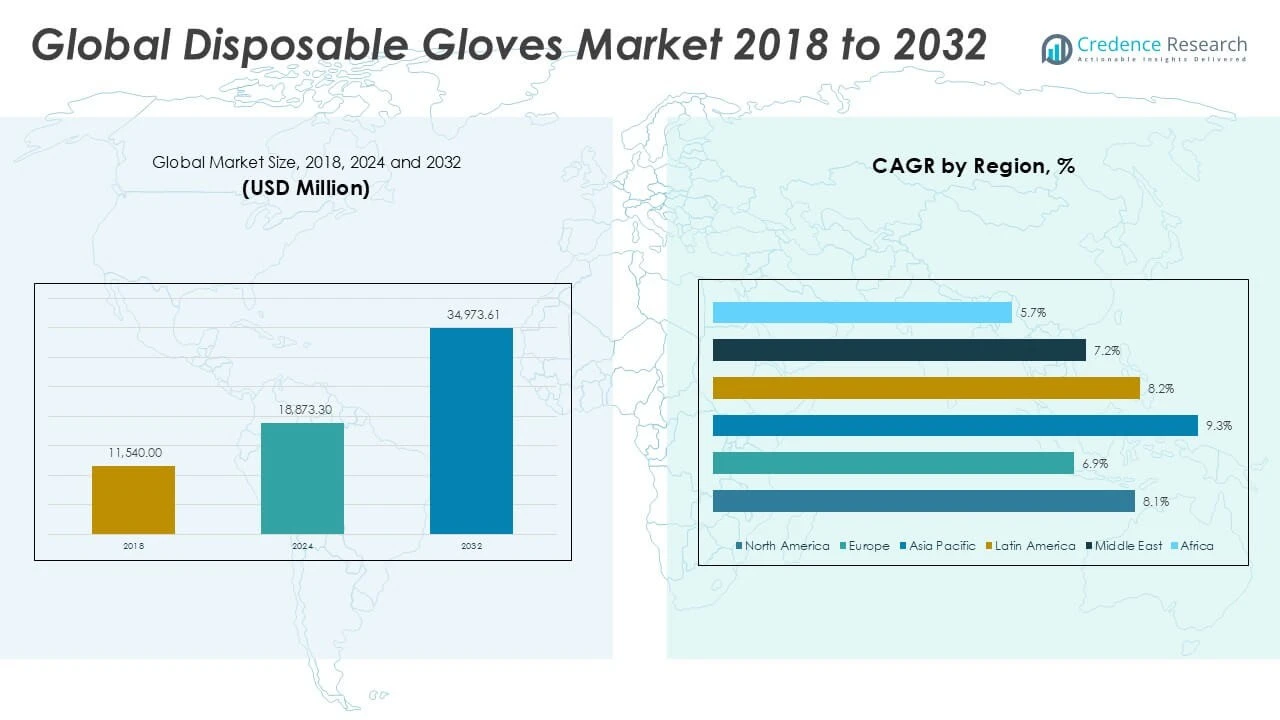
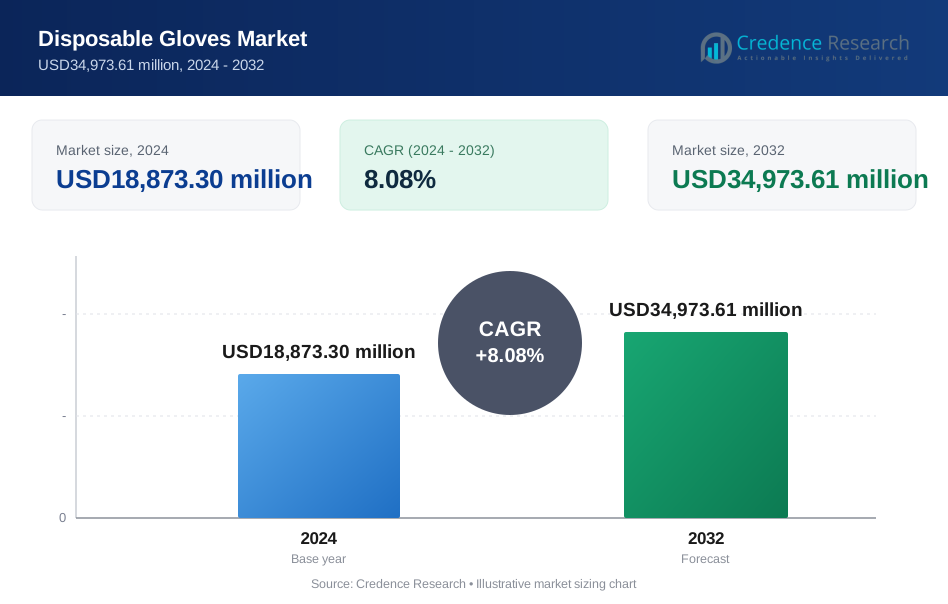
The Global Disposable Gloves Market is projected to grow from USD 18,873.30 million in 2024 to an estimated USD 34,973.61 million based on 2032, with a compound annual growth rate (CAGR) of 8.08% from 2025 to 2032.
| REPORT ATTRIBUTE | DETAILS |
|---|---|
| Historical Period | 2020-2023 |
| Base Year | 2024 |
| Forecast Period | 2025-2032 |
| Disposable Gloves Market Size 2024 | USD 18,873.30 million |
| Disposable Gloves Market, CAGR | 8.08% |
| Disposable Gloves Market Size 2032 | USD 34,973.61 million |
Key drivers of the market include growing concerns over cross-contamination and infection control, coupled with expanding applications in non-traditional sectors like retail and hospitality. The trend toward adopting eco-friendly and biodegradable glove variants is gaining momentum, driven by sustainability concerns and government regulations. Technological advancements in glove material innovation-such as nitrile and thermoplastic elastomers-are enhancing product performance, durability, and user comfort, thus expanding their application scope across industries.
Regionally, North America leads the global market due to stringent safety regulations and high healthcare awareness, followed closely by Europe. However, Asia Pacific is expected to witness the fastest growth during the forecast period, supported by growing industrialization, a rising elderly population, and an expanding healthcare infrastructure. Key players operating in the market include Ansell Limited, Top Glove Corporation Bhd, Hartalega Holdings Berhad, Kossan Rubber Industries Bhd, Supermax Corporation Berhad, Semperit AG Holding, and Kimberly-Clark Corporation.
Disposable Gloves Market Insights
- The Global Disposable Gloves Market is projected to grow from USD18,873.30 million in 2024 to USD34,973.61 million by 2032, registering a CAGR of 8.08% from 2025 to 2032.
- Rising awareness of hygiene and infection control across healthcare, food processing, and manufacturing sectors continues to drive glove consumption.
- Technological advancements in nitrile and thermoplastic elastomers are enhancing glove durability, comfort, and chemical resistance.
- Adoption of eco-friendly and biodegradable glove variants is gaining traction amid increasing environmental regulations and consumer preference.
- Fluctuations in raw material prices and supply chain disruptions challenge consistent production and profitability for manufacturers.
- North America dominates the market with a strong regulatory framework and high healthcare awareness, contributing 37.83% market share in 2024.
- Asia Pacific is the fastest-growing region, driven by industrial expansion, rising healthcare investments, and increasing glove production capacity.
Disposable Gloves Market Drivers
Rising Demand for Infection Control Across Healthcare and Non-Healthcare Settings
The Global Disposable Gloves Market is witnessing strong growth due to increasing concerns over hygiene and infection control. Hospitals, clinics, diagnostic centers, and laboratories continue to drive high-volume demand. Government mandates and institutional protocols enforce the use of gloves during patient care, diagnostics, and surgeries. The market also benefits from rising glove use in food processing, sanitation, retail, and personal services. Employers across various sectors focus on protecting workers from exposure to harmful pathogens and chemicals. This broad adoption across industries establishes disposable gloves as a critical component of safety equipment.
- For instance, hospitals and clinics account for over 70% of total disposable glove consumption, driven by infection control measures.
Expansion of Healthcare Infrastructure and Global Health Awareness
Improved access to healthcare services, especially in emerging economies, supports demand growth in the Global Disposable Gloves Market. Governments and private entities are investing in new hospitals, diagnostic centers, and clinics. Health awareness campaigns and pandemic response programs have increased public understanding of personal protective equipment. It reflects in the consistent rise in glove consumption for both medical and general use. Aging populations in several countries further expand the healthcare sector’s needs. The market continues to gain momentum due to sustained attention to health preparedness.
- For instance, emerging economies have seen a 15-20% increase in hospital construction projects, boosting disposable glove consumption.
Material Innovation and Preference for High-Performance Alternatives
Technological advances in material science are reshaping the Global Disposable Gloves Market. Demand is shifting from latex to nitrile and vinyl due to allergy concerns and better chemical resistance. Manufacturers focus on developing gloves that balance strength, comfort, and sensitivity. Innovations like powder-free, textured grip, and thermoplastic elastomer gloves meet specialized user needs. High-performance variants gain favor in industries requiring superior barrier protection. It strengthens market competition and drives product differentiation.
Supportive Regulatory Frameworks and Occupational Safety Policies
Strict safety regulations support the Global Disposable Gloves Market across developed regions. Agencies such as OSHA, FDA, and EU bodies set clear standards for glove usage in healthcare and industry. Companies are required to comply with workplace safety guidelines, creating stable demand. Regulatory support helps eliminate low-quality imports and enforces supply chain quality. This regulatory structure creates a reliable operating environment for established players. It also encourages product certification and innovation in compliance-focused glove types.
Disposable Gloves Market Trends
Shift Toward Nitrile and Non-Latex Glove Alternatives
The Global Disposable Gloves Market is experiencing a clear shift from latex to nitrile and other synthetic materials. Nitrile gloves offer superior chemical resistance, durability, and a lower risk of allergic reactions. Industries such as healthcare, automotive, and food processing increasingly favor nitrile options over traditional latex. Manufacturers invest in expanding nitrile production capacity to meet rising demand. Vinyl and neoprene gloves also see moderate adoption in non-medical applications. It reflects a broader trend toward synthetic materials that offer both safety and user comfort.
- For instance, healthcare and industrial sectors account for over 75% of total nitrile glove consumption, reflecting their widespread adoption.
Growing Popularity of Eco-Friendly and Biodegradable Gloves
Sustainability concerns influence purchasing decisions in the Global Disposable Gloves Market. Organizations look for biodegradable or compostable glove options that reduce environmental impact. Manufacturers respond by developing gloves made from plant-based polymers and other sustainable materials. Regulatory pressure and corporate environmental targets further accelerate this shift. Brands that offer low-carbon, recyclable packaging and production transparency gain competitive advantage. It signals a long-term trend toward sustainable product portfolios in the PPE industry.
- For instance, manufacturers are introducing biodegradable nitrile gloves, aligning with eco-friendly practices and regulatory requirements.
Expansion of Glove Use in Non-Traditional Sectors
The Global Disposable Gloves Market is seeing broader adoption beyond healthcare. Demand from food delivery, hospitality, personal care, and e-commerce fulfillment has grown rapidly. Businesses use gloves to comply with safety standards and reassure customers. The pandemic influenced consumer expectations around hygiene in daily transactions. Companies across sectors are institutionalizing glove usage as part of their routine safety protocols. It diversifies the customer base and stabilizes demand across economic cycles
Advancements in Manufacturing and Automation Technology
Technological improvements are transforming glove manufacturing in the Global Disposable Gloves Market. High-speed automated production lines increase output and reduce labor dependency. Quality control technologies, such as AI-based inspection, improve product consistency. These advancements support scalable production without compromising safety or comfort. Automation also helps mitigate supply chain disruptions and cost fluctuations. It enables suppliers to meet global demand with greater efficiency and reliability.
Disposable Gloves Market Challenges
Volatility in Raw Material Prices and Supply Chain Disruptions
The Global Disposable Gloves Market faces significant challenges from fluctuations in raw material prices. Materials like nitrile, latex, and vinyl are subject to global supply variations, often influenced by geopolitical tensions, climate issues, and trade restrictions. These price shifts directly affect production costs and profit margins for manufacturers. The market also contends with logistical constraints and shipping delays, which disrupt timely delivery and inventory management. It creates uncertainty for end-users and distributors who rely on consistent glove availability. Manufacturers must continuously adjust sourcing strategies to maintain supply chain resilience.
- For instance, the COVID-19 pandemic led to a 40% increase in nitrile glove prices, driven by shortages and heightened demand in healthcare settings.
Environmental Waste and Disposal Regulations Intensify Pressure
Disposal of single-use gloves poses a growing challenge in the Global Disposable Gloves Market. The accumulation of non-biodegradable waste raises environmental concerns and invites stricter government oversight. Regulatory bodies are increasing pressure on manufacturers to innovate sustainable alternatives or comply with evolving waste management laws. It drives up R\&D and compliance costs, especially for companies relying on traditional production methods. Public criticism of plastic waste has led to demand for accountability in the supply chain. The industry must address environmental impact without compromising product performance or safety standards.
Disposable Gloves Market Opportunities
Rising Demand in Emerging Economies and Underserved Sectors
The Global Disposable Gloves Market holds strong growth potential in emerging economies with expanding healthcare systems. Countries in Asia, Latin America, and Africa are increasing investments in hospitals, diagnostic labs, and public health initiatives. These developments create sustained demand for disposable gloves in both medical and non-medical contexts. Underserved sectors such as agriculture, education, and municipal services are beginning to adopt protective gear standards. It opens new revenue channels for manufacturers targeting volume-based markets. Companies can strengthen their presence through regional partnerships, localized production, and affordable product lines.
Product Innovation and Sustainable Glove Solutions Create Competitive Advantage
Growing interest in biodegradable and eco-friendly products presents a significant opportunity for the Global Disposable Gloves Market. Manufacturers that invest in sustainable materials and low-waste production methods can appeal to environmentally conscious customers. Product innovation in texture, grip, and skin sensitivity enhances usability in precision-based industries. It allows companies to meet specific application needs and build brand loyalty. Advanced gloves for chemical resistance, touchscreen compatibility, and longer shelf life also attract specialized industries. These innovations support market expansion while aligning with evolving customer expectations and regulatory trends.
Market Segmentation Analysis
By Type
The Global Disposable Gloves Market is segmented into powdered and powder-free types. Powder-free gloves dominate the market due to growing concerns over allergic reactions and contamination risks associated with powdered variants. Healthcare regulations increasingly favor powder-free options, encouraging widespread adoption. These gloves offer better tactile sensitivity and are suitable for sterile environments, which boosts their usage in medical and food industries. Powdered gloves, while still used in certain industrial applications for ease of donning, are gradually losing market share. It reflects a clear preference shift toward safer and cleaner alternatives.
By Material
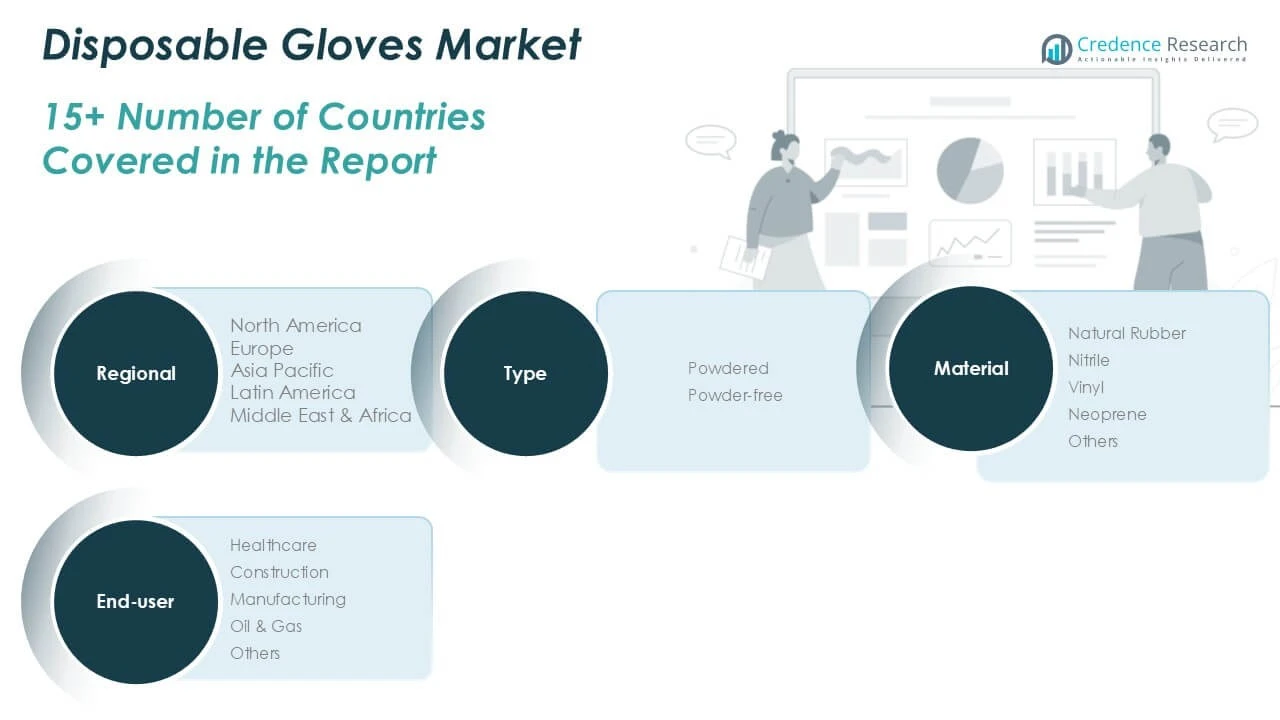
Based on material, the Global Disposable Gloves Market includes natural rubber, nitrile, vinyl, neoprene, and others. Nitrile gloves account for a significant share due to their strong chemical resistance, puncture durability, and allergy-free properties. Natural rubber gloves remain widely used in medical and general-purpose applications due to their flexibility and cost-effectiveness. Vinyl gloves serve as a budget-friendly option for low-risk environments, while neoprene gloves offer chemical resistance and strength for specialized use. It continues to evolve with innovations in biodegradable and synthetic blends that meet performance and environmental standards.
By End-User
End-user segmentation of the Global Disposable Gloves Market covers healthcare, construction, manufacturing, oil & gas, and others. Healthcare leads the market due to strict hygiene standards and routine glove usage across hospitals and clinics. The manufacturing and construction sectors adopt gloves for worker protection against chemicals, sharp objects, and machinery. Oil & gas applications require gloves with high durability and chemical resistance. It sees rising demand across broader end-user categories, including food services, cleaning, and public safety sectors, where protective gear is becoming standard protocol.
Segments
Based on Type
- Powdered
- Powder-free
Based on Material
- Natural Rubber
- Nitrile
- Vinyl
- Neoprene
- Others
Based on End-user
- Healthcare
- Construction
- Manufacturing
- Oil & Gas
- Others
Based on Region
- North America
- U.S.
- Canada
- Mexico
- Europe
- UK
- France
- Germany
- Italy
- Spain
- Russia
- Belgium
- Netherlands
- Austria
- Sweden
- Poland
- Denmark
- Switzerland
- Rest of Europe
- Asia Pacific
- China
- Japan
- South Korea
- India
- Australia
- Thailand
- Indonesia
- Vietnam
- Malaysia
- Philippines
- Taiwan
- Rest of Asia Pacific
- Latin America
- Brazil
- Argentina
- Peru
- Chile
- Colombia
- Rest of Latin America
- Middle East
- UAE
- KSA
- Israel
- Turkey
- Iran
- Rest of Middle East
- Africa
- Egypt
- Nigeria
- Algeria
- Morocco
- Rest of Africa
Regional Analysis
North America Disposable Gloves Market
North America held the largest share of the Global Disposable Gloves Market in 2024, accounting for USD 7,140.29 million, and is projected to reach USD 13,266.54 million by 2032, registering a CAGR of 8.1%. It contributed 37.83% of the global market share in 2024. The strong presence of leading manufacturers, high healthcare spending, and strict regulatory standards continue to drive market growth. Widespread use in hospitals, laboratories, and industrial workplaces sustains steady demand. Government initiatives around occupational safety and infection control increase glove usage across multiple sectors. It remains a mature yet expanding market due to innovations and growing non-medical applications.
Europe Disposable Gloves Market
Europe accounted for USD 3,842.63 million in 2024 and is expected to reach USD 6,543.62 million by 2032, at a CAGR of 6.9%, capturing 20.37% of the global market share in 2024. The region benefits from well-established healthcare infrastructure and stringent safety protocols in industries such as food processing and pharmaceuticals. Demand continues to rise in elderly care facilities and outpatient services. Environmental regulations encourage the shift toward sustainable and biodegradable glove alternatives. It maintains strong demand for powder-free and nitrile gloves due to allergy concerns and regulatory mandates.
Asia Pacific Disposable Gloves Market
Asia Pacific reached USD 4,969.66 million in 2024 and is projected to grow to USD 10,067.25 million by 2032, the fastest CAGR of 9.3%, representing 26.32% of the global market share in 2024. Rapid industrialization, urban healthcare expansion, and rising awareness about hygiene drive strong growth. Countries like China, India, and Japan are increasing investments in public health and medical infrastructure. Local manufacturing capacity is also expanding, supported by cost advantages. It emerges as a vital production and consumption hub for disposable gloves.
Latin America Disposable Gloves Market
Latin America contributed USD 1,178.17 million in 2024 and is estimated to grow to USD 2,202.92 million by 2032, with a CAGR of 8.2%, holding 6.25% of the global market share in 2024. Increasing healthcare access, improving hospital networks, and occupational safety programs in industries such as agriculture and mining support market expansion. Governments and NGOs promote hygiene practices in community health outreach. It presents opportunities for mid-tier manufacturers focusing on affordable and reliable glove options.
Middle East Disposable Gloves Market
The Middle East recorded a market value of USD 912.87 million in 2024 and is set to reach USD 1,577.75 million by 2032, with a CAGR of 7.2%, accounting for 4.84% of the global market share in 2024. Rising investments in healthcare infrastructure and infection control protocols enhance demand. Disposable gloves find increasing use in food services, oil & gas, and clinical labs across the Gulf Cooperation Council (GCC) countries. It maintains steady growth through import reliance and increasing private healthcare adoption.
Africa Disposable Gloves Market
Africa was valued at USD 829.67 million in 2024 and is forecast to reach USD 1,315.54 million by 2032, with a CAGR of 5.7%, making up 4.4% of the global market share in 2024. Glove usage is expanding in public hospitals, rural clinics, and emergency relief operations. Market development is influenced by international aid programs and non-profit health initiatives. Local distribution networks are evolving to meet growing demand. It holds long-term potential as healthcare systems strengthen across the continent
Key players
- Ansell Ltd
- Top Glove Corporation Bhd
- Hartalega Holdings Berhad
- Supermax Corporation Berhad
- Kossan Rubber Industries Bhd
- Ammex Corporation
- Kimberly-Clark Corporation
- Sempermed USA, Inc
- MCR Safety
Competitive Analysis
The Global Disposable Gloves Market is highly competitive, driven by innovation, capacity expansion, and product differentiation. Leading players like Ansell Ltd, Top Glove Corporation, and Hartalega Holdings focus on broad product portfolios and global distribution networks. These companies invest in sustainable materials, advanced manufacturing, and cost optimization to secure long-term contracts and retain customer loyalty. Mid-sized firms such as Ammex Corporation and MCR Safety serve niche industrial segments with targeted offerings. The market sees continuous entry of regional suppliers who compete on price, creating pressure on established players to maintain quality and brand value. It evolves through mergers, facility upgrades, and R\&D for latex alternatives.
Recent Developments
- In May 2025, Kossan Rubber Industries Bhd posted a 13.3% profit increase in Q1, driven by automation and digitization improvements.
- In January 2025, Ammex Corporation forecasted upward trends in glove prices, citing production optimization and raw material uncertainties.
- In April 2025, Sempermed USA, Inc. rebranded to Harps USA, Inc., signaling a strategic shift in operations.
- In 2025, MCR Safety released its 2025 New Product Guide, introducing innovative disposable gloves with improved protection and comfort.
Market Concentration and Characteristics
The Global Automotive Plastics Market features a moderately concentrated structure, with a mix of multinational corporations and regional manufacturers competing across value chains. Leading players focus on material innovation, lightweighting solutions, and integration of recyclable plastics to meet fuel efficiency and emission standards. It remains highly cost-sensitive, with pricing influenced by raw material volatility and regulatory compliance. Product differentiation and strategic collaborations with automakers drive competitive advantage. The market exhibits high entry barriers due to capital-intensive production and stringent quality standards. It continues to evolve through advancements in polymer composites and increased adoption in electric and hybrid vehicles.
Report Coverage
The research report offers an in-depth analysis based on Type, Material, End-user and Region. It details leading market players, providing an overview of their business, product offerings, investments, revenue streams, and key applications. Additionally, the report includes insights into the competitive environment, SWOT analysis, current market trends, as well as the primary drivers and constraints. Furthermore, it discusses various factors that have driven market expansion in recent years. The report also explores market dynamics, regulatory scenarios, and technological advancements that are shaping the industry. It assesses the impact of external factors and global economic changes on market growth. Lastly, it provides strategic recommendations for new entrants and established companies to navigate the complexities of the market.
Future Outlook
- The Global Automotive Plastics Market will continue to grow steadily, driven by rising demand for lightweight materials to improve fuel efficiency and reduce emissions. Automakers will increasingly replace traditional metal parts with high-performance plastic components.
- Advancements in polymer technology will enable the development of stronger, more heat-resistant plastics suitable for engine and structural applications. These materials will expand the role of plastics in both internal combustion and electric vehicles.
- Regulatory pressures aimed at sustainability will accelerate the adoption of recyclable and bio-based plastics. Manufacturers will invest in circular economy models and closed-loop recycling systems to meet environmental targets.
- Electric vehicle (EV) production will significantly influence the automotive plastics market. Lightweight plastics will be essential for battery casings, interior components, and thermal management systems in EVs.
- The growing trend of vehicle electrification and connectivity will drive demand for plastics that support complex sensor integration and durable electronic housings. Material suppliers will focus on insulation and EMI shielding properties.
- Asia Pacific will maintain its dominance in production and consumption, supported by strong automotive manufacturing bases in China, India, Japan, and South Korea. Regional investments in infrastructure and technology will boost plastic component demand.
- North America and Europe will see increased adoption of advanced engineering plastics in luxury and high-performance vehicles. OEMs in these regions will collaborate with suppliers to develop customized polymer solutions.
- Interior aesthetics and comfort will continue to drive innovation in soft-touch, noise-reducing, and UV-resistant plastic grades. Consumers will expect premium finishes with sustainable material sourcing.
- The integration of 3D printing and digital manufacturing in automotive design will promote the use of thermoplastics for prototyping and low-volume production. It will enhance design flexibility and reduce lead times.
- The market will witness consolidation through mergers and acquisitions, as large chemical and plastic manufacturers aim to strengthen their automotive product lines. Strategic partnerships with automotive OEMs will define future growth and innovation paths.
Request a Free Sample
Fill in your details and we'll send you a free sample report.
- Sample data tables & charts
- Research methodology
Need a Custom Version of This Report?
Tailor the scope, geography, or segments to your exact requirements.
- Custom geography or segment scope
- Direct access to our analyst team
Frequently Asked Questions
What was the market size of the disposable gloves industry in 2023, and what is it projected to reach by 2032?
What factors are driving the growth of the disposable gloves market?
What types of disposable gloves are gaining popularity?
Who are the major players in this market?
Table of Content
Chapter 1. Report Introduction
- 1.1 Report Description & Purpose
- 1.1.1 Report Title & Market Definition
- 1.1.2 Unique Selling Propositions (USP) & Key Differentiators
- 1.1.3 Value Proposition for Stakeholders
- 1.2 Research Objectives
- 1.2.1 Market Sizing Objectives (Volume & Revenue) (Volume Where Applicable)
- 1.2.2 Segmentation Objectives
- 1.2.3 Competitive Intelligence Objectives
- 1.2.4 Forecast & Scenario Objectives
- 1.3 Report Scope
- 1.3.1 Disposable Gloves Scope – Segments & Subsegments Covered
- 1.3.2 Geographic Scope – Regions & Countries Covered
- 1.3.3 Historical Period, Base Year & Forecast Period (2024; forecast to 2032)
- 1.3.4 Inclusions & Exclusions
- 1.4 Industry Classification & Applicable Codes
- 1.5 Currency, Measurement Units & Valuation Basis
- 1.6 Target Stakeholders
- 1.7 Limitations & Assumptions
Chapter 2. Executive Summary
- 2.1 Global Disposable Gloves Market Snapshot
- 2.1.1 Market Size – Historical (2024) & Forecast (2024-2032) (2024: USD18,873.30 million → 2032: USD34,973.61 million)
- 2.1.2 Volume & Revenue – Global Totals (Volume Where Applicable)
- 2.1.3 Key Market Highlights – Top Five Facts
- 2.2 Disposable Gloves Market Segmentation Snapshot
- 2.2.1 Market Split by Region – 2024 vs. 2032
- 2.3 Competitive Snapshot
- 2.3.1 Top 10 Players by Revenue Share – 2024
- 2.3.2 Top 10 Players by Volume Share – 2024 (Volume Where Applicable)
- 2.3.3 Recent Strategic Developments (18-Month Summary)
- 2.4 Key Investment Highlights & Strategic Conclusions
Chapter 3. Disposable Gloves Market Dynamics & Industry Analysis
- 3.1 Market Overview & Context
- 3.1.1 Disposable Gloves Market Position in the Broader Industry Value Chain
- 3.1.2 Demand Structure & Purchasing Dynamics
- 3.1.3 Market Maturity & Development Stage by Region
- 3.2 Disposable Gloves Market Drivers
- 3.3 Disposable Gloves Market Restraints & Challenges
- 3.4 Disposable Gloves Market Opportunities
- 3.5 Porter's Five Forces Analysis
- 3.5.1 Threat of New Entrants
- 3.5.2 Bargaining Power of Suppliers
- 3.5.3 Bargaining Power of Buyers
- 3.5.4 Threat of Substitutes
- 3.5.5 Competitive Rivalry – Intensity Assessment
- 3.6 Disposable Gloves Value Chain Analysis
- 3.6.1 Upstream – Key Inputs, Resources & Suppliers
- 3.6.1.1 Key Input/Resource 1
- 3.6.1.2 Key Input/Resource 2
- 3.6.1.3 Key Input/Resource 3
- 3.6.2 Midstream – Core Operations & Value Creation
- 3.6.2.1 Operating Model & Process Overview
- 3.6.2.2 Key Operating Locations & Capabilities by Company
- 3.6.3 Downstream – Market Channels & End Users
- 3.6.3.1 Direct Sales & Customer Engagement Channels
- 3.6.3.2 Indirect Sales, Intermediaries & Partner Channels
- 3.6.4 Value Chain Profitability Analysis
- 3.6.1 Upstream – Key Inputs, Resources & Suppliers
- 3.7 PESTEL Analysis
- 3.7.1 Political Factors
- 3.7.2 Economic Factors
- 3.7.3 Social Factors
- 3.7.4 Technological Factors
- 3.7.5 Environmental Factors
- 3.7.6 Legal Factors
- 3.8 Disposable Gloves Supply Chain Analysis
- 3.8.1 Critical Input & Resource Availability Risk Assessment
- 3.8.2 Supplier & Operational Concentration Risk (Geographic Exposure)
- 3.8.3 Supply & Service Disruption Impact Analysis
- 3.9 Regulatory & Policy Landscape
Note: The regulatory and policy landscape section covers regulations based on their applicability to the market, Disposable Gloves category, geography, and scope of the study. Only regulatory frameworks with a material impact on operations, compliance, trade, sustainability, or market access are analyzed in detail.
Chapter 4. Key Investment Pockets & Opportunity Analysis
- 4.1 Disposable Gloves Market Attractiveness Analysis
- 4.1.1 By Region – Investment Attractiveness Matrix (Market Size × CAGR)
- 4.2 Absolute Revenue Growth Opportunity
- 4.2.1 By Region – Absolute Revenue Growth Through 2032
- 4.3 Incremental Demand Opportunity
- 4.3.1 By Region – Incremental Demand Through 2032
- 4.3.2 Segment – Incremental Demand
- 4.4 Emerging Submarket Opportunity Deep Dive (Subject to Applicability)
- 4.5 Priority Market Opportunity Scorecards
- 4.5.1 United States
- 4.5.2 Europe
- 4.5.3 Asia
- 4.5.4 Middle East & Africa
Note: Priority market opportunity scorecards reflect the geographic scope and strategic relevance of the study. Listed markets are indicative and may be adapted to the industry.
Chapter 5. Disposable Gloves Cross-Border Trade & Market Access Analysis
- 5.1 International Trade & Cross-Border Activity Overview
- 5.1.1 Global Export Value by Country (2024)
- 5.1.2 Global Export Volume by Country (2024) (Volume Where Applicable)
- 5.1.3 Global Import Value by Country (2024)
- 5.1.4 Global Import Volume by Country (2024) (Volume Where Applicable)
- 5.1.5 Net Trade Balance by Country (2024)
- 5.2 Export Analysis – Segment
- 5.2.1 Category 1 (Applicable Classification Code)
- 5.2.2 Category 2 (Applicable Classification Code)
- 5.2.3 Category 3 (Applicable Classification Code)
- 5.2.4 Category 4 (Applicable Classification Code)
- 5.2.5 Category 5 (Applicable Classification Code)
- 5.3 Import Analysis – Segment
- 5.3.1 Category 1 (Applicable Classification Code)
- 5.3.2 Category 2 (Applicable Classification Code)
- 5.3.3 Category 3 (Applicable Classification Code)
- 5.3.4 Category 4 (Applicable Classification Code)
- 5.3.5 Category 5 (Applicable Classification Code)
- 5.4 Cross-Border Pricing & Transaction Benchmarks
- 5.4.1 Export Pricing – Segment & Country
- 5.4.2 Import Pricing – Segment & Source Country
- 5.4.3 Price Trends (2024)
- 5.5 Key Cross-Border Trade & Delivery Routes
- 5.5.1 Cross-Border Trade/Delivery Route 1
- 5.5.2 Cross-Border Trade/Delivery Route 2
- 5.5.3 Cross-Border Trade/Delivery Route 3
- 5.5.4 Cross-Border Trade/Delivery Route 4
- 5.5.5 Cross-Border Trade/Delivery Route 5
- 5.6 Trade Policy & Market Access Impact Assessment
- 5.6.1 Tariff & Non-Tariff Barriers
- 5.6.2 Regional Trade & Economic Integration Frameworks
- 5.6.3 Bilateral & Multilateral Trade Agreements
- 5.6.4 Cross-Border Operating, Licensing & Localization Requirements
Note: This chapter applies where cross-border trade or delivery is relevant to Disposable Gloves. Goods, services, and digital offerings are assessed using applicable classifications and transaction measures. Import-export volumes, trade balances, and route analyses are included only where meaningful to the market.
Chapter 6. Competitive Landscape & Company Benchmarking
- 6.1 Disposable Gloves Market Concentration & Structure
- 6.1.1 Herfindahl-Hirschman Index (HHI) – vs. 2024
- 6.1.2 Leading, Mid-Sized & Emerging Player Structure
- 6.1.3 Global, Regional & Local Player Dynamics
- 6.2 Disposable Gloves Market Share Analysis – 2024
- 6.2.1 Global Revenue Share by Company
- 6.2.2 Global Volume Share by Company (Volume Where Applicable)
- 6.2.3 Regional Revenue Share
- 6.2.4 Market Share Evolution ( vs. 2024)
- 6.2.5 Company Market Share by Key Segment
- 6.2.6 Company Market Share by Customer Group
- 6.3 Operating Scale, Capacity & Infrastructure Analysis
- 6.3.1 Global Operating Scale & Supply Capacity
- 6.3.2 Resource Utilization & Operating Efficiency
- 6.3.3 Output, Service Delivery & Activity Metrics
- 6.3.4 Operating Footprint & Infrastructure Map
- 6.3.5 Planned Operational & Capacity Expansion
- 6.4 Disposable Gloves Competitive Benchmarking Matrix
- 6.4.1 Revenue, Growth, Profitability & Operating Metric Comparison
- 6.4.2 Channel Revenue Mix
- 6.4.3 Geographic Revenue Exposure
- 6.4.4 R&D Intensity
- 6.4.5 Sustainability Maturity
- 6.5 Strategic Developments in Disposable Gloves (Last 24 Months)
- 6.5.1 Mergers, Acquisitions & Divestments
- 6.5.2 New Products, Services & Solutions in Disposable Gloves
- 6.5.3 Operational & Infrastructure Expansions
- 6.5.4 Strategic Alliances, Joint Ventures & Partnerships
- 6.5.5 Distribution Expansion & Market Entry
- 6.5.6 Sustainability & ESG Initiatives
- 6.6 Competitive Strategy Mapping
- 6.6.1 Leader, Challenger, Follower & Niche Classification
- 6.6.2 Pricing Strategy Comparison
- 6.6.3 Channel Strategy Matrix
Note: Strategic developments are included based on their materiality and the availability of reliable information.
Chapter 7. Global Disposable Gloves Market – By Sales & Delivery Channel
- 7.1 Segment Overview
- 7.1.1 Volume & Revenue Split by Channel (2024 & 2032) (Volume Where Applicable)
- 7.1.2 Channel Mix Evolution (2024-2032)
Chapter 8. Regional Market Analysis – Global Overview
- 8.1 Global Regional Overview
- 8.1.1 Regional Volume Share (Volume Where Applicable)
- 8.1.2 Regional Revenue Share
- 8.1.3 Regional Volume by Region (Volume Where Applicable)
- 8.1.4 Regional Revenue by Region
- 8.1.5 Regional Forecast Through 2032
- 8.2 Cross-Regional Segment Analysis
- 8.2.1 By Sales & Delivery Channel
- 8.2.2 By Competitive Positioning & Price Tier
Chapter 9. North America Disposable Gloves Market
- 9.1 United States
- 9.2 Canada
- 9.3 Mexico
Chapter 10. Europe Disposable Gloves Market
- 10.1 Germany
- 10.2 France
- 10.3 Italy
- 10.4 United Kingdom
- 10.5 Spain
- 10.6 Poland
- 10.7 Russia
- 10.8 Netherlands
- 10.9 Belgium
- 10.10 Sweden
- 10.11 Denmark
- 10.12 Norway
- 10.13 Rest of Europe
Chapter 11. Asia Pacific Disposable Gloves Market
- 11.1 China
- 11.2 India
- 11.3 Japan
- 11.4 South Korea
- 11.5 Thailand
- 11.6 Indonesia
- 11.7 Vietnam
- 11.8 Malaysia
- 11.9 Australia
- 11.10 Rest of Asia Pacific
Chapter 12. Latin America Disposable Gloves Market
- 12.1 Brazil
- 12.2 Argentina
- 12.3 Colombia
- 12.4 Chile
- 12.5 Rest of Latin America
Chapter 13. Middle East Disposable Gloves Market
- 13.1 Saudi Arabia
- 13.2 United Arab Emirates
- 13.3 Turkey
- 13.4 Israel
- 13.5 Iran
- 13.6 Rest of the Middle East
Chapter 14. Africa Disposable Gloves Market
- 14.1 South Africa
- 14.2 Egypt
- 14.3 Nigeria
- 14.4 Morocco
- 14.5 Rest of Africa
Chapter 15. Disposable Gloves Company Profiles
- 15.1 [Company 01]
- 15.1.1 Company Overview
- 15.1.2 Key Management Personnel
- 15.1.3 Products & Services Portfolio
- 15.1.4 Financial Performance
- 15.1.5 Key Market Focus & Geographic Presence
- 15.1.6 Recent Developments & Strategic Initiatives
Note: The company profile list is preliminary and may change based on research findings, market developments, data availability, and client requirements.
Chapter 16. Appendices
- Appendix A – List of Abbreviations & Acronyms
- Appendix B – Industry Classification Code Reference – Full Series
- Appendix C – Supply, Output & Operating Capacity Data Tables
- Appendix D – End-Use & Demand Base Tables
- Appendix E – Demand, Adoption & Usage Assumptions
- Appendix F – Pricing & Revenue Metric Reference Tables
- Appendix G – Company Operations & Infrastructure Database
- Appendix H – Cross-Border Trade & Activity Data Tables (Where Applicable)
- Appendix I – Regulatory Summary Tables
- Appendix J – Primary Research Participant List (Anonymized)
- Appendix K – Primary Research Questionnaire Framework
- Appendix L – Data Sources & Bibliography
- Appendix M – Market Size Divergence & Source Comparison
Chapter 17. Research Methodology
- 17.1 Research Framework & Philosophy
- 17.2 Secondary Research – Sources, Hierarchy & Data Extraction
- 17.3 Data Modeling – Bottom-Up & Top-Down Market Sizing
- 17.4 Primary Research – Stakeholder Framework, LOI & Sample Sizes
- 17.5 Forecast Methodology – Regression, Scenario & Sensitivity Analysis
- 17.6 Quality Control – Four-Layer Validation Framework
- 17.7 Limitations & Standard Assumptions
- 17.8 Disclaimer
