
Elastomeric Infusion Pumps Market Overview:
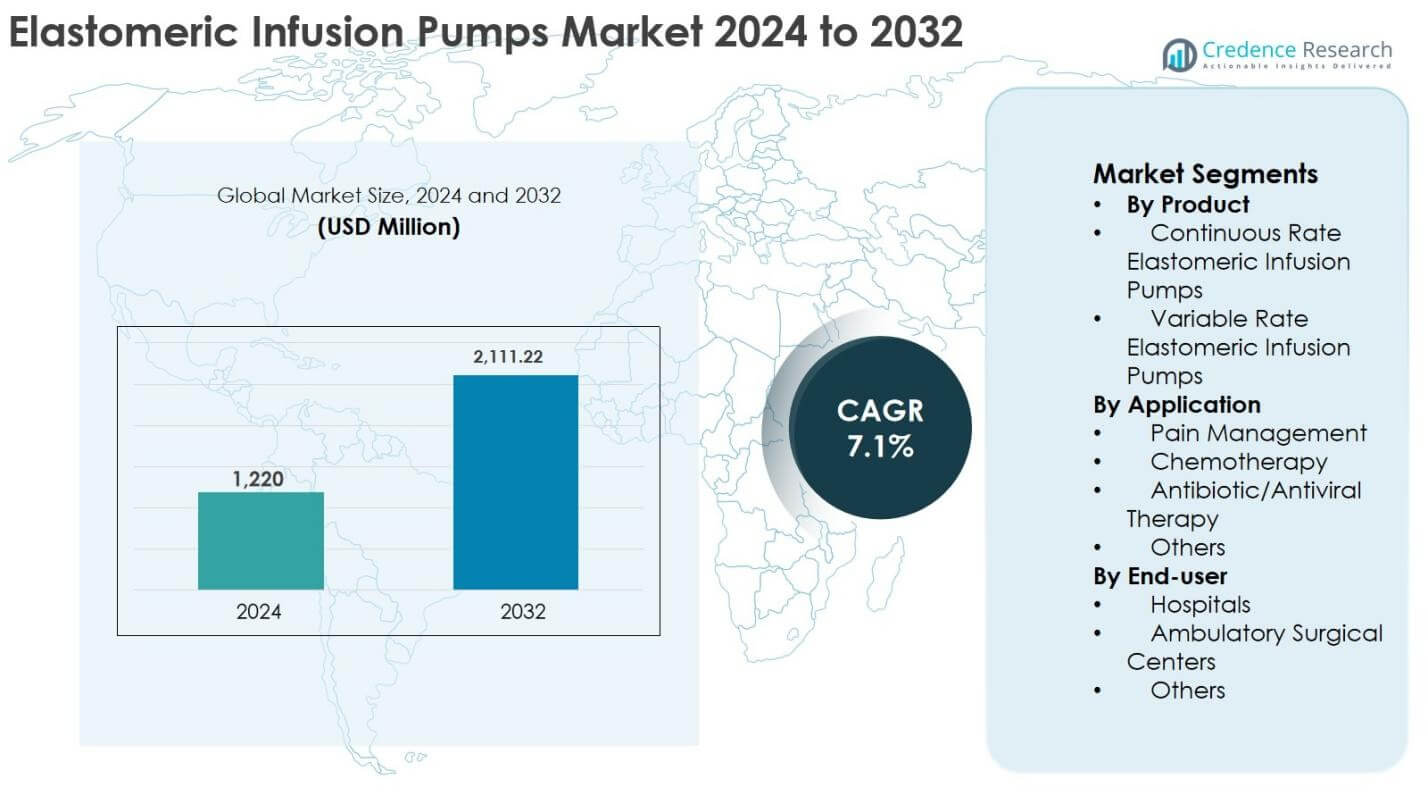
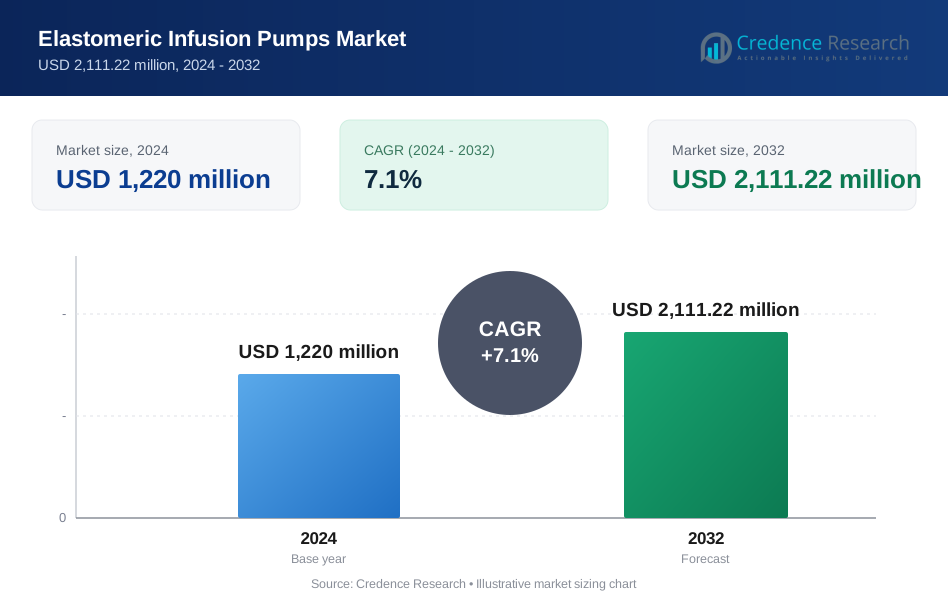
Elastomeric Infusion Pumps market size was valued at USD 1,220 million in 2024 and is anticipated to reach USD 2,111.22 million by 2032, registering a CAGR of 7.1% during the forecast period.
| REPORT ATTRIBUTE | DETAILS |
|---|---|
| Historical Period | 2020-2023 |
| Base Year | 2024 |
| Forecast Period | 2025-2032 |
| Elastomeric Infusion Pumps Market Size 2024 | USD 1,220 million |
| Elastomeric Infusion Pumps Market, CAGR | 7.1% |
| Elastomeric Infusion Pumps Market Size 2032 | USD 2,111.22 million |
Elastomeric Infusion Pumps market is characterized by the strong presence of established global medical device manufacturers focusing on disposable infusion technologies, outpatient care, and therapy-specific solutions. Leading players such as Baxter, Fresenius Kabi AG, B. Braun SE, Terumo Corporation, Smiths Group plc, Vygon Group, NIPRO, and Ambu A/S compete through portfolio expansion, product reliability, and geographic reach. North America emerged as the leading region, accounting for 38.6% market share in 2024, supported by advanced healthcare infrastructure and high adoption of ambulatory infusion therapy, followed by Europe with 27.4% share, driven by strong outpatient care models and infection-control practices.
Physical demand drivers remain rooted in clinical transitions from inpatient intravenous protocols to decentralized ambulatory and home-care settings. In 2024, active global manufacturing capacity stood at approximately 45.36 million units annually, concentrated primarily within specialized medical silicone molding and automated assembly facilities in North America, Western Europe, and East Asia. Global capacity utilization averaged 81.5% in 2024, reflecting tight supply-demand dynamics in premium-grade elastomer reservoirs and micro-capillary flow restrictor tubing.
Unit economics highlight a stable pricing structure. The global blended Average Selling Price (ASP) for standard single-use elastomeric infusion pumps stood at USD 33.00 per unit in 2024. By 2032, blended ASP is projected to rise modestly to USD 34.51 per unit, driven by material enhancements such as dual-layer polyisoprene bladders, UV-blocking outer shells, and integrated check-valve geometries that reduce dosage delivery tolerance variance from 15% down to under 8%.
Elastomeric Infusion Pumps Market Insights
- Elastomeric Infusion Pumps market was valued at USD 1,220 million in 2024 and is projected to reach USD 2,111.22 million by 2032, expanding at a CAGR of 7.1% during the forecast period.
- Market growth is driven by rising demand for ambulatory and home-based infusion therapy, increasing surgical procedures, and growing adoption of continuous pain management solutions, with continuous rate pumps holding around 64.5% segment share in 2024 due to dosing reliability and ease of use.
- Key market trends include a shift toward disposable and single-use infusion devices and increasing use in outpatient chemotherapy and antibiotic therapy, with pain management accounting for approximately 46.8% application share supported by high post-operative demand.
- The market is moderately consolidated, with leading players such as Baxter, Fresenius Kabi AG, B. Braun SE, Terumo Corporation, Smiths Group plc, NIPRO, Vygon Group, and Ambu A/S focusing on product innovation, flow-rate accuracy, and expansion in homecare settings.
- Regionally, North America led with 38.6% market share, followed by Europe at 27.4% and Asia Pacific at 22.1%, while Latin America and the Middle East & Africa together accounted for the remaining share, supported by improving healthcare infrastructure.
Elastomeric Infusion Pumps Market Segmentation Analysis:
By Product
In the Elastomeric Infusion Pumps market, continuous rate elastomeric infusion pumps dominated the product segment, accounting for approximately 64.5% market share in 2024. Their leadership is driven by consistent drug delivery, reduced risk of dosing errors, and wide adoption in long-duration therapies such as post-operative pain management and antibiotic infusion. These pumps offer simplicity, reliability, and minimal need for patient intervention, making them preferred in both inpatient and outpatient settings. Variable rate elastomeric infusion pumps are gaining traction due to dosing flexibility; however, higher costs and operational complexity continue to limit their broader adoption.
- For instance, Baxter’s Homepump C‑Series elastomeric pumps are widely used for outpatient antibiotic and chemotherapy infusions, providing fixed-rate delivery over 24–72 hours as documented in hospital outpatient protocols and product inserts.
By Application
Pain management emerged as the dominant application segment, capturing around 46.8% of the Elastomeric Infusion Pumps market share in 2024. This dominance is supported by rising surgical volumes, increasing prevalence of chronic pain conditions, and strong demand for ambulatory pain control solutions. Elastomeric pumps enable continuous analgesic delivery without electronic components, enhancing patient mobility and compliance. Chemotherapy and antibiotic/antiviral therapy segments are expanding steadily, driven by the shift toward home-based infusion care and growing infectious disease burden, though they currently trail pain management in overall usage volumes.
- For instance, Baxter’s elastomeric Homepump and B. Braun’s Easypump systems are routinely used in post-operative peripheral nerve block infusions to provide continuous local anesthetic delivery for 48–72 hours, reducing inpatient length of stay as reported in ambulatory surgery programs.
By End-user
Hospitals represented the largest end-user segment, holding nearly 52.3% market share in 2024, supported by high procedural volumes, advanced infusion infrastructure, and strong preference for reliable single-use infusion devices. Hospitals favor elastomeric pumps for post-surgical analgesia and oncology treatments due to their ease of use and low maintenance. Ambulatory surgical centers are witnessing faster growth, driven by the rise in outpatient surgeries and cost-containment initiatives. However, hospitals continue to dominate due to complex case management and higher adoption across multiple therapeutic applications.
Hospitals held the majority distribution in 2024 at 19.34 million units (52.3% volume share) valued at USD 638.06 million. However, Ambulatory Surgical Centers (ASCs) represent the fastest-growing end-user group, expanding from 11.87 million units in 2024 to 23.37 million units by 2032 at an 8.83% volume CAGR. This transition aligns with same-day orthopedic and general surgery initiatives that discharge patients directly with portable elastomeric nerve block kits.Key Growth Drivers
Rising Demand for Ambulatory and Home-Based Infusion Therapy
The Elastomeric Infusion Pumps market is strongly driven by the increasing shift toward ambulatory and home-based infusion therapy, supported by healthcare cost-containment strategies and patient-centric care models. These pumps enable continuous drug delivery without electronic components, making them well suited for outpatient pain management, chemotherapy, and antibiotic therapies. Early hospital discharge trends and reduced inpatient stays are accelerating adoption across developed and emerging markets. In addition, aging populations and the growing prevalence of chronic diseases require long-term infusion support that is portable and easy to use. Elastomeric pumps enhance patient mobility, lower hospital resource utilization, and reduce overall treatment costs, supporting sustained market expansion.
- For instance, B. Braun’s Easypump systems are deployed in hospital outpatient and day-care settings to support continuous local anesthetic and oncology infusions, helping facilities avoid capital investment in electronic ambulatory pumps.
Increasing Surgical Procedures and Pain Management Needs
The rising volume of surgical procedures globally represents a major growth driver for the Elastomeric Infusion Pumps market. Effective post-operative pain management is critical to recovery, and elastomeric pumps provide continuous, controlled analgesic delivery with minimal clinical intervention. Their disposable design lowers infection risk and reduces medication errors compared to reusable electronic systems. Growth in orthopedic, general, and minimally invasive surgeries further strengthens demand, particularly in hospitals and ambulatory surgical centers. Moreover, increased adoption of enhanced recovery after surgery protocols is encouraging consistent use of elastomeric pumps, reinforcing their importance in perioperative pain management.
- For instance, Baxter's Infusor LV5 elastomeric pumps, set at 5 mL/h, were evaluated in 430 orthopedic surgery cases, delivering reliable perineural analgesia despite flow variations in 34-47% of devices outside the manufacturer's ±15% target.
Expansion of Oncology and Anti-Infective Therapies
The increasing incidence of cancer and infectious diseases is driving demand for elastomeric infusion pumps in chemotherapy and antibiotic or antiviral therapy. These devices support extended drug infusion while allowing patients to remain mobile and outside hospital settings. Oncology care is increasingly shifting toward outpatient and home-based chemotherapy, where elastomeric pumps offer convenience and reduced dependency on clinical infrastructure. Similarly, long-term antibiotic therapy benefits from simplified infusion solutions that minimize hospital visits. As healthcare systems emphasize efficiency, patient comfort, and continuity of care, elastomeric pumps are becoming integral to advanced therapeutic delivery models.
Key Trends & Opportunities
Shift Toward Single-Use and Disposable Infusion Devices
A key trend in the Elastomeric Infusion Pumps market is the growing preference for single-use and disposable infusion devices. Healthcare providers are prioritizing infection control, workflow efficiency, and regulatory compliance, all of which favor disposable systems. Elastomeric pumps eliminate the need for cleaning, calibration, and maintenance, reducing operational burden and contamination risk. This trend creates opportunities for manufacturers to develop cost-effective, prefilled, and therapy-specific pump solutions. The expansion of outpatient care and home infusion services further supports demand for ready-to-use disposable devices, strengthening long-term market opportunities.
- For instance, a UK NHS feasibility study using prefilled elastomeric pumps for hospital IV antibiotics estimated a saving of 160 nursing hours for just nine patients, with nursing administration time costs about 10 times lower than intermittent dosing and no missed doses versus 17% with standard infusions
Product Innovation and Therapy-Specific Customization
Product innovation and customization represent significant opportunities in the Elastomeric Infusion Pumps market. Manufacturers are focusing on improving flow-rate consistency, reservoir design, and elastomer material performance to enhance delivery accuracy. Development of therapy-specific pumps tailored for pain management, oncology, or anti-infective treatment is expanding clinical adoption. Customizable flow rates and preconfigured drug volumes improve usability and patient outcomes. As healthcare providers seek optimized infusion solutions for diverse treatment protocols, innovation-driven differentiation is expected to enhance competitive positioning and unlock new growth avenues.
- For instance, Epic Medical’s SMARTeZ pump uses a dual‑layer silicone elastomer membrane to improve flow accuracy and minimize residual volume at the end of infusion, supporting more consistent drug delivery across the full run time.
Key Challenges
Flow Rate Variability and Performance Limitations
Flow rate variability remains a key challenge for the Elastomeric Infusion Pumps market. External factors such as temperature changes, drug viscosity, and patient movement can influence delivery accuracy. In therapies requiring precise dosing, this limitation may restrict adoption compared to electronic infusion systems. Clinicians may prefer electronic pumps in critical care or high-risk applications, limiting elastomeric pump penetration in certain settings. Addressing performance consistency through advanced materials, improved design, and clinical validation remains essential to overcoming this challenge.
Cost Sensitivity and Reimbursement Constraints
Cost sensitivity and reimbursement limitations continue to challenge the Elastomeric Infusion Pumps market, particularly in emerging and price-sensitive regions. Although elastomeric pumps reduce long-term treatment costs, higher upfront pricing can hinder adoption. Inconsistent reimbursement policies for home infusion therapy further restrict usage across healthcare systems. Hospitals and ambulatory centers may delay transitions from reusable devices due to budget pressures. Demonstrating cost-effectiveness, expanding reimbursement coverage, and optimizing pricing strategies will be critical for manufacturers to sustain long-term market growth.
Regional Analysis
North America
North America dominated the Elastomeric Infusion Pumps market, accounting for 38.6% market share in 2024, driven by advanced healthcare infrastructure, high adoption of ambulatory infusion therapy, and strong presence of leading manufacturers. The region benefits from a high volume of surgical procedures, widespread use of post-operative pain management devices, and growing preference for home-based chemotherapy and antibiotic infusion. Favorable reimbursement frameworks in the United States and Canada further support market penetration. In addition, rising chronic disease prevalence and early hospital discharge practices continue to strengthen demand for portable and disposable infusion solutions.
North America led global consumption in 2024, accounting for 14.27 million units (38.6% volume share) and USD 470.92 million. The region benefits from established reimbursement channels for outpatient home infusion services, high adoption of ambulatory surgery protocols, and major domestic production infrastructure anchored by facilities in the United States and Mexico. The presence of automated high-volume production lines enables North America to remain a net exporter of sterile, pre-assembled elastomeric pumps.Europe
Europe held 27.4% market share in 2024 in the Elastomeric Infusion Pumps market, supported by strong adoption of outpatient care models and well-established public healthcare systems. Countries such as Germany, France, and the United Kingdom are key contributors due to increasing surgical volumes and expanding oncology treatment programs. Emphasis on infection control and cost-effective care has encouraged the use of disposable elastomeric pumps across hospitals and ambulatory surgical centers. Aging populations and rising demand for long-term infusion therapy further drive growth, while regulatory focus on patient safety sustains steady market expansion.
Europe represented 10.13 million units (27.4% volume share) valued at USD 334.28 million in 2024. Adoption is concentrated across Germany, France, the United Kingdom, and Northern European nations, supported by public healthcare frameworks prioritizing early hospital discharge and hospital-at-home models. European manufacturing centers in Spain, Germany, and Switzerland specialize in high-precision silicone elastomeric bladders exportable to global medical markets.Asia Pacific
Asia Pacific accounted for 22.1% market share in 2024 and is expected to witness the fastest growth in the Elastomeric Infusion Pumps market during the forecast period. Rapid expansion of healthcare infrastructure, increasing surgical procedures, and rising cancer incidence are key growth drivers. Countries such as China, Japan, and India are experiencing higher adoption of cost-effective infusion technologies due to improving access to healthcare services. Growing awareness of home-based care, coupled with expanding private healthcare investment, is accelerating demand for portable infusion pumps.
Asia-Pacific consumed 8.17 million units (22.1% volume share) valued at USD 269.62 million in 2024. However, regional manufacturing output reached 11.90 million units, driven by expanding production capacity in Japan, China, and South Korea. Asia-Pacific is projected to exhibit the highest regional volume CAGR (7.95%) through 2032, supported by expanding surgical access, rising cancer incidence, and health system modernizations across India and Southeast Asia.Latin America
Latin America represented 6.8% market share in 2024 in the Elastomeric Infusion Pumps market, supported by gradual improvements in healthcare access and increasing adoption of ambulatory surgical procedures. Brazil and Mexico are the primary contributors due to rising surgical volumes and expanding oncology treatment programs. While budget constraints limit widespread adoption, growing focus on reducing hospital stays and improving pain management is encouraging the use of elastomeric pumps. Increasing private healthcare investment and gradual expansion of home infusion services are expected to support steady market growth.
Middle East & Africa
The Middle East & Africa region accounted for about 5.1% market share in 2024, reflecting early-stage but steadily growing adoption of elastomeric infusion pumps. Market growth is supported by improving healthcare infrastructure, rising surgical procedures, and expanding oncology care in countries such as Saudi Arabia, the UAE, and South Africa. However, limited reimbursement coverage and cost sensitivity continue to restrain broader penetration. Ongoing investments in hospital modernization and increasing awareness of ambulatory care benefits are expected to create long-term growth opportunities.
Raw Material & Supply Chain DynamicsThe physical performance of an elastomeric infusion pump relies entirely on the mechanical memory and stress relaxation characteristics of its elastomeric reservoir. Medical-grade liquid silicone rubber (LSR) and synthetic polyisoprene represent 32.5% of total unit manufacturing costs ($10.73 per unit). Because elastomeric reservoirs must maintain constant internal pressure (typically 7 to 15 psi) over delivery periods ranging from 1 to 144 hours, raw material selection requires medical elastomers with low hysteresis loss and zero extractables.
Flow rate control is governed by Poiseuille’s Law, where flow rate is inversely proportional to the length of the micro-capillary glass or polyether ether ketone (PEEK) tubing and directly proportional to the inner diameter to the fourth power. Consequently, micro-tubing manufacturing demands internal diameter tolerances within ±1.5 microns, accounting for 14.0% ($4.62) of total unit cost.
Sensitivity Analysis: Raw Material Price & Supply Fluctuations
-
Silicone & Polyisoprene Volatility: A 10% increase in medical-grade silicone raw material costs raises total per-unit production costs by 3.25% ($1.07 per unit). Due to long-term hospital procurement contracts, manufacturers absorb approximately 60% of this cost increase, compressing gross margins by 195 basis points.
-
Temperature Sensitivity Effects: Ambient temperature variations alter fluid viscosity and elastomer elasticity. A 2.5 degree Celsius rise in operating temperature increases delivery flow rates by approximately 10%. To mitigate clinical risk, manufacturers are incorporating temperature-compensating flow restrictors, which add $0.85 to per-unit manufacturing costs but allow devices to meet stricter European MDR and US FDA flow accuracy thresholds.
Elastomeric Infusion Pumps Market Segmentations:
By Product
- Continuous Rate Elastomeric Infusion Pumps
- Variable Rate Elastomeric Infusion Pumps
By Application
- Pain Management
- Chemotherapy
- Antibiotic/Antiviral Therapy
- Others
By End-user
- Hospitals
- Ambulatory Surgical Centers
- Others
By Geography
- North America
- U.S.
- Canada
- Mexico
- Europe
- Germany
- France
- U.K.
- Italy
- Spain
- Rest of Europe
- Asia Pacific
- China
- Japan
- India
- South Korea
- South-east Asia
- Rest of Asia Pacific
- Latin America
- Brazil
- Argentina
- Rest of Latin America
- Middle East & Africa
- GCC Countries
- South Africa
- Rest of the Middle East and Africa
Competitive Landscape
The Elastomeric Infusion Pumps market features a moderately consolidated competitive landscape characterized by the presence of established global medical device manufacturers and specialized infusion technology providers focusing on product reliability, therapy-specific designs, and geographic expansion. Key players such as Baxter, Fresenius Kabi AG, B. Braun SE, Terumo Corporation, and Smiths Group plc dominate through broad product portfolios and strong hospital relationships. Companies including Vygon Group, NIPRO, Ambu A/S, Leventon, S.A.U., and AVNS focus on niche applications, particularly pain management and oncology. Competitive strategies emphasize disposable pump innovation, flow-rate accuracy improvement, and expansion into ambulatory and home-care settings, intensifying competition across both developed and emerging markets.
Key Player Analysis
- Vygon Group
- Terumo Corporation
- Ambu A/S
- Smiths Group plc
- NIPRO
- Baxter
- Leventon, S.A.U.
- AVNS
- B. Braun SE
- Fresenius Kabi AG
Recent Developments
- In August 2024, the U.S. Food and Drug Administration (FDA) announced that Smiths Medical had initiated a corrective recall of its CADD-Solis Ambulatory Infusion Pump due to issues associated with outdated software. The FDA clarified that the recall involves corrective actions to address the identified concerns without withdrawing the affected devices from use or sale.
- In January 2024, Hospital at Home introduced a new elastomeric pump care pathway for heart failure patients across East and North Hertfordshire. The program supports earlier hospital discharge and helps reduce hospital admissions by enabling continuous, at-home therapy. The pump delivers medication over a 24-hour period and substantially reduces the need for frequent nursing visits.
- In October 2023, China’s National Medical Products Administration (NMPA) approved 221 medical device products, comprising 176 domestically manufactured Class III devices, 28 imported Class III devices, 16 imported Class II devices, and one product from Hong Kong, Macau, or Taiwan. This broad range of approvals reflects the expanding and increasingly diverse medical device landscape in China.
Report Coverage
The research report offers an in-depth analysis based on Product, Application, End-User and Geography. It details leading market players, providing an overview of their business, product offerings, investments, revenue streams, and key applications. Additionally, the report includes insights into the competitive environment, SWOT analysis, current market trends, as well as the primary drivers and constraints. Furthermore, it discusses various factors that have driven market expansion in recent years. The report also explores market dynamics, regulatory scenarios, and technological advancements that are shaping the industry. It assesses the impact of external factors and global economic changes on market growth. Lastly, it provides strategic recommendations for new entrants and established companies to navigate the complexities of the market.
Future Outlook
- The Elastomeric Infusion Pumps market will continue to expand due to increasing preference for ambulatory and home-based infusion therapies.
- Rising surgical volumes and growing emphasis on effective post-operative pain management will sustain long-term demand.
- Adoption of disposable and single-use infusion devices will increase as healthcare providers prioritize infection control and workflow efficiency.
- Technological improvements in elastomer materials will enhance flow-rate consistency and overall device performance.
- Therapy-specific pump designs will gain traction across pain management, oncology, and anti-infective treatments.
- Growth in outpatient chemotherapy and long-term antibiotic therapy will strengthen utilization in non-hospital settings.
- Expanding healthcare infrastructure in emerging economies will accelerate market penetration.
- Manufacturers will focus on product differentiation and customization to meet diverse clinical requirements.
- Strategic partnerships and geographic expansion will intensify competition among key players.
- Improved reimbursement frameworks for home infusion therapy will support broader adoption across global markets.
-
U.S. Food and Drug Administration (FDA): Center for Devices and Radiological Health (CDRH), Code of Federal Regulations Title 21 (CFR Part 880 - General Hospital and Personal Use Devices, Product Code MEB - Elastomeric Infusion Pump).
-
European Medicines Agency (EMA) / European Commission: Regulation (EU) 2017/745 on Medical Devices (EU MDR), Class IIb Classification Rules for Active/Non-Active Continuous Drug Delivery Devices.
-
U.S. Census Bureau / U.S. International Trade Commission (USITC): Harmonized System (HS) Code 9018.90 (Medical, Surgical, or Veterinary Instruments and Appliances, Including Infusion Pumps Export/Import Trade Statistics).
-
World Health Organization (WHO): Global Atlas of Medical Devices and Technical Specifications for Ambulatory Infusion Delivery Systems.
-
National Health Service (NHS England): Specialized Commissioning & Outpatient Parenteral Antimicrobial Therapy (OPAT) National Guidelines and Clinical Device Usage Studies.
-
Eurostat (Statistical Office of the European Union): Production Statistics for Medical Equipment and Supplies (PRODCOM Code 32.50.13 - Syringes, Needles, Catheters, Cannulae and the Like Used in Medical Sciences).
-
Japan Pharmaceuticals and Medical Devices Agency (PMDA): Medical Device Approval Masterfiles and Class II Managed Medical Device Standards for Ambulatory Infusion Systems.
Request a Free Sample
Fill in your details and we'll send you a free sample report.
- Sample data tables & charts
- Research methodology
Need a Custom Version of This Report?
Tailor the scope, geography, or segments to your exact requirements.
- Custom geography or segment scope
- Direct access to our analyst team
Frequently Asked Questions
What is the current market size for Elastomeric Infusion Pumps market, and what is its projected size in 2032?
At what Compound Annual Growth Rate is the Elastomeric Infusion Pumps market projected to grow between 2024 and 2032?
Which Elastomeric Infusion Pumps market segment held the largest share in 2024?
What are the primary factors fueling the growth of the Elastomeric Infusion Pumps market?
Who are the leading companies in the Elastomeric Infusion Pumps market?
Which region commanded the largest share of the Elastomeric Infusion Pumps market in 2024?
Table of Content
Chapter 1. Report Introduction
- 1.1 Report Description & Purpose
- 1.1.1 Report Title & Market Definition
- 1.1.2 Unique Selling Propositions (USP) & Key Differentiators
- 1.1.3 Value Proposition for Stakeholders
- 1.2 Research Objectives
- 1.2.1 Market Sizing Objectives (Volume & Revenue)
- 1.2.2 Segmentation Objectives
- 1.2.3 Competitive Intelligence Objectives
- 1.2.4 Forecast & Scenario Objectives
- 1.3 Report Scope
- 1.3.1 Elastomeric Infusion Pumps Scope – Types & Subtypes Covered
- 1.3.2 Geographic Scope – Regions & Countries Covered
- 1.3.3 Historical Period, Base Year & Forecast Period (2024; forecast to 2032)
- 1.3.4 Inclusions & Exclusions
- 1.4 HS Code & Classification Framework
- 1.5 Currency, Units & Pricing Basis
- 1.6 Target Stakeholders
- 1.7 Limitations & Assumptions
Chapter 2. Executive Summary
- 2.1 Global Elastomeric Infusion Pumps Market Snapshot
- 2.1.1 Market Size – Historical (2024) & Forecast (2024-2032) (2024: USD 1,220 million → 2032: USD 2,111.22 million)
- 2.1.2 Volume & Revenue – Global Totals
- 2.1.3 Key Market Highlights – Top Five Facts
- 2.2 Elastomeric Infusion Pumps Market Segmentation Snapshot
- 2.2.1 Market Split by Region – 2024 vs. 2032
- 2.3 Competitive Snapshot
- 2.3.1 Top 10 Players by Revenue Share – 2024
- 2.3.2 Top 10 Players by Volume Share – 2024
- 2.3.3 Recent Strategic Developments (18-Month Summary)
- 2.4 Key Investment Highlights & Strategic Conclusions
Chapter 3. Elastomeric Infusion Pumps Market Dynamics & Industry Analysis
- 3.1 Market Overview & Context
- 3.1.1 Elastomeric Infusion Pumps Market Position in the Broader Automotive Value Chain
- 3.1.2 OEM vs. Replacement Market Dynamics
- 3.1.3 Market Maturity & Development Stage by Region
- 3.2 Elastomeric Infusion Pumps Market Drivers
- 3.3 Elastomeric Infusion Pumps Market Restraints & Challenges
- 3.4 Elastomeric Infusion Pumps Market Opportunities
- 3.5 Porter's Five Forces Analysis
- 3.5.1 Threat of New Entrants
- 3.5.2 Bargaining Power of Suppliers
- 3.5.3 Bargaining Power of Buyers
- 3.5.4 Threat of Substitutes
- 3.5.5 Competitive Rivalry – Intensity Assessment
- 3.6 Elastomeric Infusion Pumps Value Chain Analysis
- 3.6.1 Upstream – Raw Material/Input Suppliers
- 3.6.1.1 Raw Material/Input 1
- 3.6.1.2 Raw Material/Input 2
- 3.6.1.3 Raw Material/Input 3
- 3.6.2 Midstream – Production/Manufacturing/Service Delivery
- 3.6.2.1 Production/Process Overview
- 3.6.2.2 Key Facility Locations & Capacity by Manufacturer
- 3.6.3 Downstream – Distribution & End Consumer
- 3.6.3.1 Primary Channel – B2B/OEM
- 3.6.3.2 Secondary Channels – Dealer, Retail, Online, Direct
- 3.6.4 Value Chain Profitability Analysis
- 3.6.1 Upstream – Raw Material/Input Suppliers
- 3.7 PESTEL Analysis
- 3.7.1 Political Factors
- 3.7.2 Economic Factors
- 3.7.3 Social Factors
- 3.7.4 Technological Factors
- 3.7.5 Environmental Factors
- 3.7.6 Legal Factors
- 3.8 Elastomeric Infusion Pumps Supply Chain Analysis
- 3.8.1 Raw Material/Input Supply Risk Assessment
- 3.8.2 Manufacturing Concentration Risk (Geographic Exposure)
- 3.8.3 Trade Disruption Impact Analysis
- 3.9 Regulatory & Policy Landscape
Note: The regulatory and policy landscape section covers regulations based on their applicability to the market, Elastomeric Infusion Pumps category, geography, and scope of the study. Only regulatory frameworks with a material impact on operations, compliance, trade, sustainability, or market access are analyzed in detail.
Chapter 4. Key Investment Pockets & Opportunity Analysis
- 4.1 Elastomeric Infusion Pumps Market Attractiveness Analysis
- 4.1.1 By Region – Investment Attractiveness Matrix (Volume × CAGR)
- 4.2 Absolute Revenue Growth Opportunity
- 4.2.1 By Region – Absolute USD Growth Through 2032
- 4.3 Incremental Volume Opportunity
- 4.3.1 By Region – Incremental Volume Through 2032
- 4.3.2 Segment – Incremental Volume
- 4.4 Emerging Submarket Opportunity Deep Dive (Subject to Applicability)
- 4.5 Emerging Market Opportunity Scorecards
- 4.5.1 United States
- 4.5.2 Europe
- 4.5.3 Asia
- 4.5.4 Middle East & Africa
Note: Emerging Market Opportunity Scorecards will be included based on relevance and strategic importance. Regions listed are indicative and may vary depending on data availability and market dynamics.
Chapter 5. Elastomeric Infusion Pumps Import-Export Analysis & Trade Flows
- 5.1 Global Trade Overview
- 5.1.1 Global Export Value by Country (2024)
- 5.1.2 Global Export Volume by Country (2024)
- 5.1.3 Global Import Value by Country (2024)
- 5.1.4 Global Import Volume by Country (2024)
- 5.1.5 Net Trade Balance by Country (2024)
- 5.2 Export Analysis – Segment
- 5.2.1 Type 1 (HS Code)
- 5.2.2 Type 2 (HS Code)
- 5.2.3 Type 3 (HS Code)
- 5.2.4 Type 4 (HS Code)
- 5.2.5 Type 5 (HS Code)
- 5.3 Import Analysis – Segment
- 5.3.1 Type 1 (HS Code)
- 5.3.2 Type 2 (HS Code)
- 5.3.3 Type 3 (HS Code)
- 5.3.4 Type 4 (HS Code)
- 5.3.5 Type 5 (HS Code)
- 5.4 Average Unit Trade Prices
- 5.4.1 Average Export Price – Segment & Country
- 5.4.2 Average Import Price – Segment & Source Country
- 5.4.3 Price Trends (2024)
- 5.5 Key Trade Route Analysis
- 5.5.1 Trade Route 1
- 5.5.2 Trade Route 2
- 5.5.3 Trade Route 3
- 5.5.4 Trade Route 4
- 5.5.5 Trade Route 5
- 5.6 Trade Policy Impact Assessment
- 5.6.1 US Anti-Dumping & Section 301 Tariffs
- 5.6.2 EU Customs Union Impact
- 5.6.3 Major Free Trade Agreements
- 5.6.4 USMCA Rules of Origin
Note: Trade policy analysis will be included only where relevant to the Elastomeric Infusion Pumps market.
Chapter 6. Competitive Landscape & Company Benchmarking
- 6.1 Elastomeric Infusion Pumps Market Concentration & Structure
- 6.1.1 Herfindahl-Hirschman Index (HHI) – vs. 2024
- 6.1.2 Tier 1, Tier 2 & Tier 3 Market Structure
- 6.1.3 Global, Regional & Local Player Dynamics
- 6.2 Elastomeric Infusion Pumps Market Share Analysis – 2024
- 6.2.1 Global Revenue Share by Company
- 6.2.2 Global Volume Share by Company
- 6.2.3 Regional Revenue Share
- 6.2.4 Market Share Evolution ( vs. 2024)
- 6.2.5 OEM Segment Share by Company
- 6.2.6 Replacement Segment Share by Company
- 6.3 Production/Delivery Capacity & Facility Analysis
- 6.3.1 Global Installed Capacity
- 6.3.2 Capacity Utilization Rates
- 6.3.3 Production/Output Volume
- 6.3.4 Facility Locations & Capacity Map
- 6.3.5 Planned Capacity Additions
- 6.4 Elastomeric Infusion Pumps Competitive Benchmarking Matrix
- 6.4.1 Revenue, Volume, CAGR & Profitability Comparison
- 6.4.2 Channel Revenue Mix
- 6.4.3 Geographic Revenue Exposure
- 6.4.4 R&D Intensity
- 6.4.5 Sustainability Maturity
- 6.5 Strategic Developments in Elastomeric Infusion Pumps (Last 24 Months)
- 6.5.1 Mergers, Acquisitions & Divestments
- 6.5.2 New Elastomeric Infusion Pumps Launches
- 6.5.3 Facility Expansions
- 6.5.4 Strategic Alliances, Joint Ventures & Partnerships
- 6.5.5 Distribution Expansion & Market Entry
- 6.5.6 Sustainability & ESG Initiatives
- 6.6 Competitive Strategy Mapping
- 6.6.1 Leader, Challenger, Follower & Niche Classification
- 6.6.2 Pricing Strategy Comparison
- 6.6.3 Channel Strategy Matrix
Note: Strategic developments are included based on their materiality and the availability of reliable information.
Chapter 7. Global Elastomeric Infusion Pumps Market – By Distribution Channel
- 7.1 Segment Overview
- 7.1.1 Volume & Revenue Split by Channel (2024 & 2032)
- 7.1.2 Channel Mix Evolution (2024-2032)
Chapter 8. Regional Market Analysis – Global Overview
- 8.1 Global Regional Overview
- 8.1.1 Regional Volume Share
- 8.1.2 Regional Revenue Share
- 8.1.3 Regional Volume by Region
- 8.1.4 Regional Revenue by Region
- 8.1.5 Regional Forecast Through 2032
- 8.2 Cross-Regional Segment Analysis
- 8.2.1 By Distribution Channel
- 8.2.2 By Brand/Price Tier
Chapter 9. North America Elastomeric Infusion Pumps Market
- 9.1 United States
- 9.2 Canada
- 9.3 Mexico
Chapter 10. Europe Elastomeric Infusion Pumps Market
- 10.1 Germany
- 10.2 France
- 10.3 Italy
- 10.4 United Kingdom
- 10.5 Spain
- 10.6 Poland
- 10.7 Russia
- 10.8 Netherlands
- 10.9 Belgium
- 10.10 Sweden
- 10.11 Denmark
- 10.12 Norway
- 10.13 Rest of Europe
Chapter 11. Asia Pacific Elastomeric Infusion Pumps Market
- 11.1 China
- 11.2 India
- 11.3 Japan
- 11.4 South Korea
- 11.5 Thailand
- 11.6 Indonesia
- 11.7 Vietnam
- 11.8 Malaysia
- 11.9 Australia
- 11.10 Rest of Asia Pacific
Chapter 12. Latin America Elastomeric Infusion Pumps Market
- 12.1 Brazil
- 12.2 Argentina
- 12.3 Colombia
- 12.4 Chile
- 12.5 Rest of Latin America
Chapter 13. Middle East Elastomeric Infusion Pumps Market
- 13.1 Saudi Arabia
- 13.2 United Arab Emirates
- 13.3 Turkey
- 13.4 Israel
- 13.5 Iran
- 13.6 Rest of the Middle East
Chapter 14. Africa Elastomeric Infusion Pumps Market
- 14.1 South Africa
- 14.2 Egypt
- 14.3 Nigeria
- 14.4 Morocco
- 14.5 Rest of Africa
Chapter 15. Elastomeric Infusion Pumps Company Profiles
- 15.1 [Company 01]
- 15.1.1 Company Overview
- 15.1.2 Key Management Personnel
- 15.1.3 Products & Services Portfolio
- 15.1.4 Financial Performance
- 15.1.5 Key Market Focus & Geographic Presence
- 15.1.6 Recent Developments & Strategic Initiatives
Note: The company profile list is preliminary and may change based on research findings, market developments, data availability, and client requirements.
Chapter 16. Appendices
- Appendix A – List of Abbreviations & Acronyms
- Appendix B – Industry Classification Code Reference – Full Series
- Appendix C – Production & Capacity Data Tables
- Appendix D – End-Use & Demand Base Tables
- Appendix E – Consumption & Replacement Rate Assumptions
- Appendix F – ASP Reference Tables
- Appendix G – Manufacturing & Facility Database
- Appendix H – Import-Export Data Tables
- Appendix I – Regulatory Summary Tables
- Appendix J – Primary Research Participant List (Anonymized)
- Appendix K – Primary Research Questionnaire Framework
- Appendix L – Data Sources & Bibliography
- Appendix M – Market Size Divergence & Source Comparison
Chapter 17. Research Methodology
- 17.1 Research Framework & Philosophy
- 17.2 Secondary Research – Sources, Hierarchy & Data Extraction
- 17.3 Data Modeling – Bottom-Up & Top-Down Market Sizing
- 17.4 Primary Research – Stakeholder Framework, LOI & Sample Sizes
- 17.5 Forecast Methodology – Regression, Scenario & Sensitivity Analysis
- 17.6 Quality Control – Four-Layer Validation Framework
- 17.7 Limitations & Standard Assumptions
- 17.8 Disclaimer
