
| REPORT ATTRIBUTE | DETAILS |
|---|---|
| Historical Period | 2019-2022 |
| Base Year | 2023 |
| Forecast Period | 2024-2032 |
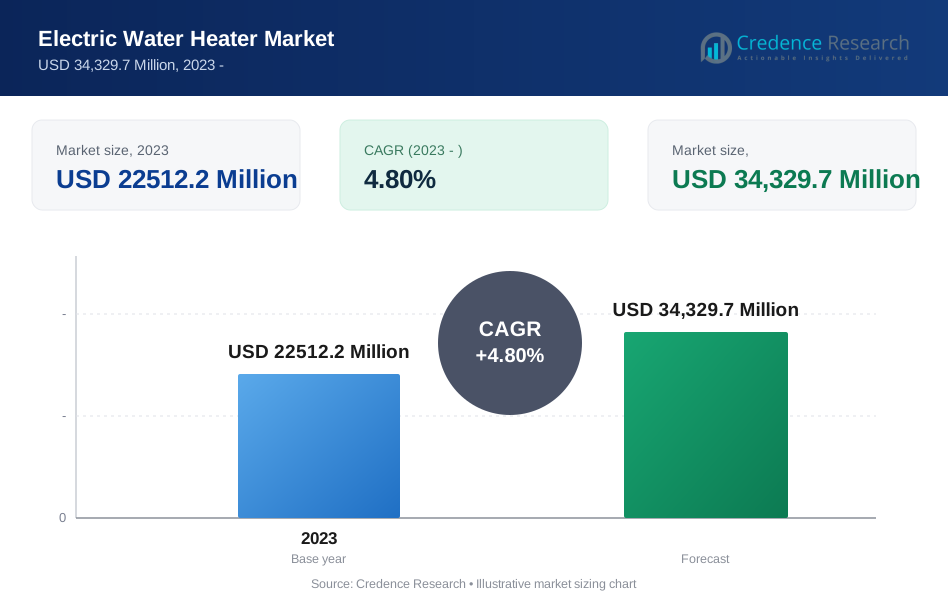
| Electric Water Heater Market Size 2023 | USD 22512.2 Million |
| Electric Water Heater Market, CAGR | 4.80% |
| Electric Water Heater Market Size 2032 | USD 34329.7 Million |
Market Insights
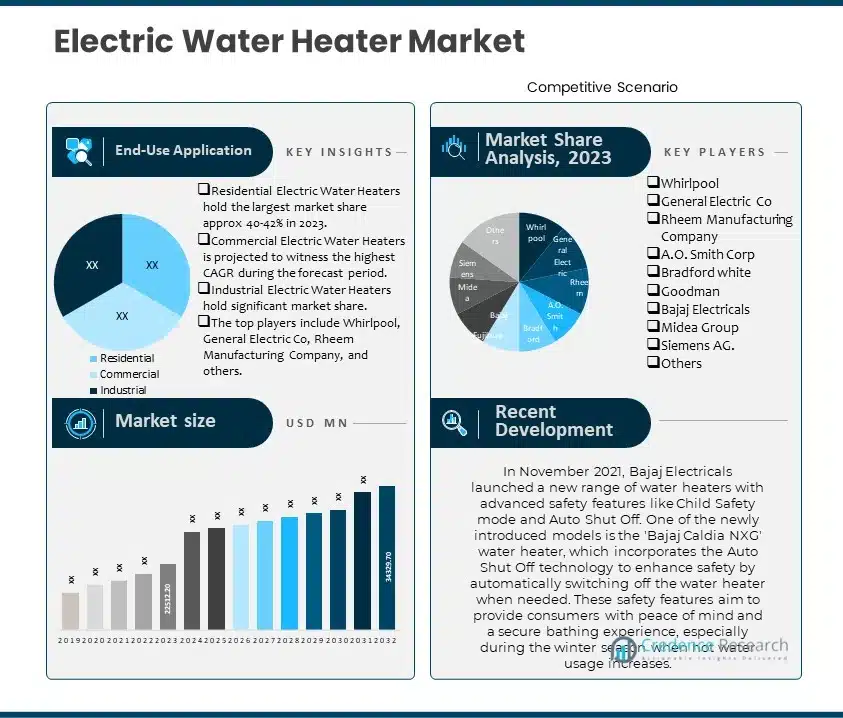
- The global Electric Water Heater Market reached a valuation of USD 22512.2 Million in 2023 and is anticipated to surge to USD 34329.7 Million by 2032, exhibiting a robust CAGR of 4.80% from 2024 to 2032.
- Among the key segments, Storage/Tank Water Heaters emerged as the market leader by type, constituting approximately 40-50% of the total market share in 2023. However, Tankless/On-demand Water Heaters are expected to experience rapid growth throughout the forecast period.
- Residential Electric Water Heaters segment holds around 40-42% of the market share in 2023 owing to diverse uses in individual homes and buildings.
- Copper Heating Elements currently hold the largest share of the market in 2023, constituting approximately 60% of the total market.
- 120V Electric Water Heaters currently hold the largest market share approx 60-62%. While, 240V Electric Water Heaters is projected to witness the highest CAGR during the forecast period.
- Home Improvement Stores currently hold the largest market share approx 40%.
- Asia Pacific accounts for a significant share of the market in 2023, followed by Europe and North America with a collective share of just under 55%.
- The rise in demand for hot water solutions and the need for energy-efficient appliances fuel the demand for Electric Water Heater Market, augmenting growth prospects.
- Key opportunities in the market include significant growth potential in Asia Pacific, increased adoption across various end-use applications, and continuous advancements in technology, fostering market expansion.
Executive Summary
Market Definition
The electric water heater market is a growing industry, driven by increasing demand for hot water, energy efficiency, cost effectiveness and technological advancements. The market is segmented into three categories such as residential, commercial and industrial. Residential water heaters are the largest category, catering to the needs of individual homes and buildings. Commercial water heaters are used in hotels, restaurants, hospitals, and other industries, while industrial water heaters are used in manufacturing, cleaning and sanitation. The market is influenced by several factors including growing population, urbanization and rising disposable income. Additionally, stringent government regulations and environmental concerns have led to a shift to energy-efficient and environmentally friendly water heaters. The market is also seeing smart water heaters equipped with advanced features such as Wi-Fi connectivity, remote monitoring and energy saving options.
Market Overview
- Among the primary segments, Storage/Tank Water Heaters dominated the market landscape by type, comprising approximately 40-50% of the total market share in 2023. However, Tankless/On-demand Water Heaters are expected to observe the highest CAGR over the forecast period.
- Residential Electric Water Heaters currently hold the largest market share approx 40-42% in 2023, driven by the substantial demand for hot water solutions in individual homes and buildings.
- Home Improvement Stores currently hold the largest market share approx 40% in 2023. Established distribution networks and easy access contribute to market growth.
- Online Retailers (e-commerce) emerged as the leading distribution channel segment in 2023, with a market share of about 40-45%, propelled by factors such as convenience and competitive pricing.
- Asia Pacific constituted a significant portion of the market in 2023, followed by Europe and North America, collectively representing just under 55% of the market share.
- The surge in demand for Electric Water Heaters, driven by factors such as increasing urbanization, rising disposable incomes, and environmental concerns, fosters market growth, especially in regions like Asia Pacific.
- Rapid advancement in Electric Water Heater manufacturing technology, including the demand for energy-efficient and technologically advanced solutions, is driving market demand, especially in regions like Asia Pacific where the growth of the Electric Water Heater industry is significant.
Segmentation by Type of Electric Water Heater
- Storage/Tank Water Heaters currently hold the largest market share approx 40-50% in 2023 owing to they are easy to install and provide a constant supply of hot water..
- Tankless/On-demand Water Heaters is projected to witness the highest CAGR during the forecast period. Futons and convertible sofas have gained popularity in recent years due to their versatility and space-saving features. This growth is attributed to their energy efficiency, space-saving design and convenience, especially in urban areas where space is limited. In addition, ductless water heaters provide an endless supply of hot water, eliminating the need for storage tanks.
- Heat Pump Water Heaters hold significanmt share due to their energy-efficiency and ability to work in colder climates.
Segmentation by Storage Capacity
- Medium (30-50 gallons) currently hold the largest market share approx 40-45% in 2023. This capacity meets the requirements of most households, provides enough hot water for daily use, and is small enough to fit most households.
- Large (more than 50 gallons) is projected to witness the highest CAGR during the forecast period. This growth is attributed to increasing demand from luxury homes, shopping centers and industrial applications. Larger water heaters provide a constant flow of hot water, making them ideal for busy homes, hotels, restaurants, and other businesses that require a constant flow of hot water.
Segmentation by Installation Location
- Indoor Water Heaters currently hold the largest market share approx 60-65% in 2023 owing to indoor water heaters are more common and convenient for most households, they do not require additional protection from the elements.
- Outdoor Water Heaters is projected to witness the highest CAGR during the forecast period. his growth is attributed to the demand for outdoor water heaters in commercial and industrial sectors such as swimming pools, spas, outdoor catering etc .
Segmentation by Energy Source
- Standard Electric Water Heaters currently hold the largest market share approx 50-55% in 2023 owing to standard electric water heaters are the most conventional and widely adopted type of electric water heater.
- Smart Electric Water Heaters is projected to witness the highest CAGR during the forecast period. This growth is accompanied by a growing demand for connected smart appliances in the home, as well as the benefits offered by smart water heaters, such as energy savings, remote monitoring and and automated maintenance scheduling.
Segmentation by Technology
- Conventional Electric Water Heaters hold the largest market share approx 50-55% in 2023.
- Advanced Electric Water Heaters (e.g., Wi-Fi connectivity, mobile app control) is projected to witness the highest CAGR during the forecast period.
Segmentation by Voltage Requirement
- 120V Electric Water Heaters currently hold the largest market share approx 60-62%. This water heaters are the most commonly used and widely available type of electric water heater, and are suitable for most residential applications.
- 240V Electric Water Heaters is projected to witness the highest CAGR during the forecast period. This increase is attributed to the high power demand of electric water heaters in commercial and industrial situations..
Segmentation by End-Use Application
- Residential Electric Water Heaters hold the largest market share approx 40-42% in 2023.
- Commercial Electric Water Heaters is projected to witness the highest CAGR during the forecast period.
Segmentation by Heating Element Material
- Copper Heating Elements currently hold the largest market share approx 60%. Copper is widely used in electric water heaters due to its excellent temperature and durability.
- Stainless Steel Heating Elements is projected to witness the highest CAGR during the forecast period.
Segmentation by Distribution Channel
- Home Improvement Stores currently hold the largest market share approx 40%. This is because home improvement stores such as Home Depot, Lowes and Menards offer a wide variety of electric water heaters and provide customers with easy access.
- Online Retailers (e-commerce) is projected to witness the highest CAGR during the forecast period. his growth is attributed to increasing online shopping, convenience and competitive pricing offered by online retailers such as Amazon, Walmart and Best Buy.
Segmentation by Region
- Asia Pacific held largest share around 35-40% of the market in 2023. Growing population and urbanization in countries like China, India, and Japan drive the market.
- Europe and North America collectively account for just under 55% share in 2023, with North America holding over 20% share in the same year.
- The rest of the world, including Latin America, the Middle East, and Africa, supplies the remaining demand for Electric Water Heater.
Technological advancements in manufacturing the electric water heater, economic conditions, population demographics, and government initiatives drive the market.
The Asia-Pacific region held largest share of Electric Water Heater market. Increasing residential and commercial hot water demand, increasing population and urbanization have driven the growth of electric water heater market in this region. China plays a crucial role for the growth of the electric water heater market in the Asia-Pacific region. By increasing the demand for electric hot water plants due to large population, rapidly expanding middle class and increasing urbanization in the country. Furthermore, Chinese government policies to promote energy consumption efficiency and encouraging environmental sustainability have encouraged the adoption of electric water heaters, which are more energy-efficient than traditional gas water heaters. Foe instance, in July 2023, the Central Committee for Comprehensive Deepening Reform passed opinions outlining China's gradual shift from dual energy consumption control to dual carbon emissions control for decarbonization. The opinions have not been made public but detail the country's strategy for achieving its climate goals. Moreover, the Indian government's efforts to promote renewable energy and energy efficiency have created opportunities for the growth of the electric water heater market. For instance, according to the Indian Renewable Energy Development Agency, the installed capacity of solar power in India has increased significantly, from 2.6 gigawatts (GW) in 2014 to 74.40 GW in 2023, which means a growth of 30 times in just 9 years. The rapid growth of solar installations in India is driving the demand for electric water heaters based on solar energy. As more homes and businesses move towards solar energy, there is a need for efficient and reliable water heating systems that can efficiently harness renewable energy.
The North America region witnesses significant growth in the Electric Water Heater market. This growth can be attributed to several factors such as increasing demand for heat pump water heaters, rising household spending and smart homes and buildings. For instance, in October 2023, A. O. Smith, introduced a new retrofit-ready, plug-in model to its Voltex heat pump water heater lineup. The Voltex 120V allows homeowners to easily switch from gas to a high efficiency heat pump water heater without costly electrical panel upgrades. It's four times more efficient than standard gas models and can deliver the same amount of hot water while taking up less space. This hassle-free replacement option offers a convenient 120V installation that plugs into a standard electrical outlet. Moreover, consumers are looking for options reduce their carbon footprint and reduce energy consumption further drive the market growth. and electric water heaters offer an effective solution to achieve this goal. For instance, in September 2022, Palo Alto, California, has set its sights on reducing carbon emissions from water heaters. The city plans to encourage residents and businesses to switch to electric heat pump water heaters, which are up to four times more efficient than traditional gas models. This initiative aims to reduce greenhouse gas emissions and meet the city's climate action plan goals. This type of goal towards reduce greenhouse gas emissions further drive the demand of more efficient electric water heater in North America.
Key Highlights of the Report
The Electric Water Heater Market is segmented by Type, Storage Capacity, Installation Location, Energy Source, Technology, Voltage Requirement, End-Use Application, Heating Element Material, Distribution Channel, and Region. The growing demand for electric water heaters is propelled by factors such as increasing urbanization, rising disposable incomes, and environmental concerns, particularly in residential properties, commercial buildings, and industrial sectors.
Storage/Tank Water Heaters dominate the segment, catering to essential hot water needs in households and businesses due to their ease of installation and constant hot water supply. Copper Heating Elements hold a significant market share, offering durability and efficient heating suitable for various water heating requirements.
Smart Electric Water Heaters are projected to witness the highest CAGR during the forecast period, driven by the growing demand for connected home appliances and energy-saving solutions. While Residential Electric Water Heaters hold the largest market share, with consumers prioritizing energy efficiency and convenience in their water heating systems.
The Asia-Pacific region held the largest share of the electric water heater market, supported by robust manufacturing infrastructure and high demand for energy-efficient appliances. Government initiatives promoting renewable energy also contribute to the region's dominance in the market.
Key players like Whirlpool, General Electric Co, and Rheem Manufacturing Company compete in the market, focusing on product innovation, distribution channel expansion, and strategic partnerships to maintain competitiveness. Collaborations and advancements in technology contribute to Asia Pacific's leadership in the Electric Water Heater Market, with major players expanding their footprint to meet growing demand in the region.
What Are The Main Drivers Of The Global Electric Water Heater Market?
The major factors driving the rise of the global furniture market are increasing demand for energy-efficient appliances, rising demand for reliable and convenient hot water solutions. Increasing awareness of environmental sustainability and reduction of low carbon footprint are the major factors driving the market growth.
What Are The Major Challenges Faced By The Global Electric Water Heater Market?
The major challenges in the global furniture market include intense competition, lack of knowledge about energy efficient water heater solutions and factors the lack of availability in some areas and the difficulty of replacing traditional gas-fired boilers with electricity pose additional obstacles. Furthermore, fluctuations in raw material prices and geopolitical pressures affecting the supply chain also affect the growth of the marke.
What Are The Growth Opportunities In The Global Electric Water Heater Market?
The global Electric Water Heater market presents numerous growth opportunities including increasing online sales and increasing urbanization driving household upgrades, and expanding adoption of smart home solutions, and adoption of various strategies among market players. Furthermore, technological advancements government initiatives promoting renewable energy also contribute to the market expansion.
Market Drivers
The global Electric Water Heater market is driven by several factors. The following are the key drivers of the global Electric Water Heater market:
Increasing Demand Of Solar Hybrid Water Heater
Increasing demand of solar hybrid water heater are driving the growth of the Electric Water Heater market. Hybrid solar water heaters combine the advantages of conventional electric water heaters with solar power and efficiency, providing a cost-effective solution to hot water needs and environmentally friendly. As consumers become more environmentally conscious and look for ways to reduce their carbon footprint, hybrid solar water heaters are expected to continue grown up, driving the overall growth of the electric water heater market. For instance, in December 2023, the Chinese PV products manufacturer Vaysunic New Energy has introduced a new hybrid photovoltaic water heater called the Solar Hybrid Water Heating V series. This innovative product is available in four versions with capacities of 100 liters, 150 liters, 200 liters, and 300 liters. The water heater is designed to be directly connected to solar panels, utilizing solar power on sunny days and automatically switching to AC power on rainy days. This types of launches further drive the demand of solar hybrid water heater.
Market Restraints
The global Electric Water Heater market faces some challenges that may hinder its growth. These include the following:
Increased Competition From Online Retailers
The global Electric Water Heater market is primarily constrained by increased competition from online retailers. The global Electric Water Heater market is facing stiff competition from online vendors, which is hampering its growth. Online retailers such as Amazon, Flipkart, and others are offer a wide range of water heater at competitive prices, making it difficult to compete with traditional retailers. This increased competition is forcing traditional retailers to adopt an omnichannel strategy, where customers are offered online and offline shopping experiences but this shift is not without challenges, as retailers have to invest heavily in technology and infrastructure into overseas to provide a seamless shopping experience across channels.
Opportunities
The global Electric Water Heater market offers significant growth opportunities. These include the following:
Adoption Of Various Strategies Among Market Players
The major companies serving the global Electric Water Heater Market are Whirlpool, General Electric Co, Rheem Manufacturing Company, A.O. Smith Corp,, among others. The market players are considerably contributing to the market growth by the adoption of various strategies including mergers & acquisitions, collaborations, funding, and new product launches, to stay competitive in the market also makes opportunity for the market growth. For instance, in December 2022, A. O. Smith introduced its newest water heater model in India, the Elegance Prime. This water heater has received a prestigious five-star rating from the Bureau of Energy Efficiency (BEE) and boasts a variety of advanced features. One notable feature is the innovative RRID (Rust Resistant Integrated Diffuser) Technology, which not only improves hot water output but also contributes to energy saving.
Competitive Landscape
Key Players
The global Electric Water Heater market is highly competitive, with several key players. Some of the major players in the market and their market share are as follows:
- Whirlpool
- General Electric Co
- Rheem Manufacturing Company
- A.O. Smith Corp
- Bradford white
- Goodman
- Bajaj Electricals
- Midea Group
- Siemens AG
- Others
These organizations prioritize product innovation, distribution channel expansion, and mergers and acquisitions to stay competitive.
The global Electric Water Heater market's key players continually seek to stay ahead by offering new products and developments.
In April 2023, Bradford White Water Heaters showcased their diverse range of innovative and high-quality products at the 2023 MCEE Show in Montreal. This event provided an opportunity for the company to connect with building professionals and demonstrate their reliable solutions, emphasizing their commitment to delivering proven products that enable distributors and contractors to excel in the industry. The presence of Bradford White Water Heaters at the MCEE Show underscores their dedication to quality and innovation in the water heating sector.
In November 2021, Bajaj Electricals launched a new range of water heaters with advanced safety features like Child Safety mode and Auto Shut Off. One of the newly introduced models is the 'Bajaj Caldia NXG' water heater, which incorporates the Auto Shut Off technology to enhance safety by automatically switching off the water heater when needed. These safety features aim to provide consumers with peace of mind and a secure bathing experience, especially during the winter season when hot water usage increases.
Summary of Key Findings
- The Electric Water Heater Market is experiencing substantial growth driven by increasing demand across residential, commercial, and industrial sectors. This growth is fueled by factors such as urbanization, rising disposable incomes, and the shift towards energy-efficient appliances.
- Market segmentation encompasses various factors including type, storage capacity, installation location, energy source, technology, voltage requirement, end-use application, heating element material, distribution channel, and region, reflecting the diverse preferences and requirements within the electric water heater industry.
- Storage/Tank Water Heaters emerge as the dominant segment, meeting essential hot water needs in households and businesses. Smart Electric Water Heaters are projected to witness the highest CAGR during the forecast period, driven by the demand for connected home appliances and energy-saving solutions.
- The Asia-Pacific region holds the largest share of the market, supported by robust manufacturing infrastructure and government initiatives promoting renewable energy. Major players like Whirlpool, General Electric Co, and Rheem Manufacturing Company compete in the market, focusing on innovation and strategic partnerships to maintain competitiveness.
Future Outlook
- The Electric Water Heater Market presents promising growth prospects, particularly in emerging markets like Asia Pacific, fueled by increasing urbanization and the demand for efficient hot water solutions. Anticipated challenges include technological advancements and competition from alternative water heating systems. To overcome these challenges, industry players should prioritize innovation, cost-effectiveness, and sustainability.
- Strategies for maintaining competitiveness include continuous product innovation, expanding distribution channels, and forging strategic partnerships to adapt to changing consumer preferences and sustain growth in the dynamic Electric Water Heater Market.
How CXOs Can Benefit from the Credence Research Electric Water Heater Networks Market Report
The Credence Research Electric Water Heater Networks Market Report provides CXOs with a comprehensive overview of the market, including:
- Market size and growth forecast:The report provides detailed estimates of the global Electric Water Heater networks market size, segmented by Type, Storage Capacity, Installation Location, Energy Source, Technology, Voltage Requirement, End-Use Application, Heating Element Material, Distribution Channel, and Region. It also includes forecasts for the market through 2032, based on key trends and drivers.
- Market segmentation:The report segments the Electric Water Heater networks market by Type, Storage Capacity, Installation Location, Energy Source, Technology, Voltage Requirement, End-Use Application, Heating Element Material, Distribution Channel, and Region. The increasing demand for advanced solutions is driven. This segmentation provides CXOs with a granular understanding of the market and the opportunities in each segment.
- Competitive landscape:The report profiles the key players in the Electric Water Heater networks market and provides insights into their strategies, product offerings, and financial performance. This information can help CXOs to identify and assess their competition.
- Key trends and drivers:The report identifies and analyzes the key trends and drivers that are shaping the Electric Water Heater networks market. This information can help CXOs to make informed decisions about their investments and strategies.
CXOs can use the insights from the Credence Research Electric Water Heater Networks Market Report to:
- Identify growth opportunities:The report can help CXOs to identify new growth opportunities in the Electric Water Heater networks market. For example, the report identifies the growing demand for Electric Water Heater networks from cloud computing providers and telecom companies as a key opportunity.
- Make informed investment decisions:The report can help CXOs to make informed investment decisions about Electric Water Heater networks. For example, the report provides insights into the key factors to consider when evaluating Electric Water Heater providers and selecting Electric Water Heater solutions.
- Develop competitive strategies:The report can help CXOs to develop competitive strategies for their Electric Water Heater networks businesses. For example, the report identifies the key strategies that Electric Water Heater providers are using to differentiate themselves from their competitors.
- Track market developments:The report can help CXOs to track market developments and stay ahead of the curve. For example, the report provides insights into the latest trends and innovations in the Electric Water Heater networks market.
Overall, the Credence Research Electric Water Heater Networks Market Report is a valuable resource for CXOs who are looking to gain a deeper understanding of the market and identify opportunities for growth.
Segmentation
- Type of Electric Water Heater:
- Storage/Tank Water Heaters
- Tankless/On-demand Water Heaters
- Heat Pump Water Heaters
- Solar Water Heaters (with electric backup)
- Hybrid Water Heaters
- Storage Capacity:
- Small (up to 30 gallons)
- Medium (30-50 gallons)
- Large (more than 50 gallons)
- Installation Location:
- Indoor Water Heaters
- Outdoor Water Heaters
- Energy Source:
- Standard Electric Water Heaters
- High-efficiency Electric Water Heaters
- Smart Electric Water Heaters
- Technology:
- Conventional Electric Water Heaters
- Advanced Electric Water Heaters (e.g., Wi-Fi connectivity, mobile app control)
- Voltage Requirement:
- 120V Electric Water Heaters
- 240V Electric Water Heaters
- End-Use Application:
- Residential Electric Water Heaters
- Commercial Electric Water Heaters
- Industrial Electric Water Heaters
- Heating Element Material:
- Copper Heating Elements
- Stainless Steel Heating Elements
- Distribution Channel:
- Online Retailers (e-commerce)
- Home Improvement Stores
- Appliance Stores
- Specialty Plumbing Stores
- Direct Sales (Manufacturer to Consumer)
- Others
- By Region
- North America
- The U.S.
- Canada
- Mexico
- Europe
- Germany
- France
- The U.K.
- Italy
- Spain
- Rest of Europe
- Asia Pacific
- China
- Japan
- India
- South Korea
- South-east Asia
- Rest of Asia Pacific
- Latin America
- Brazil
- Argentina
- Rest of Latin America
- Middle East & Africa
- GCC Countries
- South Africa
- Rest of Middle East and Africa
- North America
Request a Free Sample
Fill in your details and we'll send you a free sample report.
- Sample data tables & charts
- Research methodology
Need a Custom Version of This Report?
Tailor the scope, geography, or segments to your exact requirements.
- Custom geography or segment scope
- Direct access to our analyst team
Frequently Asked Questions
What is the current size of the global Electric Water Heater market?
What is the expected growth rate of the Electric Water Heater market between 2024 and 2032?
Which segment is leading the market share in terms of Type of Electric Water Heater?
Which Storage Capacity segments governs the demand for Electric Water Heater in the world?
Which Voltage Requirement is expected to post the highest CAGR during the forecast period?
Which region is fueling the growth of the Electric Water Heater industry?
Who are the major players in the global Electric Water Heater market?
Table of Content
Chapter 1. Report Introduction
- 1.1 Report Description & Purpose
- 1.1.1 Report Title & Market Definition
- 1.1.2 Unique Selling Propositions (USP) & Key Differentiators
- 1.1.3 Value Proposition for Stakeholders
- 1.2 Research Objectives
- 1.2.1 Market Sizing Objectives (Volume & Revenue)
- 1.2.2 Segmentation Objectives
- 1.2.3 Competitive Intelligence Objectives
- 1.2.4 Forecast & Scenario Objectives
- 1.3 Report Scope
- 1.3.1 Electric Water Heater Scope – Types & Subtypes Covered
- 1.3.2 Geographic Scope – Regions & Countries Covered
- 1.3.3 Historical Period, Base Year & Forecast Period (2023; forecast to the forecast period)
- 1.3.4 Inclusions & Exclusions
- 1.4 HS Code & Classification Framework
- 1.5 Currency, Units & Pricing Basis
- 1.6 Target Stakeholders
- 1.7 Limitations & Assumptions
Chapter 2. Executive Summary
- 2.1 Global Electric Water Heater Market Snapshot
- 2.1.1 Market Size – Historical (2023) & Forecast (the forecast period) (2023: USD 22512.2 Million → forecast year: USD 34,329.7 Million)
- 2.1.2 Volume & Revenue – Global Totals
- 2.1.3 Key Market Highlights – Top Five Facts
- 2.2 Electric Water Heater Market Segmentation Snapshot
- 2.2.1 Market Split by Region – 2023 vs.
- 2.3 Competitive Snapshot
- 2.3.1 Top 10 Players by Revenue Share – 2023
- 2.3.2 Top 10 Players by Volume Share – 2023
- 2.3.3 Recent Strategic Developments (18-Month Summary)
- 2.4 Key Investment Highlights & Strategic Conclusions
Chapter 3. Electric Water Heater Market Dynamics & Industry Analysis
- 3.1 Market Overview & Context
- 3.1.1 Electric Water Heater Market Position in the Broader Automotive Value Chain
- 3.1.2 OEM vs. Replacement Market Dynamics
- 3.1.3 Market Maturity & Development Stage by Region
- 3.2 Electric Water Heater Market Drivers
- 3.3 Electric Water Heater Market Restraints & Challenges
- 3.4 Electric Water Heater Market Opportunities
- 3.5 Porter's Five Forces Analysis
- 3.5.1 Threat of New Entrants
- 3.5.2 Bargaining Power of Suppliers
- 3.5.3 Bargaining Power of Buyers
- 3.5.4 Threat of Substitutes
- 3.5.5 Competitive Rivalry – Intensity Assessment
- 3.6 Electric Water Heater Value Chain Analysis
- 3.6.1 Upstream – Raw Material/Input Suppliers
- 3.6.1.1 Raw Material/Input 1
- 3.6.1.2 Raw Material/Input 2
- 3.6.1.3 Raw Material/Input 3
- 3.6.2 Midstream – Production/Manufacturing/Service Delivery
- 3.6.2.1 Production/Process Overview
- 3.6.2.2 Key Facility Locations & Capacity by Manufacturer
- 3.6.3 Downstream – Distribution & End Consumer
- 3.6.3.1 Primary Channel – B2B/OEM
- 3.6.3.2 Secondary Channels – Dealer, Retail, Online, Direct
- 3.6.4 Value Chain Profitability Analysis
- 3.6.1 Upstream – Raw Material/Input Suppliers
- 3.7 PESTEL Analysis
- 3.7.1 Political Factors
- 3.7.2 Economic Factors
- 3.7.3 Social Factors
- 3.7.4 Technological Factors
- 3.7.5 Environmental Factors
- 3.7.6 Legal Factors
- 3.8 Electric Water Heater Supply Chain Analysis
- 3.8.1 Raw Material/Input Supply Risk Assessment
- 3.8.2 Manufacturing Concentration Risk (Geographic Exposure)
- 3.8.3 Trade Disruption Impact Analysis
- 3.9 Regulatory & Policy Landscape
Note: The regulatory and policy landscape section covers regulations based on their applicability to the market, Electric Water Heater category, geography, and scope of the study. Only regulatory frameworks with a material impact on operations, compliance, trade, sustainability, or market access are analyzed in detail.
Chapter 4. Key Investment Pockets & Opportunity Analysis
- 4.1 Electric Water Heater Market Attractiveness Analysis
- 4.1.1 By Region – Investment Attractiveness Matrix (Volume × CAGR)
- 4.2 Absolute Revenue Growth Opportunity
- 4.2.1 By Region – Absolute USD Growth Through the forecast period
- 4.3 Incremental Volume Opportunity
- 4.3.1 By Region – Incremental Volume Through the forecast period
- 4.3.2 Segment – Incremental Volume
- 4.4 Emerging Submarket Opportunity Deep Dive (Subject to Applicability)
- 4.5 Emerging Market Opportunity Scorecards
- 4.5.1 United States
- 4.5.2 Europe
- 4.5.3 Asia
- 4.5.4 Middle East & Africa
Note: Emerging Market Opportunity Scorecards will be included based on relevance and strategic importance. Regions listed are indicative and may vary depending on data availability and market dynamics.
Chapter 5. Electric Water Heater Import-Export Analysis & Trade Flows
- 5.1 Global Trade Overview
- 5.1.1 Global Export Value by Country (2023)
- 5.1.2 Global Export Volume by Country (2023)
- 5.1.3 Global Import Value by Country (2023)
- 5.1.4 Global Import Volume by Country (2023)
- 5.1.5 Net Trade Balance by Country (2023)
- 5.2 Export Analysis – Segment
- 5.2.1 Type 1 (HS Code)
- 5.2.2 Type 2 (HS Code)
- 5.2.3 Type 3 (HS Code)
- 5.2.4 Type 4 (HS Code)
- 5.2.5 Type 5 (HS Code)
- 5.3 Import Analysis – Segment
- 5.3.1 Type 1 (HS Code)
- 5.3.2 Type 2 (HS Code)
- 5.3.3 Type 3 (HS Code)
- 5.3.4 Type 4 (HS Code)
- 5.3.5 Type 5 (HS Code)
- 5.4 Average Unit Trade Prices
- 5.4.1 Average Export Price – Segment & Country
- 5.4.2 Average Import Price – Segment & Source Country
- 5.4.3 Price Trends (2023)
- 5.5 Key Trade Route Analysis
- 5.5.1 Trade Route 1
- 5.5.2 Trade Route 2
- 5.5.3 Trade Route 3
- 5.5.4 Trade Route 4
- 5.5.5 Trade Route 5
- 5.6 Trade Policy Impact Assessment
- 5.6.1 US Anti-Dumping & Section 301 Tariffs
- 5.6.2 EU Customs Union Impact
- 5.6.3 Major Free Trade Agreements
- 5.6.4 USMCA Rules of Origin
Note: Trade policy analysis will be included only where relevant to the Electric Water Heater market.
Chapter 6. Competitive Landscape & Company Benchmarking
- 6.1 Electric Water Heater Market Concentration & Structure
- 6.1.1 Herfindahl-Hirschman Index (HHI) – vs. 2023
- 6.1.2 Tier 1, Tier 2 & Tier 3 Market Structure
- 6.1.3 Global, Regional & Local Player Dynamics
- 6.2 Electric Water Heater Market Share Analysis – 2023
- 6.2.1 Global Revenue Share by Company
- 6.2.2 Global Volume Share by Company
- 6.2.3 Regional Revenue Share
- 6.2.4 Market Share Evolution ( vs. 2023)
- 6.2.5 OEM Segment Share by Company
- 6.2.6 Replacement Segment Share by Company
- 6.3 Production/Delivery Capacity & Facility Analysis
- 6.3.1 Global Installed Capacity
- 6.3.2 Capacity Utilization Rates
- 6.3.3 Production/Output Volume
- 6.3.4 Facility Locations & Capacity Map
- 6.3.5 Planned Capacity Additions
- 6.4 Electric Water Heater Competitive Benchmarking Matrix
- 6.4.1 Revenue, Volume, CAGR & Profitability Comparison
- 6.4.2 Channel Revenue Mix
- 6.4.3 Geographic Revenue Exposure
- 6.4.4 R&D Intensity
- 6.4.5 Sustainability Maturity
- 6.5 Strategic Developments in Electric Water Heater (Last 24 Months)
- 6.5.1 Mergers, Acquisitions & Divestments
- 6.5.2 New Electric Water Heater Launches
- 6.5.3 Facility Expansions
- 6.5.4 Strategic Alliances, Joint Ventures & Partnerships
- 6.5.5 Distribution Expansion & Market Entry
- 6.5.6 Sustainability & ESG Initiatives
- 6.6 Competitive Strategy Mapping
- 6.6.1 Leader, Challenger, Follower & Niche Classification
- 6.6.2 Pricing Strategy Comparison
- 6.6.3 Channel Strategy Matrix
Note: Strategic developments are included based on their materiality and the availability of reliable information.
Chapter 7. Global Electric Water Heater Market – By Distribution Channel
- 7.1 Segment Overview
- 7.1.1 Volume & Revenue Split by Channel (2023 & )
- 7.1.2 Channel Mix Evolution (the forecast period)
Chapter 8. Regional Market Analysis – Global Overview
- 8.1 Global Regional Overview
- 8.1.1 Regional Volume Share
- 8.1.2 Regional Revenue Share
- 8.1.3 Regional Volume by Region
- 8.1.4 Regional Revenue by Region
- 8.1.5 Regional Forecast Through the forecast period
- 8.2 Cross-Regional Segment Analysis
- 8.2.1 By Distribution Channel
- 8.2.2 By Brand/Price Tier
Chapter 9. North America Electric Water Heater Market
- 9.1 United States
- 9.2 Canada
- 9.3 Mexico
Chapter 10. Europe Electric Water Heater Market
- 10.1 Germany
- 10.2 France
- 10.3 Italy
- 10.4 United Kingdom
- 10.5 Spain
- 10.6 Poland
- 10.7 Russia
- 10.8 Netherlands
- 10.9 Belgium
- 10.10 Sweden
- 10.11 Denmark
- 10.12 Norway
- 10.13 Rest of Europe
Chapter 11. Asia Pacific Electric Water Heater Market
- 11.1 China
- 11.2 India
- 11.3 Japan
- 11.4 South Korea
- 11.5 Thailand
- 11.6 Indonesia
- 11.7 Vietnam
- 11.8 Malaysia
- 11.9 Australia
- 11.10 Rest of Asia Pacific
Chapter 12. Latin America Electric Water Heater Market
- 12.1 Brazil
- 12.2 Argentina
- 12.3 Colombia
- 12.4 Chile
- 12.5 Rest of Latin America
Chapter 13. Middle East Electric Water Heater Market
- 13.1 Saudi Arabia
- 13.2 United Arab Emirates
- 13.3 Turkey
- 13.4 Israel
- 13.5 Iran
- 13.6 Rest of the Middle East
Chapter 14. Africa Electric Water Heater Market
- 14.1 South Africa
- 14.2 Egypt
- 14.3 Nigeria
- 14.4 Morocco
- 14.5 Rest of Africa
Chapter 15. Electric Water Heater Company Profiles
- 15.1 [Company 01]
- 15.1.1 Company Overview
- 15.1.2 Key Management Personnel
- 15.1.3 Products & Services Portfolio
- 15.1.4 Financial Performance
- 15.1.5 Key Market Focus & Geographic Presence
- 15.1.6 Recent Developments & Strategic Initiatives
Note: The company profile list is preliminary and may change based on research findings, market developments, data availability, and client requirements.
Chapter 16. Appendices
- Appendix A – List of Abbreviations & Acronyms
- Appendix B – Industry Classification Code Reference – Full Series
- Appendix C – Production & Capacity Data Tables
- Appendix D – End-Use & Demand Base Tables
- Appendix E – Consumption & Replacement Rate Assumptions
- Appendix F – ASP Reference Tables
- Appendix G – Manufacturing & Facility Database
- Appendix H – Import-Export Data Tables
- Appendix I – Regulatory Summary Tables
- Appendix J – Primary Research Participant List (Anonymized)
- Appendix K – Primary Research Questionnaire Framework
- Appendix L – Data Sources & Bibliography
- Appendix M – Market Size Divergence & Source Comparison
Chapter 17. Research Methodology
- 17.1 Research Framework & Philosophy
- 17.2 Secondary Research – Sources, Hierarchy & Data Extraction
- 17.3 Data Modeling – Bottom-Up & Top-Down Market Sizing
- 17.4 Primary Research – Stakeholder Framework, LOI & Sample Sizes
- 17.5 Forecast Methodology – Regression, Scenario & Sensitivity Analysis
- 17.6 Quality Control – Four-Layer Validation Framework
- 17.7 Limitations & Standard Assumptions
- 17.8 Disclaimer
