
| REPORT ATTRIBUTE | DETAILS |
|---|---|
| Historical Period | 2020-2023 |
| Base Year | 2024 |
| Forecast Period | 2025-2032 |
| Electrosurgical Devices Market Size 2024 | USD 5,502.4 million |
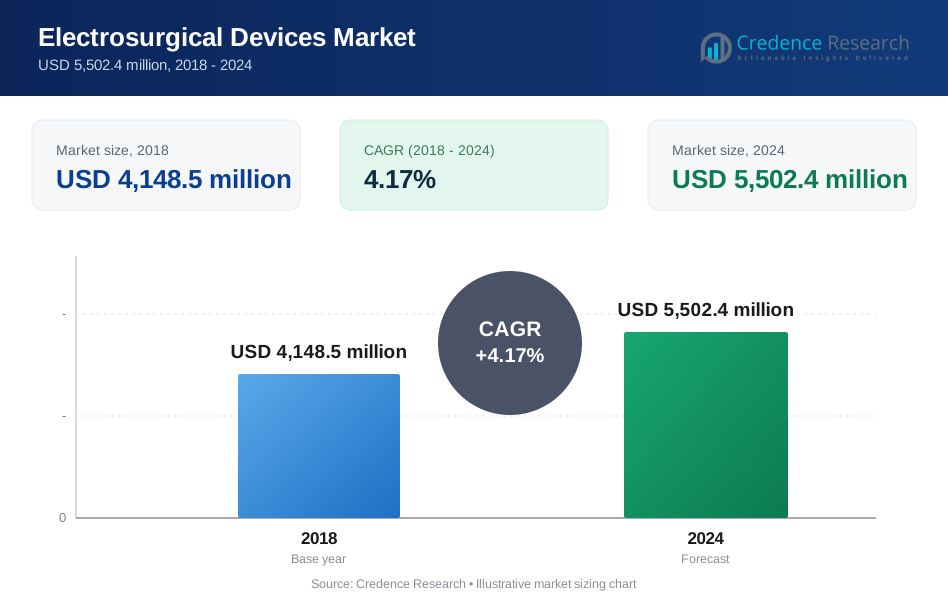
| Electrosurgical Devices Market, CAGR | 4.17% |
| Electrosurgical Devices Market Size 2032 | USD 7,643.8 million |
Market Overview:
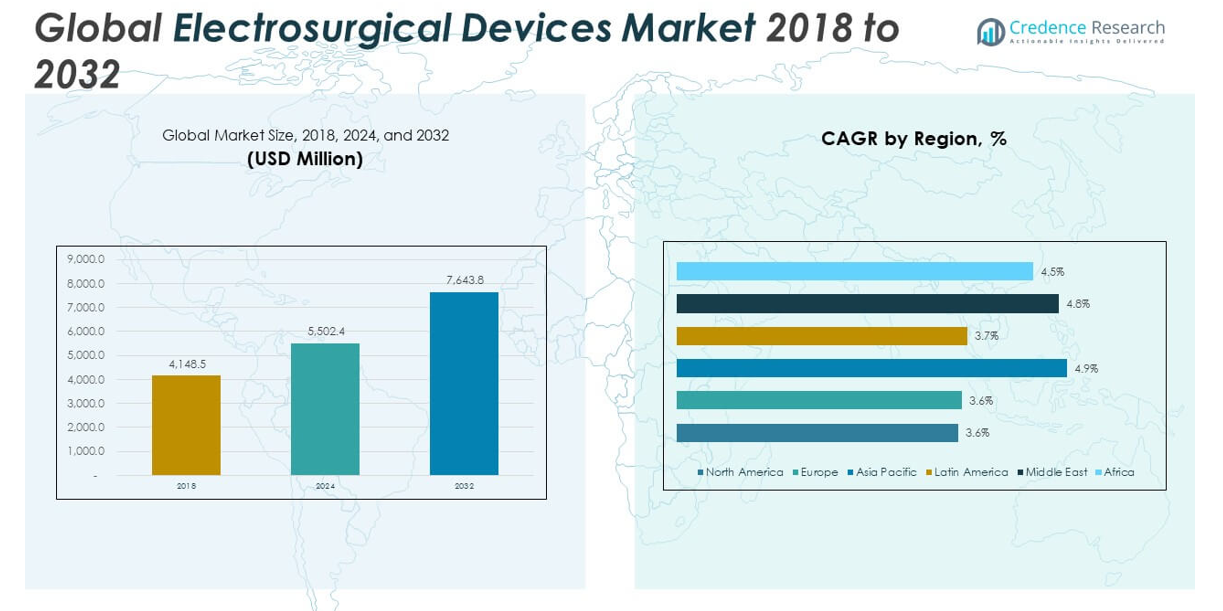
The Electrosurgical Devices Market size was valued at USD 4,148.5 million in 2018 to USD 5,502.4 million in 2024 and is anticipated to reach USD 7,643.8 million by 2032, at a CAGR of 4.17% during the forecast period.
Several factors are propelling the growth of the electrosurgical devices market. The increasing prevalence of chronic diseases, such as cardiovascular conditions, cancer, and diabetes, necessitates a higher volume of surgical interventions, thereby driving the demand for electrosurgical devices. Additionally, the aging global population is more susceptible to conditions requiring surgical treatment, further contributing to market expansion. Technological advancements in electrosurgical devices, including the development of high-frequency generators and improved safety features, enhance surgical precision and reduce procedural complications, making these devices increasingly preferred by healthcare professionals. Moreover, the growing trend towards minimally invasive surgeries, which offer benefits like reduced recovery times and less postoperative pain, is significantly influencing the adoption of electrosurgical devices.
North America currently holds the largest market share in the electrosurgical devices industry. This dominance is attributed to the region's well-established healthcare infrastructure, high healthcare expenditure, and a significant number of surgical procedures performed annually. The United States, in particular, is a major contributor to this market share, driven by a large patient population and advanced medical facilities. Europe follows as a significant market, with countries like Germany and the United Kingdom leading in the adoption of electrosurgical technologies. The Asia Pacific region is anticipated to witness the highest growth rate during the forecast period, fueled by increasing healthcare investments, a rising geriatric population, and expanding medical tourism. Countries such as China and India are emerging as key markets due to their large populations and improving healthcare systems. The Middle East and Africa, while currently holding a smaller market share, are expected to experience gradual growth, driven by healthcare infrastructure development and increasing awareness of advanced surgical technologies.
Market Insights:
- The Electrosurgical Devices Market was valued at USD 4,148.5 million in 2018 and is projected to reach USD 7,643.8 million by 2032, at a CAGR of 4.17%.
- The increasing prevalence of chronic diseases such as cardiovascular conditions, cancer, and diabetes drives the demand for electrosurgical devices in various surgeries.
- Technological advancements in electrosurgical devices, including high-frequency generators and improved safety features, enhance surgical precision and minimize complications.
- The rise in minimally invasive surgeries (MIS) is contributing to market growth, as electrosurgical devices play a key role in precision tissue dissection and coagulation.
- Healthcare spending, particularly in emerging economies, is accelerating the adoption of advanced surgical technologies, fueling the electrosurgical devices market.
- The North America region holds the largest market share, driven by its well-established healthcare infrastructure and advanced medical technologies.
- The Asia Pacific region is expected to see the highest growth, driven by increasing healthcare investments, a rising geriatric population, and expanding medical tourism.
Market Drivers:
Rising Prevalence of Chronic Diseases and Surgical Procedures
The increasing incidence of chronic diseases worldwide is a key driver for the electrosurgical devices market. Conditions such as cardiovascular diseases, cancer, diabetes, and neurological disorders are on the rise, all of which often require surgical interventions. Electrosurgical devices are crucial in these surgeries due to their ability to provide precise cutting, coagulation, and tissue sealing. As the global population ages and the number of individuals affected by chronic illnesses increases, the demand for surgical treatments rises, thereby fueling the growth of the electrosurgical devices market. These devices are used in various types of surgeries, including those for tumor removal, cardiac procedures, and orthopedic surgeries, where efficiency and precision are essential. The growing prevalence of such diseases directly correlates to an increased need for electrosurgical solutions in medical settings.
Advancements in Electrosurgical Technology Enhancing Surgical Precision
Technological advancements play a significant role in driving the electrosurgical devices market. The development of more efficient high-frequency generators, improved safety features, and the incorporation of advanced technologies such as bipolar and monopolar systems have significantly enhanced the performance of electrosurgical devices. These innovations provide surgeons with better control during procedures, allowing for more accurate tissue cutting and coagulation. The adoption of these advanced devices has also reduced the risk of complications such as thermal injury, contributing to improved patient outcomes. These technologies also streamline the surgical process, which shortens recovery times and minimizes the risk of infection. Surgeons now rely on more sophisticated electrosurgical devices for a wide range of applications, propelling market growth.
- For example, Johnson & Johnson MedTech’s DUALTO™ Energy System, launched in 2025 with recent FDA 510(k) clearance, integrates monopolar, bipolar, ultrasonic, and advanced bipolar modalities into a single platform for both open and minimally invasive surgeries.
Minimally Invasive Surgeries Driving Electrosurgical Device Adoption
Minimally invasive surgeries (MIS) have become increasingly popular due to their numerous benefits over traditional open surgery. MIS techniques reduce the size of surgical incisions, leading to less pain, faster recovery, and shorter hospital stays. Electrosurgical devices are integral to these procedures as they can perform tissue dissection, coagulation, and hemostasis with precision, all while minimizing the risk of tissue damage. With the rise in demand for MIS across various surgical fields, including orthopedics, cardiology, and urology, electrosurgical devices have become essential tools in performing these surgeries. The growing preference for less invasive procedures, driven by their benefits to both patients and healthcare providers, continues to be a major driver of the electrosurgical devices market.
- Medtronic’s Touch Surgery Live Stream for example, incorporates 14 AI algorithms that analyze laparoscopic and robotic-assisted procedures, providing actionable insights for workflow, instrument, and anatomy detection across surgeries such as cholecystectomy and hysterectomy
Increase in Healthcare Spending and Surgical Procedure Volumes Globally
An increase in healthcare spending, particularly in emerging economies, is contributing to the growth of the electrosurgical devices market. As healthcare infrastructure improves and more advanced medical technologies become available, the adoption of electrosurgical devices has risen globally. Increased investments in healthcare services, particularly in developing countries in Asia-Pacific and Latin America, have expanded the availability of surgical treatments. With better access to advanced surgical technologies, hospitals and surgical centers are more inclined to incorporate electrosurgical devices into their operating rooms. The growing number of surgeries performed globally, including elective procedures, has significantly increased the demand for electrosurgical devices. These factors combined with rising healthcare budgets worldwide have strengthened the market outlook for electrosurgical devices.
Market Trends:
Integration of Advanced Technologies in Electrosurgical Devices
The integration of advanced technologies is a prominent trend in the electrosurgical devices market. Companies are increasingly incorporating cutting-edge technologies, such as artificial intelligence (AI), robotics, and digitalization, into their electrosurgical offerings. These innovations improve the precision, efficiency, and safety of surgeries. AI-powered algorithms are being used to assist surgeons in making real-time decisions during operations, enhancing their ability to perform complex procedures. Similarly, robotic-assisted electrosurgical devices allow for greater precision in minimally invasive surgeries, where small incisions and delicate handling are crucial. This technological evolution is reshaping the landscape of electrosurgery, driving the demand for more sophisticated tools.
- For example, Medtronic’s Valleylab™ FT10 Energy Platform leverages TissueFect™ tissue sensing technology, which evaluates tissue composition 434,000 times per second to optimize energy delivery and minimize thermal injury.
Rising Demand for Minimally Invasive Surgeries
Minimally invasive surgeries (MIS) continue to be a significant trend in the electrosurgical devices market. The preference for these procedures is growing due to their reduced recovery times, lower risk of infection, and smaller scars compared to traditional open surgeries. Electrosurgical devices, which provide tissue cutting, coagulation, and hemostasis capabilities, are integral to the success of MIS. Surgeons rely on these devices to perform precise, efficient operations with minimal invasiveness. This shift toward minimally invasive techniques across various surgical disciplines, including orthopedics, cardiology, and neurology, is pushing the demand for electrosurgical devices that offer high performance in controlled settings.
- For example, Smith+Nephew’s CORI Surgical System exemplifies innovation in this space, offering a compact, portable robotic platform with 3D intraoperative imaging and precision milling tools for knee arthroplasty.
Emerging Markets Contributing to Market Growth
The growth of the electrosurgical devices market is increasingly driven by the expansion of healthcare systems in emerging markets. Countries in Asia-Pacific, the Middle East, and Latin America are investing heavily in healthcare infrastructure. The rise in surgical procedures, along with improving healthcare access and patient awareness, is fueling the demand for electrosurgical devices in these regions. As these markets continue to modernize their medical facilities and adopt advanced technologies, the demand for efficient, reliable surgical tools rises. This expansion creates new opportunities for manufacturers to enter or increase their presence in regions where healthcare demand is rapidly growing.
Focus on Safety and Efficiency Enhancements
There is a growing trend toward enhancing the safety and efficiency of electrosurgical devices. Manufacturers are focusing on developing devices with advanced safety features to minimize risks associated with electrosurgical procedures. These include improved monitoring systems, better thermal control to prevent tissue damage, and automatic feedback mechanisms that adjust settings during surgery for optimal performance. The emphasis on patient safety and surgical precision is driving manufacturers to innovate, ensuring that their devices meet the highest standards of operation. This focus on improving efficiency, reducing complications, and enhancing the overall safety profile of electrosurgical devices is expected to continue as healthcare providers prioritize better patient outcomes.
Market Challenges Analysis:
High Cost and Affordability Issues
One of the primary challenges facing the electrosurgical devices market is the high cost associated with advanced equipment. Many electrosurgical devices, especially those with integrated technologies like robotics and AI, can be prohibitively expensive for smaller healthcare facilities and hospitals in emerging economies. The upfront investment in such devices, coupled with ongoing maintenance and training costs, creates financial constraints for many institutions. As a result, the adoption of advanced electrosurgical technologies can be slow in cost-sensitive regions, limiting the market's overall growth potential. Manufacturers must explore ways to offer more affordable solutions or flexible financing options to address this barrier and expand the reach of their products.
Regulatory and Safety Compliance Challenges
Regulatory hurdles and safety compliance are significant challenges in the electrosurgical devices market. These devices are subject to rigorous testing and approval processes by health regulatory authorities across different regions. Variations in regulatory standards across markets can lead to delays in product launches and complications in global distribution. Additionally, ensuring that electrosurgical devices meet safety standards is crucial, as any malfunction can result in serious complications for patients. Manufacturers must consistently adapt to evolving regulatory requirements and enhance the safety features of their products to meet international standards. This regulatory landscape can slow down innovation and limit the speed at which new products enter the market.
Market Opportunities:
Expansion in Emerging Markets
Emerging markets present significant opportunities for growth in the electrosurgical devices market. Countries in Asia-Pacific, Latin America, and the Middle East are investing heavily in healthcare infrastructure, creating demand for advanced medical technologies. The increasing number of surgeries performed, coupled with a rising middle class and improved healthcare access, drives the need for electrosurgical devices. Manufacturers can tap into these markets by offering cost-effective and reliable solutions that meet local healthcare needs, helping to address the rising demand for efficient surgical procedures. Expansion into these regions presents both revenue opportunities and long-term market growth.
Advancements in Minimally Invasive Surgeries
The growing trend of minimally invasive surgeries (MIS) offers a valuable opportunity for the electrosurgical devices market. As healthcare providers shift towards less invasive procedures, electrosurgical devices are becoming indispensable due to their precision and ability to minimize tissue damage. The demand for MIS is projected to increase across various specialties, including orthopedics, cardiology, and urology. Manufacturers can capitalize on this trend by developing more advanced and versatile electrosurgical tools specifically designed for MIS. This shift towards minimally invasive techniques creates significant growth potential for electrosurgical device providers worldwide.
Market Segmentation Analysis:
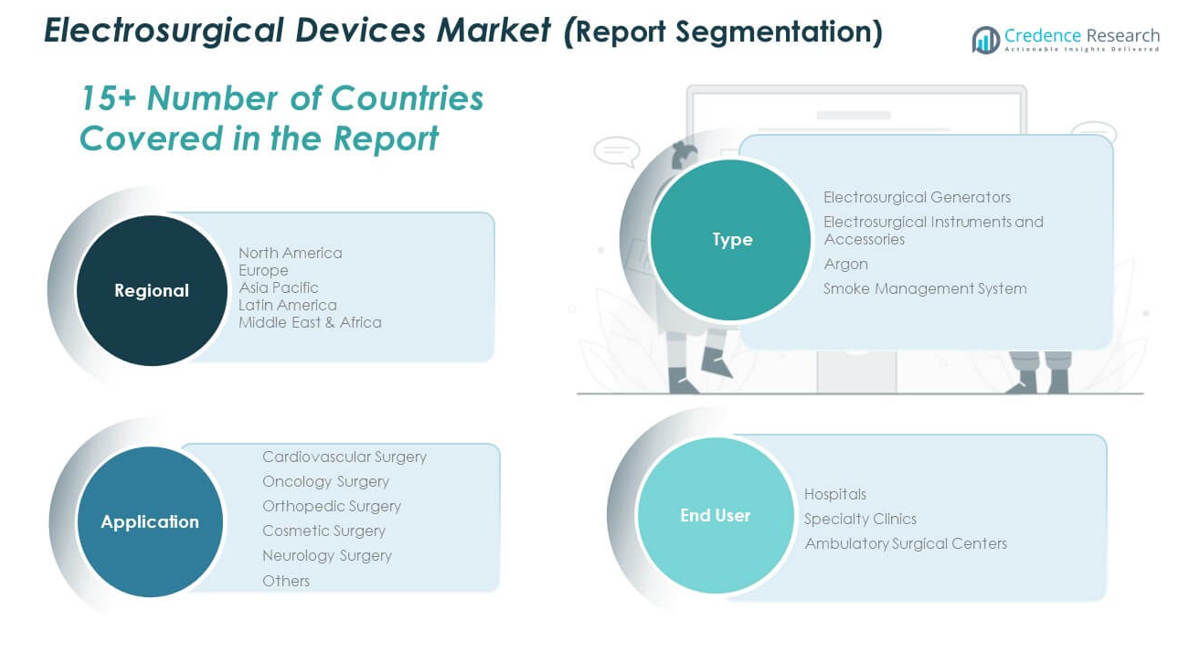
The electrosurgical devices market is segmented by type, application, and end-user, each contributing to its overall growth.
By Type, electrosurgical generators hold a dominant share due to their critical role in providing the high-frequency electrical energy required for various surgical procedures. Electrosurgical instruments and accessories, which include devices like pencils and electrodes, also contribute significantly as they are essential in performing cutting, coagulation, and sealing. The argon segment, used in argon plasma coagulation, is growing due to its effectiveness in minimizing thermal damage during surgeries. Smoke management systems are increasingly adopted for improving air quality and safety in operating rooms by removing harmful surgical smoke.
- For example, ERBE Elektromedizin’s VIO 3 with APC delivers argon plasma coagulation, minimizing thermal damage and improving hemostasis during surgical procedures.
By Application, cardiovascular surgery leads the segment due to the high demand for electrosurgical devices in cardiac procedures such as bypass surgeries and valve replacements. Oncology surgery follows, driven by the rising incidence of cancer, requiring advanced electrosurgical tools for tumor removal. Orthopedic and cosmetic surgeries also show substantial demand due to the adoption of minimally invasive techniques. Neurology surgery is growing as electrosurgical devices assist in precise brain and spinal surgeries.
By End-User, hospitals remain the largest segment, driven by their wide-ranging surgical needs and advanced facilities. Specialty clinics and ambulatory surgical centers are expanding as they increasingly offer specialized and outpatient services, respectively. The growth of these centers supports the rise in demand for efficient, cost-effective electrosurgical solutions.
- For example, Smith+Nephew’s CORI Surgical System is increasingly adopted by specialty orthopedic clinics and ambulatory centers for minimally invasive knee surgeries, reflecting the trend toward efficient, outpatient-focused electrosurgical solutions.
Segmentation:
By Type
- Electrosurgical Generators
- Electrosurgical Instruments and Accessories
- Argon
- Smoke Management System
By Application
- Cardiovascular Surgery
- Oncology Surgery
- Orthopedic Surgery
- Cosmetic Surgery
- Neurology Surgery
- Others
By End-User
- Hospitals
- Specialty Clinics
- Ambulatory Surgical Centers
- Others
By Region
- North America
- U.S.
- Canada
- Mexico
- Europe
- Germany
- France
- U.K.
- Italy
- Spain
- Rest of Europe
- Asia Pacific
- China
- Japan
- India
- South Korea
- South-east Asia
- Rest of Asia Pacific
- Latin America
- Brazil
- Argentina
- Rest of Latin America
- Middle East & Africa
- GCC Countries
- South Africa
- Rest of the Middle East and Africa
Regional Analysis:
North America Electrosurgical Devices Market
The North America Electrosurgical Devices Market size was valued at USD 945.03 million in 2018 to USD 1,211.48 million in 2024 and is anticipated to reach USD 1,605.20 million by 2032, at a CAGR of 3.6% during the forecast period. North America holds a dominant share of the global electrosurgical devices market, attributed to its well-established healthcare infrastructure, high healthcare spending, and early adoption of advanced technologies. The U.S. remains the largest contributor to the region's market, where the prevalence of chronic diseases and the rising number of surgeries are driving the demand for electrosurgical devices. In addition, the increasing focus on minimally invasive surgeries and the integration of AI and robotic technologies in medical practices further boost the market growth. This region's strong regulatory framework and emphasis on safety standards contribute to the steady demand for innovative electrosurgical devices.
Europe Electrosurgical Devices Market
The Europe Electrosurgical Devices Market size was valued at USD 1,028.00 million in 2018 to USD 1,321.53 million in 2024 and is anticipated to reach USD 1,758.08 million by 2032, at a CAGR of 3.6% during the forecast period. Europe accounts for a substantial share of the global market, driven by the increasing adoption of minimally invasive surgical procedures, advancements in electrosurgical technology, and rising healthcare expenditures. Countries like Germany, France, and the UK are major contributors to the region's market. The presence of leading medical device manufacturers, along with a high focus on patient safety and regulatory compliance, supports the continued growth of electrosurgical devices in Europe. Government initiatives to promote healthcare quality and the expanding geriatric population further contribute to market expansion.
Asia Pacific Electrosurgical Devices Market
The Asia Pacific Electrosurgical Devices Market size was valued at USD 1,290.61 million in 2018 to USD 1,791.75 million in 2024 and is anticipated to reach USD 2,637.11 million by 2032, at a CAGR of 4.9% during the forecast period. Asia Pacific is expected to experience the highest growth rate in the electrosurgical devices market due to rising healthcare investments, improved access to advanced medical technologies, and increasing surgical procedures. The region's rapidly expanding population and growing healthcare awareness contribute to the market's upward trajectory. Countries such as China, India, and Japan are key players in this market, with healthcare reforms and a growing demand for minimally invasive procedures spurring the adoption of electrosurgical devices. Increased medical tourism and government-backed healthcare programs further stimulate market growth.
Latin America Electrosurgical Devices Market
The Latin America Electrosurgical Devices Market size was valued at USD 433.52 million in 2018 to USD 559.21 million in 2024 and is anticipated to reach USD 747.56 million by 2032, at a CAGR of 3.7% during the forecast period. The Latin American market is witnessing steady growth due to improvements in healthcare infrastructure, increased access to medical technologies, and growing medical tourism in countries like Brazil and Mexico. The region's aging population and rising incidence of chronic diseases such as cardiovascular disorders are major factors driving demand for electrosurgical devices. While the market share is currently smaller compared to other regions, the expanding healthcare sector and demand for minimally invasive surgeries offer promising growth opportunities.
Middle East Electrosurgical Devices Market
The Middle East Electrosurgical Devices Market size was valued at USD 294.96 million in 2018 to USD 407.02 million in 2024 and is anticipated to reach USD 594.69 million by 2032, at a CAGR of 4.8% during the forecast period. The Middle East region is experiencing rapid growth in its healthcare sector, fueled by increasing investments in healthcare infrastructure, advanced technologies, and a rising patient population. Countries like Saudi Arabia, the UAE, and Qatar are key contributors to the region's market. The demand for electrosurgical devices is driven by the growing number of surgeries, particularly in orthopedics, cardiology, and oncology. The region's high healthcare expenditure and a focus on improving healthcare access further support market growth, along with the increasing adoption of minimally invasive surgical procedures.
Africa Electrosurgical Devices Market
The Africa Electrosurgical Devices Market size was valued at USD 156.40 million in 2018 to USD 211.45 million in 2024 and is anticipated to reach USD 301.17 million by 2032, at a CAGR of 4.5% during the forecast period. The African market is growing at a steady pace, driven by improving healthcare infrastructure, rising patient awareness, and government efforts to strengthen healthcare systems. The increasing prevalence of chronic diseases and the demand for surgical treatments are contributing to the market's expansion. South Africa and Nigeria are leading the adoption of electrosurgical devices, with improvements in medical facilities and access to healthcare technologies. While the market share remains smaller compared to other regions, the potential for growth is substantial, particularly as investments in healthcare continue to rise.
Key Player Analysis:
- Erbe Elektromedizin GmbH
- Olympus Corporation
- CONMED Corporation
- Johnson & Johnson Services, Inc.
- Bovie Medical Corporation
- BOWA-electronic GmbH & Co. KG
- Braun Melsungen AG
- Medtronic Plc
- Smith & Nephew Plc
- Boston Scientific Corporation
- Other Key Players
Competitive Analysis:
The electrosurgical devices market is highly competitive, with several key players striving for market share through technological advancements and product innovations. Major companies like Medtronic, Johnson & Johnson, and Olympus Corporation dominate the market due to their broad product portfolios and strong global presence. These companies focus on developing advanced electrosurgical tools that enhance surgical precision, minimize tissue damage, and improve patient safety. Smaller and emerging players are also gaining traction by offering cost-effective solutions and focusing on niche markets. Strategic partnerships, acquisitions, and collaborations play a significant role in expanding market reach and improving product offerings. Competitive pressure drives continuous innovation in electrosurgical technologies, with a particular emphasis on the integration of AI, robotics, and minimally invasive techniques. The market's future growth will depend on the ability of companies to address regional needs, regulatory requirements, and cost challenges while maintaining high-quality standards in their offerings.
Recent Developments:
- On May 27, 2025, Olympus Corporation announced FDA clearance for its most advanced imaging endoscopes, the EZ1500 series, featuring Extended Depth of Field (EDOF™) technology. These new gastroscopes and colonoscopes, part of the EVIS X1™ endoscopy system, enable sharper images and improved lesion detection in gastrointestinal procedures, enhancing diagnostic accuracy and workflow efficiency for clinicians
- In April 2025, Erbe Elektromedizin GmbH introduced the VIO® 3n and VIO® seal, marking a significant advancement in electrosurgical generators. The VIO® 3n expands Erbe’s VIO® 3 family with five new configurations Fire, Water, Metal, Timber, and Stone each tailored for precise surgical and endoscopic applications. The VIO® seal is the first generator in the line fully dedicated to bipolar applications.
Market Concentration & Characteristics:
The electrosurgical devices market exhibits moderate concentration, with a few dominant players holding significant market share. Key companies such as Medtronic, Johnson & Johnson, and Olympus Corporation lead the market, benefiting from established brands, expansive distribution networks, and strong research and development capabilities. While large firms maintain competitive advantages in terms of technology and global reach, smaller and regional players focus on offering specialized products or cost-effective alternatives. The market is characterized by rapid technological advancements, particularly in minimally invasive surgery, robotics, and AI integration. This drive for innovation compels companies to continuously enhance their product offerings to meet the growing demand for precision and safety in surgeries. Regulatory standards and the need for consistent product quality further shape the competitive landscape, ensuring that only the most reliable and technologically advanced devices remain competitive in the market.
Report Coverage:
The research report offers an in-depth analysis based on type, application, and end-user. It details leading market players, providing an overview of their business, product offerings, investments, revenue streams, and key applications. Additionally, the report includes insights into the competitive environment, SWOT analysis, current market trends, as well as the primary drivers and constraints. Furthermore, it discusses various factors that have driven market expansion in recent years. The report also explores market dynamics, regulatory scenarios, and technological advancements that are shaping the industry. It assesses the impact of external factors and global economic changes on market growth. Lastly, it provides strategic recommendations for new entrants and established companies to navigate the complexities of the market.
Future Outlook:
- The electrosurgical devices market is expected to grow steadily, driven by the increasing prevalence of chronic diseases and surgical procedures.
- Advancements in minimally invasive surgery techniques will continue to boost the demand for electrosurgical devices with enhanced precision and safety features.
- The integration of AI, robotics, and automation in electrosurgical devices will improve surgical outcomes and increase adoption across various specialties.
- Emerging markets in Asia-Pacific, Latin America, and the Middle East will see higher growth rates as healthcare access and infrastructure improve.
- Increasing healthcare expenditures, particularly in developing regions, will provide opportunities for market expansion.
- The demand for advanced electrosurgical devices will rise with the growing trend toward outpatient and day surgery centers.
- Regulatory compliance and safety standards will drive innovation, ensuring higher quality and performance of devices.
- Cost-effective solutions will gain popularity as healthcare systems in developing regions look to adopt advanced technology within budget constraints.
- Key players will continue to engage in strategic partnerships and acquisitions to expand their product portfolios and market reach.
- Technological advancements will continue to play a major role in shaping the competitive landscape, focusing on precision, safety, and efficiency.
Request a Free Sample
Fill in your details and we'll send you a free sample report.
- Sample data tables & charts
- Research methodology
Need a Custom Version of This Report?
Tailor the scope, geography, or segments to your exact requirements.
- Custom geography or segment scope
- Direct access to our analyst team
Frequently Asked Questions
What is the current size of the Electrosurgical Devices Market?
What are the key segments within the Electrosurgical Devices Market?
What are some challenges faced by the Electrosurgical Devices Market?
Who are the major players in the Electrosurgical Devices Market?
Table of Content
Chapter 1. Report Introduction
- 1.1 Report Description & Purpose
- 1.1.1 Report Title & Market Definition
- 1.1.2 Unique Selling Propositions (USP) & Key Differentiators
- 1.1.3 Value Proposition for Stakeholders
- 1.2 Research Objectives
- 1.2.1 Market Sizing Objectives (Volume & Revenue)
- 1.2.2 Segmentation Objectives
- 1.2.3 Competitive Intelligence Objectives
- 1.2.4 Forecast & Scenario Objectives
- 1.3 Report Scope
- 1.3.1 Electrosurgical Devices Scope – Types & Subtypes Covered
- 1.3.2 Geographic Scope – Regions & Countries Covered
- 1.3.3 Historical Period, Base Year & Forecast Period (2018; forecast to 2024)
- 1.3.4 Inclusions & Exclusions
- 1.4 HS Code & Classification Framework
- 1.5 Currency, Units & Pricing Basis
- 1.6 Target Stakeholders
- 1.7 Limitations & Assumptions
Chapter 2. Executive Summary
- 2.1 Global Electrosurgical Devices Market Snapshot
- 2.1.1 Market Size – Historical (2018) & Forecast (2018-2024) (2018: USD 4,148.5 million → 2024: USD 5,502.4 million)
- 2.1.2 Volume & Revenue – Global Totals
- 2.1.3 Key Market Highlights – Top Five Facts
- 2.2 Electrosurgical Devices Market Segmentation Snapshot
- 2.2.1 Market Split by Region – 2018 vs. 2024
- 2.3 Competitive Snapshot
- 2.3.1 Top 10 Players by Revenue Share – 2018
- 2.3.2 Top 10 Players by Volume Share – 2018
- 2.3.3 Recent Strategic Developments (18-Month Summary)
- 2.4 Key Investment Highlights & Strategic Conclusions
Chapter 3. Electrosurgical Devices Market Dynamics & Industry Analysis
- 3.1 Market Overview & Context
- 3.1.1 Electrosurgical Devices Market Position in the Broader Automotive Value Chain
- 3.1.2 OEM vs. Replacement Market Dynamics
- 3.1.3 Market Maturity & Development Stage by Region
- 3.2 Electrosurgical Devices Market Drivers
- 3.3 Electrosurgical Devices Market Restraints & Challenges
- 3.4 Electrosurgical Devices Market Opportunities
- 3.5 Porter's Five Forces Analysis
- 3.5.1 Threat of New Entrants
- 3.5.2 Bargaining Power of Suppliers
- 3.5.3 Bargaining Power of Buyers
- 3.5.4 Threat of Substitutes
- 3.5.5 Competitive Rivalry – Intensity Assessment
- 3.6 Electrosurgical Devices Value Chain Analysis
- 3.6.1 Upstream – Raw Material/Input Suppliers
- 3.6.1.1 Raw Material/Input 1
- 3.6.1.2 Raw Material/Input 2
- 3.6.1.3 Raw Material/Input 3
- 3.6.2 Midstream – Production/Manufacturing/Service Delivery
- 3.6.2.1 Production/Process Overview
- 3.6.2.2 Key Facility Locations & Capacity by Manufacturer
- 3.6.3 Downstream – Distribution & End Consumer
- 3.6.3.1 Primary Channel – B2B/OEM
- 3.6.3.2 Secondary Channels – Dealer, Retail, Online, Direct
- 3.6.4 Value Chain Profitability Analysis
- 3.6.1 Upstream – Raw Material/Input Suppliers
- 3.7 PESTEL Analysis
- 3.7.1 Political Factors
- 3.7.2 Economic Factors
- 3.7.3 Social Factors
- 3.7.4 Technological Factors
- 3.7.5 Environmental Factors
- 3.7.6 Legal Factors
- 3.8 Electrosurgical Devices Supply Chain Analysis
- 3.8.1 Raw Material/Input Supply Risk Assessment
- 3.8.2 Manufacturing Concentration Risk (Geographic Exposure)
- 3.8.3 Trade Disruption Impact Analysis
- 3.9 Regulatory & Policy Landscape
Note: The regulatory and policy landscape section covers regulations based on their applicability to the market, Electrosurgical Devices category, geography, and scope of the study. Only regulatory frameworks with a material impact on operations, compliance, trade, sustainability, or market access are analyzed in detail.
Chapter 4. Key Investment Pockets & Opportunity Analysis
- 4.1 Electrosurgical Devices Market Attractiveness Analysis
- 4.1.1 By Region – Investment Attractiveness Matrix (Volume × CAGR)
- 4.2 Absolute Revenue Growth Opportunity
- 4.2.1 By Region – Absolute USD Growth Through 2024
- 4.3 Incremental Volume Opportunity
- 4.3.1 By Region – Incremental Volume Through 2024
- 4.3.2 Segment – Incremental Volume
- 4.4 Emerging Submarket Opportunity Deep Dive (Subject to Applicability)
- 4.5 Emerging Market Opportunity Scorecards
- 4.5.1 United States
- 4.5.2 Europe
- 4.5.3 Asia
- 4.5.4 Middle East & Africa
Note: Emerging Market Opportunity Scorecards will be included based on relevance and strategic importance. Regions listed are indicative and may vary depending on data availability and market dynamics.
Chapter 5. Electrosurgical Devices Import-Export Analysis & Trade Flows
- 5.1 Global Trade Overview
- 5.1.1 Global Export Value by Country (2018)
- 5.1.2 Global Export Volume by Country (2018)
- 5.1.3 Global Import Value by Country (2018)
- 5.1.4 Global Import Volume by Country (2018)
- 5.1.5 Net Trade Balance by Country (2018)
- 5.2 Export Analysis – Segment
- 5.2.1 Type 1 (HS Code)
- 5.2.2 Type 2 (HS Code)
- 5.2.3 Type 3 (HS Code)
- 5.2.4 Type 4 (HS Code)
- 5.2.5 Type 5 (HS Code)
- 5.3 Import Analysis – Segment
- 5.3.1 Type 1 (HS Code)
- 5.3.2 Type 2 (HS Code)
- 5.3.3 Type 3 (HS Code)
- 5.3.4 Type 4 (HS Code)
- 5.3.5 Type 5 (HS Code)
- 5.4 Average Unit Trade Prices
- 5.4.1 Average Export Price – Segment & Country
- 5.4.2 Average Import Price – Segment & Source Country
- 5.4.3 Price Trends (2018)
- 5.5 Key Trade Route Analysis
- 5.5.1 Trade Route 1
- 5.5.2 Trade Route 2
- 5.5.3 Trade Route 3
- 5.5.4 Trade Route 4
- 5.5.5 Trade Route 5
- 5.6 Trade Policy Impact Assessment
- 5.6.1 US Anti-Dumping & Section 301 Tariffs
- 5.6.2 EU Customs Union Impact
- 5.6.3 Major Free Trade Agreements
- 5.6.4 USMCA Rules of Origin
Note: Trade policy analysis will be included only where relevant to the Electrosurgical Devices market.
Chapter 6. Competitive Landscape & Company Benchmarking
- 6.1 Electrosurgical Devices Market Concentration & Structure
- 6.1.1 Herfindahl-Hirschman Index (HHI) – vs. 2018
- 6.1.2 Tier 1, Tier 2 & Tier 3 Market Structure
- 6.1.3 Global, Regional & Local Player Dynamics
- 6.2 Electrosurgical Devices Market Share Analysis – 2018
- 6.2.1 Global Revenue Share by Company
- 6.2.2 Global Volume Share by Company
- 6.2.3 Regional Revenue Share
- 6.2.4 Market Share Evolution ( vs. 2018)
- 6.2.5 OEM Segment Share by Company
- 6.2.6 Replacement Segment Share by Company
- 6.3 Production/Delivery Capacity & Facility Analysis
- 6.3.1 Global Installed Capacity
- 6.3.2 Capacity Utilization Rates
- 6.3.3 Production/Output Volume
- 6.3.4 Facility Locations & Capacity Map
- 6.3.5 Planned Capacity Additions
- 6.4 Electrosurgical Devices Competitive Benchmarking Matrix
- 6.4.1 Revenue, Volume, CAGR & Profitability Comparison
- 6.4.2 Channel Revenue Mix
- 6.4.3 Geographic Revenue Exposure
- 6.4.4 R&D Intensity
- 6.4.5 Sustainability Maturity
- 6.5 Strategic Developments in Electrosurgical Devices (Last 24 Months)
- 6.5.1 Mergers, Acquisitions & Divestments
- 6.5.2 New Electrosurgical Devices Launches
- 6.5.3 Facility Expansions
- 6.5.4 Strategic Alliances, Joint Ventures & Partnerships
- 6.5.5 Distribution Expansion & Market Entry
- 6.5.6 Sustainability & ESG Initiatives
- 6.6 Competitive Strategy Mapping
- 6.6.1 Leader, Challenger, Follower & Niche Classification
- 6.6.2 Pricing Strategy Comparison
- 6.6.3 Channel Strategy Matrix
Note: Strategic developments are included based on their materiality and the availability of reliable information.
Chapter 7. Global Electrosurgical Devices Market – By Distribution Channel
- 7.1 Segment Overview
- 7.1.1 Volume & Revenue Split by Channel (2018 & 2024)
- 7.1.2 Channel Mix Evolution (2018-2024)
Chapter 8. Regional Market Analysis – Global Overview
- 8.1 Global Regional Overview
- 8.1.1 Regional Volume Share
- 8.1.2 Regional Revenue Share
- 8.1.3 Regional Volume by Region
- 8.1.4 Regional Revenue by Region
- 8.1.5 Regional Forecast Through 2024
- 8.2 Cross-Regional Segment Analysis
- 8.2.1 By Distribution Channel
- 8.2.2 By Brand/Price Tier
Chapter 9. North America Electrosurgical Devices Market
- 9.1 United States
- 9.2 Canada
- 9.3 Mexico
Chapter 10. Europe Electrosurgical Devices Market
- 10.1 Germany
- 10.2 France
- 10.3 Italy
- 10.4 United Kingdom
- 10.5 Spain
- 10.6 Poland
- 10.7 Russia
- 10.8 Netherlands
- 10.9 Belgium
- 10.10 Sweden
- 10.11 Denmark
- 10.12 Norway
- 10.13 Rest of Europe
Chapter 11. Asia Pacific Electrosurgical Devices Market
- 11.1 China
- 11.2 India
- 11.3 Japan
- 11.4 South Korea
- 11.5 Thailand
- 11.6 Indonesia
- 11.7 Vietnam
- 11.8 Malaysia
- 11.9 Australia
- 11.10 Rest of Asia Pacific
Chapter 12. Latin America Electrosurgical Devices Market
- 12.1 Brazil
- 12.2 Argentina
- 12.3 Colombia
- 12.4 Chile
- 12.5 Rest of Latin America
Chapter 13. Middle East Electrosurgical Devices Market
- 13.1 Saudi Arabia
- 13.2 United Arab Emirates
- 13.3 Turkey
- 13.4 Israel
- 13.5 Iran
- 13.6 Rest of the Middle East
Chapter 14. Africa Electrosurgical Devices Market
- 14.1 South Africa
- 14.2 Egypt
- 14.3 Nigeria
- 14.4 Morocco
- 14.5 Rest of Africa
Chapter 15. Electrosurgical Devices Company Profiles
- 15.1 [Company 01]
- 15.1.1 Company Overview
- 15.1.2 Key Management Personnel
- 15.1.3 Products & Services Portfolio
- 15.1.4 Financial Performance
- 15.1.5 Key Market Focus & Geographic Presence
- 15.1.6 Recent Developments & Strategic Initiatives
Note: The company profile list is preliminary and may change based on research findings, market developments, data availability, and client requirements.
Chapter 16. Appendices
- Appendix A – List of Abbreviations & Acronyms
- Appendix B – Industry Classification Code Reference – Full Series
- Appendix C – Production & Capacity Data Tables
- Appendix D – End-Use & Demand Base Tables
- Appendix E – Consumption & Replacement Rate Assumptions
- Appendix F – ASP Reference Tables
- Appendix G – Manufacturing & Facility Database
- Appendix H – Import-Export Data Tables
- Appendix I – Regulatory Summary Tables
- Appendix J – Primary Research Participant List (Anonymized)
- Appendix K – Primary Research Questionnaire Framework
- Appendix L – Data Sources & Bibliography
- Appendix M – Market Size Divergence & Source Comparison
Chapter 17. Research Methodology
- 17.1 Research Framework & Philosophy
- 17.2 Secondary Research – Sources, Hierarchy & Data Extraction
- 17.3 Data Modeling – Bottom-Up & Top-Down Market Sizing
- 17.4 Primary Research – Stakeholder Framework, LOI & Sample Sizes
- 17.5 Forecast Methodology – Regression, Scenario & Sensitivity Analysis
- 17.6 Quality Control – Four-Layer Validation Framework
- 17.7 Limitations & Standard Assumptions
- 17.8 Disclaimer
