
Market Overview:
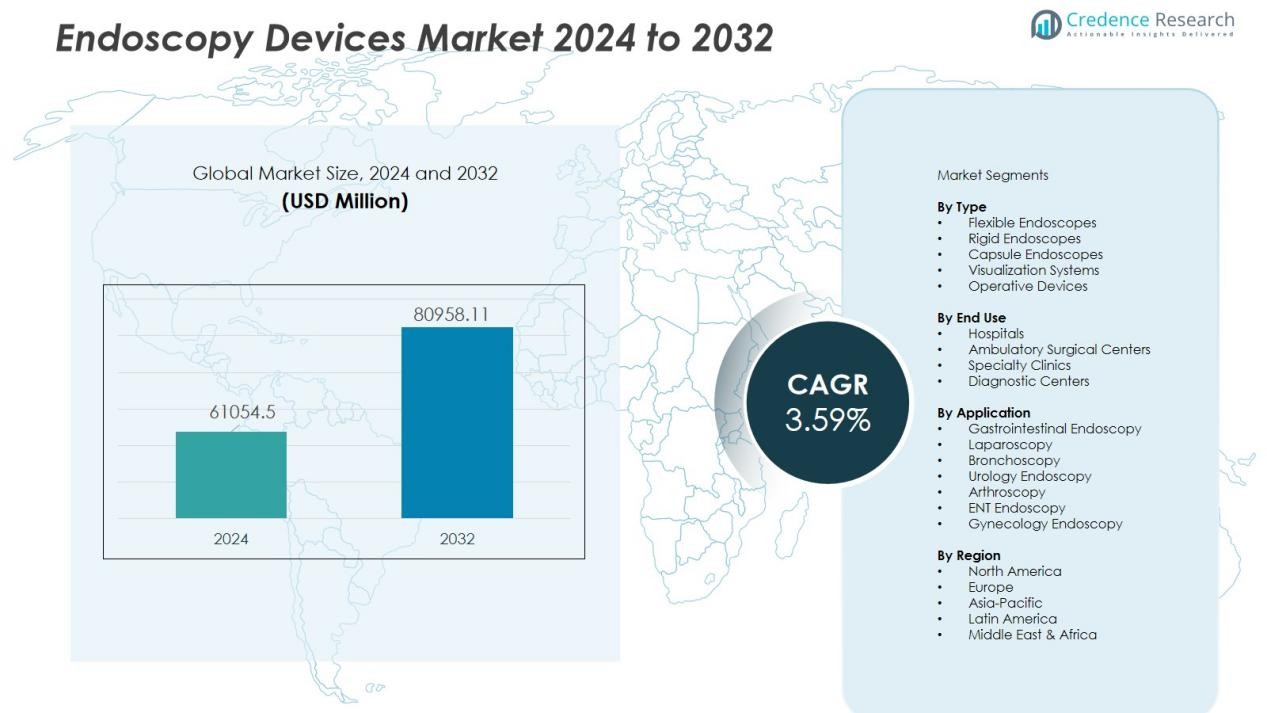
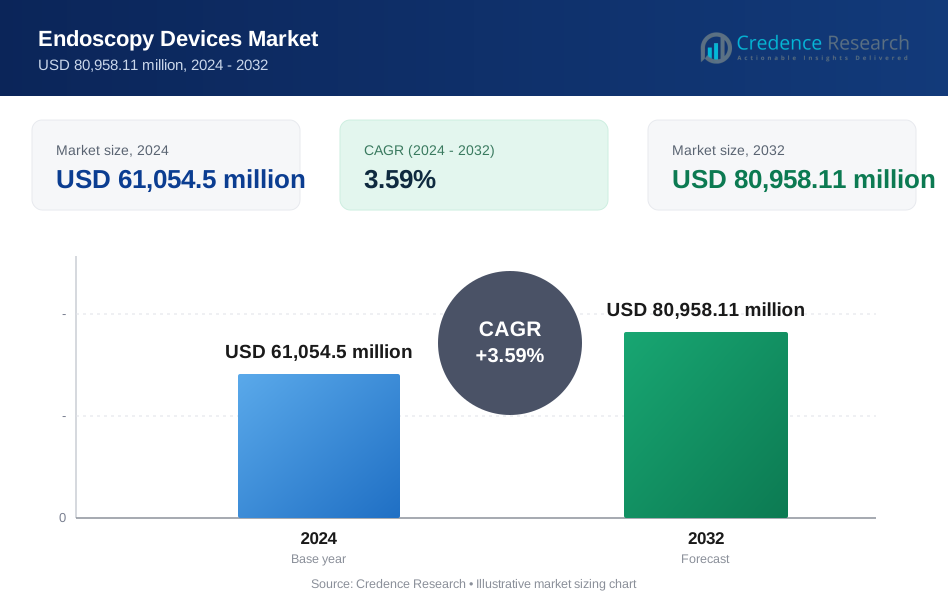
The endoscopy devices market size was valued at USD 61054.5 million in 2024 and is anticipated to reach USD 80958.11 million by 2032, at a CAGR of 3.59 % during the forecast period.
| REPORT ATTRIBUTE | DETAILS |
|---|---|
| Historical Period | 2020-2023 |
| Base Year | 2024 |
| Forecast Period | 2025-2032 |
| Endoscopy Devices Market Size 2024 | USD 61054.5 Million |
| Endoscopy Devices Market, CAGR | 3.59 % |
| Endoscopy Devices Market Size 2032 | USD 80958.11 Million |
Key market drivers include rising prevalence of gastrointestinal disorders, colorectal cancer, and lifestyle-related conditions requiring endoscopic evaluation and therapeutic intervention. Healthcare providers prioritize minimally invasive procedures to reduce hospitalization time, surgical trauma, and overall treatment costs. Continuous innovation-such as 3D visualization, AI-enabled image analysis, robotic-assisted endoscopy, and disposable endoscopes-further accelerates market adoption. Increasing investments in outpatient surgical centers and expanding reimbursement support for endoscopic procedures strengthen market momentum.
Regionally, North America leads due to advanced healthcare infrastructure, high screening rates, and rapid integration of next-generation visualization technologies. Europe follows with strong government-backed screening programs and growing adoption of minimally invasive interventions. Asia-Pacific is expected to record the fastest growth, supported by rising healthcare expenditure, expanding hospital infrastructure, and increasing awareness of preventive diagnostic procedures across China, India, and Southeast Asia.
Market Insights:
- The endoscopy devices market is projected to grow from USD 61,054.5 million in 2024 to USD 80,958.11 million by 2032, at a CAGR of 3.59%.
- Rising adoption of minimally invasive procedures boosts demand for advanced endoscopes across major specialties, improving patient recovery and procedural efficiency.
- Increasing burden of gastrointestinal diseases, colorectal cancer, and chronic conditions drives higher screening and diagnostic endoscopy volumes globally.
- Continuous innovation-such as AI-enhanced imaging, robotics, and disposable scopes-improves clinical accuracy and reduces infection risks.
- North America leads the market, while Asia-Pacific records the fastest growth due to expanding healthcare infrastructure and rising preventive screening awareness.
Market Drivers:
Rising Need for Minimally Invasive Procedures Strengthens Technology Adoption
The endoscopy devices market gains strong momentum as healthcare providers shift toward minimally invasive procedures that reduce recovery time and surgical risk. It supports improved patient comfort and shortens hospital stays, which enhances treatment efficiency. Demand rises in gastroenterology, pulmonology, urology, and gynecology as physicians prefer precise, image-guided interventions. Hospitals expand procurement of rigid and flexible endoscopes to improve procedural accuracy. Growing preference for outpatient care further encourages device adoption.
- For instance, Olympus Corporation’s EVIS X1 endoscopy system features advanced imaging technologies such as Texture and Color Enhancement Imaging (TXI™), Red Dichromatic Imaging (RDI™), and Narrow Band Imaging (NBI™), designed to enhance the visibility of lesions, deep blood vessels, and mucosal patterns.
Expanding Burden of Gastrointestinal and Chronic Diseases Drives Procedure Volume
The endoscopy devices market benefits from rising cases of colorectal cancer, inflammatory bowel disease, GERD, liver disorders, and age-related gastrointestinal complications. It supports earlier disease detection and timely therapeutic intervention. Screening programs in developed and emerging economies raise the number of diagnostic endoscopies. Strong clinical guidelines encourage routine colonoscopy and upper GI evaluations. Higher disease prevalence increases the need for advanced visualization platforms.
- For Instance, The Endotics™ system, a robotic-assisted colonoscopy technology, achieved a cecal intubation rate of 82% in a study of 71 unsedated patients. This system has been shown to be better tolerated with less pain compared to conventional colonoscopy, reducing the need for sedation.
Continuous Advancements in Imaging, AI, and Robotics Enhance Clinical Outcomes
The endoscopy devices market advances with the integration of high-definition imaging, enhanced optics, robotic assistance, and AI-supported image interpretation. It improves lesion detection and strengthens decision-making accuracy. Manufacturers introduce next-generation endoscopes with better maneuverability and disposable options that reduce infection risk. Hospitals evaluate digital integration features that support workflow efficiency. Increased R&D investments accelerate the introduction of smart endoscopy systems.
Rising Investments in Healthcare Infrastructure and Ambulatory Surgical Centers Boost Device Utilization
The endoscopy devices market benefits from strong investments in ambulatory surgical centers and specialty clinics that focus on cost-efficient minimally invasive care. It supports wider access to diagnostic and therapeutic procedures in urban and semi-urban regions. Governments strengthen screening programs that require high-quality visualization systems. Private healthcare providers expand endoscopy units to meet growing patient demand. Infrastructure upgrades create consistent procurement opportunities for advanced devices.
Market Trends:
Growing Integration of AI, Robotics, and Digital Platforms Reshapes Procedural Capabilities
The endoscopy devices market advances with rapid integration of AI algorithms that support real-time lesion detection and automated image interpretation. It improves diagnostic accuracy and reduces variation in clinical outcomes. Robotic-assisted endoscopy gains momentum due to better navigation control and enhanced precision in complex interventions. Hospitals adopt digital ecosystems that connect towers, scopes, and software into unified platforms. Cloud-based data management strengthens documentation and remote collaboration. Disposable endoscopes gain attention because they reduce infection risk and simplify reprocessing steps. Manufacturers expand portfolios to match hospital demand for fully digital and intelligent endoscopy suites.
- For instance, the Olympus AI-assisted colonoscopy systems, such as those integrated into the EVIS X1 platform (using the ENDO-AID CADe application) and the cloud-based OLYSENSE suite, provide real-time computer-aided detection and characterization of suspected lesions.
Shift Toward Minimally Invasive Screening, Specialty Procedures, and Outpatient Care Reshapes Market Dynamics
The endoscopy devices market benefits from rising focus on early detection programs for gastrointestinal cancers and chronic digestive disorders. It supports procedure volume growth across colonoscopy, bronchoscopy, and laparo-endoscopic segments. Demand increases for compact, mobile, and high-definition systems that improve workflow in ambulatory surgical centers. Hospitals adopt 4K and 3D visualization technologies that enhance tissue differentiation during examinations. Integration of narrow-band imaging and fluorescence technology strengthens clinical decision accuracy. New product development focuses on ergonomic scope designs that reduce operator fatigue. The expansion of outpatient care settings accelerates procurement of cost-efficient and portable endoscopy platforms.
- For instance, the Image1 S™ Rubina® system combines 4K imaging, 3D visualization, and ICG fluorescence, enabling surgeons to visualize blood flow and tissue perfusion in real-time.
Market Challenges Analysis:
High Capital Costs, Maintenance Demands, and Complex Reprocessing Limit Technology Adoption
The endoscopy devices market faces constraints due to high procurement costs for advanced visualization systems and robotic-assisted platforms. It creates financial pressure on small hospitals and ambulatory centers with limited budgets. Complex reprocessing protocols increase the burden on staff and raise operational risks when sterilization steps are incomplete. Disposable scopes help reduce contamination concerns but elevate per-procedure expenses. Frequent maintenance needs disrupt workflow and extend downtime. High repair costs for delicate optics and electronics add further challenges. Budget constraints slow upgrades in facilities that operate older endoscopy systems.
Shortage of Skilled Professionals and Rising Regulatory Requirements Slow Market Expansion
The endoscopy devices market is challenged by a shortage of trained endoscopists and technicians who can handle advanced digital and AI-enabled systems. It restricts utilization rates and weakens efficiency in high-volume centers. Regulatory agencies enforce strict safety, performance, and sterilization standards that increase compliance costs. Lengthy approval timelines delay product launches in global markets. Training requirements rise as new technologies enter clinical practice. Hospitals allocate significant resources to adopt updated guidelines. Operational gaps appear when staff struggle to adapt to rapidly evolving endoscopic techniques.
Market Opportunities:
Growing Demand for AI-Enabled, Disposable, and Smart Visualization Platforms Expands Growth Potential
The endoscopy devices market gains new opportunities as hospitals pursue AI-supported systems that elevate diagnostic precision and streamline clinical workflows. It encourages adoption of image-guided platforms that detect early-stage lesions with higher accuracy. Demand rises for disposable endoscopes that reduce infection risk and eliminate complex sterilization steps. Manufacturers invest in lightweight, ergonomic designs that improve operator comfort during high-volume procedures. Integrated digital ecosystems create avenues for remote collaboration and tele-endoscopy. Cloud-enabled platforms support real-time data sharing and strengthen decision pathways. Product portfolios expand to include smart scopes with enhanced optics and embedded sensors.
Emerging Markets, Preventive Screening Programs, and Outpatient Expansion Create Strong Adoption Pathways
The endoscopy devices market benefits from growth opportunities in emerging economies where healthcare investments accelerate and screening programs expand. It supports wider access to colonoscopy, bronchoscopy, and GI diagnostic procedures in urban and semi-urban regions. Rising healthcare insurance coverage encourages patients to seek early diagnosis. Ambulatory surgical centers invest in compact and cost-efficient endoscopy towers to manage rising procedure volumes. Governments promote cancer prevention initiatives that require high-quality visualization tools. Market players introduce affordable systems tailored for low-resource settings. Strengthening healthcare infrastructure creates consistent demand for advanced endoscopic technologies
Market Segmentation Analysis:
By Type
The endoscopy devices market expands across flexible endoscopes, rigid endoscopes, capsule endoscopes, and visualization equipment. Flexible endoscopes hold a major share due to wide use in GI, pulmonary, and urology procedures. It supports enhanced maneuverability and high-quality imaging for complex internal examinations. Rigid endoscopes remain essential in laparoscopy, arthroscopy, ENT, and gynecology. Capsule endoscopy gains traction due to patient comfort and improved small-bowel diagnostics. Visualization systems with 4K, 3D, and fluorescence technologies strengthen clinical accuracy. Rising demand for portable towers boosts procurement in outpatient facilities.
- For instance, Olympus' reusable flexible endoscopes integrate high pixel count CCD or CMOS sensors, providing advanced diagnostic imaging capabilities through technologies like Narrow Band Imaging (NBI) and Extended Depth of Field (EDOF), thereby enhancing real-time visualization with superior image quality during procedures.
By Application
The endoscopy devices market benefits from strong adoption across gastrointestinal endoscopy, laparoscopy, bronchoscopy, arthroscopy, urology, and ENT procedures. Gastrointestinal applications dominate due to the high prevalence of colorectal cancer, GERD, and inflammatory bowel conditions. It contributes to strong demand for advanced scopes with AI-assisted detection. Laparoscopy gains steady growth driven by minimally invasive surgical preferences. Bronchoscopy and urology procedures expand with rising respiratory diseases and prostate disorders. ENT and arthroscopy maintain consistent utilization in routine diagnostics and targeted interventions.
- For instance, Intuitive Surgical's da Vinci system features EndoWrist instruments with 7 degrees of freedom, enabling precise movements that reduce tremor by up to 5 times compared to traditional laparoscopy.
By End Use
The endoscopy devices market records strong use across hospitals, ambulatory surgical centers, and specialty clinics. Hospitals lead due to high patient volume, broad specialty coverage, and access to advanced visualization platforms. It supports adoption of next-generation endoscopy suites with integrated digital systems. Ambulatory surgical centers gain momentum with a focus on cost-efficient minimally invasive procedures. Specialty clinics increase procurement for GI, pulmonary, and urology services. Rising preference for outpatient care boosts demand for compact and mobile endoscopy systems.
Segmentations:
By Type
- Flexible Endoscopes
- Rigid Endoscopes
- Capsule Endoscopes
- Visualization Systems
- Operative Devices
By Application
- Gastrointestinal Endoscopy
- Laparoscopy
- Bronchoscopy
- Urology Endoscopy
- Arthroscopy
- ENT Endoscopy
- Gynecology Endoscopy
By End Use
- Hospitals
- Ambulatory Surgical Centers
- Specialty Clinics
- Diagnostic Centers
By Region
- North America
- U.S.
- Canada
- Mexico
- Europe
- Germany
- France
- U.K.
- Italy
- Spain
- Rest of Europe
- Asia Pacific
- China
- Japan
- India
- South Korea
- South-east Asia
- Rest of Asia Pacific
- Latin America
- Brazil
- Argentina
- Rest of Latin America
- Middle East & Africa
- GCC Countries
- South Africa
- Rest of the Middle East and Africa
Regional Analysis:
Strong Market Leadership in North America Driven by Advanced Healthcare Infrastructure
The endoscopy devices market maintains a strong presence in North America due to high procedure volumes, widespread adoption of minimally invasive techniques, and early access to next-generation visualization platforms. It benefits from well-established cancer screening programs that raise demand for colonoscopy and bronchoscopy. Hospitals expand investments in 4K, 3D, and AI-enhanced imaging systems that improve diagnostic accuracy. Reimbursement support strengthens procurement across large health systems. The U.S. leads the region with strong uptake of robotic-assisted endoscopy and disposable scopes. Canada follows with steady modernization of endoscopy units and a growing focus on early GI disease detection.
Rising Technology Integration and Screening Initiatives Support Europe’s Growth Outlook
The endoscopy devices market records strong growth in Europe due to structured clinical guidelines, government-supported screening programs, and increasing preference for minimally invasive interventions. It gains momentum as hospitals integrate advanced imaging modalities and fluorescence-guided systems into routine clinical practice. Demand rises in Germany, the U.K., and France where cancer prevention strategies drive high colonoscopy uptake. Manufacturers introduce AI-enabled solutions that align with Europe’s focus on precision diagnostics. Regulatory frameworks encourage safe adoption of digital endoscopy platforms. Eastern Europe expands its healthcare infrastructure, which strengthens market penetration.
Rapid Healthcare Modernization and Expanding Patient Access Accelerate Asia-Pacific Growth
The endoscopy devices market gains significant traction in Asia-Pacific due to rising healthcare investments, expanding hospital networks, and growing awareness of early disease detection. It benefits from stronger adoption in China, India, Japan, and South Korea where gastrointestinal and respiratory disorders remain prevalent. Governments promote preventive screening programs that raise demand for high-quality scopes and visualization systems. Private hospitals invest in advanced endoscopy suites to meet rising procedural needs. Local manufacturing capabilities expand, which improves device availability and pricing flexibility. Emerging Southeast Asian markets strengthen uptake with increasing insurance coverage and greater access to specialty care.
Key Player Analysis:
- AnX Robotics
- Arthrex Inc.
- asap endoscopic products GmbH
- Braun SE
- Boston Scientific Corp.
- Clarus Medical LLC
- Conmed Corp.
- Cook Group Inc.
- Ecleris USA
- ESC Medicams
- FUJIFILM Corp.
- Integrated Endoscopy
- Johnson and Johnson Services Inc.
- KARL STORZ SE and Co. KG
Competitive Analysis:
The endoscopy devices market features strong competition driven by continuous innovation, expanding product portfolios, and strategic investments in advanced imaging technologies. Major players such as AnX Robotics, Arthrex Inc., asap endoscopic products GmbH, B. Braun SE, and Boston Scientific Corp. strengthen their positions through R&D initiatives, geographic expansion, and partnerships with healthcare institutions. It benefits from rapid integration of AI-enabled detection tools, lightweight ergonomic scopes, and digital visualization platforms that enhance clinical precision. Companies focus on disposable endoscopes to address infection control concerns and support high-volume centers. Product differentiation relies on image quality, ease of use, workflow integration, and compatibility with robotic-assisted systems. Market participants accelerate innovation to capture demand from hospitals and ambulatory centers seeking minimally invasive solutions. Intensifying competition encourages continuous upgrades and faster adoption of smart endoscopy technologies.
Recent Developments:
- In December 2024, AnX Robotica was awarded a national group purchasing agreement for Gastrointestinal Endoscopy Products with Premier, Inc., effective February 1, 2025. This allows Premier members access to special pricing and terms for Small Bowel Video Capsule Endoscopy products.
- In July 2025, B. Braun Medical Inc. expanded its heparin portfolio with the launch of two new premixed Heparin Sodium Injection products (25,000 Units in 0.45% Sodium Chloride at 50 units/mL and 100 units/mL)
Report Coverage:
The research report offers an in-depth analysis based on Type, Application, End Use and Region. It details leading Market players, providing an overview of their business, product offerings, investments, revenue streams, and key applications. Additionally, the report includes insights into the competitive environment, SWOT analysis, current Market trends, as well as the primary drivers and constraints. Furthermore, it discusses various factors that have driven Market expansion in recent years. The report also explores Market dynamics, regulatory scenarios, and technological advancements that are shaping the industry. It assesses the impact of external factors and global economic changes on Market growth. Lastly, it provides strategic recommendations for new entrants and established companies to navigate the complexities of the Market.
Future Outlook:
- AI-driven detection capabilities will gain wider integration across routine diagnostic and interventional procedures.
- Demand for disposable endoscopes will rise as hospitals prioritize infection control and streamlined workflows.
- Hybrid surgical platforms will expand adoption as physicians combine endoscopy with advanced minimally invasive techniques.
- Outpatient and ambulatory surgical centers will increase procurement of compact, mobile, and cost-efficient endoscopy systems.
- Digital ecosystems will enhance workflow efficiency through real-time data sharing, remote guidance, and automated documentation.
- Manufacturers will introduce ergonomic scope designs that reduce operator fatigue and support longer procedures.
- Fluorescence, narrow-band imaging, and 3D visualization will strengthen early lesion detection in high-risk patient groups.
- Global screening programs for gastrointestinal cancers will expand, driving consistent demand for advanced visualization tools.
- Emerging markets will accelerate adoption due to healthcare modernization, insurance penetration, and infrastructure upgrades.
- Collaborations between med-tech companies and AI innovators will reshape competitive strategies and product development timelines.
Request a Free Sample
Fill in your details and we'll send you a free sample report.
- Sample data tables & charts
- Research methodology
Need a Custom Version of This Report?
Tailor the scope, geography, or segments to your exact requirements.
- Custom geography or segment scope
- Direct access to our analyst team
Frequently Asked Questions
What is the current market size for the Endoscopy Devices Market, and what is its projected size in 2032?
At what Compound Annual Growth Rate is the Endoscopy Devices Market projected to grow between 2024 and 2032?
Which Endoscopy Devices Market segment held the largest share in 2024?
What are the primary factors fueling the growth of the Endoscopy Devices Market?
Who are the leading companies in the Endoscopy Devices Market?
Which region commanded the largest share of the Endoscopy Devices Market in 2024?
Table of Content
Chapter 1. Report Introduction
- 1.1 Report Description & Purpose
- 1.1.1 Report Title & Market Definition
- 1.1.2 Unique Selling Propositions (USP) & Key Differentiators
- 1.1.3 Value Proposition for Stakeholders
- 1.2 Research Objectives
- 1.2.1 Market Sizing Objectives (Volume & Revenue)
- 1.2.2 Segmentation Objectives
- 1.2.3 Competitive Intelligence Objectives
- 1.2.4 Forecast & Scenario Objectives
- 1.3 Report Scope
- 1.3.1 Endoscopy Devices Scope – Types & Subtypes Covered
- 1.3.2 Geographic Scope – Regions & Countries Covered
- 1.3.3 Historical Period, Base Year & Forecast Period (2024; forecast to 2032)
- 1.3.4 Inclusions & Exclusions
- 1.4 HS Code & Classification Framework
- 1.5 Currency, Units & Pricing Basis
- 1.6 Target Stakeholders
- 1.7 Limitations & Assumptions
Chapter 2. Executive Summary
- 2.1 Global Endoscopy Devices Market Snapshot
- 2.1.1 Market Size – Historical (2024) & Forecast (2024-2032) (2024: USD 61,054.5 million → 2032: USD 80,958.11 million)
- 2.1.2 Volume & Revenue – Global Totals
- 2.1.3 Key Market Highlights – Top Five Facts
- 2.2 Endoscopy Devices Market Segmentation Snapshot
- 2.2.1 Market Split by Region – 2024 vs. 2032
- 2.3 Competitive Snapshot
- 2.3.1 Top 10 Players by Revenue Share – 2024
- 2.3.2 Top 10 Players by Volume Share – 2024
- 2.3.3 Recent Strategic Developments (18-Month Summary)
- 2.4 Key Investment Highlights & Strategic Conclusions
Chapter 3. Endoscopy Devices Market Dynamics & Industry Analysis
- 3.1 Market Overview & Context
- 3.1.1 Endoscopy Devices Market Position in the Broader Automotive Value Chain
- 3.1.2 OEM vs. Replacement Market Dynamics
- 3.1.3 Market Maturity & Development Stage by Region
- 3.2 Endoscopy Devices Market Drivers
- 3.3 Endoscopy Devices Market Restraints & Challenges
- 3.4 Endoscopy Devices Market Opportunities
- 3.5 Porter's Five Forces Analysis
- 3.5.1 Threat of New Entrants
- 3.5.2 Bargaining Power of Suppliers
- 3.5.3 Bargaining Power of Buyers
- 3.5.4 Threat of Substitutes
- 3.5.5 Competitive Rivalry – Intensity Assessment
- 3.6 Endoscopy Devices Value Chain Analysis
- 3.6.1 Upstream – Raw Material/Input Suppliers
- 3.6.1.1 Raw Material/Input 1
- 3.6.1.2 Raw Material/Input 2
- 3.6.1.3 Raw Material/Input 3
- 3.6.2 Midstream – Production/Manufacturing/Service Delivery
- 3.6.2.1 Production/Process Overview
- 3.6.2.2 Key Facility Locations & Capacity by Manufacturer
- 3.6.3 Downstream – Distribution & End Consumer
- 3.6.3.1 Primary Channel – B2B/OEM
- 3.6.3.2 Secondary Channels – Dealer, Retail, Online, Direct
- 3.6.4 Value Chain Profitability Analysis
- 3.6.1 Upstream – Raw Material/Input Suppliers
- 3.7 PESTEL Analysis
- 3.7.1 Political Factors
- 3.7.2 Economic Factors
- 3.7.3 Social Factors
- 3.7.4 Technological Factors
- 3.7.5 Environmental Factors
- 3.7.6 Legal Factors
- 3.8 Endoscopy Devices Supply Chain Analysis
- 3.8.1 Raw Material/Input Supply Risk Assessment
- 3.8.2 Manufacturing Concentration Risk (Geographic Exposure)
- 3.8.3 Trade Disruption Impact Analysis
- 3.9 Regulatory & Policy Landscape
Note: The regulatory and policy landscape section covers regulations based on their applicability to the market, Endoscopy Devices category, geography, and scope of the study. Only regulatory frameworks with a material impact on operations, compliance, trade, sustainability, or market access are analyzed in detail.
Chapter 4. Key Investment Pockets & Opportunity Analysis
- 4.1 Endoscopy Devices Market Attractiveness Analysis
- 4.1.1 By Region – Investment Attractiveness Matrix (Volume × CAGR)
- 4.2 Absolute Revenue Growth Opportunity
- 4.2.1 By Region – Absolute USD Growth Through 2032
- 4.3 Incremental Volume Opportunity
- 4.3.1 By Region – Incremental Volume Through 2032
- 4.3.2 Segment – Incremental Volume
- 4.4 Emerging Submarket Opportunity Deep Dive (Subject to Applicability)
- 4.5 Emerging Market Opportunity Scorecards
- 4.5.1 United States
- 4.5.2 Europe
- 4.5.3 Asia
- 4.5.4 Middle East & Africa
Note: Emerging Market Opportunity Scorecards will be included based on relevance and strategic importance. Regions listed are indicative and may vary depending on data availability and market dynamics.
Chapter 5. Endoscopy Devices Import-Export Analysis & Trade Flows
- 5.1 Global Trade Overview
- 5.1.1 Global Export Value by Country (2024)
- 5.1.2 Global Export Volume by Country (2024)
- 5.1.3 Global Import Value by Country (2024)
- 5.1.4 Global Import Volume by Country (2024)
- 5.1.5 Net Trade Balance by Country (2024)
- 5.2 Export Analysis – Segment
- 5.2.1 Type 1 (HS Code)
- 5.2.2 Type 2 (HS Code)
- 5.2.3 Type 3 (HS Code)
- 5.2.4 Type 4 (HS Code)
- 5.2.5 Type 5 (HS Code)
- 5.3 Import Analysis – Segment
- 5.3.1 Type 1 (HS Code)
- 5.3.2 Type 2 (HS Code)
- 5.3.3 Type 3 (HS Code)
- 5.3.4 Type 4 (HS Code)
- 5.3.5 Type 5 (HS Code)
- 5.4 Average Unit Trade Prices
- 5.4.1 Average Export Price – Segment & Country
- 5.4.2 Average Import Price – Segment & Source Country
- 5.4.3 Price Trends (2024)
- 5.5 Key Trade Route Analysis
- 5.5.1 Trade Route 1
- 5.5.2 Trade Route 2
- 5.5.3 Trade Route 3
- 5.5.4 Trade Route 4
- 5.5.5 Trade Route 5
- 5.6 Trade Policy Impact Assessment
- 5.6.1 US Anti-Dumping & Section 301 Tariffs
- 5.6.2 EU Customs Union Impact
- 5.6.3 Major Free Trade Agreements
- 5.6.4 USMCA Rules of Origin
Note: Trade policy analysis will be included only where relevant to the Endoscopy Devices market.
Chapter 6. Competitive Landscape & Company Benchmarking
- 6.1 Endoscopy Devices Market Concentration & Structure
- 6.1.1 Herfindahl-Hirschman Index (HHI) – vs. 2024
- 6.1.2 Tier 1, Tier 2 & Tier 3 Market Structure
- 6.1.3 Global, Regional & Local Player Dynamics
- 6.2 Endoscopy Devices Market Share Analysis – 2024
- 6.2.1 Global Revenue Share by Company
- 6.2.2 Global Volume Share by Company
- 6.2.3 Regional Revenue Share
- 6.2.4 Market Share Evolution ( vs. 2024)
- 6.2.5 OEM Segment Share by Company
- 6.2.6 Replacement Segment Share by Company
- 6.3 Production/Delivery Capacity & Facility Analysis
- 6.3.1 Global Installed Capacity
- 6.3.2 Capacity Utilization Rates
- 6.3.3 Production/Output Volume
- 6.3.4 Facility Locations & Capacity Map
- 6.3.5 Planned Capacity Additions
- 6.4 Endoscopy Devices Competitive Benchmarking Matrix
- 6.4.1 Revenue, Volume, CAGR & Profitability Comparison
- 6.4.2 Channel Revenue Mix
- 6.4.3 Geographic Revenue Exposure
- 6.4.4 R&D Intensity
- 6.4.5 Sustainability Maturity
- 6.5 Strategic Developments in Endoscopy Devices (Last 24 Months)
- 6.5.1 Mergers, Acquisitions & Divestments
- 6.5.2 New Endoscopy Devices Launches
- 6.5.3 Facility Expansions
- 6.5.4 Strategic Alliances, Joint Ventures & Partnerships
- 6.5.5 Distribution Expansion & Market Entry
- 6.5.6 Sustainability & ESG Initiatives
- 6.6 Competitive Strategy Mapping
- 6.6.1 Leader, Challenger, Follower & Niche Classification
- 6.6.2 Pricing Strategy Comparison
- 6.6.3 Channel Strategy Matrix
Note: Strategic developments are included based on their materiality and the availability of reliable information.
Chapter 7. Global Endoscopy Devices Market – By Distribution Channel
- 7.1 Segment Overview
- 7.1.1 Volume & Revenue Split by Channel (2024 & 2032)
- 7.1.2 Channel Mix Evolution (2024-2032)
Chapter 8. Regional Market Analysis – Global Overview
- 8.1 Global Regional Overview
- 8.1.1 Regional Volume Share
- 8.1.2 Regional Revenue Share
- 8.1.3 Regional Volume by Region
- 8.1.4 Regional Revenue by Region
- 8.1.5 Regional Forecast Through 2032
- 8.2 Cross-Regional Segment Analysis
- 8.2.1 By Distribution Channel
- 8.2.2 By Brand/Price Tier
Chapter 9. North America Endoscopy Devices Market
- 9.1 United States
- 9.2 Canada
- 9.3 Mexico
Chapter 10. Europe Endoscopy Devices Market
- 10.1 Germany
- 10.2 France
- 10.3 Italy
- 10.4 United Kingdom
- 10.5 Spain
- 10.6 Poland
- 10.7 Russia
- 10.8 Netherlands
- 10.9 Belgium
- 10.10 Sweden
- 10.11 Denmark
- 10.12 Norway
- 10.13 Rest of Europe
Chapter 11. Asia Pacific Endoscopy Devices Market
- 11.1 China
- 11.2 India
- 11.3 Japan
- 11.4 South Korea
- 11.5 Thailand
- 11.6 Indonesia
- 11.7 Vietnam
- 11.8 Malaysia
- 11.9 Australia
- 11.10 Rest of Asia Pacific
Chapter 12. Latin America Endoscopy Devices Market
- 12.1 Brazil
- 12.2 Argentina
- 12.3 Colombia
- 12.4 Chile
- 12.5 Rest of Latin America
Chapter 13. Middle East Endoscopy Devices Market
- 13.1 Saudi Arabia
- 13.2 United Arab Emirates
- 13.3 Turkey
- 13.4 Israel
- 13.5 Iran
- 13.6 Rest of the Middle East
Chapter 14. Africa Endoscopy Devices Market
- 14.1 South Africa
- 14.2 Egypt
- 14.3 Nigeria
- 14.4 Morocco
- 14.5 Rest of Africa
Chapter 15. Endoscopy Devices Company Profiles
- 15.1 [Company 01]
- 15.1.1 Company Overview
- 15.1.2 Key Management Personnel
- 15.1.3 Products & Services Portfolio
- 15.1.4 Financial Performance
- 15.1.5 Key Market Focus & Geographic Presence
- 15.1.6 Recent Developments & Strategic Initiatives
Note: The company profile list is preliminary and may change based on research findings, market developments, data availability, and client requirements.
Chapter 16. Appendices
- Appendix A – List of Abbreviations & Acronyms
- Appendix B – Industry Classification Code Reference – Full Series
- Appendix C – Production & Capacity Data Tables
- Appendix D – End-Use & Demand Base Tables
- Appendix E – Consumption & Replacement Rate Assumptions
- Appendix F – ASP Reference Tables
- Appendix G – Manufacturing & Facility Database
- Appendix H – Import-Export Data Tables
- Appendix I – Regulatory Summary Tables
- Appendix J – Primary Research Participant List (Anonymized)
- Appendix K – Primary Research Questionnaire Framework
- Appendix L – Data Sources & Bibliography
- Appendix M – Market Size Divergence & Source Comparison
Chapter 17. Research Methodology
- 17.1 Research Framework & Philosophy
- 17.2 Secondary Research – Sources, Hierarchy & Data Extraction
- 17.3 Data Modeling – Bottom-Up & Top-Down Market Sizing
- 17.4 Primary Research – Stakeholder Framework, LOI & Sample Sizes
- 17.5 Forecast Methodology – Regression, Scenario & Sensitivity Analysis
- 17.6 Quality Control – Four-Layer Validation Framework
- 17.7 Limitations & Standard Assumptions
- 17.8 Disclaimer
