
Market Overview
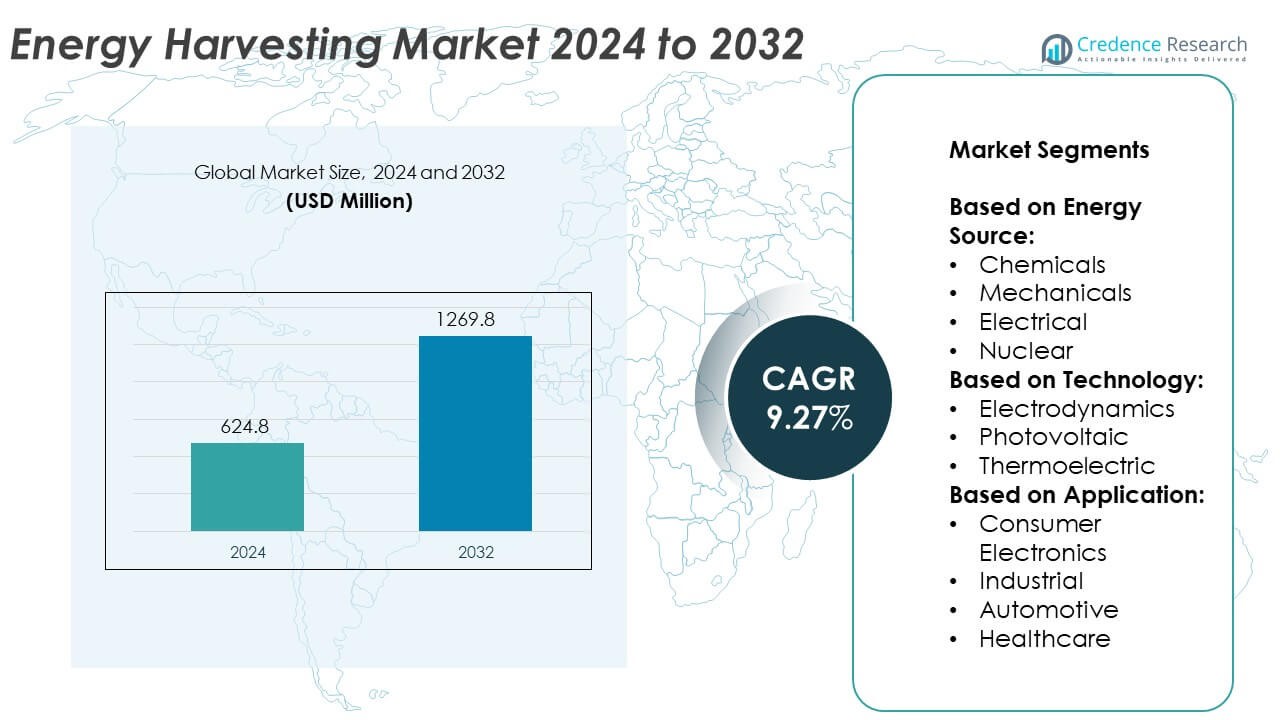
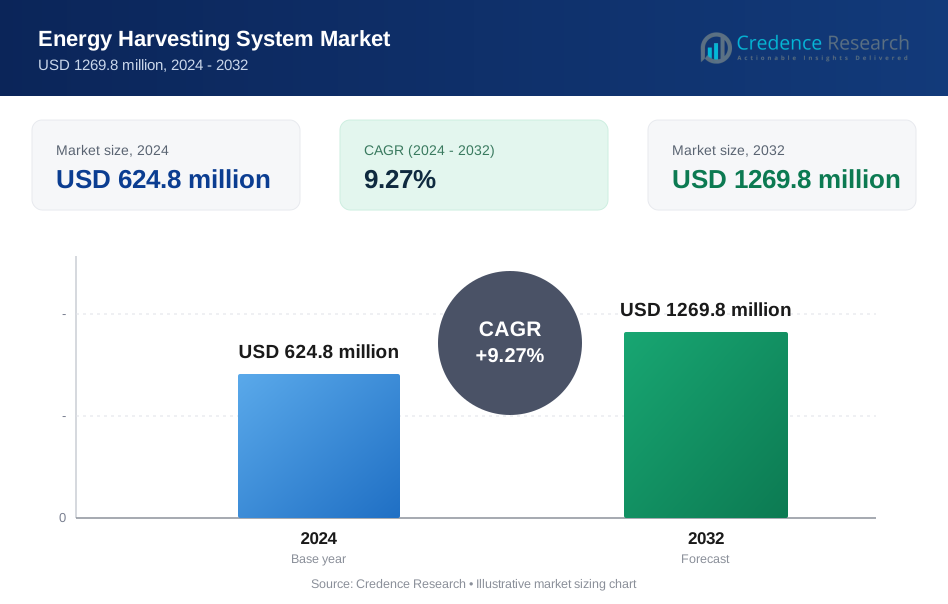
The Global Energy Harvesting System Market size was valued at USD 624.8 million in 2024 and is anticipated to reach USD 1269.8 million by 2032, at a CAGR of 9.27% during the forecast period.
| REPORT ATTRIBUTE | DETAILS |
|---|---|
| Historical Period | 2020-2024 |
| Base Year | 2024 |
| Forecast Period | 2025-2032 |
| Energy Harvesting System Market Size 2024 | USD 624.8 Million |
| Energy Harvesting System Market , CAGR | 9.27% |
| Energy Harvesting System Market Size 2032 | USD 1269.8 Million |
The Energy Harvesting System Market is driven by the increasing demand for sustainable energy solutions, advancements in technology, and the growth of IoT devices. Rising environmental concerns and government regulations are pushing industries to adopt renewable energy sources. Technological innovations in photovoltaic, thermoelectric, and electrodynamic systems are enhancing efficiency and expanding applications. The market also benefits from the miniaturization of devices and the integration of energy harvesting into consumer electronics, industrial sensors, and automotive systems.
The Energy Harvesting System Market is experiencing significant growth across various regions, driven by advancements in renewable energy and sustainability initiatives. North America and Europe lead the adoption of energy harvesting technologies, particularly in industrial applications, IoT devices, and consumer electronics. Asia-Pacific is also emerging as a key region with increasing investments in renewable energy and smart infrastructure. Key players driving this market include ABB, known for its industrial automation solutions ,energy efficient technologies, and STMicroelectronics, which focuses on innovative energy harvesting systems for IoT applications. These companies are leading the way in developing advanced and cost-effective energy solutions.
Market Insights
- The Energy Harvesting System Market was valued at USD 624.8 million in 2024 and is projected to reach USD 1269.8 million by 2032, growing at a CAGR of 9.27% during the forecast period.
- Increasing demand for sustainable energy solutions and technological advancements are key drivers of the market’s growth.
- The growth of IoT devices and the need for self-sustaining power sources are fueling demand for energy harvesting technologies across various sectors.
- Trends in the market include miniaturization of devices, integration of hybrid energy harvesting systems, and the growing adoption of energy harvesting in consumer electronics and industrial applications.
- Competitive analysis reveals that key players like ABB, Honeywell, and STMicroelectronics are leading the market by providing innovative solutions tailored to various industrial and consumer applications.
- Market restraints include high initial costs and limited energy capture efficiency, especially in low-energy environments, affecting widespread adoption.
- North America and Europe are the leading regions in the Energy Harvesting market, driven by strong technological advancements and regulatory support for sustainability. The Asia-Pacific region is also witnessing increased adoption, particularly in industrial and automotive applications.
Market Drivers
Growing Demand for Sustainable Energy Solutions
The increasing focus on renewable and sustainable energy solutions is driving the Energy Harvesting market. With growing environmental concerns and regulatory pressure to reduce carbon footprints, businesses and industries are increasingly seeking alternative energy sources. Energy harvesting provides a viable solution by capturing ambient energy, such as solar, thermal, and kinetic energy, to power low-energy devices. It aligns with global initiatives toward sustainable practices and supports the transition to cleaner energy systems. This demand for sustainable solutions is expanding the adoption of energy harvesting technologies across various sectors.
- For instance, EnOcean has developed a self-powered wireless switch using energy harvested from the surrounding light, eliminating the need for batteries. The technology has been deployed in over 1 million smart buildings, enabling energy-efficient lighting control systems.
Technological Advancements in Energy Harvesting Devices
Recent advancements in energy harvesting technologies have enhanced the performance and efficiency of devices, further boosting the Energy Harvesting market. Innovations in materials science, such as piezoelectric and thermoelectric materials, have improved the efficiency of energy capture from mechanical vibrations and heat sources. These technological improvements have led to the development of more compact, cost-effective, and reliable energy harvesting systems. As a result, industries can now integrate these systems into smaller devices and systems, widening their application scope across consumer electronics, healthcare, and automotive industries.
- For instance, Honeywell has integrated thermoelectric energy harvesting systems into industrial temperature sensors. These systems have been deployed in more than 200 factories worldwide, eliminating the need for external power sources and reducing maintenance costs.
Increasing Adoption of Internet of Things (IoT) Devices
The rapid growth of IoT devices is driving demand for energy harvesting technologies. With the proliferation of connected devices that require continuous power, energy harvesting presents an ideal solution to ensure uninterrupted operation without relying on traditional power sources. The Energy Harvesting market benefits from the integration of energy harvesting systems into IoT devices, such as sensors, wearables, and smart meters. It enables self-sustaining operation and reduces dependency on battery replacements, lowering operational costs and enhancing device longevity.
Government Initiatives and Regulatory Support
Government policies and regulatory frameworks supporting energy efficiency and renewable energy sources are major drivers of the Energy Harvesting market. Many governments are offering incentives, tax breaks, and funding to encourage the adoption of energy-efficient technologies. These initiatives foster the development and commercialization of energy harvesting systems in various applications, from industrial monitoring to smart cities. With regulatory pressure to meet energy consumption targets, organizations are increasingly integrating energy harvesting solutions to meet sustainability and energy efficiency standards.
Market Trends
Integration of Energy Harvesting in Consumer Electronics
The integration of energy harvesting technologies in consumer electronics is becoming a significant trend in the Energy Harvesting market. With the growing demand for smart devices and wearables, manufacturers are exploring energy-efficient solutions to extend battery life. Energy harvesting systems, such as those capturing kinetic energy from movement or solar energy, are being incorporated into devices like smartwatches, fitness trackers, and wireless sensors. These innovations contribute to the development of self-sustaining devices, reducing the need for frequent battery replacements and enhancing the user experience.
- For instance, Texas Instruments has introduced a power management chip designed specifically for IoT sensors powered by energy harvesting systems. This chip has been integrated into over 500,000 IoT devices globally, enabling wireless operation without requiring battery replacements.
Advancements in Miniaturization of Energy Harvesting Devices
The trend towards miniaturization in energy harvesting devices is gaining traction across various industries. As technologies evolve, there is a growing emphasis on designing smaller, more efficient systems that can be embedded into a wide range of products. The Energy Harvesting market is benefiting from these advances, with compact energy harvesters being integrated into wearables, medical implants, and industrial sensors. These devices enable uninterrupted operation in constrained environments, where traditional power sources may not be feasible. Smaller, more efficient harvesters are also lowering the cost of adoption, broadening their use across various sectors.
- For instance, Power's technology is now being used in over 50 commercial installations, including remote environmental monitoring stations, demonstrating the effectiveness of government initiatives in promoting the adoption of energy harvesting solutions for sustainability and energy efficiency across various sectors.
Expansion of Energy Harvesting in Industrial Applications
Energy harvesting is increasingly being adopted in industrial applications, particularly for powering sensors and monitoring systems. In industries such as manufacturing, logistics, and construction, the need for real-time data collection without frequent maintenance is pushing the adoption of energy harvesting technologies. It enables the deployment of wireless sensors in remote or hard-to-reach locations without the need for external power sources. This trend is leading to improved operational efficiency and reduced maintenance costs, making energy harvesting a preferred solution for industrial IoT devices.
Growing Role of Hybrid Energy Harvesting Systems
Hybrid energy harvesting systems, which combine multiple energy sources such as solar, thermal, and vibration, are gaining popularity in the Energy Harvesting market. These systems offer greater reliability and efficiency by utilizing energy from various environmental sources. The increasing demand for hybrid solutions is driven by their ability to optimize energy capture in diverse environments. Hybrid systems are being integrated into smart infrastructure, automotive applications, and off-grid energy solutions, offering enhanced versatility and reduced dependence on a single energy source.
Market Challenges Analysis
High Initial Costs and Limited Cost-Effectiveness
One of the primary challenges facing the Energy Harvesting market is the high initial cost of implementation. While energy harvesting technologies offer long-term savings and sustainability, the upfront investment required for research, development, and installation can be significant. This is particularly challenging for smaller businesses and industries that may not have the financial capacity to adopt these systems. Despite their potential for cost savings in the long term, the initial expense of energy harvesting devices, especially for large-scale applications, often limits their widespread adoption, particularly in cost-sensitive sectors.
Energy Capture Efficiency and Limited Power Output
Energy harvesting systems often struggle with energy capture efficiency and limited power output, especially in low-energy environments. While advancements in technology have improved performance, these systems still face limitations in capturing and converting ambient energy effectively across diverse applications. For the Energy Harvesting market, optimizing power output without compromising device size or efficiency remains a critical hurdle. In some use cases, such as industrial monitoring or wearable devices, the energy harvested may not be sufficient to meet the power demands, requiring supplementary energy sources or frequent maintenance, which can reduce the overall appeal of these systems.
Market Opportunities
Expansion of Energy Harvesting in IoT and Smart Devices
The increasing adoption of Internet of Things (IoT) devices presents a significant opportunity for the Energy Harvesting market. With the proliferation of smart devices, sensors, and wearables, the need for efficient, self-sustaining power solutions is growing. Energy harvesting technologies can provide continuous power to these devices, reducing the reliance on traditional batteries and minimizing maintenance. As IoT applications expand across sectors such as healthcare, agriculture, and home automation, energy harvesting offers an attractive solution for powering low-energy devices in remote or difficult-to-access locations. This trend opens up new avenues for energy harvesting technologies to integrate seamlessly into the IoT ecosystem, boosting their demand and application.
Growing Focus on Sustainable and Off-Grid Energy Solutions
The rising global demand for sustainable and off-grid energy solutions offers another key opportunity for the Energy Harvesting market. With increasing efforts to reduce dependence on conventional power grids and minimize environmental impacts, energy harvesting technologies provide an efficient, renewable power source for remote locations and off-grid applications. Industries such as agriculture, construction, and outdoor operations are increasingly seeking ways to power sensors, monitoring systems, and small devices in isolated areas. Energy harvesting can enable these sectors to adopt cleaner, more sustainable energy solutions, further promoting its integration in global energy strategies and expanding its market potential.
Market Segmentation Analysis:
By Energy Source:
The Energy Harvesting market is segmented by energy source into chemicals, mechanicals, electrical, and nuclear. Chemical energy harvesting systems capture and convert energy from chemical reactions, often used in small-scale applications such as sensors and batteries. Mechanical energy harvesting, driven by kinetic or vibrational forces, is widely used in industrial applications to power sensors and wearables. Electrical energy harvesting captures energy from sources like radio waves and electromagnetic fields, powering devices such as wireless communication equipment. Nuclear energy harvesting, though less common, is a niche segment that focuses on utilizing radioactive decay or thermal energy for specific high-demand applications.
- For instance, STMicroelectronics developed a thermoelectric energy harvesting system for automotive applications, capturing heat energy from vehicle exhaust systems to power low-power devices like tire pressure monitoring sensors. The system has been integrated into over 50,000 vehicles, improving energy efficiency in automotive applications.
By Technology:
The market is also segmented by technology into electrodynamics, photovoltaic, and thermoelectric systems. Electrodynamic harvesting captures energy from motion through the interaction of magnetic fields, commonly used in automotive and industrial applications. Photovoltaic energy harvesting, which relies on solar energy, is the most widely adopted technology for energy harvesting, powering a wide range of devices from consumer electronics to remote sensors. Thermoelectric energy harvesting converts heat differences into electrical power, making it suitable for applications in automotive and industrial sectors where temperature gradients are present. Each of these technologies offers unique advantages in different settings, based on the energy requirements and environmental conditions.
- For instance, Philips has developed energy harvesting solutions for wearable healthcare devices, capturing kinetic energy to power continuous health monitoring systems. These devices are currently used in over 200,000 patient monitoring applications globally.
By Application:
In terms of application, the Energy Harvesting market spans across consumer electronics, industrial, automotive, and healthcare sectors. Consumer electronics have the largest share, as energy harvesting technologies help extend battery life and reduce the need for frequent recharging, especially in wearables and wireless devices. The industrial sector is another key adopter, where energy harvesting powers monitoring systems, sensors, and remote devices in harsh environments. In automotive applications, energy harvesting is integrated into electric vehicles and advanced driver-assistance systems to improve energy efficiency. Healthcare applications, particularly in medical devices and implants, are increasingly adopting energy harvesting to reduce dependence on batteries, providing longer device lifespans and improved reliability.
Segments:
Based on Energy Source:
- Chemicals
- Mechanicals
- Electrical
- Nuclear
Based on Technology:
- Electrodynamics
- Photovoltaic
- Thermoelectric
Based on Application:
- Consumer Electronics
- Industrial
- Automotive
- Healthcare
Based on the Geography:
- North America
- U.S.
- Canada
- Mexico
- Europe
- UK
- France
- Germany
- Italy
- Spain
- Russia
- Belgium
- Netherlands
- Austria
- Sweden
- Poland
- Denmark
- Switzerland
- Rest of Europe
- Asia Pacific
- China
- Japan
- South Korea
- India
- Australia
- Thailand
- Indonesia
- Vietnam
- Malaysia
- Philippines
- Taiwan
- Rest of Asia Pacific
- Latin America
- Brazil
- Argentina
- Peru
- Chile
- Colombia
- Rest of Latin America
- Middle East
- UAE
- KSA
- Israel
- Turkey
- Iran
- Rest of Middle East
- Africa
- Egypt
- Nigeria
- Algeria
- Morocco
- Rest of Africa
Regional Analysis
North America
North America holds the largest market share in the Energy Harvesting market, accounting for 40% of the global market. The region’s leadership is driven by advanced technological innovations, high levels of investment in renewable energy, and the increasing adoption of energy-efficient solutions across various industries. The United States and Canada have been particularly active in deploying energy harvesting technologies in applications such as industrial automation, consumer electronics, and IoT devices. The demand for sustainable energy solutions, coupled with government incentives promoting energy efficiency, has further propelled the growth of the market. The strong presence of major energy harvesting companies and increased investments in R&D have significantly contributed to the dominance of this region.
Europe
Europe holds a significant market share of 28% in the global Energy Harvesting market, owing to the region’s commitment to sustainability and green energy solutions. Countries like Germany, the UK, and France are leading the adoption of energy harvesting technologies, particularly in industrial applications, consumer electronics, and smart buildings. The European Union’s stringent regulations regarding energy efficiency and environmental sustainability have pushed industries to adopt energy harvesting systems in an effort to meet compliance standards. Moreover, Europe’s strong automotive and healthcare sectors are integrating energy harvesting technologies to power sensors and wearables, thus driving market growth.
Asia-Pacific
Asia-Pacific accounts for 22% of the global Energy Harvesting market, with China, Japan, and India emerging as key contributors. China’s large-scale adoption of renewable energy and industrial automation technologies has made it a leading player in the market. Japan has made significant advancements in the use of photovoltaic and thermoelectric energy harvesting, particularly in consumer electronics and automotive industries. India, with its growing focus on renewable energy and smart cities, is increasingly integrating energy harvesting solutions for IoT applications and industrial sensors. The region’s rapid industrialization and the push for green energy solutions are expected to further accelerate the market’s growth in the coming years.
Latin America
Latin America holds a smaller market share of 5% in the Energy Harvesting market. However, the region is seeing a gradual increase in the adoption of renewable energy solutions, particularly in Brazil and Mexico. In these countries, energy harvesting technologies are being incorporated into remote monitoring systems, renewable energy projects, and industrial sensors. While the adoption rate is currently lower compared to other regions, government initiatives aimed at promoting energy efficiency and reducing carbon emissions are expected to boost the market in Latin America over the next few years. Additionally, the growing interest in off-grid energy solutions in rural areas is opening up new opportunities for energy harvesting technologies.
Middle East and Africa
The Middle East and Africa region also holds a smaller market share of 5% in the global Energy Harvesting market. Despite being a relatively smaller market, there is a growing emphasis on sustainable energy solutions in countries like Saudi Arabia, the UAE, and South Africa. These nations are investing in renewable energy sources, with solar power being a major focus. Energy harvesting solutions are increasingly being integrated into off-grid systems, particularly in remote and energy-deficient areas, where conventional power infrastructure is limited. The ongoing development of smart cities and the adoption of energy-efficient solutions in industries like oil and gas, construction, and transportation are expected to support market growth in the region.
Key Player Analysis
- ABB
- Advanced Linear Devices
- Cedrat Technologies
- EnOcean
- Fujitsu
- Honeywell
- Kinergizer
- Laird Connectivity
- Mide Technology
- Mouser Electronics
- Perpetua Power
- Powercast
- Renesas Electronics
- STMicroelectronics
- Texas Instruments
- ZF Friedrichshafen
Competitive Analysis
Key players in the Energy Harvesting market include ABB, Honeywell, STMicroelectronics, Fujitsu, Texas Instruments, Powercast, and Perpetua Power. These companies are at the forefront of developing advanced energy harvesting technologies across various applications such as industrial automation, IoT, and consumer electronics. ABB has made significant strides in the industrial automation space, offering energy-efficient solutions that integrate energy harvesting systems to improve operational efficiency. Honeywell focuses on providing smart and energy-efficient solutions across various sectors, leveraging its expertise in sensor technologies. STMicroelectronics leads with its innovations in low-power energy harvesting devices, particularly for IoT and wearable applications. Companies like Powercast and Perpetua Power are pioneers in wireless energy transfer and ultra-low power energy harvesting systems, catering to the growing demand for self-sustaining IoT devices and sensors. Texas Instruments continues to innovate in low-power semiconductor solutions, while Fujitsu’s energy harvesting systems are making their mark in remote and off-grid applications. These companies are actively investing in R&D to enhance the efficiency and scalability of energy harvesting technologies. Competitive strategies include expanding product portfolios, forming strategic partnerships, and exploring emerging markets to capture growing demand in renewable energy and IoT applications.
Recent Developments
- In 2025, ABB is recognized as a major player in the energy harvesting market, involved in providing efficient and secure solutions for both conventional and renewable power generation.
- In 2025, EnOcean GmbH is listed among the key companies driving innovation in energy harvesting systems, focusing on wireless sensor networks and sustainable electronics.
- In 2025, Mouser Electronics: Provides a broad range of Energy Harvesting applications and products, and highlights the growing energy harvesting market reliant on ultra-low-power MCUs.
Market Concentration & Characteristics
The Energy Harvesting market is moderately concentrated, with a mix of established global players and emerging startups. It is characterized by continuous innovation, particularly in energy efficiency and technology integration. Large corporations, such as ABB, Honeywell, and STMicroelectronics, dominate the market through their strong R&D capabilities, broad product portfolios, and global presence. These players focus on providing energy harvesting solutions across industries like industrial automation, consumer electronics, and automotive. Smaller companies, such as Powercast and Perpetua Power, contribute to market diversity by specializing in wireless energy transfer and ultra-low power solutions. The market is highly competitive, with companies investing heavily in research to enhance energy capture efficiency, reduce costs, and expand application ranges. Regulatory support for sustainable energy solutions and growing demand for energy-efficient devices drive the market, creating opportunities for both established and new entrants. The emphasis on developing hybrid systems and integrating energy harvesting into IoT devices further fuels the market's evolution.
Report Coverage
The research report offers an in-depth analysis based on Energy Source, Technology, Application and Geography. It details leading market players, providing an overview of their business, product offerings, investments, revenue streams, and key applications. Additionally, the report includes insights into the competitive environment, SWOT analysis, current market trends, as well as the primary drivers and constraints. Furthermore, it discusses various factors that have driven market expansion in recent years. The report also explores market dynamics, regulatory scenarios, and technological advancements that are shaping the industry. It assesses the impact of external factors and global economic changes on market growth. Lastly, it provides strategic recommendations for new entrants and established companies to navigate the complexities of the market.
Future Outlook
- The Energy Harvesting market is expected to see continued growth driven by increasing demand for sustainable and self-sustaining energy solutions.
- Advancements in technology, particularly in photovoltaic, thermoelectric, and electrodynamic systems, will improve the efficiency and cost-effectiveness of energy harvesting devices.
- The proliferation of IoT devices and wearables will significantly boost the adoption of energy harvesting solutions, reducing dependency on traditional batteries.
- Hybrid energy harvesting systems, integrating multiple energy sources, are likely to gain traction due to their ability to capture energy more efficiently.
- Consumer electronics will continue to be a major application area, with energy harvesting technologies extending the lifespan of devices and reducing the need for frequent charging.
- Industrial sectors will adopt energy harvesting technologies for powering remote sensors, machinery, and monitoring systems in harsh environments.
- The automotive industry will increasingly incorporate energy harvesting to power sensors and systems in electric and autonomous vehicles.
- Emerging markets, particularly in Asia-Pacific and Latin America, will witness significant adoption of energy harvesting solutions as infrastructure development and sustainability initiatives grow.
- Government policies focused on sustainability and energy efficiency will drive the adoption of energy harvesting systems in various industries.
- The market will become more competitive as new players emerge and established companies expand their portfolios to meet the growing demand for renewable energy solutions.
Request a Free Sample
Fill in your details and we'll send you a free sample report.
- Sample data tables & charts
- Research methodology
Need a Custom Version of This Report?
Tailor the scope, geography, or segments to your exact requirements.
- Custom geography or segment scope
- Direct access to our analyst team
Frequently Asked Questions
What is the current market size for the Energy Harvesting System market, and what is its projected size in 2032?
At what Compound Annual Growth Rate is the Energy Harvesting System Market projected to grow between 2025 and 2032?
What are the primary factors fueling the growth of the Energy Harvesting System market?
Who are the leading companies in the Energy Harvesting System Market?
Table of Content
Chapter 1. Report Introduction
- 1.1 Report Description & Purpose
- 1.1.1 Report Title & Market Definition
- 1.1.2 Unique Selling Propositions (USP) & Key Differentiators
- 1.1.3 Value Proposition for Stakeholders
- 1.2 Research Objectives
- 1.2.1 Market Sizing Objectives (Volume & Revenue)
- 1.2.2 Segmentation Objectives
- 1.2.3 Competitive Intelligence Objectives
- 1.2.4 Forecast & Scenario Objectives
- 1.3 Report Scope
- 1.3.1 Energy Harvesting System Scope – Types & Subtypes Covered
- 1.3.2 Geographic Scope – Regions & Countries Covered
- 1.3.3 Historical Period, Base Year & Forecast Period (2024; forecast to 2032)
- 1.3.4 Inclusions & Exclusions
- 1.4 HS Code & Classification Framework
- 1.5 Currency, Units & Pricing Basis
- 1.6 Target Stakeholders
- 1.7 Limitations & Assumptions
Chapter 2. Executive Summary
- 2.1 Global Energy Harvesting System Market Snapshot
- 2.1.1 Market Size – Historical (2024) & Forecast (2024-2032) (2024: USD 624.8 million → 2032: USD 1269.8 million)
- 2.1.2 Volume & Revenue – Global Totals
- 2.1.3 Key Market Highlights – Top Five Facts
- 2.2 Energy Harvesting System Market Segmentation Snapshot
- 2.2.1 Market Split by Region – 2024 vs. 2032
- 2.3 Competitive Snapshot
- 2.3.1 Top 10 Players by Revenue Share – 2024
- 2.3.2 Top 10 Players by Volume Share – 2024
- 2.3.3 Recent Strategic Developments (18-Month Summary)
- 2.4 Key Investment Highlights & Strategic Conclusions
Chapter 3. Energy Harvesting System Market Dynamics & Industry Analysis
- 3.1 Market Overview & Context
- 3.1.1 Energy Harvesting System Market Position in the Broader Automotive Value Chain
- 3.1.2 OEM vs. Replacement Market Dynamics
- 3.1.3 Market Maturity & Development Stage by Region
- 3.2 Energy Harvesting System Market Drivers
- 3.3 Energy Harvesting System Market Restraints & Challenges
- 3.4 Energy Harvesting System Market Opportunities
- 3.5 Porter's Five Forces Analysis
- 3.5.1 Threat of New Entrants
- 3.5.2 Bargaining Power of Suppliers
- 3.5.3 Bargaining Power of Buyers
- 3.5.4 Threat of Substitutes
- 3.5.5 Competitive Rivalry – Intensity Assessment
- 3.6 Energy Harvesting System Value Chain Analysis
- 3.6.1 Upstream – Raw Material/Input Suppliers
- 3.6.1.1 Raw Material/Input 1
- 3.6.1.2 Raw Material/Input 2
- 3.6.1.3 Raw Material/Input 3
- 3.6.2 Midstream – Production/Manufacturing/Service Delivery
- 3.6.2.1 Production/Process Overview
- 3.6.2.2 Key Facility Locations & Capacity by Manufacturer
- 3.6.3 Downstream – Distribution & End Consumer
- 3.6.3.1 Primary Channel – B2B/OEM
- 3.6.3.2 Secondary Channels – Dealer, Retail, Online, Direct
- 3.6.4 Value Chain Profitability Analysis
- 3.6.1 Upstream – Raw Material/Input Suppliers
- 3.7 PESTEL Analysis
- 3.7.1 Political Factors
- 3.7.2 Economic Factors
- 3.7.3 Social Factors
- 3.7.4 Technological Factors
- 3.7.5 Environmental Factors
- 3.7.6 Legal Factors
- 3.8 Energy Harvesting System Supply Chain Analysis
- 3.8.1 Raw Material/Input Supply Risk Assessment
- 3.8.2 Manufacturing Concentration Risk (Geographic Exposure)
- 3.8.3 Trade Disruption Impact Analysis
- 3.9 Regulatory & Policy Landscape
Note: The regulatory and policy landscape section covers regulations based on their applicability to the market, Energy Harvesting System category, geography, and scope of the study. Only regulatory frameworks with a material impact on operations, compliance, trade, sustainability, or market access are analyzed in detail.
Chapter 4. Key Investment Pockets & Opportunity Analysis
- 4.1 Energy Harvesting System Market Attractiveness Analysis
- 4.1.1 By Region – Investment Attractiveness Matrix (Volume × CAGR)
- 4.2 Absolute Revenue Growth Opportunity
- 4.2.1 By Region – Absolute USD Growth Through 2032
- 4.3 Incremental Volume Opportunity
- 4.3.1 By Region – Incremental Volume Through 2032
- 4.3.2 Segment – Incremental Volume
- 4.4 Emerging Submarket Opportunity Deep Dive (Subject to Applicability)
- 4.5 Emerging Market Opportunity Scorecards
- 4.5.1 United States
- 4.5.2 Europe
- 4.5.3 Asia
- 4.5.4 Middle East & Africa
Note: Emerging Market Opportunity Scorecards will be included based on relevance and strategic importance. Regions listed are indicative and may vary depending on data availability and market dynamics.
Chapter 5. Energy Harvesting System Import-Export Analysis & Trade Flows
- 5.1 Global Trade Overview
- 5.1.1 Global Export Value by Country (2024)
- 5.1.2 Global Export Volume by Country (2024)
- 5.1.3 Global Import Value by Country (2024)
- 5.1.4 Global Import Volume by Country (2024)
- 5.1.5 Net Trade Balance by Country (2024)
- 5.2 Export Analysis – Segment
- 5.2.1 Type 1 (HS Code)
- 5.2.2 Type 2 (HS Code)
- 5.2.3 Type 3 (HS Code)
- 5.2.4 Type 4 (HS Code)
- 5.2.5 Type 5 (HS Code)
- 5.3 Import Analysis – Segment
- 5.3.1 Type 1 (HS Code)
- 5.3.2 Type 2 (HS Code)
- 5.3.3 Type 3 (HS Code)
- 5.3.4 Type 4 (HS Code)
- 5.3.5 Type 5 (HS Code)
- 5.4 Average Unit Trade Prices
- 5.4.1 Average Export Price – Segment & Country
- 5.4.2 Average Import Price – Segment & Source Country
- 5.4.3 Price Trends (2024)
- 5.5 Key Trade Route Analysis
- 5.5.1 Trade Route 1
- 5.5.2 Trade Route 2
- 5.5.3 Trade Route 3
- 5.5.4 Trade Route 4
- 5.5.5 Trade Route 5
- 5.6 Trade Policy Impact Assessment
- 5.6.1 US Anti-Dumping & Section 301 Tariffs
- 5.6.2 EU Customs Union Impact
- 5.6.3 Major Free Trade Agreements
- 5.6.4 USMCA Rules of Origin
Note: Trade policy analysis will be included only where relevant to the Energy Harvesting System market.
Chapter 6. Competitive Landscape & Company Benchmarking
- 6.1 Energy Harvesting System Market Concentration & Structure
- 6.1.1 Herfindahl-Hirschman Index (HHI) – vs. 2024
- 6.1.2 Tier 1, Tier 2 & Tier 3 Market Structure
- 6.1.3 Global, Regional & Local Player Dynamics
- 6.2 Energy Harvesting System Market Share Analysis – 2024
- 6.2.1 Global Revenue Share by Company
- 6.2.2 Global Volume Share by Company
- 6.2.3 Regional Revenue Share
- 6.2.4 Market Share Evolution ( vs. 2024)
- 6.2.5 OEM Segment Share by Company
- 6.2.6 Replacement Segment Share by Company
- 6.3 Production/Delivery Capacity & Facility Analysis
- 6.3.1 Global Installed Capacity
- 6.3.2 Capacity Utilization Rates
- 6.3.3 Production/Output Volume
- 6.3.4 Facility Locations & Capacity Map
- 6.3.5 Planned Capacity Additions
- 6.4 Energy Harvesting System Competitive Benchmarking Matrix
- 6.4.1 Revenue, Volume, CAGR & Profitability Comparison
- 6.4.2 Channel Revenue Mix
- 6.4.3 Geographic Revenue Exposure
- 6.4.4 R&D Intensity
- 6.4.5 Sustainability Maturity
- 6.5 Strategic Developments in Energy Harvesting System (Last 24 Months)
- 6.5.1 Mergers, Acquisitions & Divestments
- 6.5.2 New Energy Harvesting System Launches
- 6.5.3 Facility Expansions
- 6.5.4 Strategic Alliances, Joint Ventures & Partnerships
- 6.5.5 Distribution Expansion & Market Entry
- 6.5.6 Sustainability & ESG Initiatives
- 6.6 Competitive Strategy Mapping
- 6.6.1 Leader, Challenger, Follower & Niche Classification
- 6.6.2 Pricing Strategy Comparison
- 6.6.3 Channel Strategy Matrix
Note: Strategic developments are included based on their materiality and the availability of reliable information.
Chapter 7. Global Energy Harvesting System Market – By Distribution Channel
- 7.1 Segment Overview
- 7.1.1 Volume & Revenue Split by Channel (2024 & 2032)
- 7.1.2 Channel Mix Evolution (2024-2032)
Chapter 8. Regional Market Analysis – Global Overview
- 8.1 Global Regional Overview
- 8.1.1 Regional Volume Share
- 8.1.2 Regional Revenue Share
- 8.1.3 Regional Volume by Region
- 8.1.4 Regional Revenue by Region
- 8.1.5 Regional Forecast Through 2032
- 8.2 Cross-Regional Segment Analysis
- 8.2.1 By Distribution Channel
- 8.2.2 By Brand/Price Tier
Chapter 9. North America Energy Harvesting System Market
- 9.1 United States
- 9.2 Canada
- 9.3 Mexico
Chapter 10. Europe Energy Harvesting System Market
- 10.1 Germany
- 10.2 France
- 10.3 Italy
- 10.4 United Kingdom
- 10.5 Spain
- 10.6 Poland
- 10.7 Russia
- 10.8 Netherlands
- 10.9 Belgium
- 10.10 Sweden
- 10.11 Denmark
- 10.12 Norway
- 10.13 Rest of Europe
Chapter 11. Asia Pacific Energy Harvesting System Market
- 11.1 China
- 11.2 India
- 11.3 Japan
- 11.4 South Korea
- 11.5 Thailand
- 11.6 Indonesia
- 11.7 Vietnam
- 11.8 Malaysia
- 11.9 Australia
- 11.10 Rest of Asia Pacific
Chapter 12. Latin America Energy Harvesting System Market
- 12.1 Brazil
- 12.2 Argentina
- 12.3 Colombia
- 12.4 Chile
- 12.5 Rest of Latin America
Chapter 13. Middle East Energy Harvesting System Market
- 13.1 Saudi Arabia
- 13.2 United Arab Emirates
- 13.3 Turkey
- 13.4 Israel
- 13.5 Iran
- 13.6 Rest of the Middle East
Chapter 14. Africa Energy Harvesting System Market
- 14.1 South Africa
- 14.2 Egypt
- 14.3 Nigeria
- 14.4 Morocco
- 14.5 Rest of Africa
Chapter 15. Energy Harvesting System Company Profiles
- 15.1 [Company 01]
- 15.1.1 Company Overview
- 15.1.2 Key Management Personnel
- 15.1.3 Products & Services Portfolio
- 15.1.4 Financial Performance
- 15.1.5 Key Market Focus & Geographic Presence
- 15.1.6 Recent Developments & Strategic Initiatives
Note: The company profile list is preliminary and may change based on research findings, market developments, data availability, and client requirements.
Chapter 16. Appendices
- Appendix A – List of Abbreviations & Acronyms
- Appendix B – Industry Classification Code Reference – Full Series
- Appendix C – Production & Capacity Data Tables
- Appendix D – End-Use & Demand Base Tables
- Appendix E – Consumption & Replacement Rate Assumptions
- Appendix F – ASP Reference Tables
- Appendix G – Manufacturing & Facility Database
- Appendix H – Import-Export Data Tables
- Appendix I – Regulatory Summary Tables
- Appendix J – Primary Research Participant List (Anonymized)
- Appendix K – Primary Research Questionnaire Framework
- Appendix L – Data Sources & Bibliography
- Appendix M – Market Size Divergence & Source Comparison
Chapter 17. Research Methodology
- 17.1 Research Framework & Philosophy
- 17.2 Secondary Research – Sources, Hierarchy & Data Extraction
- 17.3 Data Modeling – Bottom-Up & Top-Down Market Sizing
- 17.4 Primary Research – Stakeholder Framework, LOI & Sample Sizes
- 17.5 Forecast Methodology – Regression, Scenario & Sensitivity Analysis
- 17.6 Quality Control – Four-Layer Validation Framework
- 17.7 Limitations & Standard Assumptions
- 17.8 Disclaimer
