
| REPORT ATTRIBUTE | DETAILS |
|---|---|
| Historical Period | 2019-2022 |
| Base Year | 2023 |
| Forecast Period | 2024-2032 |
| Farm Management Software Market Size 2024 | USD 3,505 Million |
| Farm Management Software Market, CAGR | 11% |
| Farm Management Software Market Size 2032 | USD 8,077.404 Million |
Market Overview
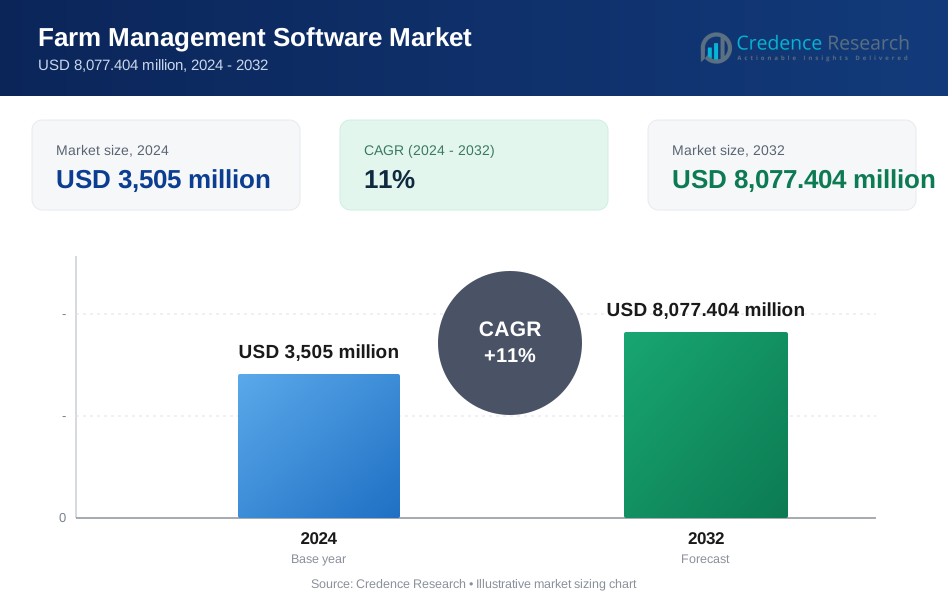
The Farm Management Software Market is projected to grow from USD 3,505 million in 2024 to USD 8,077.404 million by 2032, reflecting a robust compound annual growth rate (CAGR) of 11%.
The Farm Management Software Market is driven by increasing demand for precision agriculture and the need for improved farm productivity. Technological advancements, such as IoT integration and data analytics, enhance decision-making and operational efficiency. Additionally, rising awareness of sustainable farming practices fuels the adoption of software solutions that optimize resource use and minimize environmental impact. The trend toward cloud-based solutions offers flexibility and scalability, making farm management more accessible to growers of all sizes. Furthermore, government initiatives promoting digital agriculture are accelerating the integration of farm management software into everyday farming operations, fostering growth in this dynamic market.
The Farm Management Software Market exhibits significant geographical diversity, with North America leading due to advanced agricultural practices and high technology adoption rates, holding over 35% of the market share. Europe follows closely, representing approximately 28% of the market, driven by sustainability initiatives and regulatory support for precision farming. Key players in this market include Trimble Inc., Deere & Company, and IBM, alongside innovative firms like AGRIVI and Farmers Edge. These companies are at the forefront of developing cutting-edge solutions that enhance farm productivity and efficiency, thereby driving the growth of the farm management software sector worldwide.
Market Drivers
Rising Demand for Food Security and Productivity
The global population is steadily increasing, resulting in heightened demand for food production. This demographic shift necessitates efficient food production systems, particularly as urbanization continues to draw more people into cities. According to the Food and Agriculture Organization (FAO), despite significant pesticide use, a substantial portion of global crop yields is still lost to pests and diseases, underscoring the urgent need for enhanced agricultural productivity. Farmers are now challenged to innovate and enhance productivity to meet this rising demand while ensuring food security.
Advancements in Technology
Recent advancements in technology play a crucial role in transforming farm management practices. The integration of IoT and sensors allows for real-time monitoring of essential farm parameters, including soil moisture, temperature, and crop health. For instance, soil sensors can provide critical data on moisture levels and temperature, enabling farmers to adjust their practices accordingly. Furthermore, artificial intelligence and machine learning empower farmers to analyze vast datasets, optimizing operations, predicting crop yields, and improving decision-making. Additionally, cloud computing offers scalable and accessible solutions, making farm management more cost-effective and efficient.
Increasing Need for Precision Agriculture
The growing focus on precision agriculture emphasizes the need for resource optimization. By employing precision techniques, farmers can utilize water, fertilizers, and pesticides more efficiently, leading to significant yield improvements. Tailoring agricultural practices to specific field conditions enables farmers to maximize crop output while minimizing environmental impacts. This approach fosters environmental sustainability by reducing waste and pollution associated with traditional farming methods.
Government Initiatives and Subsidies
Governments worldwide are taking proactive steps to support the modernization of agriculture through initiatives and subsidies. They promote the adoption of advanced agricultural technologies, aiming to boost productivity and sustainability in the sector. Financial incentives, such as grants and subsidies, encourage farmers to invest in farm management software and related technologies, facilitating a transition toward more efficient and environmentally friendly farming practices.
Market Trends
Integration of IoT, AI, and Cloud-Based Solutions
The Farm Management Software Market is experiencing transformative advancements through the integration of IoT, sensors, and artificial intelligence (AI). For instance, a survey conducted by the United States Department of Agriculture (USDA) indicated that the use of IoT devices in agriculture has significantly increased, providing farmers with real-time data on critical parameters such as soil moisture and crop health. This influx of information enables farmers to make informed, data-driven decisions, enhancing operational efficiency and mitigating risks. AI and machine learning (ML) technologies are increasingly utilized for predictive analytics, allowing farmers to forecast crop yields and identify potential disease outbreaks. A recent report highlighted that AI-powered systems are automating essential tasks such as irrigation and fertilization, which not only boosts productivity but also reduces labor costs. Additionally, AI-powered systems automate key tasks like irrigation, fertilization, and harvesting, improving productivity and reducing labor costs. Cloud-based solutions complement these technologies by offering scalability and flexibility, allowing farmers to access their data and applications from anywhere, making farm management more cost-effective compared to traditional on-premise systems. These integrated technologies are revolutionizing the farming industry by optimizing operations and enhancing decision-making capabilities.
Focus on Sustainability, Mobile Applications, and Data Security
Sustainability is becoming a central focus in the Farm Management Software Market, with solutions increasingly designed to help farmers minimize their environmental impact. By optimizing resource use and reducing waste, farm management software plays a critical role in supporting environmentally conscious farming practices. Tools for measuring and reducing carbon emissions are also becoming more prevalent, aligning with the growing global emphasis on sustainability. Mobile applications further enhance farm management by providing farmers with easy access to their data and tools on the go, offering intuitive interfaces for better user experiences. This ease of access encourages wider adoption of farm management software, particularly in developing countries where government initiatives and affordability are driving growth. Meanwhile, as the collection and storage of agricultural data expand, data security and privacy have become essential considerations. Farm management software providers are increasingly focusing on ensuring data protection and compliance with relevant regulations, addressing growing concerns about the safety and privacy of sensitive farming information.
Market Challenges Analysis
Technology Adoption and Data Quality Challenges
One of the major challenges in the Farm Management Software Market is technology adoption, especially for farmers with limited digital literacy skills. For instance, a study indicated that many farmers struggle to effectively use advanced software systems due to a lack of familiarity with digital tools. Many farmers struggle to effectively use advanced software systems due to a lack of familiarity with digital tools. Furthermore, the initial investment required for hardware, software, and training presents a significant financial barrier for small and medium-scale farmers. Reliable internet connectivity, critical for the operation of cloud-based farm management systems, is also limited in rural areas, which can hinder adoption. Another significant challenge revolves around data quality and accuracy. The effectiveness of farm management software depends heavily on the reliability of sensors used to gather real-time data, such as soil moisture and crop health. If sensors malfunction or deliver inaccurate readings, the software’s insights can be compromised. Additionally, human errors in data entry can lead to inaccuracies in analysis and decision-making, further reducing the effectiveness of these solutions.
Interoperability, Customization, and Market Pressures
Interoperability and integration issues also pose challenges for the farm management software market. With varying levels of compatibility between different systems, such as weather stations, irrigation systems, and software solutions, farmers often struggle to seamlessly integrate their tools for efficient operations. Data sharing between stakeholders, including farmers, cooperatives, and government agencies, adds another layer of complexity. Customization and flexibility are further hurdles, as the diverse needs of farms—based on size, crop type, and location—make it difficult for developers to create one-size-fits-all solutions. Tailoring software to meet the specific requirements of each farm is often expensive and time-consuming. Additionally, software providers face mounting challenges with regulatory compliance, especially regarding data privacy and adherence to industry standards, which can be costly to navigate. The saturated market also intensifies competition, leading to pricing pressures and making it difficult for software providers to differentiate their products while maintaining profitability in this growing industry.
Market Segmentation Analysis:
By Offering:
The Farm Management Software Market is segmented by offering into on-cloud, on-premise, and data analytics services. On-cloud solutions dominate the market due to their scalability, flexibility, and accessibility, allowing farmers to access data from any location with an internet connection. This model is especially appealing to small and medium-sized farms that prefer lower initial costs and easier software updates. On-premise solutions, while offering more control and customization, are more suited for larger farms with the infrastructure and resources to manage in-house systems. These systems typically require a higher initial investment but offer enhanced data privacy and customization options. Data analytics services are increasingly gaining traction as they enable farmers to make data-driven decisions, optimize resource use, and predict crop yields. With advancements in IoT and AI, these services are becoming integral to modern farm management, offering insights that improve productivity and sustainability across farms of all sizes.
By Farm Size:
The farm management software market is also segmented by farm size into small, medium, and large farms. Small farms typically face challenges related to budget constraints and limited technological expertise, making affordable and easy-to-use software essential. On-cloud solutions are particularly popular among small farms as they offer low upfront costs and ease of access without the need for extensive infrastructure. Medium-sized farms benefit from more advanced features that balance cost and capability, enabling them to adopt solutions that improve operational efficiency while remaining cost-effective. Large farms, on the other hand, require comprehensive farm management systems capable of handling complex operations. These farms often opt for both on-premise solutions and data analytics services to ensure precise control, automation, and the integration of multiple data points for optimal resource management. Large-scale operations prioritize solutions that enhance productivity and streamline processes across vast areas of land and diverse crop or livestock operations.
Segments:
Based on Offering
- On-cloud
- On-premise
- Data Analytics Services
Based on Farm Size
- Small
- Medium
- Large
Based on Farm Production
- Pre-production Planning
- Production Planning
- Post-production Planning
Based on Application
- Precision Farming
- Precision Livestock
- Precision Aquaculture
- Precision Forestry
- Smart Greenhouses
- Other Applications
Based on the Geography:
- North America
- U.S.
- Canada
- Mexico
- Europe
- Germany
- France
- U.K.
- Italy
- Spain
- Rest of Europe
- Asia Pacific
- China
- Japan
- India
- South Korea
- South-east Asia
- Rest of Asia Pacific
- Latin America
- Brazil
- Argentina
- Rest of Latin America
- Middle East & Africa
- GCC Countries
- South Africa
- Rest of the Middle East and Africa
Regional Analysis
North America
North America holds a significant market share, accounting for over 35% of the global Farm Management Software Market. The region’s dominance is driven by advanced farming practices, widespread adoption of digital technologies, and strong infrastructure, particularly in the United States. Farmers across North America increasingly rely on on-cloud solutions for their flexibility and cost-effectiveness, especially on small and medium-sized farms. Government initiatives supporting precision agriculture, along with high investment in R&D for IoT and AI technologies, further propel the adoption of farm management software in this region. Data analytics services are also in high demand, helping large farms optimize productivity and resource management.
Europe
Europe holds the second-largest market share in the Farm Management Software Market, representing around 28% of the global market. The region’s growth is fueled by the European Union’s focus on sustainable farming practices and stringent environmental regulations, which drive demand for software solutions that optimize resource use and reduce environmental impact. Countries like Germany, France, and the Netherlands lead the adoption of cloud-based solutions and data analytics services, particularly among medium and large farms. The rising emphasis on sustainability and the integration of precision agriculture techniques are key factors contributing to the rapid growth of farm management software in Europe.
Key Player Analysis
- AGRIVI (UK)
- Trimble Inc. (US)
- Granular Inc. (US)
- Climate LLC (US)
- Agworld Pty Ltd (US)
- Raven Industries, Inc. (US)
- TOPCON CORPORATION (Japan)
- AgJunction LLC (US)
- Farmers Edge Inc. (Canada)
- IBM (US)
- Afimilk Ltd. (Israel)
- ABACO S.p.A. (Italy)
- Deere & Company (US)
- Microsoft (US)
Competitive Analysis
The competitive landscape of the Farm Management Software Market is characterized by several key players, including Trimble Inc., Deere & Company, IBM, AGRIVI, Farmers Edge, Granular Inc., Climate LLC, Raven Industries, Agworld Pty Ltd, and TOPCON CORPORATION. These companies leverage advanced technologies such as IoT, AI, and data analytics to provide innovative solutions that enhance farm productivity and operational efficiency. Companies differentiate themselves by offering comprehensive platforms that cater to various farm sizes and production needs, focusing on user-friendly interfaces and scalable solutions. Additionally, there is a growing emphasis on integrating AI-driven data analytics to empower farmers with actionable insights. As the market witnesses increasing demand for sustainability and precision agriculture, firms are continuously enhancing their offerings and forming strategic partnerships to meet the evolving demands of modern agriculture. This competitive environment fosters rapid innovation and development, ensuring that solutions remain effective and relevant in addressing the challenges faced by the agricultural sector.
Recent Developments
- In October 2023, AGRIVI joined forces with ReddAgro, a leading Agri-Tech firm known for its expertise in precision farming, greenhouse control and automation, and agricultural supply chain management solutions. Together, they aim to transform farming methods, fostering innovation and sustainability across the agricultural sector in Jordan, Sudan, Saudi Arabia, Egypt, and Iraq. Both ReddAgro and AGRIVI are aligned in their vision of a more sustainable and efficient agricultural future. Through this partnership, they seek to bring this vision to fruition by leveraging their respective strengths, knowledge, and international presence.
- In September 2023, Trimble Inc. disclosed a definitive agreement to establish a joint venture with AGCO, aiming to enhance support for farmers in the mixed fleet precision agriculture market through factory-fitted and aftermarket applications. Together, Trimble and AGCO share the vision of creating a global leader in smart farming and autonomy solutions for mixed fleets.
- In June 2023, TOPCON CORPORATION introduced significant advancements to its cloud-based software platform, TAP FEED management, catering to dairy and beef operations. The platform now offers several options, including the free TAP FEED App and subscription-based choices like TAP FEED Lite and TAP FEED Pro, designed specifically for dairy producers. Additionally, Topcon Agriculture has unveiled the TAP FEED Advisor customer management tool, tailored for feed advisors, consultants, and nutritionists.
- In August 2023, Raven Industries indeed stands out as a frontrunner in the realm of agricultural technology, consistently demonstrating its dedication to advancing farming practices through innovative solutions. By forging strategic partnerships and leveraging its expertise in innovation, Raven not only enhances its own offerings but also contributes to the overall efficiency and productivity of the agricultural sector.
- In November 2023, Kubota and Chouette have collaborated aimed at creating solutions that minimize the use of chemical pesticides while also reducing the labor needed for growth monitoring. This partnership integrates Chouette's AI-driven technology, which detects diseases and assesses growth issues through vineyard imagery, with Kubota's tractors and sprayers. The result is the generation of maps highlighting optimal locations and volumes for chemical application, enhancing efficiency and sustainability in agricultural practices.
Market Concentration & Characteristics
The Farm Management Software Market exhibits a moderate level of concentration, characterized by a mix of established players and emerging startups. While a few key companies dominate the landscape, numerous smaller firms contribute to innovation and competition, driving the development of specialized solutions tailored to specific agricultural needs. This dynamic environment encourages collaboration among technology providers, agronomists, and farmers to enhance software functionalities and address diverse farming challenges. The market is characterized by rapid technological advancements, particularly in areas such as data analytics, IoT, and artificial intelligence, which are increasingly integrated into farm management solutions. Furthermore, the growing emphasis on precision agriculture and sustainability is shaping product offerings, prompting companies to develop tools that optimize resource use and improve overall farm efficiency. As a result, the Farm Management Software Market is evolving rapidly, with a strong focus on user-friendly interfaces, scalability, and data-driven insights to support modern agricultural practices.
Report Coverage
The research report offers an in-depth analysis based on Offering, Farm Size, Farm Production, Application and Geography. It details leading market players, providing an overview of their business, product offerings, investments, revenue streams, and key applications. Additionally, the report includes insights into the competitive environment, SWOT analysis, current market trends, as well as the primary drivers and constraints. Furthermore, it discusses various factors that have driven market expansion in recent years. The report also explores market dynamics, regulatory scenarios, and technological advancements that are shaping the industry. It assesses the impact of external factors and global economic changes on market growth. Lastly, it provides strategic recommendations for new entrants and established companies to navigate the complexities of the market.
Future Outlook
- The Farm Management Software Market is expected to continue growing at a significant rate, driven by increasing demand for sustainable agricultural practices.
- Advancements in artificial intelligence and machine learning will enhance data analytics capabilities, providing farmers with more accurate predictions and insights.
- The integration of IoT devices will facilitate real-time monitoring and management of farm operations, improving efficiency and productivity.
- Cloud-based solutions will become more prevalent, offering scalability and flexibility for farmers of all sizes.
- Increasing smartphone penetration will lead to the rise of mobile applications, enabling farmers to manage operations on the go.
- There will be a greater emphasis on precision agriculture, as farmers seek to optimize resource use and reduce environmental impact.
- Partnerships and collaborations among technology providers and agricultural stakeholders will drive innovation in software solutions.
- Regulatory support and government initiatives will encourage the adoption of farm management software in developing regions.
- Data security and privacy concerns will prompt software providers to enhance their security measures and compliance with regulations.
- The market will witness a shift towards user-friendly interfaces, making technology more accessible to farmers with varying levels of digital literacy.
Request a Free Sample
Fill in your details and we'll send you a free sample report.
- Sample data tables & charts
- Research methodology
Need a Custom Version of This Report?
Tailor the scope, geography, or segments to your exact requirements.
- Custom geography or segment scope
- Direct access to our analyst team
Frequently Asked Questions
What is the current size of the Farm Management Software Market?
What factors are driving the growth of the Farm Management Software Market?
What are the key segments within the Farm Management Software Market?
What are some challenges faced by the Farm Management Software Market?
Who are the major players in the Farm Management Software Market?
Table of Content
Chapter 1. Report Introduction
- 1.1 Report Description & Purpose
- 1.1.1 Report Title & Market Definition
- 1.1.2 Unique Selling Propositions (USP) & Key Differentiators
- 1.1.3 Value Proposition for Stakeholders
- 1.2 Research Objectives
- 1.2.1 Market Sizing Objectives (Volume & Revenue)
- 1.2.2 Segmentation Objectives
- 1.2.3 Competitive Intelligence Objectives
- 1.2.4 Forecast & Scenario Objectives
- 1.3 Report Scope
- 1.3.1 Farm Management Software Scope – Types & Subtypes Covered
- 1.3.2 Geographic Scope – Regions & Countries Covered
- 1.3.3 Historical Period, Base Year & Forecast Period (2024; forecast to 2032)
- 1.3.4 Inclusions & Exclusions
- 1.4 HS Code & Classification Framework
- 1.5 Currency, Units & Pricing Basis
- 1.6 Target Stakeholders
- 1.7 Limitations & Assumptions
Chapter 2. Executive Summary
- 2.1 Global Farm Management Software Market Snapshot
- 2.1.1 Market Size – Historical (2024) & Forecast (2024-2032) (2024: USD 3,505 million → 2032: USD 8,077.404 million)
- 2.1.2 Volume & Revenue – Global Totals
- 2.1.3 Key Market Highlights – Top Five Facts
- 2.2 Farm Management Software Market Segmentation Snapshot
- 2.2.1 Market Split by Region – 2024 vs. 2032
- 2.3 Competitive Snapshot
- 2.3.1 Top 10 Players by Revenue Share – 2024
- 2.3.2 Top 10 Players by Volume Share – 2024
- 2.3.3 Recent Strategic Developments (18-Month Summary)
- 2.4 Key Investment Highlights & Strategic Conclusions
Chapter 3. Farm Management Software Market Dynamics & Industry Analysis
- 3.1 Market Overview & Context
- 3.1.1 Farm Management Software Market Position in the Broader Automotive Value Chain
- 3.1.2 OEM vs. Replacement Market Dynamics
- 3.1.3 Market Maturity & Development Stage by Region
- 3.2 Farm Management Software Market Drivers
- 3.3 Farm Management Software Market Restraints & Challenges
- 3.4 Farm Management Software Market Opportunities
- 3.5 Porter's Five Forces Analysis
- 3.5.1 Threat of New Entrants
- 3.5.2 Bargaining Power of Suppliers
- 3.5.3 Bargaining Power of Buyers
- 3.5.4 Threat of Substitutes
- 3.5.5 Competitive Rivalry – Intensity Assessment
- 3.6 Farm Management Software Value Chain Analysis
- 3.6.1 Upstream – Raw Material/Input Suppliers
- 3.6.1.1 Raw Material/Input 1
- 3.6.1.2 Raw Material/Input 2
- 3.6.1.3 Raw Material/Input 3
- 3.6.2 Midstream – Production/Manufacturing/Service Delivery
- 3.6.2.1 Production/Process Overview
- 3.6.2.2 Key Facility Locations & Capacity by Manufacturer
- 3.6.3 Downstream – Distribution & End Consumer
- 3.6.3.1 Primary Channel – B2B/OEM
- 3.6.3.2 Secondary Channels – Dealer, Retail, Online, Direct
- 3.6.4 Value Chain Profitability Analysis
- 3.6.1 Upstream – Raw Material/Input Suppliers
- 3.7 PESTEL Analysis
- 3.7.1 Political Factors
- 3.7.2 Economic Factors
- 3.7.3 Social Factors
- 3.7.4 Technological Factors
- 3.7.5 Environmental Factors
- 3.7.6 Legal Factors
- 3.8 Farm Management Software Supply Chain Analysis
- 3.8.1 Raw Material/Input Supply Risk Assessment
- 3.8.2 Manufacturing Concentration Risk (Geographic Exposure)
- 3.8.3 Trade Disruption Impact Analysis
- 3.9 Regulatory & Policy Landscape
Note: The regulatory and policy landscape section covers regulations based on their applicability to the market, Farm Management Software category, geography, and scope of the study. Only regulatory frameworks with a material impact on operations, compliance, trade, sustainability, or market access are analyzed in detail.
Chapter 4. Key Investment Pockets & Opportunity Analysis
- 4.1 Farm Management Software Market Attractiveness Analysis
- 4.1.1 By Region – Investment Attractiveness Matrix (Volume × CAGR)
- 4.2 Absolute Revenue Growth Opportunity
- 4.2.1 By Region – Absolute USD Growth Through 2032
- 4.3 Incremental Volume Opportunity
- 4.3.1 By Region – Incremental Volume Through 2032
- 4.3.2 Segment – Incremental Volume
- 4.4 Emerging Submarket Opportunity Deep Dive (Subject to Applicability)
- 4.5 Emerging Market Opportunity Scorecards
- 4.5.1 United States
- 4.5.2 Europe
- 4.5.3 Asia
- 4.5.4 Middle East & Africa
Note: Emerging Market Opportunity Scorecards will be included based on relevance and strategic importance. Regions listed are indicative and may vary depending on data availability and market dynamics.
Chapter 5. Farm Management Software Import-Export Analysis & Trade Flows
- 5.1 Global Trade Overview
- 5.1.1 Global Export Value by Country (2024)
- 5.1.2 Global Export Volume by Country (2024)
- 5.1.3 Global Import Value by Country (2024)
- 5.1.4 Global Import Volume by Country (2024)
- 5.1.5 Net Trade Balance by Country (2024)
- 5.2 Export Analysis – Segment
- 5.2.1 Type 1 (HS Code)
- 5.2.2 Type 2 (HS Code)
- 5.2.3 Type 3 (HS Code)
- 5.2.4 Type 4 (HS Code)
- 5.2.5 Type 5 (HS Code)
- 5.3 Import Analysis – Segment
- 5.3.1 Type 1 (HS Code)
- 5.3.2 Type 2 (HS Code)
- 5.3.3 Type 3 (HS Code)
- 5.3.4 Type 4 (HS Code)
- 5.3.5 Type 5 (HS Code)
- 5.4 Average Unit Trade Prices
- 5.4.1 Average Export Price – Segment & Country
- 5.4.2 Average Import Price – Segment & Source Country
- 5.4.3 Price Trends (2024)
- 5.5 Key Trade Route Analysis
- 5.5.1 Trade Route 1
- 5.5.2 Trade Route 2
- 5.5.3 Trade Route 3
- 5.5.4 Trade Route 4
- 5.5.5 Trade Route 5
- 5.6 Trade Policy Impact Assessment
- 5.6.1 US Anti-Dumping & Section 301 Tariffs
- 5.6.2 EU Customs Union Impact
- 5.6.3 Major Free Trade Agreements
- 5.6.4 USMCA Rules of Origin
Note: Trade policy analysis will be included only where relevant to the Farm Management Software market.
Chapter 6. Competitive Landscape & Company Benchmarking
- 6.1 Farm Management Software Market Concentration & Structure
- 6.1.1 Herfindahl-Hirschman Index (HHI) – vs. 2024
- 6.1.2 Tier 1, Tier 2 & Tier 3 Market Structure
- 6.1.3 Global, Regional & Local Player Dynamics
- 6.2 Farm Management Software Market Share Analysis – 2024
- 6.2.1 Global Revenue Share by Company
- 6.2.2 Global Volume Share by Company
- 6.2.3 Regional Revenue Share
- 6.2.4 Market Share Evolution ( vs. 2024)
- 6.2.5 OEM Segment Share by Company
- 6.2.6 Replacement Segment Share by Company
- 6.3 Production/Delivery Capacity & Facility Analysis
- 6.3.1 Global Installed Capacity
- 6.3.2 Capacity Utilization Rates
- 6.3.3 Production/Output Volume
- 6.3.4 Facility Locations & Capacity Map
- 6.3.5 Planned Capacity Additions
- 6.4 Farm Management Software Competitive Benchmarking Matrix
- 6.4.1 Revenue, Volume, CAGR & Profitability Comparison
- 6.4.2 Channel Revenue Mix
- 6.4.3 Geographic Revenue Exposure
- 6.4.4 R&D Intensity
- 6.4.5 Sustainability Maturity
- 6.5 Strategic Developments in Farm Management Software (Last 24 Months)
- 6.5.1 Mergers, Acquisitions & Divestments
- 6.5.2 New Farm Management Software Launches
- 6.5.3 Facility Expansions
- 6.5.4 Strategic Alliances, Joint Ventures & Partnerships
- 6.5.5 Distribution Expansion & Market Entry
- 6.5.6 Sustainability & ESG Initiatives
- 6.6 Competitive Strategy Mapping
- 6.6.1 Leader, Challenger, Follower & Niche Classification
- 6.6.2 Pricing Strategy Comparison
- 6.6.3 Channel Strategy Matrix
Note: Strategic developments are included based on their materiality and the availability of reliable information.
Chapter 7. Global Farm Management Software Market – By Distribution Channel
- 7.1 Segment Overview
- 7.1.1 Volume & Revenue Split by Channel (2024 & 2032)
- 7.1.2 Channel Mix Evolution (2024-2032)
Chapter 8. Regional Market Analysis – Global Overview
- 8.1 Global Regional Overview
- 8.1.1 Regional Volume Share
- 8.1.2 Regional Revenue Share
- 8.1.3 Regional Volume by Region
- 8.1.4 Regional Revenue by Region
- 8.1.5 Regional Forecast Through 2032
- 8.2 Cross-Regional Segment Analysis
- 8.2.1 By Distribution Channel
- 8.2.2 By Brand/Price Tier
Chapter 9. North America Farm Management Software Market
- 9.1 United States
- 9.2 Canada
- 9.3 Mexico
Chapter 10. Europe Farm Management Software Market
- 10.1 Germany
- 10.2 France
- 10.3 Italy
- 10.4 United Kingdom
- 10.5 Spain
- 10.6 Poland
- 10.7 Russia
- 10.8 Netherlands
- 10.9 Belgium
- 10.10 Sweden
- 10.11 Denmark
- 10.12 Norway
- 10.13 Rest of Europe
Chapter 11. Asia Pacific Farm Management Software Market
- 11.1 China
- 11.2 India
- 11.3 Japan
- 11.4 South Korea
- 11.5 Thailand
- 11.6 Indonesia
- 11.7 Vietnam
- 11.8 Malaysia
- 11.9 Australia
- 11.10 Rest of Asia Pacific
Chapter 12. Latin America Farm Management Software Market
- 12.1 Brazil
- 12.2 Argentina
- 12.3 Colombia
- 12.4 Chile
- 12.5 Rest of Latin America
Chapter 13. Middle East Farm Management Software Market
- 13.1 Saudi Arabia
- 13.2 United Arab Emirates
- 13.3 Turkey
- 13.4 Israel
- 13.5 Iran
- 13.6 Rest of the Middle East
Chapter 14. Africa Farm Management Software Market
- 14.1 South Africa
- 14.2 Egypt
- 14.3 Nigeria
- 14.4 Morocco
- 14.5 Rest of Africa
Chapter 15. Farm Management Software Company Profiles
- 15.1 [Company 01]
- 15.1.1 Company Overview
- 15.1.2 Key Management Personnel
- 15.1.3 Products & Services Portfolio
- 15.1.4 Financial Performance
- 15.1.5 Key Market Focus & Geographic Presence
- 15.1.6 Recent Developments & Strategic Initiatives
Note: The company profile list is preliminary and may change based on research findings, market developments, data availability, and client requirements.
Chapter 16. Appendices
- Appendix A – List of Abbreviations & Acronyms
- Appendix B – Industry Classification Code Reference – Full Series
- Appendix C – Production & Capacity Data Tables
- Appendix D – End-Use & Demand Base Tables
- Appendix E – Consumption & Replacement Rate Assumptions
- Appendix F – ASP Reference Tables
- Appendix G – Manufacturing & Facility Database
- Appendix H – Import-Export Data Tables
- Appendix I – Regulatory Summary Tables
- Appendix J – Primary Research Participant List (Anonymized)
- Appendix K – Primary Research Questionnaire Framework
- Appendix L – Data Sources & Bibliography
- Appendix M – Market Size Divergence & Source Comparison
Chapter 17. Research Methodology
- 17.1 Research Framework & Philosophy
- 17.2 Secondary Research – Sources, Hierarchy & Data Extraction
- 17.3 Data Modeling – Bottom-Up & Top-Down Market Sizing
- 17.4 Primary Research – Stakeholder Framework, LOI & Sample Sizes
- 17.5 Forecast Methodology – Regression, Scenario & Sensitivity Analysis
- 17.6 Quality Control – Four-Layer Validation Framework
- 17.7 Limitations & Standard Assumptions
- 17.8 Disclaimer
