
| REPORT ATTRIBUTE | DETAILS |
|---|---|
| Historical Period | 2019-2022 |
| Base Year | 2023 |
| Forecast Period | 2024-2032 |
| Floating Solar Panels Market Size 2023 | USD 1958.20 Million |
| Floating Solar Panels Market, CAGR | 16.20% |
| Floating Solar Panels Market Size 2032 | USD 7563.32 Million |
Market Insights
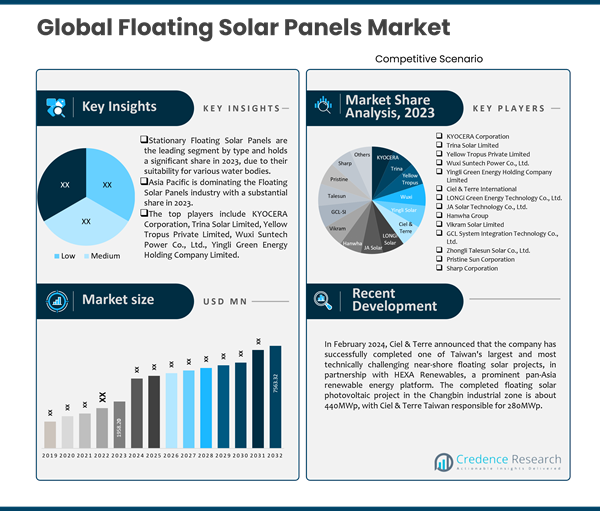
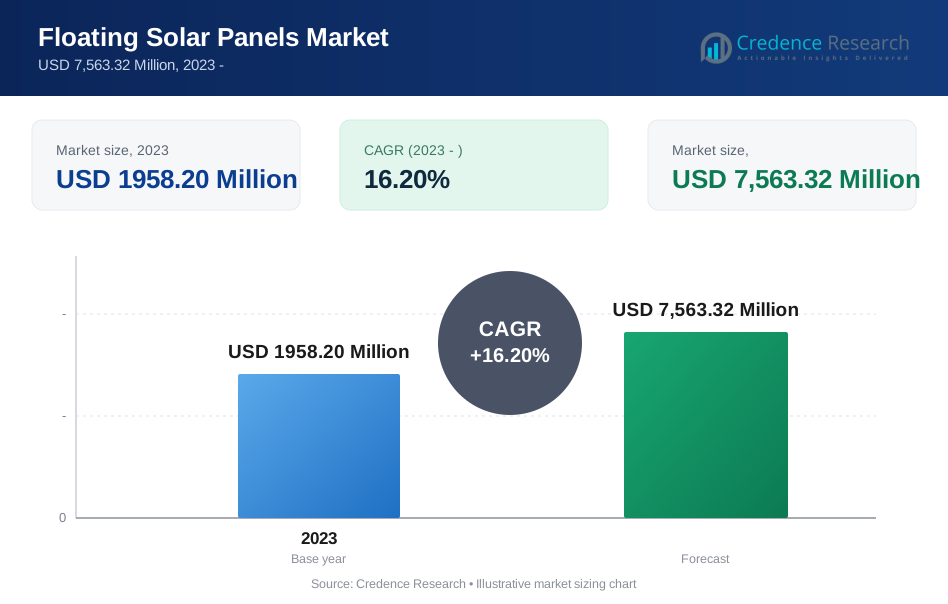
- The global demand for floating solar panels was valued at USD 1958.20 Million in 2023 and is expected to reach USD 7563.32 Million in 2032, growing at a CAGR of 16.20% between 2024 and 2032.
- The stationary floating solar panels are the market leader by type, accounting for a significant portion of total value in 2023, while the solar tracking floating solar panels segment is expected to grow rapidly throughout the forecast period.
- The 5 MW - 50 MW segment dominates the market in terms of capacity, accounting for a significant portion in 2023. The above 50 MW segment is predicted to expand at a high CAGR.
- Over the projection period, monocrystalline silicon technology is expected to expand at the highest rate, while polycrystalline silicon dominates the market in 2023 with a substantial share.
- Asia Pacific is dominating the floating solar panels industry with a substantial share in 2023, while Asia Pacific is expected to grow at the highest rate during the forecast period.
- The market's primary possibilities include innovative floating structures that maximize energy capture, advanced photovoltaic technologies that increase efficiency, scalable installation solutions to meet varying energy demands, and integrated energy storage systems to ensure consistent power supply.
Executive Summary
Market Definition
Floating solar panels, also known as floating photovoltaic (FPV) systems, are solar panels mounted on bodies of water, such as lakes, reservoirs, and ponds, instead of being installed on land. These systems utilize the water surface to host photovoltaic modules, which convert sunlight into electricity through semiconductor materials like silicon.
Floating solar panels work similarly to traditional land-based solar arrays but offer unique advantages. They benefit from the natural cooling effect of water, which enhances solar panel efficiency and lifespan by reducing heat-induced degradation.
Additionally, their installation helps to conserve land space, making them particularly suitable for densely populated areas where land availability is limited. Floating solar panels also reduce water evaporation from reservoirs and provide opportunities for dual land-water use, such as combining solar energy generation with water resource management. This innovative approach to solar energy production contributes to sustainable energy practices while leveraging underutilized water surfaces for renewable power generation.
Market Overview
The global floating solar panels market has witnessed steady growth in recent years and is expected to grow at a CAGR of 16.20% between 2024 and 2032. The market was valued at USD 1958.20 million in 2023 and is expected to reach USD 7563.32 million in 2032.
The floating solar panels market is experiencing significant growth due to the limited availability of land for traditional solar panel installations in several densely populated regions. Floating solar panels offer a solution by utilizing water surfaces such as lakes, reservoirs, and other bodies of water. Moreover, by using water surfaces, the environmental impact associated with land use is minimized. This leads to less deforestation, habitat disruption, and soil degradation.
Furthermore, government investments and policies are significant in driving the growth of the floating solar panels market. Financial incentives, such as subsidies, grants, and tax credits, significantly offset the initial costs of installing floating solar panels, making these investments more attractive. Regulatory support, including renewable energy mandates and simplified permitting processes, creates a favorable environment for the adoption of floating solar technology. Additionally, public funding for research and development (R&D) helps drive innovation and reduce costs, further enhancing the competitiveness of floating solar solutions.
In addition, continuous technological advancements and innovations in the field of solar energy are further driving the global floating solar panels market. The development of more efficient and cost-effective photovoltaic (PV) technologies has significantly enhanced the viability and attractiveness of floating solar panels. Innovations such as bifacial solar panels, which can capture sunlight from both sides and advancements in floating structures that withstand harsh aquatic environments are making floating solar installations more durable and efficient, thereby increasing their adoption.
Segmentation by type
- Stationary Floating Solar Panels are the leading segment by type and hold a substantial share in 2023. These panels are simpler in design, easier to install, and generally more cost-effective compared to solar tracking systems. Their widespread adoption is driven by their suitability for various water bodies, including reservoirs, lakes, and ponds, making them the dominant segment in the market.
- Solar tracking floating solar panels are the fastest-growing segment due to their higher efficiency and energy output, as these systems can adjust the angle of the panels to follow the sun's trajectory throughout the day. Moreover, advancements in tracking technology, increasing demand for maximizing energy generation, and the growing interest in large-scale renewable energy projects are driving the rapid adoption of solar tracking floating solar panels.
Segmentation by Capacity
- The 5 MW - 50 MW segment boasts the dominating position in the floating solar panels industry, holding a massive share in 2023. Projects within this capacity range are optimal for balancing cost, installation complexity, and energy output, making them popular for both commercial and utility-scale applications. This segment's broad applicability to various settings and its ability to meet significant energy demands contribute to its dominant market share.
- The above 50 MW segment is expected to grow with the highest CAGR during the projected period due to the increasing number of large-scale projects aimed at maximizing renewable energy output. Governments and private sectors are investing heavily in large floating solar farms to meet rising energy needs and sustainability goals. Advances in technology and economies of scale are making high-capacity floating solar projects more feasible and attractive, thus driving the growth of this segment.
- The below 5 MW capacity segment holds a lower share compared to the 5MW-50MW segment.
Segmentation by Technology
- Polycrystalline silicon boasts the dominating position in the floating solar panels industry, holding an immense share in 2023 as they are widely used due to their cost-effectiveness and relatively high efficiency. They are easier and less expensive to manufacture compared to other panels, making them a popular choice for large-scale installations on water bodies.
- Monocrystalline Silicon is expected to grow at the highest rate due to the increasing demand for higher efficiency and better performance in solar panels. Monocrystalline panels offer higher efficiency and longer lifespan compared to polycrystalline and thin-film panels, making them increasingly attractive for new floating solar projects. As technology advances and production costs decrease, more projects are opting for monocrystalline silicon to maximize energy output and overall system performance.
- Thin film technology and other technologies contribute significantly to the growth of the market.
Segmentation by Region
- Asia Pacific is fuelling the growth of the floating solar panels industry with a massive share in 2023 due to
- Moreover, the Asia Pacific market is expected to grow at the highest rate during the forecasted period.
- The rest of the world, including Latin America, the Middle East, and Africa, supplies the remaining demand for the floating solar panels industry.
Asia Pacific holds the dominant share of the floating solar panels market and is expected to maintain its dominance during the forecast period. Moreover, the region is anticipated to be the fastest-growing market for floating solar panels during the forecast period. This growth can be attributed to increasing government initiatives and support, which are driving the adoption of floating solar panels across the region. For instance, in February 2022, the Government of India announced that under its Panchamrita agenda, the country aims to target of installing 500 gigawatts (GW) of renewable energy by 2030, including floating solar panels. In March 2024, the government of India laid the foundation stone for its largest floating solar power plant with a capacity of 15MW/22MWp.
Moreover, the presence of leading market players such as Trina Solar, Yellow Tropus Pvt. Ltd., Wuxi Suntech Power Co., Ltd., and LONGi Solar are continuously developing innovative floating solar technologies and expanding their business in the Asia Pacific region is further boosting the growth of the Market. For instance, in August 2022, Trina Solar secured a 50 MWac (71 MWdc) Floating Solar Photovoltaic (FPV) project in the Malaysian state of Sarawak. The project will be located at the Batang Ai Hydroelectric Plant and will be built on the plant's reservoir surface of 191.12 hectares.
Key Highlights of the Report
The global Floating Solar Panels Market is segmented by type, capacity, technology, and region. Stationary Floating Solar Panels are the most popular segment, while 5 MW - 50 MW is the primary capacity range. In addition, polycrystalline silicon is the most demanding technology, with the Asia Pacific region leading the market share.
The floating solar panels market is driven by limited land availability for traditional solar installations in densely populated areas. Additionally, government investments and policies play a crucial role in the market growth, offering financial incentives like subsidies, grants, and tax credits, as well as regulatory support through renewable energy mandates and streamlined permitting processes. Furthermore, technological advancements, including more efficient photovoltaic technologies and durable floating structures, improve the viability and appeal of floating solar panels, increasing their adoption.
Nonetheless, Asia Pacific is anticipated to have the greatest share of the worldwide Floating Solar Panels Market, driven by increasing government initiatives and support. Moreover, the presence of leading market players who are developing innovative technologies and expanding their businesses in the region further boosts market growth.
What Are the Main Drivers of the Global Floating Solar Panels Market?
The growth of the Floating Solar Panels Market is propelled by the limited land availability for traditional solar installations in densely populated regions. Moreover, government investments and policies also play a crucial role in market growth, offering financial incentives such as subsidies, grants, and tax credits and providing regulatory support through renewable energy mandates and simplified permitting processes. Additionally, technological advancements, including more efficient photovoltaic technologies and durable floating structures, enhance the viability and attractiveness of floating solar panels, boosting their adoption.
What Are the Major Challenges Faced by the Global Floating Solar Panels Market?
The global floating solar panels market faces significant restraint due to the high initial investment and installation costs. These expenses are substantially higher compared to traditional ground-mounted solar systems, as they require specialized materials and technologies to ensure stability and durability on water surfaces. Additionally, there are technical challenges and maintenance issues associated with water-based environments. These include the need for regular cleaning due to biofouling, potential corrosion from water exposure, and the complexity of anchoring and mooring systems, which can increase operational costs and deter potential investors.
What Are the Growth Opportunities in the Global Floating Solar Panels Market?
The integration of floating solar panels with other renewable energy technologies, such as wind or hydroelectric power, presents a significant opportunity for the global market. Hybrid systems can maximize energy production by leveraging the complementary nature of different energy sources. For instance, combining floating solar with hydroelectric plants can optimize water usage and energy generation, especially during dry seasons when water levels are low. This approach enhances overall energy efficiency and provides a more stable and reliable power supply. Additionally, hybrid systems can reduce the variability associated with solar energy, making renewable energy solutions more attractive to grid operators and utility companies.
Market Drivers
Growing Government Investment and Projects
One of the significant drivers propelling the global floating solar panels market is the increasing government investments and projects aimed at expanding renewable energy infrastructure. For instance, in April 2024, the U.S. government announced a funding of USD 19.5 million for multiple federal projects focusing on the deployment of solar panels over irrigation canals. This initiative is part of a broader strategy to enhance the country's renewable energy capacity and optimize land use.
These projects play a crucial role in boosting the market for floating solar panels. By leveraging existing water bodies such as irrigation canals, the installation of solar panels mitigates land use conflicts, reduces water evaporation, and enhances energy generation efficiency. Moreover, such government-backed projects provide financial support and create a favorable regulatory environment, encouraging private-sector participation and innovation in floating solar technology, thereby driving the growth of the market.
Market Restraints
High Installation and Maintenance Cost
The floating solar panels market faces significant restraint due to the high initial investment and installation costs associated with these systems. Unlike traditional ground-mounted or rooftop solar installations, floating solar systems require specialized equipment and materials to ensure durability and efficiency in water-based environments. The construction of floating platforms, anchoring systems, and electrical infrastructure capable of withstanding water exposure contributes to the elevated costs. Additionally, logistical challenges, such as transporting materials to remote water bodies and ensuring proper installation, further increase the initial expenditure. These factors often deter potential investors and project developers, especially in regions with limited financial resources or higher perceived risks, thereby slowing market growth.
Floating solar panels also encounter technical challenges and maintenance issues that can hinder their widespread adoption. Operating in aquatic environments subjects these systems to unique stresses, such as constant exposure to moisture, fluctuating water levels, and the potential for biofouling, where aquatic organisms accumulate on surfaces. These conditions can compromise the efficiency and longevity of solar panels, requiring more frequent maintenance and specialized cleaning methods to ensure optimal performance.
Additionally, the anchoring and mooring systems must be robust enough to withstand water currents, wind, and potentially extreme weather events, adding complexity and cost to the design and upkeep. These ongoing technical and maintenance challenges can lead to increased operational costs and downtime, making floating solar projects less attractive compared to traditional land-based solar installations.
Opportunities
Development of Hybrid Solar Systems Combining Floating Solar with Other Renewable Technologies
The development of hybrid solar systems presents a significant opportunity in the global floating solar panels market. By integrating floating solar panels with other renewable energy technologies, such as wind, hydro, or energy storage systems, the efficiency and reliability of power generation can be significantly enhanced. These hybrid systems can take advantage of complementary generation profiles, where solar power can be harnessed during sunny days, and wind or hydropower can compensate for cloudy or rainy conditions. This integration not only optimizes energy production but also provides a more consistent and reliable power supply, addressing one of the key challenges of renewable energy—intermittency. Moreover, the co-location of different renewable technologies can lead to shared infrastructure and maintenance costs, further driving down the overall expenses and making renewable energy projects more financially viable.
Additionally, the combination of floating solar with other renewable technologies can maximize the utilization of available space and resources. For instance, floating solar panels can be installed on reservoirs used for hydroelectric power, leveraging existing infrastructure and grid connections. This approach minimizes land use conflicts and can be particularly beneficial in regions with limited land availability but abundant water bodies. Furthermore, hybrid systems can enhance the energy resilience of local communities by providing a diversified energy mix, reducing dependency on a single power source. As the demand for clean and sustainable energy continues to grow, the development of such innovative hybrid systems will play a crucial role in advancing the adoption of renewable energy worldwide, making the floating solar panels market an attractive prospect for investors and stakeholders.
Competitive Landscape
Key Players
The global floating solar panels market is highly competitive, with several key players. Some of the major players in the market are as follows:
- KYOCERA Corporation
- Trina Solar Limited
- Yellow Tropus Private Limited
- Wuxi Suntech Power Co., Ltd.
- Yingli Green Energy Holding Company Limited (Yingli Solar)
- Ciel & Terre International
- LONGi Green Energy Technology Co., Ltd. (LONGi Solar)
- JA Solar Technology Co., Ltd.
- Hanwha Group
- Vikram Solar Limited
- GCL System Integration Technology Co., Ltd. (GCL-SI)
- Zhongli Talesun Solar Co., Ltd. (Talesun)
- Pristine Sun Corporation
- Sharp Corporation
These organizations prioritize business expansions, partnerships, and collaborations to stay competitive.
The global floating solar panels market's key players continually seek to stay ahead by expanding their businesses globally.
In February 2024, Ciel & Terre announced that the company has successfully completed one of Taiwan's largest and most technically challenging near-shore floating solar projects in partnership with HEXA Renewables, a prominent pan-Asia renewable energy platform. The completed floating solar photovoltaic project in the Changbin industrial zone is about 440MWp, with Ciel & Terre Taiwan responsible for 280MWp.
In September 2022, JA Solar announced that the company had completed the installation of a 10.7-MW floating solar park at the Tel Yitzhak Reservoir in Israel on behalf of local project developer S'energy. This project was part of a previously signed deal between the two companies for a total of 50 MW of capacity. The floating solar park utilizes JA Solar's DeepBlue 3.0 PV modules, which offer steady performance in high temperatures and humidity.
How are Companies Performing in the Floating Solar Panels Market?
The global floating solar panels market is highly competitive, with several key players.
Startups are playing a pivotal role in shaping the landscape of the floating solar panels industry, bringing innovation and fresh perspectives to the market.
Ocean Sun, a Norwegian startup, employs flexible floating structures equipped with silicon solar modules and proprietary non-permeable membranes. This design enhances thermal efficiency by maximizing contact with water bodies, offering a durable and cost-effective solution for floating solar power generation.
HelioRec, a French startup, pioneers end-to-end solar projects integrated with hydropower, focusing on minimizing carbon footprints and deployment costs. Their approach includes comprehensive feasibility studies and the use of recycled materials, reinforcing sustainability across their floating solar installations.
HELIOFLOAT, an Austrian startup, introduces floating concentrated solar power (CSP) platforms designed for offshore applications. These platforms maximize solar efficiency by minimizing shading issues and allowing natural cooling of solar panels, ensuring optimal performance and system reliability.
Summary of Key Findings
- The floating solar panels market is driven by limited land availability for traditional solar installations in densely populated areas. Additionally, government investments and policies play a crucial role in the market growth, offering financial incentives like subsidies, grants, and tax credits, as well as regulatory support through renewable energy mandates and streamlined permitting processes. Furthermore, technological advancements, including more efficient photovoltaic technologies and durable floating structures, improve the viability and appeal of floating solar panels, increasing their adoption.
- Market segmented by type, capacity, technology, and region.
- Asia Pacific is leading market growth; the market is highly competitive with key players, including KYOCERA Corporation, Trina Solar Limited, Yellow Tropus Private Limited, Wuxi Suntech Power Co., Ltd., Yingli Green Energy Holding Company Limited (Yingli Solar), Ciel & Terre International, LONGi Green Energy Technology Co., Ltd. (LONGi Solar), JA Solar Technology Co., Ltd., Hanwha Group, Vikram Solar Limited, GCL System Integration Technology Co., Ltd. (GCL-SI), Zhongli Talesun Solar Co., Ltd. (Talesun), Pristine Sun Corporation, and Sharp Corporation.
Future Outlook
- Positive outlook for the global floating solar panels market with significant growth potential in the Asia Pacific region.
- One of the main factors promoting the market's expansion is limited land availability for traditional solar installations, along with favorable government investments and policies.
- During the forecast period, High initial investment and installation costs, coupled with technical challenges and maintenance issues in water-based environments, act as significant restraints in the global floating solar panels market
- To stay competitive, key firms in the Floating Solar Panels Market should prioritize innovation in technology, cost-effective solutions, strategic partnerships, and sustainable practices.
How CXOs Can Benefit from the Credence Research Floating Solar Panels Market Report
The Credence Research Floating Solar Panels Market Report provides CXOs with a comprehensive overview of the market, including:
- Market size and growth forecast:The report provides detailed estimates of the global floating solar panels market size, segmented by type, capacity, technology, and region. It also includes forecasts for the market through 2032 based on key trends and drivers.
- Market segmentation:The report segments the Floating Solar Panels Market by type, capacity, application, and region. This segmentation provides CXOs with a granular understanding of the market and the opportunities in each segment.
- Competitive Landscape:The report profiles the key players in the Floating Solar Panels Market and provides insights into their strategies, product offerings, and financial performance. This information can help CXOs to identify and assess their competition.
- Key trends and drivers:The report identifies and analyses the key trends and drivers shaping the Floating Solar Panels Market. This information can help CXOs make informed decisions about their investments and strategies.
CXOs can use the insights from the Credence Research Floating Solar Panels Market Report to:
- Identify growth opportunities:The report can help CXOs to identify new growth opportunities in the Floating Solar Panels Market. For example, the report identifies emerging trends in floating solar panel technologies, regional market dynamics influencing adoption rates, and strategic partnerships that can enhance market penetration and technological innovation in the industry.
- Make informed investment decisions:The report can help CXOs make informed investment decisions about the floating solar panels industry. For example, it provides insights into the key factors to consider when evaluating and selecting floating solar panel providers.
- Develop competitive strategies:The report can help CXOs develop competitive strategies for their floating solar panels businesses. For example, the report identifies the key strategies that floating solar panel providers are using to differentiate themselves from their competitors.
- Track market developments:The report can help CXOs monitor market developments and stay ahead of the curve. For example, it provides insights into the latest trends and innovations in the Floating Solar Panels Market.
Overall, the Credence Research Floating Solar Panels Market Report is a valuable resource for CXOs who are looking to gain a deeper understanding of the market and identify opportunities for growth.
Segmentation
- By Type
- Stationary Floating Solar Panels
- Solar Tracking Floating Solar Panels
-
By Capacity
- Below 5 MW
- 5 MW - 50 MW
- Above 50 MW
-
By Technology
- Monocrystalline Silicon
- Polycrystalline Silicon
- Thin Film
- Others
-
By Region
- North America
- US
- Canada
- Mexico
- Europe
- Germany
- France
- UK.
- Italy
- Spain
- Rest of Europe
- Asia Pacific
- China
- Japan
- India
- South Korea
- South-east Asia
- Rest of Asia Pacific
- Latin America
- Brazil
- Argentina
- Rest of Latin America
- Middle East & Africa
- GCC Countries
- South Africa
- Rest of the Middle East and Africa
- North America
Adjacent Markets
In the Floating Solar Panels Market, several adjacent markets have high revenue growth opportunities. The key adjacent markets for Floating Solar Panels Market -
Adjacent Markets |
||
| Traditional Solar Panels Market | Wind Energy Market | Hydroelectric Power Market |
| Energy Storage Market | Water Management Systems Market | Marine Engineering Market |
| Electricity Grid Infrastructure Market | Environmental Monitoring Market | Desalination Plant Market |
Request a Free Sample
Fill in your details and we'll send you a free sample report.
- Sample data tables & charts
- Research methodology
Need a Custom Version of This Report?
Tailor the scope, geography, or segments to your exact requirements.
- Custom geography or segment scope
- Direct access to our analyst team
Frequently Asked Questions
What is the current size of the global floating solar panels market?
What is the expected growth rate of the floating solar panels market between 2024 and 2032?
Which segment is leading the market share in terms of Type?
Which segment is leading the market share in terms of Capacity?
Which segment is expected to post the highest CAGR during the forecast period in terms of Technology?
Which region is dominating the floating solar panels market share?
Who are the major players in the global floating solar panels market?
What are the major market drivers of the global floating solar panels market?
What is the major market restraint of the Floating Solar Panels Market?
What are the major market opportunities of the global floating solar panels market?
Table of Content
Chapter 1. Report Introduction
- 1.1 Report Description & Purpose
- 1.1.1 Report Title & Market Definition
- 1.1.2 Unique Selling Propositions (USP) & Key Differentiators
- 1.1.3 Value Proposition for Stakeholders
- 1.2 Research Objectives
- 1.2.1 Market Sizing Objectives (Volume & Revenue)
- 1.2.2 Segmentation Objectives
- 1.2.3 Competitive Intelligence Objectives
- 1.2.4 Forecast & Scenario Objectives
- 1.3 Report Scope
- 1.3.1 Floating Solar Panels Scope – Types & Subtypes Covered
- 1.3.2 Geographic Scope – Regions & Countries Covered
- 1.3.3 Historical Period, Base Year & Forecast Period (2023; forecast to the forecast period)
- 1.3.4 Inclusions & Exclusions
- 1.4 HS Code & Classification Framework
- 1.5 Currency, Units & Pricing Basis
- 1.6 Target Stakeholders
- 1.7 Limitations & Assumptions
Chapter 2. Executive Summary
- 2.1 Global Floating Solar Panels Market Snapshot
- 2.1.1 Market Size – Historical (2023) & Forecast (the forecast period) (2023: USD 1958.20 Million → forecast year: USD 7,563.32 Million)
- 2.1.2 Volume & Revenue – Global Totals
- 2.1.3 Key Market Highlights – Top Five Facts
- 2.2 Floating Solar Panels Market Segmentation Snapshot
- 2.2.1 Market Split by Region – 2023 vs.
- 2.3 Competitive Snapshot
- 2.3.1 Top 10 Players by Revenue Share – 2023
- 2.3.2 Top 10 Players by Volume Share – 2023
- 2.3.3 Recent Strategic Developments (18-Month Summary)
- 2.4 Key Investment Highlights & Strategic Conclusions
Chapter 3. Floating Solar Panels Market Dynamics & Industry Analysis
- 3.1 Market Overview & Context
- 3.1.1 Floating Solar Panels Market Position in the Broader Automotive Value Chain
- 3.1.2 OEM vs. Replacement Market Dynamics
- 3.1.3 Market Maturity & Development Stage by Region
- 3.2 Floating Solar Panels Market Drivers
- 3.3 Floating Solar Panels Market Restraints & Challenges
- 3.4 Floating Solar Panels Market Opportunities
- 3.5 Porter's Five Forces Analysis
- 3.5.1 Threat of New Entrants
- 3.5.2 Bargaining Power of Suppliers
- 3.5.3 Bargaining Power of Buyers
- 3.5.4 Threat of Substitutes
- 3.5.5 Competitive Rivalry – Intensity Assessment
- 3.6 Floating Solar Panels Value Chain Analysis
- 3.6.1 Upstream – Raw Material/Input Suppliers
- 3.6.1.1 Raw Material/Input 1
- 3.6.1.2 Raw Material/Input 2
- 3.6.1.3 Raw Material/Input 3
- 3.6.2 Midstream – Production/Manufacturing/Service Delivery
- 3.6.2.1 Production/Process Overview
- 3.6.2.2 Key Facility Locations & Capacity by Manufacturer
- 3.6.3 Downstream – Distribution & End Consumer
- 3.6.3.1 Primary Channel – B2B/OEM
- 3.6.3.2 Secondary Channels – Dealer, Retail, Online, Direct
- 3.6.4 Value Chain Profitability Analysis
- 3.6.1 Upstream – Raw Material/Input Suppliers
- 3.7 PESTEL Analysis
- 3.7.1 Political Factors
- 3.7.2 Economic Factors
- 3.7.3 Social Factors
- 3.7.4 Technological Factors
- 3.7.5 Environmental Factors
- 3.7.6 Legal Factors
- 3.8 Floating Solar Panels Supply Chain Analysis
- 3.8.1 Raw Material/Input Supply Risk Assessment
- 3.8.2 Manufacturing Concentration Risk (Geographic Exposure)
- 3.8.3 Trade Disruption Impact Analysis
- 3.9 Regulatory & Policy Landscape
Note: The regulatory and policy landscape section covers regulations based on their applicability to the market, Floating Solar Panels category, geography, and scope of the study. Only regulatory frameworks with a material impact on operations, compliance, trade, sustainability, or market access are analyzed in detail.
Chapter 4. Key Investment Pockets & Opportunity Analysis
- 4.1 Floating Solar Panels Market Attractiveness Analysis
- 4.1.1 By Region – Investment Attractiveness Matrix (Volume × CAGR)
- 4.2 Absolute Revenue Growth Opportunity
- 4.2.1 By Region – Absolute USD Growth Through the forecast period
- 4.3 Incremental Volume Opportunity
- 4.3.1 By Region – Incremental Volume Through the forecast period
- 4.3.2 Segment – Incremental Volume
- 4.4 Emerging Submarket Opportunity Deep Dive (Subject to Applicability)
- 4.5 Emerging Market Opportunity Scorecards
- 4.5.1 United States
- 4.5.2 Europe
- 4.5.3 Asia
- 4.5.4 Middle East & Africa
Note: Emerging Market Opportunity Scorecards will be included based on relevance and strategic importance. Regions listed are indicative and may vary depending on data availability and market dynamics.
Chapter 5. Floating Solar Panels Import-Export Analysis & Trade Flows
- 5.1 Global Trade Overview
- 5.1.1 Global Export Value by Country (2023)
- 5.1.2 Global Export Volume by Country (2023)
- 5.1.3 Global Import Value by Country (2023)
- 5.1.4 Global Import Volume by Country (2023)
- 5.1.5 Net Trade Balance by Country (2023)
- 5.2 Export Analysis – Segment
- 5.2.1 Type 1 (HS Code)
- 5.2.2 Type 2 (HS Code)
- 5.2.3 Type 3 (HS Code)
- 5.2.4 Type 4 (HS Code)
- 5.2.5 Type 5 (HS Code)
- 5.3 Import Analysis – Segment
- 5.3.1 Type 1 (HS Code)
- 5.3.2 Type 2 (HS Code)
- 5.3.3 Type 3 (HS Code)
- 5.3.4 Type 4 (HS Code)
- 5.3.5 Type 5 (HS Code)
- 5.4 Average Unit Trade Prices
- 5.4.1 Average Export Price – Segment & Country
- 5.4.2 Average Import Price – Segment & Source Country
- 5.4.3 Price Trends (2023)
- 5.5 Key Trade Route Analysis
- 5.5.1 Trade Route 1
- 5.5.2 Trade Route 2
- 5.5.3 Trade Route 3
- 5.5.4 Trade Route 4
- 5.5.5 Trade Route 5
- 5.6 Trade Policy Impact Assessment
- 5.6.1 US Anti-Dumping & Section 301 Tariffs
- 5.6.2 EU Customs Union Impact
- 5.6.3 Major Free Trade Agreements
- 5.6.4 USMCA Rules of Origin
Note: Trade policy analysis will be included only where relevant to the Floating Solar Panels market.
Chapter 6. Competitive Landscape & Company Benchmarking
- 6.1 Floating Solar Panels Market Concentration & Structure
- 6.1.1 Herfindahl-Hirschman Index (HHI) – vs. 2023
- 6.1.2 Tier 1, Tier 2 & Tier 3 Market Structure
- 6.1.3 Global, Regional & Local Player Dynamics
- 6.2 Floating Solar Panels Market Share Analysis – 2023
- 6.2.1 Global Revenue Share by Company
- 6.2.2 Global Volume Share by Company
- 6.2.3 Regional Revenue Share
- 6.2.4 Market Share Evolution ( vs. 2023)
- 6.2.5 OEM Segment Share by Company
- 6.2.6 Replacement Segment Share by Company
- 6.3 Production/Delivery Capacity & Facility Analysis
- 6.3.1 Global Installed Capacity
- 6.3.2 Capacity Utilization Rates
- 6.3.3 Production/Output Volume
- 6.3.4 Facility Locations & Capacity Map
- 6.3.5 Planned Capacity Additions
- 6.4 Floating Solar Panels Competitive Benchmarking Matrix
- 6.4.1 Revenue, Volume, CAGR & Profitability Comparison
- 6.4.2 Channel Revenue Mix
- 6.4.3 Geographic Revenue Exposure
- 6.4.4 R&D Intensity
- 6.4.5 Sustainability Maturity
- 6.5 Strategic Developments in Floating Solar Panels (Last 24 Months)
- 6.5.1 Mergers, Acquisitions & Divestments
- 6.5.2 New Floating Solar Panels Launches
- 6.5.3 Facility Expansions
- 6.5.4 Strategic Alliances, Joint Ventures & Partnerships
- 6.5.5 Distribution Expansion & Market Entry
- 6.5.6 Sustainability & ESG Initiatives
- 6.6 Competitive Strategy Mapping
- 6.6.1 Leader, Challenger, Follower & Niche Classification
- 6.6.2 Pricing Strategy Comparison
- 6.6.3 Channel Strategy Matrix
Note: Strategic developments are included based on their materiality and the availability of reliable information.
Chapter 7. Global Floating Solar Panels Market – By Distribution Channel
- 7.1 Segment Overview
- 7.1.1 Volume & Revenue Split by Channel (2023 & )
- 7.1.2 Channel Mix Evolution (the forecast period)
Chapter 8. Regional Market Analysis – Global Overview
- 8.1 Global Regional Overview
- 8.1.1 Regional Volume Share
- 8.1.2 Regional Revenue Share
- 8.1.3 Regional Volume by Region
- 8.1.4 Regional Revenue by Region
- 8.1.5 Regional Forecast Through the forecast period
- 8.2 Cross-Regional Segment Analysis
- 8.2.1 By Distribution Channel
- 8.2.2 By Brand/Price Tier
Chapter 9. North America Floating Solar Panels Market
- 9.1 United States
- 9.2 Canada
- 9.3 Mexico
Chapter 10. Europe Floating Solar Panels Market
- 10.1 Germany
- 10.2 France
- 10.3 Italy
- 10.4 United Kingdom
- 10.5 Spain
- 10.6 Poland
- 10.7 Russia
- 10.8 Netherlands
- 10.9 Belgium
- 10.10 Sweden
- 10.11 Denmark
- 10.12 Norway
- 10.13 Rest of Europe
Chapter 11. Asia Pacific Floating Solar Panels Market
- 11.1 China
- 11.2 India
- 11.3 Japan
- 11.4 South Korea
- 11.5 Thailand
- 11.6 Indonesia
- 11.7 Vietnam
- 11.8 Malaysia
- 11.9 Australia
- 11.10 Rest of Asia Pacific
Chapter 12. Latin America Floating Solar Panels Market
- 12.1 Brazil
- 12.2 Argentina
- 12.3 Colombia
- 12.4 Chile
- 12.5 Rest of Latin America
Chapter 13. Middle East Floating Solar Panels Market
- 13.1 Saudi Arabia
- 13.2 United Arab Emirates
- 13.3 Turkey
- 13.4 Israel
- 13.5 Iran
- 13.6 Rest of the Middle East
Chapter 14. Africa Floating Solar Panels Market
- 14.1 South Africa
- 14.2 Egypt
- 14.3 Nigeria
- 14.4 Morocco
- 14.5 Rest of Africa
Chapter 15. Floating Solar Panels Company Profiles
- 15.1 [Company 01]
- 15.1.1 Company Overview
- 15.1.2 Key Management Personnel
- 15.1.3 Products & Services Portfolio
- 15.1.4 Financial Performance
- 15.1.5 Key Market Focus & Geographic Presence
- 15.1.6 Recent Developments & Strategic Initiatives
Note: The company profile list is preliminary and may change based on research findings, market developments, data availability, and client requirements.
Chapter 16. Appendices
- Appendix A – List of Abbreviations & Acronyms
- Appendix B – Industry Classification Code Reference – Full Series
- Appendix C – Production & Capacity Data Tables
- Appendix D – End-Use & Demand Base Tables
- Appendix E – Consumption & Replacement Rate Assumptions
- Appendix F – ASP Reference Tables
- Appendix G – Manufacturing & Facility Database
- Appendix H – Import-Export Data Tables
- Appendix I – Regulatory Summary Tables
- Appendix J – Primary Research Participant List (Anonymized)
- Appendix K – Primary Research Questionnaire Framework
- Appendix L – Data Sources & Bibliography
- Appendix M – Market Size Divergence & Source Comparison
Chapter 17. Research Methodology
- 17.1 Research Framework & Philosophy
- 17.2 Secondary Research – Sources, Hierarchy & Data Extraction
- 17.3 Data Modeling – Bottom-Up & Top-Down Market Sizing
- 17.4 Primary Research – Stakeholder Framework, LOI & Sample Sizes
- 17.5 Forecast Methodology – Regression, Scenario & Sensitivity Analysis
- 17.6 Quality Control – Four-Layer Validation Framework
- 17.7 Limitations & Standard Assumptions
- 17.8 Disclaimer
