
| REPORT ATTRIBUTE | DETAILS |
|---|---|
| Historical Period | 2019-2022 |
| Base Year | 2023 |
| Forecast Period | 2024-2032 |
| Focused Ion Beam (FIB) Systems Market Size 2023 | USD 1,687.34 Million |
| Focused Ion Beam (FIB) Systems Market, CAGR | 7.20% |
| Focused Ion Beam (FIB) Systems Market Size 2032 | USD 3,154.68 Million |
Market Overview
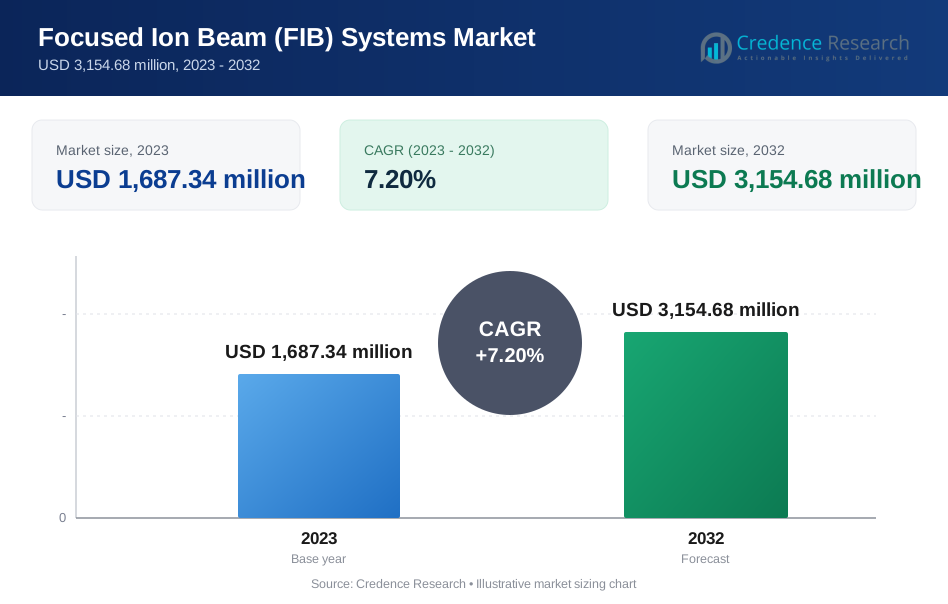
The Focused Ion Beam (FIB) Systems Market is projected to grow from USD 1,687.34 million in 2023 to USD 3,154.68 million by 2032, reflecting a compound annual growth rate (CAGR) of 7.20%.
The Global Focused Ion Beam (FIB) Systems Market is driven by the increasing demand for precise material analysis and modification in industries such as semiconductors, materials science, and nanotechnology. The growing complexity of semiconductor devices and the need for high-resolution imaging and accurate failure analysis are key factors propelling market growth. Additionally, advancements in FIB technology, including the integration of advanced imaging and milling capabilities, are enhancing the efficiency and accuracy of these systems. The rise in research and development activities across various sectors further fuels the demand for FIB systems, supporting sustained market expansion.
The Global Focused Ion Beam (FIB) Systems Market exhibits significant geographical variation, with North America and Europe leading due to their strong semiconductor industries, advanced research infrastructure, and high investment in R&D. Asia-Pacific is rapidly emerging as a key market, driven by the expansion of the electronics and semiconductor sectors, particularly in China, Japan, and South Korea. Key players in the market include Thermo Fisher Scientific, Hitachi High-Technologies Corporation, and Carl Zeiss AG, who dominate through innovation, extensive product portfolios, and strong global distribution networks, catering to the diverse needs of industries and research institutions across regions.
Market Drivers
Advancements in Semiconductor and Electronics Industry
The Global Focused Ion Beam (FIB) Systems Market is significantly driven by advancements in the semiconductor and electronics industry. The ongoing trend toward miniaturization in electronic devices demands advanced manufacturing and analysis techniques, where FIB systems excel in precise material manipulation, imaging, and failure analysis. For instance, Government data shows the global semiconductor market reached $555.9 billion in 2021, up 26.2% year-over-year, indicating strong growth in this sector driving FIB adoption. As semiconductor devices become increasingly complex, the need for non-destructive, high-resolution analysis tools like FIB systems grows, making them indispensable in ensuring the integrity and performance of these intricate components. Additionally, substantial investments in research and development (R&D) for next-generation electronic components drive the demand for FIB systems, which are crucial for prototyping and experimentation in cutting-edge semiconductor technologies.
Growth in Material Science and Nanotechnology
Material science and nanotechnology represent significant growth areas for the FIB Systems Market. FIB systems are essential tools for material characterization, enabling the analysis of microstructures and properties at the nanoscale, which is crucial for the development of new materials and technologies. For instance, The National Nanotechnology Initiative in the U.S. has cumulatively invested over $29 billion in nanotechnology research since 2001. Additionally, FIB systems play a pivotal role in nanofabrication, allowing researchers to create complex nanostructures with high precision. This capability is driving advancements in nanotechnology research and its various applications, from electronics to pharmaceuticals, thereby expanding the market for FIB systems.
Rising Demand for Precision Manufacturing
The demand for precision manufacturing is another key driver of the FIB Systems Market, particularly in the aerospace, automotive, and medical device industries. In aerospace and automotive sectors, where high-precision components and rigorous materials analysis are critical, FIB systems provide unparalleled capabilities for prototyping, failure analysis, and quality control. Similarly, the increasing demand for miniaturized and complex medical devices drives the adoption of FIB systems for precision manufacturing and quality assurance. These industries rely on the advanced imaging and manipulation capabilities of FIB systems to maintain the high standards required in their products, further boosting market growth.
Increasing Government and Private Investments in Research
Government and private investments in research and development are further propelling the growth of the FIB Systems Market. Substantial funding in fields such as nanotechnology, materials science, and electronics is fueling the demand for advanced research equipment, including FIB systems. These investments are particularly evident in the life sciences sector, where FIB systems are increasingly used to study biological samples at the nanoscale, driving growth in this segment. Additionally, continuous technological advancements in FIB systems, such as higher resolution imaging and the integration of FIB with other analytical techniques like scanning electron microscopy (SEM) and energy-dispersive X-ray spectroscopy (EDX), enhance their capabilities and broaden their application scope.
Market Trends
Technological Advancements and Expanding Applications
The Global Focused Ion Beam (FIB) Systems Market is witnessing significant technological advancements that are reshaping its landscape. One of the most notable trends is the continuous push for higher resolution imaging and more precise material manipulation, driving the development of next-generation FIB systems. For instance, overall worldwide IT spending is forecast to increase by eight percent between 2023 and 2024, reaching approximately five trillion U.S. dollars, as organizations invest in emerging technologies to drive business and digital transformation. Manufacturers are increasingly integrating FIB with scanning electron microscopy (SEM) to create dual-beam systems, which combine the strengths of both technologies, enhancing capabilities for detailed analysis and precise modifications. In life sciences, for example, FIB systems are increasingly used for studying biological samples at the nanoscale, providing insights into cellular structures and functions. In materials science, they play a crucial role in characterizing microstructures and developing new materials with enhanced properties. The use of FIB in failure analysis is also growing, particularly in identifying failure modes in electronic components, which is critical for ensuring the reliability and longevity of devices. Furthermore, FIB-based deposition techniques are gaining traction in additive manufacturing, enabling the creation of complex 3D structures at the nanoscale. These expanding applications are driving market growth and highlighting the versatility of FIB systems in addressing a wide range of scientific and industrial challenges.
Market Consolidation and Rising Demand in Emerging Economies
The FIB Systems Market is also experiencing a wave of consolidation as mergers and acquisitions reshape the competitive landscape. Key players are engaging in strategic partnerships and collaborations with end-users, fostering innovation and expanding market reach. These consolidations are aimed at leveraging complementary technologies and expertise, enabling companies to offer more comprehensive solutions to their customers. For instance, the integration of FIB systems with other advanced analytical tools through strategic partnerships enhances their functionality and appeal across different industries. This trend towards consolidation is expected to continue as companies seek to strengthen their market positions and capitalize on emerging opportunities. In parallel, there is a rising demand for FIB systems in emerging economies, driven by increased investments in research and development (R&D) and the growth of semiconductor and electronics manufacturing in regions like China, India, and South Korea. These countries are becoming significant players in the global market, fueled by government initiatives to boost technological innovation and industrial growth. The expansion of manufacturing capabilities in these regions is creating new opportunities for FIB system providers, who are looking to tap into these rapidly growing markets.
Market Challenges Analysis
High Costs and Complex Operation
The Global Focused Ion Beam (FIB) Systems Market faces significant challenges related to the high cost of systems and consumables, which can limit accessibility for smaller research institutions and companies. According to a survey by the National Science Foundation, the average cost of a FIB system ranges from $1-3 million, with annual operating costs of $100,000-$200,000. FIB systems are sophisticated instruments that require substantial capital expenditure, making them a considerable investment for any organization. Beyond the initial purchase, ongoing expenses for consumables such as ion sources and gas injection systems add to the financial burden, significantly impacting operating budgets. These costs can deter potential users, particularly in academic settings or smaller enterprises, from adopting FIB technology despite its advanced capabilities. Additionally, the operation and maintenance of FIB systems are complex, requiring a highly skilled workforce trained in the intricacies of these machines. Finding qualified personnel can be challenging, and the specialized nature of the work often leads to higher labor costs. Moreover, any downtime for maintenance or repairs can disrupt research and production schedules, further complicating the operational dynamics of using FIB systems. This combination of high costs and operational complexity poses a significant barrier to broader adoption of FIB technology.
Limited Ion Sources and Environmental Concerns
Another challenge in the FIB Systems Market is the limited availability of reliable ion sources, which creates dependency on gallium—a material that poses supply chain vulnerabilities and potential price fluctuations. Most FIB systems currently rely on gallium ion sources, making the market sensitive to changes in the availability and cost of this material. Although research is ongoing to develop alternative ion sources, such as helium or neon, these alternatives are not yet widely adopted or commercially viable, leaving the market exposed to risks associated with gallium dependency. Environmental concerns further complicate the use of FIB systems, as the operation often involves hazardous materials like gallium, which require careful handling and disposal to comply with environmental regulations. Adhering to these regulations not only increases operational costs but also adds complexity to the maintenance and disposal processes. Companies must invest in appropriate safety measures and ensure regulatory compliance, which can strain resources and impact the overall profitability of operating FIB systems. Additionally, the competitive landscape of the FIB market is shaped by a few dominant players, leading to market consolidation that can limit competition and pricing flexibility. Product differentiation becomes increasingly challenging as technological convergence makes it difficult for companies to stand out based on performance and features alone. Finally, specific application challenges, such as the complexity of data analysis and sample preparation, add another layer of difficulty, requiring advanced software and expertise to extract meaningful insights from FIB data. These challenges collectively highlight the hurdles that must be overcome to fully realize the potential of FIB systems in various industries.
Market Segmentation Analysis:
By Source:
The Global Focused Ion Beam (FIB) Systems Market is segmented into Liquid Metal Ion Source, Gas Field Ion Source, and Plasma Ion Source. Liquid Metal Ion Source dominates the market due to its widespread application in high-resolution imaging and precise material removal. This source is favored for its ability to deliver fine beam currents essential for detailed analysis and micromachining, particularly in semiconductor and materials science applications. Gas Field Ion Source, while still emerging, offers advantages in terms of resolution and beam stability, making it increasingly popular in specialized applications, such as life sciences and nanoscale patterning. Plasma Ion Source, known for its high material removal rates, is gaining traction in applications requiring rapid prototyping and large-scale material modification.
By Application: The FIB systems market is also categorized based on applications, including Quality Control & Failure Analysis, Market Analysis, Semiconductor Device Packaging, Nano-micro-Patterning, and Others. Quality Control & Failure Analysis is a leading segment, driven by the demand for precise defect analysis and failure mode identification in electronics and semiconductors. Semiconductor Device Packaging also represents a significant application area, where FIB systems are utilized for device modification and packaging inspections. Nano-micro-Patterning is an emerging application, leveraging FIB systems for the creation of intricate nanoscale structures, crucial in advancing nanotechnology and materials research. These diverse applications underscore the versatility and critical role of FIB systems across multiple industries.
Segments:
Based on Source:
- Liquid Metal Ion Source
- Gas Field Ion Source
- Plasma Ion Source
Based on Application:
- Quality Control & Failure Analysis
- Market Analysis
- Semiconductor Device Packaging
- Nano-micro-Patterning
- Others
Based on End-user:
- Material Science
- Life Science
- Electronics & Semiconductors
- Research & Academia
- Others
Based on the Geography:
- North America
- US
- Canada
- Mexico
- Europe
- Germany
- France
- UK
- Italy
- Spain
- Rest of Europe
- Asia Pacific
- China
- Japan
- India
- South Korea
- South-east Asia
- Rest of Asia Pacific
- Latin America
- Brazil
- Argentina
- Rest of Latin America
- Middle East & Africa
- GCC Countries
- South Africa
- Rest of Middle East and Africa
Regional Analysis
North America
North America leads the market with a dominant 40% share, fueled by its strong presence in semiconductor manufacturing, materials science research, and nanotechnology development. The region's market is characterized by a high concentration of leading FIB system manufacturers and a robust ecosystem of research institutions and high-tech industries. The United States, in particular, stands out for its continuous investment in cutting-edge FIB technologies, with applications spanning from failure analysis in the semiconductor industry to advanced materials characterization in aerospace and defense sectors. The North American market also sees strong demand from life sciences and geological research, where FIB systems are increasingly used for sample preparation and 3D imaging at the nanoscale.
Europe
Europe holds the second-largest market share at 30%, with a FIB systems market that is driven by a strong focus on scientific research and industrial innovation. Countries like Germany, the United Kingdom, and France are key contributors to the European market growth, with their well-established research institutions and high-tech manufacturing sectors. For instance, the Science, Research and Innovation performance of the EU 2024 report highlights the essential role of R&I in driving competitiveness, environmental sustainability and improved quality of life. The European market is characterized by a growing application of FIB systems in renewable energy research, particularly in the development of advanced solar cells and battery technologies. There is also significant demand from the automotive industry for failure analysis and quality control applications. European users of FIB systems are increasingly focusing on environmental sustainability, pushing for the development of more energy-efficient and eco-friendly FIB technologies.
Key Player Analysis
- Thermo Fisher Scientific, Inc.
- Hitachi High-Technologies Corporation
- Carl Zeiss AG
- JEOL Ltd.
- Evans Analytical Group
- Fibics, Inc.
- TESCAN ORSAY HOLDING a.s.
- Raith GmbH
- Zerok Nano Tech Corporation
Competitive Analysis
The Global Focused Ion Beam (FIB) Systems Market is highly competitive, with leading players such as Thermo Fisher Scientific, Hitachi High-Technologies Corporation, Carl Zeiss AG, and JEOL Ltd. dominating the landscape. Thermo Fisher Scientific is a market leader, leveraging its strong research and development capabilities to offer advanced FIB systems with integrated solutions for materials science and semiconductor applications. Hitachi High-Technologies Corporation focuses on innovation and customization, providing versatile FIB systems that cater to diverse industrial needs. Carl Zeiss AG is known for its high-resolution imaging and precision in nanofabrication, maintaining a strong presence in research and academic institutions. JEOL Ltd. combines its expertise in electron microscopy with FIB technology, offering robust systems that excel in both imaging and milling. These companies continuously invest in product development, strategic partnerships, and global expansion to maintain their competitive edge and address the evolving demands of the market.
Recent Developments
- In July 2024, Hitachi High-Tech Corporation established the Advanced Application Innovation Center for Focused Ion Beam System in Taiwan University.
- In February 2023, JEOL launched the completely redesigned JIB-PS500i focused gallium ion beam (FIB) preparation system.
- In August 2023, TESCAN ORSAY HOLDING, a.s. merged with TESCAN BRNO, s.r.o. to form TESCAN GROUP, a.s.
- In July 2022, Thermo Fisher Scientific unveiled the Thermo Scientific Arctis Cryo-Plasma Focused Ion Beam (Cryo-PFIB), a new connected and automated microscope designed to advance the pace of cryo-electron tomography (cryo-ET) research.
Market Concentration & Characteristics
The Global Focused Ion Beam (FIB) Systems Market is characterized by moderate to high market concentration, with a few key players such as Thermo Fisher Scientific, Hitachi High-Technologies Corporation, Carl Zeiss AG, and JEOL Ltd. holding significant market shares. These companies dominate the market through their extensive product portfolios, advanced technological capabilities, and strong global distribution networks. The market is marked by continuous innovation, particularly in the development of dual-beam systems that integrate FIB with scanning electron microscopy (SEM), enhancing both imaging and material manipulation capabilities. Despite the dominance of these major players, the market remains competitive with the presence of smaller, specialized firms focusing on niche applications and emerging technologies. The industry is driven by the increasing demand for precision in semiconductor manufacturing, materials science, and nanotechnology, which requires advanced FIB systems for high-resolution imaging, failure analysis, and nanofabrication.
Report Coverage
The research report offers an in-depth analysis based on Source, Application, End-user and Geography. It details leading market players, providing an overview of their business, product offerings, investments, revenue streams, and key applications. Additionally, the report includes insights into the competitive environment, SWOT analysis, current market trends, as well as the primary drivers and constraints. Furthermore, it discusses various factors that have driven market expansion in recent years. The report also explores market dynamics, regulatory scenarios, and technological advancements that are shaping the industry. It assesses the impact of external factors and global economic changes on market growth. Lastly, it provides strategic recommendations for new entrants and established companies to navigate the complexities of the market.
Future Outlook
- The demand for FIB systems will continue to grow, driven by advancements in semiconductor manufacturing and nanotechnology.
- Integration of FIB with other analytical techniques, such as SEM, will enhance system capabilities and expand application areas.
- Emerging markets in Asia-Pacific will offer significant growth opportunities due to increased R&D investments and expanding manufacturing sectors.
- Development of alternative ion sources, like helium and neon, will diversify system offerings and improve performance.
- The rising complexity of electronic devices will further increase the need for precise failure analysis and material characterization.
- FIB systems will see increased adoption in life sciences for nanoscale biological research and medical device manufacturing.
- The trend toward miniaturization in various industries will drive the demand for high-precision FIB-based fabrication techniques.
- Growing focus on eco-friendly practices will push the industry toward developing sustainable and energy-efficient FIB systems.
- The market will witness consolidation through mergers and acquisitions as companies seek to strengthen their market positions.
- Continuous technological advancements will reduce system costs, making FIB systems more accessible to a broader range of users.
Request a Free Sample
Fill in your details and we'll send you a free sample report.
- Sample data tables & charts
- Research methodology
Need a Custom Version of This Report?
Tailor the scope, geography, or segments to your exact requirements.
- Custom geography or segment scope
- Direct access to our analyst team
Frequently Asked Questions
What is the current size of the Global Focused Ion Beam (FIB) Systems Market?
What factors are driving the growth of the Global Focused Ion Beam (FIB) Systems Market?
What are the key segments within the Global Focused Ion Beam (FIB) Systems Market?
What are some challenges faced by the Global Focused Ion Beam (FIB) Systems Market?
Who are the major players in the Global Focused Ion Beam (FIB) Systems Market?
Table of Content
Chapter 1. Report Introduction
- 1.1 Report Description & Purpose
- 1.1.1 Report Title & Market Definition
- 1.1.2 Unique Selling Propositions (USP) & Key Differentiators
- 1.1.3 Value Proposition for Stakeholders
- 1.2 Research Objectives
- 1.2.1 Market Sizing Objectives (Volume & Revenue)
- 1.2.2 Segmentation Objectives
- 1.2.3 Competitive Intelligence Objectives
- 1.2.4 Forecast & Scenario Objectives
- 1.3 Report Scope
- 1.3.1 Focused Ion Beam (FIB) Systems Scope – Types & Subtypes Covered
- 1.3.2 Geographic Scope – Regions & Countries Covered
- 1.3.3 Historical Period, Base Year & Forecast Period (2023; forecast to 2032)
- 1.3.4 Inclusions & Exclusions
- 1.4 HS Code & Classification Framework
- 1.5 Currency, Units & Pricing Basis
- 1.6 Target Stakeholders
- 1.7 Limitations & Assumptions
Chapter 2. Executive Summary
- 2.1 Global Focused Ion Beam (FIB) Systems Market Snapshot
- 2.1.1 Market Size – Historical (2023) & Forecast (2023-2032) (2023: USD 1,687.34 million → 2032: USD 3,154.68 million)
- 2.1.2 Volume & Revenue – Global Totals
- 2.1.3 Key Market Highlights – Top Five Facts
- 2.2 Focused Ion Beam (FIB) Systems Market Segmentation Snapshot
- 2.2.1 Market Split by Region – 2023 vs. 2032
- 2.3 Competitive Snapshot
- 2.3.1 Top 10 Players by Revenue Share – 2023
- 2.3.2 Top 10 Players by Volume Share – 2023
- 2.3.3 Recent Strategic Developments (18-Month Summary)
- 2.4 Key Investment Highlights & Strategic Conclusions
Chapter 3. Focused Ion Beam (FIB) Systems Market Dynamics & Industry Analysis
- 3.1 Market Overview & Context
- 3.1.1 Focused Ion Beam (FIB) Systems Market Position in the Broader Automotive Value Chain
- 3.1.2 OEM vs. Replacement Market Dynamics
- 3.1.3 Market Maturity & Development Stage by Region
- 3.2 Focused Ion Beam (FIB) Systems Market Drivers
- 3.3 Focused Ion Beam (FIB) Systems Market Restraints & Challenges
- 3.4 Focused Ion Beam (FIB) Systems Market Opportunities
- 3.5 Porter's Five Forces Analysis
- 3.5.1 Threat of New Entrants
- 3.5.2 Bargaining Power of Suppliers
- 3.5.3 Bargaining Power of Buyers
- 3.5.4 Threat of Substitutes
- 3.5.5 Competitive Rivalry – Intensity Assessment
- 3.6 Focused Ion Beam (FIB) Systems Value Chain Analysis
- 3.6.1 Upstream – Raw Material/Input Suppliers
- 3.6.1.1 Raw Material/Input 1
- 3.6.1.2 Raw Material/Input 2
- 3.6.1.3 Raw Material/Input 3
- 3.6.2 Midstream – Production/Manufacturing/Service Delivery
- 3.6.2.1 Production/Process Overview
- 3.6.2.2 Key Facility Locations & Capacity by Manufacturer
- 3.6.3 Downstream – Distribution & End Consumer
- 3.6.3.1 Primary Channel – B2B/OEM
- 3.6.3.2 Secondary Channels – Dealer, Retail, Online, Direct
- 3.6.4 Value Chain Profitability Analysis
- 3.6.1 Upstream – Raw Material/Input Suppliers
- 3.7 PESTEL Analysis
- 3.7.1 Political Factors
- 3.7.2 Economic Factors
- 3.7.3 Social Factors
- 3.7.4 Technological Factors
- 3.7.5 Environmental Factors
- 3.7.6 Legal Factors
- 3.8 Focused Ion Beam (FIB) Systems Supply Chain Analysis
- 3.8.1 Raw Material/Input Supply Risk Assessment
- 3.8.2 Manufacturing Concentration Risk (Geographic Exposure)
- 3.8.3 Trade Disruption Impact Analysis
- 3.9 Regulatory & Policy Landscape
Note: The regulatory and policy landscape section covers regulations based on their applicability to the market, Focused Ion Beam (FIB) Systems category, geography, and scope of the study. Only regulatory frameworks with a material impact on operations, compliance, trade, sustainability, or market access are analyzed in detail.
Chapter 4. Key Investment Pockets & Opportunity Analysis
- 4.1 Focused Ion Beam (FIB) Systems Market Attractiveness Analysis
- 4.1.1 By Region – Investment Attractiveness Matrix (Volume × CAGR)
- 4.2 Absolute Revenue Growth Opportunity
- 4.2.1 By Region – Absolute USD Growth Through 2032
- 4.3 Incremental Volume Opportunity
- 4.3.1 By Region – Incremental Volume Through 2032
- 4.3.2 Segment – Incremental Volume
- 4.4 Emerging Submarket Opportunity Deep Dive (Subject to Applicability)
- 4.5 Emerging Market Opportunity Scorecards
- 4.5.1 United States
- 4.5.2 Europe
- 4.5.3 Asia
- 4.5.4 Middle East & Africa
Note: Emerging Market Opportunity Scorecards will be included based on relevance and strategic importance. Regions listed are indicative and may vary depending on data availability and market dynamics.
Chapter 5. Focused Ion Beam (FIB) Systems Import-Export Analysis & Trade Flows
- 5.1 Global Trade Overview
- 5.1.1 Global Export Value by Country (2023)
- 5.1.2 Global Export Volume by Country (2023)
- 5.1.3 Global Import Value by Country (2023)
- 5.1.4 Global Import Volume by Country (2023)
- 5.1.5 Net Trade Balance by Country (2023)
- 5.2 Export Analysis – Segment
- 5.2.1 Type 1 (HS Code)
- 5.2.2 Type 2 (HS Code)
- 5.2.3 Type 3 (HS Code)
- 5.2.4 Type 4 (HS Code)
- 5.2.5 Type 5 (HS Code)
- 5.3 Import Analysis – Segment
- 5.3.1 Type 1 (HS Code)
- 5.3.2 Type 2 (HS Code)
- 5.3.3 Type 3 (HS Code)
- 5.3.4 Type 4 (HS Code)
- 5.3.5 Type 5 (HS Code)
- 5.4 Average Unit Trade Prices
- 5.4.1 Average Export Price – Segment & Country
- 5.4.2 Average Import Price – Segment & Source Country
- 5.4.3 Price Trends (2023)
- 5.5 Key Trade Route Analysis
- 5.5.1 Trade Route 1
- 5.5.2 Trade Route 2
- 5.5.3 Trade Route 3
- 5.5.4 Trade Route 4
- 5.5.5 Trade Route 5
- 5.6 Trade Policy Impact Assessment
- 5.6.1 US Anti-Dumping & Section 301 Tariffs
- 5.6.2 EU Customs Union Impact
- 5.6.3 Major Free Trade Agreements
- 5.6.4 USMCA Rules of Origin
Note: Trade policy analysis will be included only where relevant to the Focused Ion Beam (FIB) Systems market.
Chapter 6. Competitive Landscape & Company Benchmarking
- 6.1 Focused Ion Beam (FIB) Systems Market Concentration & Structure
- 6.1.1 Herfindahl-Hirschman Index (HHI) – vs. 2023
- 6.1.2 Tier 1, Tier 2 & Tier 3 Market Structure
- 6.1.3 Global, Regional & Local Player Dynamics
- 6.2 Focused Ion Beam (FIB) Systems Market Share Analysis – 2023
- 6.2.1 Global Revenue Share by Company
- 6.2.2 Global Volume Share by Company
- 6.2.3 Regional Revenue Share
- 6.2.4 Market Share Evolution ( vs. 2023)
- 6.2.5 OEM Segment Share by Company
- 6.2.6 Replacement Segment Share by Company
- 6.3 Production/Delivery Capacity & Facility Analysis
- 6.3.1 Global Installed Capacity
- 6.3.2 Capacity Utilization Rates
- 6.3.3 Production/Output Volume
- 6.3.4 Facility Locations & Capacity Map
- 6.3.5 Planned Capacity Additions
- 6.4 Focused Ion Beam (FIB) Systems Competitive Benchmarking Matrix
- 6.4.1 Revenue, Volume, CAGR & Profitability Comparison
- 6.4.2 Channel Revenue Mix
- 6.4.3 Geographic Revenue Exposure
- 6.4.4 R&D Intensity
- 6.4.5 Sustainability Maturity
- 6.5 Strategic Developments in Focused Ion Beam (FIB) Systems (Last 24 Months)
- 6.5.1 Mergers, Acquisitions & Divestments
- 6.5.2 New Focused Ion Beam (FIB) Systems Launches
- 6.5.3 Facility Expansions
- 6.5.4 Strategic Alliances, Joint Ventures & Partnerships
- 6.5.5 Distribution Expansion & Market Entry
- 6.5.6 Sustainability & ESG Initiatives
- 6.6 Competitive Strategy Mapping
- 6.6.1 Leader, Challenger, Follower & Niche Classification
- 6.6.2 Pricing Strategy Comparison
- 6.6.3 Channel Strategy Matrix
Note: Strategic developments are included based on their materiality and the availability of reliable information.
Chapter 7. Global Focused Ion Beam (FIB) Systems Market – By Distribution Channel
- 7.1 Segment Overview
- 7.1.1 Volume & Revenue Split by Channel (2023 & 2032)
- 7.1.2 Channel Mix Evolution (2023-2032)
Chapter 8. Regional Market Analysis – Global Overview
- 8.1 Global Regional Overview
- 8.1.1 Regional Volume Share
- 8.1.2 Regional Revenue Share
- 8.1.3 Regional Volume by Region
- 8.1.4 Regional Revenue by Region
- 8.1.5 Regional Forecast Through 2032
- 8.2 Cross-Regional Segment Analysis
- 8.2.1 By Distribution Channel
- 8.2.2 By Brand/Price Tier
Chapter 9. North America Focused Ion Beam (FIB) Systems Market
- 9.1 United States
- 9.2 Canada
- 9.3 Mexico
Chapter 10. Europe Focused Ion Beam (FIB) Systems Market
- 10.1 Germany
- 10.2 France
- 10.3 Italy
- 10.4 United Kingdom
- 10.5 Spain
- 10.6 Poland
- 10.7 Russia
- 10.8 Netherlands
- 10.9 Belgium
- 10.10 Sweden
- 10.11 Denmark
- 10.12 Norway
- 10.13 Rest of Europe
Chapter 11. Asia Pacific Focused Ion Beam (FIB) Systems Market
- 11.1 China
- 11.2 India
- 11.3 Japan
- 11.4 South Korea
- 11.5 Thailand
- 11.6 Indonesia
- 11.7 Vietnam
- 11.8 Malaysia
- 11.9 Australia
- 11.10 Rest of Asia Pacific
Chapter 12. Latin America Focused Ion Beam (FIB) Systems Market
- 12.1 Brazil
- 12.2 Argentina
- 12.3 Colombia
- 12.4 Chile
- 12.5 Rest of Latin America
Chapter 13. Middle East Focused Ion Beam (FIB) Systems Market
- 13.1 Saudi Arabia
- 13.2 United Arab Emirates
- 13.3 Turkey
- 13.4 Israel
- 13.5 Iran
- 13.6 Rest of the Middle East
Chapter 14. Africa Focused Ion Beam (FIB) Systems Market
- 14.1 South Africa
- 14.2 Egypt
- 14.3 Nigeria
- 14.4 Morocco
- 14.5 Rest of Africa
Chapter 15. Focused Ion Beam (FIB) Systems Company Profiles
- 15.1 [Company 01]
- 15.1.1 Company Overview
- 15.1.2 Key Management Personnel
- 15.1.3 Products & Services Portfolio
- 15.1.4 Financial Performance
- 15.1.5 Key Market Focus & Geographic Presence
- 15.1.6 Recent Developments & Strategic Initiatives
Note: The company profile list is preliminary and may change based on research findings, market developments, data availability, and client requirements.
Chapter 16. Appendices
- Appendix A – List of Abbreviations & Acronyms
- Appendix B – Industry Classification Code Reference – Full Series
- Appendix C – Production & Capacity Data Tables
- Appendix D – End-Use & Demand Base Tables
- Appendix E – Consumption & Replacement Rate Assumptions
- Appendix F – ASP Reference Tables
- Appendix G – Manufacturing & Facility Database
- Appendix H – Import-Export Data Tables
- Appendix I – Regulatory Summary Tables
- Appendix J – Primary Research Participant List (Anonymized)
- Appendix K – Primary Research Questionnaire Framework
- Appendix L – Data Sources & Bibliography
- Appendix M – Market Size Divergence & Source Comparison
Chapter 17. Research Methodology
- 17.1 Research Framework & Philosophy
- 17.2 Secondary Research – Sources, Hierarchy & Data Extraction
- 17.3 Data Modeling – Bottom-Up & Top-Down Market Sizing
- 17.4 Primary Research – Stakeholder Framework, LOI & Sample Sizes
- 17.5 Forecast Methodology – Regression, Scenario & Sensitivity Analysis
- 17.6 Quality Control – Four-Layer Validation Framework
- 17.7 Limitations & Standard Assumptions
- 17.8 Disclaimer
