
| REPORT ATTRIBUTE | DETAILS |
|---|---|
| Historical Period | 2019-2022 |
| Base Year | 2023 |
| Forecast Period | 2024-2032 |
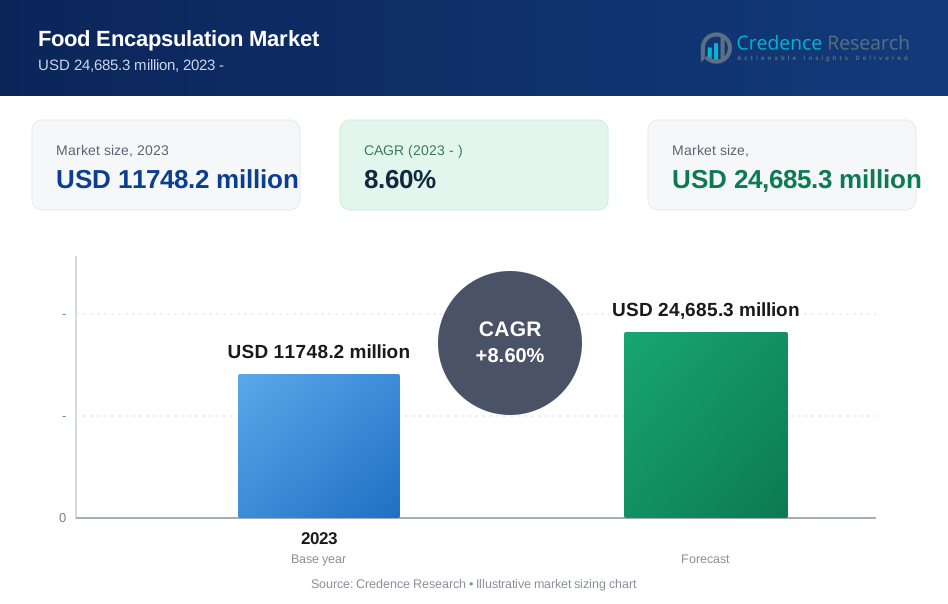
| Food Encapsulation Market Size 2023 | USD 11748.2 Million |
| Food Encapsulation Market, CAGR | 8.60% |
| Food Encapsulation Market Size 2032 | USD 24685.3 Million |
Market Insights
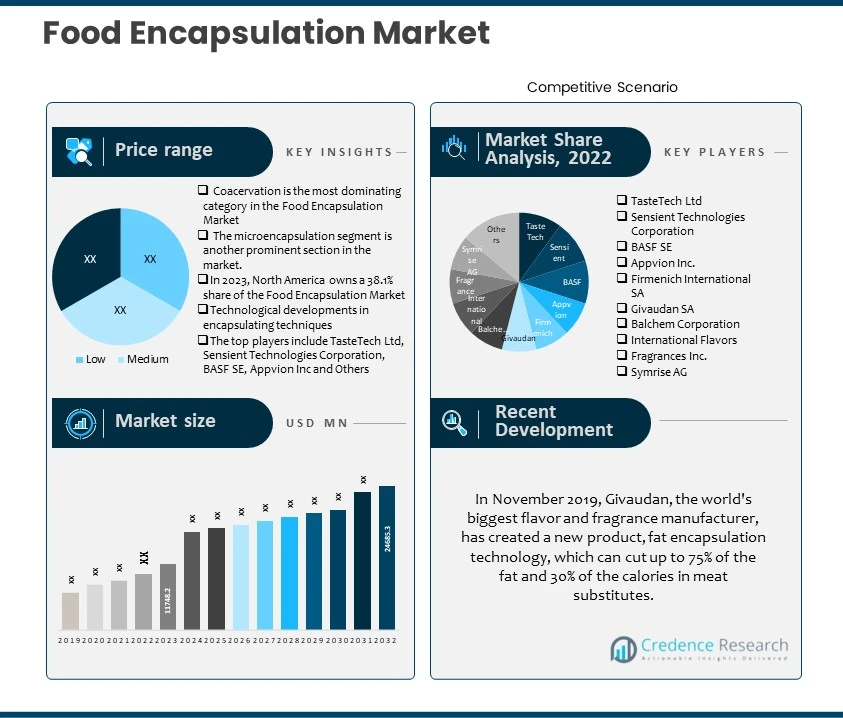
- The global demand for Food Encapsulation was valued at USD 11748.2 million in 2023 and is expected to reach USD 24685.3 million in 2032, growing at a CAGR of 8.60% between 2024 and 2032.
- The microencapsulation type category is anticipated to have the biggest market share over the projection period, while the macroencapsulation segment is another prominent section in the market.
- The vitamin and mineral category is predicted to lead the Food Encapsulation Market, while the probiotics segment is expected to have the greatest CAGR during the forecast period.
- Polysaccharides are expected to have the largest market share, and another popular category is proteins.
- Coacervation is the most dominating category in the Food Encapsulation Market, and extrusion is considered the fastest-growing industry.
- Dietary supplement demand is predicted to expand rapidly over the projection period, and the Dairy Products category is expected to play an additional role in the market.
- Food and beverage manufacturers are key shareholders in the market.
- Controlled Release is the most popular segment of the Food Encapsulation Market, while Shelf-Life Extension is another major segment.
- In 2023, North America owns a 38.1% share of the Food Encapsulation Market, and Asia Pacific is predicted to become the fastest-growing region from 2023 to 2032, while Europe is expected to grow at a constant rate during the forecast period.
- Increased demand for fortified and functional foods increases the food encapsulation industry.
- The high cost of technology limits market growth.
Executive Summary
Market Definition
Food encapsulation is widely utilized in the pharmaceutical, food, textile, personal care, chemical, and other industries to sustain the release of flavoring ingredients. Food encapsulation improves the taste of food products while also increasing shelf life and quality. Its primary duty is to conceal and safeguard the quality of the food product. In the chemical business, it is used to create solvents, and in the pharmaceutical industry, it is utilized to increase drug delivery flexibility while meeting regulatory requirements. It is used in the textile sector to enhance scent release, repel insects, and prevent microbiological development.
Market Overview
The global Food Encapsulation Market has witnessed steady growth in recent years and is expected to grow at a CAGR of 8.60% between 2024 and 2032. The market was valued at USD 11748.2 million in 2023 and is expected to reach USD 24685.3 million in 2032.
A Food Encapsulation is a single seating unit within a train carriage or compartment where passengers sit during their journey. It is an important aspect of passenger comfort and safety since it provides a dedicated space for travelers to sit. These chairs include armrests, tray tables, and adjustable reclining settings.
The Food Encapsulation Market is expanding significantly due to the rising population and the need for faster, safer, and more pleasant transit. Governments are making significant investments in rail infrastructure and development. Urban quality promotion via high-speed railroads has been examined from a dynamic network perspective, emphasizing the significance of high-speed train networks in urban expansion.
Segmentation by Type of Encapsulation
- The microencapsulation type category is predicted to have the highest market share over the projection period. Microencapsulated goods with dimensions of 1 to 100 µm can be created using physical and physio-chemical procedures. The physical properties of the material to be coated are important considerations when selecting a microencapsulation process.
- The Macro encapsulation segment is another popular segment in the market with a significant market share in 2023
.Segmentation by Core Material
- The vitamin and mineral category is expected to lead the Food Encapsulation Market, owing to extensive consumer demand for fortified foods and dietary supplements that enhance overall health and wellness.
- The probiotics segment is expected to have the highest CAGR over the forecast period. Probiotics provide health benefits such as preventing children from having loose bowels, increasing nutrient bioavailability and hereditary disease, improving immunity levels by controlling lymphocytes and antibodies, and preventing certain cancers by lowering the conversion levels of digestive fluid into matter, a cancer-causing substance.
Segmentation By Wall Material
- Polysaccharides are predicted to have the biggest market share due to their increased use as encapsulating matrices to preserve delicate oils and bioactive components.
- Another popular sector is Proteins.
Segmentation by Method of Encapsulation
- Coacervation is the most dominant category in the Food Encapsulation Market because to its adaptability and effectiveness in encapsulating a wide range of substances.
- On the other hand, Extrusion is regarded as the fastest-growing industry due to its efficiency and capacity to manufacture encapsulated items on a massive scale while maintaining uniform quality.
Segmentation by Application
- Dietary supplement demand is expected to rise fast throughout the forecast period due to the rising demand for food-encapsulating supplements. Meal encapsulation is an effective way to include health-promoting chemicals in food without reducing its bioavailability or utility.
- The Dairy Products segment is expected to have another importance in the market
Segmentation by End-User
- Food and beverage manufacturers are major stockholders in the Food Encapsulation Market. They play an important role in driving market growth by using encapsulation technology to improve the functionality, flavor, and shelf life of their food goods.
Segmentation by Functionality
- Controlled Release is the popular segment of the Food Encapsulation Market. Food and beverage manufacturers value the ability to manage the release of active chemicals, tastes, or nutrients in their goods, assuring optimal taste and usefulness.
- On the other hand, Shelf-Life Extension is another important segment, owing to an increased emphasis on extending food product shelf life, decreasing food waste, and maintaining product quality over time.
Segmentation by Region
- In 2023, North America holds a 38.1% share of the Food Encapsulation Market.
- Asia Pacific is expected to become the fastest-growing region from 2023 to 2032 and Europe is expected to grow at a consistent rate over the projection period
- The rest of the world, including Latin America, the Middle East, and Africa, supplies the remaining demand for Food Encapsulation.
North America is predicted to have the highest market share over the projection period. Food items with greater heat and oxidative resistance, increased shelf-life stability, and improved end-product quality are in high demand in this region. The increasing demand for functional food products would help grow the market. The region's growth is assisted by rising demand for shell materials such as hydrocolloids and emulsions and the existence of numerous producers.
In addition, due to rapidly rising food processing industries, Asia Pacific is expected to become the fastest-growing region from 2023 to 2032. Countries such as China and India are expected to drive market expansion in the Asia Pacific area as living standards rise and the processed food industry develops.
Moreover, Europe is expected to grow at a consistent rate over the projection period, owing to the region's processed food industry's increasing technological progress.
Key Highlights of the Report
The global Food Encapsulation Market is segmented based on Type of Encapsulation, Core Material, Wall Material, Method of Encapsulation, Application, End-User, Functionality, and region. The microencapsulation category is expected to have the largest market share, while the microencapsulation segment is also popular. In addition, extrusion is regarded as the fastest-growing industry, and dietary supplement demand is predicted to develop rapidly throughout the projection period. Also, the probiotic segment is predicted to have the highest CAGR North America is driving market expansion.
The rising demand for natural flavors and clean-label products is expected to propel the food encapsulation business. Furthermore, issues with encapsulate stability caused by volatility in ingredient availability across the food industry are expected to boost food encapsulation market expansion. Furthermore, rising investment by key players in encapsulating technology to broaden their presence is projected to fuel the growth of the food encapsulation business.
North America is expected to have the largest market share throughout the projection period. Foods with higher heat and oxidative resistance, longer shelf life stability, and higher end-product quality are in high demand in this region. Furthermore, due to rapidly expanding food processing industries, Asia Pacific is predicted to be the fastest-growing area from 2023 to 2032. Furthermore, Europe is predicted to increase at a constant rate throughout the projection period.
What Are The Main Drivers Of The Global Food Encapsulation Market?
Increasing research and development for novel food encapsulation processing methods is driving market expansion in a variety of end-use sectors. Corporations are also investing in nanotechnology, food chemistry, and formulation to meet the growing need for nutritional, newborn nutrition, and sports beverage products in the food sector. This is expected to boost market growth.
What Are The Major Challenges Faced By The Global Food Encapsulation Market?
Additional production expenses are expected to stifle market expansion for food encapsulation. The high cost of production is a big problem for manufacturers, and it is predicted to limit the use of food encapsulation. This, in turn, is expected to limit the market growth for food encapsulation.
What Are The Growth Opportunities In The Global Food Encapsulation Market?
The growing popularity of functional foods and beverages, combined with changing living standards and dietary patterns among individuals worldwide, is driving market demand in the forecast period and the next years.
Market Drivers
Several factors drive the global Food Encapsulation Market. The following are the key drivers of the global Food Encapsulation Market:
Increased Demand For Fortified And Functional Foods
Fortified food contains nutrients that are not found naturally in the diet. In addition to basic nutrition, functional food lowers the risk of disease and supports optimal health. Fortified and functional foods are commonly used in the food encapsulation market because they contain additional nutrients or healthful components. For instance, in February 2023, Nestle, a Swiss food and beverage processing firm, distributed 124.6 billion fortified servings of food and beverages through its popular brands, including Bear Brand, Cerevita, and Maggi.
Market Restraints
The global Food Encapsulation Market faces some challenges that may hinder its growth. These include the following:
High Cost of Technology
The high cost of technology in the Food Encapsulation Market is a key barrier due to the enormous expenditure necessary for research, development, and deployment of advanced encapsulation techniques. This expense may limit the use of encapsulation technology by smaller food manufacturers and startups, affecting industry growth and innovation. Furthermore, the fees associated with specialized equipment, materials, and qualified personnel add to the overall high cost of food encapsulation technology. As a result, enterprises may encounter difficulties in attaining cost-effective manufacturing procedures and competitive pricing, thus impeding market expansion and access to a greater range of food products utilizing encapsulation technology.
Opportunities
The global Food Encapsulation Market offers significant growth opportunities. These include the following:
Rising Obesity Rates
The rising prevalence of obesity is likely to drive future growth in the food encapsulation market. Obesity is a medical condition defined by an excess of body fat that can have a detrimental impact on a person's health. meal encapsulation contributes to obesity-related concerns by giving better meal options, promoting portion management, and improving overall nutritional quality. For instance, in May 2023, the Government Digital Service, a UK-based government entity, predicted that 25.9% of adults (18 and older) in England would be obese, up from 25.2% in 2021-2022. Thus, the market for food encapsulation is expanding due to the rising incidence of obesity.
Competitive Landscape
Key Players
The global Food Encapsulation Market is highly competitive, with several key players. Some of the major players in the market and their market share are as follows:
- TasteTech Ltd
- Sensient Technologies Corporation
- BASF SE
- Appvion Inc.
- Firmenich International SA
- Givaudan SA
- Balchem Corporation
- International Flavors
- Fragrances Inc.
- Symrise AG
These organizations prioritize product innovation, Service Provider expansion, and mergers and acquisitions to stay competitive.
The global Food Encapsulation Market's key players continually seek to stay ahead by offering new products and developments.
In February 2024, Ingredion and NanoGuardian Foods cooperated to create and market a new chitosan-based encapsulation technology for improved bioactive ingredient delivery.
In February 2024, Kerry introduced their "SeaCapture" technology, a plant-based encapsulating solution for omega-3 oils that is a more environmentally friendly alternative to traditional gelatin capsules.
In February 2024, PepsiCo invested in a company developing an AI-powered platform for optimizing food encapsulation processes, with the goal of increasing product efficiency and consistency.
Summary of Key Findings
- Rising obesity rates drive demand in the food encapsulation sector.
- The market is segmented by Type of Encapsulation, Core Material, Wall Material, Method of Encapsulation, Application, End-User, Functionality and Region.
- Dietary supplement demand is predicted to expand rapidly during the forecast period
- Polysaccharides are expected to have the greatest market share
- North America is leading market growth. The market is highly competitive, with key players including TasteTech Ltd, Sensient Technologies Corporation, BASF SE, Appvion Inc and Others.
Future Outlook
- Increasing demand for functional food products.
- Technological developments in encapsulating techniques
- Growing emphasis on extending shelf life and improving product stability.
- Growing usage in the pharmaceutical and nutraceutical industries.
- Market expansion to include new application areas
How CXOs Can Benefit from the Credence Research Food Encapsulation Market Report
The Credence Research Food Encapsulation Market Report provides CXOs with a comprehensive overview of the market, including:
- Market Size and Growth Forecast: The report provides detailed estimates of the global Food Encapsulation Market segmented by Type of Encapsulation, Core Material, Wall Material, Method of Encapsulation, Application, End-User, Functionality and Region. It also includes forecasts for the market through 2032 based on key trends and drivers.
- Market segmentation: The report segments the Food Encapsulation Market by Type of Encapsulation, Core Material, Wall Material, Method of Encapsulation, Application, End-User, Functionality and Region. This segmentation provides CXOs with a granular understanding of the market and the opportunities in each segment.
- Competitive Landscape: The report profiles the key players in the Food Encapsulation Market and provides insights into their strategies, product offerings, and financial performance. This information can help CXOs to identify and assess their competition.
- Key trends and drivers: The report identifies and analyzes the key trends and drivers shaping the Food Encapsulation Market. This information can help CXOs make informed decisions about their investments and strategies.
CXOs can use the insights from the Credence Research Food Encapsulation Market Report to:
- Identify growth opportunities: The report can help CXOs identify new growth opportunities in the Food Encapsulation Market. It provides valuable insights and analysis that can assist them in making informed decisions and strategic plans for their businesses.
- Make in Informed investment decisions: The report can help CXOs to make informed investment decisions about Food Encapsulation. For example, it provides valuable market insights such as growth trends, market size, and competitive analysis. CXOs can use this information to assess the potential profitability and growth opportunities in the Food Encapsulation Market.
- Develop competitive strategies: The report can help CXOs develop competitive strategies for their Food Encapsulation businesses. It provides insights into market trends, customer preferences, and competitive landscape analysis.
- Track market developments: The report can help CXOs track market developments and stay ahead of the curve. For example, It provides valuable insights and analysis that can inform strategic decision-making and help them stay ahead of the competition.
Overall, the Credence Research Food Encapsulation Market Report is a valuable resource for CXOs who are looking to gain a deeper understanding of the market and identify opportunities for growth.
Segmentation
By Type of Encapsulation:- Microencapsulation
- Nanoencapsulation
- Macroencapsulation
- Vitamins and Minerals
- Flavoring Agents
- Colors and Pigments
- Essential Oils
- Enzymes
- Sweeteners
- Probiotics and Prebiotics
- Nutraceuticals
- Others
- Polysaccharides (e.g., starch, cellulose, alginate)
- Proteins (e.g., gelatin, whey protein, soy protein)
- Lipids (e.g., vegetable oils, waxes)
- Synthetic Polymers (e.g., polyethylene glycol, polyvinyl alcohol)
- Composite Materials
- Others
- Spray Drying
- Fluid Bed Coating
- Extrusion
- Emulsion and Solvent Evaporation
- Coacervation
- Freeze Drying
- Others
- Beverages
- Bakery and Confectionery
- Dairy Products
- Snacks and Convenience Foods
- Dietary Supplements
- Nutraceuticals
- Pharmaceuticals
- Others
- Food and Beverage Manufacturers
- Nutraceutical Companies
- Pharmaceutical Companies
- Research Institutions
- Others
- Flavor Masking
- Controlled Release
- Protection of Sensitive Ingredients
- Texture Modification
- Shelf-Life Extension
- Others
- North America
- The U.S.
- Canada
- Mexico
- Europe
- Germany
- France
- The U.K.
- Italy
- Spain
- Rest of Europe
- Asia Pacific
- China
- Japan
- India
- South Korea
- South-east Asia
- Rest of Asia Pacific
- Latin America
- Brazil
- Argentina
- Rest of Latin America
- Middle East & Africa
- GCC Countries
- South Africa
- Rest of the Middle East and Africa
Request a Free Sample
Fill in your details and we'll send you a free sample report.
- Sample data tables & charts
- Research methodology
Need a Custom Version of This Report?
Tailor the scope, geography, or segments to your exact requirements.
- Custom geography or segment scope
- Direct access to our analyst team
Frequently Asked Questions
What is the current Type of Encapsulation of the global Food Encapsulation Market?
What is the expected growth rate of the Food Encapsulation Market between 2024 and 2032?
Which segment is leading the market share in terms of Type of Encapsulation?
Which Wall Material segment governs the demand for rapid pharmaceutical microbiology testing in the world?
Who are the major players in the global Food Encapsulation Market?
What are the major market drivers of the Food Encapsulation industry?
Table of Content
Chapter 1. Report Introduction
- 1.1 Report Description & Purpose
- 1.1.1 Report Title & Market Definition
- 1.1.2 Unique Selling Propositions (USP) & Key Differentiators
- 1.1.3 Value Proposition for Stakeholders
- 1.2 Research Objectives
- 1.2.1 Market Sizing Objectives (Volume & Revenue)
- 1.2.2 Segmentation Objectives
- 1.2.3 Competitive Intelligence Objectives
- 1.2.4 Forecast & Scenario Objectives
- 1.3 Report Scope
- 1.3.1 Food Encapsulation Scope – Types & Subtypes Covered
- 1.3.2 Geographic Scope – Regions & Countries Covered
- 1.3.3 Historical Period, Base Year & Forecast Period (2023; forecast to the forecast period)
- 1.3.4 Inclusions & Exclusions
- 1.4 HS Code & Classification Framework
- 1.5 Currency, Units & Pricing Basis
- 1.6 Target Stakeholders
- 1.7 Limitations & Assumptions
Chapter 2. Executive Summary
- 2.1 Global Food Encapsulation Market Snapshot
- 2.1.1 Market Size – Historical (2023) & Forecast (the forecast period) (2023: USD 11748.2 million → forecast year: USD 24,685.3 million)
- 2.1.2 Volume & Revenue – Global Totals
- 2.1.3 Key Market Highlights – Top Five Facts
- 2.2 Food Encapsulation Market Segmentation Snapshot
- 2.2.1 Market Split by Region – 2023 vs.
- 2.3 Competitive Snapshot
- 2.3.1 Top 10 Players by Revenue Share – 2023
- 2.3.2 Top 10 Players by Volume Share – 2023
- 2.3.3 Recent Strategic Developments (18-Month Summary)
- 2.4 Key Investment Highlights & Strategic Conclusions
Chapter 3. Food Encapsulation Market Dynamics & Industry Analysis
- 3.1 Market Overview & Context
- 3.1.1 Food Encapsulation Market Position in the Broader Automotive Value Chain
- 3.1.2 OEM vs. Replacement Market Dynamics
- 3.1.3 Market Maturity & Development Stage by Region
- 3.2 Food Encapsulation Market Drivers
- 3.3 Food Encapsulation Market Restraints & Challenges
- 3.4 Food Encapsulation Market Opportunities
- 3.5 Porter's Five Forces Analysis
- 3.5.1 Threat of New Entrants
- 3.5.2 Bargaining Power of Suppliers
- 3.5.3 Bargaining Power of Buyers
- 3.5.4 Threat of Substitutes
- 3.5.5 Competitive Rivalry – Intensity Assessment
- 3.6 Food Encapsulation Value Chain Analysis
- 3.6.1 Upstream – Raw Material/Input Suppliers
- 3.6.1.1 Raw Material/Input 1
- 3.6.1.2 Raw Material/Input 2
- 3.6.1.3 Raw Material/Input 3
- 3.6.2 Midstream – Production/Manufacturing/Service Delivery
- 3.6.2.1 Production/Process Overview
- 3.6.2.2 Key Facility Locations & Capacity by Manufacturer
- 3.6.3 Downstream – Distribution & End Consumer
- 3.6.3.1 Primary Channel – B2B/OEM
- 3.6.3.2 Secondary Channels – Dealer, Retail, Online, Direct
- 3.6.4 Value Chain Profitability Analysis
- 3.6.1 Upstream – Raw Material/Input Suppliers
- 3.7 PESTEL Analysis
- 3.7.1 Political Factors
- 3.7.2 Economic Factors
- 3.7.3 Social Factors
- 3.7.4 Technological Factors
- 3.7.5 Environmental Factors
- 3.7.6 Legal Factors
- 3.8 Food Encapsulation Supply Chain Analysis
- 3.8.1 Raw Material/Input Supply Risk Assessment
- 3.8.2 Manufacturing Concentration Risk (Geographic Exposure)
- 3.8.3 Trade Disruption Impact Analysis
- 3.9 Regulatory & Policy Landscape
Note: The regulatory and policy landscape section covers regulations based on their applicability to the market, Food Encapsulation category, geography, and scope of the study. Only regulatory frameworks with a material impact on operations, compliance, trade, sustainability, or market access are analyzed in detail.
Chapter 4. Key Investment Pockets & Opportunity Analysis
- 4.1 Food Encapsulation Market Attractiveness Analysis
- 4.1.1 By Region – Investment Attractiveness Matrix (Volume × CAGR)
- 4.2 Absolute Revenue Growth Opportunity
- 4.2.1 By Region – Absolute USD Growth Through the forecast period
- 4.3 Incremental Volume Opportunity
- 4.3.1 By Region – Incremental Volume Through the forecast period
- 4.3.2 Segment – Incremental Volume
- 4.4 Emerging Submarket Opportunity Deep Dive (Subject to Applicability)
- 4.5 Emerging Market Opportunity Scorecards
- 4.5.1 United States
- 4.5.2 Europe
- 4.5.3 Asia
- 4.5.4 Middle East & Africa
Note: Emerging Market Opportunity Scorecards will be included based on relevance and strategic importance. Regions listed are indicative and may vary depending on data availability and market dynamics.
Chapter 5. Food Encapsulation Import-Export Analysis & Trade Flows
- 5.1 Global Trade Overview
- 5.1.1 Global Export Value by Country (2023)
- 5.1.2 Global Export Volume by Country (2023)
- 5.1.3 Global Import Value by Country (2023)
- 5.1.4 Global Import Volume by Country (2023)
- 5.1.5 Net Trade Balance by Country (2023)
- 5.2 Export Analysis – Segment
- 5.2.1 Type 1 (HS Code)
- 5.2.2 Type 2 (HS Code)
- 5.2.3 Type 3 (HS Code)
- 5.2.4 Type 4 (HS Code)
- 5.2.5 Type 5 (HS Code)
- 5.3 Import Analysis – Segment
- 5.3.1 Type 1 (HS Code)
- 5.3.2 Type 2 (HS Code)
- 5.3.3 Type 3 (HS Code)
- 5.3.4 Type 4 (HS Code)
- 5.3.5 Type 5 (HS Code)
- 5.4 Average Unit Trade Prices
- 5.4.1 Average Export Price – Segment & Country
- 5.4.2 Average Import Price – Segment & Source Country
- 5.4.3 Price Trends (2023)
- 5.5 Key Trade Route Analysis
- 5.5.1 Trade Route 1
- 5.5.2 Trade Route 2
- 5.5.3 Trade Route 3
- 5.5.4 Trade Route 4
- 5.5.5 Trade Route 5
- 5.6 Trade Policy Impact Assessment
- 5.6.1 US Anti-Dumping & Section 301 Tariffs
- 5.6.2 EU Customs Union Impact
- 5.6.3 Major Free Trade Agreements
- 5.6.4 USMCA Rules of Origin
Note: Trade policy analysis will be included only where relevant to the Food Encapsulation market.
Chapter 6. Competitive Landscape & Company Benchmarking
- 6.1 Food Encapsulation Market Concentration & Structure
- 6.1.1 Herfindahl-Hirschman Index (HHI) – vs. 2023
- 6.1.2 Tier 1, Tier 2 & Tier 3 Market Structure
- 6.1.3 Global, Regional & Local Player Dynamics
- 6.2 Food Encapsulation Market Share Analysis – 2023
- 6.2.1 Global Revenue Share by Company
- 6.2.2 Global Volume Share by Company
- 6.2.3 Regional Revenue Share
- 6.2.4 Market Share Evolution ( vs. 2023)
- 6.2.5 OEM Segment Share by Company
- 6.2.6 Replacement Segment Share by Company
- 6.3 Production/Delivery Capacity & Facility Analysis
- 6.3.1 Global Installed Capacity
- 6.3.2 Capacity Utilization Rates
- 6.3.3 Production/Output Volume
- 6.3.4 Facility Locations & Capacity Map
- 6.3.5 Planned Capacity Additions
- 6.4 Food Encapsulation Competitive Benchmarking Matrix
- 6.4.1 Revenue, Volume, CAGR & Profitability Comparison
- 6.4.2 Channel Revenue Mix
- 6.4.3 Geographic Revenue Exposure
- 6.4.4 R&D Intensity
- 6.4.5 Sustainability Maturity
- 6.5 Strategic Developments in Food Encapsulation (Last 24 Months)
- 6.5.1 Mergers, Acquisitions & Divestments
- 6.5.2 New Food Encapsulation Launches
- 6.5.3 Facility Expansions
- 6.5.4 Strategic Alliances, Joint Ventures & Partnerships
- 6.5.5 Distribution Expansion & Market Entry
- 6.5.6 Sustainability & ESG Initiatives
- 6.6 Competitive Strategy Mapping
- 6.6.1 Leader, Challenger, Follower & Niche Classification
- 6.6.2 Pricing Strategy Comparison
- 6.6.3 Channel Strategy Matrix
Note: Strategic developments are included based on their materiality and the availability of reliable information.
Chapter 7. Global Food Encapsulation Market – By Distribution Channel
- 7.1 Segment Overview
- 7.1.1 Volume & Revenue Split by Channel (2023 & )
- 7.1.2 Channel Mix Evolution (the forecast period)
Chapter 8. Regional Market Analysis – Global Overview
- 8.1 Global Regional Overview
- 8.1.1 Regional Volume Share
- 8.1.2 Regional Revenue Share
- 8.1.3 Regional Volume by Region
- 8.1.4 Regional Revenue by Region
- 8.1.5 Regional Forecast Through the forecast period
- 8.2 Cross-Regional Segment Analysis
- 8.2.1 By Distribution Channel
- 8.2.2 By Brand/Price Tier
Chapter 9. North America Food Encapsulation Market
- 9.1 United States
- 9.2 Canada
- 9.3 Mexico
Chapter 10. Europe Food Encapsulation Market
- 10.1 Germany
- 10.2 France
- 10.3 Italy
- 10.4 United Kingdom
- 10.5 Spain
- 10.6 Poland
- 10.7 Russia
- 10.8 Netherlands
- 10.9 Belgium
- 10.10 Sweden
- 10.11 Denmark
- 10.12 Norway
- 10.13 Rest of Europe
Chapter 11. Asia Pacific Food Encapsulation Market
- 11.1 China
- 11.2 India
- 11.3 Japan
- 11.4 South Korea
- 11.5 Thailand
- 11.6 Indonesia
- 11.7 Vietnam
- 11.8 Malaysia
- 11.9 Australia
- 11.10 Rest of Asia Pacific
Chapter 12. Latin America Food Encapsulation Market
- 12.1 Brazil
- 12.2 Argentina
- 12.3 Colombia
- 12.4 Chile
- 12.5 Rest of Latin America
Chapter 13. Middle East Food Encapsulation Market
- 13.1 Saudi Arabia
- 13.2 United Arab Emirates
- 13.3 Turkey
- 13.4 Israel
- 13.5 Iran
- 13.6 Rest of the Middle East
Chapter 14. Africa Food Encapsulation Market
- 14.1 South Africa
- 14.2 Egypt
- 14.3 Nigeria
- 14.4 Morocco
- 14.5 Rest of Africa
Chapter 15. Food Encapsulation Company Profiles
- 15.1 [Company 01]
- 15.1.1 Company Overview
- 15.1.2 Key Management Personnel
- 15.1.3 Products & Services Portfolio
- 15.1.4 Financial Performance
- 15.1.5 Key Market Focus & Geographic Presence
- 15.1.6 Recent Developments & Strategic Initiatives
Note: The company profile list is preliminary and may change based on research findings, market developments, data availability, and client requirements.
Chapter 16. Appendices
- Appendix A – List of Abbreviations & Acronyms
- Appendix B – Industry Classification Code Reference – Full Series
- Appendix C – Production & Capacity Data Tables
- Appendix D – End-Use & Demand Base Tables
- Appendix E – Consumption & Replacement Rate Assumptions
- Appendix F – ASP Reference Tables
- Appendix G – Manufacturing & Facility Database
- Appendix H – Import-Export Data Tables
- Appendix I – Regulatory Summary Tables
- Appendix J – Primary Research Participant List (Anonymized)
- Appendix K – Primary Research Questionnaire Framework
- Appendix L – Data Sources & Bibliography
- Appendix M – Market Size Divergence & Source Comparison
Chapter 17. Research Methodology
- 17.1 Research Framework & Philosophy
- 17.2 Secondary Research – Sources, Hierarchy & Data Extraction
- 17.3 Data Modeling – Bottom-Up & Top-Down Market Sizing
- 17.4 Primary Research – Stakeholder Framework, LOI & Sample Sizes
- 17.5 Forecast Methodology – Regression, Scenario & Sensitivity Analysis
- 17.6 Quality Control – Four-Layer Validation Framework
- 17.7 Limitations & Standard Assumptions
- 17.8 Disclaimer
