
| REPORT ATTRIBUTE | DETAILS |
|---|---|
| Historical Period | 2019-2022 |
| Base Year | 2023 |
| Forecast Period | 2024-2032 |
| Food Preservatives Market Size 2023 | USD 4884.4 Million |
| Food Preservatives Market, CAGR | 3.40% |
| Food Preservatives Market Size 2032 | USD 12172.6 Million |
Market Insights
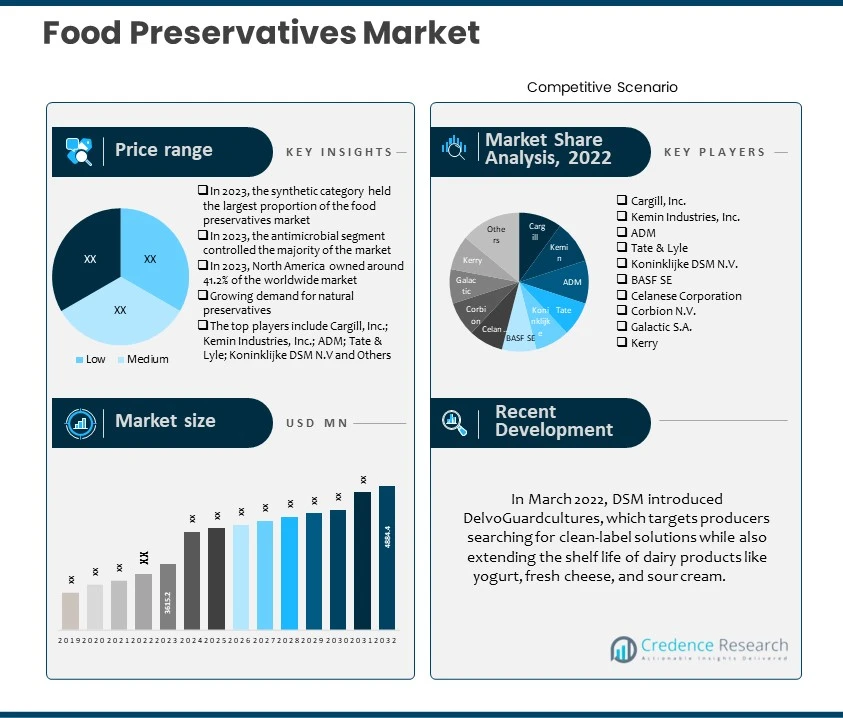
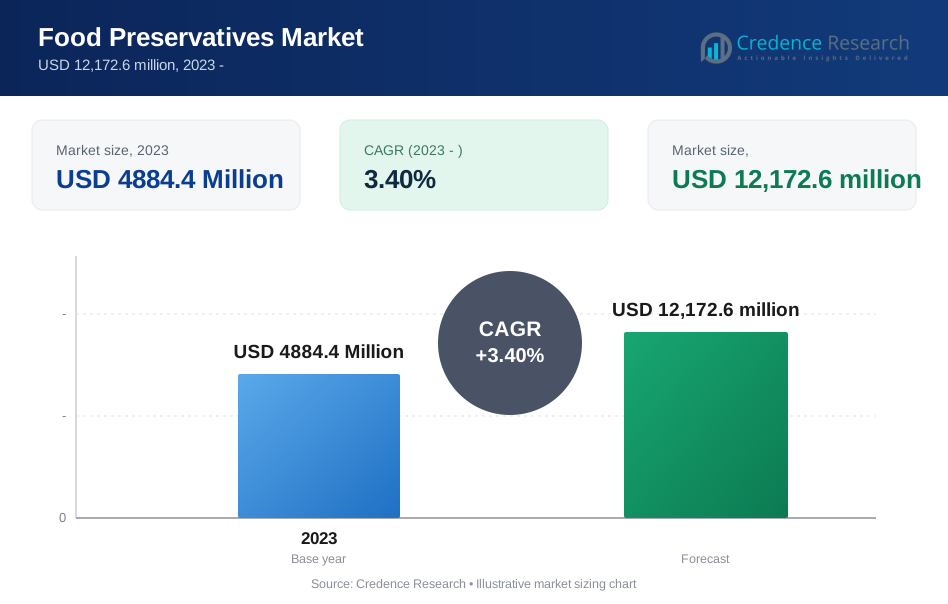
- The global demand for Food Preservatives was valued at USD 4884.4 million in 2023 and is expected to reach USD 12172.6 million in 2032, growing at a CAGR of 3.40% between 2024 and 2032.
- The antimicrobial category is expected to account for the largest part of the food preservatives industry, with antioxidants being one of the most important variables.
- In 2023, the synthetic category held the largest proportion of the food preservatives market, while the natural food preservatives market is predicted to grow quicker.
- In 2023, the Meat, Poultry, and Seafood products segment held the highest proportion of the food preservatives market, while the drinks category is predicted to rise the fastest.
- In 2023, the antimicrobial segment controlled the majority of the market, accounting for 76%, while the antioxidant part of the food preservatives market is predicted to grow rapidly.
- In 2023, North America owned around 41.2% of the worldwide market, and Asia Pacific is the fastest expanding food preservatives industry.
- Increased demand for convenience and processed meals fuels market expansion.
- Increased desire for "clean label" and natural components impedes industry expansion.
Executive Summary
Market Definition
The food preservatives market includes the production and sale of various chemical preservatives that are applied to food products to prevent decomposition caused by microbial growth or physical, chemical, or biochemical changes. Salts, sugars, sorbitol, benzoates, nitrites, and sulfites are common food preservatives that help increase the shelf life of goods while retaining their taste and quality. The global demand for convenience and processed meals has propelled the rise of the food preservatives market.
Market Overview
The global Food Preservatives Market has witnessed steady growth in recent years and is expected to grow at a CAGR of 3.40% between 2024 and 2032. The market was valued at USD 4884.4 million in 2023 and is expected to reach USD 12172.6 million in 2032.
Food preservatives are substances used in food processing to improve stability and prevent deterioration. They are added in modest amounts to a variety of foods according on the situation. Historically, salt, sugar, and spices were used to preserve meat and other foods. Food preservatives suppress or postpone food decomposition by preventing microbial development. They are divided into two categories based on their toxicity: non-toxic and moderately toxic. Non-toxic preservatives can be employed in the processing. However, moderately toxic preservatives are regulated by applicable regulatory organizations such as the United States Food and Drug Administration (FDA) and the European Food Safety Authority (EFSA) and indicated by suitable index (INS or E) codes.
Segmentation By Type of Preservatives
- The anti-microbial category is anticipated to account for 41.2% of the food preservatives market due to its capacity to directly limit the growth of dangerous bacteria, molds, and yeasts that cause food spoiling. Anti-microbial preservatives affect these bacteria' metabolic processes and cellular structures through distinct modes of action such as DNA/RNA inhibition, enzyme system interaction, and changes in cell membrane permeability.
- Antioxidants are one of the most important variables in food labeling since customers are becoming more aware of the health advantages of chemicals and choose products high in antioxidants.
Segmentation By Source
- In 2023, the synthetic segment held the greatest share of the food preservatives market, accounting for 70%. For food companies, synthetic preservatives are more financially feasible because they are typically less expensive than natural ones. It often has stronger antibacterial properties than natural alternatives, allowing food goods to have a longer shelf life and be preserved better.
- The natural food preservatives market is expected to increase faster than synthetic food preservatives demand, owing to regulatory bodies' support of natural preservatives and rising customer health consciousness.
Segmentation by Application
- In 2023, the Meat, Poultry & Seafood products segment held the largest share of the food preservatives market, accounting for 32%. Because of the high global demand for these commodities, preservatives are unavoidable in order to keep meat and poultry products fresh and extend their shelf life. Meat and poultry are among the most perishable foods.
- The beverages category is expected to develop the quickest CAGR in the food preservatives market during the forecast period. Preservatives are in great demand because busy consumers desire easy-to-drink beverages.
Segmentation By Function
- In 2023, the anti-microbial segment held the majority of the food preservatives market, accounting for 76%. Preservatives that effectively inhibit the growth of hazardous germs are in increased demand as consumer awareness of foodborne illnesses and the need of food safety develops. Antimicrobial preservatives reduce food spoilage and waste by limiting the growth of bacteria, yeast, and molds, hence increasing the shelf life of foods.
- During the projected period, the antioxidant section of the food preservatives market is expected to increase significantly.
Segmentation by Region
- In 2023, North America held roughly 41.2% of the global market.
- Asia Pacific is the fastest growing for food preservatives market
- The rest of the world, including Latin America, the Middle East, and Africa, supplies the remaining demand for Food Preservatives.
North America has long been the major player in the worldwide food preservatives market, accounting for 41.2%. With a large number of top food manufacturers and a developed food processing industry, demand for various preservatives remains high. Companies in the United States and Canada have sophisticated distribution networks and supply chains that make preservatives readily available throughout the region. There is also an increasing demand for convenient packaged and processed meals that rely heavily on preservatives to extend shelf life. Stringent food safety rules increase the requirement for preservatives.
Moreover, Asia Pacific has emerged as the world's fastest-expanding market for food preservatives. Countries like China, India, Japan, and others. Demand for packaged and ready-to-eat convenience foods has grown in tandem with rising disposable income. To meet the growing demand in these rising nations, both multinational and domestic food corporations have erected sizable production facilities. With improved cold chain infrastructure and increased urbanization, more preservatives are being used in food processing and distribution throughout Asia Pacific.
Key Highlights of the Report
Type of Preservatives, Source, Application, Function, and region segment of the global Food Preservatives Market. In 2023, the synthetic and antimicrobial segments accounted for the largest proportion of the food preservatives market, while the beverages category is predicted to grow at the fastest CAGR. likewise, the antioxidant segment of the food preservatives market is predicted to grow significantly, with North America leading the market expansion.
The key drivers of the natural food preservatives market are rising consumer awareness and inclination for healthy, natural food products. Furthermore, the market's main restrictions include limited efficacy, supply chain difficulties, government impediments, and stability issues. The market's significant opportunities include technological advancements, industry cooperation, and shelf-life extension.
North America has traditionally been the dominant player in the global food preservative business. With a significant number of leading food manufacturers and a mature food processing industry, demand for various preservatives remains strong. Furthermore, Asia Pacific has emerged as the world's fastest growing market for food preservatives. Countries including China, India, Japan, and others. The demand for packaged and ready-to-eat convenience foods has increased in parallel with rising disposable income.
What Are The Main Drivers Of The Global Food Preservatives Market?
The market is moderately fragmented and increasing at a medium rate. Continuous innovation, such as advances in preservation technologies, such as the creation of natural and clean-label preservatives, is propelling the market forward.
What Are The Major Challenges Faced By The Global Food Preservatives Market?
Several elements in the business may impede overall market growth. Price volatility and fluctuations in the availability of raw materials required for Fresh Food Preservatives are important factors that may impede market expansion over the forecast period. Furthermore, the presence of severe government rules for fresh, clean packaging presents significant obstacles to the market's leading competitors.
What Are The Growth Opportunities In The Global Food Preservatives Market?
Despite these constraints, there are substantial prospects for the market. The growing emphasis on environmentally friendly food packaging is a crucial area of opportunity for market vendors. The market's top players are primarily focused on research and development operations aimed at creating novel ecologically friendly and recyclable food packaging for fresh meat.
Market Drivers
Several factors drive the global Food Preservatives Market. The following are the key drivers of the global Food Preservatives Market:
Increased desire for convenience and processed foods
Processed foods' shelf life must be extended on a regular basis to ensure their safety and quality. Food preservatives prevent oxidation, microbial development, and other forms of deterioration, hence extending the shelf life of these products. Due to urbanization and hectic lifestyles, there is a growing need for ready-to-eat and portable food items. Food preservatives assist manufacturers in meeting the needs of urban consumers by producing portable, easy-to-transport items with extended shelf lives. As a result, increased demand for easy and processed meals is expected to fuel the expansion of the food preservatives market.
Changing consumer preferences
Consumers shun artificial additives and preservatives in favor of fresher, healthier, and more natural food choices. This shift in customer tastes has led food producers to seek alternative preservation measures, such as natural preservatives or inventive packaging, in order to meet demand while maintaining product safety and shelf life. As a result, natural and clean-label preservatives derived from plant extracts, essential oils, and fermentation methods are gaining popularity in the food preservation industry. As consumer preferences for healthy products shift, producers are stressing transparency in labeling and marketing to communicate that their products contain no chemical preservatives.
Market Restraints
The global Food Preservatives Market faces some challenges that may hinder its growth. These include the following:
Increasing demand for "clean label" and natural ingredients.
Customers are increasingly more cautious about artificial additives, particularly synthetic preservatives, and prefer products with fewer ingredient lists. As consumer tastes have shifted, food makers have altered their products to eliminate or limit the use of chemical preservatives in favor of natural counterparts. As a result, as people prefer healthier and more natural products, the market for traditional synthetic preservatives is shrinking.
Opportunities
The global Food Preservatives Market offers significant growth opportunities. These include the following:
Investing in researching and developing novel natural preservatives
Customers are getting more interested in natural and clean-label products due to concerns about the potential health risks of synthetic substances. Creating natural preservatives gives firms a competitive advantage in meeting consumer demands and is consistent with this trend. Natural preservatives often surpass their synthetic counterparts in terms of environmental impact. Businesses can reduce their carbon footprint and attract environmentally conscious clients by investing in sustainable research and development.
Competitive Landscape
Key Players
The global Food Preservatives market is highly competitive, with several key players. Some of the major players in the market and their market share are as follows:
- Cargill, Inc.
- Kemin Industries, Inc.
- ADM
- Tate & Lyle
- Koninklijke DSM N.V.
- BASF SE
- Celanese Corporation
- Corbion N.V.
- Galactic S.A.
- Kerry
These organizations prioritize product innovation, Application expansion, and mergers and acquisitions to stay competitive.
The global Food Preservatives Market's key players continually seek to stay ahead by offering new products and developments.
In September 2022, With a CPF of zero, the business first introduced propionic acid (PA) and neopentyl glycol (NPG). Applications for PA include the benefits of airtight silos or preservation by drying, both economically and environmentally.
In June 2022, A market-leading business for plant-based phytogenic feed additives that improve animal nutrition will be established by Cargill and Delacon. Increased production of nutritious food, global reach, and deep feed additive experience are anticipated outcomes of the acquisition.
In January 2022, VegStable Fresh is a novel plant-based antioxidant that Florida Food Products (FFP), a leading developer, formulator, and manufacturer of vegetable and fruit-based clean-label component solutions, will unveil at the International Production & Processing Expo (IPPE) in Atlanta, Georgia.
In November, 2021, Tate & Lyle PLC has announced the construction of a new biomass boiler at its acidulants facility in Santa Rosa, Brazil.
Summary of Key Findings
- Investing in discovering and creating new natural preservatives.
- The market is segmented by Type of Preservatives, Source, Application, Function, and region.
- In 2023, the anti-microbial segment retained the majority of the market
- In 2023, the synthetic category held the largest share of the food preservatives market
- North America is leading in market growth; the market is highly competitive, with key players including Cargill, Inc.; Kemin Industries, Inc.; ADM; Tate & Lyle; Koninklijke DSM N.V and Others.
Future Outlook
- Growing demand for natural preservatives
- Technological advances in preservation procedures.
- Increased awareness of food safety and shelf-life extension
- The expansion of the convenience food sector is pushing the demand for preservatives.
- Stringent laws affecting preservative usage
How CXOs Can Benefit from the Credence Research Food Preservatives Market Report
The Credence Research Food Preservatives Market Report provides CXOs with a comprehensive overview of the market, including:
- Market size and growth forecast: The report provides detailed estimates of the global Food Preservatives Marketsize, segmented By Type of Preservatives, Source, Application, Function and region. It also includes forecasts for the market through 2032 based on key trends and drivers.
- Market segmentation: The report segments the Food Preservatives MarketBy by Type of Preservatives, Source, Application, Function, and region. This segmentation provides CXOs with a granular understanding of the market and the opportunities in each segment.
- Competitive Landscape: The report profiles the key players in the Food Preservatives Market and provides insights into their strategies, product offerings, and financial performance. This information can help CXOs identify and assess their competition.
- Key trends and drivers: The report identifies and analyzes the key trends and drivers that are shaping the Food Preservatives Market. This information can help CXOs to make informed decisions about their investments and strategies.
CXOs can use the insights from the Credence Research Food Preservatives Market Report to:
- Identify growth opportunities: The report can help CXOs identify new growth opportunities in the Food Preservatives Market. By analyzing the data and trends in the report, they can make informed decisions about where to invest and expand their business.
- Make informed investment decisions: The report can help CXOs make informed investment decisions about Food Preservatives. For example, it may provide useful insights into market trends, customer preferences, the competitive landscape, and growth prospects in the Food Preservatives Market.
- Develop competitive strategies: The report can help CXOs develop competitive strategies for their Food Preservatives businesses. For example, by analyzing market trends, client preferences, and the competitive environment mentioned in the report, CXOs can fine-tune their strategies, differentiate their offers, and effectively position their firms in the marketplace.
- Track market developments: The report can help CXOs monitor market developments and stay ahead of the curve. For example, it provides insights into the latest trends and innovations in the Food Preservatives Market.
Overall, the Credence Research Food Preservatives Market Report is a valuable resource for CXOs who want to gain a deeper understanding of the market and identify opportunities for growth.
Segmentation
- By Type of Preservatives:
- Antioxidants
- Antimicrobials
- Antimycotics
- Others
- By Source:
- Synthetic
- Natural
- By Application:
- Bakery & Confectionery
- Meat, Poultry & Seafood
- Dairy & Frozen Products
- Beverages
- Oils & Fats
- Snacks & Convenience Foods
- Others
- By Function:
- Antimicrobial
- Antioxidant
- Others (such as chelating agents for metal ion control)
- By Region
- North America
- The U.S.
- Canada
- Mexico
- Europe
- Germany
- France
- The U.K.
- Italy
- Spain
- Rest of Europe
- Asia Pacific
- China
- Japan
- India
- South Korea
- South-east Asia
- Rest of Asia Pacific
- Latin America
- Brazil
- Argentina
- Rest of Latin America
- Middle East & Africa
- GCC Countries
- South Africa
- Rest of the Middle East and Africa
- North America
Request a Free Sample
Fill in your details and we'll send you a free sample report.
- Sample data tables & charts
- Research methodology
Need a Custom Version of This Report?
Tailor the scope, geography, or segments to your exact requirements.
- Custom geography or segment scope
- Direct access to our analyst team
Frequently Asked Questions
What is the current size of the global Food Preservatives Market?
What is the expected growth rate of the Food Preservatives Market between 2024 and 2032?
Which segment is leading the market share in terms of Application?
Which Type of Preservatives segment governs the demand for Food Preservatives in the world?
Who are the major players in the global Food Preservatives Market?
Table of Content
Chapter 1. Report Introduction
- 1.1 Report Description & Purpose
- 1.1.1 Report Title & Market Definition
- 1.1.2 Unique Selling Propositions (USP) & Key Differentiators
- 1.1.3 Value Proposition for Stakeholders
- 1.2 Research Objectives
- 1.2.1 Market Sizing Objectives (Volume & Revenue)
- 1.2.2 Segmentation Objectives
- 1.2.3 Competitive Intelligence Objectives
- 1.2.4 Forecast & Scenario Objectives
- 1.3 Report Scope
- 1.3.1 Food Preservatives Scope – Types & Subtypes Covered
- 1.3.2 Geographic Scope – Regions & Countries Covered
- 1.3.3 Historical Period, Base Year & Forecast Period (2023; forecast to the forecast period)
- 1.3.4 Inclusions & Exclusions
- 1.4 HS Code & Classification Framework
- 1.5 Currency, Units & Pricing Basis
- 1.6 Target Stakeholders
- 1.7 Limitations & Assumptions
Chapter 2. Executive Summary
- 2.1 Global Food Preservatives Market Snapshot
- 2.1.1 Market Size – Historical (2023) & Forecast (the forecast period) (2023: USD 4884.4 Million → forecast year: USD 12,172.6 million)
- 2.1.2 Volume & Revenue – Global Totals
- 2.1.3 Key Market Highlights – Top Five Facts
- 2.2 Food Preservatives Market Segmentation Snapshot
- 2.2.1 Market Split by Region – 2023 vs.
- 2.3 Competitive Snapshot
- 2.3.1 Top 10 Players by Revenue Share – 2023
- 2.3.2 Top 10 Players by Volume Share – 2023
- 2.3.3 Recent Strategic Developments (18-Month Summary)
- 2.4 Key Investment Highlights & Strategic Conclusions
Chapter 3. Food Preservatives Market Dynamics & Industry Analysis
- 3.1 Market Overview & Context
- 3.1.1 Food Preservatives Market Position in the Broader Automotive Value Chain
- 3.1.2 OEM vs. Replacement Market Dynamics
- 3.1.3 Market Maturity & Development Stage by Region
- 3.2 Food Preservatives Market Drivers
- 3.3 Food Preservatives Market Restraints & Challenges
- 3.4 Food Preservatives Market Opportunities
- 3.5 Porter's Five Forces Analysis
- 3.5.1 Threat of New Entrants
- 3.5.2 Bargaining Power of Suppliers
- 3.5.3 Bargaining Power of Buyers
- 3.5.4 Threat of Substitutes
- 3.5.5 Competitive Rivalry – Intensity Assessment
- 3.6 Food Preservatives Value Chain Analysis
- 3.6.1 Upstream – Raw Material/Input Suppliers
- 3.6.1.1 Raw Material/Input 1
- 3.6.1.2 Raw Material/Input 2
- 3.6.1.3 Raw Material/Input 3
- 3.6.2 Midstream – Production/Manufacturing/Service Delivery
- 3.6.2.1 Production/Process Overview
- 3.6.2.2 Key Facility Locations & Capacity by Manufacturer
- 3.6.3 Downstream – Distribution & End Consumer
- 3.6.3.1 Primary Channel – B2B/OEM
- 3.6.3.2 Secondary Channels – Dealer, Retail, Online, Direct
- 3.6.4 Value Chain Profitability Analysis
- 3.6.1 Upstream – Raw Material/Input Suppliers
- 3.7 PESTEL Analysis
- 3.7.1 Political Factors
- 3.7.2 Economic Factors
- 3.7.3 Social Factors
- 3.7.4 Technological Factors
- 3.7.5 Environmental Factors
- 3.7.6 Legal Factors
- 3.8 Food Preservatives Supply Chain Analysis
- 3.8.1 Raw Material/Input Supply Risk Assessment
- 3.8.2 Manufacturing Concentration Risk (Geographic Exposure)
- 3.8.3 Trade Disruption Impact Analysis
- 3.9 Regulatory & Policy Landscape
Note: The regulatory and policy landscape section covers regulations based on their applicability to the market, Food Preservatives category, geography, and scope of the study. Only regulatory frameworks with a material impact on operations, compliance, trade, sustainability, or market access are analyzed in detail.
Chapter 4. Key Investment Pockets & Opportunity Analysis
- 4.1 Food Preservatives Market Attractiveness Analysis
- 4.1.1 By Region – Investment Attractiveness Matrix (Volume × CAGR)
- 4.2 Absolute Revenue Growth Opportunity
- 4.2.1 By Region – Absolute USD Growth Through the forecast period
- 4.3 Incremental Volume Opportunity
- 4.3.1 By Region – Incremental Volume Through the forecast period
- 4.3.2 Segment – Incremental Volume
- 4.4 Emerging Submarket Opportunity Deep Dive (Subject to Applicability)
- 4.5 Emerging Market Opportunity Scorecards
- 4.5.1 United States
- 4.5.2 Europe
- 4.5.3 Asia
- 4.5.4 Middle East & Africa
Note: Emerging Market Opportunity Scorecards will be included based on relevance and strategic importance. Regions listed are indicative and may vary depending on data availability and market dynamics.
Chapter 5. Food Preservatives Import-Export Analysis & Trade Flows
- 5.1 Global Trade Overview
- 5.1.1 Global Export Value by Country (2023)
- 5.1.2 Global Export Volume by Country (2023)
- 5.1.3 Global Import Value by Country (2023)
- 5.1.4 Global Import Volume by Country (2023)
- 5.1.5 Net Trade Balance by Country (2023)
- 5.2 Export Analysis – Segment
- 5.2.1 Type 1 (HS Code)
- 5.2.2 Type 2 (HS Code)
- 5.2.3 Type 3 (HS Code)
- 5.2.4 Type 4 (HS Code)
- 5.2.5 Type 5 (HS Code)
- 5.3 Import Analysis – Segment
- 5.3.1 Type 1 (HS Code)
- 5.3.2 Type 2 (HS Code)
- 5.3.3 Type 3 (HS Code)
- 5.3.4 Type 4 (HS Code)
- 5.3.5 Type 5 (HS Code)
- 5.4 Average Unit Trade Prices
- 5.4.1 Average Export Price – Segment & Country
- 5.4.2 Average Import Price – Segment & Source Country
- 5.4.3 Price Trends (2023)
- 5.5 Key Trade Route Analysis
- 5.5.1 Trade Route 1
- 5.5.2 Trade Route 2
- 5.5.3 Trade Route 3
- 5.5.4 Trade Route 4
- 5.5.5 Trade Route 5
- 5.6 Trade Policy Impact Assessment
- 5.6.1 US Anti-Dumping & Section 301 Tariffs
- 5.6.2 EU Customs Union Impact
- 5.6.3 Major Free Trade Agreements
- 5.6.4 USMCA Rules of Origin
Note: Trade policy analysis will be included only where relevant to the Food Preservatives market.
Chapter 6. Competitive Landscape & Company Benchmarking
- 6.1 Food Preservatives Market Concentration & Structure
- 6.1.1 Herfindahl-Hirschman Index (HHI) – vs. 2023
- 6.1.2 Tier 1, Tier 2 & Tier 3 Market Structure
- 6.1.3 Global, Regional & Local Player Dynamics
- 6.2 Food Preservatives Market Share Analysis – 2023
- 6.2.1 Global Revenue Share by Company
- 6.2.2 Global Volume Share by Company
- 6.2.3 Regional Revenue Share
- 6.2.4 Market Share Evolution ( vs. 2023)
- 6.2.5 OEM Segment Share by Company
- 6.2.6 Replacement Segment Share by Company
- 6.3 Production/Delivery Capacity & Facility Analysis
- 6.3.1 Global Installed Capacity
- 6.3.2 Capacity Utilization Rates
- 6.3.3 Production/Output Volume
- 6.3.4 Facility Locations & Capacity Map
- 6.3.5 Planned Capacity Additions
- 6.4 Food Preservatives Competitive Benchmarking Matrix
- 6.4.1 Revenue, Volume, CAGR & Profitability Comparison
- 6.4.2 Channel Revenue Mix
- 6.4.3 Geographic Revenue Exposure
- 6.4.4 R&D Intensity
- 6.4.5 Sustainability Maturity
- 6.5 Strategic Developments in Food Preservatives (Last 24 Months)
- 6.5.1 Mergers, Acquisitions & Divestments
- 6.5.2 New Food Preservatives Launches
- 6.5.3 Facility Expansions
- 6.5.4 Strategic Alliances, Joint Ventures & Partnerships
- 6.5.5 Distribution Expansion & Market Entry
- 6.5.6 Sustainability & ESG Initiatives
- 6.6 Competitive Strategy Mapping
- 6.6.1 Leader, Challenger, Follower & Niche Classification
- 6.6.2 Pricing Strategy Comparison
- 6.6.3 Channel Strategy Matrix
Note: Strategic developments are included based on their materiality and the availability of reliable information.
Chapter 7. Global Food Preservatives Market – By Distribution Channel
- 7.1 Segment Overview
- 7.1.1 Volume & Revenue Split by Channel (2023 & )
- 7.1.2 Channel Mix Evolution (the forecast period)
Chapter 8. Regional Market Analysis – Global Overview
- 8.1 Global Regional Overview
- 8.1.1 Regional Volume Share
- 8.1.2 Regional Revenue Share
- 8.1.3 Regional Volume by Region
- 8.1.4 Regional Revenue by Region
- 8.1.5 Regional Forecast Through the forecast period
- 8.2 Cross-Regional Segment Analysis
- 8.2.1 By Distribution Channel
- 8.2.2 By Brand/Price Tier
Chapter 9. North America Food Preservatives Market
- 9.1 United States
- 9.2 Canada
- 9.3 Mexico
Chapter 10. Europe Food Preservatives Market
- 10.1 Germany
- 10.2 France
- 10.3 Italy
- 10.4 United Kingdom
- 10.5 Spain
- 10.6 Poland
- 10.7 Russia
- 10.8 Netherlands
- 10.9 Belgium
- 10.10 Sweden
- 10.11 Denmark
- 10.12 Norway
- 10.13 Rest of Europe
Chapter 11. Asia Pacific Food Preservatives Market
- 11.1 China
- 11.2 India
- 11.3 Japan
- 11.4 South Korea
- 11.5 Thailand
- 11.6 Indonesia
- 11.7 Vietnam
- 11.8 Malaysia
- 11.9 Australia
- 11.10 Rest of Asia Pacific
Chapter 12. Latin America Food Preservatives Market
- 12.1 Brazil
- 12.2 Argentina
- 12.3 Colombia
- 12.4 Chile
- 12.5 Rest of Latin America
Chapter 13. Middle East Food Preservatives Market
- 13.1 Saudi Arabia
- 13.2 United Arab Emirates
- 13.3 Turkey
- 13.4 Israel
- 13.5 Iran
- 13.6 Rest of the Middle East
Chapter 14. Africa Food Preservatives Market
- 14.1 South Africa
- 14.2 Egypt
- 14.3 Nigeria
- 14.4 Morocco
- 14.5 Rest of Africa
Chapter 15. Food Preservatives Company Profiles
- 15.1 [Company 01]
- 15.1.1 Company Overview
- 15.1.2 Key Management Personnel
- 15.1.3 Products & Services Portfolio
- 15.1.4 Financial Performance
- 15.1.5 Key Market Focus & Geographic Presence
- 15.1.6 Recent Developments & Strategic Initiatives
Note: The company profile list is preliminary and may change based on research findings, market developments, data availability, and client requirements.
Chapter 16. Appendices
- Appendix A – List of Abbreviations & Acronyms
- Appendix B – Industry Classification Code Reference – Full Series
- Appendix C – Production & Capacity Data Tables
- Appendix D – End-Use & Demand Base Tables
- Appendix E – Consumption & Replacement Rate Assumptions
- Appendix F – ASP Reference Tables
- Appendix G – Manufacturing & Facility Database
- Appendix H – Import-Export Data Tables
- Appendix I – Regulatory Summary Tables
- Appendix J – Primary Research Participant List (Anonymized)
- Appendix K – Primary Research Questionnaire Framework
- Appendix L – Data Sources & Bibliography
- Appendix M – Market Size Divergence & Source Comparison
Chapter 17. Research Methodology
- 17.1 Research Framework & Philosophy
- 17.2 Secondary Research – Sources, Hierarchy & Data Extraction
- 17.3 Data Modeling – Bottom-Up & Top-Down Market Sizing
- 17.4 Primary Research – Stakeholder Framework, LOI & Sample Sizes
- 17.5 Forecast Methodology – Regression, Scenario & Sensitivity Analysis
- 17.6 Quality Control – Four-Layer Validation Framework
- 17.7 Limitations & Standard Assumptions
- 17.8 Disclaimer
