
| REPORT ATTRIBUTE | DETAILS |
|---|---|
| Historical Period | 2019-2022 |
| Base Year | 2023 |
| Forecast Period | 2024-2032 |
| Food Service Disposables Market Size 2023 | USD 57,135.50 Million |
| Food Service Disposables Market, CAGR | 5.20% |
| Food Service Disposables Market Size 2032 | USD 90,167.014 Million |
Market Insights
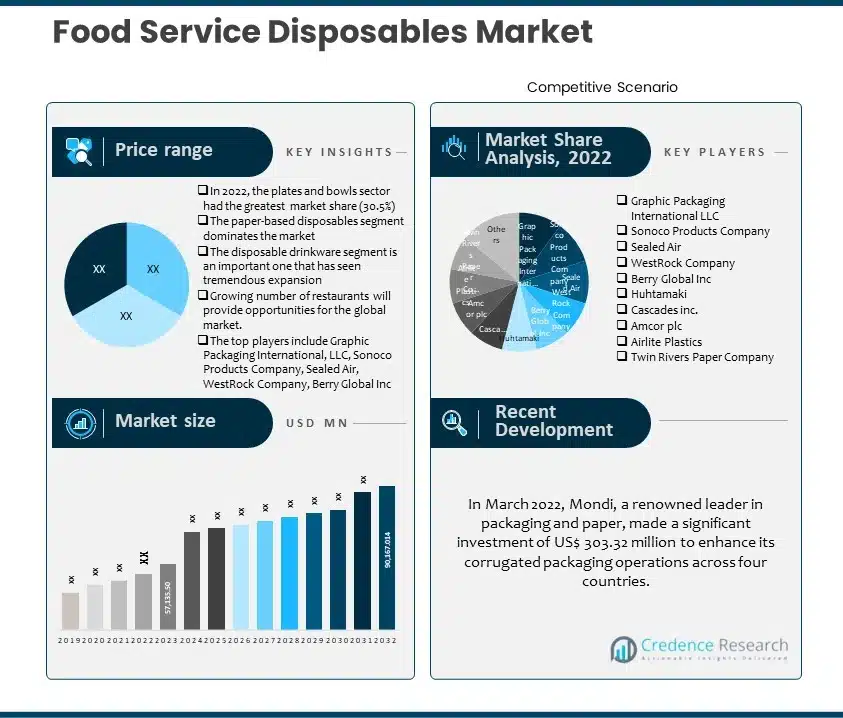
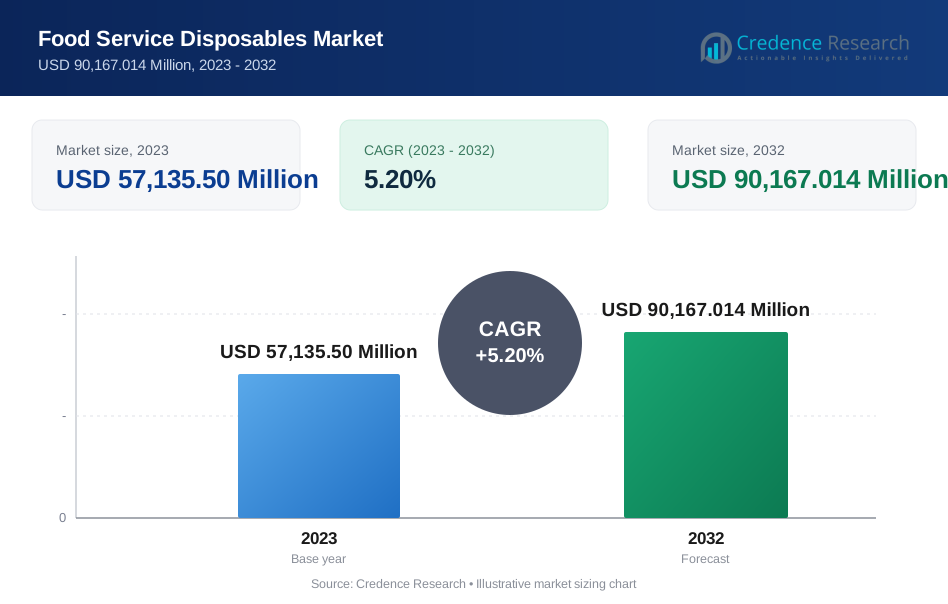
- The global demand for Food Service Disposables was valued at USD 57,135.50 Million in 2023 and is expected to reach USD 90,167.014 Million in 2032, growing at a CAGR of 5.20% between 2024 and 2032.
- The plates and bowls sector is the market leader by type of disposables, accounting for more than 31% of total value in 2023, while the cups and lids segment is expected to grow rapidly throughout the forecast period.
- The paper-based disposables dominates the global need for Food Service Disposables, accounting for more than 20% in 2023 and plastic-based disposables is predicted to expand at a high CAGR.
- The disposable drinkware sector is predicted to grow fastest over the projection period, while the disposable tableware segment will have a market share of more than 19% in 2023.
- Over the projection period, the cafeterias and food courts category is expected to expand at the highest rate, while the restaurants and fast-food chains category will dominate the market in 2023 with a 25% share.
- The cash and carry stores category is expected to expand quickly over the forecast period, while the foodservice distributors segment will have the greatest market share in 2023.
- Asia Pacific is fueling the growth of the Food Service Disposables industry with over one-third share in 2023, while North America and Europe collectively account for just under 55% share in 2023. Europe held over 20% share in 2023.
- Due to the growing number of restaurants, cafes, fast food chains, and catering services globally is driving the demand for food service disposable products.
- The market's primary possibilities include the significant growth potential in Asia Pacific, with the increasing popularity of takeout and delivery services, there is a higher demand for disposable packaging such as containers, cups, and utensils.
Executive Summary
Market Definition
Food service disposables refer to a range of single-use products used in the food and beverage industry for serving, packaging, and storing food items. These disposable items include containers, cups, plates, utensils, napkins, and packaging materials made from materials like paper, plastic, or biodegradable materials. Food service disposables are designed to provide convenience, hygiene, and efficiency for businesses and consumers in various foodservice settings, such as restaurants, cafes, fast food chains, catering services, and events. They are widely used for takeout orders, delivery services, outdoor dining, and catering events, offering practical solutions for serving food on-the-go or in large-scale settings.
Market Overview
The global Food Service Disposables market has witnessed steady growth in recent years and is expected to grow at a CAGR of 5.20% between 2024 and 2032. The market was valued at USD 57,135.50 million in 2023 and is expected to reach USD 90,167.014 million in 2032.
The key driver boosting the growth rate of the Food Service Disposables market is the rising number of foodservice establishments worldwide, including restaurants, cafes, fast food chains, and catering services, is fueling the demand for disposable products. With the expanding foodservice industry catering to diverse consumer preferences and dining habits, there is a growing need for convenient and hygienic disposable packaging solutions to serve food on-the-go or for takeaway and delivery services. Additionally, the increasing popularity of takeout and delivery services, particularly driven by the rise of food delivery apps and online ordering platforms, is driving the demand for disposable containers, cups, utensils, and packaging materials to accommodate these dining trends.
Furthermore, the growing emphasis on hygiene and food safety standards, especially in light of the COVID-19 pandemic, is accelerating the adoption of food service disposables. With heightened awareness of health risks associated with reusable items and the importance of minimizing contact points, businesses in the foodservice industry are increasingly turning to single-use disposable products to ensure the safety of their customers and employees. Disposable packaging solutions offer a convenient and hygienic way to serve and transport food, reducing the risk of cross-contamination and the spread of pathogens. As a result, there is a growing preference for disposable tableware, utensils, and packaging materials that provide a safe and convenient dining experience for consumers, driving market growth in the food service disposables segment.
Segmentation by Type of Disposables
- Plates and bowls is the leading segment by type of disposables and held over 31% share in value in 2023, attributable to the rise in demand for takeout and delivery services.
- The cups and lids segment will likely exhibit a significant CAGR during the forecast period. Urbanization and busy lifestyles have led to a rise in on-the-go dining habits, further fueling the demand for cups and lids products.
Segmentation by Material Composition
- The paper-based disposables segment governs the demand for Food Service Disposables in the world, holding a massive share of over 20% in 2023, and plastic-based disposables is also expected to grow at a rapid CAGR because emphasis on hygiene and food safety standards, especially in light of the COVID-19 pandemic, has led to a greater reliance on single-use disposable items in the foodservice industry.
- The foam-based disposables, biodegradable and compostable disposables, aluminum-based disposables, sugarcane bagasse-based disposables, and others sectors segment contributes to the demand for Food Service Disposables.
Segmentation by Functionality
- The disposable drinkware segment is expected to post the highest CAGR during the forecast period. This is primarily due to the disposable drinkware products offer convenience and time efficiency for both consumers and businesses, contributing to their widespread adoption.
- The disposable tableware segment is leading the market share with over 19% share in 2023.
Segmentation by End-Use Application
- The cafeterias and food courts segment is anticipated to register the highest CAGR during the projection period.
- With a market share of nearly 25% in 2023, the restaurants and fast-food chains category is currently in the lead.
- The category of end-use application segment includes catering services, hotels and hospitality industry, healthcare facilities (e.g., hospitals, nursing homes), schools and educational institutions, airline and railway catering, events and parties, convenience stores and gas stations, and others.
Segmentation by Distribution Channel
- The foodservice distributors dominate the global need for Food Service Disposables, accounting for more than 50% in 2023 and cash and carry stores are predicted to expand at a high CAGR.
- The rest of the demand for food service disposables comes from the online retailers (e-commerce), specialty stores, mass merchandisers, direct sales (manufacturer to end user), and others.
Segmentation by Region
- Asia Pacific is fueling the growth of the Food Service Disposables industry with over one-third share in 2023 due to the region's expansion of the fast food industry, along with the increasing popularity of food delivery apps, is driving the demand for disposable packaging solutions.
- North America and Europe collectively account for just under 55% share in 2023, with Europe holding over 20% share in the same year.
- The rest of the world, including Latin America, the Middle East, and Africa, supplies the remaining demand for Food Service Disposables.
The market for Food Service Disposables is driven by the growth of the tourism and hospitality industry, particularly in emerging markets, is boosting the demand for disposable products used in hotels, resorts, and cruise ships, thereby stimulating market growth.
Asia Pacific emerges as a dominating region, showcasing significant consumption and production levels. Countries within Asia Pacific, such as China, India, Japan, and South Korea, are experiencing rapid urbanization, population growth, and changing consumer preferences, all of which contribute to the region's dominance in the market. With a flourishing foodservice industry catering to diverse culinary traditions and dining habits, there is a substantial demand for disposable products such as containers, cups, plates, and utensils to accommodate takeaway, delivery services, and on-the-go dining. Furthermore, the prevalence of street food vendors, food stalls, and outdoor markets in many Asian countries further drives the demand for disposable packaging solutions, solidifying Asia Pacific's position as a dominant force in the food service disposable market.
Furthermore, China and India collectively represent 40% of the world's population. With their populations on the rise, the popularity of delivery services is increasing notably in both countries. In India, the online delivery sector is expanding rapidly, with companies like Zomato and Swiggy gaining momentum through strategic partnerships. This trend presents a lucrative growth opportunity for the market, particularly within the organized food industry. Similarly, over the past two years, China has experienced a surge in app-based delivery services. Companies such as 8peppers, Ele.me, and Meituan are primarily focusing on delivery services, thereby reducing costs associated with employing attendants/waiters and maintaining open dining rooms, which in turn fosters the growth of the market.
The North America stands out as the fastest-growing region in the food service disposable market. With a well-established foodservice industry and a high level of consumer demand for convenience, North America presents lucrative opportunities for market growth. The region's adoption of takeout and delivery services, fueled by the popularity of food delivery apps and online ordering platforms, is driving the demand for disposable packaging solutions. Additionally, stringent hygiene and food safety regulations, particularly in light of the COVID-19 pandemic, have accelerated the adoption of single-use disposable products in the foodservice industry. As a result, North America is experiencing rapid growth in the demand for food service disposables, positioning the region as a key growth driver in the global market.
The primary factor driving the Food Service Disposables market's growth rate is the rising number of foodservice establishments worldwide, including restaurants, cafes, fast food chains, and catering services, is fueling the demand for disposable products. With the expanding foodservice industry catering to diverse consumer preferences and dining habits, there is a growing need for convenient and hygienic disposable packaging solutions to serve food on-the-go or for takeaway and delivery services.
Key Highlights of the Report
The global Food Service Disposables market is segmented by type of disposables, material composition, functionality, end-use application, distribution channel, and region. Plates and Bowls-based Food Service Disposables are the most popular, while cups and lids, and Paper-based Disposables are the primary segments. In addition, disposable tableware, and restaurants and fast-food chains are the most commonly used categories. However, foodservice distributors dominate the market, with Asia Pacific leading the market growth.
One of the main factors propelling the global market for Food Service Disposables is the rising number of foodservice establishments worldwide, including restaurants, cafes, fast food chains, and catering services, is fueling the demand for disposable products. With the expanding foodservice industry catering to diverse consumer preferences and dining habits, there is a growing need for convenient and hygienic disposable packaging solutions to serve food on-the-go or for takeaway and delivery services. Additionally, the increasing popularity of takeout and delivery services, particularly driven by the rise of food delivery apps and online ordering platforms, is driving the demand for disposable containers, cups, utensils, and packaging materials to accommodate these dining trends.
Nonetheless, Asia Pacific is anticipated to have the greatest share of the global food service disposables market With a flourishing foodservice industry catering to diverse culinary traditions and dining habits, there is a substantial demand for disposable products such as containers, cups, plates, and utensils to accommodate takeaway, delivery services, and on-the-go dining. Furthermore, the market is anticipated to expand at the highest rate in the North America region due to the adoption of takeout and delivery services, fueled by the popularity of food delivery apps and online ordering platforms.
What Are The Main Drivers Of The Global Food Service Disposables Market?
Key drivers include the increasing number of foodservice establishments globally, rising demand for takeout and delivery services, emphasis on convenience and time efficiency, growing hygiene and food safety concerns, urbanization, and busy lifestyles.
What Are The Major Challenges Faced By The Global Food Service Disposables Market?
Major challenges include fluctuations in raw material prices, environmental concerns related to disposable packaging, regulatory compliance, competition from reusable alternatives, and the need for innovation to meet evolving consumer preferences.
What Are The Growth Opportunities In The Global Food Service Disposables Market?
Growth opportunities include the expansion of the fast food industry, growth in the events and catering sector, development of eco-friendly and biodegradable alternatives, technological advancements in packaging materials, strategic partnerships and collaborations, and the rising demand in emerging markets.
Market Drivers
The global Food Service Disposables market is driven by several factors. The following are the key drivers of the global Food Service Disposables market:
Increasing Demand for Convenience
One significant driver of the global food service disposables market is the increasing demand for convenience among consumers. With busy lifestyles and on-the-go dining habits becoming more prevalent, there is a growing preference for disposable packaging solutions that offer convenience and time efficiency. Disposable containers, cups, plates, and utensils allow consumers to enjoy meals conveniently, whether it's for takeout orders, delivery services, or outdoor dining.
Market Restraints
The global Food Service Disposables market faces some challenges that may hinder its growth. These include the following:
Environmental Concerns
A major restraint faced by the global food service disposables market is environmental concerns surrounding disposable packaging materials. The use of single-use plastics and other non-biodegradable materials has raised significant environmental issues, including pollution, waste accumulation, and harm to marine life. As a result, there is increasing pressure from consumers, governments, and environmental organizations to reduce the use of disposable plastics and transition to more sustainable alternatives.
Opportunities
The global Food Service Disposables market offers significant growth opportunities. These include the following:
Innovation in Sustainable Packaging
An opportunity for growth in the global food service disposables market lies in innovation and the development of sustainable packaging solutions. With growing awareness of environmental issues, there is a rising demand for eco-friendly and biodegradable alternatives to traditional disposable plastics. Companies that invest in research and development to create innovative, sustainable packaging materials stand to capitalize on this trend and gain a competitive edge in the market. Opportunities exist for the development of compostable packaging, plant-based alternatives, and recyclable materials that meet both environmental and performance standards.
Competitive Landscape
Key Players
The global Food Service Disposables market is highly competitive, with several key players. Some of the major players in the market and their market share are as follows:
- Graphic Packaging International LLC
- Sonoco Products Company
- Sealed Air
- WestRock Company
- Berry Global Inc
- Huhtamaki
- Cascades inc.
- Amcor plc
- Airlite Plastics
- Twin Rivers Paper Company
- Seda Group, Inc.
- Fabri-Kal
- Dart Container Corporation
- Anchor Packaging Inc
- Placon
- Novolex
- Hoffmaster Group Inc
- D&W Fine Pack
- Menasha Packaging Company, LLC
- Inteplast Group
- Others
These organizations prioritize product innovation, distribution channel expansion, and mergers and acquisitions to stay competitive.
The global Food Service Disposables market's key players continually seek to stay ahead by offering new products and developments.
In October 2021, Placon, the top thermoformer of durable plastic packaging in North America, announced its expansion plans by acquiring a former Sonoco packaging facility located in Wilson, North Carolina, U.S. This acquisition aims to bolster Placon's manufacturing capacity and workforce, enabling it to meet the growing production demands in the retail and medical sectors. Furthermore, it positions Placon to reinforce its leadership position in thermoforming sustainable recycled PET packaging.
In March 2022, Mondi, a renowned leader in packaging and paper, made a significant investment of US$ 303.32 million to enhance its corrugated packaging operations across four countries. This investment includes approximately US$ 200.41 million allocated to its network of corrugated solutions plants in eastern and central Europe, alongside US$ 102.91 million directed towards the containerboard mill owned by Mondi Wiecie in Poland. The strategic move aims to boost production capacity and improve customer service, solidifying Mondi's position as a key player in the packaging industry.
Summary of Key Findings
- The demand for Food Service Disposables is rising due to the increasing demand for convenience among consumers. With busy lifestyles and on-the-go dining habits becoming more prevalent, there is a growing preference for disposable packaging solutions that offer convenience and time efficiency.
- Market segmented by type of disposables, material composition, functionality, end-use application, distribution channel, and region.
- Plates and Bowls-based Food Service Disposables are the most popular, while cups and lids, and Paper-based Disposables are the primary segments.
- In addition, disposable tableware, and restaurants and fast-food chains are the most commonly used categories. However, foodservice distributors dominate the market.
- Asia Pacific is leading market growth; the market is highly competitive with key players including Graphic Packaging International, LLC, Sonoco Products Company, Sealed Air, WestRock Company, Berry Global Inc, Huhtamaki, Cascades inc., Amcor plc, Airlite Plastics, Twin Rivers Paper Company, Seda Group, Inc., Fabri-Kal, Dart Container Corporation, Anchor Packaging Inc, Placon, Novolex,, Hoffmaster Group, Inc, D&W Fine Pack, Menasha Packaging Company, LLC, Inteplast Group, and Others.
Future Outlook
- Positive outlook for the global Food Service Disposables market with significant growth potential in the Asia Pacific region
- One of the main factors promoting the market's expansion is the government and business sectors' current reliance on Food Service Disposables.
- During the forecast period, fluctuation in raw material prices is a significant factor projected to restrain the growth of the Food Service Disposables market.
- Key firms must focus on product innovation, growing market reach, and maintaining competitive pricing to keep ahead of the competition.
How CXOs Can Benefit from the Credence Research Food Service Disposables Market Report
The Credence Research Food Service Disposables Market Report provides CXOs with a comprehensive overview of the market, including:
- Market size and growth forecast: The report provides detailed estimates of the global Food Service Disposables market size, segmented by type of disposables, material composition, functionality, end-use application, distribution channel, and region. It also includes forecasts for the market through 2032, based on key trends and drivers.
- Market segmentation: The report segments the Food Service Disposables market by type of disposables, material composition, functionality, end-use application, distribution channel, and region. This segmentation provides CXOs with a granular understanding of the market and the opportunities in each segment.
- Competitive landscape: The report profiles the key players in the Food Service Disposables market and provides insights into their strategies, product offerings, and financial performance. This information can help CXOs to identify and assess their competition.
- Key trends and drivers: The report identifies and analyzes the key trends and drivers that are shaping the Food Service Disposables This information can help CXOs to make informed decisions about their investments and strategies.
CXOs can use the insights from the Credence Research Food Service Disposables Market Report to:
- Identify growth opportunities: The report can help CXOs to identify new growth opportunities in the Food Service Disposables For example, the report identifies the growing demand for Food Service Disposables from Food Service Disposables providers and manufacturing companies as a key opportunity.
- Make informed investment decisions: The report can help CXOs to make informed investment decisions about Food Service Disposables. For example, the report provides insights into the key factors to consider when evaluating Food Service Disposables providers and selecting Food Service Disposables
- Develop competitive strategies: The report can help CXOs to develop competitive strategies for their Food Service Disposables For example, the report identifies the key strategies that Food Service Disposables providers are using to differentiate themselves from their competitors.
- Track market developments: The report can help CXOs to track market developments and stay ahead of the curve. For example, the report provides insights into the latest trends and innovations in the Food Service Disposables
Overall, the Credence Research Food Service Disposables Market Report is a valuable resource for CXOs who are looking to gain a deeper understanding of the market and identify opportunities for growth.
Segmentation
- By Type of Disposables
- Plates and Bowls
- Cups and Lids
- Cutlery (e.g., forks, knives, spoons)
- Napkins and Tissues
- Food Containers (e.g., clamshells, trays, boxes)
- Straws and Stirrers
- Wraps and Foils
- Disposable Gloves
- Others (e.g., placemats, table covers)
- By Material Composition
- Paper-based Disposables
- Plastic-based Disposables
- Foam-based Disposables
- Biodegradable and Compostable Disposables
- Aluminum-based Disposables
- Sugarcane Bagasse-based Disposables
- Others
- By Functionality
- Disposable Tableware
- Disposable Drinkware
- Disposable Food Packaging
- Disposable Serveware
- Disposable Utensils
- Others
- By End-Use Application
- Restaurants and Fast-Food Chains
- Cafeterias and Food Courts
- Catering Services
- Hotels and Hospitality Industry
- Healthcare Facilities (e.g., hospitals, nursing homes)
- Schools and Educational Institutions
- Airline and Railway Catering
- Events and Parties
- Convenience Stores and Gas Stations
- Others
- By Distribution Channel
- Foodservice Distributors
- Cash and Carry Stores
- Online Retailers (e-commerce)
- Specialty Stores
- Mass Merchandisers
- Direct Sales (Manufacturer to End User)
- Others
- By Region
- North America
- The U.S.
- Canada
- Mexico
- Europe
- Germany
- France
- The U.K.
- Italy
- Spain
- Rest of Europe
- Asia Pacific
- China
- Japan
- India
- South Korea
- South-east Asia
- Rest of Asia Pacific
- Latin America
- Brazil
- Argentina
- Rest of Latin America
- Middle East & Africa
- GCC Countries
- South Africa
- Rest of Middle East and Africa
- North America
Request a Free Sample
Fill in your details and we'll send you a free sample report.
- Sample data tables & charts
- Research methodology
Need a Custom Version of This Report?
Tailor the scope, geography, or segments to your exact requirements.
- Custom geography or segment scope
- Direct access to our analyst team
Frequently Asked Questions
What is the current size of the global Food Service Disposables market?
What is the expected growth rate of the Food Service Disposables market between 2024 and 2032?
Which segment is leading the market share in terms of Type of Disposables?
Which material composition segment governs the demand for Food Service Disposables in the world?
Who are the major players in the global Food Service Disposables market?
Table of Content
Chapter 1. Report Introduction
- 1.1 Report Description & Purpose
- 1.1.1 Report Title & Market Definition
- 1.1.2 Unique Selling Propositions (USP) & Key Differentiators
- 1.1.3 Value Proposition for Stakeholders
- 1.2 Research Objectives
- 1.2.1 Market Sizing Objectives (Volume & Revenue) (Volume Where Applicable)
- 1.2.2 Segmentation Objectives
- 1.2.3 Competitive Intelligence Objectives
- 1.2.4 Forecast & Scenario Objectives
- 1.3 Report Scope
- 1.3.1 Food Service Disposables Scope – Segments & Subsegments Covered
- 1.3.2 Geographic Scope – Regions & Countries Covered
- 1.3.3 Historical Period, Base Year & Forecast Period (2023; forecast to 2032)
- 1.3.4 Inclusions & Exclusions
- 1.4 Industry Classification & Applicable Codes
- 1.5 Currency, Measurement Units & Valuation Basis
- 1.6 Target Stakeholders
- 1.7 Limitations & Assumptions
Chapter 2. Executive Summary
- 2.1 Global Food Service Disposables Market Snapshot
- 2.1.1 Market Size – Historical (2023) & Forecast (2023-2032) (2023: USD 57,135.50 Million → 2032: USD 90,167.014 Million)
- 2.1.2 Volume & Revenue – Global Totals (Volume Where Applicable)
- 2.1.3 Key Market Highlights – Top Five Facts
- 2.2 Food Service Disposables Market Segmentation Snapshot
- 2.2.1 Market Split by Region – 2023 vs. 2032
- 2.3 Competitive Snapshot
- 2.3.1 Top 10 Players by Revenue Share – 2023
- 2.3.2 Top 10 Players by Volume Share – 2023 (Volume Where Applicable)
- 2.3.3 Recent Strategic Developments (18-Month Summary)
- 2.4 Key Investment Highlights & Strategic Conclusions
Chapter 3. Food Service Disposables Market Dynamics & Industry Analysis
- 3.1 Market Overview & Context
- 3.1.1 Food Service Disposables Market Position in the Broader Industry Value Chain
- 3.1.2 Demand Structure & Purchasing Dynamics
- 3.1.3 Market Maturity & Development Stage by Region
- 3.2 Food Service Disposables Market Drivers
- 3.3 Food Service Disposables Market Restraints & Challenges
- 3.4 Food Service Disposables Market Opportunities
- 3.5 Porter's Five Forces Analysis
- 3.5.1 Threat of New Entrants
- 3.5.2 Bargaining Power of Suppliers
- 3.5.3 Bargaining Power of Buyers
- 3.5.4 Threat of Substitutes
- 3.5.5 Competitive Rivalry – Intensity Assessment
- 3.6 Food Service Disposables Value Chain Analysis
- 3.6.1 Upstream – Key Inputs, Resources & Suppliers
- 3.6.1.1 Key Input/Resource 1
- 3.6.1.2 Key Input/Resource 2
- 3.6.1.3 Key Input/Resource 3
- 3.6.2 Midstream – Core Operations & Value Creation
- 3.6.2.1 Operating Model & Process Overview
- 3.6.2.2 Key Operating Locations & Capabilities by Company
- 3.6.3 Downstream – Market Channels & End Users
- 3.6.3.1 Direct Sales & Customer Engagement Channels
- 3.6.3.2 Indirect Sales, Intermediaries & Partner Channels
- 3.6.4 Value Chain Profitability Analysis
- 3.6.1 Upstream – Key Inputs, Resources & Suppliers
- 3.7 PESTEL Analysis
- 3.7.1 Political Factors
- 3.7.2 Economic Factors
- 3.7.3 Social Factors
- 3.7.4 Technological Factors
- 3.7.5 Environmental Factors
- 3.7.6 Legal Factors
- 3.8 Food Service Disposables Supply Chain Analysis
- 3.8.1 Critical Input & Resource Availability Risk Assessment
- 3.8.2 Supplier & Operational Concentration Risk (Geographic Exposure)
- 3.8.3 Supply & Service Disruption Impact Analysis
- 3.9 Regulatory & Policy Landscape
Note: The regulatory and policy landscape section covers regulations based on their applicability to the market, Food Service Disposables category, geography, and scope of the study. Only regulatory frameworks with a material impact on operations, compliance, trade, sustainability, or market access are analyzed in detail.
Chapter 4. Key Investment Pockets & Opportunity Analysis
- 4.1 Food Service Disposables Market Attractiveness Analysis
- 4.1.1 By Region – Investment Attractiveness Matrix (Market Size × CAGR)
- 4.2 Absolute Revenue Growth Opportunity
- 4.2.1 By Region – Absolute Revenue Growth Through 2032
- 4.3 Incremental Demand Opportunity
- 4.3.1 By Region – Incremental Demand Through 2032
- 4.3.2 Segment – Incremental Demand
- 4.4 Emerging Submarket Opportunity Deep Dive (Subject to Applicability)
- 4.5 Priority Market Opportunity Scorecards
- 4.5.1 United States
- 4.5.2 Europe
- 4.5.3 Asia
- 4.5.4 Middle East & Africa
Note: Priority market opportunity scorecards reflect the geographic scope and strategic relevance of the study. Listed markets are indicative and may be adapted to the industry.
Chapter 5. Food Service Disposables Cross-Border Trade & Market Access Analysis
- 5.1 International Trade & Cross-Border Activity Overview
- 5.1.1 Global Export Value by Country (2023)
- 5.1.2 Global Export Volume by Country (2023) (Volume Where Applicable)
- 5.1.3 Global Import Value by Country (2023)
- 5.1.4 Global Import Volume by Country (2023) (Volume Where Applicable)
- 5.1.5 Net Trade Balance by Country (2023)
- 5.2 Export Analysis – Segment
- 5.2.1 Category 1 (Applicable Classification Code)
- 5.2.2 Category 2 (Applicable Classification Code)
- 5.2.3 Category 3 (Applicable Classification Code)
- 5.2.4 Category 4 (Applicable Classification Code)
- 5.2.5 Category 5 (Applicable Classification Code)
- 5.3 Import Analysis – Segment
- 5.3.1 Category 1 (Applicable Classification Code)
- 5.3.2 Category 2 (Applicable Classification Code)
- 5.3.3 Category 3 (Applicable Classification Code)
- 5.3.4 Category 4 (Applicable Classification Code)
- 5.3.5 Category 5 (Applicable Classification Code)
- 5.4 Cross-Border Pricing & Transaction Benchmarks
- 5.4.1 Export Pricing – Segment & Country
- 5.4.2 Import Pricing – Segment & Source Country
- 5.4.3 Price Trends (2023)
- 5.5 Key Cross-Border Trade & Delivery Routes
- 5.5.1 Cross-Border Trade/Delivery Route 1
- 5.5.2 Cross-Border Trade/Delivery Route 2
- 5.5.3 Cross-Border Trade/Delivery Route 3
- 5.5.4 Cross-Border Trade/Delivery Route 4
- 5.5.5 Cross-Border Trade/Delivery Route 5
- 5.6 Trade Policy & Market Access Impact Assessment
- 5.6.1 Tariff & Non-Tariff Barriers
- 5.6.2 Regional Trade & Economic Integration Frameworks
- 5.6.3 Bilateral & Multilateral Trade Agreements
- 5.6.4 Cross-Border Operating, Licensing & Localization Requirements
Note: This chapter applies where cross-border trade or delivery is relevant to Food Service Disposables. Goods, services, and digital offerings are assessed using applicable classifications and transaction measures. Import-export volumes, trade balances, and route analyses are included only where meaningful to the market.
Chapter 6. Competitive Landscape & Company Benchmarking
- 6.1 Food Service Disposables Market Concentration & Structure
- 6.1.1 Herfindahl-Hirschman Index (HHI) – vs. 2023
- 6.1.2 Leading, Mid-Sized & Emerging Player Structure
- 6.1.3 Global, Regional & Local Player Dynamics
- 6.2 Food Service Disposables Market Share Analysis – 2023
- 6.2.1 Global Revenue Share by Company
- 6.2.2 Global Volume Share by Company (Volume Where Applicable)
- 6.2.3 Regional Revenue Share
- 6.2.4 Market Share Evolution ( vs. 2023)
- 6.2.5 Company Market Share by Key Segment
- 6.2.6 Company Market Share by Customer Group
- 6.3 Operating Scale, Capacity & Infrastructure Analysis
- 6.3.1 Global Operating Scale & Supply Capacity
- 6.3.2 Resource Utilization & Operating Efficiency
- 6.3.3 Output, Service Delivery & Activity Metrics
- 6.3.4 Operating Footprint & Infrastructure Map
- 6.3.5 Planned Operational & Capacity Expansion
- 6.4 Food Service Disposables Competitive Benchmarking Matrix
- 6.4.1 Revenue, Growth, Profitability & Operating Metric Comparison
- 6.4.2 Channel Revenue Mix
- 6.4.3 Geographic Revenue Exposure
- 6.4.4 R&D Intensity
- 6.4.5 Sustainability Maturity
- 6.5 Strategic Developments in Food Service Disposables (Last 24 Months)
- 6.5.1 Mergers, Acquisitions & Divestments
- 6.5.2 New Products, Services & Solutions in Food Service Disposables
- 6.5.3 Operational & Infrastructure Expansions
- 6.5.4 Strategic Alliances, Joint Ventures & Partnerships
- 6.5.5 Distribution Expansion & Market Entry
- 6.5.6 Sustainability & ESG Initiatives
- 6.6 Competitive Strategy Mapping
- 6.6.1 Leader, Challenger, Follower & Niche Classification
- 6.6.2 Pricing Strategy Comparison
- 6.6.3 Channel Strategy Matrix
Note: Strategic developments are included based on their materiality and the availability of reliable information.
Chapter 7. Global Food Service Disposables Market – By Sales & Delivery Channel
- 7.1 Segment Overview
- 7.1.1 Volume & Revenue Split by Channel (2023 & 2032) (Volume Where Applicable)
- 7.1.2 Channel Mix Evolution (2023-2032)
Chapter 8. Regional Market Analysis – Global Overview
- 8.1 Global Regional Overview
- 8.1.1 Regional Volume Share (Volume Where Applicable)
- 8.1.2 Regional Revenue Share
- 8.1.3 Regional Volume by Region (Volume Where Applicable)
- 8.1.4 Regional Revenue by Region
- 8.1.5 Regional Forecast Through 2032
- 8.2 Cross-Regional Segment Analysis
- 8.2.1 By Sales & Delivery Channel
- 8.2.2 By Competitive Positioning & Price Tier
Chapter 9. North America Food Service Disposables Market
- 9.1 United States
- 9.2 Canada
- 9.3 Mexico
Chapter 10. Europe Food Service Disposables Market
- 10.1 Germany
- 10.2 France
- 10.3 Italy
- 10.4 United Kingdom
- 10.5 Spain
- 10.6 Poland
- 10.7 Russia
- 10.8 Netherlands
- 10.9 Belgium
- 10.10 Sweden
- 10.11 Denmark
- 10.12 Norway
- 10.13 Rest of Europe
Chapter 11. Asia Pacific Food Service Disposables Market
- 11.1 China
- 11.2 India
- 11.3 Japan
- 11.4 South Korea
- 11.5 Thailand
- 11.6 Indonesia
- 11.7 Vietnam
- 11.8 Malaysia
- 11.9 Australia
- 11.10 Rest of Asia Pacific
Chapter 12. Latin America Food Service Disposables Market
- 12.1 Brazil
- 12.2 Argentina
- 12.3 Colombia
- 12.4 Chile
- 12.5 Rest of Latin America
Chapter 13. Middle East Food Service Disposables Market
- 13.1 Saudi Arabia
- 13.2 United Arab Emirates
- 13.3 Turkey
- 13.4 Israel
- 13.5 Iran
- 13.6 Rest of the Middle East
Chapter 14. Africa Food Service Disposables Market
- 14.1 South Africa
- 14.2 Egypt
- 14.3 Nigeria
- 14.4 Morocco
- 14.5 Rest of Africa
Chapter 15. Food Service Disposables Company Profiles
- 15.1 [Company 01]
- 15.1.1 Company Overview
- 15.1.2 Key Management Personnel
- 15.1.3 Products & Services Portfolio
- 15.1.4 Financial Performance
- 15.1.5 Key Market Focus & Geographic Presence
- 15.1.6 Recent Developments & Strategic Initiatives
Note: The company profile list is preliminary and may change based on research findings, market developments, data availability, and client requirements.
Chapter 16. Appendices
- Appendix A – List of Abbreviations & Acronyms
- Appendix B – Industry Classification Code Reference – Full Series
- Appendix C – Supply, Output & Operating Capacity Data Tables
- Appendix D – End-Use & Demand Base Tables
- Appendix E – Demand, Adoption & Usage Assumptions
- Appendix F – Pricing & Revenue Metric Reference Tables
- Appendix G – Company Operations & Infrastructure Database
- Appendix H – Cross-Border Trade & Activity Data Tables (Where Applicable)
- Appendix I – Regulatory Summary Tables
- Appendix J – Primary Research Participant List (Anonymized)
- Appendix K – Primary Research Questionnaire Framework
- Appendix L – Data Sources & Bibliography
- Appendix M – Market Size Divergence & Source Comparison
Chapter 17. Research Methodology
- 17.1 Research Framework & Philosophy
- 17.2 Secondary Research – Sources, Hierarchy & Data Extraction
- 17.3 Data Modeling – Bottom-Up & Top-Down Market Sizing
- 17.4 Primary Research – Stakeholder Framework, LOI & Sample Sizes
- 17.5 Forecast Methodology – Regression, Scenario & Sensitivity Analysis
- 17.6 Quality Control – Four-Layer Validation Framework
- 17.7 Limitations & Standard Assumptions
- 17.8 Disclaimer
