
| REPORT ATTRIBUTE | DETAILS |
|---|---|
| Historical Period | 2019-2022 |
| Base Year | 2023 |
| Forecast Period | 2024-2032 |
| Forestry Truck Mounted Cranes Market Size 2023 | USD 1215.2 Million |
| Forestry Truck Mounted Cranes Market, CAGR | 5.20% |
| Forestry Truck Mounted Cranes Market Size 2032 | USD 1917.7 Million |
Market Insights
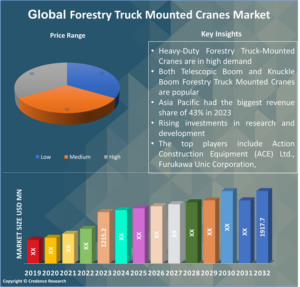
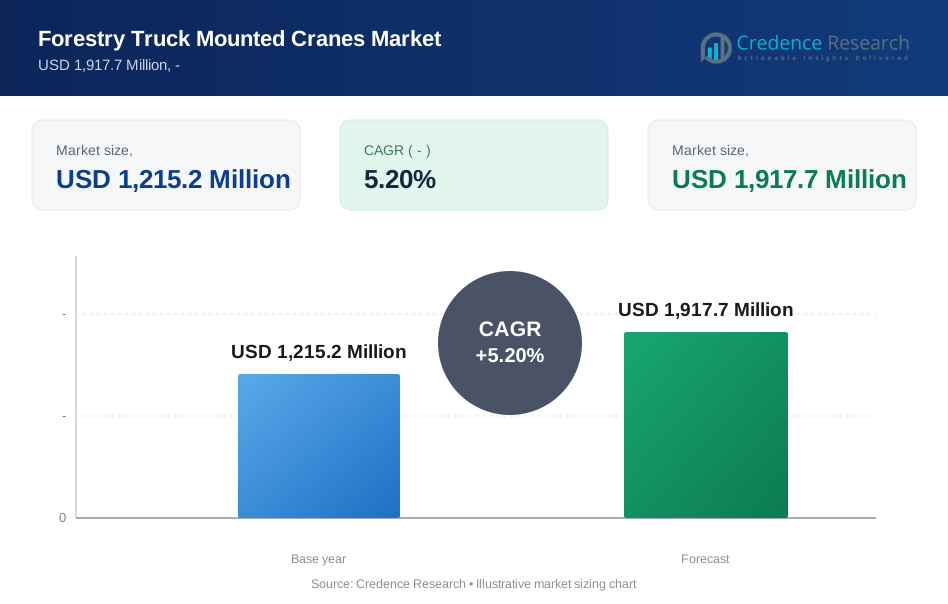
- The global demand for Forestry Truck Mounted Cranes was valued at USD 1215.2 Million in 2023 and is expected to reach USD 1917.7 Million in 2032, growing at a CAGR of 5.20% between 2024 and 2032.
- Heavy-duty forest truck-mounted cranes are in high demand.
- Telescopic Boom and Knuckle Boom Forestry Truck Mounted Cranes are popular.
- Utility Line Maintenance is the fastest-growing segment, while Timber Harvesting is another dominating market area for Forestry Truck Mounted Cranes.
- Commercial logging companies play a vital role, as do government and municipal forestry departments.
- Hydraulic Control Forestry Truck Mounted Cranes dominated the forest truck. Mounted Cranes Market and Remote Control Forestry Truck-Mounted Cranes is the fastest growing sector.
- Dedicated Forestry Trucks with Cranes dominate the Forestry Truck Mounted Cranes Market, however Adaptable/Attachment Cranes for Trucks are also popular.
- The most frequent segment of the Forestry Truck Mounted Cranes Market is Diesel-Powered Forestry Truck Mounted Cranes. While electric-powered forestry truck-mounted cranes gain market share.
- The leading market segment is collision avoidance systems, while another key market sector is load moment limiting systems.
- In 2023, Asia Pacific had the highest revenue share (43%), while Europe had the second-largest market share for cranes.
- Growing Focus on Public-Private Partnerships (PPPs) to Improve Market Growth Prospects
- Limited availability of skilled workers and volatile raw material prices would limit market growth.
Executive Summary
Market Definition
The Forestry Truck Mounted Cranes Market refers to the market for cranes that are specifically designed and mounted on trucks for use in the forestry industry. These cranes are used for various tasks in forestry operations, such as lifting and moving heavy logs, loading and unloading timber, and assisting in tree removal and maintenance. They provide efficient and versatile solutions for forestry companies, allowing them to carry out their operations effectively.
Market Overview
The global Forestry Truck Mounted Cranes Market has witnessed steady growth in recent years and is expected to grow at a CAGR of 5.20% between 2024 and 2032. The market was valued at USD 1215.2 million in 2023 and is expected to reach USD 1917.7 million in 2032.
The market for forestry truck mounted cranes is experiencing steady growth due to the increasing demand for efficient and versatile equipment in the forestry industry. These cranes offer the ability to lift heavy loads, maneuver in challenging terrains, and provide enhanced productivity for forestry operations. The market is driven by factors such as the expansion of the forestry industry, the need for mechanization, and the focus on improving operational efficiency. The market is expected to continue growing as forestry companies seek advanced and specialized equipment to optimize their operations.
Segmentation by Lifting Capacity
- Heavy-Duty Forestry Truck-Mounted Cranes are in high demand in the Forestry Truck Mounted Cranes Market. Heavy-duty cranes are intended to perform larger and more difficult forestry operations, such as lifting and transporting heavy logs or equipment.
Segmentation by Boom Type
- Both Telescopic Boom and Knuckle Boom Forestry Truck Mounted Cranes are popular. Telescopic Boom cranes have a straight, extensible boom that provides outstanding reach and lifting capabilities, making them ideal for a variety of forestry applications. In contrast, Knuckle Boom cranes have a hinged boom that provides for greater flexibility and manoeuvrability, making them excellent for handling confined locations in forestry operations.
Segmentation by Mounting Position
- Rear-mounted cranes are often installed near the rear of the vehicle chassis, which provides benefits such as improved weight distribution and manoeuvrability.
Segmentation by Deployment Type
- Utility Line Maintenance is the fastest-growing segment. The demand for specialized cranes for maintaining and repairing utility lines, such as power lines and telecommunication cables, has increased. Utility Line Maintenance Cranes have the appropriate reach and lifting capacity to efficiently handle equipment and materials during line maintenance operations.
- Timber Harvesting is another dominant market segment for Forestry Truck Mounted Cranes..
Segmentation by End-User
- Commercial Logging Companies are an important component of the Forestry Truck Mounted Cranes market. These companies specialize in large-scale timber harvesting and processing. They frequently require efficient and powerful cranes to manage the heavy lifting and loading of logs during the logging process.
- Another significant category is Government and Municipal Forestry Departments.
- Forestry contractors also have a another important part in the market.
Segmentation by Control Type
- Hydraulic Control Forestry Truck Mounted Cranes dominate the Market. These cranes are powered by hydraulic systems, providing precise control and effective lifting capabilities. They are frequently employed in a variety of forestry applications because to their dependability and flexibility.
- On the other hand, Remote Control Forestry Truck-Mounted Cranes is the market's fastest expanding sector.
Segmentation by Vehicle Type
- Forestry Truck Mounted Cranes Market is dominated by Dedicated Forestry Trucks with Cranes. These trucks are specifically developed and manufactured for forestry applications, with integrated crane systems optimised for lifting and handling activities in the forestry industry.
- Adaptable/Attachment Cranes for Trucks are also in demand.
Segmentation by Power Source
- The most common sector of the Forestry Truck Mounted Cranes Market is Diesel-Powered Forestry Truck Mounted Cranes. Diesel engines power these cranes, giving them the strength and torque required for heavy lifting and difficult forestry work. Diesel-powered cranes are frequently utilized in the industry due to their dependability, longevity, and ability to work in distant areas where electricity may not be easily available.
- While electric-powered forestry truck-mounted cranes are gaining market share because to their environmental benefits and lower operating costs, diesel-powered cranes continue to be popular due to their proven performance and broad availability
Segmentation by Safety Features
- Collision Avoidance Systems is the dominant market segment. These systems rely on sensors, cameras, and complex algorithms to identify and avoid probable collisions. They send real-time alerts and cautions to the crane operator, which helps to improve safety and prevent accidents in forestry operations.
- Another major market sector is Load Moment Limiting Systems. These technologies monitor and control the crane's load capacity to ensure that it functions within safe parameters. They serve to minimize overloading and instability, encouraging safe and efficient lifting operations in the forestry industry.
- While Stability Control Systems and Emergency Stop Systems play critical roles in improving safety and preventing accidents,
Segmentation by Region
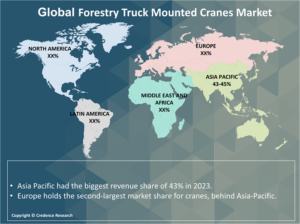
- Asia Pacific had the biggest revenue share of 43% in 2023.
- Europe holds the second-largest market share for cranes, behind Asia-Pacific.
- The rest of the world, including Latin America, the Middle East, and Africa, supplies the remaining demand for Forestry Truck Mounted Cranes.
Asia-Pacific has the largest truck-mounted cranes market share due to increased development of new infrastructure, and improved financial conditions, which leads to growth in the construction industry and the truck-mounted cranes market. Asia-Pacific is considered the fastest-growing construction region, with emerging economies such as India, China, Australia, and Vietnam serving as important country-level marketplaces.
Emerging countries such as India and China have boosted the use of Truck Mounted Cranes as consumers prefer more productive, user-friendly, and efficient technologies. The construction industry's never-ending demand from numerous end-use industries is driving market expansion in this area. Rapid urbanization, increased real estate investment, and rising government and consumer expenditure are the primary drivers expected to boost Asian countries' economic growth during the next 10-15 years, resulting in expansion in the region's building and construction industries.
In addition, Europe has the second-largest crane market share, after Asia-Pacific. This is because Europe is a major crane manufacturing region, with Konecranes Plc, Liebherr-International AG, Cargotec Corporation, and Mammoet dominating the market. Furthermore, European manufacturers are increasingly concerned with the emission management of heavy gear such as cranes. As a result, electric cranes are in high demand throughout the region. As a result, these factors collectively contribute to the growth of the European crane market.
Key Highlights of the Report
The global Forestry Truck Mounted Cranes Market is segmented by Lifting Capacity, Boom Type, Mounting Positions, Deployment Type, End-User, Control Type, Vehicle Type, Power Source, Safety Features and region. The leading market segments are collision avoidance and hydraulic control, while Utility Line Maintenance is the fastest-growing area. Also, Telescopic Boom and Knuckle Boom Forestry Truck Mounted Cranes are common, and Commercial Logging Companies play an essential role. Furthermore, adaptable/attachment cranes for trucks are also in demand, with Asia Pcific leading the market growth.
The market's key drivers include rising demand for efficient and flexible forestry equipment, an increased emphasis on mechanization and automation to improve operational efficiency, and the expansion of the forestry industry in emerging regions. Furthermore, the key market hurdles include the high initial investment cost for forestry truck mounted cranes, the paucity of qualified operators for specialized equipment, and environmental regulations and restrictions on logging activities in specific regions.
Nonetheless, Asia-Pacific has the largest truck-mounted cranes market share due to increased development of new infrastructure, and improved financial conditions, which leads to growth in the construction industry and the truck-mounted cranes market. Furthermore, Europe has the second-largest market share for cranes,
What Are The Main Drivers Of The Global Forestry Truck Mounted CranesMarket?
The Forestry Truck Mounted Cranes Market is being driven by several factors. Firstly, there is an increasing demand for efficient and versatile equipment in the forestry industry. Forestry truck mounted cranes provide the ability to lift heavy loads and maneuver in challenging terrains, improving productivity in forestry operations. Secondly, there is a growing focus on mechanization and automation to enhance operational efficiency. These cranes offer advanced features such as remote control and automation, allowing for more streamlined and efficient forestry operations.
What Are The Major Challenges Faced By The Global Forestry Truck Mounted CranesMarket?
there are a few restraints that the Forestry Truck Mounted Cranes Market faces. One of the main restraints is the high initial investment cost associated with these cranes. The specialized design and capabilities of forestry truck mounted cranes make them relatively expensive, which can be a barrier for some forestry companies. Additionally, there is a limited availability of skilled operators for these specialized equipment. Operating forestry truck mounted cranes requires specific training and expertise, and finding qualified personnel can be a challenge.
What Are The Growth Opportunities In The Global Forestry Truck Mounted CranesMarket?
The Forestry Truck Mounted Cranes Market also presents several opportunities for growth and development. Technological advancements in crane design and functionality offer opportunities for improved efficiency and safety. Manufacturers are constantly innovating to enhance the capabilities of these cranes, making them more reliable and user-friendly. Additionally, there is a rising demand for eco-friendly and sustainable equipment in the forestry industry. This drives the development of greener forestry cranes that minimize environmental impact while still delivering high performance.
Market Drivers
Growing Focus on Public-Private Partnerships (PPPs) to Enhance Market Growth Prospects
The absence of government funding is one of the most major barriers to infrastructure development, particularly in developing countries. Building new infrastructure is an important aspect in the rapid expansion of metropolitan areas. The infrastructure gap is caused by a lack of financial resources and ineffective avenues for mobilizing resources for national growth. In a number of countries, public-private partnerships (PPPs), sometimes known as public-private partnerships, have successfully directed private capital into infrastructure development.
Market Restraints
Finite Availability of Skilled Workers and Unstable Raw Material Prices to Limit Market Growth
Manufacturing companies have been obliged to raise employee wages in response to the industry's rising demand for skilled labour. As a result, manufacturing enterprises have incurred significant expenses merely for labour. Organizations face a significant personnel crisis, leaving workers overworked and dissatisfied with their positions. Furthermore, the usage of overhead cranes in industrial settings is becoming more common, which is predicted to raise demand for competent, trained, and certified labour on the factory floor.
Aluminium and steel prices have recently risen, raising the overall price of manufactured items and affecting the cost of valves and electronic components. The US administration has boosted taxes on imports of steel and aluminium derivatives. Crane production requires a substantial amount of steel, which is a significant barrier to expanding the crane business.
Opportunities
Automation in Cranes to Increase Market Opportunities
Crane systems that are both autonomous and automated provide remote access to machinery that do not require human operators. Mobile cranes may now be remotely monitored using artificial intelligence and networking sensors. Providing real-time information on the boom's angle, load weight, horizontal reach, and crane efficiency removes the risk of human error. Remotely controlled cranes reduce the likelihood of accidents and fatalities. As a result, automation in mobile cranes is expected to create attractive potential for the cranes market.
Competitive Landscape
Key Players
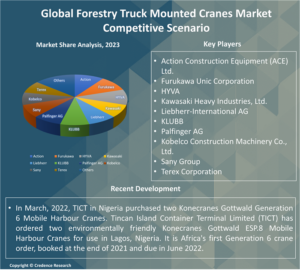
The global Forestry Truck Mounted Cranes Market is highly competitive, with several key players. Some of the major players in the market and their market share are as follows:
- Action Construction Equipment (ACE) Ltd.
- Furukawa Unic Corporation
- HYVA
- Kawasaki Heavy Industries, Ltd.
- Liebherr-International AG
- KLUBB
- Palfinger AG
- Kobelco Construction Machinery Co., Ltd.
- Sany Group
- Terex Corporation
- Xuzhou Construction Machinery Group Co., Ltd. (XCMG)
- Manitex International Inc. (Badger Equipment Company)
- Broderson Manufacturing Corporation (Lanco International Inc.)
- IHI Corporation
- Link-Belt Cranes (Sumitomo Heavy Industries Ltd.)
- Tadano
- ZOOMLION Heavy Industry Science & Technology Co., Ltd.
- Cargotec Corporation
- Konecranes Plc
- Manitowoc Cranes
These organizations prioritize product innovation, Forestry Truck Mounted Cranes Centers expansion, and mergers and acquisitions to stay competitive.
The global Forestry Truck Mounted Cranes Market's key players continually seek to stay ahead by offering new products and developments.
In June 2022, Manitowoc has released a new version of Potain MCT 565 for short-jib applications. Manitowoc has introduced the Potain MCT 565A, a more compact but equally powerful variant of the 32-ton capacity MCT 565 M32, the second-largest topless crane constructed at the Zhangjiagang, China site after the Potain MCT 805.
In May 2022, Liebherr-Mischtechnik GmbH and FBR collaborated to commercialise a bricklaying robot. Liebherr-Mischtechnik and FBR, an Australian firm, are working together to build a mobile bricklaying robot. Hadrian, the robot, is a swift and effective mason.
Summary of Key Findings
- Automation in Cranes Will Expand Market Opportunities
- Market segmented by Lifting Capacity, Boom Type, Mounting Positions, Deployment Type, End-User, Control Type, Vehicle Type, Power Source, Safety Features and region.
- Hydraulic Control Forestry Truck Mounted Cranes dominate the forestry truck
- Commercial logging companies are a major component
- Asia Pacific is leading market growth; the market is highly competitive with key players including Action Construction Equipment (ACE) Ltd., Furukawa Unic Corporation, HYVA, Kawasaki Heavy Industries, Ltd., Liebherr-International AG, KLUBB and Others.
Future Outlook
- Increasing adoption of advanced technologies
- Growing demand for eco-friendly and sustainable equipment
- Expansion of the forestry industry in emerging markets
- Focus on improving safety and efficiency in forestry operations
- Integration of automation and remote control features
- Rising investments in research and development
How CXOs Can Benefit from the Credence Research Forestry Truck Mounted Cranes Market Report
The Credence Research Forestry Truck Mounted Cranes Market Report provides CXOs with a comprehensive overview of the market, including:
- Market size and growth forecast:The report provides detailed estimates of the global Forestry Truck Mounted Cranes Market size, segmented by Lifting Capacity, Boom Type, Mounting Positions, Deployment Type, End-User, Control Type, Vehicle Type, Power Source, Safety Features and region. It also includes forecasts for the market through 2032, based on key trends and drivers.
- Market segmentation:The report segments the Forestry Truck Mounted Cranes Market by Lifting Capacity, Boom Type, Mounting Positions, Deployment Type, End-User, Control Type, Vehicle Type, Power Source, Safety Features and region. This segmentation provides CXOs with a granular understanding of the market and the opportunities in each segment.
- Competitive landscape:The report profiles the key players in the Forestry Truck Mounted Cranes Market and provides insights into their strategies, product offerings, and financial performance. This information can help CXOs to identify and assess their competition.
- Key trends and drivers:The report identifies and analyzes the key trends and drivers that are shaping the Forestry Truck Mounted Cranes Market. This information can help CXOs to make informed decisions about their investments and strategies.
CXOs can use the insights from the Credence Research Forestry Truck Mounted Cranes Market Report to:
- Identify growth opportunities:The report can help CXOs to identify new growth opportunities in the Forestry Truck Mounted Cranes Market. For example, it can provide potential expansion opportunities in regions where the demand for forestry truck-mounted cranes is growing rapidly. Additionally, the report can highlight technological advancements and innovations in the industry, allowing CXOs to invest in new and improved crane models that meet the evolving needs of the market.
- Make informed investment decisions:The report can help CXOs to make informed investment decisions about Forestry Truck Mounted Cranes. For example, the report can provide CXOs with valuable insights on market trends, demand projections, and competitive landscape in the Forestry Truck Mounted Cranes Market. With this information, CXOs can assess the potential profitability and growth prospects of investing in forestry truck-mounted cranes.
- Develop competitive strategies:The report can help CXOs to develop competitive strategies for their Forestry Truck Mounted Cranes businesses. For example, competitive landscape, including key players, their market share, and their strategies. It can also analyze customer preferences, industry trends, and emerging technologies to help CXOs identify unique selling points and differentiate their offerings.
- Track market developments:The report can help CXOs to track market developments and stay ahead of the curve. For example, the report provides insights into the latest trends and innovations in the Forestry Truck Mounted Cranes Market.
Overall, the Credence Research Forestry Truck Mounted Cranes Market Report is a valuable resource for CXOs who are looking to gain a deeper understanding of the market and identify growth opportunities.
Segmentation
By Lifting Capacity:
- Light-Duty Forestry Truck-Mounted Cranes
- Medium-Duty Forestry Truck-Mounted Cranes
- Heavy-Duty Forestry Truck-Mounted Cranes
By Boom Type:
- Telescopic Boom Forestry Truck-Mounted Cranes
- Knuckle Boom Forestry Truck-Mounted Cranes
By Mounting Position:
- Rear-Mounted Forestry Truck-Mounted Cranes
- Front-Mounted Forestry Truck-Mounted Cranes
By Application:
- Timber Harvesting
- Log Loading and Unloading
- Brush Clearing and Removal
- Utility Line Maintenance
- Forestry Equipment Transport
- Others
By End-User:
- Commercial Logging Companies
- Forestry Contractors
- Government and Municipal Forestry Departments
- Private Landowners
- Others
By Control Type:
- Manual Control Forestry Truck-Mounted Cranes
- Remote Control Forestry Truck-Mounted Cranes
- Hydraulic Control Forestry Truck-Mounted Cranes
By Vehicle Type:
- Dedicated Forestry Trucks with Cranes
- Adaptable/Attachment Cranes for Trucks
- Others
By Power Source:
- Diesel-Powered Forestry Truck-Mounted Cranes
- Electric-Powered Forestry Truck-Mounted Cranes
- Others
By Safety Features:
- Load Moment Limiting Systems
- Stability Control Systems
- Collision Avoidance Systems
- Emergency Stop Systems
- Others
By Region
- North America
- US
- Canada
- Mexico
- Europe
- Germany
- France
- UK
- Italy
- Spain
- Rest of Europe
- Asia Pacific
- China
- Japan
- India
- South Korea
- South-east Asia
- Rest of Asia Pacific
- Latin America
- Brazil
- Argentina
- Rest of Latin America
- Middle East & Africa
- GCC Countries
- South Africa
- Rest of Middle East and Africa
Adjacent Markets
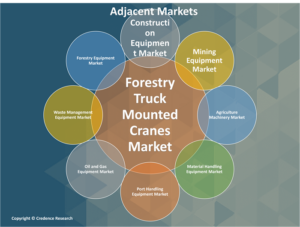
In the Forestry Truck Mounted Cranes Market, there are several adjacent markets which has high revenue growth opportunities. The key adjacent markets for Forestry Truck Mounted Cranes Market -
Request a Free Sample
Fill in your details and we'll send you a free sample report.
- Sample data tables & charts
- Research methodology
Need a Custom Version of This Report?
Tailor the scope, geography, or segments to your exact requirements.
- Custom geography or segment scope
- Direct access to our analyst team
Table of Content
Chapter 1. Report Introduction
- 1.1 Report Description & Purpose
- 1.1.1 Report Title & Market Definition
- 1.1.2 Unique Selling Propositions (USP) & Key Differentiators
- 1.1.3 Value Proposition for Stakeholders
- 1.2 Research Objectives
- 1.2.1 Market Sizing Objectives (Volume & Revenue)
- 1.2.2 Segmentation Objectives
- 1.2.3 Competitive Intelligence Objectives
- 1.2.4 Forecast & Scenario Objectives
- 1.3 Report Scope
- 1.3.1 Forestry Truck Mounted Cranes Scope – Types & Subtypes Covered
- 1.3.2 Geographic Scope – Regions & Countries Covered
- 1.3.3 Historical Period, Base Year & Forecast Period (the historical period; forecast to the forecast period)
- 1.3.4 Inclusions & Exclusions
- 1.4 HS Code & Classification Framework
- 1.5 Currency, Units & Pricing Basis
- 1.6 Target Stakeholders
- 1.7 Limitations & Assumptions
Chapter 2. Executive Summary
- 2.1 Global Forestry Truck Mounted Cranes Market Snapshot
- 2.1.1 Market Size – Historical (the historical period) & Forecast (the forecast period) (base year: USD 1,215.2 Million → forecast year: USD 1,917.7 Million)
- 2.1.2 Volume & Revenue – Global Totals
- 2.1.3 Key Market Highlights – Top Five Facts
- 2.2 Forestry Truck Mounted Cranes Market Segmentation Snapshot
- 2.2.1 Market Split by Region – vs.
- 2.3 Competitive Snapshot
- 2.3.1 Top 10 Players by Revenue Share –
- 2.3.2 Top 10 Players by Volume Share –
- 2.3.3 Recent Strategic Developments (18-Month Summary)
- 2.4 Key Investment Highlights & Strategic Conclusions
Chapter 3. Forestry Truck Mounted Cranes Market Dynamics & Industry Analysis
- 3.1 Market Overview & Context
- 3.1.1 Forestry Truck Mounted Cranes Market Position in the Broader Automotive Value Chain
- 3.1.2 OEM vs. Replacement Market Dynamics
- 3.1.3 Market Maturity & Development Stage by Region
- 3.2 Forestry Truck Mounted Cranes Market Drivers
- 3.3 Forestry Truck Mounted Cranes Market Restraints & Challenges
- 3.4 Forestry Truck Mounted Cranes Market Opportunities
- 3.5 Porter's Five Forces Analysis
- 3.5.1 Threat of New Entrants
- 3.5.2 Bargaining Power of Suppliers
- 3.5.3 Bargaining Power of Buyers
- 3.5.4 Threat of Substitutes
- 3.5.5 Competitive Rivalry – Intensity Assessment
- 3.6 Forestry Truck Mounted Cranes Value Chain Analysis
- 3.6.1 Upstream – Raw Material/Input Suppliers
- 3.6.1.1 Raw Material/Input 1
- 3.6.1.2 Raw Material/Input 2
- 3.6.1.3 Raw Material/Input 3
- 3.6.2 Midstream – Production/Manufacturing/Service Delivery
- 3.6.2.1 Production/Process Overview
- 3.6.2.2 Key Facility Locations & Capacity by Manufacturer
- 3.6.3 Downstream – Distribution & End Consumer
- 3.6.3.1 Primary Channel – B2B/OEM
- 3.6.3.2 Secondary Channels – Dealer, Retail, Online, Direct
- 3.6.4 Value Chain Profitability Analysis
- 3.6.1 Upstream – Raw Material/Input Suppliers
- 3.7 PESTEL Analysis
- 3.7.1 Political Factors
- 3.7.2 Economic Factors
- 3.7.3 Social Factors
- 3.7.4 Technological Factors
- 3.7.5 Environmental Factors
- 3.7.6 Legal Factors
- 3.8 Forestry Truck Mounted Cranes Supply Chain Analysis
- 3.8.1 Raw Material/Input Supply Risk Assessment
- 3.8.2 Manufacturing Concentration Risk (Geographic Exposure)
- 3.8.3 Trade Disruption Impact Analysis
- 3.9 Regulatory & Policy Landscape
Note: The regulatory and policy landscape section covers regulations based on their applicability to the market, Forestry Truck Mounted Cranes category, geography, and scope of the study. Only regulatory frameworks with a material impact on operations, compliance, trade, sustainability, or market access are analyzed in detail.
Chapter 4. Key Investment Pockets & Opportunity Analysis
- 4.1 Forestry Truck Mounted Cranes Market Attractiveness Analysis
- 4.1.1 By Region – Investment Attractiveness Matrix (Volume × CAGR)
- 4.2 Absolute Revenue Growth Opportunity
- 4.2.1 By Region – Absolute USD Growth Through the forecast period
- 4.3 Incremental Volume Opportunity
- 4.3.1 By Region – Incremental Volume Through the forecast period
- 4.3.2 Segment – Incremental Volume
- 4.4 Emerging Submarket Opportunity Deep Dive (Subject to Applicability)
- 4.5 Emerging Market Opportunity Scorecards
- 4.5.1 United States
- 4.5.2 Europe
- 4.5.3 Asia
- 4.5.4 Middle East & Africa
Note: Emerging Market Opportunity Scorecards will be included based on relevance and strategic importance. Regions listed are indicative and may vary depending on data availability and market dynamics.
Chapter 5. Forestry Truck Mounted Cranes Import-Export Analysis & Trade Flows
- 5.1 Global Trade Overview
- 5.1.1 Global Export Value by Country (the historical period)
- 5.1.2 Global Export Volume by Country (the historical period)
- 5.1.3 Global Import Value by Country (the historical period)
- 5.1.4 Global Import Volume by Country (the historical period)
- 5.1.5 Net Trade Balance by Country (the historical period)
- 5.2 Export Analysis – Segment
- 5.2.1 Type 1 (HS Code)
- 5.2.2 Type 2 (HS Code)
- 5.2.3 Type 3 (HS Code)
- 5.2.4 Type 4 (HS Code)
- 5.2.5 Type 5 (HS Code)
- 5.3 Import Analysis – Segment
- 5.3.1 Type 1 (HS Code)
- 5.3.2 Type 2 (HS Code)
- 5.3.3 Type 3 (HS Code)
- 5.3.4 Type 4 (HS Code)
- 5.3.5 Type 5 (HS Code)
- 5.4 Average Unit Trade Prices
- 5.4.1 Average Export Price – Segment & Country
- 5.4.2 Average Import Price – Segment & Source Country
- 5.4.3 Price Trends (the historical period)
- 5.5 Key Trade Route Analysis
- 5.5.1 Trade Route 1
- 5.5.2 Trade Route 2
- 5.5.3 Trade Route 3
- 5.5.4 Trade Route 4
- 5.5.5 Trade Route 5
- 5.6 Trade Policy Impact Assessment
- 5.6.1 US Anti-Dumping & Section 301 Tariffs
- 5.6.2 EU Customs Union Impact
- 5.6.3 Major Free Trade Agreements
- 5.6.4 USMCA Rules of Origin
Note: Trade policy analysis will be included only where relevant to the Forestry Truck Mounted Cranes market.
Chapter 6. Competitive Landscape & Company Benchmarking
- 6.1 Forestry Truck Mounted Cranes Market Concentration & Structure
- 6.1.1 Herfindahl-Hirschman Index (HHI) – vs.
- 6.1.2 Tier 1, Tier 2 & Tier 3 Market Structure
- 6.1.3 Global, Regional & Local Player Dynamics
- 6.2 Forestry Truck Mounted Cranes Market Share Analysis –
- 6.2.1 Global Revenue Share by Company
- 6.2.2 Global Volume Share by Company
- 6.2.3 Regional Revenue Share
- 6.2.4 Market Share Evolution ( vs. )
- 6.2.5 OEM Segment Share by Company
- 6.2.6 Replacement Segment Share by Company
- 6.3 Production/Delivery Capacity & Facility Analysis
- 6.3.1 Global Installed Capacity
- 6.3.2 Capacity Utilization Rates
- 6.3.3 Production/Output Volume
- 6.3.4 Facility Locations & Capacity Map
- 6.3.5 Planned Capacity Additions
- 6.4 Forestry Truck Mounted Cranes Competitive Benchmarking Matrix
- 6.4.1 Revenue, Volume, CAGR & Profitability Comparison
- 6.4.2 Channel Revenue Mix
- 6.4.3 Geographic Revenue Exposure
- 6.4.4 R&D Intensity
- 6.4.5 Sustainability Maturity
- 6.5 Strategic Developments in Forestry Truck Mounted Cranes (Last 24 Months)
- 6.5.1 Mergers, Acquisitions & Divestments
- 6.5.2 New Forestry Truck Mounted Cranes Launches
- 6.5.3 Facility Expansions
- 6.5.4 Strategic Alliances, Joint Ventures & Partnerships
- 6.5.5 Distribution Expansion & Market Entry
- 6.5.6 Sustainability & ESG Initiatives
- 6.6 Competitive Strategy Mapping
- 6.6.1 Leader, Challenger, Follower & Niche Classification
- 6.6.2 Pricing Strategy Comparison
- 6.6.3 Channel Strategy Matrix
Note: Strategic developments are included based on their materiality and the availability of reliable information.
Chapter 7. Global Forestry Truck Mounted Cranes Market – By Distribution Channel
- 7.1 Segment Overview
- 7.1.1 Volume & Revenue Split by Channel ( & )
- 7.1.2 Channel Mix Evolution (the forecast period)
Chapter 8. Regional Market Analysis – Global Overview
- 8.1 Global Regional Overview
- 8.1.1 Regional Volume Share
- 8.1.2 Regional Revenue Share
- 8.1.3 Regional Volume by Region
- 8.1.4 Regional Revenue by Region
- 8.1.5 Regional Forecast Through the forecast period
- 8.2 Cross-Regional Segment Analysis
- 8.2.1 By Distribution Channel
- 8.2.2 By Brand/Price Tier
Chapter 9. North America Forestry Truck Mounted Cranes Market
- 9.1 United States
- 9.2 Canada
- 9.3 Mexico
Chapter 10. Europe Forestry Truck Mounted Cranes Market
- 10.1 Germany
- 10.2 France
- 10.3 Italy
- 10.4 United Kingdom
- 10.5 Spain
- 10.6 Poland
- 10.7 Russia
- 10.8 Netherlands
- 10.9 Belgium
- 10.10 Sweden
- 10.11 Denmark
- 10.12 Norway
- 10.13 Rest of Europe
Chapter 11. Asia Pacific Forestry Truck Mounted Cranes Market
- 11.1 China
- 11.2 India
- 11.3 Japan
- 11.4 South Korea
- 11.5 Thailand
- 11.6 Indonesia
- 11.7 Vietnam
- 11.8 Malaysia
- 11.9 Australia
- 11.10 Rest of Asia Pacific
Chapter 12. Latin America Forestry Truck Mounted Cranes Market
- 12.1 Brazil
- 12.2 Argentina
- 12.3 Colombia
- 12.4 Chile
- 12.5 Rest of Latin America
Chapter 13. Middle East Forestry Truck Mounted Cranes Market
- 13.1 Saudi Arabia
- 13.2 United Arab Emirates
- 13.3 Turkey
- 13.4 Israel
- 13.5 Iran
- 13.6 Rest of the Middle East
Chapter 14. Africa Forestry Truck Mounted Cranes Market
- 14.1 South Africa
- 14.2 Egypt
- 14.3 Nigeria
- 14.4 Morocco
- 14.5 Rest of Africa
Chapter 15. Forestry Truck Mounted Cranes Company Profiles
- 15.1 [Company 01]
- 15.1.1 Company Overview
- 15.1.2 Key Management Personnel
- 15.1.3 Products & Services Portfolio
- 15.1.4 Financial Performance
- 15.1.5 Key Market Focus & Geographic Presence
- 15.1.6 Recent Developments & Strategic Initiatives
Note: The company profile list is preliminary and may change based on research findings, market developments, data availability, and client requirements.
Chapter 16. Appendices
- Appendix A – List of Abbreviations & Acronyms
- Appendix B – Industry Classification Code Reference – Full Series
- Appendix C – Production & Capacity Data Tables
- Appendix D – End-Use & Demand Base Tables
- Appendix E – Consumption & Replacement Rate Assumptions
- Appendix F – ASP Reference Tables
- Appendix G – Manufacturing & Facility Database
- Appendix H – Import-Export Data Tables
- Appendix I – Regulatory Summary Tables
- Appendix J – Primary Research Participant List (Anonymized)
- Appendix K – Primary Research Questionnaire Framework
- Appendix L – Data Sources & Bibliography
- Appendix M – Market Size Divergence & Source Comparison
Chapter 17. Research Methodology
- 17.1 Research Framework & Philosophy
- 17.2 Secondary Research – Sources, Hierarchy & Data Extraction
- 17.3 Data Modeling – Bottom-Up & Top-Down Market Sizing
- 17.4 Primary Research – Stakeholder Framework, LOI & Sample Sizes
- 17.5 Forecast Methodology – Regression, Scenario & Sensitivity Analysis
- 17.6 Quality Control – Four-Layer Validation Framework
- 17.7 Limitations & Standard Assumptions
- 17.8 Disclaimer
