
| REPORT ATTRIBUTE | DETAILS |
|---|---|
| Historical Period | 2019-2022 |
| Base Year | 2023 |
| Forecast Period | 2024-2032 |
| Furniture Logistics Market Size 2023 | USD 110514.2 Million |
| Furniture Logistics Market, CAGR | 5.0% |
| Furniture Logistics Market Size 2032 | USD 171443.8 Million |
Market Insights
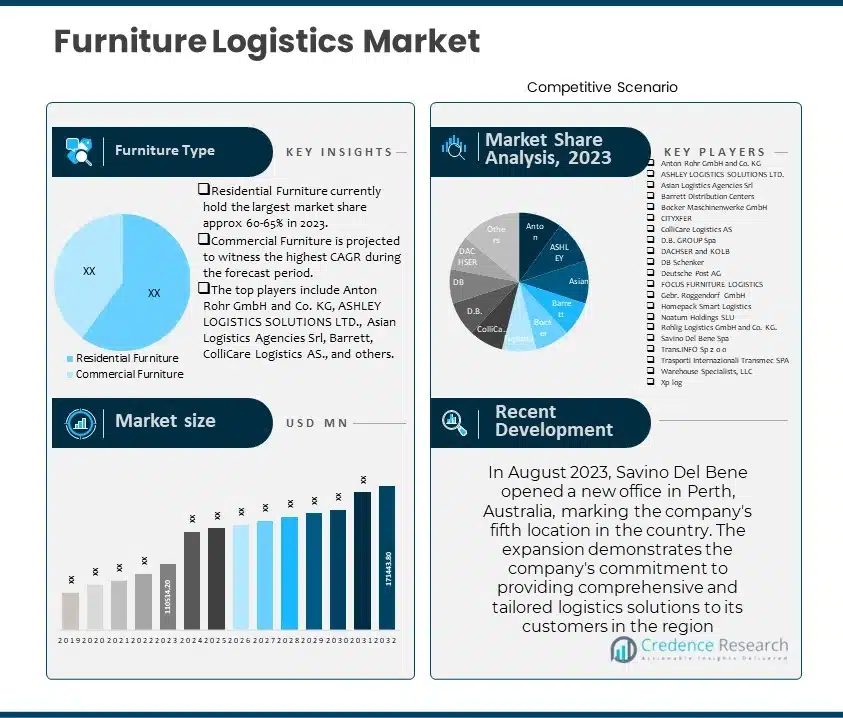
- The Furniture Logistics Market reached a valuation of USD 110514.2 Million in 2023 and is anticipated to rise to USD 171443.8 Million by 2032, indicating a strong CAGR of 5.0% from 2024 to 2032.
- mong the key segments, Residential Furniture emerged as the market leader by type, holding approximately 60-65% of the total market share in 2023. However, Commercial Furniture is projected to witness the highest growth rate during the forecast period.
- Transportation Services currently hold the largest market share approx 40-45% in 2023., owing to its variety of modes, including road, rail, sea and air, to cater for different distances and budgets. Distribution Services is projected to witness the highest CAGR during the forecast period.
- Retailers currently hold the largest market share approx 30-45% in 2023, driven by the continuous need for furniture in homes and apartments.
- E-commerce Platforms is projected to witness the highest CAGR during the forecast period, driven by the convenience and accessibility it offers to consumers.
- Asia Pacific accounts for the largest share of the market in 2023, followed by Europe and North America with a collective share of just under 55%.
- The rise in demand for furniture logistics, driven by increasing urbanization, changing lifestyles, and the growth of the e-commerce sector, fuels the growth of the Furniture Logistics Market.
- Key opportunities in the market include significant growth potential in emerging markets, increased adoption of efficient shipping solutions, and continuous advancements in technology, fostering market expansion.
Executive Summary
Market Definition
The furniture logistics market involves furniture logistics and distribution from manufacturers to retailers or directly to customers. There are many factors that contribute to its growth. First, the growth of the e-commerce industry has increased the demand for efficient shipping. In addition, globalization has increased the international trade in furniture, thus requiring sophisticated logistics solutions. Additionally, technological advances in channel optimization software, real-time tracking systems, and others have improved efficiency and reduced costs in the furniture industry Practices. The rise of environmentally friendly regulations has given companies access to sustainable electric vehicles and better shipping lanes. Transportation methods are also adopted, to reduce carbon emissions
In terms of applications, furniture logistics caters to a variety of industries including residential, commercial and hospitality. It plays an important role in furniture distribution, serving homes with a variety of furnishings from sofas to beds. Furniture logistics in retail supports businesses through office furniture, while the hospitality industry depends on the timely delivery of furniture for hotels, restaurants and venues.
Market Overview
- The Furniture Logistics Market reached a valuation of USD 110514.2 Million in 2023 and is anticipated to rise to USD 171443.8 Million by 2032, indicating a strong CAGR of 5.0% from 2024 to 2032.
- Among the primary segments, Residential Furniture dominated the market landscape by type, comprising approximately 60-65% of the total market share in 2023. However, Commercial Furniture is expected to observe the highest CAGR over the forecast period.
- Transportation Services currently hold the largest market share approx 40-45% in 2023, driven by the substantial demand for furniture logistics in residential property furnishing and various commercial establishments.
- Retailers currently hold the largest market share approx 30-45% in 2023. Established Networks and Customer Service Integration contributed in market growth.
- Road Transportation emerged as the leading transportation mode segment in 2023, with a market share of about 40-42%, propelled by factors such as cost-effectiveness for bulk furniture shipments over long distances and increased global trade of furniture.
- Asia Pacific constituted a significant portion of the market in 2023, followed by Europe and North America, collectively representing just under 55% of the market share.
- The surge in demand for furniture logistics, driven by factors such as increasing furniture production, globalization, and the rise of e-commerce, fosters market growth, especially in regions like Asia Pacific.
- Rapid advancement in furniture manufacturing technology, including the demand for flexible and environmentally friendly logistics solutions, is driving the demand for furniture logistics, especially in regions like Asia Pacific where furniture industry growth is significant.
Segmentation by Transportation Mode
- Road Transportation currently hold the largest market share approx 40-42% in 2023. It offers cost-effectiveness, flexibility, and accessibility benefits, making it ideal for short- and medium-haul shipments of especially for bulky but non-fragile furniture.
- Sea Transportation is projected to witness the highest CAGR during the forecast period due to increased global trade of furniture, and cost-effectiveness for bulk furniture shipments over long distances.
Segmentation by Service Type
- Transportation Services currently hold the largest market share approx 40-45% in 2023. Transportation services include a variety of modes, including road, rail, sea and air, to cater for different distances and budgets.
- Distribution Services is projected to witness the highest CAGR during the forecast period due to growing e-commerce and urbanization trends.
Segmentation by Furniture Type
- Residential Furniture currently hold the largest market share approx 60-65% in 2023. Individuals and families tend to furnish or refurnish their homes more often compared to commercial establishments drive the market growth.
- Commercial Furniture is projected to witness the highest CAGR during the forecast period. Modern office design tends to reflect flexible design and activity-based functionality, requiring furniture to be constantly rearranged and moved.
Segmentation by Distribution Channel
- Retailers currently hold the largest market share approx 30-45% in 2023. Established Networks and Customer Service Integration contributed in market growth.
- E-commerce Platforms is projected to witness the highest CAGR during the forecast period. E-commerce offers a convenient and often price-competitive way to buy furniture, further driving growth.
Segmentation by Region
- Asia Pacific held largest share around 35-40% of the market in 2023. Growing population and urbanization in countries like China, India, and Japan drive the market.
- Europe and North America collectively account for just under 55% share in 2023, with North America holding over 20% share in the same year.
- The rest of the world, including Latin America, the Middle East, and Africa, supplies the remaining demand for Furniture Logistics.
Technological advancements in manufacturing the furniture logistics, fastest growing sector of online shopping has brought an increase in demand for furniture and installation services which incrementally cause growth of the sector.
The Asia-Pacific region held largest share of Furniture Logistics market. The Asia-Pacific region is the largest market for furniture products, accounting for the largest share of the global industry. This dominance can be attributed to several factors such as rapid population growth, increasing urbanization and increasing use of cash in countries like China, India and Indonesia. For instance, according to the World Bank, Population in China has 1412.2 million in 2022. In addition as e-commerce the expanding manufacturing sector in the region has increased the demand for efficient and reliable delivery services.
China in particular has emerged as a leading country in the furniture export market, as many international companies set up manufacturing facilities in the country. For instance, according to the World Integrated Trade Solution, in 2022, China is the leading exporter of wooden furniture for offices, with a value of $1.18 billion and 22 million items in 2022. The EU, Canada, Vietnam, and Poland follow, with export values ranging from $304 million to $660 million. Manufacturing in China and the demand for furniture in this region drive the need for efficient and cost-effective logistics solutions, making the Asia-Pacific region the largest market with logistics. India is another key market for furniture in the Asia-Pacific region. With a large and growing middle class, there is a demand for high-quality, domestically produced and imported furniture. Efforts by the Indian government to improve infrastructure and reduce bureaucratic barriers have made it easier for companies to do business in the country.
The North America region witnesses significant growth in the Furniture Logistics market. This growth can be attributed to various factors such as increasing demand for home delivery services, rise in e-commerce and expansion in the furniture industry in the region especially the US.For instance, in March 2023, IKEA U.S. is celebrated Earth Month with various sustainability-focused initiatives. The company is launched As-is online, a service allowing IKEA Family members to browse and reserve gently used products online for in-store pickup. contributes significantly to the growth of the logistics market in North America, as its largest customer, growing e-commerce. The growth of e-commerce in this segment has increased the demand for delivery services, as consumers opt for the convenience of having their purchases delivered directly to their homes Also, quality the growing trend of purchasing furniture online has led to the introduction of heavyweights and larger Produced
Moreover, the expansion of the furniture industry in North America has also contributed to the growth of the furniture export market. As new furniture manufacturers and retailers enter the market, they need efficient and cost-effective logistics solutions to ensure their products are delivered to their customers on time in the right place. To meet these needs, furniture management providers in North America are offering innovative solutions, such as automation, real-time tracking, customized delivery options and are investing in technology and infrastructure to increase their capacity and provide better services to their customers. For instance, in June 2023, AptDeco, a furniture resale marketplace, trained a dedicated delivery team to handle the unique challenges of moving used furniture. The team is trained to ensure products match their online listings and handle furniture directly between buyers and sellers, skipping the need for storage. This approach helps streamline the process and reduce costs. AptDeco's expansion across the contiguous US has been successful, with the company partnering with another shipping company for sales outside the Northeast region. By handling fulfillment in-house, AptDeco can maintain quality control and provide a seamless experience for customers.
Key Highlights of the Report
The Furniture Logistics Market is segmented by Type, Transportation Mode, Service Type, Furniture Type, Distribution Channel, and Region. The growing demand for furniture logistics is propelled by factors such as increasing furniture production, globalization, and the rise of e-commerce across multiple sectors, including residential, commercial, and hospitality industries.
Residential Furniture dominates the segment, catering to essential needs in home furnishing and refurbishment across various types of residential properties due to its widespread application and necessity. Wooden furniture holds a significant market share, offering versatility and popularity suitable for most residential furniture applications.
Sea Transportation is projected to witness the highest CAGR during the forecast period, driven by its cost-effectiveness for bulk furniture shipments over long distances and increased global trade of furniture. While the retail segment remains a major contributor to the distribution channel segment, with significant demand for furniture logistics in retail distribution and customer service integration.
The Asia-Pacific region held the largest share of the furniture logistics market, supported by prominent furniture industries and robust manufacturing infrastructure, along with high demand for efficient delivery solutions.
Key players like Savino Del Bene Spa, Anton Rohr GmbH and Co. KG, and ASHLEY LOGISTICS SOLUTIONS LTD. compete in the market, focusing on product innovation, distribution channel expansion, and strategic partnerships to maintain competitiveness. Collaborations and technological advancements contribute to Asia Pacific's dominance in the Furniture Logistics Market, with major players expanding their presence and capabilities in the region to meet growing demand..
What Are The Main Drivers Of The Global Furniture Logistics Market?
The major factors driving the global Furniture Logistics market are growing demand for home deliveries, rise in online sales, need to monitor supply chain more efficiently and cost-effectively. Other factors contributing to the growth of the market are urbanization, changing lifestyles, and rising e-commerce initiatives. Furthermore, Partnerships between manufacturer and third-party logistics (3PL) providers also expected to boost the market growth during the forecast period.
What Are The Major Challenges Faced By The Global Furniture Logistics Market?
The major challenges in the global automotive exhaust filter market include high transportation costs, complex and bulky production volumes, lack of standards in packaging and labeling , difficulty in tracking and tracking products during transportation and other challenges during handling and storage including damage and breakage, prolonged use , regulatory compliance hinder the market growth.
What Are The Growth Opportunities In The Global Furniture Logistics Market?
The global Furniture Logistics market presents numerous growth opportunities including the growing demand for omnichannel retail, which requires seamless integration of online and offline channels. Another opportunity is artificial intelligence, IoT, growth in e-commerce and expanding middle classes in developing countries as well will create new opportunities for the furniture logistics industry, and make sustainable green logistics practices important to companies. Alongwith Adoption of various strategies among market players makes opportunity for the market.
Market Drivers
The global Furniture Logistics market is driven by several factors. The following are the key drivers of the global Furniture Logistics market:
Partnerships between furniture companies and third-party logistics (3PL) providers
Partnerships between furniture companies and third-party logistics (3PL) providers are driving the growth of the furniture logistics market. These networks enable furniture companies to outsource their logistics operations to specialists, allowing them to focus on core competencies such as design, manufacturing and sales. On the other hand, 3PL professionals can improve logistics through their expertise, products and technology. Collaboration benefits both parties and ultimately enhances the overall customer experience. For instance, in January 2021, Kenco Logistics, a top 3PL provider, has been awarded a second distribution center site by Walker Edison, a leading online furniture retailer. This expanded partnership will help Walker Edison grow by increasing storage capacity, improving parcel carrier capacity, and maintaining high customer service standards.
Market Restraints
The global Furniture Logistics market faces some challenges that may hinder its growth. These include the following:
Complex and bulky production volumes
The global Furniture Logistics market is primarily constrained by complex and bulky production volumes. The global furniture market is facing major hurdles due to the complexity and scale of furniture manufacturing. The size and weight of furniture poses significant challenges for logistics manufacturers, making it difficult to effectively manage logistics throughout the supply chain. The size of furniture also creates constraints in terms of consumption. The variety of shapes, sizes and materials used in the furniture manufacturing industry leads to the demand for a wide variety of materials transported, requiring specialized equipment and transportation methods. This variety makes it difficult for suppliers materials into the room to achieve economies of scale and optimize their operations.
Opportunities
The global Furniture Logistics market offers significant growth opportunities. These include the following:
Adoption of various strategies among market players
The major companies serving the global Furniture Logistics Market are Savino Del Bene Spa, Anton Rohr GmbH and Co. KG, ASHLEY LOGISTICS SOLUTIONS LTD., Asian Logistics Agencies Srl, Barrett Distribution Centers, among others. The market players are considerably contributing to the market growth by the adoption of various strategies including mergers & acquisitions, collaborations, funding, and new product launches, to stay competitive in the market also makes opportunity for the market growth. For instance, in November 2023, Savino Del Bene, an Italian logistics company, has acquired Transocean Shipping Int'l Transport & Foreign Trade Inc. Co., a Turkish freight forwarder. The move expands Savino Del Bene's presence in Turkey and strengthens its position in the international logistics market. With this acquisition, the company aims to offer improved services and enhanced customer satisfaction in the region.
Competitive Landscape
Key Players
The global Furniture Logistics market is highly competitive, with several key players. Some of the major players in the market and their market share are as follows:
- Anton Rohr GmbH and Co. KG
- ASHLEY LOGISTICS SOLUTIONS LTD.
- Asian Logistics Agencies Srl
- Barrett Distribution Centers
- Bocker Maschinenwerke GmbH
- CITYXFER
- ColliCare Logistics AS
- D.B. GROUP Spa
- DACHSER and KOLB
- DB Schenker
- Deutsche Post AG
- FOCUS FURNITURE LOGISTICS
- Gebr. Roggendorf GmbH
- Homepack Smart Logistics
- Noatum Holdings SLU
- Rohlig Logistics GmbH and Co. KG.
- Savino Del Bene Spa
- Trans.INFO Sp z o o
- Trasporti Internazionali Transmec SPA
- Warehouse Specialists, LLC
- Xp log
- Zenith Global Logistics
- Others
These organizations prioritize product innovation, distribution channel expansion, and mergers and acquisitions to stay competitive.
The global Furniture Logistics market's key players continually seek to stay ahead by offering new products and developments.
In August 2023, Savino Del Bene opened a new office in Perth, Australia, marking the company's fifth location in the country. The expansion demonstrates the company's commitment to providing comprehensive and tailored logistics solutions to its customers in the region.
In August 2022, J.B. Hunt's latest venture into home furnishings delivery has generated $28 million in revenue in its first full quarter. The service, which was launched through the acquisition of Zenith Global Logistics, has seen significant growth in demand for its white glove delivery and installation services. This success highlights the potential for J.B. Hunt to continue expanding its reach in the home furnishings market.
Summary of Key Findings
- The Furniture Logistics Market is experiencing significant growth driven by increasing demand across various sectors, including residential, commercial, and hospitality industries. This growth is attributed to factors such as rising furniture production, globalization, and the rise of e-commerce.
- Market segmentation includes factors like type, transportation mode, service type, furniture type, distribution channel, and region, reflecting the diverse applications and requirements within the furniture logistics industry.
- Residential Furniture emerges as the dominant segment, essential for home furnishing and refurbishment across different residential properties. Wooden furniture holds a substantial market share, offering versatility and popularity suitable for most residential furniture applications.
- The sea transportation mode holds a prominent market share, driven by its cost-effectiveness for bulk furniture shipments over long distances and increased global trade of furniture. The retail segment dominates the distribution channel segment, with significant demand for furniture logistics in retail distribution and customer service integration..
Future Outlook
- The Furniture Logistics Market presents promising growth opportunities, particularly in emerging markets like Asia Pacific, driven by increasing furniture production, urbanization, and growing demand for quality delivery solutions. Anticipated challenges include technological advancements and competition from alternative logistics methods. To overcome these challenges, industry players should focus on innovation, cost-efficiency, and sustainability.
- Strategies for maintaining competitiveness include product innovation, expanding distribution channels, and strategic partnerships to meet evolving market demands and sustain growth in the dynamic Furniture Logistics Market.
How CXOs Can Benefit from the Credence Research Furniture Logistics Networks Market Report
The Credence Research Furniture Logistics Networks Market Report provides CXOs with a comprehensive overview of the market, including:
- Market size and growth forecast: The report provides detailed estimates of the global Furniture Logistics networks market size, segmented by type, transportation mode, service type, furniture type, distribution channel, and region. It also includes forecasts for the market through 2032, based on key trends and drivers.
- Market segmentation: The report segments the Furniture Logistics networks market by type, transportation mode, service type, furniture type, distribution channel, and region. The increasing demand for advanced solutions is driven. This segmentation provides CXOs with a granular understanding of the market and the opportunities in each segment.
- Competitive landscape: The report profiles the key players in the Furniture Logistics networks market and provides insights into their strategies, product offerings, and financial performance. This information can help CXOs to identify and assess their competition.
- Key trends and drivers: The report identifies and analyzes the key trends and drivers that are shaping the Furniture Logistics networks market. This information can help CXOs to make informed decisions about their investments and strategies.
CXOs can use the insights from the Credence Research Furniture Logistics Networks Market Report to:
- Identify growth opportunities: The report can help CXOs to identify new growth opportunities in the Furniture Logistics networks market. For example, the report identifies the growing demand for Furniture Logistics networks from cloud computing providers and telecom companies as a key opportunity.
- Make informed investment decisions: The report can help CXOs to make informed investment decisions about Furniture Logistics networks. For example, the report provides insights into the key factors to consider when evaluating Furniture Logistics providers and selecting Furniture Logistics solutions.
- Develop competitive strategies: The report can help CXOs to develop competitive strategies for their Furniture Logistics networks businesses. For example, the report identifies the key strategies that Furniture Logistics providers are using to differentiate themselves from their competitors.
- Track market developments: The report can help CXOs to track market developments and stay ahead of the curve. For example, the report provides insights into the latest trends and innovations in the Furniture Logistics networks market.
Overall, the Credence Research Furniture Logistics Networks Market Report is a valuable resource for CXOs who are looking to gain a deeper understanding of the market and identify opportunities for growth.
Segmentation
- Transportation Mode:
- Road Transportation
- Rail Transportation
- Air Transportation
- Sea Transportation
- Service Type:
- Transportation Services
- Warehousing Services
- Distribution Services
- Assembly and Installation Services
- Reverse Logistics Services (e.g., returns, repairs)
- Furniture Type:
- Residential Furniture
- Living Room Furniture
- Bedroom Furniture
- Dining Room Furniture
- Kitchen Furniture
- Home Office Furniture
- Others
- Commercial Furniture
- Office Furniture
- Hospitality Furniture (e.g., hotels, restaurants)
- Retail Furniture (e.g., store fixtures, displays)
- Healthcare Furniture
- Educational Furniture
- Others
- Distribution Channel:
- Direct-to-Consumer (DTC)
- Retailers
- E-commerce Platforms
- Wholesale Distributors
- Others
- By Region
- North America
- The U.S.
- Canada
- Mexico
- Europe
- Germany
- France
- The U.K.
- Italy
- Spain
- Rest of Europe
- Asia Pacific
- China
- Japan
- India
- South Korea
- South-east Asia
- Rest of Asia Pacific
- Latin America
- Brazil
- Argentina
- Rest of Latin America
- Middle East & Africa
- GCC Countries
- South Africa
- Rest of Middle East and Africa
- North America
- Residential Furniture

Request a Free Sample
Fill in your details and we'll send you a free sample report.
- Sample data tables & charts
- Research methodology
Market Dynamics
Growth of E-commerce and Omnichannel Retail
The rapid expansion of e-commerce platforms and omnichannel retail strategies has significantly increased the demand for efficient, flexible, and timely furniture logistics solutions, as consumers expect fast and reliable delivery of bulky items directly to their homes.
Urbanization and Changing Lifestyles
Rising urban populations and evolving consumer lifestyles, especially in Asia Pacific, are driving increased furniture purchases for both residential and commercial spaces, necessitating robust logistics networks to meet diverse delivery and installation needs.
Globalization and International Furniture Trade
The globalization of furniture manufacturing and trade, particularly with Asia Pacific as a major production hub, has created a need for sophisticated logistics solutions capable of handling cross-border shipments, customs, and multimodal transportation.
Technological Advancements in Logistics
Adoption of advanced logistics technologies such as real-time tracking, channel optimization software, and automation has improved supply chain efficiency, reduced costs, and enhanced customer satisfaction, making logistics providers more competitive.
Sustainability and Green Logistics Initiatives
Increasing regulatory and consumer focus on sustainability is pushing logistics providers to adopt eco-friendly practices, such as electric vehicles and optimized shipping routes, which not only reduce environmental impact but also appeal to environmentally conscious customers.
Need a Custom Version of This Report?
Tailor the scope, geography, or segments to your exact requirements.
- Custom geography or segment scope
- Direct access to our analyst team
Frequently Asked Questions
What is the current size of the global Furniture Logistics market?
What is the expected growth rate of the Furniture Logistics market between 2024 and 2032?
Which segment is leading the market share in terms of Transportation Mode?
Which Furniture Type segments governs the demand for Furniture Logistics in the world?
Who are the major players in the global Furniture Logistics market?
Table of Content
Chapter 1 Market Segmentation
- 1.1 Segmentation Framework
- 1.1.1 Product and Service Classification
- 1.1.2 Application and End-Use Classification
- 1.1.3 Technology and Solution Classification
- 1.1.4 Customer and Distribution Channel Classification
- 1.1.5 Geographic Segmentation
- 1.1.6 Market Segment Definitions and Boundaries
- 1.2 By Service Type
- 1.2.1 Transportation Services
- 1.2.2 Warehousing Services
- 1.2.3 Distribution Services
- 1.2.4 Assembly and Installation Services
- 1.2.5 Reverse Logistics Services
- 1.3 By Furniture Type
- 1.3.1 Residential Furniture
- 1.3.2 Commercial Furniture
- 1.3.3 Hospitality Furniture
- 1.3.4 Healthcare Furniture
- 1.3.5 Educational Furniture
- 1.4 By Transportation Mode
- 1.4.1 Road Transportation
- 1.4.2 Rail Transportation
- 1.4.3 Air Transportation
- 1.4.4 Sea Transportation
Chapter 2 Introduction
- 2.1 Report Objectives and Scope
- 2.2 Product Definition and Industry Terminology
- 2.3 Market Inclusions and Exclusions
- 2.4 Research Process
- 2.4.1 Primary Research and Expert Interviews
- 2.4.2 Secondary Research and Source Review
- 2.4.3 Top-Down and Bottom-Up Estimation
- 2.4.4 Data Triangulation and Verification
- 2.5 Market Size Measurement Basis
- 2.5.1 2023: USD 110514.2 Million → 2032: USD 171,443.8 Million
- 2.6 Historical and Forecast Reference Periods
- 2.6.1 Base Year: 2023
- 2.6.2 Forecast Period: 2023-2032
- 2.7 Research Assumptions and Limitations
Chapter 3 Executive Summary
- 3.1 Market Snapshot and Key Findings
- 3.2 Base-Year Market Size, 2023
- 3.3 Forecast Market Size, 2032
- 3.4 Revenue and Volume Growth Outlook
- 3.5 Key Demand and Supply Indicators
- 3.6 Leading Market Segments
- 3.7 Fastest-Growing Market Opportunities
- 3.8 Regional Performance Highlights
- 3.9 Technology and Industry Transformation
- 3.10 Competitive Landscape Summary
- 3.11 Analyst View and Strategic Implications
Chapter 4 Global Furniture Logistics Market Trends and Developments
- 4.1 Historical Industry Development
- 4.2 Recent Market Trends and Developments
- 4.3 Demand and Customer Behavior Trends
- 4.4 Technology and Product Innovation
- 4.5 Artificial Intelligence, Automation and Digitalization
- 4.6 Local Manufacturing and Supply Chain Realignment
- 4.7 Industry Partnerships, Mergers and Acquisitions
- 4.8 Sustainability and Circular Economy Developments
- 4.9 Government and Private Sector Investment Trends
- 4.10 Emerging Business Models and Commercialization
- 4.11 Industry Developments and Announcements
Chapter 5 Global Furniture Logistics Market Production, Supply and Demand Analysis
- 5.1 Demand Trend and Consumption Analysis
- 5.2 Demand Forecast, 2023-2032
- 5.3 Production and Output Trend
- 5.4 Production and Output Forecast, 2023-2032
- 5.5 Installed Capacity and Capacity Utilization
- 5.6 Company-Wise Production Plants and Statistics
- 5.6.1 Installed Production Capacity
- 5.6.2 Actual Production
- 5.6.3 Planned Capacity and Expansion Targets
- 5.7 Supply Chain Structure and Procurement Trends
- 5.8 Supply-Demand Gap and Bottlenecks
- 5.9 Import Dependence and Sourcing Structure
- 5.10 Contract Manufacturing and Outsourcing
- 5.11 Regional Supply and Demand Concentration
Chapter 6 Global Furniture Logistics Market Pricing Analysis
- 6.1 Pricing Structure and Measurement
- 6.2 Historical Pricing Trends
- 6.3 Pricing Outlook, 2023-2032
- 6.4 Average Selling Price and Unit Economics
- 6.5 Pricing by Product and Market Segment
- 6.6 Geographic Pricing Differences
- 6.7 Key Input, Energy, Labor and Logistics Costs
- 6.8 Contract Pricing and Purchasing Models
- 6.9 Pricing Sensitivity and Competitive Positioning
- 6.10 Price, Margin and Profitability Implications
Chapter 7 Global Furniture Logistics Market Dynamics
- 7.1 Market Growth Drivers
- 7.1.1 Demand-Side Drivers
- 7.1.2 Technology and Innovation Drivers
- 7.1.3 Infrastructure and Investment Drivers
- 7.1.4 Regulatory and Policy Drivers
- 7.2 Market Restraints
- 7.2.1 Cost and Affordability Constraints
- 7.2.2 Technology and Adoption Barriers
- 7.2.3 Supply Chain and Operational Constraints
- 7.3 Market Challenges
- 7.3.1 Competitive Pressure and Margin Erosion
- 7.3.2 Skills, Infrastructure and Implementation Gaps
- 7.4 Emerging Market Opportunities
- 7.5 Market Dynamics Impact and Time-Horizon Assessment
Chapter 8 Global Furniture Logistics Value Chain Analysis
- 8.1 Industry Value Chain Overview
- 8.2 Upstream Suppliers and Critical Inputs
- 8.3 Technology and Component Providers
- 8.4 Manufacturing or Service Delivery
- 8.5 Distribution, Channel Partners and Integrators
- 8.6 Downstream Applications and End Users
- 8.7 Value Addition and Profit Pools
- 8.8 Vertical Integration and Outsourcing
- 8.9 Supplier Concentration and Risk
- 8.10 Supply Chain Localization and Resilience
Chapter 9 Global Furniture Logistics Market Regulations and Policies
- 9.1 Relevant Laws, Standards and Compliance Frameworks
- 9.2 Product, Service, Safety and Quality Requirements
- 9.3 Government Policies, Incentives and Subsidies
- 9.4 Imports, Exports and Trade Barriers
- 9.5 Public Procurement and Local Content Requirements
- 9.6 Environmental and Sustainability Compliance
- 9.7 Upcoming Policy Changes and Market Implications
Chapter 10 Global Furniture Logistics Market Hotspots and Opportunities
- 10.1 Market Opportunity Mapping and Growth Hotspots
- 10.2 High-Growth Applications and Customer Groups
- 10.3 Underserved Markets and White-Space Opportunities
- 10.4 Emerging Technology and Product Opportunities
- 10.5 New Capacity and Investment Hotspots
- 10.6 Market Entry and Expansion Opportunities
- 10.7 Distribution and Partnership Opportunities
- 10.8 Near-Term and Long-Term Commercial Potential
- 10.9 Opportunity Attractiveness and Execution Risks
Chapter 11 Global Furniture Logistics Market Outlook, 2023-2032
- 11.1 Market Size and Analysis
- 11.1.1 Revenue (Market Measurement: 2023: USD 110514.2 Million → 2032: USD 171,443.8 Million)
- 11.1.2 Market Volume and Quantity Sold
- 11.1.3 Historical Market Size
- 11.1.4 Base-Year Market Size, 2023
- 11.2 Market Forecast, 2023-2032
- 11.2.1 Revenue Forecast to 2032
- 11.2.2 Volume Forecast to 2032
- 11.2.3 CAGR and Year-on-Year Growth
- 11.2.4 Incremental Revenue Opportunity
- 11.3 Forecast Assumptions and Scenario Analysis
- 11.3.1 Base-Case Forecast
- 11.3.2 Optimistic and Conservative Scenarios
- 11.3.3 Technology, Pricing and Policy Sensitivities
- 11.4 Market Attractiveness and Growth Outlook
Chapter 12 Global Furniture Logistics Market Segmentation and Outlook
- 12.1 Segmentation Summary and Market Shares, 2023
- 12.2 Largest and Fastest-Growing Segments
- 12.3 By Service Type - Market Size and Forecast, 2023-2032
- 12.3.1 Segment Definition and Scope
- 12.3.2 Historical Market Size
- 12.3.3 Revenue Forecast, 2023-2032
- 12.3.4 Volume Forecast, 2023-2032
- 12.3.5 Base-Year Market Share, 2023
- 12.3.6 Segment CAGR and Growth Drivers
- 12.3.7 Subsegment Market Size and Forecast
- 12.3.7.1 Transportation Services
- 12.3.7.2 Warehousing Services
- 12.3.7.3 Distribution Services
- 12.3.7.4 Assembly and Installation Services
- 12.3.7.5 Reverse Logistics Services
- 12.3.8 Subsegment Pricing and Adoption Trends
- 12.3.9 Leading Suppliers and Competition
- 12.3.10 Regional Demand and Opportunities
- 12.4 By Furniture Type - Market Size and Forecast, 2023-2032
- 12.4.1 Segment Definition and Scope
- 12.4.2 Historical Market Size
- 12.4.3 Revenue Forecast, 2023-2032
- 12.4.4 Volume Forecast, 2023-2032
- 12.4.5 Base-Year Market Share, 2023
- 12.4.6 Segment CAGR and Growth Drivers
- 12.4.7 Subsegment Market Size and Forecast
- 12.4.7.1 Residential Furniture
- 12.4.7.2 Commercial Furniture
- 12.4.7.3 Hospitality Furniture
- 12.4.7.4 Healthcare Furniture
- 12.4.7.5 Educational Furniture
- 12.4.8 Subsegment Pricing and Adoption Trends
- 12.4.9 Leading Suppliers and Competition
- 12.4.10 Regional Demand and Opportunities
- 12.5 By Transportation Mode - Market Size and Forecast, 2023-2032
- 12.5.1 Segment Definition and Scope
- 12.5.2 Historical Market Size
- 12.5.3 Revenue Forecast, 2023-2032
- 12.5.4 Volume Forecast, 2023-2032
- 12.5.5 Base-Year Market Share, 2023
- 12.5.6 Segment CAGR and Growth Drivers
- 12.5.7 Subsegment Market Size and Forecast
- 12.5.7.1 Road Transportation
- 12.5.7.2 Rail Transportation
- 12.5.7.3 Air Transportation
- 12.5.7.4 Sea Transportation
- 12.5.8 Subsegment Pricing and Adoption Trends
- 12.5.9 Leading Suppliers and Competition
- 12.5.10 Regional Demand and Opportunities
- 12.6 Segment Growth Comparison
- 12.7 Segment Attractiveness and Priority Matrix
Chapter 13 Global Furniture Logistics Geographic Market Outlook, 2023-2032
- 13.1 Regional Market Size and Share, 2023
- 13.2 Regional Market Forecast, 2023-2032
- 13.3 Regional Pricing, Production and Demand Differences
- 13.4 North America
- 13.4.1 United States
- 13.4.2 Canada
- 13.4.3 Mexico
- 13.5 Europe
- 13.5.1 Germany
- 13.5.2 France
- 13.5.3 Italy
- 13.5.4 United Kingdom
- 13.5.5 Spain
- 13.5.6 Poland
- 13.5.7 Russia
- 13.5.8 Netherlands
- 13.5.9 Belgium
- 13.5.10 Sweden
- 13.5.11 Denmark
- 13.5.12 Norway
- 13.5.13 Rest of Europe
- 13.6 Asia Pacific
- 13.6.1 China
- 13.6.2 India
- 13.6.3 Japan
- 13.6.4 South Korea
- 13.6.5 Thailand
- 13.6.6 Indonesia
- 13.6.7 Vietnam
- 13.6.8 Malaysia
- 13.6.9 Australia
- 13.6.10 Rest of Asia Pacific
- 13.7 Latin America
- 13.7.1 Brazil
- 13.7.2 Argentina
- 13.7.3 Colombia
- 13.7.4 Chile
- 13.7.5 Rest of Latin America
- 13.8 Middle East
- 13.8.1 Saudi Arabia
- 13.8.2 United Arab Emirates
- 13.8.3 Turkey
- 13.8.4 Israel
- 13.8.5 Iran
- 13.8.6 Rest of the Middle East
- 13.9 Africa
- 13.9.1 South Africa
- 13.9.2 Egypt
- 13.9.3 Nigeria
- 13.9.4 Morocco
- 13.9.5 Rest of Africa
- 13.10 Regional Investment, Policy and Supply Chain Differences
- 13.11 Regional Competitive Landscape
- 13.12 Geographic Growth Hotspots
Chapter 14 Global Furniture Logistics Technology, Innovation and Sustainability Outlook
- 14.1 Technology Landscape and Maturity
- 14.2 Product, Process and Service Innovation
- 14.3 AI, Automation and Digital Tools in the Industry
- 14.4 Technology Adoption and Performance Benchmarking
- 14.5 Innovation Pipeline and R&D Investment
- 14.6 Patent and Intellectual Property Trends
- 14.7 Energy Efficiency and Resource Management
- 14.8 Sustainability, Recycling and Circularity
- 14.9 Technology Roadmap, 2023-2032
- 14.10 Risks of Obsolescence and Technology Substitution
Chapter 15 Global Furniture Logistics Market Key Strategic Imperatives
- 15.1 Growth and Market Entry Priorities
- 15.2 High-Return Products and Segments
- 15.3 Pricing, Profitability and Cost Optimization
- 15.4 Technology Investment and Product Differentiation
- 15.5 Supply Chain Localization and Resilience
- 15.6 Distribution and Customer Acquisition
- 15.7 Partnership, Acquisition and Capacity Strategy
- 15.8 Regional Expansion Priorities
- 15.9 Short-, Medium- and Long-Term Actions
Chapter 16 Competition Outlook
- 16.1 Industry Competition Characteristics
- 16.2 Market Structure and Concentration
- 16.3 Market Share and Competitive Positioning, 2023
- 16.4 Company-Wise Revenue and Product Benchmarking
- 16.5 Production and Service Capacity Benchmarking
- 16.6 Technology, Pricing and Differentiation
- 16.7 Regional Footprint and Distribution Strength
- 16.8 Mergers, Acquisitions and Strategic Alliances
- 16.9 New Entrants and Competitive Threats
- 16.10 Porter's Five Forces and Industry Attractiveness
- 16.11 Competitive Outlook, 2023-2032
Chapter 17 Company Profiles
- 17.1 Company Coverage and Selection Criteria
- 17.2 Savino Del Bene Spa
- 17.2.1 Business Description
- 17.2.2 Company Ownership and Geographic Presence
- 17.2.3 Product and Service Portfolio
- 17.2.4 Manufacturing and Operating Footprint
- 17.2.5 Production Capacity and Expansion Plans
- 17.2.6 Financial Performance and Investment
- 17.2.7 Market Share and Competitive Position
- 17.2.8 Technology and Innovation Capabilities
- 17.2.9 Strategic Alliances or Partnerships
- 17.2.10 Recent Developments
- 17.2.11 Growth Strategy and Outlook
- 17.3 Anton Rohr GmbH and Co. KG
- 17.4 ASHLEY LOGISTICS SOLUTIONS LTD.
- 17.5 Barrett Distribution Centers
- 17.6 DB Schenker
- 17.7 Deutsche Post AG
- 17.8 ColliCare Logistics AS
- 17.9 Zenith Global Logistics
- 17.10 Noatum Holdings SLU
- 17.11 DACHSER and KOLB
- 17.12 Other Relevant Market Participants
Note: Every listed company is profiled on the structure shown under the first company. The company list is preliminary and may change based on research findings, market developments, data availability and client requirements.
Chapter 18 Disclaimer
- 18.1 Research and Forecast Disclaimer
- 18.2 Data Source and Estimation Limitations
Note: The depth of individual sections depends on data availability for this market. Volume, capacity, trade and other unit-based metrics are included where applicable.

