
| REPORT ATTRIBUTE | DETAILS |
|---|---|
| Historical Period | 2019-2022 |
| Base Year | 2023 |
| Forecast Period | 2024-2032 |
| Gas Detection Equipment Market Size 2023 | USD 4851.2 Million |
| Gas Detection Equipment Market, CAGR | 11.50% |
| Gas Detection Equipment Market Size 2032 | USD 12921.79 Million |
Market Insights
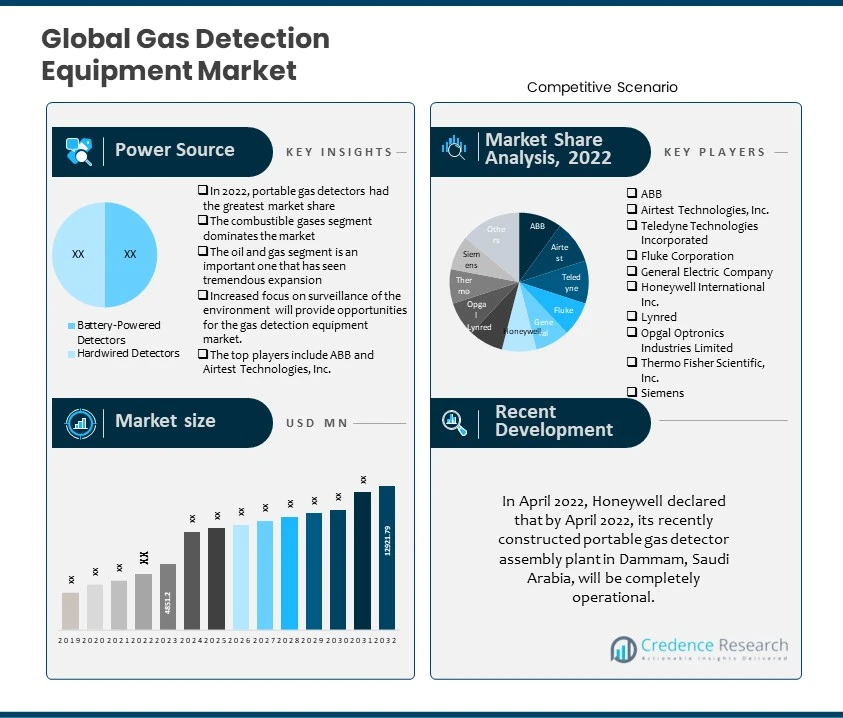
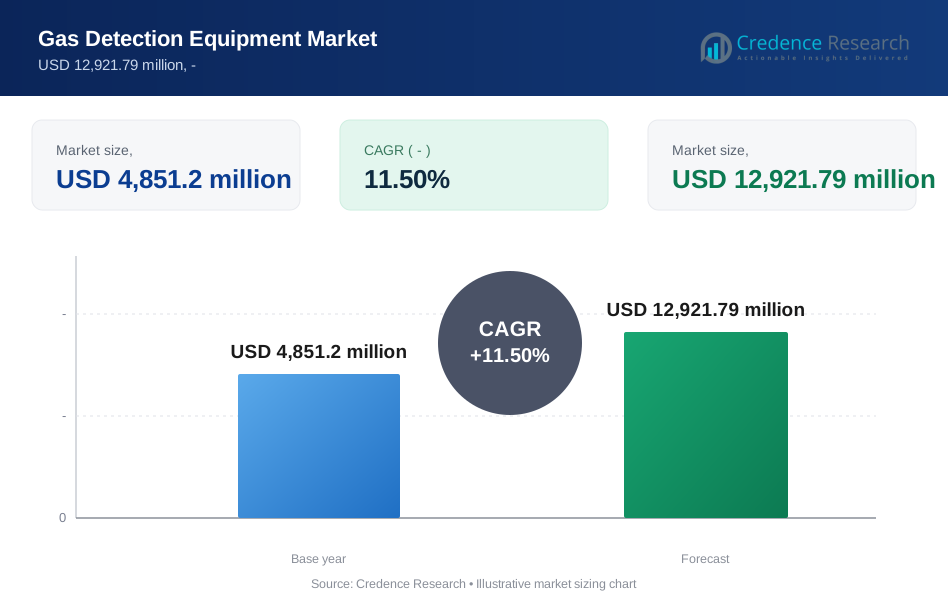
- The demand for gas detection equipment is expected to grow at a compound annual growth rate (CAGR) of 11.50% between 2024 and 2032, from its estimated USD 4851.2 million in 2023 to USD 12921.79 million in 2032.
- The largest product type section is portable gas detectors. On the other hand, fixed gas detectors are expected to grow at a strong CAGR.
- Combustible gases are the leading gas type segment.
- The CAGR for catalytic bead sensors is expected to be the highest during the projection period.
- Throughout the prediction period, oil and gas will probably have the highest CAGR.
- Air quality monitoring is estimated to have the greatest CAGR during the forecast period.
- The battery-powered detectors segment will likely have the highest CAGR during the prediction period.
- During forecasting, direct sales will probably have the highest CAGR.
- In terms of gas detection equipment, North America led the market.
- Regarding gas detection equipment market share, Europe is expected to come second.
- Asia Pacific is anticipated to grow fastest in the gas detection equipment market.
- The requirement for gas detection technology has been spurred by an increasing understanding of the importance of a healthy and secure working atmosphere.
- The functionality and capacities of gas detection equipment have been boosted by constant developments in sensor technology and communication systems.
Executive Summary
Market Definition
Combustible, flammable, poisonous, and oxygen-depleting gases can all be found with gas detectors. To monitor manufacturing processes and cutting-edge technologies like photovoltaics, this kind of equipment is frequently utilized in industry and can be found in places like oil rigs. Through the monitoring of flammable gas levels and the activation of alarms or automated shutdown systems in the event that concentrations of the gas surpass safe limits, fixed gas detectors contribute to the reduction of accidents. Explosion and fire risks can be greatly decreased with this preventive measure.
Market Overview
With consistent growth in recent years, the global gas detection equipment market is predicted to expand at a compound annual growth rate (CAGR) of 11.50% between 2024 and 2032. The market was valued at USD 4851.2 million in 2023 and is expected to reach USD 12921.79 million in 2032.
The majority of industrial sectors are not the only non-industrial applications where people are becoming more conscious of the risks posed by gas; public spaces, residential structures, and commercial buildings are among them. The increased use of gas detection technology in various settings results from this growing understanding. Monitoring and regulating emissions is becoming more important for environmental protection and occupational safety. In line with international environmental measures, gas detection technology is essential for locating and reducing hazardous gas emissions.
The Internet of Things (IoT) integration enables improved device communication and data sharing. IoT-enabled gas detection systems provide predictive maintenance, real-time monitoring, and increased system efficiency. The increasing number of multinational corporations and the globalization of supply networks require uniform safety procedures in different places. Consequently, there is a growing need for dependable and consistent gas detection systems.
Segmentation by Product Type
- Portable gas detectors are the market leader by product type. Workers utilize portable gas detectors as moveable tools to monitor gas levels before access. In order to determine if a location is safe for people to enter, each portable gadget measures the gas levels there.
- The fixed gas detectors category is anticipated to exhibit a sizable CAGR during the projected period. Fixed gas detectors are placed permanently on-site and are utilized to monitor environments continuously. Fixed detectors function similarly to smoke and fire alarms. Target gas-specific detectors are mounted on the premises and attached to a control panel.
- Other product types, such as detector tubes, also contribute to the demand for gas detection equipment.
Segmentation by Gas Type
- The main gas type is combustible gases. Combustible gases are those that catch fire when they come into contact with oxygen. The most prevalent gases that can catch fire are carbon monoxide, hydrogen, methane, propane, and butane.
- The toxic gases category will likely register a significant CAGR during forecasting. Gases that can have harmful physiological effects when inhaled are known as toxic gases. Smoke inhalation injuries are mostly caused by carbon monoxide and hydrogen cyanide, the two poisonous gases that cause harm by inhalation most frequently.
- Other gas types, such as oxygen depletion/enrichment, also contribute to the demand for gas detection equipment.
Segmentation by Technology
- It is projected that over the projection period, the category of catalytic bead sensors will grow at the fastest rate. In gas detectors, one kind of gas sensor that is frequently utilized is the catalytic bead sensor. Utilising a chemical reaction, it determines the existence and quantity of gases in the air. The catalyst (such as palladium or platinum)-coated tiny bead and two electrodes make up the sensor.
- Other technologies, such as infrared (IR) gas sensors, electrochemical sensors, ultrasonic gas detectors, and photoionization detectors (PID), also contribute to the demand for gas detection equipment.
Segmentation by End-Use Industry
- The oil and gas category will likely have the highest CAGR during the projection period. In the onshore oil and gas sector, gas detection is a crucial safety component. The 903-X5 stationary gas detection system, along with its mobile counterparts, offers a complete response to the risks associated with this sector. The 903-X5's dual sensor capacity allows it to detect combustible gases as well as low-level volatile organic compounds (VOCs), which makes it perfect for the onshore oil and gas industry, where it's important to detect numerous gases at once in a fixed device.
- Other end-use industries, such as chemical and petrochemical, mining, utilities, and power generation, and construction, also contribute to the demand for gas detection equipment.
Segmentation by Application
- Air quality monitoring will be expected to have the foremost CAGR during the prediction period. Pollutants, including carbon monoxide (CO), sulfur dioxide (SO2), nitrogen dioxide (NO2), ozone (O3), and particulate matter, are all detected and measured by means of gas detectors. Monitoring these contaminants aids in evaluating the quality of the air and adherence to environmental laws.
- Other applications, such as industrial safety, environmental monitoring, and building automation, also contribute to the demand for gas detection equipment.
Segmentation by Power Source
- Throughout the forecast duration, the category for battery-powered detectors is anticipated to have the greatest CAGR. Worker mobility and the necessity to operate in locations without established power sources are common in restricted space and construction operations. To ensure worker safety in these dynamic conditions, battery-operated gas detectors enable continuous monitoring of potentially dangerous gases.
- Other power sources, such as hardwired detectors, also contribute to the demand for gas detection equipment.
Segmentation by Distribution Channel
- The direct sales channel is anticipated to have the highest CAGR throughout the forecast period. It is often required to customise gas detection equipment in order to fulfil the specific needs of different industries or applications. Direct sales channels allow producers to offer specialized solutions and technical know-how to satisfy each customer's needs.
- Other distribution channels, such as distributors, dealers, and online retail, also contribute to the demand for gas detection equipment.
Segmentation by Region
- North America leads the gas detection equipment industry. The need to ensure the safety and security of workers exposed to hazardous gases regularly has contributed to expanding regional markets.
- Europe is estimated to rank second in market size for gas detection equipment.
- Asia Pacific will witness the most rapid growth in the gas detection equipment market.
- The remaining need for gas detection equipment is met by parts of the world, such as Africa, the Middle East, and Latin America.
The need for gas detection equipment has increased due to the Covid-19 epidemic. The epidemic and the nation's warmer temperatures caused a 2.1 Bcf/d decrease in business and residential gas use between 2019 and 2020, according to research released in April 2021 by the U.S. Energy Information Administration. Rising temperatures lowered the need for natural gas to heat buildings. Lower consumption raises the proportion of natural gas storage facilities in the United States, increasing demand for gas detectors among the country's natural gas producers.
Regarding forecasting, the gas detection equipment market is leading in North America due to several important factors. In the United States of America, environmental conservation and workplace safety are of the utmost importance. Using gas detection equipment is mandated in many industries by strict rules from organizations like the Environmental Protection Agency and the Occupational Safety and Health Administration, propelling market expansion. Gas detection equipment consumption is also driven by the expansion of manufacturing, construction, and oil & gas industries.
According to the estimate, growth in the Asia Pacific area is anticipated to be the fastest. This is because there are a lot of chemical production facilities, a developed petroleum industry, a sizable manufacturing sector, strong industrial demand, and a high level of big-player penetration in the area. The region's market is expanding steadily due to developing countries' improving economic situations. Furthermore, it is anticipated that there will be a greater need for gas detection equipment in the upcoming years due to China's, India's, and Japan's strong infrastructural growth and continuing investments in safety and security.
In addition, the area is home to numerous important industrial sectors for consumer goods, electronics, specialized chemicals, and other industries. Japan prioritizes disaster preparedness due to its susceptibility to natural disasters like earthquakes and tsunamis. For emergency services and first responders, gas detectors are essential. Protection and radiation monitoring are given a lot of weight in the Japanese nuclear energy industry, which has created a niche market for specialized gas detection equipment suppliers.
Key Highlights of the Report
The global gas detection equipment market is segmented by product type, gas type, technology, end-use industry, application, power source, distribution channel, and region. As far as the product type is concerned, portable gas detectors are the market spearhead. Combustible gases are the top gas type segment. The catalytic bead sensors category is anticipated to increase at the highest CAGR throughout the projection period. The battery-powered detectors will experience the highest CAGR during the forecast period. The gas detection equipment market is expanding mostly in North America.
The increasing sense of urgency for their safety among workers worldwide is predicted to contribute to the market's expansion. One major factor driving market expansion is the strict regulations that public safety organizations like the Health and Safety Executive and the Occupational Safety and Health Administration (OSHA) have set for the usage of gas detection equipment. Furthermore, technological developments are projected to drive market expansion in the upcoming years, including using cloud computing and the Internet of Things in gas detection systems.
However, according to forecasts, North America will hold the largest market share for gas detection equipment globally. Expansion in the market is encouraged by a substantial pipeline network and refineries for oil and gas in countries like the United States and Canada. The market is anticipated to grow fastest in the Asia Pacific region. Because of its versatility and ease of use, portable gas detectors are expanding in popularity throughout Asia Pacific. Enormous industrial operations can benefit greatly from the easy installation and repositioning of these detectors. The pursuit of more precise and dependable gas detectors is also being supported by advancements in sensor technology.
Which Key Factors Are Driving The Global Gas Detection Equipment Market?
The expanding scope of the chemical, oil and gas, and industrial infrastructure sectors are among the reasons driving the development of the gas detection equipment market.
What Are The Key Challenges In The Global Market For Gas Detection Equipment?
The excessive reliance on personal protective equipment (PPE), the lack of qualified workers, and insufficient testing and validation standards are some obstacles the gas detection equipment market must overcome to continue growing.
What Market Opportunities Exist For Gas Detection Equipment Globally?
The gas detection equipment sector is becoming more and more well-known due to government schemes for workplace safety, increased focus on surveillance of the environment, and the convergence of technology with IoT.
Market Drivers
Multiple factors propel the gas detection equipment industry across the globe. The primary factors propelling the global gas detection equipment market are as follows:
Growing Numbers of Gas Leak Events
Numerous manufacturing facilities, chemical facilities, and urban infrastructure have been established due to the world's rapid processes of industrialization and urbanization. Consequently, the likelihood of gas leaks in residential and commercial spaces has escalated, making installing reliable gas detection systems imperative. Gas leaks are more likely to occur in aging infrastructure, particularly in wealthy nations. Over time, older storage tanks, pipes, and facilities may become vulnerable; therefore, leak detection is essential to averting calamities and guaranteeing public safety. Gas leakage becomes more likely with the growth of oil and gas production and exploration activities, which includes the creation of new wells and extraction locations. To quickly reduce threats and keep an eye out for leaks, gas detection equipment becomes important in these operations.
Market Restraints
There are several obstacles that the global gas detection equipment market must overcome to continue growing. Among them are the following:
Growth is Constrained by the Penetration of Low-Quality Products
Low-quality materials are used by several local firms to produce gas detection equipment. When end users utilize these low-quality or maintenance-free detectors, inaccurate predictions may arise, which could have major repercussions. These devices provide false information and shut down after a certain period. The increasing ubiquity of these inadequate goods will have a negative impact on the market's growth. Brand awareness tactics are being explored to overcome this problem. A further option to combat this is the implementation of legal protections.
Opportunities
There are plenty of potential prospects in the global gas detection equipment industry. Among these are the following:
Increasing Safety Awareness in the Oil and Gas Industry Increasing Sales
For unsafe and hazardous gases, gas detection equipment is very important since leaks could result in catastrophic consequences if the gas mixes with the surrounding air. Consequently, several rules and guidelines have been established by governments, and participation in safety awareness campaigns is mandatory for every industry. Such initiatives raise important safety awareness, especially in the oil and gas industry, where errors or ignorance are not accepted. Since gas detection equipment detects leaks immediately and gives operators enough time to take charge of the situation, it considerably lowers the risk of explosions, which is one of the factors driving increased demand for the technology. Thus, throughout the projection period, sales of safety items like gas detection equipment will continue to rise due to government interference and increased awareness in the oil and gas business.
Competitive Landscape
Key Players
There are several major competitors in the fiercely competitive global gas detection equipment market. The following are a few of the leading market participants and their market shares:
- ABB
- Airtest Technologies, Inc.
- Teledyne Technologies Incorporated
- Fluke Corporation
- General Electric Company
- Honeywell International Inc.
- Lynred
- Opgal Optronics Industries Limited
- Thermo Fisher Scientific, Inc.
- Siemens
- Others
These companies prioritize product innovation, distribution channel expansion, mergers, and acquisitions to remain competitive.
The major global gas detection equipment market players always try to remain ahead of the competition by introducing innovations and products.
In July 2022, In a major development for portable and fixed gas detection, Abingdon-based Crowcon Detection Instruments Ltd. introduced the first fixed detector in history equipped with a Molecular Property Spectrometer (MPS) Sensor. The next generation of flammable gas detectors is represented by NevadaNano's MPS sensors. Eighteen combustible gases can be simultaneously detected by MPS.
In December 2021, Drager introduced their new MetCam optical gas detection camera. This camera is capable of real-time detection and monitoring of methane leaks, even in challenging conditions. This makes evaluating potential risks from escaping gases easier and more accurate. Metacam adds area monitoring to conventional point gas detection systems.
In July 2021, Bacharach, Inc. was acquired by MSA Safety Incorporated for US $337 million. Regarding gas detection technology utilized in the HVAC (heating, ventilation, air conditioning) and refrigeration industries, the latter is a global forerunner.
Summary of Key Findings
- Research and development expenditures result in the creation of increasingly sophisticated and effective gas detection devices.
- The market is segmented by product type, gas type, technology, end-use industry, application, power source, distribution channel, and region.
- The most popular product type in the market is portable gas detectors.
- Combustible gases are the foremost gas type category.
- Regarding CAGR, catalytic bead sensors are expected to grow fastest during the forecast period.
- The category for air quality monitoring will likely see the highest CAGR during the anticipated time frame.
- North America is leading market development; the market is highly competitive with key players including ABB, Airtest Technologies, Inc., Teledyne Technologies Incorporated, Fluke Corporation, General Electric Company, Honeywell International Inc., Lynred, Opgal Optronics Industries Limited, Thermo Fisher Scientific, Inc., Siemens, and Others.
Future Outlook
- The gas detection equipment industry is expected to increase significantly in North America and has a positive outlook worldwide.
- The market for gas detection equipment is growing because of escalating industrial automation.
- During the projected period, the market for gas detection equipment is expected to face several challenges, one of which is the absence of standardization in the types of gases.
- To stay ahead of the competition, key enterprises must develop new products, expand their market reach, and keep their prices competitive.
How CXOs Can Benefit from the Credence Research Gas Detection Equipment Market Report
CXOs may get a detailed picture of the market in the Credence Research Gas Detection Equipment Market Report, which includes:
- Market size and growth forecast: The report provides detailed estimates of the global gas detection equipment market size, segmented by product type, gas type, technology, end-use industry, application, power source, distribution channel, and region. It also includes forecasts for the market through 2032 based on key trends and drivers.
- Market segmentation: The research report breaks down the market for gas detection equipment into segments based on product type, gas type, technology, end-use industry, application, power source, distribution channel, and region. This segmentation provides CXOs with a granular understanding of the market and the opportunities in each segment.
- Competitive landscape: The research report offers a detailed analysis of the major companies in the gas detection equipment industry, including information on their business plans, line of products, and earnings. CXOs can use this information to evaluate and identify their competitors.
- Key trends and drivers: The research report identifies and evaluates the main trends and factors influencing the market for gas detection equipment. CXOs can use this information to make well-informed choices regarding their plans and investments.
CXOs can use the insights from the Credence Research Gas Detection Equipment Market Report to:
- Identify growth opportunities: With the help of this analysis, CXOs may identify new growth opportunities in the gas detection equipment sector. For example, the report identifies the growing demand for gas detection equipment from chemical and petrochemical as a key opportunity.
- Make informed investment decisions: With the help of the report, CXOs can choose gas detection equipment wisely. For example, the research study provides information on the critical factors to consider while selecting gas detection equipment solutions and evaluating gas detection equipment suppliers.
- Develop competitive strategies: The research report can be used by CXOs to develop competitive strategies for their gas detection equipment businesses. For example, the research paper outlines the main strategies suppliers of gas detection equipment utilize to differentiate themselves from competitors.
- Track market developments: CXOs may stay ahead of the curve by tracking market developments with the aid of this research report. For instance, the research report offers insights into the most recent developments and trends in the market for gas detection equipment.
In general, CXOs seeking to expand their industry knowledge and spot growth prospects will find the Credence Research Gas Detection Equipment Market Report a useful tool.
Segmentation
- By Product Type
- Fixed Gas Detectors
- Portable Gas Detectors
- Detector Tubes
- By Gas Type
- Combustible Gases
- Toxic Gases
- Oxygen Depletion/Enrichment
- By Technology
- Catalytic Bead Sensors
- Infrared (IR) Gas Sensors
- Electrochemical Sensors
- Ultrasonic Gas Detectors
- Photoionization Detectors (PID)
- By End-Use Industry
- Oil and Gas
- Chemical and Petrochemical
- Mining
- Utilities and Power Generation
- Construction
- By Application
- Industrial Safety
- Environmental Monitoring
- Building Automation
- Air Quality Monitoring
- By Power Source
- Battery-Powered Detectors
- Hardwired Detectors
- By Distribution Channel
- Direct Sales
- Distributors and Dealers
- Online Retail
- By Region
- North America
- The U.S.
- Canada
- Mexico
- Europe
- Germany
- France
- The U.K.
- Italy
- Spain
- Rest of Europe
- Asia Pacific
- China
- Japan
- India
- South Korea
- South-east Asia
- Rest of Asia Pacific
- Latin America
- Brazil
- Argentina
- Rest of Latin America
- Middle East & Africa
- GCC Countries
- South Africa
- Rest of Middle East and Africa
- North America
Request a Free Sample
Fill in your details and we'll send you a free sample report.
- Sample data tables & charts
- Research methodology
Need a Custom Version of This Report?
Tailor the scope, geography, or segments to your exact requirements.
- Custom geography or segment scope
- Direct access to our analyst team
Frequently Asked Questions
How big is the global gas detection equipment market right now?
What is the projected growth rate of the gas detection equipment market between 2024 and 2032?
Which market segment is leading in terms of product type?
Which end-use industry segment is estimated to have the highest CAGR throughout the forecast period?
Who are the key participants in the global market for gas detection equipment?
Table of Content
Chapter 1. Report Introduction
- 1.1 Report Description & Purpose
- 1.1.1 Report Title & Market Definition
- 1.1.2 Unique Selling Propositions (USP) & Key Differentiators
- 1.1.3 Value Proposition for Stakeholders
- 1.2 Research Objectives
- 1.2.1 Market Sizing Objectives (Volume & Revenue) (Volume Where Applicable)
- 1.2.2 Segmentation Objectives
- 1.2.3 Competitive Intelligence Objectives
- 1.2.4 Forecast & Scenario Objectives
- 1.3 Report Scope
- 1.3.1 Gas Detection Equipment Scope – Segments & Subsegments Covered
- 1.3.2 Geographic Scope – Regions & Countries Covered
- 1.3.3 Historical Period, Base Year & Forecast Period (the historical period; forecast to the forecast period)
- 1.3.4 Inclusions & Exclusions
- 1.4 Industry Classification & Applicable Codes
- 1.5 Currency, Measurement Units & Valuation Basis
- 1.6 Target Stakeholders
- 1.7 Limitations & Assumptions
Chapter 2. Executive Summary
- 2.1 Global Gas Detection Equipment Market Snapshot
- 2.1.1 Market Size – Historical (the historical period) & Forecast (the forecast period) (base year: USD 4,851.2 million → forecast year: USD 12,921.79 million)
- 2.1.2 Volume & Revenue – Global Totals (Volume Where Applicable)
- 2.1.3 Key Market Highlights – Top Five Facts
- 2.2 Gas Detection Equipment Market Segmentation Snapshot
- 2.2.1 Market Split by Region – vs.
- 2.3 Competitive Snapshot
- 2.3.1 Top 10 Players by Revenue Share –
- 2.3.2 Top 10 Players by Volume Share – (Volume Where Applicable)
- 2.3.3 Recent Strategic Developments (18-Month Summary)
- 2.4 Key Investment Highlights & Strategic Conclusions
Chapter 3. Gas Detection Equipment Market Dynamics & Industry Analysis
- 3.1 Market Overview & Context
- 3.1.1 Gas Detection Equipment Market Position in the Broader Industry Value Chain
- 3.1.2 Demand Structure & Purchasing Dynamics
- 3.1.3 Market Maturity & Development Stage by Region
- 3.2 Gas Detection Equipment Market Drivers
- 3.3 Gas Detection Equipment Market Restraints & Challenges
- 3.4 Gas Detection Equipment Market Opportunities
- 3.5 Porter's Five Forces Analysis
- 3.5.1 Threat of New Entrants
- 3.5.2 Bargaining Power of Suppliers
- 3.5.3 Bargaining Power of Buyers
- 3.5.4 Threat of Substitutes
- 3.5.5 Competitive Rivalry – Intensity Assessment
- 3.6 Gas Detection Equipment Value Chain Analysis
- 3.6.1 Upstream – Key Inputs, Resources & Suppliers
- 3.6.1.1 Key Input/Resource 1
- 3.6.1.2 Key Input/Resource 2
- 3.6.1.3 Key Input/Resource 3
- 3.6.2 Midstream – Core Operations & Value Creation
- 3.6.2.1 Operating Model & Process Overview
- 3.6.2.2 Key Operating Locations & Capabilities by Company
- 3.6.3 Downstream – Market Channels & End Users
- 3.6.3.1 Direct Sales & Customer Engagement Channels
- 3.6.3.2 Indirect Sales, Intermediaries & Partner Channels
- 3.6.4 Value Chain Profitability Analysis
- 3.6.1 Upstream – Key Inputs, Resources & Suppliers
- 3.7 PESTEL Analysis
- 3.7.1 Political Factors
- 3.7.2 Economic Factors
- 3.7.3 Social Factors
- 3.7.4 Technological Factors
- 3.7.5 Environmental Factors
- 3.7.6 Legal Factors
- 3.8 Gas Detection Equipment Supply Chain Analysis
- 3.8.1 Critical Input & Resource Availability Risk Assessment
- 3.8.2 Supplier & Operational Concentration Risk (Geographic Exposure)
- 3.8.3 Supply & Service Disruption Impact Analysis
- 3.9 Regulatory & Policy Landscape
Note: The regulatory and policy landscape section covers regulations based on their applicability to the market, Gas Detection Equipment category, geography, and scope of the study. Only regulatory frameworks with a material impact on operations, compliance, trade, sustainability, or market access are analyzed in detail.
Chapter 4. Key Investment Pockets & Opportunity Analysis
- 4.1 Gas Detection Equipment Market Attractiveness Analysis
- 4.1.1 By Region – Investment Attractiveness Matrix (Market Size × CAGR)
- 4.2 Absolute Revenue Growth Opportunity
- 4.2.1 By Region – Absolute Revenue Growth Through the forecast period
- 4.3 Incremental Demand Opportunity
- 4.3.1 By Region – Incremental Demand Through the forecast period
- 4.3.2 Segment – Incremental Demand
- 4.4 Emerging Submarket Opportunity Deep Dive (Subject to Applicability)
- 4.5 Priority Market Opportunity Scorecards
- 4.5.1 United States
- 4.5.2 Europe
- 4.5.3 Asia
- 4.5.4 Middle East & Africa
Note: Priority market opportunity scorecards reflect the geographic scope and strategic relevance of the study. Listed markets are indicative and may be adapted to the industry.
Chapter 5. Gas Detection Equipment Cross-Border Trade & Market Access Analysis
- 5.1 International Trade & Cross-Border Activity Overview
- 5.1.1 Global Export Value by Country (the historical period)
- 5.1.2 Global Export Volume by Country (the historical period) (Volume Where Applicable)
- 5.1.3 Global Import Value by Country (the historical period)
- 5.1.4 Global Import Volume by Country (the historical period) (Volume Where Applicable)
- 5.1.5 Net Trade Balance by Country (the historical period)
- 5.2 Export Analysis – Segment
- 5.2.1 Category 1 (Applicable Classification Code)
- 5.2.2 Category 2 (Applicable Classification Code)
- 5.2.3 Category 3 (Applicable Classification Code)
- 5.2.4 Category 4 (Applicable Classification Code)
- 5.2.5 Category 5 (Applicable Classification Code)
- 5.3 Import Analysis – Segment
- 5.3.1 Category 1 (Applicable Classification Code)
- 5.3.2 Category 2 (Applicable Classification Code)
- 5.3.3 Category 3 (Applicable Classification Code)
- 5.3.4 Category 4 (Applicable Classification Code)
- 5.3.5 Category 5 (Applicable Classification Code)
- 5.4 Cross-Border Pricing & Transaction Benchmarks
- 5.4.1 Export Pricing – Segment & Country
- 5.4.2 Import Pricing – Segment & Source Country
- 5.4.3 Price Trends (the historical period)
- 5.5 Key Cross-Border Trade & Delivery Routes
- 5.5.1 Cross-Border Trade/Delivery Route 1
- 5.5.2 Cross-Border Trade/Delivery Route 2
- 5.5.3 Cross-Border Trade/Delivery Route 3
- 5.5.4 Cross-Border Trade/Delivery Route 4
- 5.5.5 Cross-Border Trade/Delivery Route 5
- 5.6 Trade Policy & Market Access Impact Assessment
- 5.6.1 Tariff & Non-Tariff Barriers
- 5.6.2 Regional Trade & Economic Integration Frameworks
- 5.6.3 Bilateral & Multilateral Trade Agreements
- 5.6.4 Cross-Border Operating, Licensing & Localization Requirements
Note: This chapter applies where cross-border trade or delivery is relevant to Gas Detection Equipment. Goods, services, and digital offerings are assessed using applicable classifications and transaction measures. Import-export volumes, trade balances, and route analyses are included only where meaningful to the market.
Chapter 6. Competitive Landscape & Company Benchmarking
- 6.1 Gas Detection Equipment Market Concentration & Structure
- 6.1.1 Herfindahl-Hirschman Index (HHI) – vs.
- 6.1.2 Leading, Mid-Sized & Emerging Player Structure
- 6.1.3 Global, Regional & Local Player Dynamics
- 6.2 Gas Detection Equipment Market Share Analysis –
- 6.2.1 Global Revenue Share by Company
- 6.2.2 Global Volume Share by Company (Volume Where Applicable)
- 6.2.3 Regional Revenue Share
- 6.2.4 Market Share Evolution ( vs. )
- 6.2.5 Company Market Share by Key Segment
- 6.2.6 Company Market Share by Customer Group
- 6.3 Operating Scale, Capacity & Infrastructure Analysis
- 6.3.1 Global Operating Scale & Supply Capacity
- 6.3.2 Resource Utilization & Operating Efficiency
- 6.3.3 Output, Service Delivery & Activity Metrics
- 6.3.4 Operating Footprint & Infrastructure Map
- 6.3.5 Planned Operational & Capacity Expansion
- 6.4 Gas Detection Equipment Competitive Benchmarking Matrix
- 6.4.1 Revenue, Growth, Profitability & Operating Metric Comparison
- 6.4.2 Channel Revenue Mix
- 6.4.3 Geographic Revenue Exposure
- 6.4.4 R&D Intensity
- 6.4.5 Sustainability Maturity
- 6.5 Strategic Developments in Gas Detection Equipment (Last 24 Months)
- 6.5.1 Mergers, Acquisitions & Divestments
- 6.5.2 New Products, Services & Solutions in Gas Detection Equipment
- 6.5.3 Operational & Infrastructure Expansions
- 6.5.4 Strategic Alliances, Joint Ventures & Partnerships
- 6.5.5 Distribution Expansion & Market Entry
- 6.5.6 Sustainability & ESG Initiatives
- 6.6 Competitive Strategy Mapping
- 6.6.1 Leader, Challenger, Follower & Niche Classification
- 6.6.2 Pricing Strategy Comparison
- 6.6.3 Channel Strategy Matrix
Note: Strategic developments are included based on their materiality and the availability of reliable information.
Chapter 7. Global Gas Detection Equipment Market – By Sales & Delivery Channel
- 7.1 Segment Overview
- 7.1.1 Volume & Revenue Split by Channel ( & ) (Volume Where Applicable)
- 7.1.2 Channel Mix Evolution (the forecast period)
Chapter 8. Regional Market Analysis – Global Overview
- 8.1 Global Regional Overview
- 8.1.1 Regional Volume Share (Volume Where Applicable)
- 8.1.2 Regional Revenue Share
- 8.1.3 Regional Volume by Region (Volume Where Applicable)
- 8.1.4 Regional Revenue by Region
- 8.1.5 Regional Forecast Through the forecast period
- 8.2 Cross-Regional Segment Analysis
- 8.2.1 By Sales & Delivery Channel
- 8.2.2 By Competitive Positioning & Price Tier
Chapter 9. North America Gas Detection Equipment Market
- 9.1 United States
- 9.2 Canada
- 9.3 Mexico
Chapter 10. Europe Gas Detection Equipment Market
- 10.1 Germany
- 10.2 France
- 10.3 Italy
- 10.4 United Kingdom
- 10.5 Spain
- 10.6 Poland
- 10.7 Russia
- 10.8 Netherlands
- 10.9 Belgium
- 10.10 Sweden
- 10.11 Denmark
- 10.12 Norway
- 10.13 Rest of Europe
Chapter 11. Asia Pacific Gas Detection Equipment Market
- 11.1 China
- 11.2 India
- 11.3 Japan
- 11.4 South Korea
- 11.5 Thailand
- 11.6 Indonesia
- 11.7 Vietnam
- 11.8 Malaysia
- 11.9 Australia
- 11.10 Rest of Asia Pacific
Chapter 12. Latin America Gas Detection Equipment Market
- 12.1 Brazil
- 12.2 Argentina
- 12.3 Colombia
- 12.4 Chile
- 12.5 Rest of Latin America
Chapter 13. Middle East Gas Detection Equipment Market
- 13.1 Saudi Arabia
- 13.2 United Arab Emirates
- 13.3 Turkey
- 13.4 Israel
- 13.5 Iran
- 13.6 Rest of the Middle East
Chapter 14. Africa Gas Detection Equipment Market
- 14.1 South Africa
- 14.2 Egypt
- 14.3 Nigeria
- 14.4 Morocco
- 14.5 Rest of Africa
Chapter 15. Gas Detection Equipment Company Profiles
- 15.1 [Company 01]
- 15.1.1 Company Overview
- 15.1.2 Key Management Personnel
- 15.1.3 Products & Services Portfolio
- 15.1.4 Financial Performance
- 15.1.5 Key Market Focus & Geographic Presence
- 15.1.6 Recent Developments & Strategic Initiatives
Note: The company profile list is preliminary and may change based on research findings, market developments, data availability, and client requirements.
Chapter 16. Appendices
- Appendix A – List of Abbreviations & Acronyms
- Appendix B – Industry Classification Code Reference – Full Series
- Appendix C – Supply, Output & Operating Capacity Data Tables
- Appendix D – End-Use & Demand Base Tables
- Appendix E – Demand, Adoption & Usage Assumptions
- Appendix F – Pricing & Revenue Metric Reference Tables
- Appendix G – Company Operations & Infrastructure Database
- Appendix H – Cross-Border Trade & Activity Data Tables (Where Applicable)
- Appendix I – Regulatory Summary Tables
- Appendix J – Primary Research Participant List (Anonymized)
- Appendix K – Primary Research Questionnaire Framework
- Appendix L – Data Sources & Bibliography
- Appendix M – Market Size Divergence & Source Comparison
Chapter 17. Research Methodology
- 17.1 Research Framework & Philosophy
- 17.2 Secondary Research – Sources, Hierarchy & Data Extraction
- 17.3 Data Modeling – Bottom-Up & Top-Down Market Sizing
- 17.4 Primary Research – Stakeholder Framework, LOI & Sample Sizes
- 17.5 Forecast Methodology – Regression, Scenario & Sensitivity Analysis
- 17.6 Quality Control – Four-Layer Validation Framework
- 17.7 Limitations & Standard Assumptions
- 17.8 Disclaimer
