
| REPORT ATTRIBUTE | DETAILS |
|---|---|
| Historical Period | 2019-2022 |
| Base Year | 2023 |
| Forecast Period | 2024-2032 |
| Gas Turbine Electrical Power Generation Market Size 2023 | USD 15,021.24 Million |
| Gas Turbine Electrical Power Generation Market , CAGR | 3.74% |
| Gas Turbine Electrical Power Generation Market Size 2032 | USD 20,903.64 Million |
Market Insights
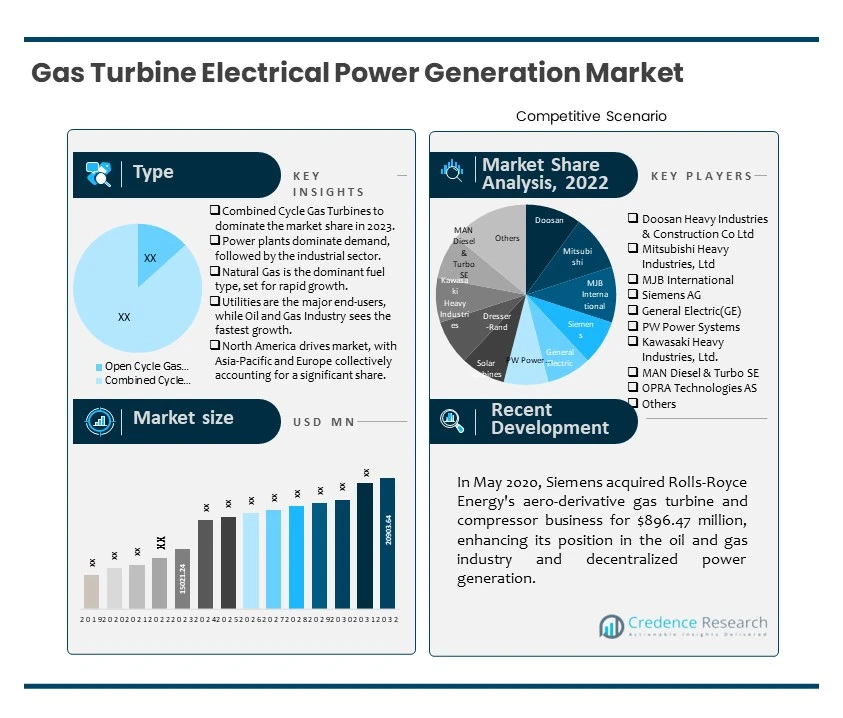
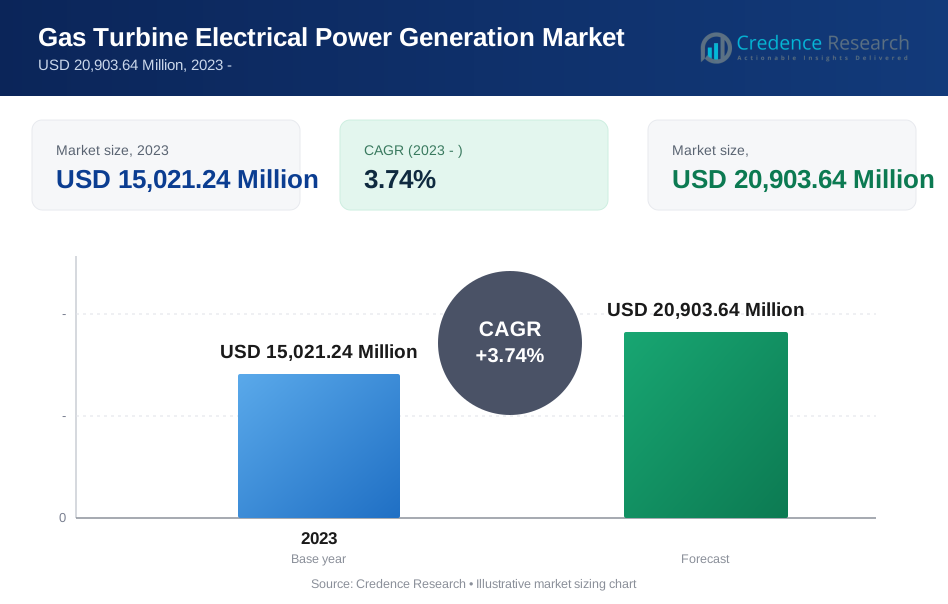
- The global Gas Turbine Electrical Power Generation market was valued at USD 15,021.24 Million in 2023 and is expected to reach USD 20,903.64 Million in 2032, growing at a CAGR of 3.74% between 2024 and 2032.
- The Combined Cycle Gas Turbines sector is the dominant market segment, accounting for more than 80% of the total value in 2023, while Open Cycle Gas Turbines are experiencing a decline, constituting less than 20%.
- The power plants application segment dominates the global demand for Gas Turbine Electrical Power Generation, accounting for more than 60% in 2023, with moderate growth expected. The industrial segment follows, representing 20-30% and experiencing the fastest growth, driven by distributed generation trends.
- In terms of capacity, the above 120 MW category holds the largest share, constituting over 60% in 2023, with moderate growth expected. The 1 MW - 40 MW category is the fastest-growing, driven by rapid decentralization trends.
- Natural Gas is the dominant fuel type, representing more than 70% of the market share in 2023. It is expected to experience the fastest growth, driven by its abundance, affordability, and lower emissions.
- Utilities are the major end-users, contributing to over 50% of the market share, driven by increasing demand. The Oil and Gas Industry segment is the fastest-growing, tied to exploration and production activities.
- The compressor component holds the largest segment share, accounting for more than 30%. The turbine and combustor segments follow closely, with the generator segment contributing 15-20%.
- North America is a significant driver of the Gas Turbine Electrical Power Generation market, with over one-third share in 2023, while Asia-Pacific and Europe collectively account for just under 55% share. Europe held over 20% share in 2023.
- The market for Gas Turbine Electrical Power Generation is driven by the increasing demand for electricity, and the primary growth opportunities include the significant potential in North America, increased adoption in educational establishments, and novel distribution methods.
Executive Summary
Market Definition
A gas turbine is a mechanical device that leverages the energy stored in a working fluid or gas to produce electricity. Operating on the Brayton cycle, the turbine comprises a heater, compressor, turbine, and cooler, which facilitate the conversion of mechanical or heat energy into rotational energy. Through a series of thermodynamic processes, the working fluid undergoes a transformation, ultimately yielding electricity as the output. The gas turbine electrical power generation market encompasses the manufacturing, installation, and maintenance of gas turbine power plants for electricity generation. It includes the production and distribution of gas turbines, as well as related components such as generators, control systems, and auxiliary equipment.
Market Overview
The global Gas Turbine Electrical Power Generation market has demonstrated consistent growth in recent years and is projected to grow at a CAGR of 3.74% between 2024 and 2032. The market, valued at USD 15,021.24 million in 2023, is anticipated to reach USD 20,903.64 million in 2032.
The primary driver fueling the growth of the Gas Turbine Electrical Power Generation market is the increasing adoption of gas turbine electrical power generation technology, attributed to its efficiency and reliability compared to alternative power generation methods. The demand for electricity generation, especially in power plants and industrial applications, positively influences the market's expansion.
Moreover, the Gas Turbine Electrical Power Generation market is expanding due to the versatility and effectiveness of gas turbines in various applications, particularly in confined spaces where their efficiency shines. The market is expected to witness significant growth during the forecast period as a result of the growing preference for gas turbine electrical power generation devices, considering their superior speed and data handling capabilities compared to alternative solutions.
Additionally, the integration of gas turbine technology into new products and its relevance in meeting the energy needs of diverse industries, including the aerospace sector and oil and gas exploration, presents numerous opportunities for the Gas Turbine Electrical Power Generation market to thrive in the estimated timeframe. The reliability and efficiency of gas turbines contribute to their sustained adoption in various applications, ensuring a positive trajectory for the market's expansion.
Segmentation by Type:
- Open Cycle Gas Turbines hold a market share of more than 20% in the Gas Turbine Electrical Power Generation Market in the year 2023.
- Combined Cycle Gas Turbines are the fastest-growing segment and are anticipated to register the fastest CAGR growth, driven by their efficiency and the growing trend towards combined cycle power generation.
Segmentation by Technology:
- Aero-Derivative Gas Turbines constitute less than 25% of the Gas Turbine Electrical Power Generation Market share in 2023.
- Heavy-Duty Gas Turbines, with their stable performance, are expected to dominate and register a steady CAGR growth over the forecast period.
Segmentation by Application:
- Power Plants account for over 60% of the market share in the Gas Turbine Electrical Power Generation Market in 2023.
- Industrial applications are the fastest-growing segment, driven by demand and the rapid adoption of distributed generation trends.
Segmentation by Capacity:
- 1 MW - 40 MW capacity category holds less than 20% of the market share in 2023.
- The 1 MW - 40 MW capacity category is the fastest-growing, experiencing rapid growth due to decentralization trends.
Segmentation by Fuel Type:
- Natural Gas dominates with more than 70% market share in the Gas Turbine Electrical Power Generation Market in 2023.
- The Others (Renewable Fuels) category is the fastest-growing, experiencing rapid growth due to sustainability initiatives.
Segmentation by End-User:
- Utilities contribute to more than 50% of the market share in the Gas Turbine Electrical Power Generation Market in 2023.
- The Oil and Gas Industry is the fastest-growing segment, tied to exploration and production activities.
Segmentation by Component:
- Compressor holds the largest market share, accounting for more than 30% in the Gas Turbine Electrical Power Generation Market in 2023.
- Turbine is the fastest-growing segment, anticipated to register the fastest CAGR growth owing to advancements in turbine technology and efficiency improvements.
Segmentation by Region
- North America is propelling the growth of the Gas Turbine Electrical Power Generation Market, contributing to over one-third of the market share in 2023. This surge is attributed to the region's increasing demand for electricity and the expansion of power generation infrastructure, driven by factors such as industrial growth and the need for reliable energy sources.
- Asia Pacific and Europe collectively represent just under 55% of the Gas Turbine Electrical Power Generation Market in 2023, with Europe holding a substantial share of over 20% during the same period. The growth in these regions is fueled by a rising emphasis on cleaner and more efficient energy solutions, aligning with environmental sustainability goals.
- The rest of the world, encompassing Latin America, the Middle East, and Africa, accounts for the remaining demand for gas turbine electrical power generation. These regions are witnessing increased adoption of gas turbines to meet energy demands, driven by factors such as expanding industrial activities and the need for reliable power supply in remote areas.
The North America gas turbine electrical power generation market has been witnessing steady growth in recent years. This growth can be attributed to the increasing demand for electricity, especially in countries like the United States and Canada, coupled with the aging infrastructure of existing power plants that require replacement or upgrades. Accordingly the government in the region is actively investing in energy infrastructure which is anticipated to increase the demand of gas turbine electrical power generation in the region. For insatance, in October 2023, The US government allocated $3.46 billion for upgrading the US electric grid. The investment will promote grid resilience, clean energy integration, and 400 microgrids. Such initiatives by the government is anticipated to create favourable demand for gas turbine electric power generation in the region.
The Asia-Pacific gas turbine electrical power generation market has witnessed substantial growth in recent years and is expected to continue expanding. The increasing demand for electricity, driven by population growth and rising per capita income, has been a key factor contributing to the growth of this market. Additionally rising demand for clean hydrogen technologies, including gas turbine development, is driving the growth of the Gas Turbine Electrical Power Generation Market in the region. For instance, As part of South Korea's Hydrogen Economy Roadmap, the demand for clean hydrogen is expected to rise from 900 thousand tons in 2030 to 3.6 million tons by 2040. Accordingly market players actively expanding their business in clean energy such as hydrogen which in turn is creating favorable condition for the growth of the market. For instance, in May 2021, Doosan Heavy Industries & Construction revealed its plan to expand its hydrogen business, aiming to produce blue hydrogen in Changwon and green hydrogen in Jeju. The company plans to develop a hydrogen gas turbine and strengthen its hydrogen equipment business to solidify its market leadership. Doosan is strategically positioning itself to meet this growing demand by exploring various hydrogen production methods linked with its existing business capabilities.
Key Highlights of the Report
Key Highlights of the Gas Turbine Electrical Power Generation Market Report The global Gas Turbine Electrical Power Generation Market is segmented by turbine type, end-users, applications, power generation capacity, fuel type, and region. Combined Cycle Gas Turbines are the dominant type, with the power plants and industrial sectors being the primary segments. Additionally, Heavy-Duty Gas Turbines and Aero-Derivative Gas Turbines are widely utilized categories. Original equipment manufacturers (OEMs) and medium capacity range turbines play a key role in market dominance, with North America leading in market growth.
One of the main drivers propelling the global Gas Turbine Electrical Power Generation Market is the increasing demand for efficient and reliable power generation. The necessity for power in various applications, including power plants and industrial settings, fuels the demand for gas turbine electrical power generation components. The versatility of gas turbines in providing power in a range of capacities contributes to their effectiveness in diverse applications.
Nonetheless, North America is anticipated to have the largest share of the worldwide Gas Turbine Electrical Power Generation Market due to ongoing advancements in gas turbine technology and the region's robust infrastructure development. Furthermore, the market is expected to experience the highest growth rate in the Asia-Pacific (APAC) region, driven by the presence of numerous gas turbine manufacturing firms and the rising demand for efficient power generation.
What Are The Main Drivers Of The Gas Turbine Electrical Power Generation Market?
Growing demand for reliable and efficient power generation solutions, increased emphasis on clean energy sources, rising industrialization, and the need for decentralized energy production are the key factors propelling the Gas Turbine Electrical Power Generation Market forward.
What Are The Major Challenges Faced By The Gas Turbine Electrical Power Generation Market?
The primary challenges impacting the growth of the Gas Turbine Electrical Power Generation Market include regulatory uncertainties, initial capital investment requirements, and potential fluctuations in fuel prices.
What Are The Growth Opportunities In The Gas Turbine Electrical Power Generation Market?
The expanding energy needs, especially in emerging markets, and the increasing focus on sustainable power generation present significant growth opportunities for the Gas Turbine Electrical Power Generation Market. Additionally, advancements in turbine technology and the integration of digital solutions for efficient operations create new avenues for market growth.
Market Drivers
The global Gas Turbine Electrical Power Generation Market is driven by several factors. The following are the key drivers of the global Gas Turbine Electrical Power Generation Market:
Increasing Demand for Electricity Worldwide
The key driver in the gas turbine electrical power generation market is the increasing demand for electricity worldwide. As the global population continues to grow, so does the need for reliable and efficient power generation. Gas turbines are a popular choice for electrical power generation due to their high efficiency and flexibility in various applications. According to the International Energy Agency (IEA), global electricity demand is projected to grow by 2.1% per year through 2040, also the share of electricity in total final energy consumption is expected to rise from 19% in 2018 to 24% in 2040. This growing demand for electricity is making favourable market conditions for the growth of the gas turbine electrical power generation market. For example, in regions with high renewable energy penetration, gas turbines are used as backup power sources to ensure grid stability and reliability. This trend is driving the adoption of gas turbine electrical power generation systems across the globe.
Market Restraints
The global Gas Turbine Electrical Power Generation Market faces some challenges that may hinder its growth. These include the following:
Environmental Impact Associated with Gas Turbine Emissions
One key restraint in the gas turbine electrical power generation market is the environmental impact associated with gas turbine emissions. While gas turbines are known for their high efficiency, they still produce greenhouse gas emissions, including carbon dioxide (CO2) and nitrogen oxides (NOx). These emissions contribute to climate change and air pollution, leading to regulatory pressures on gas turbine operators to reduce their environmental footprint. For instance, stringent environmental regulations in many countries require gas turbine operators to invest in emission control technologies and adhere to strict emission limits. The most common emission control technologies used in gas turbines include wet controls, dry controls, and post-combustion catalytic control. Wet controls use steam or water injection to reduce combustion temperatures for NOX control, while dry controls use advanced combustor design to suppress NOX formation and/or promote CO burnout. Post-combustion catalytic control is used to selectively reduce NOX and/or oxidize CO emissions from the turbine.
Opportunities
The global Gas Turbine Electrical Power Generation Market offers significant growth opportunities. These include the following:
Integration of Advanced Digital Technologies for Improved Efficiency and Performance
Digitalization offers the potential to optimize gas turbine operations, enhance predictive maintenance, and enable better asset management. For example, advanced data analytics and machine learning algorithms can be used to analyze operational data from gas turbines in real time, allowing operators to identify potential issues proactively and optimize performance. This allows operators to simulate various scenarios and make informed decisions to maximize efficiency and reliability. The integration of digital solutions also enables remote monitoring and control of gas turbine assets, reducing downtime and improving overall operational efficiency. For instance, in February 2023, GE's Indian subsidiary, GE India Industrial Pvt Ltd, contracted with Cochin Shipyard to provide digital solutions, including GE's SmartSignal, for the LM2500 marine gas turbines on the Indian Navy's IAC-1 Vikrant. The technology aims to offer early equipment condition indications, reduce operational risks, and move towards predictive gas turbine propulsion operation. Thus the adoption of digital technologies presents a significant opportunity for gas turbine electrical power generation to reduce maintenance costs, and improve overall operational flexibility..
Competitive Landscape
Key Players
The global Gas Turbine Electrical Power Generation Market is highly competitive, with several key players. Some of the major players in the market and their market share are as follows:
- Doosan Heavy Industries & Construction Co Ltd
- Mitsubishi Heavy Industries, Ltd
- MJB International
- Siemens AG
- General Electric(GE)
- PW Power Systems
- Solar Turbines Incorporated
- Dresser-Rand
- Kawasaki Heavy Industries, Ltd.
- MAN Diesel & Turbo SE
- OPRA Technologies AS
- MTU AERO ENGINES AG
- Wood Group
- Chromalloy Gas Turbine LLC
- EthosEnergy
- NYE Thermodynamics Corporation
- Urban Green Energy
- Enercon GmbH
- International Aero Engines AG
- Suzlon Energy Limited
These organizations prioritize product innovation, distribution channel expansion, and mergers and acquisitions to stay competitive.
The global gas turbine electrical power generation market's key players continually seek to stay ahead by offering new products and developments.
- October 2023, The HYFLEXPOWER consortium, led by Siemens Energy, successfully demonstrated operation of a gas turbine with 100% renewable hydrogen at a paper mill in France. The project aims to decarbonize energy-intensive industries.
- October 2023, Mitsubishi Power began commercial operation of the sixth M701JAC gas turbine at a GTCC power plant in Rayong, Thailand. The project, owned by Gulf Group and Mitsui & Co., aims for 5,300MW from eight systems, reaching 50,000 AOH across five units.
- May 2020, Siemens moved its powerful SGT5-9000 HL gas turbine to the UK's Keadby 2 power plant for testing, targeting 840 MW generation with over 63% efficiency and reduced emissions.
Summary of Key Findings
- The demand for Gas Turbine Electrical Power Generation is on the rise due to the increasing need for efficient and reliable power generation. This growth is fueled by the demand for high-capacity electricity production in various sectors, including power plants, industrial applications, aerospace, and the oil and gas industry.
- The Gas Turbine Electrical Power Generation Market is segmented by turbine type, end-users, capacity, fuel type, and region. This segmentation allows for a comprehensive understanding of the market dynamics.
- Combined Cycle Gas Turbines dominate the market, representing over 80% of the market share, driven by their efficiency in power generation. The end-users span across utilities, the oil and gas industry, manufacturing, aerospace, and other niche applications.
- Gas Turbine Electrical Power Generation is commonly used for high-capacity electricity production, with a focus on the 40 MW - 120 MW capacity segment. This is driven by steady growth and demand for moderate-capacity power generation.
- North America leads in the growth of the Gas Turbine Electrical Power Generation Market, with key players such as Doosan Heavy Industries & Construction Co Ltd, Mitsubishi Heavy Industries, Ltd, Siemens AG, and General Electric (GE) competing in this highly competitive market..
Future Outlook
- Positive outlook for the global Gas Turbine Electrical Power Generation Market with significant growth potential, especially in North America.
- One of the main factors promoting the market's expansion is the increasing demand for reliable and efficient power generation solutions in the utility and industrial sectors.
- During the forecast period, the transition towards renewable energy sources may pose challenges to the growth of the Gas Turbine Electrical Power Generation Market. However, advancements in gas turbine technology and the push for cleaner energy are likely to offset these challenges.
- Key firms in the Gas Turbine Electrical Power Generation Market must focus on continuous innovation in turbine technology, expanding market reach to emerging economies, and maintaining competitive pricing to stay ahead of the competition. Additionally, strategic partnerships and collaborations with government and industry stakeholders can play a crucial role in market growth..
How CXOs Can Benefit from the Gas Turbine Electrical Power Generation Market Report
The Gas Turbine Electrical Power Generation Market Report provides CXOs with a comprehensive overview of the market, including:
Market size and growth forecast: The report provides detailed estimates of the global gas turbine electrical power generation market size, segmented by type, technology, application, capacity, fuel type, end-user, and component. It also includes forecasts for the market through 2032, based on key trends and drivers specific to the gas turbine electrical power generation industry.
Market segmentation: The report segments the gas turbine electrical power generation market by type, technology, application, capacity, fuel type, end-user, and component. This segmentation provides CXOs with a granular understanding of the market and the opportunities in each segment.
- Competitive landscape: The report profiles the key companies in the gas turbine electrical power generation market and provides insights into their strategies, product offerings, and financial performance. This information can help CXOs to identify and assess their competition within the gas turbine electrical power generation industry.
- Key trends and drivers: The report identifies and analyzes the key trends and drivers that are shaping the gas turbine electrical power generation market. This information can help CXOs to make informed decisions about their investments and strategies in the gas turbine electrical power generation sector.
CXOs can use the insights from the Gas Turbine Electrical Power Generation Market Report to:
- Identify growth opportunities: The report can help CXOs to identify new growth opportunities in the gas turbine electrical power generation market. For example, the report highlights the increasing demand for gas turbine power generation in various applications such as power plants, industrial settings, aerospace, and the oil and gas industry.
- Make informed investment decisions: The report can help CXOs to make informed investment decisions about gas turbine electrical power generation. For example, it provides insights into the key factors to consider when evaluating gas turbine technology, selecting appropriate capacity ranges, and choosing fuel types for power generation.
- Develop competitive strategies: The report can help CXOs to develop competitive strategies for their gas turbine electrical power generation businesses. For example, it identifies the strategies that leading companies in the market are employing to differentiate themselves and thrive in the competitive landscape.
- Track market developments: The report can help CXOs to track market developments and stay ahead of the curve in the gas turbine electrical power generation industry. For instance, it provides insights into the latest innovations and trends influencing the gas turbine electrical power generation market.
Overall, the Gas Turbine Electrical Power Generation Market Report is a valuable resource for CXOs seeking a deeper understanding of the market dynamics and identifying strategic opportunities for growth within the gas turbine electrical power generation sector.
Segmentation
By Type
- Open Cycle Gas Turbines
- Combined Cycle Gas Turbines
By Technology
- Aero-Derivative Gas Turbines
- Heavy-Duty Gas Turbines
By Application
- Power Plants
- Industrial
- Aerospace
- Oil and Gas
- Others
By Capacity
- 1 MW - 40 MW
- 40 MW - 120 MW
- Above 120 MW
By Fuel Type
- Natural Gas
- Diesel
- Aviation Fuel
- Others
By End-User
- Utilities
- Oil and Gas Industry
- Manufacturing
- Aerospace
- Others
By Component
- Compressor
- Combustor
- Turbine
- Generator
By Region
- North America
- The U.S.
- Canada
- Mexico
- Europe
- Germany
- France
- The U.K.
- Italy
- Spain
- Rest of Europe
- Asia Pacific
- China
- Japan
- India
- South Korea
- South-east Asia
- Rest of Asia Pacific
- Latin America
- Brazil
- Argentina
- Rest of Latin America
- Middle East & Africa
- GCC Countries
- South Africa
- Rest of Middle East and Africa
Request a Free Sample
Fill in your details and we'll send you a free sample report.
- Sample data tables & charts
- Research methodology
Need a Custom Version of This Report?
Tailor the scope, geography, or segments to your exact requirements.
- Custom geography or segment scope
- Direct access to our analyst team
Frequently Asked Questions
What is the current size of the global Gas Turbine Electrical Power Generation Market?
What is the expected growth rate of the Gas Turbine Electrical Power Generation Market between 2024 and 2032?
Which segment is leading the market share in terms of turbine type?
Which end-users segment governs the demand for Gas Turbine Electrical Power Generation globally?
Who are the major players in the global Gas Turbine Electrical Power Generation Market?
Table of Content
Chapter 1. Report Introduction
- 1.1 Report Description & Purpose
- 1.1.1 Report Title & Market Definition
- 1.1.2 Unique Selling Propositions (USP) & Key Differentiators
- 1.1.3 Value Proposition for Stakeholders
- 1.2 Research Objectives
- 1.2.1 Market Sizing Objectives (Volume & Revenue)
- 1.2.2 Segmentation Objectives
- 1.2.3 Competitive Intelligence Objectives
- 1.2.4 Forecast & Scenario Objectives
- 1.3 Report Scope
- 1.3.1 Gas Turbine Electrical Power Generation Scope – Types & Subtypes Covered
- 1.3.2 Geographic Scope – Regions & Countries Covered
- 1.3.3 Historical Period, Base Year & Forecast Period (2023; forecast to the forecast period)
- 1.3.4 Inclusions & Exclusions
- 1.4 HS Code & Classification Framework
- 1.5 Currency, Units & Pricing Basis
- 1.6 Target Stakeholders
- 1.7 Limitations & Assumptions
Chapter 2. Executive Summary
- 2.1 Global Gas Turbine Electrical Power Generation Market Snapshot
- 2.1.1 Market Size – Historical (2023) & Forecast (the forecast period) (2023: USD 15,021.24 Million → forecast year: USD 20,903.64 Million)
- 2.1.2 Volume & Revenue – Global Totals
- 2.1.3 Key Market Highlights – Top Five Facts
- 2.2 Gas Turbine Electrical Power Generation Market Segmentation Snapshot
- 2.2.1 Market Split by Region – 2023 vs.
- 2.3 Competitive Snapshot
- 2.3.1 Top 10 Players by Revenue Share – 2023
- 2.3.2 Top 10 Players by Volume Share – 2023
- 2.3.3 Recent Strategic Developments (18-Month Summary)
- 2.4 Key Investment Highlights & Strategic Conclusions
Chapter 3. Gas Turbine Electrical Power Generation Market Dynamics & Industry Analysis
- 3.1 Market Overview & Context
- 3.1.1 Gas Turbine Electrical Power Generation Market Position in the Broader Automotive Value Chain
- 3.1.2 OEM vs. Replacement Market Dynamics
- 3.1.3 Market Maturity & Development Stage by Region
- 3.2 Gas Turbine Electrical Power Generation Market Drivers
- 3.3 Gas Turbine Electrical Power Generation Market Restraints & Challenges
- 3.4 Gas Turbine Electrical Power Generation Market Opportunities
- 3.5 Porter's Five Forces Analysis
- 3.5.1 Threat of New Entrants
- 3.5.2 Bargaining Power of Suppliers
- 3.5.3 Bargaining Power of Buyers
- 3.5.4 Threat of Substitutes
- 3.5.5 Competitive Rivalry – Intensity Assessment
- 3.6 Gas Turbine Electrical Power Generation Value Chain Analysis
- 3.6.1 Upstream – Raw Material/Input Suppliers
- 3.6.1.1 Raw Material/Input 1
- 3.6.1.2 Raw Material/Input 2
- 3.6.1.3 Raw Material/Input 3
- 3.6.2 Midstream – Production/Manufacturing/Service Delivery
- 3.6.2.1 Production/Process Overview
- 3.6.2.2 Key Facility Locations & Capacity by Manufacturer
- 3.6.3 Downstream – Distribution & End Consumer
- 3.6.3.1 Primary Channel – B2B/OEM
- 3.6.3.2 Secondary Channels – Dealer, Retail, Online, Direct
- 3.6.4 Value Chain Profitability Analysis
- 3.6.1 Upstream – Raw Material/Input Suppliers
- 3.7 PESTEL Analysis
- 3.7.1 Political Factors
- 3.7.2 Economic Factors
- 3.7.3 Social Factors
- 3.7.4 Technological Factors
- 3.7.5 Environmental Factors
- 3.7.6 Legal Factors
- 3.8 Gas Turbine Electrical Power Generation Supply Chain Analysis
- 3.8.1 Raw Material/Input Supply Risk Assessment
- 3.8.2 Manufacturing Concentration Risk (Geographic Exposure)
- 3.8.3 Trade Disruption Impact Analysis
- 3.9 Regulatory & Policy Landscape
Note: The regulatory and policy landscape section covers regulations based on their applicability to the market, Gas Turbine Electrical Power Generation category, geography, and scope of the study. Only regulatory frameworks with a material impact on operations, compliance, trade, sustainability, or market access are analyzed in detail.
Chapter 4. Key Investment Pockets & Opportunity Analysis
- 4.1 Gas Turbine Electrical Power Generation Market Attractiveness Analysis
- 4.1.1 By Region – Investment Attractiveness Matrix (Volume × CAGR)
- 4.2 Absolute Revenue Growth Opportunity
- 4.2.1 By Region – Absolute USD Growth Through the forecast period
- 4.3 Incremental Volume Opportunity
- 4.3.1 By Region – Incremental Volume Through the forecast period
- 4.3.2 Segment – Incremental Volume
- 4.4 Emerging Submarket Opportunity Deep Dive (Subject to Applicability)
- 4.5 Emerging Market Opportunity Scorecards
- 4.5.1 United States
- 4.5.2 Europe
- 4.5.3 Asia
- 4.5.4 Middle East & Africa
Note: Emerging Market Opportunity Scorecards will be included based on relevance and strategic importance. Regions listed are indicative and may vary depending on data availability and market dynamics.
Chapter 5. Gas Turbine Electrical Power Generation Import-Export Analysis & Trade Flows
- 5.1 Global Trade Overview
- 5.1.1 Global Export Value by Country (2023)
- 5.1.2 Global Export Volume by Country (2023)
- 5.1.3 Global Import Value by Country (2023)
- 5.1.4 Global Import Volume by Country (2023)
- 5.1.5 Net Trade Balance by Country (2023)
- 5.2 Export Analysis – Segment
- 5.2.1 Type 1 (HS Code)
- 5.2.2 Type 2 (HS Code)
- 5.2.3 Type 3 (HS Code)
- 5.2.4 Type 4 (HS Code)
- 5.2.5 Type 5 (HS Code)
- 5.3 Import Analysis – Segment
- 5.3.1 Type 1 (HS Code)
- 5.3.2 Type 2 (HS Code)
- 5.3.3 Type 3 (HS Code)
- 5.3.4 Type 4 (HS Code)
- 5.3.5 Type 5 (HS Code)
- 5.4 Average Unit Trade Prices
- 5.4.1 Average Export Price – Segment & Country
- 5.4.2 Average Import Price – Segment & Source Country
- 5.4.3 Price Trends (2023)
- 5.5 Key Trade Route Analysis
- 5.5.1 Trade Route 1
- 5.5.2 Trade Route 2
- 5.5.3 Trade Route 3
- 5.5.4 Trade Route 4
- 5.5.5 Trade Route 5
- 5.6 Trade Policy Impact Assessment
- 5.6.1 US Anti-Dumping & Section 301 Tariffs
- 5.6.2 EU Customs Union Impact
- 5.6.3 Major Free Trade Agreements
- 5.6.4 USMCA Rules of Origin
Note: Trade policy analysis will be included only where relevant to the Gas Turbine Electrical Power Generation market.
Chapter 6. Competitive Landscape & Company Benchmarking
- 6.1 Gas Turbine Electrical Power Generation Market Concentration & Structure
- 6.1.1 Herfindahl-Hirschman Index (HHI) – vs. 2023
- 6.1.2 Tier 1, Tier 2 & Tier 3 Market Structure
- 6.1.3 Global, Regional & Local Player Dynamics
- 6.2 Gas Turbine Electrical Power Generation Market Share Analysis – 2023
- 6.2.1 Global Revenue Share by Company
- 6.2.2 Global Volume Share by Company
- 6.2.3 Regional Revenue Share
- 6.2.4 Market Share Evolution ( vs. 2023)
- 6.2.5 OEM Segment Share by Company
- 6.2.6 Replacement Segment Share by Company
- 6.3 Production/Delivery Capacity & Facility Analysis
- 6.3.1 Global Installed Capacity
- 6.3.2 Capacity Utilization Rates
- 6.3.3 Production/Output Volume
- 6.3.4 Facility Locations & Capacity Map
- 6.3.5 Planned Capacity Additions
- 6.4 Gas Turbine Electrical Power Generation Competitive Benchmarking Matrix
- 6.4.1 Revenue, Volume, CAGR & Profitability Comparison
- 6.4.2 Channel Revenue Mix
- 6.4.3 Geographic Revenue Exposure
- 6.4.4 R&D Intensity
- 6.4.5 Sustainability Maturity
- 6.5 Strategic Developments in Gas Turbine Electrical Power Generation (Last 24 Months)
- 6.5.1 Mergers, Acquisitions & Divestments
- 6.5.2 New Gas Turbine Electrical Power Generation Launches
- 6.5.3 Facility Expansions
- 6.5.4 Strategic Alliances, Joint Ventures & Partnerships
- 6.5.5 Distribution Expansion & Market Entry
- 6.5.6 Sustainability & ESG Initiatives
- 6.6 Competitive Strategy Mapping
- 6.6.1 Leader, Challenger, Follower & Niche Classification
- 6.6.2 Pricing Strategy Comparison
- 6.6.3 Channel Strategy Matrix
Note: Strategic developments are included based on their materiality and the availability of reliable information.
Chapter 7. Global Gas Turbine Electrical Power Generation Market – By Distribution Channel
- 7.1 Segment Overview
- 7.1.1 Volume & Revenue Split by Channel (2023 & )
- 7.1.2 Channel Mix Evolution (the forecast period)
Chapter 8. Regional Market Analysis – Global Overview
- 8.1 Global Regional Overview
- 8.1.1 Regional Volume Share
- 8.1.2 Regional Revenue Share
- 8.1.3 Regional Volume by Region
- 8.1.4 Regional Revenue by Region
- 8.1.5 Regional Forecast Through the forecast period
- 8.2 Cross-Regional Segment Analysis
- 8.2.1 By Distribution Channel
- 8.2.2 By Brand/Price Tier
Chapter 9. North America Gas Turbine Electrical Power Generation Market
- 9.1 United States
- 9.2 Canada
- 9.3 Mexico
Chapter 10. Europe Gas Turbine Electrical Power Generation Market
- 10.1 Germany
- 10.2 France
- 10.3 Italy
- 10.4 United Kingdom
- 10.5 Spain
- 10.6 Poland
- 10.7 Russia
- 10.8 Netherlands
- 10.9 Belgium
- 10.10 Sweden
- 10.11 Denmark
- 10.12 Norway
- 10.13 Rest of Europe
Chapter 11. Asia Pacific Gas Turbine Electrical Power Generation Market
- 11.1 China
- 11.2 India
- 11.3 Japan
- 11.4 South Korea
- 11.5 Thailand
- 11.6 Indonesia
- 11.7 Vietnam
- 11.8 Malaysia
- 11.9 Australia
- 11.10 Rest of Asia Pacific
Chapter 12. Latin America Gas Turbine Electrical Power Generation Market
- 12.1 Brazil
- 12.2 Argentina
- 12.3 Colombia
- 12.4 Chile
- 12.5 Rest of Latin America
Chapter 13. Middle East Gas Turbine Electrical Power Generation Market
- 13.1 Saudi Arabia
- 13.2 United Arab Emirates
- 13.3 Turkey
- 13.4 Israel
- 13.5 Iran
- 13.6 Rest of the Middle East
Chapter 14. Africa Gas Turbine Electrical Power Generation Market
- 14.1 South Africa
- 14.2 Egypt
- 14.3 Nigeria
- 14.4 Morocco
- 14.5 Rest of Africa
Chapter 15. Gas Turbine Electrical Power Generation Company Profiles
- 15.1 [Company 01]
- 15.1.1 Company Overview
- 15.1.2 Key Management Personnel
- 15.1.3 Products & Services Portfolio
- 15.1.4 Financial Performance
- 15.1.5 Key Market Focus & Geographic Presence
- 15.1.6 Recent Developments & Strategic Initiatives
Note: The company profile list is preliminary and may change based on research findings, market developments, data availability, and client requirements.
Chapter 16. Appendices
- Appendix A – List of Abbreviations & Acronyms
- Appendix B – Industry Classification Code Reference – Full Series
- Appendix C – Production & Capacity Data Tables
- Appendix D – End-Use & Demand Base Tables
- Appendix E – Consumption & Replacement Rate Assumptions
- Appendix F – ASP Reference Tables
- Appendix G – Manufacturing & Facility Database
- Appendix H – Import-Export Data Tables
- Appendix I – Regulatory Summary Tables
- Appendix J – Primary Research Participant List (Anonymized)
- Appendix K – Primary Research Questionnaire Framework
- Appendix L – Data Sources & Bibliography
- Appendix M – Market Size Divergence & Source Comparison
Chapter 17. Research Methodology
- 17.1 Research Framework & Philosophy
- 17.2 Secondary Research – Sources, Hierarchy & Data Extraction
- 17.3 Data Modeling – Bottom-Up & Top-Down Market Sizing
- 17.4 Primary Research – Stakeholder Framework, LOI & Sample Sizes
- 17.5 Forecast Methodology – Regression, Scenario & Sensitivity Analysis
- 17.6 Quality Control – Four-Layer Validation Framework
- 17.7 Limitations & Standard Assumptions
- 17.8 Disclaimer
