
| REPORT ATTRIBUTE | DETAILS |
|---|---|
| Historical Period | 2019-2022 |
| Base Year | 2023 |
| Forecast Period | 2024-2032 |
| Pressure Pumping Market Size 2023 | USD 83514.2 Million |
| Pressure Pumping Market, CAGR | 6.90% |
| Pressure Pumping Market Size 2032 | USD 152250.8 Million |
Market Insights
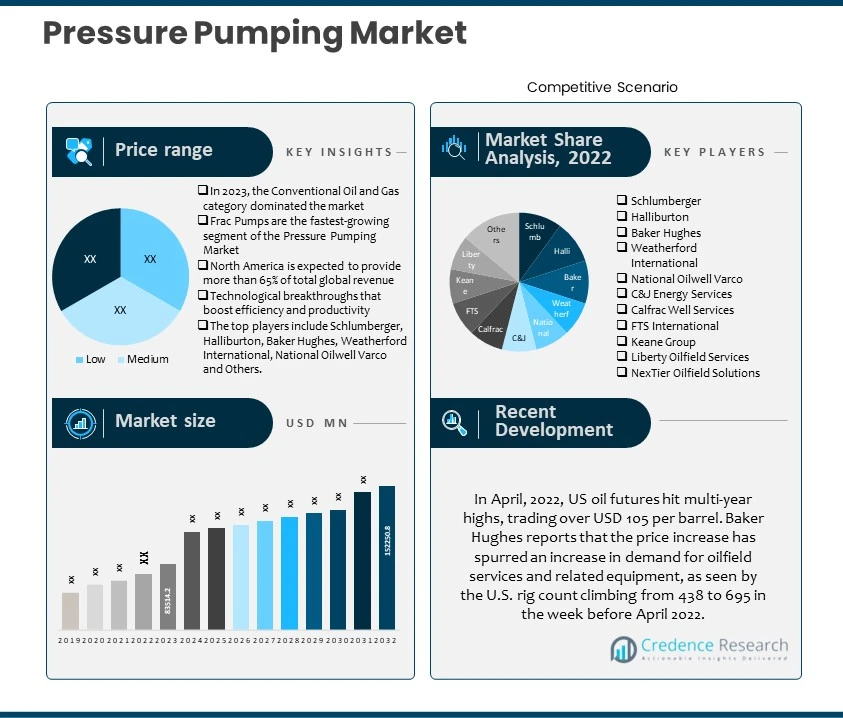
- The global demand for Pressure Pumpings was valued at USD 83514.2 Million in 2023 and is expected to reach USD 152250.8 Million in 2032, growing at a CAGR of 6.90% between 2024 and 2032.
- In 2023, the hydraulic fracturing category led the market, accounting for over 57%, while the cementing category is expected to rise at a high revenue CAGR.
- In 2023, the Horizontal Wells segment dominated the market, while vertical wells are expected to have a significant revenue CAGR throughout the projected period.
- The Deep Wells sector represents a sizable portion of the Pressure Pumping Market.
- Frac Pumps are the fastest-growing segment of the Pressure Pumping Market, while Blenders are another prominent market category.
- In 2023, the conventional oil and gas category led the market, while the unconventional oil and gas (shale gas, tight oil) segment is expected to develop the fastest over the forecast period.
- North America is expected to account for more than 65% of total global revenue, while the Asia-Pacific region is expected to grow at the quickest CAGR throughout the projection period.
- Market growth is driven by reservoir optimization and maximum recovery.
- Infrastructure limitations impede market growth
Executive Summary
Market Definition
"Pressure pumping" is the process of pumping cement into a wellbore while utilizing pressurized fracturing fluid to propagate a fracture through multiple layers of rock. This type of pumping is critical in reservoirs containing resources such as coalbed methane, shale gas, and tight oil and gas, where conventional drilling is difficult to use. Some examples of pressure pumping services include workover pumping, wireline intervention, acidizing, cementing well injection, pressured fluid pumping, and coiled tubing.
It's widely used in the mining, oil, and gas industries. Pressure Pumping has had significant expansion over the last 20 years, but this growth has also resulted in a number of challenges as the organization's structure and employee behavior have evolved. The Global Pressure Pumping Market is seeing substantial changes as firms are forced to adapt in order to retain the structure of their operations.
Market Overview
The global Pressure Pumping Market has witnessed steady growth in recent years and is expected to grow at a CAGR of 6.90% between 2024 and 2032. The market was valued at USD 83514.2 million in 2023 and is expected to reach USD 152250.8 million in 2032.
Population expansion, urbanization, and increasing economies are all contributing to the expected increase in global gas and oil consumption. This will increase exploration and production activity, increasing demand for pressure pumping services. In recent years, the Pressure Pumping Market has seen substantial technological breakthroughs, such as the usage of electric-powered fracturing pumps, real-time data analytics, and AI. These innovations have increased the efficiency, safety, and environmental sustainability of pressure pumping operations, making them more appealing to consumers.
In recent years, shale gas and tight oil production have been major drivers of the Pressure Pumping Market. These unconventional resources require pressure pumping to extract oil and gas, and output is expected to increase further in the coming years. Many governments around the world promote the oil and gas business with advantageous regulations, tax breaks, and subsidies. This assistance is projected to spur more investment in exploration and production activities, increasing demand for pressure pumping services.
Segmentation By Type of Service
- In 2023, the hydraulic fracturing category led the market, accounting for around 57%. Because hydraulic fracturing creates vast fracture networks inside the reservoir, it generally boosts well productivity.
- The cementing category is predicted to grow at a high revenue CAGR over the forecast period due to rising global demand for drilling services.
Segmentation By Well Type
- In 2023, the Horizontal Wells segment dominated the market, accounting for almost 84%. Horizontal wells have a far broader area of contact with the reservoir than vertical wells. The extended method, which increases productivity, enables increased exposure to hydrocarbon-bearing deposits.
- Vertical wells are predicted to have a substantial revenue CAGR throughout the forecast period.
Segmentation By Well Depth
- The Deep Wells sector holds a considerable part of the Pressure Pumping Market. Deep wells require high-pressure pumping services for exploration and extraction, resulting in a bigger market share than shallow wells.
Segmentation by Pressure Pumping Equipment Type
- Frac Pumps are the fastest-expanding segment of the Pressure Pumping Market. Frac Pumps play a critical part in hydraulic fracturing operations, boosting demand and contributing to the segment's rapid expansion.
- Blenders are another popular market segment. Blenders are necessary for mixing chemicals and proppants with fracturing fluid, making them a popular component in pressure-pumping applications.
Segmentation by Application
- In 2023, the Conventional Oil and Gas segment dominated the market, accounting for over 62%. Conventional pressure pumping services are critical in matured and mature fields where reservoir pressure naturally decreases and interventions are required to maintain or improve output.
- However, the Unconventional Oil and Gas (Shale Gas, Tight Oil) segment is predicted to grow the fastest during the forecast period.
Segmentation by Region
- North America is estimated to contribute to more than 65% of total worldwide revenue.
- The Asia-Pacific region is predicted to develop at the fastest CAGR throughout the projection period.
- The rest of the world, including Latin America, the Middle East, and Africa, supplies the remaining demand for Pressure Pumpings.
North America emerged as the most important worldwide Pressure pumping market in 2023. The United States is a vital contributor to the region's market growth and development. The shale revolution and North America's primacy in the petroleum pumping business are inextricably linked. Pumping procedures have increased dramatically as a result of shale gas exploration. Hydraulic fracturing has become synonymous with massive volumes of oil and gas that can be extracted, bolstering North America's market supremacy. North America has the benefit of a well-established infrastructure network that enables smooth pumping operations. This network consists of transportation and waste disposal infrastructure. A large pipeline network makes it easier to move resources swiftly and effectively, reducing operational costs and logistical challenges. This infrastructure advantage helps to explain North America's enormous market dominance. To preserve their competitive advantage, regional market participants employ a variety of market strategies, including product innovation, product differentiation, mergers and acquisitions, partnerships, and strategic alliances.
Moreover, the Asia Pacific area is predicted to develop significantly at a CAGR of 12.5% over the forecast period. Regional research institutes will hold conferences to educate locals and promote awareness about locally relevant technologies. Furthermore, the number of wells drilled in the region has expanded dramatically.
Key Highlights of the Report
The Type of Service, Well Type, Well Depth, Pressure Pumping Equipment Type, Application, and region segment of the global Pressure Pumping Market. In 2023, the hydraulic fracturing category led the market, while the Horizontal Wells sector dominated. Moreover, Frac Pumps is the fastest-growing segment, while Vertical Wells is expected to have a significant revenue CAGR throughout the projected period. Blenders are another popular market segment in North America, leading the market growth.
The Pressure Pumping Market is being driven by rising demand for pressure pumping services in the oil and gas industry, increased exploration and production activities, and technical advances in hydraulic fracturing techniques. However, market constraints include swings in oil prices, environmental concerns about hydraulic fracturing, and regulatory hurdles. Opportunities in the Pressure Pumping Market include increased demand for unconventional energy sources, increased shale gas exploration, and the development of environmentally friendly pressure pumping technology.
North America became the world's largest pressure pumping market in 2023. The United States makes an important contribution to the region's market growth and development. The shale revolution and North America's leadership in the petroleum pumping industry are intimately connected. Furthermore, the Asia-Pacific region is expected to grow rapidly at a CAGR of 12.5% during the projection period.
What Are The Main Drivers Of The Global Pressure Pumping Market?
Several main drivers are propelling the Pressure Pumping Market. The oil and gas industry has a high need for pressure pumping services, which is driving market expansion. Furthermore, as exploration and production activities rise, there will be a greater demand for pressure-pumping services. Furthermore, technical improvements in hydraulic fracturing techniques are adding to the growth of the Pressure Pumping market.
What Are The Major Challenges Faced By The Global Pressure Pumping Market?
On the other side, the market has some constraints that may limit its expansion. Oil price fluctuations significantly influence demand for pressure-pumping services. Furthermore, environmental worries about hydraulic fracturing procedures present problems for the business. Regulatory barriers and compliance requirements also function as impediments in the Pressure Pumping Market.
What Are The Growth Opportunities In The Global Pressure Pumping Market?
Despite these challenges, the Pressure Pumping Market offers numerous chances for growth. The increasing demand for unconventional energy sources, such as shale gas, is opening up new opportunities for pressure pumping services. Moroever, the increase in shale gas exploration operations is propelling the industry ahead. Also, the development of eco-friendly pressure-pumping technology allows enterprises to adapt and satisfy the industry's changing needs.
Market Drivers
Several factors drive the global Pressure Pumping Market. The following are the key drivers of the global Pressure Pumping Market:
Reservoir Optimization and Maximum Recovery
Reservoir engineers and operators seek to enhance hydrocarbon recovery while maintaining peak reservoir performance. This comprises adopting pumping techniques to boost production, induce fractures, and stimulate reservoirs, such as acidizing and hydraulic fracturing. The industry's demand for expert pumping services is only growing as it seeks more efficient and effective recovery methods. Pumping operations provide significant benefits for reservoir optimization. Fracking, also known as hydraulic fracturing, is a procedure that splits rocks to facilitate hydrocarbon flow. Injecting high-pressure fluid into the reservoir increases permeability and production rates by forcing the formation to crack. This is the major driver driving market growth and development.
Market Restraints
The global Pressure Pumping Market faces some challenges that may hinder its growth. These include the following:
Infrastructure Limitations
Poor infrastructure and constraints provide substantial barriers to the worldwide pressure-pumping market's growth and development. Supplying relevant devices, equipment, and laborers to and from project sites might be difficult for pumping firms that lack infrastructure-backed transportation networks. This may lead to operational inefficiencies, greater transportation costs, and longer project completion timelines. Logistical challenges are exacerbated by poor infrastructure, which may limit access to remote or difficult routes where pumping operations are routinely performed. Inadequate infrastructure drives up operational costs for pressure-pumping firms. Businesses may need to allocate more cash to trash management and alternative modes of transportation if waste disposal facilities are insufficient or transportation networks are inefficient.
Opportunities
The global Pressure Pumping Market offers significant growth opportunities. These include the following:
Technological Advancements
The continual technological advancements in practice pumping methods and gear have resulted in a significant increase in the practice pumping business. These innovations have been critical in increasing overall well-being production, lowering costs, and improving operational efficiency. One of the biggest technological breakthroughs contributing to this difficulty is hydraulic fracturing. Real-time monitoring systems allow opponents to rapidly get critical information regarding task performance, equipment status, and environmental conditions. These systems, which use sophisticated sensors, technology, and data analytics, deliver actionable insights that aid in proactive decision-making. Real-time monitoring systems allow operators to enhance production efficiency and address operational issues quickly by continuously monitoring crucial metrics such as time, performance, and flow rates.
Competitive Landscape
Key Players
The global Pressure Pumping Market is highly competitive, with several key players. Some of the major players in the market and their market share are as follows:
- Schlumberger
- Halliburton
- Baker Hughes
- Weatherford International
- National Oilwell Varco
- C&J Energy Services
- Calfrac Well Services
- FTS International
- Keane Group
- Liberty Oilfield Services
- NexTier Oilfield Solutions
- Patterson-UTI Energy
- ProPetro Holding Corp.
- RPC Inc.
- Sanjel Energy Services
- Superior Energy Services
- Trican Well Service
- Basic Energy Services
- Mammoth Energy Services
- Nine Energy Service
These organizations prioritize product innovation, Application expansion, and mergers and acquisitions to stay competitive.
The global Pressure Pumping Market's key players continually seek to stay ahead by offering new products and developments.
In January, 2021, Schlumberger's onshore hydraulic fracturing operations in the United States and Canada have amalgamated with Liberty Oilfield Services, Inc. Schlumberger will retain a 37% share in the North American oilfield company as part of the deal. Liberty's working pressure pumping capacity is expected to increase as a result of the transaction, with no additional debt on its financial sheet.
In August, 2021, NexTier Oilfield Solutions Inc., a US-based oilfield services provider, paid an undisclosed sum for Alamo Pressure Pumping, LLC. NexTier Oilfield Solutions Inc. anticipates that the acquisition by Alamo would strengthen its position as the industry leader in next-generation technology, expedite and deepen the impacts of its low-cost, low-carbon strategy, and increase long-term shareholder value. Alamo Pressure Pumping, LLC is a US-based pressure pump producer.
Summary of Key Findings
- Technological advancements
- Market segmented By Type of Service, Well Type, Well Depth, Pressure Pumping Equipment Type, Application and region.
- The cementing category is the highest revenue CAGR holder.
- In 2023, the Horizontal Wells segment dominated the market
- North America is leading in market growth; the market is highly competitive with key players, including Schlumberger, Halliburton, Baker Hughes, Weatherford International, National Oilwell Varco and Others.
Future Outlook
- Continued increase in demand for pressure pumping services.
- Technological breakthroughs that boost efficiency and productivity
- The expansion of unconventional energy sources has contributed to market growth.
- Expanding exploration and production operations
- Concentrate on environmentally friendly pressure pumping technologies.
How CXOs Can Benefit from the Credence Research Pressure Pumping Market Report
The Credence Research Pressure Pumping Market Report provides CXOs with a comprehensive overview of the market, including:
- Market size and growth forecast: The report provides detailed estimates of the global Pressure Pumping Market size, segmented By Type of Service, Well Type, Well Depth, Pressure Pumping Equipment Type , Application and region. It also includes forecasts for the market through 2032 based on key trends and drivers.
- Market segmentation: The report segments the Pressure Pumping Market By Type of Service, Well Type, Well Depth, Pressure Pumping Equipment Type , Application and region. This segmentation provides CXOs with a granular understanding of the market and the opportunities in each segment.
- Competitive Landscape: The report profiles the key players in the Pressure Pumping Market and provides insights into their strategies, product offerings, and financial performance. This information can help CXOs to identify and assess their competition.
- Key trends and drivers: The report identifies and analyzes the key trends and drivers that are shaping the Pressure Pumping Market. This information can help CXOs to make informed decisions about their investments and strategies.
CXOs can use the insights from the Credence Research Pressure Pumping Market Report to:
- Identify growth opportunities: The report can help CXOs identify new growth opportunities in the Pressure Pumping Market. By analyzing the data and trends in the report, they can make informed decisions about where to invest and expand their business.
- Make informed investment decisions: The report can help CXOs make informed investment decisions about Pressure Pumpings. By examining the insights and trends in the report, they can strategically allocate resources and capitalize on the right opportunities in the market.
- Develop competitive strategies: The report can help CXOs develop competitive strategies for their Pressure Pumpings businesses. For example, by delving into the insights and trends within the report, they can strategically position themselves in the market and stay ahead of the competition.
- Track market developments: The report can help CXOs monitor market developments and stay ahead of the curve. For example, it provides insights into the latest trends and innovations in the Pressure Pumping Market.
Overall, the Credence Research Pressure Pumping Market Report is a valuable resource for CXOs who are looking to gain a deeper understanding of the market and identify opportunities for growth.
Segmentation
- By Type of Service:
- Hydraulic Fracturing
- Cementing
- Acidizing
- Coiled Tubing Services
- Others
- By Well Type:
- Vertical Wells
- Horizontal Wells
- By Well Depth:
- Shallow Wells
- Deep Wells
- By Pressure Pumping Equipment Type:
- Frac Pumps
- Blenders
- Sand Handling Equipment
- Fluid Management Equipment
- Others
- By Application:
- Unconventional Oil and Gas (Shale Gas, Tight Oil)
- Conventional Oil and Gas
- Coal Bed Methane
- Others
- By Region
- North America
- The U.S.
- Canada
- Mexico
- Europe
- Germany
- France
- The U.K.
- Italy
- Spain
- Rest of Europe
- Asia Pacific
- China
- Japan
- India
- South Korea
- South-east Asia
- Rest of Asia Pacific
- Latin America
- Brazil
- Argentina
- Rest of Latin America
- Middle East & Africa
- GCC Countries
- South Africa
- Rest of the Middle East and Africa
- North America

Request a Free Sample
Fill in your details and we'll send you a free sample report.
- Sample data tables & charts
- Research methodology
Market Dynamics
Reservoir Optimization and Maximum Recovery
Operators are increasingly using advanced pressure pumping techniques such as hydraulic fracturing and acidizing to maximize hydrocarbon recovery from both conventional and unconventional reservoirs, driving demand for specialized services and equipment.
Expansion of Unconventional Oil and Gas Exploration
The surge in shale gas and tight oil exploration, particularly in North America and emerging Asia Pacific markets, requires extensive pressure pumping operations, significantly boosting market growth.
Technological Advancements in Pumping Equipment
Innovations such as electric-powered fracturing pumps, real-time data analytics, and AI-driven monitoring systems are improving operational efficiency, safety, and environmental sustainability, making pressure pumping more attractive to operators.
Supportive Regulatory and Fiscal Policies
Government incentives, tax breaks, and favorable regulations for oil and gas exploration and production are encouraging investment in new wells, which in turn increases the need for pressure pumping services.
Growing Energy Demand from Urbanization and Industrialization
Rising global energy consumption, driven by population growth, urbanization, and industrial expansion, is leading to increased oil and gas production activities, thereby fueling the demand for pressure pumping solutions.
Need a Custom Version of This Report?
Tailor the scope, geography, or segments to your exact requirements.
- Custom geography or segment scope
- Direct access to our analyst team
Frequently Asked Questions
What is the current size of the global Pressure Pumping Market?
What is the expected growth rate of the Pressure Pumping Market between 2024 and 2032?
Which segment is leading the market share in terms of the Type of Service?
Which Pressure Pumping Equipment Type segment governs the demand for Pressure Pumpings in the world?
Who are the major players in the global Pressure Pumping Market?
Table of Content
Chapter 1 Market Segmentation
- 1.1 Segmentation Framework
- 1.1.1 Product and Service Classification
- 1.1.2 Application and End-Use Classification
- 1.1.3 Technology and Solution Classification
- 1.1.4 Customer and Distribution Channel Classification
- 1.1.5 Geographic Segmentation
- 1.1.6 Market Segment Definitions and Boundaries
- 1.2 By Well Type
- 1.2.1 Horizontal Wells
- 1.2.2 Vertical Wells
- 1.3 By Application
- 1.3.1 Conventional Oil and Gas
- 1.3.2 Unconventional Oil and Gas (Shale Gas, Tight Oil)
- 1.3.3 Coal Bed Methane
- 1.3.4 Others
- 1.4 By Type of Service
- 1.4.1 Hydraulic Fracturing
- 1.4.2 Cementing
- 1.4.3 Acidizing
- 1.4.4 Coiled Tubing Services
- 1.4.5 Others
- 1.5 By Pressure Pumping Equipment Type
- 1.5.1 Frac Pumps
- 1.5.2 Blenders
- 1.5.3 Sand Handling Equipment
- 1.5.4 Fluid Management Equipment
- 1.5.5 Others
Chapter 2 Introduction
- 2.1 Report Objectives and Scope
- 2.2 Product Definition and Industry Terminology
- 2.3 Market Inclusions and Exclusions
- 2.4 Research Process
- 2.4.1 Primary Research and Expert Interviews
- 2.4.2 Secondary Research and Source Review
- 2.4.3 Top-Down and Bottom-Up Estimation
- 2.4.4 Data Triangulation and Verification
- 2.5 Market Size Measurement Basis
- 2.5.1 2023: USD 83514.2 Million → 2032: USD 152,250.8 Million
- 2.6 Historical and Forecast Reference Periods
- 2.6.1 Base Year: 2023
- 2.6.2 Forecast Period: 2023-2032
- 2.7 Research Assumptions and Limitations
Chapter 3 Executive Summary
- 3.1 Market Snapshot and Key Findings
- 3.2 Base-Year Market Size, 2023
- 3.3 Forecast Market Size, 2032
- 3.4 Revenue and Volume Growth Outlook
- 3.5 Key Demand and Supply Indicators
- 3.6 Leading Market Segments
- 3.7 Fastest-Growing Market Opportunities
- 3.8 Regional Performance Highlights
- 3.9 Technology and Industry Transformation
- 3.10 Competitive Landscape Summary
- 3.11 Analyst View and Strategic Implications
Chapter 4 Global Pressure Pumping Market Trends and Developments
- 4.1 Historical Industry Development
- 4.2 Recent Market Trends and Developments
- 4.3 Demand and Customer Behavior Trends
- 4.4 Technology and Product Innovation
- 4.5 Artificial Intelligence, Automation and Digitalization
- 4.6 Local Manufacturing and Supply Chain Realignment
- 4.7 Industry Partnerships, Mergers and Acquisitions
- 4.8 Sustainability and Circular Economy Developments
- 4.9 Government and Private Sector Investment Trends
- 4.10 Emerging Business Models and Commercialization
- 4.11 Industry Developments and Announcements
Chapter 5 Global Pressure Pumping Market Production, Supply and Demand Analysis
- 5.1 Demand Trend and Consumption Analysis
- 5.2 Demand Forecast, 2023-2032
- 5.3 Production and Output Trend
- 5.4 Production and Output Forecast, 2023-2032
- 5.5 Installed Capacity and Capacity Utilization
- 5.6 Company-Wise Production Plants and Statistics
- 5.6.1 Installed Production Capacity
- 5.6.2 Actual Production
- 5.6.3 Planned Capacity and Expansion Targets
- 5.7 Supply Chain Structure and Procurement Trends
- 5.8 Supply-Demand Gap and Bottlenecks
- 5.9 Import Dependence and Sourcing Structure
- 5.10 Contract Manufacturing and Outsourcing
- 5.11 Regional Supply and Demand Concentration
Chapter 6 Global Pressure Pumping Market Pricing Analysis
- 6.1 Pricing Structure and Measurement
- 6.2 Historical Pricing Trends
- 6.3 Pricing Outlook, 2023-2032
- 6.4 Average Selling Price and Unit Economics
- 6.5 Pricing by Product and Market Segment
- 6.6 Geographic Pricing Differences
- 6.7 Key Input, Energy, Labor and Logistics Costs
- 6.8 Contract Pricing and Purchasing Models
- 6.9 Pricing Sensitivity and Competitive Positioning
- 6.10 Price, Margin and Profitability Implications
Chapter 7 Global Pressure Pumping Market Dynamics
- 7.1 Market Growth Drivers
- 7.1.1 Demand-Side Drivers
- 7.1.2 Technology and Innovation Drivers
- 7.1.3 Infrastructure and Investment Drivers
- 7.1.4 Regulatory and Policy Drivers
- 7.2 Market Restraints
- 7.2.1 Cost and Affordability Constraints
- 7.2.2 Technology and Adoption Barriers
- 7.2.3 Supply Chain and Operational Constraints
- 7.3 Market Challenges
- 7.3.1 Competitive Pressure and Margin Erosion
- 7.3.2 Skills, Infrastructure and Implementation Gaps
- 7.4 Emerging Market Opportunities
- 7.5 Market Dynamics Impact and Time-Horizon Assessment
Chapter 8 Global Pressure Pumping Value Chain Analysis
- 8.1 Industry Value Chain Overview
- 8.2 Upstream Suppliers and Critical Inputs
- 8.3 Technology and Component Providers
- 8.4 Manufacturing or Service Delivery
- 8.5 Distribution, Channel Partners and Integrators
- 8.6 Downstream Applications and End Users
- 8.7 Value Addition and Profit Pools
- 8.8 Vertical Integration and Outsourcing
- 8.9 Supplier Concentration and Risk
- 8.10 Supply Chain Localization and Resilience
Chapter 9 Global Pressure Pumping Market Regulations and Policies
- 9.1 Relevant Laws, Standards and Compliance Frameworks
- 9.2 Product, Service, Safety and Quality Requirements
- 9.3 Government Policies, Incentives and Subsidies
- 9.4 Imports, Exports and Trade Barriers
- 9.5 Public Procurement and Local Content Requirements
- 9.6 Environmental and Sustainability Compliance
- 9.7 Upcoming Policy Changes and Market Implications
Chapter 10 Global Pressure Pumping Market Hotspots and Opportunities
- 10.1 Market Opportunity Mapping and Growth Hotspots
- 10.2 High-Growth Applications and Customer Groups
- 10.3 Underserved Markets and White-Space Opportunities
- 10.4 Emerging Technology and Product Opportunities
- 10.5 New Capacity and Investment Hotspots
- 10.6 Market Entry and Expansion Opportunities
- 10.7 Distribution and Partnership Opportunities
- 10.8 Near-Term and Long-Term Commercial Potential
- 10.9 Opportunity Attractiveness and Execution Risks
Chapter 11 Global Pressure Pumping Market Outlook, 2023-2032
- 11.1 Market Size and Analysis
- 11.1.1 Revenue (Market Measurement: 2023: USD 83514.2 Million → 2032: USD 152,250.8 Million)
- 11.1.2 Market Volume and Quantity Sold
- 11.1.3 Historical Market Size
- 11.1.4 Base-Year Market Size, 2023
- 11.2 Market Forecast, 2023-2032
- 11.2.1 Revenue Forecast to 2032
- 11.2.2 Volume Forecast to 2032
- 11.2.3 CAGR and Year-on-Year Growth
- 11.2.4 Incremental Revenue Opportunity
- 11.3 Forecast Assumptions and Scenario Analysis
- 11.3.1 Base-Case Forecast
- 11.3.2 Optimistic and Conservative Scenarios
- 11.3.3 Technology, Pricing and Policy Sensitivities
- 11.4 Market Attractiveness and Growth Outlook
Chapter 12 Global Pressure Pumping Market Segmentation and Outlook
- 12.1 Segmentation Summary and Market Shares, 2023
- 12.2 Largest and Fastest-Growing Segments
- 12.3 By Well Type - Market Size and Forecast, 2023-2032
- 12.3.1 Segment Definition and Scope
- 12.3.2 Historical Market Size
- 12.3.3 Revenue Forecast, 2023-2032
- 12.3.4 Volume Forecast, 2023-2032
- 12.3.5 Base-Year Market Share, 2023
- 12.3.6 Segment CAGR and Growth Drivers
- 12.3.7 Subsegment Market Size and Forecast
- 12.3.7.1 Horizontal Wells
- 12.3.7.2 Vertical Wells
- 12.3.8 Subsegment Pricing and Adoption Trends
- 12.3.9 Leading Suppliers and Competition
- 12.3.10 Regional Demand and Opportunities
- 12.4 By Application - Market Size and Forecast, 2023-2032
- 12.4.1 Segment Definition and Scope
- 12.4.2 Historical Market Size
- 12.4.3 Revenue Forecast, 2023-2032
- 12.4.4 Volume Forecast, 2023-2032
- 12.4.5 Base-Year Market Share, 2023
- 12.4.6 Segment CAGR and Growth Drivers
- 12.4.7 Subsegment Market Size and Forecast
- 12.4.7.1 Conventional Oil and Gas
- 12.4.7.2 Unconventional Oil and Gas (Shale Gas, Tight Oil)
- 12.4.7.3 Coal Bed Methane
- 12.4.7.4 Others
- 12.4.8 Subsegment Pricing and Adoption Trends
- 12.4.9 Leading Suppliers and Competition
- 12.4.10 Regional Demand and Opportunities
- 12.5 By Type of Service - Market Size and Forecast, 2023-2032
- 12.5.1 Segment Definition and Scope
- 12.5.2 Historical Market Size
- 12.5.3 Revenue Forecast, 2023-2032
- 12.5.4 Volume Forecast, 2023-2032
- 12.5.5 Base-Year Market Share, 2023
- 12.5.6 Segment CAGR and Growth Drivers
- 12.5.7 Subsegment Market Size and Forecast
- 12.5.7.1 Hydraulic Fracturing
- 12.5.7.2 Cementing
- 12.5.7.3 Acidizing
- 12.5.7.4 Coiled Tubing Services
- 12.5.7.5 Others
- 12.5.8 Subsegment Pricing and Adoption Trends
- 12.5.9 Leading Suppliers and Competition
- 12.5.10 Regional Demand and Opportunities
- 12.6 By Pressure Pumping Equipment Type - Market Size and Forecast, 2023-2032
- 12.6.1 Segment Definition and Scope
- 12.6.2 Historical Market Size
- 12.6.3 Revenue Forecast, 2023-2032
- 12.6.4 Volume Forecast, 2023-2032
- 12.6.5 Base-Year Market Share, 2023
- 12.6.6 Segment CAGR and Growth Drivers
- 12.6.7 Subsegment Market Size and Forecast
- 12.6.7.1 Frac Pumps
- 12.6.7.2 Blenders
- 12.6.7.3 Sand Handling Equipment
- 12.6.7.4 Fluid Management Equipment
- 12.6.7.5 Others
- 12.6.8 Subsegment Pricing and Adoption Trends
- 12.6.9 Leading Suppliers and Competition
- 12.6.10 Regional Demand and Opportunities
- 12.7 Segment Growth Comparison
- 12.8 Segment Attractiveness and Priority Matrix
Chapter 13 Global Pressure Pumping End-Use and Application Market Outlook
- 13.1 End-Use Industry and Customer Demand Structure
- 13.2 Leading Applications and Customer Groups
- 13.3 End-Use Market Size, Share and Forecast
- 13.4 Major End-Use Industry Deep Dives
- 13.4.1 Customer Requirements and Use Cases
- 13.4.2 Demand and Replacement Cycles
- 13.4.3 Technical and Regulatory Considerations
- 13.4.4 Purchasing and Procurement Models
- 13.4.5 Leading Vendors and Distribution Channels
- 13.4.6 Forecast and Commercial Opportunities
- 13.5 Emerging Applications and Cross-Segment Demand
- 13.6 End-Use Industry Investment Priorities
Chapter 14 Global Pressure Pumping Geographic Market Outlook, 2023-2032
- 14.1 Regional Market Size and Share, 2023
- 14.2 Regional Market Forecast, 2023-2032
- 14.3 Regional Pricing, Production and Demand Differences
- 14.4 North America
- 14.4.1 United States
- 14.4.2 Canada
- 14.4.3 Mexico
- 14.5 Europe
- 14.5.1 Germany
- 14.5.2 France
- 14.5.3 Italy
- 14.5.4 United Kingdom
- 14.5.5 Spain
- 14.5.6 Poland
- 14.5.7 Russia
- 14.5.8 Netherlands
- 14.5.9 Belgium
- 14.5.10 Sweden
- 14.5.11 Denmark
- 14.5.12 Norway
- 14.5.13 Rest of Europe
- 14.6 Asia Pacific
- 14.6.1 China
- 14.6.2 India
- 14.6.3 Japan
- 14.6.4 South Korea
- 14.6.5 Thailand
- 14.6.6 Indonesia
- 14.6.7 Vietnam
- 14.6.8 Malaysia
- 14.6.9 Australia
- 14.6.10 Rest of Asia Pacific
- 14.7 Latin America
- 14.7.1 Brazil
- 14.7.2 Argentina
- 14.7.3 Colombia
- 14.7.4 Chile
- 14.7.5 Rest of Latin America
- 14.8 Middle East
- 14.8.1 Saudi Arabia
- 14.8.2 United Arab Emirates
- 14.8.3 Turkey
- 14.8.4 Israel
- 14.8.5 Iran
- 14.8.6 Rest of the Middle East
- 14.9 Africa
- 14.9.1 South Africa
- 14.9.2 Egypt
- 14.9.3 Nigeria
- 14.9.4 Morocco
- 14.9.5 Rest of Africa
- 14.10 Regional Investment, Policy and Supply Chain Differences
- 14.11 Regional Competitive Landscape
- 14.12 Geographic Growth Hotspots
Chapter 15 Global Pressure Pumping Technology, Innovation and Sustainability Outlook
- 15.1 Technology Landscape and Maturity
- 15.2 Product, Process and Service Innovation
- 15.3 AI, Automation and Digital Tools in the Industry
- 15.4 Technology Adoption and Performance Benchmarking
- 15.5 Innovation Pipeline and R&D Investment
- 15.6 Patent and Intellectual Property Trends
- 15.7 Energy Efficiency and Resource Management
- 15.8 Sustainability, Recycling and Circularity
- 15.9 Technology Roadmap, 2023-2032
- 15.10 Risks of Obsolescence and Technology Substitution
Chapter 16 Global Pressure Pumping Market Key Strategic Imperatives
- 16.1 Growth and Market Entry Priorities
- 16.2 High-Return Products and Segments
- 16.3 Pricing, Profitability and Cost Optimization
- 16.4 Technology Investment and Product Differentiation
- 16.5 Supply Chain Localization and Resilience
- 16.6 Distribution and Customer Acquisition
- 16.7 Partnership, Acquisition and Capacity Strategy
- 16.8 Regional Expansion Priorities
- 16.9 Short-, Medium- and Long-Term Actions
Chapter 17 Competition Outlook
- 17.1 Industry Competition Characteristics
- 17.2 Market Structure and Concentration
- 17.3 Market Share and Competitive Positioning, 2023
- 17.4 Company-Wise Revenue and Product Benchmarking
- 17.5 Production and Service Capacity Benchmarking
- 17.6 Technology, Pricing and Differentiation
- 17.7 Regional Footprint and Distribution Strength
- 17.8 Mergers, Acquisitions and Strategic Alliances
- 17.9 New Entrants and Competitive Threats
- 17.10 Porter's Five Forces and Industry Attractiveness
- 17.11 Competitive Outlook, 2023-2032
Chapter 18 Company Profiles
- 18.1 Company Coverage and Selection Criteria
- 18.2 Schlumberger
- 18.2.1 Business Description
- 18.2.2 Company Ownership and Geographic Presence
- 18.2.3 Product and Service Portfolio
- 18.2.4 Manufacturing and Operating Footprint
- 18.2.5 Production Capacity and Expansion Plans
- 18.2.6 Financial Performance and Investment
- 18.2.7 Market Share and Competitive Position
- 18.2.8 Technology and Innovation Capabilities
- 18.2.9 Strategic Alliances or Partnerships
- 18.2.10 Recent Developments
- 18.2.11 Growth Strategy and Outlook
- 18.3 Halliburton
- 18.4 Baker Hughes
- 18.5 Weatherford International
- 18.6 National Oilwell Varco
- 18.7 Liberty Oilfield Services
- 18.8 NexTier Oilfield Solutions
- 18.9 Calfrac Well Services
- 18.10 Trican Well Service
- 18.11 ProPetro Holding Corp.
- 18.12 Other Relevant Market Participants
Note: Every listed company is profiled on the structure shown under the first company. The company list is preliminary and may change based on research findings, market developments, data availability and client requirements.
Chapter 19 Disclaimer
- 19.1 Research and Forecast Disclaimer
- 19.2 Data Source and Estimation Limitations
Note: The depth of individual sections depends on data availability for this market. Volume, capacity, trade and other unit-based metrics are included where applicable.

